Showing posts with label hunting. Show all posts

Tuesday, September 25, 2012

Do human thought waves spook deer

DRO - Buck and Human Vibes
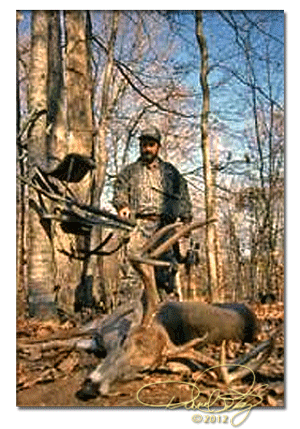
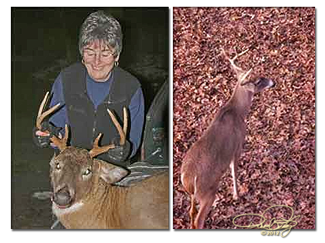
My wife Kay knows how to shoot bucks. A quartering-away shot
photo c. Dave Richey Outdoors ©2012

You may have read this before because I've posted it a few times over nine years. If so, revisit it, determine for yourself how it may apply to your hunting techniques.

Ever see a buck coming through the woods and suddenly it flees for no apparent reason?  Have you ever had a doe stop upwind of your stand, snort, blow, stomp her foot and run off even though the wind was right and you hadn't moved.

Sure you have. It happens to everyone on occasion. What follows may disturb some hunters, could cause other sportsmen to wonder if this topic is true, and if so, how does it happen?

New hunters arrive on the scene every year, and probably haven't read this before or missed it when it was published years ago. It needs to be revisited every so often.

Trust me on this: This topic will be a quantum leap for some deer hunters when they read it. I've stated my opinions at deer-hunting seminars I've given over many years, and some folks sit in total disbelief. They look as if they've been sucker-punched.

Don't stop reading just yet. These thoughts, if you accept and think logically about the topic, may make you a better deer hunter. We'll be talking about your mental rather than physical actions.

My many years of testing this theory

It's not important that hunters believe as I do, but over 40-plus years I've tested this theory on countless occasions in many scattered locations. Each time it is tested, the result is the same. I strongly believe what follows to be true, and all I expect of readers is to study and decide if they believe and trust it.

Know this before we go any further. There is much that modern science doesn't know about the brain, brain waves, and how it affects people and many of the wild animals we hunt.

My thoughts on spooking deer

Here goes: I believe, being a very capable and deep thinking predator, that deer -- especially does -- can sense the presence of danger without the benefit of movement, noise, scent or other stimuli. I once hunted mountain lions in northern Arizona, and my guide told me the reason he feels cougars kill mostly mule deer bucks is because those deer are so full of themselves they act and feel immune to danger.

They are not alert or attuned to the presence of danger. Does, on the other hand, are constantly alert to the possibility of nearby predators as they try to protect their fawns from predation.

My thoughts are pretty straightforward. I believe that thinking hard about killing an incoming buck or doe can transfer some type of danger signal to the animals. Are human thoughts carried by brain waves? Do these vibes, for lack of a better description, throw out a silent alarm that does can pick it up much easier than bucks?

Clear your mind of all predatory thoughts

I never think, after spotting an incoming buck or doe that I am going to shoot that animal. My brain stays in neutral, idling without conscious thought. I purposely avoid thinking about shooting and killing the animal. I may and often do spend that time thinking about my next article to be written.

My belief is to never stare at a buck or doe. Looking into a deer's eyes seems to allow that animal to feel or sense human presence. My thoughts remain neutral, and when I draw, aim and shoot, I'm concentrating on my aiming point but am not thinking about killing the animal.

Testing this theory over many years has proven informative. My normal hunting method is to allow my eyes to sweep over the deer without lingering on any part of its head or body. It's easy to establish the animal is a buck if antlers are visible, and that data is stored in my mind. I know it is a buck but no longer think about it, and I never dwell on such thoughts, which I feel are counterproductive.

Instead, I think about going hunting the next night, which stand may be productive under the current wind direction, or I'll recall something that has nothing whatever to do with hunting. I could just as easily think about painting the basement walls, which is a horrid thought, even when trying to fool a nice buck.

My main train of nonviolent thoughts

However, my mind knows why I'm out there, and that is to possibly shoot a buck or doe. However, my mind focuses on another thought or topic, or on nothing at all, and when it tells me it's time to shoot, the bow is drawn, the red-dot settles behind the front shoulder and the arrow is gone before my mind tells my finger to shoot.

The deer never senses a threat or any unease. It doesn't feel my predatory instincts coming its way, and the deer remains relaxed. Calm and cool thoughts or even not thinking at all is far preferable than telling yourself that the shot will go through its lungs and heart. That may happen, but if you don't think hard on it, I'm convinced the deer will not bolt unless you move or make a sound at the wrong time.

On the other hand, I've often thought about killing the buck as a specific test. I'll think: Here comes a buck, and look at those antlers. My eyes scan the bone on the buck's head, and then I look at its eyes, and then strongly focus my attention on the heart-lung area.

The buck, suddenly alert, turns his head to look around. My eyes lock on his, a predator against a nice buck. His head turns slowly away, and I come to full draw, think about driving the arrow into the chest cavity, and at about that time, the animal suddenly bolts off in panicked flight.

There has been no noise or sudden movements on my part, and no way the deer could smell me. But my thoughts were keenly focused on shooting that animal, and perhaps this comes from my many years of hunting experience and shooting many deer. Perhaps my vibes are stronger than those of others who have largely been unsuccessful.

A human example to illustrate my point

Think of it this way. I no longer drink, but back in the day, my entering a bar was always an experience. If I were a stranger, I'd immediately sense the vibes of other people looking at me, and then would come a strong feeling that someone was staring intently in my direction. With practiced determination, my eyes would scan the room until the person staring at me was located.

It was then I'd size up the situation. Is this a friendly person or one who wants to put knuckle bumps on my noggin? If I sensed agitation or aggressive hostility, I'd turn and walk out while it was possible. It's the same thing with deer. Flight is always preferable to fight.

An example of street smarts

In some areas they often say a person has "street smarts." Why. Pray tell, don't deer have "woods smarts?" They do, and their instincts are more finely honed toward survival than yours or mine.

If deer sense danger, however it is transmitted to them, it becomes an instinctive reaction. It's like an adrenaline rush: it triggers the fight or flight response. Deer don't grow large antlers by ignoring these little niggling feelings. I draw the line at granting deer human-like qualities, but am convinced these animals can pick up hostile vibes from someone trying to shoot it with a bow, which are invariably close shots.

Deer can do the same thing, as humans although how they process this invisible information is an unknown factor. Years ago, while shooting some of the deer photos needed for stories, the deer would hear the shutter click, look around, and nothing happened. Minutes later another photo or two would be taken, and the deer would become used to the noise. Nothing happens, and they would soon relax.

It's strange but deer seem to sense when a hunter or photographer means no harm, and while an old doe may go charging off, if they are not unduly alarmed, they often return within minutes.

Deer that may sense a hunter intent on shooting them can get as freaky as a mule deer doe when she suspects the presence of a nearby cougar. She doesn't want her or her fawns to be dinner, and will take whatever evasive actions are needed to avoid the predator

Bucks, on the other hand, seem unaware of danger unless it picks up some predatory vibes, catches a whiff of human odor or sees some movement. Often, if a doe spooks and runs off, a nearby buck may do the same thing without feeling any sense of danger.

This is where it becomes extremely important to remain in a non-predatory mind-set. Think about killing, and things can quickly change and game can vanish without a shot being taken.

A quick recap

Never look deer in the eye, never think about shooting them, scan past the animal, never put a lingering stare on the deer, and if I'm about to shoot, my mind is emptied of all predatory thoughts. Ninety-five percent (or more) of the deer that have fallen to my arrows were dead before they knew their lives were in danger.

I repeat: it's not necessary you believe this, and hunters can continue to hunt as they choose. However, when I hunt, my purpose is to get close to deer, never get them excited, and if the right buck comes by, I'll take the shot. Cougars hunt the same way and they are far more deadly predators than most humans.

It's quite likely this may be the most radical bit of deer hunting lore you'll read this year. I'm not trying to change your hunting style or your mind-set, but ask you to consider an alternative line of thinking when deer approach. Many of the key hunters in North America, if pinned to the floor with a hammerlock, will agree with these thoughts. All I'm taking is your time (the line from an old song) and my hopes are you'll give this the mental consideration it deserves.

Feel free to share your thoughts. Do you agree or disagree? Your comments, please. Contact me at dave@daverichey.com. Thanks for your time spent reading this. Give it some thought, and you may or may not disagree.

Posted via email from Dave Richey Outdoors

Sunday, September 23, 2012

Missing my twin brother

DRO-Missing my twin brother George.
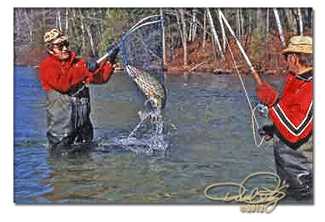
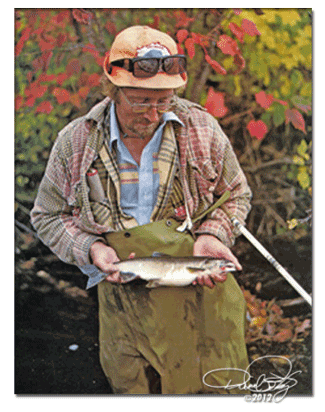
George Richey (both photos) landing and holding a big king salmon
photo c. Dave Richey Outdoors ©2012

September 10 is a day I won’t likely forget. It’s the first day of Michigan’s Upper Peninsula black bear season, but that’s not why I remember it even though I’ve shot a bear on that day on several occasions.

Yesterday was the ninth anniversary of my twin brother George’s death. It happened nine years ago. He was taken ill and learned he had seven different kinds of cancer, and four days later died in Traverse City’s Munson Hospital.

He faced his impending death bravely, didn’t quibble about the outcome he knew was coming, and greeted death on an optimistic note. I lay in his hospital bed, clinging to him while staring at the heart monitor. The flat line seemed meaningless because of the gravity of his various cancers. It simply spelled an end to a great life.

He didn’t fear death but embraced it

You see, George and I began steelhead fishing many years ago in the early 1950s, and we traipsed all over the Upper and Lower peninsulas in search of steelhead once we became old enough to drive. We were always together in the early years, and we could read each other’s mind. He could start a sentence and I could finish it. Twins often have such gifts.

We both loved the same things. First it was steelhead, and then jumbo brown trout in numerous locations, and then salmon came along in the mid-1960s. George jumped on the lure bandwagon by manufacturing a wide variety of Michigan Squids, Michigan Sparkle Flies and other trolling flies for salmon.

George’s son – Casey Richey of Frankfort – has taken over the fly business, and has expanded on many of his father’s ideas. Casey held the brown trout state record for a short time before it was beat by a larger fish caught in the Manistee River.

George had a long run with his lure business, and lived to age 63. He died just five months after I retired from The Detroit News as their staff outdoor writer-photographer, We made plans for countless fishing and hunting trips, and we both looked forward to retracing our earlier study of Lake Superior tributaries for steelhead.

We’d planned a more leisurely assault on such rivers as the Big Two Hearted, Huron, Middle Branch of the Ontonagon, Mosquito, and many others that we’d fished in the late 1960s. We’d planned a pilgrimage to the Rock River for pink salmon as we’d done in the early 1970s.

He had caught more than his share of Chinook and coho salmon during our 1967-1976 guiding career on Lake Michigan tributaries, and during his lengthy career in the lure business. He also tied fishing flies for added income, and came up with several flies that he formulated to work on clear and dark-watered streams.

George had a great deal of fun with big salmonids but he and I shared a secret love for back-of-beyond jump-across creeks and silt-laden beaver ponds for brook trout, and wee little ponds and lakes for bluegills.

He loved small fish as well, and loved bluegills and brook trout

He didn’t share in my love of big game hunting, but he would go on such trips just so we could share another memorable event together. He shot mule deer and whitetails in Texas, was on a one-shot big whitetail hunt in Quebec where we saw only one whitetail over a four-day hunt. He shot two caribou in northern Quebec, and one was a cow caribou, which he proclaimed, as “having a bigger spread than any whitetail he ever shot. That netted him a good razzing from others in camp, but George didn’t care.

“If they are picking on me,” George said, “they are leaving someone else alone.”

That was George. Many people knew him, everyone liked him, and those who knew him through his lure collecting, admired the depth of his research for his books Made In Michigan Lures and Made In Michigan Lures II. Both editions are available from me, and the first edition is rare and very collectible.

He was a picker. He could look through a mountain of old lures, often a pile that had been picked by another collector, and find the proverbial diamond in a coal mine. His skill at uncovering old Michigan-made fishing lures was legendary. His skill at identifying old Michigan-made lures was an enviable one.

In many respects, George was a legend in his own time. Not only as a fly tier, fishing lure maker, fishing guide, angling and lure historian as well as an outdoor writer.

George Richey had many loves and most of all were his old lures

Brother George and I grew up in a little town north of Flint (Clio) and moved north after years of barbering in Clio and Flint. He was a well-known hunter and angler, and many people came to pick his brain on a variety of topics.

He liked people, people cared for him, and he made a lasting impression on others. Readers often write me to ask if George and I were related, and when they learned we were twins, they didn’t know how there really could be two of us.

We were proud of being twins, and we each praised the other when such praise was needed. He’s gone now, but will never be forgotten by me or those who knew him, and I guess I may now  have to do the steelhead assault on the Upper Peninsula streams alone. It just won’t be the same without him but it will give us something new to talk about  when I meet him again up yonder.

I still miss him and that empty hole in my heart is where he lives.

Posted via email from Dave Richey Outdoors

Sunday, September 02, 2012

Come along on an outdoor adventure

DRO - King salmon caught on a Michigan Squid in the early fall
A nice king salmon caught in early fall on a Michigan Squid
photo c. Dave Richey Outdoors ©2012
The above title asks a good question, and it's been tossed my way for nearly nine years by many readers. My answer is invariably the same: why not?

Anglers and hunters can understand a column, which is nothing more than a bit of self-indulgence plus some solid fishing or hunting experience and information. Columns are about what I think, feel, do, believe in, rant against, etc.

The same thing can be said about a blog. A blog (short for weblog) is a daily journal of sorts. It covers the wide range of my daily emotions, and how I look at things through a bleary and somewhat biased or jaundiced eye. You may sense a touch of anger, animosity, joy, sorrow or other human emotions. My feelings on a wide variety of things is never far from the surface nor am I adverse to bluntly speaking my mind.


I've been writing a daily weblog since I retired from The News


You'll almost always feel my love for the environment, the animals, birds and fish that we hunt or try to catch, and you'll feel my sense of betrayal and delusion when some sorry dude levels perfectly wonderful wildlife habitat and then builds a shopping mall or hard-scrabble subdivision.

Readers will read my unabashed feelings on brook trout that invariably turn me on in their watery little trickles, and the litter that invariably turns me off when I must look at it. You'll note, hopefully with a righteous indignation like mine, when I bare my soul about the destruction of an ever-decreasing amount of wild land.

Hopefully, you'll share my glee when the DNR does something really great or get ticked off when they continue to do something utterly stupid like depriving you and me of the opportunity to obtain private-land turkey permits in Region II while granting such permits to people in the Upper Peninsula and southern Lower Peninsula.


My blog runs daily except when something happens to my computer


My weblog runs daily, and I've only missed a few days since November, 2003, and then only because some piece of crud hacked my website. My archives are available to one and all, and I urge readers to dust off some of them and see what you've missed.

You'll share my pain when my beloved twin brother George died on Sept. 10, 2003. You'll get as excited as I did when catching a 30-pound muskie, writing about the Christmas Tree Bomber, and other true tales. I invite you to walk with me when we go into a bear swamp for a hunt, and what is even more fun, when we walk out in the darkness. Jump into my tree stand as we bow-hunt for whitetails, and whisper in my ear when it's time to shoot a dandy buck or tell me to draw down on him and let up, giving him a life he could have lost had I shot.

Come along as we wade belly-deep into an area steelhead stream during those cold March days, and grab the net when we slug it out with hefty Chinook salmon in the fall. Let's take a walleye fishing trip on Long or Platte lakes, a bluegill outing to Arbutus Lake, and we can trudge through the January snow in search of cottontails and snowshoe hares.


Sharing the outdoor life with each other


Do you feel up to laying flat on the ground as Canada geese hover overhead, honking loudly, as our belly muscles tighten and we lever our way to a sitting and shooting position? Is there anyone out there who doesn't thrill to the loud and clattering flush of a ruffed grouse as the October dew dries on the ready-to-fall golden leaves?

Does any upland gunner fail to rejoice to the towering flight of woodcock as they dart and twist ever upward out of the alders before quickly plummeting to earth before we can swing and shoot

Calling predators with that high-pitched squeal of a dying rabbit is a heap of fun during the winter months as the coyote darts out of a thicket, and begins circling to a downwind location. We know a shot may be possible but it's nerve wracking to watch the animal close in on a spot straight downwind. Will we get a shot?

Fishing and hunting has been a major part of my life for more than 60 of my 73 years, and I eagerly await each new season and every new adventure. You ask me: why do I write a daily weblog?

I write because I have a strong need within me to do so. There is a deep need to write, and a need to share my love of fishing and hunting with my readers. I don't have to write for the money although I wish this blog and website paid more; instead, writing about the outdoors makes me feel good, makes me feel whole and helps smooth out all the rough spots in my life.

You and me, we can go places and do things. We can discover new places to fish or hunt, and learn more about what pulls us ever onward to another wonderful outdoor adventure. People who stay indoors, and watch idiotic game shows on television have my sincere sympathy.

Me, I'd rather be outdoors with a bow or rod in my hand and enjoying all that nature has to offer. How about you?

Wednesday, August 22, 2012

Who Will Blink First?

DRO-eyes locked
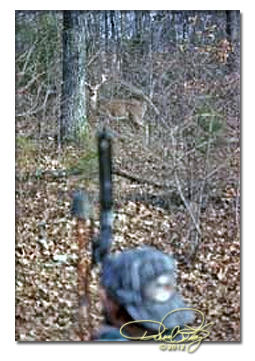
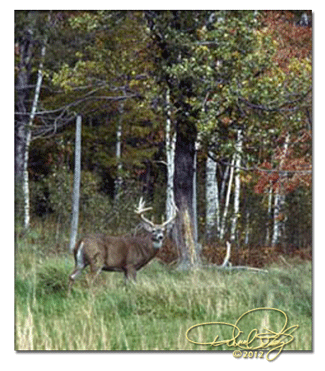
This buck is screened by a tree and brush; Wait for him to move
photo courtesy Dave Richey Outdoors ©2012
It takes some age and an abundance of hunting experience to accomplish one of the most difficult things in bow hunting: determining when not to take a shot. There are times when taking a bow shot at a buck just doesn’t make sense.

I was sitting in one of my stands last October. Deer movements were slow, and going home and soaking up some heat seemed a good idea. A bad thing about taking a shot under iffy conditions is knowing that if the deer is not killed, it will be spooky of that area in the future.

Some say a deer's memory is less than five minutes, but I'm convinced that while deer do not think as we do, they react to instinct. A close call can cause a buck to change his travel patterns.

My decision was the right one: I'd sit and wait. There was no rush as plenty of shooting time remained, but I'm constantly amazed at how long a buck can remain motionless. This buck never moved a muscle, but yet, it had to move forward or sideways to offer a shot.


Sometimes it’s just a wise decision to wait out a deer


It chose to stand still and only its head moved very slightly. It moved its head an inch or two when other deer filtered past me, but I believe that some game animals can sense potential danger.

This buck seemed rooted stiffly in place, and he stood as still as a statue and never moved. I can set still for long periods of time, but this old boy's life depended on his choice of action. He stood, immobile, waiting and watching for something to confirm his suspicions.

Thirty minutes passed, and like a case of stare-down between two people, someone had to blink. It was me, and although I knew the buck couldn't see my eyes, he seemed to sense when I blinked.

He whirled and disappeared back into the tag alders. Other deer spurted away, frightened by his sudden actions, and they were visible momentarily before all was quiet again.


Such experience makes one wonder about whitetail deer


I sat back, and thought about our standoff. It was nothing I did or he did that resulted in his flight except me blinking my eyes. I was wearing a face mask, and he couldn't see my eyes. Turkey hunters swear an incoming gobbler will see the waiting hunter blink.

Maybe it's so. I certainly don't know everything about whitetail deer, but I do know this buck sensed danger. When his nerves couldn't stand the strain, he bolted.

It's what caused him to run is the question, and the answer is yet to be determined. I can’t believe he saw or even sensed me. It’s such encounters that make hunters wonder what they did wrong.

In all likelihood, the deer may have been spooked earlier, and was still a bit owly about that experience. It’s as good a theory as any.

Friday, August 17, 2012

A kill isn't always necessary

DRO-elk; kill is not necessary
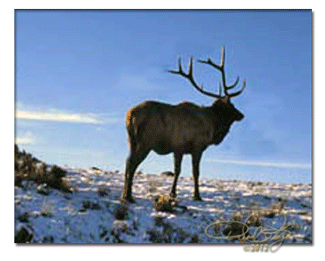
The elk were high, and this would have been easy but not what I wanted
photo courtesy Dave Richey Outdoors ©2012
To shoot or not to shoot? That was the immediate question.
I was in Colorado 20 years ago on an elk hunt. My buddy and I had seen several bull elk so far and out hunt still had a few days to go. We spotted a small elk herd from a distance, glassed them to see what they looked like.

"The bull on the far right is a nice 6X5," he whispered. "The middle bull is just a spike, and the left one is partly hidden. I can't see his rack."

The bull then eased from the black timber and offered us  a long  look


"Wait. He's stepping out, and he's a dandy 5X5 with good ivory tips," the guide said. The right and left bulls are shooters. We have the wind in our favor, and if we can get 75-100 yards closer we can sneak in close for a good shot if cow elk don't get in our way."

To shoot or not to shoot? Shakespeare never had this problem. For me, it was easily solved. I chose not to make the stalk and take the shot. The bulls were decent racks but not what I'd hoped for. I offered them to my Michigan friend,

This hunt took place in September. I was looking for something big; I'm not a trophy hunter, but had fond hopes of getting a big bull. Besides, I wasn't keen on shooting a nice bull elk so early in the hunt.

"Want him?" my buddy asked our guides who also had an elk tag. "The best bull is on the right, and most hunters would be tickled to take him. He's broadside, and after a short stalk it would be an easy bow shot at 40 yards."

He knew I could kill a  bull elk at 40 yards, but I didn't want to shoot the animal.


I shook my head no, and the three of us moved quietly from the area to look for a bigger bull. The guide and my friend kept looking sideways at me, probably thinking I was nuts for not shooting.

Sometimes elk hunting should be a solitary sport

The next day we drove as far up-hill as possible to get near a water-hole up an old mountainous two-track. We left the truck behind, and then climbed uphill within easy reach of the water hole. Two hours later, we were there and had scouted the entire area. An elk bugled briefly and we shifted our attention to the sound.

"Here comes a nice bull," the guide said. "He looks great: heavy antler beams, long tines and a 5X5 rack. I'll try calling to see if he's interested."

My neck hairs lifted at the sound of elk music drifting through the mountains, and the bull responded by moving closer. The call had him interested, and for good reason: The bull wanted water from the water-hole, and figured he may have to get past the other bull. He closed to within 100 yards, turned broadside and challenged the unseen bull.

I again shook my head no to the unasked question. My friend couldn't understand my apparent reluctance to shoot a bull. Neither could the guide.

"I shot a beauty here two years ago, and since I have a choice in the matter, I'll wait for something bigger," I told him. "If I see an elk larger than what I've already taken, I'll shoot. Until then, I'll hold off and shoot a deer when I get home."

Many elk were seen but we never fired an arrow at any of them


We saw 16 antlered bull elk on that Colorado hunt, and I passed on each one. He wound up shooting a nice 5X5, and was very pleased with his choice. It was his first elk with a bow, and a wonderful accomplishment.

I shot nothing, and wasn't disappointed. He, a first-time elk hunter was ecstatic, but still couldn't figure out why I wouldn't shoot. He didn't realize that I'd been here before, and had shot my share of bulls, and didn't need to do so again.

I assured him that he'd been a great hunting partner but the simple fact was I hadn't seen an animal I wanted. The hunt offered thrills and many opportunities, and no one could have asked for anything more. I had numerous chances to shoot in a sport where one lost opportunity may be all a hunter ever gets.

A successful hunt doesn't always mean returning home with game. I had many chances to shoot, but there was no need unless I saw an elk I really wanted. The animal I had hoped to take never materialized, but that didn't diminish my time afield.

If anything, it enhanced my hunt, which is difficult for other hunters to understand. My time was well spent, and seeing game in beautiful hunting country was a plus, but I've never regretted my decision.

A kill isn't always needed to produce a meaningful hunting experience on this or three other elk hunt where I've passed up nearly 40 bulls. I would have been happy and proud to see my hometown friend do the job but he wouldn't either.

I hunt for what I please, and what is legal, and if I don't shoot, it's because of one of three reasons: the bulls were too young to shoot or I simply couldn't catch up with them. A third choice is possible.

Perhaps because I greatly enjoy the hunt, that when it comes time to shoot, the urge to kill the bull has gone away.
In any respect, the guide and other hunter had a choice and decided not to shoot either. For us, the hunt itself had been enough.

Friday, August 03, 2012

Positive thinking helps bow hunters

DRO-080312_positive-thinking
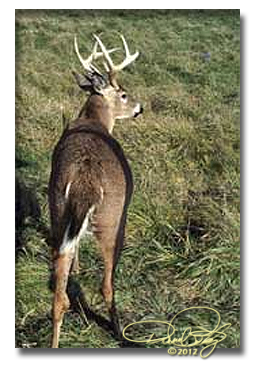
Never take bad shots; Wait for a broadside or quartering-away shot
photo courtesy Dave Richey Outdoors ©2012
It's difficult to do things that require skill without having a good attitude. A problem I find with some hunters is they lack drive or motivation, and this usually comes from not having a proper attitude.

There are good attitudes and bad 'tudes, and a bad one isn't conducive to being an effective deer hunter. Hunters with a bad 'tudes are constantly griping about the weather, the lack of deer, too many does, too many hunters, and on and on.

Can't remember the name of the guy but years ago he held classes that praised the power of positive thinking. He believed that thinking in a positive way made a big difference, and I completely agree.

The power of positive thinking works while bow hunting


Think of deer hunting this way. You climb into a tree stand or ground blind, feeling good about yourself and your ability to sit still and shoot straight. You know you can shoot that buck if it comes your way.

This positive thinking attitude doesn't work every time. If it did, we would all soon tire of deer hunting, rolling a 300 game while bowling, or clobbering two home runs in the local softball game.

What this positive thinking does do is allow a hunter to do everything else right. A buck starts heading your way, and you spot it immediately. You sit still and don't wiggle around, and you've got the wind in your favor at all times.

Stay alert and pay attention to your surroundings; Don’t move


Turn this whole scenario around, and head into the woods with hope in your heart, and a good feeling about hunting. There is a feeling that you sense more than feel, that today will be a day when a nice buck will offer a shot. You can sense that buck, and you sit tight with bow at the ready, and when he shows up, you are fully capable of shooting it.

The power of positive thinking is something that many people rarely acknowledge. They might be thinking about a beer after the hunt, and be thinking of that brew when they should be thinking about a deer.

This is a mental concept that is very difficult to explain, and in all honesty, hunters must have a few bucks under their belt. They must know their way around the deer woods, and must learn to think like a deer. If I was a deer, where would I enter this area from and why? You study the terrain, figure it out, and sure enough, on many occasions the deer will travel the trails you've puzzled out.

Hunters with a positive attitude have their game face on whenever they enter a stand. They are out there to hunt, not just spend time outdoors, and they are constantly running the angles through their brain. They are, without knowing it, trying to will a buck to them.

Now, that is a bit of a stretch, and although I'm not saying a person can will a deer to them, I believe the hunter with the right attitude will do more things right than hunters with a different mind-set.

Hunters often refer to those people who always shoot a nice buck to be "lucky." They are not lucky in the normal sense of the word; instead, by having the proper attitude, and the willingness to think things through and do everything right, they can make their own luck.

Hunters who always take a buck with a bow are prepared for a shot


This positive attitude allows hunters to scout more efficiently, pinpoint key buck areas, and to be in the right spot at the right time. This occurs because they believe in themselves and what they are doing.

Hunting means you must believe in yourself, your abilities and hunting skills. If you think negative thoughts, chance are good you'll be daydreaming about the boss you intensely dislike, and a buck will sneak past and be out of range or back in thick cover before it is seen.
You've blown an opportunity.

I can't teach you or anyone else how to develop a proper deer-hunting attitude. You either have it or you don't, and those who do, know what I'm talking about.

Those that don't will never know unless they put this column aside and read it every day before they go hunting. Then, maybe with a tiny bit of common sense and the right attitude, a buck may walk within range of a hunter who is mentally and physically prepared to shoot.

Sunday, July 22, 2012

Unraveling some bow-hunting myths

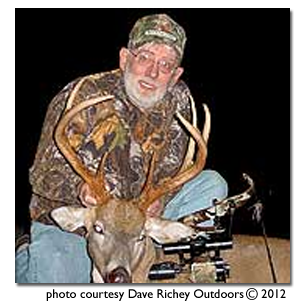
The author with a nice buck
photo courtesy Dave Richey Outdoors ©2012
You know what a myth is? It's something that is commonly accepted as fact, but it really isn't. You know what I mean: pick up a toad, and you'll get warts and other stuff like that.

There are many myths about bow hunting. Some have been steeped in public acceptance for so long it's difficult to dislodge the thought. Here are a few that bow hunters seem to accept as fact.

*Rutting bucks are stupid. This one has been around so long that it should have long gray whiskers. It's simply not true.

Some myths are repeated so often that many consider them true


Bucks do run during the day and chase does, and occasionally they will do something that humans might think stupid, but they probably make perfect sense to the deer. Don't look for them to run up to a human, and stand idly by while someone shoots at them.

If bucks make any mistake it is chasing does during the mid-day hours. A bow hunter can turn that knowledge to good use by hunting from 10 a.m. to 2 p.m.

*Deer always travel into the wind. That too has been proven wrong so many times each year one would think it would fall out of fashion. Gran'pappy tells his son that two or three dozen times when the kid is young and impressionable, and he believes it. So he tells it to his son, and these old wives' tales get passed down from one generation to the next.

The truth is deer often travel downwind, cross-wind, and quartering into or away from the wind. Deer have always headed west in the morning and east in the evening, and it makes no difference which way the wind is blowing. They will travel upwind, downwind, or quartering into or with the wind.

One thing is certain. Move or make a faint noise, and a curious deer may turn around and come upwind to determine what and where you are. The trick is to give deer no reason to circle into the wind.

*The deer jumped the string. This means a bow hunter comes to full draw, releases an arrow and the deer jumps up or goes down to "duck" the arrow. What nonsense is this? That gives deer human-like intelligence that tells them an arrow is coming.


This can be a problem if deer have been alerted to human presence


Deer will move up, down or sideways if they have been alerted. Deer that travel head-up are alert, cautious and a walking bundle of raw nerve endings. Give them a reason to be alert by being caught moving, making some small noise or being winded, and an alert deer may move to avoid danger.

However, if an arrow is traveling 180 feet per second, and a deer is within 20 yards of the hunter, the arrow will impact the animal before the buck or doe can react to the bowstring launching an arrow. Most arrows are traveling from 220 to 280 feet per second, and sometimes more than 300 fps. This precludes a relaxed deer from "jumping the string." Some muscle-bound people who can pull 100 pounds and shoot an arrow in excess of 300 feet per second will have little trouble hitting a relaxed deer.

*The higher the treestand the less chance there is a deer winding you. OK, I've hunted a few times at 30 to 35 feet and dislike it intensely. I know of people who hunt 40 feet in the air, and a friend swears he saw some fool stand on what looked like a tree stand the size of a postage stamp at 50 feet in the air.

What being that high does, if the wind is blowing down toward the ground, is transfer your scent farther from your hunting area. If a deer gets downwind of you at 200 yards, he may still smell you. Knowing which way the wind is blowing, and using milkweed seeds to see where the scent travels, makes far more sense.


I prefer more tree cover than being too high in the air


My tree stand preference is 15-16 feet. I depend on my being downwind of the deer, being able to sit still, not make any noise, and being able to shoot accurately from an elevated position. It works exceptionally well for me.

The higher a tree stand the more acute the angle when shooting down at a deer. That angle becomes even more acute the closer the deer is to the stand. Lose your anchor point while aiming, or be a fraction of an inch off at higher elevations, the greater the chance is of missing or wounding a deer.

There are many other bow hunting myths kicking around, and one day soon, we look at some other ones.

Friday, July 20, 2012

Lord, grant us some cooler weather

catfish

Kim caught a Flathead catfish and Kay netting the fish
photo courtesy Dave Richey Outdoors ©2012

The idea of going fishing today was just an idea. It quickly faded as the temperature crawled steadily upward from 85 degrees to top out in the mid-90s.

The heat index in Traverse City was 105 degrees, and I had a doctor's appointment. There we were -- Kay and I -- in a car when the air conditioning decided it wasn't going to push out any more cool air. At best, it just kept the warm air circulating around.

Kay and I were in thick stop-and-go for a minor accident meant less circulating air, and the 15-minute ride to the sawbones took a half hour. I quit thinking about fishing in 100-degree temperatures.

Me and high temperature levels have never gotten along well

It hurt my head to think about being outside, on the water, fighting the heat, the broiling sun, the reflected sunshine off the water, and gave it up as a lost cause. Memories of countless days like that came to mind, and most of them were in the late 1960s and through the 1970s when, as a free-lance outdoor writer, it was write and sell stories or starve. There was no choice one summer. We had to tough it out.

That summer, Kay, my daughter Kim and I traveled all summer hoping to catch fish. We were all over Canada, northern Michigan and Wisconsin, and throughout the mid-south. Everywhere we went that summer the temperatures were in the 90s or higher, and fishing was horrible.

We spent a great deal of time on the water from before dawn until 9 a.m., and from 7 p.m. until dark, and it was still sweltering. I remember a northern pike trip to Quebec's northern area, set up shop behind one of their new hydroelectric dams and fished the flooded timber. We barely caught enough fish to eat, and for those of you who read the outdoor magazines, no one is interested in hammer-handle pike stories.

We fished for jumbo walleyes in some of the TVA (Tennessee Valley Authority) lakes in Tennessee where 10-pound walleyes were reasonably common. We never saw one, nor did we catch a walleye. The unbearable heat took the fish deep, slowed their metabolism, and it was another busted trip.

There was a big-bass bite going on in a Georgia lake for a bit in the spring, but by the time we got there, no bucket-mouth bass had been caught in two weeks. The weather hovered near 100 degrees, and then at mid-day, it warmed up.

I was as brown as mahogany, and we dipped our hats and shirts in the water and put them on again. Thirty minutes later we were dipping them again. We'd start the day with two 10-pound blocks of ice in our cooler to keep beverages cold.

The old-fashioned cooler gave up its ghost in short order

Forget it. We had melted water within three hours. Coleman had yet to invent their famous cooler that keeps things cold for nearly a week at a time, regardless of the outside temperature.

We went to North Dakota to fish their reservoirs, and did catch a few early-morning sauger and walleyes, but the fish were small. The bigger photo fish were conspicuous by their absence. Another story idea shot down.

We came home, fished for Lake Michigan salmon, and early morning and last-light seemed to be the only productive times. We did manage enough big kings for a feature story, but all of the other feature stories for Outdoor Life, Field & Stream and Sports Afield were a complete bust.

Strange thing, this free-lance outdoor writing business. Get the story and great photos, and everyone wants to buy stuff. If you can't catch cold in the heat, and the photos are of small fish, no one is interested. It turned out to be absolutely the worst summer of my writing career. It was a major skunk job for that summer. This year is much the same.

Fishing skunks are never fun but broiling heat makes them worse

Were there some hot tips? Everything was hot, but the tips were only lukewarm. Fish early, fish late, fish when the sky was overcast, put in the time, sweat a lot, and go home empty-handed. Get up early the next morning and try it again.

Fishing, normally a contemplative sport, became very boring that summer. The scarcity of willing biters, and constant battering of a hot sun on our bodies, slowly took its toll.

We finally cancelled some of our summer trips, and doubled-up on the fall trips in hopes of recovering some lost income. It worked, up to a point, but one thing about a broiling hot sun, you can never make up everything you've lost.

We well remember that summer when we boiled in our own juices. I mean, really, how could we ever forget such a pitiful summer? Such trips, hopefully, are a once-in-a-lifetime affair. But, if things don’t change soon, this could be another scorcher, and as I grow older, my appetite for heat vanishes.

I wouldn’t mind a foot of snow about now.

Posted via email from Dave Richey Outdoors

Sunday, July 15, 2012

Ethics: Rules to live by

Television personality Jerry McKinnis with a river salmon
photo courtesy Dave Richey Outdoors ©2012

Outdoor ethics are a bit like marriage vows. They are those hard-to-explain things that keep sportsmen from breaking fish or game laws if we think someone might be watching us.

That's fine, as far as it goes, but it's a gross oversimplification of a very complex issue. And, these issues baffle many sportsmen.

Stated another way, if you must look over your shoulder or around you before doing something, chances are you will be breaking a fish or game law. Perhaps, if you find yourself doing this bit of odd behavior, you might wish to rethink the situation.

Be aware of some ethical acts and those that are not

Outdoor ethics are those complex but unquestionable rules that sportsmen must follow whether others are watching or not. They are rules we must endorse if fishing and hunting will survive this century.

Want a few examples; Consider these

I had six chances to arrow a big 10-point a few years ago this October. He always showed up five minutes after shooting time ended. No one was within 500 yards of me, and no one would have known if I cheated and taken a late shot at that buck.

No one, that is, except me. It would have chewed at my guts like a malignant cancer until the taking of that big 10-point would have been reduced to a humiliating experience. It would have ruined my hunt.

One night last fall I climbed into my bow stand, tried to remove my wallet from my back pocket, and it wasn't there. My bow license was home on the dresser. I had a valid license but it wasn't in my immediate possession so my bow was stowed away in its case.

The evening was spent watching deer through binoculars. It was fun even without a bow in my hands.

A big problem with outdoor ethics is they are impossible to legislate and very hard to enforce. Only one person–you or me–can deal with ethical situations whenever they arise.

For instance: we shoot a rooster pheasant and it glides across a fence and falls on posted property. Does winging this bird give us the right to pursue it without landowner permission? Nope.

We're fishing in flies-only water for trout and a stiff breeze puts down the hatch. Is it ethical to fish worms here? The answer is no.

Or, as I mentioned earlier about the10-point buck, could I have cheated and shot? Sure, but I would have had to deal with my emotions and my personal sense of right, wrong and/or guilt.

It is legal to shoot a grouse on the ground but it's not ethical

Mallards pinwheel down on a freshening breeze to spill into bobbing decoys. It's a perfect morning, and five minutes before legal shooting time. Hunters in a nearby blind have shot and dropped two hen mallards. Does that make it legal for us to shoot early as well?

The answer is an obvious “No” but some hunters would shoot any way, and could be ticketed by a Federal or state conservation officer.

Ethics prevent us from doing illegal or quasi-illegal acts. Hunters don't shoot ducks on the water unless they've been wounded or shoot grouse on the ground. We don't snag fish, and we don't keep undersized fish or fish over our limit.

Know the rules; Read annual fishing-hunting digests

Buying a fishing or hunting license is no guarantee of a full game bag, a trophy buck, a hefty creel or a brace of pheasants. The license only grants us an opportunity to fish or hunt during the legal season. It offers sportsmen nothing more and nothing less.

Ethical behavior is a topic as personal as the color of our morning toothbrush. It also serves as the bare-bones foundation on which our sporting ethics are built. We are judged by our conduct, and those who wink at fish or game law violations or encourage any breach of ethical conduct, do themselves and other sportsmen a real disservice.

Posted via email from Dave Richey Outdoors

Friday, July 13, 2012

From Okavango to the Plains of East Africa

book
This is a great new book on hunting African big game
From the Okavango to the Plains of East Africa

author: Christenson

TITLE: From the Okavango to the Plains of East Africa
(Sub-title: Hunting In Africa In The Latter Part Of The Twentieth Century)
AUTHOR: Christenson
DETAILS: 465 pages, color photos, 1st edition, hardcover, gilt titles, color photos & maps
SIZE: 7x10 inches, limited to 1,000 copies PUBLISHER: Safari Press
DIST
RIBUTOR: Safari Press
[NOTE: Books are not sold in stores, and are available only from Safari Press Inc.]


CONTACT:

Safari Press
15621 Chemical Lane
Building B
Huntington Beach, CA
92649-1506


WEBSITE:
Safari Press
eMAIL: info@safaripress.com
PHONE:
Phone (714) 894-9080
COST:
$100.00 + S/H;

Many African hunting books were published years after the events portrayed actually happened, but such is not the case here. The author began his African hunting career in 1977 with the noted and professional hunter Willie Engelbrecht In Botswana. This is a record of those hunts. In some cases, the book wasn’t written until long after an author’s death.

It was a dream come true for the author. It was one fascinating adventure after another.

First the hunter took a 10-foot maned lion from the bush country, and then a native tracker was attacked by a leopard. He took three safaris with Willie, and then he hunted with legendary PH Harry Selby.

Christenson hunted most of Africa, and received what he considered superb mentoring from other professionals such as Wally Johnson, George Angelides and others for a variety of large and small game/ His tales include elephant hunts, and trips for buffalo, leopard and lion,

Mixed in with the big game are notes from his side trips to hunter smaller game such as the Abbott duiker, sable, sitatunga, nyala. Lord Derby eland. Greater kudu, gemsbok, blue wildebeest, red lechwe, impala, oryx, wildebeest, bushbuck, zebra, klipspringer, Robert’s gazelle and others were taken on many of Christenson’s thrilling safaris.

This is a book to get lost in. It’s big, heavy and filled with anecdotes that would help anyone planning an African hunt. There is plenty of excitement, some fun, information on the native trackers and gun bearers.

Perhaps even more exciting than great color photos of elephants, lions, leopards and Cape buffalo are the color maps of the areas being hunted. Wonderful color silhouette photos reach out and grab you with their deep colors. These maps certainly set off this book in grand fashion, and they enable the reader to keep track of where the author is hunting. They fill a much-needed hole in most African books.

It’s easy to keep up with the author because he mentions hunting in various locations, and these maps help a great deal. I’ve always wondered why many African hunting books do not have maps. I wonder no longer, and project we’ll see more maps in other upcoming Safari Press books. and an African spiral-horn appears on the front cover. A gilt title, author’s name and gilt rules decorate the spine. It’s a lavish book, and certainly worthy of its price. It is one of only 1,000 copies, and is destined to become a collectible item.

Posted via email from Dave Richey Outdoors

Quiver: On Or Off The Bow

Quiver: On or Off 071112_dro
My buddy, Harold Knight, with a nice buck taken from a tree stand
photo courtesy Dave Richey Outdoors ©2012

This applies as well to bow hunting as anything else. Every bow hunter worthy of the name has his or her way of doing things, and often they turn out right. We all learn from the best teacher -- experience.

Bow quivers are a case in point that was brought home to me a couple of nights ago. We were watching a TV hunting show, and a woman was trying to draw and shoot at a buck with the bow quiver on. She was having trouble, and it begged the question.

Should hunters leave the quiver on the bow while sitting in a stand and shooting at a buck? Or, should they take the quiver off to minimize weight and to eliminate an unnecessary item that could easily tangle in tree limbs and mess up a shot?


Each person must answer this question individually; I don’t preach concepts

I'll go first, and throw my hat in the ring and voice my heartfelt opinion. I climb into a tree stand, and after attaching my full-body safety harness to the tree and my body; I sit down, and use the haul rope to raise my bow from ground level. The bow quiver is then removed and placed elsewhere on the tree after one arrow is removed. I often hang the quiver on a nearby limb where it will help break up my silhouette.

Once the quiver in hung, I unscrew the broadhead and attach my Game string behind the broadhead, and screw it into my Maxima carbon arrow shaft.

I attach the release to the string, stuff the lower limb of my C.P. Oneida Black Eagle bow into my left boot, and relax. I hunt and shoot sitting down, and my stands are positioned so bucks usually come from behind me and on my left side.

If the deer follows his normal pattern, he will approach from behind and on my left side. I'm right-handed, so when the buck comes within shooting range, and looks the other way, I start my draw and as I reach full draw, the lower limb clears the top of my boot and is clear of my leg, the stand or any tree branches.

This allows for a minimum of movement, is very quiet, and oh so effective once a hunter becomes used to it. This method of drawing a bow wouldn't be possible if my bow quiver was still attached.

The arrow shafts, vanes or even the quiver could get caught up in clothing, limbs or branches. But there is another reason why my quiver comes off my bow when I begin hunting.

It reduces the overall bow weight. Not much, mind you, but when hunting in a variety of locations, sooner or later a bow quiver is going to hang up on something. I remove all possibilities of that happening by removing it and hanging it some place where it is out of my way.

As a deer moves, it’s easier to follow the animal if the quiver is off the bow

Whenever I watch a television show, or hunt with someone who always leaves his or her quiver on the bow, it makes me wonder how many lost opportunities have occurred because of that quiver.

A bow is a one-shot piece of archery equipment. It's not like hunting with a bolt, pump or semi-automatic firearm. Unless the wind is very strong and noisy, second shots at a buck are so rare as to almost be nonexistent.

A bow quiver on a bow, doesn't speed up getting off a second shot at a deer. It is somewhat awkward to reach to the quiver, pull out another arrow, reach across the bow to nock it, and prepare to shoot again. Chances are, any self-respecting buck with heavy headgear will be long gone if you miss the first shot.

I often use my bow to help camouflage my upper body and head. I wear a facemask while hunting, and can still turn the bow inside my left boot so the handle and upper limb breaks up my silhouette. If a deer offers a shot, a simple and slow half-turn of the wrist will point the bow toward the animal as the hunter comes to full draw.

Such a movement may or may not be necessary, and that is a debatable point, but it would be impossible to do with a bow quiver attached. For me, that is a strong reason for removing the quiver.

The slight added weight of a bow quiver (even a three-arrow quiver like mine) can allow a hunter to unknowingly cant the bow to that side. Is it enough, under the pressure of a nearby buck, to throw the arrow off its intended course?

I don't know and don't care to test the theory. My preference is to shoot a bow unencumbered by a quiver. It's my thought that it just simplifies everything, reduces weight, eliminates canting, and besides ... it works for me.

Anyone willing to plead his or her case for keeping a bow quiver on a bow while hunting is encouraged to contact me. You won't change your mind, I won't change mine, but I'd love to hear your philosophy.

Posted via email from Dave Richey Outdoors

Back roads of our memories

Backroad Memories 070812-DRO
A buck like this must be hunted properly without spooking him
photo courtesy Dave Richey Outdoors ©2012

Fishermen love their  "fishing memories," and continue going back time after time to the same old spot. Sometimes it works on deer, and sometime it doesn't, but memories often remain long after the size of the rack and the venison has disappeared.

Hunters often have the same problem. We develop a feeling for certain ground blinds or tree stands, and often this can be good. In many cases, if a particular stand was once good, it may still be good.

For three years I shared the same tree stand with a good friend. It probably produced a dozen nice bucks for us, and then it seemed to go dead. They didn't hunt it daily, and it may only have been hunted once or twice per week.

My buddy took a few nice 8-pointers there, as did I, and we still talk fondly about hunting that tree. However, as I make my rounds to study deer behavior and travel routes, it has become obvious that deer had quit moving past that tree.

That tree was on an elevated knob 15 feet above a great deer trail.

I've got several memories of favorite tree stands, and those thoughts often are built around having taken a really good buck from it or having seen a wide-racked buck nearby. In some cases, a new stand may reveal a great travel corridor than has been overlooked.

One particular stand sticks out because I had seen a heavy beamed 10-pointer there, and I noted the time he passed by. I was there the next night but he wasn't, and several deer were passed up because I didn't want to shoot a lesser buck if the big one may be nearby.

I went back to that stand periodically, and saw that buck on three occasions but he was either screened by heavy brush or just too far away. And this brings up a point: bow hunters should know what their maximum range is for making an accurate shot.

Shooting at a buck too far away usually results in a miss but a deer that is spooked by an irresponsible shot may never return. Even worse, a bad hit may be made, and that may result in a long tracking job and even then, the animal may never be found. Sportsmen must know their limitations, and strive not to exceed them.

Know your limitations and always hunt within them. Never take long shots.

Years ago, one of my favorite tree stands was in a crooked tree. If a back didn't hurt when they climbed in, it would be hurting when they climbed down. That stand, many years ago,  was positioned between a bedding area and nearby crop fields, and it produced quite a few bucks. It is no longer being hunted.

Another of my favorite locations was a dead elm, and it was located 15 yards from a hole in a fence between my land and a neighbors, and was positioned for a broadside shot once the deer came through. Many people do not realize that given the chance, a deer often prefers going through a hole in the fence rather jumping the wire.

The last time I came down out from that fence-hole stand I felt the tree shudder. I kept going and made it to the ground. The next day I drove down a wooded trail past that tree, and it was on the ground.

Hunting memories, my phrase for going back to tree stands that once produced shots at good whitetail bucks, is something that hunters do. Some of it is nostalgia, and some is to determine if that area is as good as it once was.

These memories are good for hunters. It helps us remember a stand that once led to the arrowing a nice buck, or a memorable miss, or a stand that just makes us feel good.

I'm willing to bet that all of us have such memories. A little thought can make them reappear on demand, and part of hunting's thrill is traveling down the back roads of our memories.

Posted via email from Dave Richey Outdoors

Friday, July 06, 2012

Troubled times and the written word

Dave Richey and his books
Dave Richey looks through book files for a certain book
photo courtesy Dave Richey Outdoors ©2012
Folks, no one needs to tell us that these are troubled times.

Many jobs are in peril. Job security is questionable or even doubtful. Many folks are out of work, and homes have been foreclosed on and lost.

Management in some areas don’t worry about the worker. Insurance rates are rising, as are prescription drugs, and many wonder how long they can hang on to their job.

Amid all these worries is the desire to fish and hunt more, and spend time outdoors. The cost of travel has skyrocketed with $3.75-per-gallon (or more) gas, and fuel prices don't show any sign of going down soon. Jobs are leaving this state daily, and billions of dollars go overseas while our workers wonder about their future.

Sportsmen want to fish and hunt more. We find it difficult to justify a trip north for a two- or three-day fishing or hunting trip because we'll easily spend $150 or more for gas, another  $100-175 for a motel for one night, add another $75-100 for food, and suddenly the
price of fishing and hunting becomes very expensive.

A wealth of knowledge is just waiting for you to discover it


What can anglers and hunters do to take the edge off their outdoor cravings. It's simple, and much like my need for a fishing or hunting fix when as a kid. If a round-the-world trip cost only $10, I couldn't get out of Clio, my hometown.

Each year I managed to squirrel away money to pay for subscriptions to Field & Stream, Outdoor Life and Sports Afield magazines. I devoured every word, and then as my meager job paid a bit more money or I took a second job, I joined the now-defunct Outdoor Life Book Club. Once a month would come a notice about an upcoming book, and if I thought I'd like it, the book would be ordered.

Mind you, being entertained in your mind through the magic of the written word and a wonderful photograph isn't quite the same as actually fishing or hunting, but it provided an escape for those of us who couldn't shake loose $200 or more for a weekend fishing or hunting trip.

Books can provide that mental escape we need to visit another world, to a place where fish bite and where big bucks are abundant. It can take us to places where big browns sip flies off the surface, where grouse and woodcock inhabit tag alder runs and dogwood thickets, to places where rooster pheasants cackle in mid-air, and a wedge of bluebills skim the tops of white-flecked waves under a pewter-grey sky.

It was an inexpensive way to escape the humdrum of an era 55 years ago when the economy was shaky. Car sales were poor, and I lived in Clio, a bedroom community north of Flint. Most people worked for General Motors in Flint, and many people were out of work.

Books carried me along on a voyage of discovery, to a place where vicariously, we fished alongside Ernie Schwiebert, listened to the tales of Robert Ruark's Old Man talking to the boy. Now, because of books, we can learn about Louis Spray and the meanderings of his life, to the Green Hills of Africa with Ernest Hemingway, to the wonderfully written books of the incomparable George Bird Evans and William H. Foster.

Some literary giants wrote fishing-hunting stories


We can read and inherit the love of hunting from the late Jack O'Connor, whose books are steadily increasing in value. O'Connor has almost as many fans now as he did 50 years ago, and his skill at writing hunting stories was legendary. He was the real thing, and not a young wanna-be outdoor writer trying to sell his wares today.

Book catalogs that deal with fishing and hunting titles are wondrous things and I get a few every month.  Name the genre, and there are books out there to fit the wallet of every sportsman. Muskie fishing and turkey hunting are my two passions, and I spend time looking for those books on these topics that I don't have or simply can't afford.

I maintain lists of books I need. Some books are author signed, and many are not. Some books I need are low-priced and common and a few are expensive. Books allow people who can't afford a fishing or hunting trip to pour themselves into a good book and come out the other side knowing they've experienced something grand and wonderful while learning something they didn't know before.

Most of you know I buy and sell fishing and hunting books. I still read, everything from a cereal box to a mystery to a nonfiction fishing or hunting book. Some people don't know what they want, and they contact me and we discuss it by email.

Books are the gift that keeps on giving. Christmas is a long way off but a good book can be read over and over again, and instead of a goofy power tie for work, take Dad’s mind off work worries with a book on a topic of interest to him. Buying gifts now removes the panic that sets in if you forget to shop.

Forget TV; Books energize the mind; eMail me for help.


Take a look at my books on Scoop's Books.  On the Landing Page, scroll down and click on Scoop's Books Catalog, and take a look around.

If you need a specific title that isn't listed, email and ask if I have it. If you are thinking of selling fishing or hunting books, contact me. I buy books all the time, and you may have what I'm looking for, especially if it is on turkey hunting.

If you need help with a certain book purchase, contact me for assistance. Reading a good book may not be quite as exciting as actually catching a fish or taking a big buck with a bow, but when travel to do these things become almost cost-prohibitive in these economic doldrums, reading about fishing and hunting beats whatever else comes in second-best.

Saturday, May 26, 2012

The season's last bird

Last ditch effort to salvage a turkey season. Not the best way to do this, but it can work. Maybe...
Two gobblers crossed the road ahead of the car as my neighbor and I headed for town and a dental appointment. Both birds had long beards, and were traveling together.

I've thought of them the last few hours. They were heading for a distant woodlot, and it's likely they will roost in those woods tonight. Would it be possible to call one in on the last day of the spring turkey season?

It would be a last-ditch effort. My computer has been messed up for three days, and we think the system got zapped by lightning. Who knows what caused the problem, but until today, turkey hunting has been the farthest thing from my mind.

I'm thinking of making an early-morning foray to the woodlot tomorrow. I can get close by sticking near a combination fence line-hedge row, and maybe I can pinpoint their roosting location. If so, there is a chance this late in the season that one or the other will come to the call.

It will be a quick in-and-out hunt. Approach closely, work into position under cover of darkness. sit still and whisper a love-sick hen call at dawn. I'll give them a chance to gobble if they choose to, but if they don't make a sound, I'll see if I can stir a gobble or two out of them. If that doesn't work, I'll be ready for one to come sneaking in to the call.
It's highly likely they won't be there. I should be out right now trying to roost the birds, but computer problems have messed up my schedule. I've just seen too many situations where the birds can travel a mile or two in the last hour or two before dark.

These Toms have been around here all season, and some hens have already had their little feather-ball babies, so perhaps a gobbler or two will come to visit a sexy-sounding hen. And again, maybe they won't move my way at all.
It will be me, light-weight camo clothing, camo hat, face mask, brown gloves and my Remington Model 870 3-inch magnum 12 gauge shotgun stoked with No. 5 copper-plated shot.

If things go as planned, and the gobblers walk out to me and my neighbor (haven't figured out yet whether to take a hen decoy or not), he aims to be ready. This is my last-chance day to call in a bird for him, and I want it to be as good as it can be.

There is no room for errors, and if this hunt works, it will be a first for me. I've never shot a gobbler on the last day of the season, but then again, I've never had to worry about this problem.

Hunting this late in the season has never been necessary. If my buddy is to shoot a bird, I almost always have done it on the first or second day of my hunting season. This year, my golden opportunity was wrecked by two people walking down the road.

I'm not mad at them because they have as much right to be there as I had being where I was at, but I had a gobbler in front of me and another behind me, and both were heading for the hen. It can be the best spot to be in, and it was obvious I hadn't factored in the walkers.

So that took care of my best opportunity. Whatever happens tomorrow morning will be the result of a last-ditch effort.
The gobblers may respond or they may be a mile or two away. I don't know, and I don't care, but I know one thing:
Unless lightning is flashing, and a storm is passing overhead, come dawn tomorrow, I'll be back-up to a big tree, and whining, cutting, purring and yelping for all I'm worth ... if that's what it takes to call in a gobbler.

Because the season ends very soon, and there will be no more chances until next year, so I'll do the best job possible. It will either be good enough to lure a gobbler within 40 yards or it won't. Hopefully, my neighbor's  hunting season will end with a bang.

If not, I've had a good season trying to work birds afflicted with a bad case of the shut-mouth. I like to pretend it's all about skill, but come morning, my buddy will be hoping for a bit of luck.

Friday, April 27, 2012

Buying old turkey hunting books

Scoop's Books sells antique, rare and hard-to-find sporting literature
Unique, Rare and Hard-to-Find books are what Scoop’s Books deals in: looking for and For Sale. Contact us today to Buy or Sell.
photos by Dave Richey
I spent just enough time outdoors today to go to the doctor, say hello to my neighbor and bask in the warming breezes. I’m trying to work some nasty knots out of my back, and it’s not working very well.

At 45 degrees, the weather seems almost balmy. I spent some time arranging and rearranging books that will be for sale on my Scoop’s Books website. Some titles are once-in-a-lifetime acquisitions for any sportsmen and some are moderately priced. I may have a new address for my new book website soon. I hope to have 1,000 or more fishing and hunting books up very soon.

These fishing and hunting books are meant to provide two specific things for book buyers: education and information.

I also am placing some books on eBay for auction purposes. Feel free to check them out.

I want to buy your old turkey hunting & duck decoy books

It's obvious that not all sportsmen like to read books, and that is OK. They just don't know what they are missing. There are so many fine fishing and hunting books available and listed on Scoop's Books. Find a book cover that interests you, and email me at the above email address to see if the book is still available.

A hunter might ask: why buy a book on deer hunting? I already know how to deer hunt. Good question but a poor answer. Anyone who doesn't study deer regularly will know something about hunting these animals, but won't know enough about how to hunt them when the going gets tough.

It's the same with turkey hunting books. I buy as money as I can afford for my collection, and still need some others. If you have any turkey titles, and might consider selling them, send me a list of the book titles and the author's name, and I'll get with you soon.

Lots of people can cast a fly, but there are countless books available that can help with casting more accurately but also can teach us how to read the river, determine which insect is hatching, and which patterns will help fool the fish. Nothing is ever guaranteed except paying taxes until you die, but reading can broaden your horizons and help people learn new skills.

I'm constantly looking for fishing or hunting books to buy. I need to buy books in order to sell books, and I'm picky about condition but pay fair prices. So just what am I looking for and hope to buy from you?

I'm primarily interested in turkey hunting titles now. The scarcer they are, the better. Common turkey hunting books I don't need.
The easiest answer is for you to tell me the author's name, the title of the book, and whether it is a paperback or hard-bound book with a dust jacket. From that tiny bit of information, I can usually determine whether I may be or am not interested in buying that title.

Contrary to popular belief, all fishing and hunting books are not scarce. Most also are not worth big money. Many books I turn down are not worth $5, and I have no need for them. But for you, the potential seller, I will pay within reason what it takes to buy books in good shape that I want for resale.

Books with damaged covers, childish scribbles, underlined passages, highlighted sentences, damp-stained covers or those with other faults are not worth offering. I never buy musty, mildewed or ex-library books because they usually aren't worth owning.

Anything noted immediately above is what I don't want

So, c'mon Richey, what exactly are you interested in? I seldom buy new titles. I never buy Readers Digest or condensed books. I prefer books that state 1st edition or 1st printing on the copyright page. I absolutely will not buy print-on-demand books.

Topics of interest to me include Atlantic salmon, muskie, brook trout, tarpon, fly tying, bamboo rod building and other types of fishing books work for me. I crave good books on hunting ruffed grouse, deer, ducks, geese, upland game, wild turkey, woodcock and other hunting books. I have a mild interest in African hunting books but am picky about what I buy. I do pick up books on duck decoys.

Some hunting authors that I'm collecting. Please save this list. There are certain authors I collect.

Robert Austin Fred Bear Havilah Babcock Larry Benoit Wayne Bledsoe
Stewart Bristol Bob Brunner Nash Buckingham Doug Camp Thomas C. Chubback Burns
Peter Hathaway Capstick
(first editions only)
Russell Chatham Wally Chodak Thomas C. Chubb Malcomb Commer
Wingbone Cryer Eugene Connett Ralf Coykendall Paul Dalke Henry Davis
Jack Dudley John Duff George Bird Evans J. Wayne Fears Bill Harper
William Harnden Foster Percy Haver Marv Heeler Vic Jansen John Knapp
Dana Lamb Homer LeBlanc J. Stockley Ligon Doyle Loadholtz John Lowther
Thomas McGuane John Minor Art Moraski Richard Nissley Jack O'Connor
Hoffman Phiilip W. H. Purser John Pusztay Larry Ramsell George Richey
Robert Ruark Ernest Schwiebert Louie Spray Bob Swineheart Robert Traver
Jack L. Turner Ted Vogel Alfred Weed

and many more.

I'm always interested in any books written by Michigan turkey hunters like Denny Geurink. State published turkey hunting, management, ecology, roosting habits, food habits, etc. are needed.

People have nothing invested in offering me books for possible purchase. If I can't or won't buy your books, I'll be happy to explain why. If I do buy, know that I will give you the highest possible price, and hope then to be able to resell the books for a modest profit but that doesn't always happen.

I've never cheated anyone, and don't plan on starting now. My reputation is excellent, and I sell books off my website and some by mail order sales. It's in my best interest to pay the highest possible price, and still realize a potential profit.

I grade books fairly, charge a fair price and pay a fair price when I buy. I've been buying and selling books for 43 years, and one doesn't stay in this kind of business for long by cheating people.

Give me a try. The nasty winter weather is behind us, but late spring rains may stall your outdoor activities.  Take a bit of that time to dig through that pile of fishing and hunting books stashed in the attic, barn, basement, cellar, closet, garage or wherever, write down the author's name, the book title, and whether paperback or hardcover with dust jacket. If you can read this, you can certainly email me and tell me what you have for sale.

It's that easy. And who knows? The book you sell could be valuable or not, but the payment may allow you to purchase some fishing or hunting equipment. Try me and let's see what happens.

Wednesday, April 18, 2012

Apathy describes many anglers and hunters

What would spring fishing be like without steelhead?

Apathy is killing our outdoor heritage activities. Speak UP for hunting and angling activities. If we don't we'll loose them.
photo Dave Richey ©2012
Does apathy adequately describe many of Michigan's anglers and hunters? I think it does. For those who haven't visited a dictionary, apathy means a lack of emotion or feeling or a sense of indifference.

An election in 2006 proved that most hunters didn't care much about a Michigan dove hunt. The measure got whipped in a bad way, and few hunters seemed very upset about it. No one seemed to care.

Folks, believe it or not, but that vote for a Michigan dove season went much deeper than keeping state sportsmen from shooting mourning doves. It was the first big step in a long parade of other items that can and one day will be stuck on the ballot. The next one might directly affect something you feel strongly about.

Would apathy keep people from fighting for their country?

How would you feel if it was put to a vote to end archery hunting. Or,  the next vote may be to prohibit firearm hunting for deer and/or other game species. It might come to a vote to outlaw dogs while hunting which would affect most bird hunters and bear, bobcat, coyote and fox hunting. Don't think so? Dream on!

Does anyone out there understand that the anti-hunters whupped us on the dove issue? Why, because many hunters are apathetic. They don't care enough to get involved. They wait for others to fight their battles for them. Read again the definition of apathy. It's present here.

I know a guy who whined about the dove season being defeated. The man has never voted for anything (including presidential elections) in his life, never discussed hunting issues with anyone other than his buddies, and he was most upset when I told him he didn't deserve the opportunity to whine and gripe. That behavior is reserved for those who have enough courage and gumption to vote.

People who don't vote on issues of importance to anglers and hunters should have no say in how a democracy is run. And trust me on this: anti-hunters know that sportsmen are unwilling to take a stand, and many folks claim to be too busy to vote. Say what?

Who among these unenlightened sportsmen is willing to wake up and see what goes on around them. They gripe and complain about a possible raise in license fees, but when the sporting segment of this country needs help to fight anti-hunting measures, where are these folks? They are too busy to care. Apathy reigns supreme.

Many avoid the voting booth as if the curtains were coated with asbestos. The day of letting others fight our battles is over. People who want to hunt, now and in the future, had best realize that forces are underway to eliminate all types of hunting. Wake up!

The deer kill was down last year. It also was down the year before last, and likely will be down again this year. Do you care? As a hunter, aren't you concerned about a declining deer herd? You should be

Will the same people who are against legalized hunting want to ban ownership of firearms? What will happen to our wildlife if the DNR has no money to manage it, which has already happened. Will the United States become neutered like Australia and Great Britain? Does anyone care? People need to get a grip on reality soon.

An out-of-control deer herd is entirely possible. The state has worked hard for years to reduce the herd size, and in many areas, they did their job too well and the deer numbers are way down. We saw the results of this problem the last two years. Each person can make a difference but they must get off their backside, learn what the really important issues are and get involved.

Michigan United Conservation Clubs, the state's largest conservation organization, is trying to fight the good fight. They keep people posted on what is happening, but MUCC membership rolls have shrunk dramatically from their highs of 20-30 years ago.

Why? The short and ugly answer is public apathy. Sportsmen no longer care about joining groups. They often say they don't have time or money to be a member. And for some that is probably true.

Others have different priorities. Where fishing and hunting was once their good time, bowling and golf may have replaced some of the leisure time activities. Others simply are not joiners, and care little about joining Delta Waterfowl, Ducks Unlimited, National Rifle Association, Trout Unlimited and many other excellent organizations that are trying to fight for all sportsmen.

Where do we go from here? I'm one man, preaching to the choir and to those who enjoy reading about the outdoors and who has nothing against hunting, but I'm only one man. I'm not a one-man army.

Speak up and show some true American spirit

Others must stand up and be heard. They must stand and fight the good fight. Are you willing to step up to the plate for our fishing and hunting and wise management of those resources?

I've heard it many times at a conservation club, Kiwanis meetings, or in other places. People actually ask me to fight their battles for them. I'm just one man with one voice, but they must make their voices heard. Sportsmen must become involved before it is too late.

Hunters of all stripes, whether bird hunters or a bear and deer hunter, must unite under one common banner to endorse all forms of legal hunting and be prepared to vote on critical issues. If one method of hunting is lost, as happened on the dove issue, anti-hunters will go after the next least defensible hunting method. Will it be bow hunting as many believe?

It could be dog ownership which would hurt hunters who use a pooch for their sport. If they don't support bear and deer hunting, and treeing coons with a hound or chasing bunnies with a beagle, than it is quite likely their lack of action will help future anti-hunters win.

The past issue was supposedly about dove hunting. That's nonsense. It was simply the first nail in the coffin of legalized hunting in this state, and hundreds of thousands of hunters stood by and watched it happen.

How sad. And who will feel sorry for you when your favorite fishing or hunting sport comes up on a ballot, and one by one, our outdoor pleasures and heritage are taken away from us because apathetic sportsmen don't care enough to become involved?

Or because they are too lazy, and cannot comprehend what is happening to them. It's time for many people to wake up, smell the coffee brewing, pull on their boots and fight for our hunting heritage.

It really is worth fighting for. Grow up, wake up, and fight. And if we lose part of outdoor heritage because of apathy, don't come whining to me to fight even harder. I've fought this battle for more than 50 years.

What exactly have you done?

Wednesday, April 11, 2012

Missing my twin brother

George Richey hold his former State (MI) Record pink salmon
George Richey, holding his former, 2lb. 7oz., Michigan State Record pink salmon.
photo Dave Richey ©2012
It was one of those mid-September days when it felt right to be going through my deer-hunting backpack and sharpening broad-heads. It was something to do while waiting for my next trout fishing trip to arrive.

So I was puttering with my bow quiver of sharpened heads when a memory jolted me as it entered my mind without me thinking. It was of brother George, and he was coming down the Little Manistee River in high water in early April with a rampaging steelhead on his line.

"Try and get a net under this guy," he hollered. "I hooked him a quarter-mile upstream, but he's riding the current broadside. Stick your net in the water, and I'll put him head-first into the net. Ready?"

We'd done this for each other and both knew what to do

My net was pulled from under my belt behind my back, and my rod butt went in underneath the belt. The fish was 10 feet upstream as my net went into the water, and George leaned back on the rod to get the fish up onto the surface, and just at the right time, he dropped the rod tip and the fish dove right into the net. My job was to lift it from the water.

"Good dip," he said, as we waded ashore. The steelhead, a red-sashed male with bright cheeks and gill covers, was 16 pounds of broad-beamed raw power. George worked the No. 4 wiggler fly free, eased the big guy into the river, and with a mighty splash it was gone.

Another time George and I hunted Le Chateau Montebello, a famous resort in Quebec. We were there to hunt deer, and the guide told us we would be lucky to see a deer. If we did, he said, it would be a shooter.

The guy put on one-man drives, and I've been involved in deer drives for most of my life. I can tell good from bad, and this guy was an expert. He walked softly, yipped like a beagle puppy on occasion, and he never hurried the deer. They just moved slowly ahead of him.

We driven deer for years, and this guy was the best I'd seen

Far off, on the third day, I heard him yip softly to let us know he was coming. It was a large area to watch, but 10 minutes later a white-antlered 8-pointer eased from the woods and stood, side-lit by the afternoon sun against a pine, and he was a beautiful sight to behold.
He turned to look the opposite way at George, and I slowly raised the rifle and aimed. He went down at the shot, and George almost beat me to that buck. It was the only deer either of us saw on that hunt, but he wasn't disappointed not to get one. He loved listening to the wolves howl at night, and was happy that one of us shot a good buck.
"Good shot, good buck, and where's the guide?" He asked. "This buck weighs well over 200 pounds, and we will need help to move it far."
The guide showed up, we boiled a kettle to have hot tea with our sandwiches, and then had us a four-mile hike back to his truck and he drove up to the dead animal. It is the only whitetail I've taken in Quebec, but it's important to me because George and I shared the hunt in a unique part of Canada.

Ours was never a competitive thing. We just had fun

Neither of us have ever been truly competitive with each other, but years ago before I wrote the first story about runs of pink salmon in Upper Peninsula streams, George was with me to share what might or might not be an adventure. We didn't know if we'd find the pink salmon.

We would fish pink salmon in the morning and hunt bears in the afternoon, and we found some fish in the Big Huron River. They usually spawned during September on odd-numbered years and we found hordes of them on the first gravel patch above the river-mouth.

We'd been guiding river fishermen for a few years, and started catching pinkies of flies. An orange fly tied on a No 6 hook seemed to produce best, and they were some of George's tried-and-true steelhead and salmon patterns. The fish weren't big but they were aggressive.

"Here's another one," he said. "I'm taking it in to the store to get it weighed. I figure it to be just over two pounds. There's no state record for these fish so one of us should set the record."

Back he came, and it weighed 2 lbs., 3 oz., and so I tried to beat him. Mine weighed 2 lbs., 4 oz. The next day we caught fish of 2 lbs., 5 oz, and then 2 lbs., six oz. It was on the last day that George caught one that weighed 2 lbs., 7 oz., and it became the state record that held up for many years.

I was tickled for him, and he got a Master Angler award, and the mounted fish hung in the DNR offices in Lansing for years before his record was broken. He didn't care. He'd had his "15 minutes of fame."

And that was the neat thing about brother George. He could go with the flow, be happy doing anything outdoors, and greet each new day with a smile on his face. He had the capacity to make people feel good.

He's been gone for nearly nine years, and I miss him greatly. I'd trade many of my tomorrows for a single yesterday, doing something outdoors with him.