Showing posts with label caution. Show all posts

Wednesday, August 22, 2012

Who Will Blink First?

DRO-eyes locked
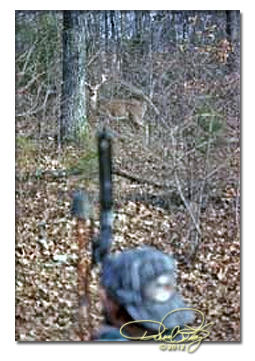
This buck is screened by a tree and brush; Wait for him to move
photo courtesy Dave Richey Outdoors ©2012
It takes some age and an abundance of hunting experience to accomplish one of the most difficult things in bow hunting: determining when not to take a shot. There are times when taking a bow shot at a buck just doesn’t make sense.

I was sitting in one of my stands last October. Deer movements were slow, and going home and soaking up some heat seemed a good idea. A bad thing about taking a shot under iffy conditions is knowing that if the deer is not killed, it will be spooky of that area in the future.

Some say a deer's memory is less than five minutes, but I'm convinced that while deer do not think as we do, they react to instinct. A close call can cause a buck to change his travel patterns.

My decision was the right one: I'd sit and wait. There was no rush as plenty of shooting time remained, but I'm constantly amazed at how long a buck can remain motionless. This buck never moved a muscle, but yet, it had to move forward or sideways to offer a shot.


Sometimes it’s just a wise decision to wait out a deer


It chose to stand still and only its head moved very slightly. It moved its head an inch or two when other deer filtered past me, but I believe that some game animals can sense potential danger.

This buck seemed rooted stiffly in place, and he stood as still as a statue and never moved. I can set still for long periods of time, but this old boy's life depended on his choice of action. He stood, immobile, waiting and watching for something to confirm his suspicions.

Thirty minutes passed, and like a case of stare-down between two people, someone had to blink. It was me, and although I knew the buck couldn't see my eyes, he seemed to sense when I blinked.

He whirled and disappeared back into the tag alders. Other deer spurted away, frightened by his sudden actions, and they were visible momentarily before all was quiet again.


Such experience makes one wonder about whitetail deer


I sat back, and thought about our standoff. It was nothing I did or he did that resulted in his flight except me blinking my eyes. I was wearing a face mask, and he couldn't see my eyes. Turkey hunters swear an incoming gobbler will see the waiting hunter blink.

Maybe it's so. I certainly don't know everything about whitetail deer, but I do know this buck sensed danger. When his nerves couldn't stand the strain, he bolted.

It's what caused him to run is the question, and the answer is yet to be determined. I can’t believe he saw or even sensed me. It’s such encounters that make hunters wonder what they did wrong.

In all likelihood, the deer may have been spooked earlier, and was still a bit owly about that experience. It’s as good a theory as any.

Thursday, July 05, 2012

Bears in the berry patches

A black bear feeding on summer berries is still alert to danger.
photo courtesy Dave Richey Outdoors ©2012
Several days ago, while visiting an archery shop, I heard the first reference to picking berries. The word was some early raspberries were out, but we needed more rain.

So, we had two rain showers. I don't know whether we've had enough rain to do the berries much good, but I plan to get out and check it soon. I'm thinking red and black raspberries and blueberries next month. I love them on my breakfast cereal. The larger blackberries pop out this month and next,

I love all kinds of summer berries. I can get red and black raspberries near home but have to travel to some remote locations for the others. The travel doesn't bother me, but in these remote locations there are others critters that love wild berries.

They are called black bears. Several of the areas where I pick black raspberries and blue berries are areas frequented by bears.

Two things of major important occur in July and August. We reach the point when female bears come into estrus, and male bears are cruising in search of females. Most of the breeding is done by adult boars, but  since they like berries, it's not all that unlikely that a bruin could be feeding in a berry patch.

Be aware of bear habits and habitats


Most of the time bears will go out of their way to avoid humans. However, bear cubs are much like small children who are so into having fun, they could get close to human berry pickers. Should that happen, and should the sow bear be close to cubs, it could lead to some trouble.

The easiest way to solve this problem is to make enough noise by talking as you walk through the swamps, uplands and hardwoods. Bears, especially adult animals, are always alert to the sound of humans nearby.

Given any kind of chance, bears will retreat to a more quiet area when humans are not found. They often feed on berries, wild apples, cherries and other fruit during the night, but bears do move during daylight hours. So, it means taking a load of common sense into the woods with you. Make more noise once you get near the berry patch, and look around for bears.

Pay some attention to the photo above. The bear is sitting down behind some brush as it feeds in a berry patch. The image doesn't jump right out at you, but the animal is easy to see if you are looking for a black object.

If you happen onto a feeding bear, it makes sense to move to a different berry patch where there are no bruins openly feeding on the fruit.
Make a quiet retreat, but don't running off yelling at the top of your lungs. Once well away from the area, continue to make some noise. If you go back to the berry patch, approach it with human voice talks and progress slowly. A cautious but noisy approach will usually find the bear long gone.

Continue to use common sense where moving down rows of blueberries. Bears, by nature, are rather curious animals but there is no logic and no sense in remaining silent when heading for the nearest berry patch.

Perhaps you've never seen a bruin in that patch, but that doesn't mean a bear couldn't be in there feeding. They are rather silent feeders, and make little noise when walking if they are suspicious of humans nearby.

Common sense and awareness keep men and bears out of confrontation


I've taken quite a few photos of wild bear, and don't photograph tame bears, and you've got to work pretty hard to fool an adult bruin. One other tip is to figure out where the wind is blowing to, and get in the wind with it at your back as you enter a berry patch. Having the wind at your back means a bear will smell you before it sees or hears you, and will be long gone before you get close/

Understand that no one knows everything about bears, and what is written here is written by a man who has hunted bears often, and has had a few confrontations with sows and cubs. Remember this: bears are normally docile and will move away from humans if given the chance, but black bears are more unpredictable than most of the other bear species.

Being unpredictable means you should never trust them. I've written numerous stories about some of my experiences, but don't expect bruins to always act as they have with me. This is not mean to be a frightening story, nor is it meant to keep people from finding berry patches and picking berries.

It is meant to give people a heads-up about bears that breed and feed on berries during the summer. A word to the wise should be sufficient.

Sunday, March 06, 2011

Which is best: Guessing or knowing?


Pick the right spot and you may shoot a nice buck like the author.


It's a common problem for deer hunters. They find themselves in unfamiliar territory, and are trying to puzzle out where the best place is to hunt.
Many hunters take a wild flying guess based on minimal input from gazing at trails, and pick a spot. Often, it may look good but in many cases it is a hurry-up and poor guess that won't pay off.

Having said that, we can answer the question that serves as the title of this daily blog.

Guessing at good hunting spots is never a great idea.


Knowing where to hunt is always better than guessing. Knowing comes from a constant familiarity with the area being hunted. Let's put it another way: We travel to Alabama in mid-January when the rut is in full swing, hoping for a good buck, and we hunt on private club land.

Someone acts as a paid or unpaid guide, drives us to a stand where deer are known to pass, and with some luck, we shoot a buck. If we don't shoot a buck, it means that none were seen, none were of the size we wanted or a buck did show up but didn't offer a chance for an accurate shot.

We hunt again in the evening, and are placed in a key location where we should see deer. No one can always make deer move, and no one can guarantee that a hunter can and will sit still.

If we should hunt this way, with others telling us where to hunt, it's a wise move to pay close attention to the terrain in which we hunt. There are always some things that can offer subtle hints about each location. Try to figure them out as you move deeper into cover.

More deer are shot in thick cover than out in the open.


Deer often are found in fringe cover, that area between thick heavy cover and open land. Of course, a ground blind or tree stand may be located anywhere in-between, and it's up to the hunter to learn why one particular spot is better than another.

One of my favorite spots is on a low hillside with thick heavy cover on three sides with open land on the west side. The prevailing westerly wind blows down through the open cover, and the stand is cross-wind.

The only way a deer can pick up a hunter's scent here is if he climbs into or out of the stand. The stand should be high enough on this small hill to blow scent over the surrounding thick cover.

One thing hunters must do is look at terrain the way a deer look at it.
  • Where is the food supply?
  • Where are the key bedding areas?
  • Which trails connect those two key locations?
  • How can deer, especially larger bucks, travel back and forth without being on trails?
Other key factors include:
  • How does the wind blow in each location, and does it swirl backwards when hitting a woodline?
  • How can a hunter get into and out of the area without bumping into moving deer?
  • Does the hunting area have two or three way to enter and exit to avoid traveling the same route time after time?

Choose a stand site that is easy to access without bumping deer.

  • Which type of stand is best suited to that area?
  • Which would work best: a ground blind, pit blind, tree stand or elevated coop?
  • How high is high enough for elevated stands?

I've found that a tree stand elevation of 15 to 18 feet is usually high enough under most circumstances. I've got one stand that is close to 30 feet in the air, and it is a consistent producer but steep-angle shots are not a good bet when a hunter must make a decision in a hurry, and then take a quick well-aimed shot.

Many of my stands are at 14-15 feet. That places a standing bow hunter at roughly 20 feet in the air. A stand at 18 feet puts the same hunter at roughly 24 feet. Each stand has special requirements, and hunters must solve these problems long before the season opens. Match stand height to the best natural features of a tree. Don’t place stands directly on a trail but just far enough away that a deer moving toward you won’t be looking directly at you.

Hunters will have far better hunting success if they know why a hunting location is best. Guessing implies that one is trusting to luck or fate. With a guess, the hunter will have a 50-50 chance of guessing right. If you error, make certain you error on the side of common sense when choosing a stand site.

Of course, this also means a 50-50 chance of guessing wrong. There is nothing worse than a stand that requires hours of effort and time to prepare only to learn it is not in the right spot.

This year, don't guess. Know where the hotspots are long before the season opens. Doing so beats guessing every time, and you can take that to the bank.

Wednesday, December 29, 2010

Major concerns about ice safety


Walleyes like the one above, and other game fish, are fun to catch on lures.


There is reasonably safe ice on many lakes or ponds north of US-10. It's been fairly cold the past two weeks, but taking a chances on early and thin ice is a risk that no one should take.

Most of the big lakes such as Crystal, Glen, Houghton, Higgins and many others have not 'gone over,' (frozen over) in the past 10 days. However, any ice before Jan. 1 can be a little suspect and due caution is advised.

There isn't a game fish that swims anywhere in North-Country lakes worth risking one's life by venturing out onto one-inch-thick ice. I'm very squeamish about two or three inches of ice, but once a solid mantle of four-inch or thicker ice covers a lake, it's safe for me to walk on.

Ice fishing is great winter fun but requires more than a little common sense.


This is a bad year for many outdoor pastimes, and the fact the ice is has formed early means that many anglers feel a pent-up need to go ice fishing. It is this desire to fish frozen water that can lead to an angler taking an unnecessary chance.

Falling into ice-cold water is a tremendous shock to the human body. The water is so cold it rips air from your lungs. A person with a bad heart or high blood pressure could be in extreme danger of a heart attack or a stroke when they first plunge through. There always is the risk of drowning as well.

In the past I've written about the three times I've gone through, and they need not be repeated now. However, the initial shock of going through and into the cold water, isn't something I need to do again. People who survive one such escapade should consider themselves fortunate. To fall through twice is uncommon, but to go through three times as I have shows either blind stupidity or loads of bad luck.

I'm not dumb, and don't take chances, and in each case it was a freakish accident. I'm far more cautious now than ever before.

Common sense should be the common denominator for ice fishermen. They should seek advice on local lakes from bait dealers or other anglers, and avoid making a mistake because they are so driven to go fishing that they become willing to take a chance with their life.

The ice story I wrote for Outdoor Life magazine was a true tragedy.


Years ago, while working for Outdoor Life magazine, I was a frequent ghost-writer for people who had stories to tell but couldn't write it themselves. One such story interview was conducted the same day I got married, and it involved the only survivor among several people who went through rotten ice on Lake Erie.

This man broke through three times, and was pulled out by the other men, and then they fell through and he had no chance to return the favor. It was, at that time, the first time Outdoor Life had run an ordeal story where someone died.

He described his gut-wrenching fear, told how he watched his friends and two other people go down during a blizzard, and how he was lucky to make it to shore. His clothing was caked with ice, and he was so cold that it was a major challenge to fit the key in the lock to unlock the vehicle door.

The fear hung in his voice like a black curtain being lowered over the faces of the victims. He questioned how and why he survived, and it was a horrific experience. The fact is they were fishing off a warm-water discharge, a blizzard came up without warning, visibility was zero, and they wandered too close to the discharge. The ice was rotted, and could not bear the weight of a single person.

Does a person need to drown for others to grasp the significance of bad ice? Do people have to wrap themselves around telephone poles, trees or vehicles to exercise more caution when snowmobiling?

Play it safe on the ice and live to fish another day.


This winter fishing business is based on making individual choices or decisions. Others can preach about ice safety, but if the choir isn't listening, it is very difficult to keep some people from making serious mistakes and killing themselves.

My buddy -- Dennis Buchner of Grawn -- is the state's largest wholesale live bait dealer. He's been starving, as have bait shop owners across the state, but he advises me that all of the smaller lakes and most, if not all of the bigger lakes, are reasonably safe. That said, it still become a person's individual decision to venture out on the ice. Use your own judgment and go through, it's still your mistake.

Weakened ice can be found on many lakes, and savvy anglers use a spud to test the ice ahead of them. Many carry a length of sturdy rope and some sharp-pointed objects like ice picks or screwdrivers to use to stab into the ice to pull yourself from the water. Wearing a life jacket may make you look like a sissy but I'd rather be alive and be called that than be a dead fisherman.

The ice conditions should be superb if we don't get rain or freezing rain over the next few days. Take advantage of the early-ice opportunity but use all due caution.

Engage brain before venturing out on early-ice. The fishing is usually the best it will be at this time of year, but catching a fish isn't worth risking a cold dunking or losing your life.

Posted via email from Dave Richey Outdoors