Showing posts with label Dave Richey. Show all posts

Tuesday, August 13, 2013

Grunt Up a Buck


You might have missed this chance, but with a
well-placed call, you stopped him dead-in-his-tracks
and in your sights.

The 8-pointer was slowly making his way along the edge of a thick tag alder run, and was crosswind to me. I gave one short, and one slightly longer grunt. Both were rather obnoxious sounding.

Not to the buck, though. He stopped in his tracks, swiveled his head in my direction, and slowly turned in my direction. There is only one big-time rule to follow when using a grunt call for deer.

If the buck heads in your direction, don't call again. If the animal comes 50 or 100 yards, stops and looks around, turn your head away from the deer, and give one soft and muffled call. The buck is looking for a direction, and you can say "Over Here" with one grunt. Put the call away and get ready for a shot.

On came the deer, and he swaggered to within eight yards, and stopped. He milled around for a minute or so, snuffling the air, and then turned broadside. My First Cut 90-grain broadhead took him behind the front shoulder and exited the brisket. He went 40 yards and folded up.

I've used calls on coyotes, deer, ducks, elk, foxes, geese and wild turkeys. If any one thing holds true, it is that animals and birds can determine almost exactly where the call is coming from.

I've used many calls from a tree until three years ago. I've used all types of deer calls including those made by A-Way, Knight & Hale, Primos, Stratton Game Calls, Woods-Wise and many others.

One problem I've always had is that I know deer and other critters can pinpoint a call's location. Who has ever seen a deer calling from an elevation position. I haven't.

H&M Archery Products of Willis, Michigan. has a novel call that I've been using for three years. Their philosophy is that deer don't climb trees so why should a hunter call from a tree.

They produce a call with a 14-foot length of coil-kink resistant rubber latex tubing that another 12-foot length of tubing can be attached to, and a hunter can sit 15 feet up a tree and lay out the other 11 feet of rubber tubing, and call from a tree but the grunt comes from ground level where it sounds most natural.

Any condensation occurs in the tubing, not in the call. This helps eliminate freeze-up in cold weather.

I began with the 14-foot length but soon added another 12-foot length that allows the call to be places off to one side of the tree where an investigating buck will be properly positioned for a shot.

The nice thing is this tubing arrangement will fit most tube-type calls. It puts the sound at ground level where it is most effective.

Many hunters blow a sequence of grunts that is much too long. I keep my grunts short, pause and grunt again for several seconds, and then stop. Ten minutes later try calling again.

There are many different types of deer vocalizations but the grunt call works well. I've had no success with a fawn bleat, and only minimal success with a doe bleat.

One thing that works is to grunt if you see a buck. I've called in numerous bucks that were unseen, but calling works well on visible bucks. It gives hunters a chance to judge the deer's reaction to the call, but if they stop coming, muffle the call and grunt softly one more time. If they keep coming, do nothing but get ready to draw and shoot.

One of the most exciting things about deer hunting is grunting in a good buck. The noises that come out of an inhale, exhale or inhale-exhale call may sound like your hunting buddy in camp after a plate of refried beans, but the grunt call works.

As is true with everything else about bow hunting whitetail bucks, nothing is 100 percent except for Uncle Sam tapping you for a yearly donation and that someday you will pass on to your just rewards. That said, grunt in a good buck and if he charges in with his neck hairs standing up, you will be a convert.

Trust me, it works ... on a fairly regular basis.

Monday, November 12, 2012

My Mistress and I

dave jade
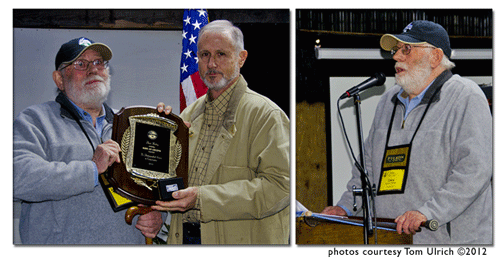
Jim Low (right) presents the Jade of Chiefs Award. A humbling acceptance speech.
photos c. Tom Ulrich ©2012


CHENA HOT SPRINGS, ALASKA -- OK, it’s true confession time. I have a mistress, and have had for 44 years. There, I feel better getting that off my chest.

She’s not some cute woman 25 years my junior. My wife knows about her, all of our  friends know this little secret, and they know I’ll do whatever she asks of me if it is possible. It’s been this way for more than four decades, and I’m actually proud of my actions.

Whoa! What’s up with this? Richey is publicly confessing to having a mistress. Well, yes, I am doing so and freely admit it.

All of this is just my reason for being what and who I am.

My mistress is an organization. Her nickname is OWAA, which stands for the Outdoor Writers Association of America. We began as just friends back in 1968 when I was much slimmer, had blond hair, and was more tidy than now.

I’d began writing outdoor magazine articles in 1967, and seemed to have a way with words. Magazines bought the first six pieces I wrote, and two went to Sports Afield. I figured this was so easy I should have started writing in high school.

The good times lasted as long as those first six stories, and then I smashed headfirst into the brick wall of magazine rejection slips. My first six stories were something of a tease, and despite the rejections, I felt head over heels in love.

Writing was all I could think about, and even though I had some natural talent, I had to learn how to write saleable copy. That took more time than I earlier believed was possible, and after several years, my reputation began to build. Magazines began to come to me, and sales increased.

My first three-year term on the Board of Directors as a great experience.

With increased sales, my reputation began to grow, and as time went on, I ran for the OWAA Board of Directors. I wasn’t nominated, but 20 people thought enough of me to sign a petition and in time I became a Board member. After three years, I got an Outstanding Board member award and was kissed goodbye.

I then ran for the Board again after a year off, and yet again had to gain 20 signatures to get on the ballot. Again I was elected a board member, and again three years passed, and then I said goodbye for another two years, and was re-elected as a Board member the third time, somethng that has happened only twice in OWAA history.

I served on my mistress’ Board of Directors for a total of nine years, ran for 3rd vice-president several times, but was never elected. It seemed my mistress had other plans for me, and over many years I served on many ad hoc and standing committees. If memory serves me right, I served on nearly 50 different committees over four decades.

Somewhere along the way, I was rocked to my sox by being awarded the J. Hammond Brown Award, for many years of continuous service to my mistress. With the Ham Brown comes a lifetime membership. She and other Board members thought enough of me to give me this award.

I was deeply honored, and nine years later she blessed me with the Excellence in Craft Award, which meant a great to me because I came to feel my mistress was again paying tribute to my work. Sometime shortly after, an article was written about me in OWAA’s Outdoors Unlimited newsletter, and it called me a Legendary Writer. Now, my friends, that’s some pretty heady stuff.

Other honors had a deep and meaningful effect on me.

After another nine years of service to my mistress, and after a long flight to Fairbanks, Alaska earlier this month, the angels smiled again. This time, dressed in jeans, baseball cap, jacket and scruffy beard, I hobbled up the podium steps while leaning on my stick, and was presented yet another prestigious OWAA award – the Jade Of Chiefs Award by Jim Low, a past recipient of the award and a past president.

If I’m correct, I am the 44th recipient of this award since it’s inception in 1958. It is not awarded every year, and in my wildest dreams, I’d come to believe that this award wasn’t to be. It isn’t given by OWAA, but given by other living OWAA recipients to honor a person by affirmation of OWAA adherence to, and support of, the principles of conservation. It is the highest conservation award among outdoor writer’s groups.

It puts me in with some pretty heady and influential past and present writers. Past recipients include such worthies as

  • Arthur Carhart
  • Henry P. Davis
  • Nash Buckingham
  • Roger Latham
  • Homer Circle
  • John Madson
  • George Laycock
  • Karl Maslowski
  • Ed Zern
  • George Harrison
  • George Reiger
  • Ted Williams (not the baseball star)
  • Joel Vance
  • Erwin Bauer
  • Leonard Lee Rue III
  • Charlie Elliott
  • Grits Gresham
  • Michael Furtman
  • Tony Dean
  • Greg Patterson
  • Rich Patterson
  • Chris Madson
  • Jim Low

and many others that I have known over the years.

These members had a terrific impact on how I approached conservation issues.

This award was granted for a wealth of conservation stories I had written for The Detroit News, and during my freelance career. A 13-part series on profit poaching in Michigan brought this problem to the forefront. Other stories including an 18-part series about the need for increased study on state black bear numbers, and more positive studies on this animal. I covered Indian Treaty Rights and negotiations from both sides, fought hard for a dove season that lasted only one year, and many other resource management stories.

My 44-year affair with my mistress, and 36 years with my lovely wife Kay, has brought me many highs in my lifetime. It hasn’t all been fun, and that’s one of the things about life we must accept, but I consider my life and career to be the best thing that has ever happened to me.

My long-term friendship with these and many other writers have been a joy to my life. I’ve mentored many beginning writers over the years in hopes they carry the literary torch for conservation in the future, and it’s all been a great and wonderful time.

My life as an outdoor writer has become the model for my professional career. Honestly, I must admit to being one of the luckiest and most humbled men men in the world. And I also admit that my wife, and my mistress, are greatly responsible to me being what I am today.

May God bless and smile kindly on all present, and all who have blessed me with their friendship. Your obedient servant. -- David J. Richey

Posted via email from Dave Richey Outdoors

Tuesday, September 25, 2012

Do human thought waves spook deer

DRO - Buck and Human Vibes
My wife Kay knows how to shoot bucks. A quartering-away shot
photo c. Dave Richey Outdoors ©2012

You may have read this before because I've posted it a few times over nine years. If so, revisit it, determine for yourself how it may apply to your hunting techniques.

Ever see a buck coming through the woods and suddenly it flees for no apparent reason?  Have you ever had a doe stop upwind of your stand, snort, blow, stomp her foot and run off even though the wind was right and you hadn't moved.

Sure you have. It happens to everyone on occasion. What follows may disturb some hunters, could cause other sportsmen to wonder if this topic is true, and if so, how does it happen?

New hunters arrive on the scene every year, and probably haven't read this before or missed it when it was published years ago. It needs to be revisited every so often.

Trust me on this: This topic will be a quantum leap for some deer hunters when they read it. I've stated my opinions at deer-hunting seminars I've given over many years, and some folks sit in total disbelief. They look as if they've been sucker-punched.

Don't stop reading just yet. These thoughts, if you accept and think logically about the topic, may make you a better deer hunter. We'll be talking about your mental rather than physical actions.

My many years of testing this theory

It's not important that hunters believe as I do, but over 40-plus years I've tested this theory on countless occasions in many scattered locations. Each time it is tested, the result is the same. I strongly believe what follows to be true, and all I expect of readers is to study and decide if they believe and trust it.

Know this before we go any further. There is much that modern science doesn't know about the brain, brain waves, and how it affects people and many of the wild animals we hunt.

My thoughts on spooking deer

Here goes: I believe, being a very capable and deep thinking predator, that deer -- especially does -- can sense the presence of danger without the benefit of movement, noise, scent or other stimuli. I once hunted mountain lions in northern Arizona, and my guide told me the reason he feels cougars kill mostly mule deer bucks is because those deer are so full of themselves they act and feel immune to danger.

They are not alert or attuned to the presence of danger. Does, on the other hand, are constantly alert to the possibility of nearby predators as they try to protect their fawns from predation.

My thoughts are pretty straightforward. I believe that thinking hard about killing an incoming buck or doe can transfer some type of danger signal to the animals. Are human thoughts carried by brain waves? Do these vibes, for lack of a better description, throw out a silent alarm that does can pick it up much easier than bucks?

Clear your mind of all predatory thoughts

I never think, after spotting an incoming buck or doe that I am going to shoot that animal. My brain stays in neutral, idling without conscious thought. I purposely avoid thinking about shooting and killing the animal. I may and often do spend that time thinking about my next article to be written.

My belief is to never stare at a buck or doe. Looking into a deer's eyes seems to allow that animal to feel or sense human presence. My thoughts remain neutral, and when I draw, aim and shoot, I'm concentrating on my aiming point but am not thinking about killing the animal.

Testing this theory over many years has proven informative. My normal hunting method is to allow my eyes to sweep over the deer without lingering on any part of its head or body. It's easy to establish the animal is a buck if antlers are visible, and that data is stored in my mind. I know it is a buck but no longer think about it, and I never dwell on such thoughts, which I feel are counterproductive.

Instead, I think about going hunting the next night, which stand may be productive under the current wind direction, or I'll recall something that has nothing whatever to do with hunting. I could just as easily think about painting the basement walls, which is a horrid thought, even when trying to fool a nice buck.

My main train of nonviolent thoughts

However, my mind knows why I'm out there, and that is to possibly shoot a buck or doe. However, my mind focuses on another thought or topic, or on nothing at all, and when it tells me it's time to shoot, the bow is drawn, the red-dot settles behind the front shoulder and the arrow is gone before my mind tells my finger to shoot.

The deer never senses a threat or any unease. It doesn't feel my predatory instincts coming its way, and the deer remains relaxed. Calm and cool thoughts or even not thinking at all is far preferable than telling yourself that the shot will go through its lungs and heart. That may happen, but if you don't think hard on it, I'm convinced the deer will not bolt unless you move or make a sound at the wrong time.

On the other hand, I've often thought about killing the buck as a specific test. I'll think: Here comes a buck, and look at those antlers. My eyes scan the bone on the buck's head, and then I look at its eyes, and then strongly focus my attention on the heart-lung area.

The buck, suddenly alert, turns his head to look around. My eyes lock on his, a predator against a nice buck. His head turns slowly away, and I come to full draw, think about driving the arrow into the chest cavity, and at about that time, the animal suddenly bolts off in panicked flight.

There has been no noise or sudden movements on my part, and no way the deer could smell me. But my thoughts were keenly focused on shooting that animal, and perhaps this comes from my many years of hunting experience and shooting many deer. Perhaps my vibes are stronger than those of others who have largely been unsuccessful.

A human example to illustrate my point

Think of it this way. I no longer drink, but back in the day, my entering a bar was always an experience. If I were a stranger, I'd immediately sense the vibes of other people looking at me, and then would come a strong feeling that someone was staring intently in my direction. With practiced determination, my eyes would scan the room until the person staring at me was located.

It was then I'd size up the situation. Is this a friendly person or one who wants to put knuckle bumps on my noggin? If I sensed agitation or aggressive hostility, I'd turn and walk out while it was possible. It's the same thing with deer. Flight is always preferable to fight.

An example of street smarts

In some areas they often say a person has "street smarts." Why. Pray tell, don't deer have "woods smarts?" They do, and their instincts are more finely honed toward survival than yours or mine.

If deer sense danger, however it is transmitted to them, it becomes an instinctive reaction. It's like an adrenaline rush: it triggers the fight or flight response. Deer don't grow large antlers by ignoring these little niggling feelings. I draw the line at granting deer human-like qualities, but am convinced these animals can pick up hostile vibes from someone trying to shoot it with a bow, which are invariably close shots.

Deer can do the same thing, as humans although how they process this invisible information is an unknown factor. Years ago, while shooting some of the deer photos needed for stories, the deer would hear the shutter click, look around, and nothing happened. Minutes later another photo or two would be taken, and the deer would become used to the noise. Nothing happens, and they would soon relax.

It's strange but deer seem to sense when a hunter or photographer means no harm, and while an old doe may go charging off, if they are not unduly alarmed, they often return within minutes.

Deer that may sense a hunter intent on shooting them can get as freaky as a mule deer doe when she suspects the presence of a nearby cougar. She doesn't want her or her fawns to be dinner, and will take whatever evasive actions are needed to avoid the predator

Bucks, on the other hand, seem unaware of danger unless it picks up some predatory vibes, catches a whiff of human odor or sees some movement. Often, if a doe spooks and runs off, a nearby buck may do the same thing without feeling any sense of danger.

This is where it becomes extremely important to remain in a non-predatory mind-set. Think about killing, and things can quickly change and game can vanish without a shot being taken.

A quick recap

Never look deer in the eye, never think about shooting them, scan past the animal, never put a lingering stare on the deer, and if I'm about to shoot, my mind is emptied of all predatory thoughts. Ninety-five percent (or more) of the deer that have fallen to my arrows were dead before they knew their lives were in danger.

I repeat: it's not necessary you believe this, and hunters can continue to hunt as they choose. However, when I hunt, my purpose is to get close to deer, never get them excited, and if the right buck comes by, I'll take the shot. Cougars hunt the same way and they are far more deadly predators than most humans.

It's quite likely this may be the most radical bit of deer hunting lore you'll read this year. I'm not trying to change your hunting style or your mind-set, but ask you to consider an alternative line of thinking when deer approach. Many of the key hunters in North America, if pinned to the floor with a hammerlock, will agree with these thoughts. All I'm taking is your time (the line from an old song) and my hopes are you'll give this the mental consideration it deserves.

Feel free to share your thoughts. Do you agree or disagree? Your comments, please. Contact me at dave@daverichey.com. Thanks for your time spent reading this. Give it some thought, and you may or may not disagree.

Posted via email from Dave Richey Outdoors

Saturday, September 01, 2012

REMINDER: Read 'Hunt Pre-Rut Bucks'

buckingrass

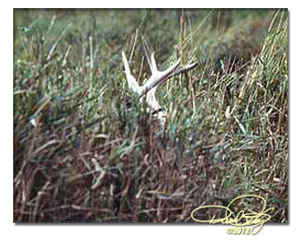
Bone-white antlers of a resting buck show above weeds during the pre-rut


This method has worked for me, and can work for you regardless of where you hunt.

Try it this fall and see if it doesn't produce action at a time when no one is hunting. It's rut hunting's biggest secret, and now only you, me and several hundred thousand other people will know.

Mark this blog and go back and read it again in mid-October, and maybe it will produce a nice buck for you next fall.

OK. Here's your reminder.  Re-Read, "Hunt Pre-Rut Bucks' and go get your mid-day buck.

Tuesday, August 28, 2012

Rainy Day Whitetails

dro_big buck
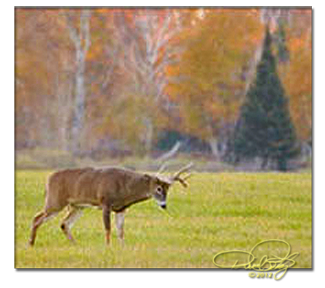
A big buck posturing in a soft rain and far from any bow hunters
photo courtesy Dave Richey Outdoors©2012
There are times when a bow hunter can hear a whitetail coming for 100 yards. If the animal is upwind, and the leaves are as dry as corn flakes, the sound carries for a long distance.

Whitetails depend on their hearing for survival, and dry leaves advertise their presence. The opposite is true when it rains.

The leaves soak up the rainy weather, and a whitetail can ghost through the woods with barely a sound. This is an important reason for hunters to spend time in the woods when the rain is falling.

Fog, a light mist or a soft drizzle can cause bucks to move


I've written before that deer love to travel when a soft misty rain is falling. There is a soft pitter-patting sound under such conditions, but it doesn't seem to bother the deer. They seem to be able to separate that soft noise from a dangerous noise without a problem.

These soft rains seem to get deer moving earlier in the evening, and it appears that deer move with more confidence during a soft rain. They appear more comfortable moving between bedding and feeding areas, and they seem to eat and move without hesitation.

I've had people ask if I feel a soft rain will carry human scent downward. I believe, to a small degree, that it does. I also think that low-lying ground fog will hold human scent near the ground.

Soft rains and fog seem to go hand in hand during the autumn months, and I've seen some of my largest bucks under such conditions. The fog seems to offer big bucks a sense of security, and they seem to be on the move. This is most certainly true during the pre-rut, rut and post-rut, when buck and doe activity is high.

One thing about fog is it distorts the sense of sound. I don't know how many times I've listened to a buck grunting as he tends an estrus doe, and in the fog, my vision and hearing is limited. I've seen bucks appear and disappear in the rainy fog without ever seeing the doe, and there have been many times when the doe is visible but the tending buck cannot be seen.

Fog is the hardest to hunt in because it distorts hearing and vision


It's at times like this that a hunter must be alert. I remember one night several years ago just before the Nov. 15 firearm season opener, when I saw a half-dozen bucks appear and vanish into the fog. All were moving, all were grunting, and the antler and body size of each one indicated they were individual animals.

Judging distance in the fog can be difficult. I've talked with a number of people who know the far edge of their bait pile is 20 yards away, and if a doe or buck appears in heavy fog, they feel the animal is much farther away that it appears. They aim high to compensate for this imagined difference and shoot over the animal.

The best advice is to put out markers  if you are not using bait. A measured distance must be believed, even if the fog makes the animal appear much farther away than what it is.

I like rain on the roof, rain after my crops are planted, and rain (on occasion) when I'm hunting. I dislike a steady diet of it, and I compare that to eating steak every night. One soon grows tired of it.

I find it enjoyable to  hunt under these conditions


Hunting in the rain isn't too bad. It offers something a little different to a bow hunter, and that is fine by me. I enjoy a variety, a change of pace, in my hunting, and I can hunt in anything except a downpour or when the lightning is dancing in the sky.

Most of all, I like to hunt in those soft misty evening when the darkness comes early because of heavy rain clouds overhead, and when the whitetails seem to slip up on a guy. That is when a hunt really means something to me.

Monday, August 27, 2012

Thinking and being alert to deer is easy

DRO-big bucks
This buck has a larger rack than you think; Count the points
photo c.  Dave Richey Outdoors
My mind seemingly has tunnel vision. The only two things i seem focus intently on while bow hunting is studying deer, which really doesn’t make me all bad. I could care less about ball parks, Nascar races, or tournament golf.

Whitetails excite me; almost everything else is far less interesting, and certainly a lot less fun.

People question how I can only think about these two items most of the time. It must be easy because both passions have consumed my thoughts for more than 50 years.

Both thoughts are of equal importance, and without my intense study, there would be less hunting success. A number of years ago, I was asked a question at a bow-hunting seminar I was giving.

Another seminar attendee asked if the only thing I thought about was writing. I gave the man a straight answer.

It's a wise hunter who can act and think at the same time


"Writing is what I do," I said. "It's how I make a living, and to do my job properly, I'm always thinking about the next story. It has to be what I think about on a daily basis. I'd be dead in the water without the next story idea. The same thing applies when I bow hunt for whitetails."

My answer is based on these reasons. For me, hunting whitetails with a bow, and studying the animals at every opportunity, is what I do. To stop studying deer is to stop learning about whitetail deer. To stop learning means less opportunities and decreased success.

When I hunt, I become totally focused and immersed in my surroundings, and what the deer are doing. I never lose my concentration on deer, but I continue to focus and watch other deer. I can solve all kinds of deer hunting problems while sitting in my ground blind or in an elevated coop or tree stand.

Stay focused on your surroundings and remain alert


When working, my thoughts are always on deer hunting or trying to figure out why a particular deer did what it did the night before. Most people forget yesterday's hunt but not me.

Some people find it hard to think about two things at once or have trouble chewing gum and walking. That often happens when deer hunting: I'll be trying to solve a knotty little deer travel pattern problem, and a nice buck will walk out. My reflexes take over, and I can shoot that buck while shifting mental gears, and then I will shift back to solving other problems after shooting the deer or passing up a shot.
Solving any bow-hunting problem is always easier while bow hunting. Any hunting area always has some natural noises, but out there, the phone doesn't ring to distract me.

Years ago I learned that many of my award-winning articles and columns came to me while sleeping. One part of my brain kicked into gear, and I would wake up, slip out of bed, head for my office and write it while the idea was still fresh in my mind.

The same thing happens while bow hunting. A problem may bother me for weeks, and then one night while sound asleep, the answer wakes me up faster than a face slap with an ice-cold wash cloth. I suspect that being asleep allows the subconscious to kick in, provide the needed answer, and usually the answer is so simple I wonder why it didn't come to me much sooner.

Hunting and thinking is just as easy as walking and talking


I'm able to study deer, think about various deer patterning problems, and be ready and able to shift gears automatically, and shoot the buck. It's what I've trained my body and mind to do, and anyone else can do it providing they've learned the basic fundamentals of drawing and properly aiming a bow and making a smooth release. Do those things long enough, and do them properly, and it becomes simple.

This sort of thing often happens while I'm hunting. When my two main thoughts meld while aiming at a big buck, it is one of the most memorable events of my life.

Sunday, August 26, 2012

Hunt regardless of the weather

DRO-think big bucks
Check out these bucks; They’re all standing up at once
illustration/photo c. Dave Richey Outdoors / I65DESIGN+MEDIA ©2012
Millions of deer hunters are found across this great nation of ours, and we all seem to have a different philosophy on deer hunting. We seldom agree on wildly varying topics.

Some hunters refuse to hunt various wind directions. Anything from the east is normally bad. For years, October featured south and southwest winds and then west and northwest, and by December we were hunting northwest, north and northeasterly winds.

All the climatic changes we've seem to have produced more hot, dry weather, and the drought we've experienced this year has burned up many food plots or farm fields. It's still a bit unclear what we will be dealing with this fall, but all of us will probably dealing with freaky weather changes.

If we can’t change the weather, learn how to work with it


So, do we worry about it or allow nature take its course, and we deal with the changes as necessary?  My though is that we deal with the changes as best we can because we can't change the weather.

My philosophy is that a deer hunter won't get much hunting in if they stay home whenever there is a bad wind. I hunt but switch from an open tree stand to an elevated and enclosed coop on such days. A few stands are set for an east wind, and they are in demand when the wind goes sour.

I strongly advise hunters to make certain there are a couple of stands, whether elevated or on the ground, that allow us to cope with and hunt on an east wind.

Many are the deer hunters who believe they should only hunt during the dark of the moon. Others only hunt the week before the full moon, and others never hunt during a full moon.

There are those who believe in hunting around the Harvest Moon, the Hunters Moon, the Rutting Moon, and some who will only hunt just before the second full moon after the autumnal equinox. The nice thing about living in a free society is each of us can indulge in such pleasures that make us happy and perhaps more productive.

I personally don't care which day of the week it may be, which way the wind blows, what the moon phase happens to be, or anything else. I find it difficult to kill deer while sitting in the house rather than be out hunting.

There are others who place great emphasis on hunting the rut. Little do they know that the 10 days before the full rut begins, deer go through the chasing stage or the pre-rut. It is a wonderful time to be hunting, regardless of the moon phase or wind direction. Just hunt with the wind in your favor and forget everything else.

The rut is pretty much at the same time in Michigan


Many feel the rut begins Oct. 20-25, and that is the beginning of the chasing stage, and it will last for about 10 days before the full rut begins. It's possible to find many people who would disagree on when the rut actually begins.

The peak of the rut in northern Michigan where I hunt will occur on or about Nov. 3-4, and it is winding down by the Nov. 15 firearm season opener.

There are numerous variations, depending on where you hunt. Weather conditions and people pressure can alter these dates a bit.
Some hunters are addicted to the Solunar Tables. These tables, first invented by John Alden Knight many years ago, are based on the sun and moon and their effect on tides and the earth. They contend there are normally two minor and two major periods most days when fish bite, and when wild game move about.

Some sportsmen hunt according to the Solunar Tables and kill deer, and I know other folks who hunt whenever they can, and they also have good hunting success while hunting outside of these major and minor periods.

Nothing is 100 percent but hunt when cows are standing up


One time an old Florida cracker took me fishing. We poked around because he told me the fish aren't biting and the deer aren't moving. Two hours later cattle along the St. Johns River began getting to their feet.

"Let's go fishing now," he yelled, tossing a small baited jig into the water. We caught lots of fish while the cows were up, soon the cows laid down and the fish quit biting.

"I've watches this phenomenon for many years," he said, "and there is a correlation between standing cows, biting fish and moving deer. Fish and hunt when the cows stand up."

I've hunted many years with some poor and some great success. Good hunting habits bring wonderful hunting success, and simply being afield whenever possible is a good reason some people are more successful than others.

I forget about all this other business, and go on doing what works best for me. That means that I hunt whenever possible, and try to hunt every day of the season.

Take the normal precautions with the wind, stay downwind of the deer, and it becomes fairly easy to build your own deer-hunting success .... at least during normal weather.

The jury is still out on how future weather will affect hunting.

Saturday, August 25, 2012

Highlighting Michigan’s Massasauga Rattlesnake

ra
Map showing snake counties (brown) and a photo of a
Massasauga rattler
illustration courtesy Dave Richey Outdoors / I65DESIGN+MEDIA ©2012
CADILLAC - No one has an accurate count on how many Massasauga Rattlesnakes (Sistrurus catenatus catenatus) live in Michigan, but one thing is well known: We have the lions share of the population of this, the state's only venomous snake.

All the other populations that stretch from Iowa and Missouri up through Illinois, Indiana, Michigan, Minnesota, New York, Ohio, Pennsylvania, Wisconsin, and a small number in Ontario, make up the world's population.

"These snakes are very scarce, and everywhere else, they are considered  "threatened" or "endangered," said Michigan State University doctoral candidate Rebecca Christoffel of East Lansing, who was speaking to some Michigan Outdoor Writers. "I've studied these little rattlers for some years. They are harder to find than most wildlife in this state or any other area."

Currently the Massasuaga rattlesnake is listed in Michigan under Special Concern and is a candidate for federal listing.

These small rattlesnakes are shy and reclusive, and are seldom seen


This snake is seen so seldom that there is much that most state residents do not know about these pit vipers. This much is known: the Eastern Massasauga rattlesnake (Sistrurus catenatus catenatus) is quite small, averaging 18.5-30 inches in length. They are thick-bodied, and gray or light brown with large, light-edged, chocolate-brown saddle-shaped blotches on the back with smaller dark spots along the sides. It has a blunt tipped tail with a segmented rattle at the end.

They are found throughout Michigan's Lower Peninsula and Lake Huron's Bois Blanc Island off Cheboygan. None are found in the Upper Peninsula, and wherever they are found, the land is mostly wetlands that include bogs, fens, marshes, sedge meadows, swamps and other wetlands that include prairies and savannas. See the above map for counties where known rattlesnake sightings have been documented.

Periods when Massasaugas are active


Massasaugas are active from April through October, and often are seen basking in the sun. Personally, I've seen only one live Massasauga rattler other than the one shown in the photo published today.

"Many people are frightened of these small rattlesnakes," Christoffel said, "but they are quite shy and will try to hide from view to avoid detection. They generally strike only when threatened, and most bites come when people try to handle them. They shake their small rattles, but the sound isn't as distinct as with a larger rattlesnake. Their rattling sounds more like the faint buzzing of an insect."

She said that perhaps 25 to 50 percent of massasauga snakebites are "dry," meaning the snake does not release venom. She added that from  1999-2005, from three to eight statewide snakebites were reported to Michigan Poison Control.

The chances of getting bitten by a Massasauga rattlesnake are very remote. There are certain precautions one can take, and that is to recognize where these snakes may be found. Usually, in the wild, they are found on or near humps of ground; near root wads of fallen trees; and near trash dumped in the woods by ignorant people.

"Learn to recognize possible rattlesnake habitat," she said. "The ground can be moist or sandy and dry, but there is normally some woody debris on the ground. Piles of fallen tree limbs, leafy areas, sandy hills and marginally wet areas around marsh hummocks are key locations for these snakes."

She also offers these tips to prevent getting bitten by these short-fanged snakes.

Tips to remember when in possible snake country

  • Stay on the trail or the beaten path while walking in potential snake habitat.
  • Always wear close-toed boots or shoes and long pants. Use a flashlight when walking after dark.
  • Watch where you place your hands and feet. Do not reach into brush, rocks or dark places where it's impossible to see.
  • Stop moving and determine the snake's location if you hear a rattle or buzzing sound. Step away slowly and give the snake the opportunity to move away.
  • Never pick up a Massasauga rattlesnake or any other snake you cannot positively identify. Trying to pick up a snake is the most common cause of snakebites.
  • Never chase, harass or threaten a snake. This is the second most common cause of snakebites. Remember, Michigan's Massasaugas, while not endangered or threatened, are protected (of Special Concern; candidate for federal listing). It is illegal to bother them.
  • A Massasauga rattlesnake can strike a distance of half to two-thirds of its body length. A two-foot snake can strike 12 to about 16 inches.
  • Keep pets on a leash at all times when in wild places. Besides the remote possibility of being bitten, a dog can run off to chase a fawn or even an adult deer. Keep them under control at all times or leave them behind.
  • Four other snake species often are improperly misidentified as a Massasauga rattlesnake. Learn the many differences between the
    • Eastern Milk snake (Lampropeltis triangulum triangulum) [photo.info]
    • Eastern Hognose snake (Heterodon platirhinos) [photo.info]
    • Northern Water snake (Nerodia sipedon) [photo.info]
    • Eastern Fox snake (Elaphe vulpina and Elaphe gloydi) [photo.info]

The Massasauga rattlesnake is a rather timid animal, and will go out of its way to avoid humans. Michigan has the largest number of these small rattlesnakes, but the population is a relative thing. These snakes are not plentiful even in the best habitat, and they deserve the protection afforded them.

For more information on massasauga rattlesnakes, go to the Michigan DNR -Massasauga website.

Friday, August 24, 2012

Start deer scouting soon

DRO_deer scouting success
The author with a nice buck he scouted after the season opened
photo courtesy Dave Richey Outdoors ©2012
There is nothing better than putting down boot leather when it comes to learning a new hunting area, and that is what most people do. A few take this "learning-the-land" proposition two steps further.

The use of topographical maps is one key element of learning new land, and aerial photographs is still another. Combine these strategies, and a hunter will have a recipe for possible success.

To properly scout an area, it's vitally important to prevent your scent from drifting downwind to a whitetail bedding area. Play the wind like a fine violin, stay downwind of bedding areas, move through the area while checking ground sign for trails, food areas and bedding spots.


There is just a bit more than a month to scout before the opener


Nothing is 100 percent when it comes to hunting whitetail deer, but having a firm grip on the terrain is very important. There is a quarter-mile field that runs mostly north and south on my land, and through this open field are a series of small rolling hills and dips in the land. Deer have learned to use those tiny valleys and tiny hills to sneak through the open terrain.

Walking such an area is one way to learn how deer travel, and doing it with some snow on the ground is even better. There are places where bucks can enter the field on the west side, and by moving left and right, they can stay down in the dips and out of sight of most hunters.

What I've done is build hunting coops and they are strategically placed so that most of these travel routes can be covered. Deer often move east in the evening and west in the morning, and hunters can place themselves in key positions to waylay the animals as they pass.

However, when hunting strange land that you've never hunted before, topo maps and aerial photographs, when combined with walking the terrain will enable hunters to determine good spots to hunt.


Use time wisely to learn where deer travel; Do it now


Funnels are an absolute deadly spot to hunt. A funnel is created by a narrowing of heavy cover. It can be a brushy fence-row that connects a wood lot and swamp, two wood lots, a wood lot and a pine plantation, and other such thick and narrow places like creek beds where deer movements are funneled through a narrow area. They are natural travel corridors that deer use.

The bases of hills are another hotspot. Often the thicker cover is at the lower elevations, and if there are three hills, only one will be vitally important to hunters. Deer often choose the one that offers the easiest access and exit routes to heavy cover, and they will ignore other nearby hills.

Field corners that border on swampy or wooded areas are great, Again, only one field corner is most likely to produce deer, and again, it is usually the thickest corner that still provides animals with a good view of a distant field.

Saddles or breaks in flat or low-lying areas or ridges that allow easy access to feeding fields are good spots. Such locations may have one good trail that leads from higher ground, down through the saddle, and through swampy or wooded areas that border the crop lands.

Dry or wet creek or river bottoms are especially good because there is a good deal of cover, the possibility of mast crops such as acorns and beech nuts, most bottom land areas are thick with berry bushes and other cover.


Don't ignore aerial maps or topographical maps; They can help


Walking this land is fine, but putting aerial photos and topo maps together enable hunters to obtain a birds-eye view, and the topo maps will show contour changes. Most topo maps have contour lines and special colors or symbols that indicate hills, wooded areas, swamps, creek or river beds and much more.

Spot the funnels, saddles and other topographical features, find their relationship to the aerial maps, and plot the best method of moving into these areas to hunt. Find such key locations, determine the bedding and feeding areas, and then begin scouting for active deer sign.

Locate the food source, and then find the bedding area, and the trails deer use will be relatively easy to find. Determine the prevailing wind direction, and start looking for good trees for a stand.

Finding hotspots in new areas isn't terribly difficult but it requires some scouting time. Most of all, carry a compass or GPS, and know how to use them. Finding such out-of-the-way areas, where other people seldom hunt, and you'll have your own little gold mine for deer.

Wednesday, August 22, 2012

Who Will Blink First?

DRO-eyes locked
This buck is screened by a tree and brush; Wait for him to move
photo courtesy Dave Richey Outdoors ©2012
It takes some age and an abundance of hunting experience to accomplish one of the most difficult things in bow hunting: determining when not to take a shot. There are times when taking a bow shot at a buck just doesn’t make sense.

I was sitting in one of my stands last October. Deer movements were slow, and going home and soaking up some heat seemed a good idea. A bad thing about taking a shot under iffy conditions is knowing that if the deer is not killed, it will be spooky of that area in the future.

Some say a deer's memory is less than five minutes, but I'm convinced that while deer do not think as we do, they react to instinct. A close call can cause a buck to change his travel patterns.

My decision was the right one: I'd sit and wait. There was no rush as plenty of shooting time remained, but I'm constantly amazed at how long a buck can remain motionless. This buck never moved a muscle, but yet, it had to move forward or sideways to offer a shot.


Sometimes it’s just a wise decision to wait out a deer


It chose to stand still and only its head moved very slightly. It moved its head an inch or two when other deer filtered past me, but I believe that some game animals can sense potential danger.

This buck seemed rooted stiffly in place, and he stood as still as a statue and never moved. I can set still for long periods of time, but this old boy's life depended on his choice of action. He stood, immobile, waiting and watching for something to confirm his suspicions.

Thirty minutes passed, and like a case of stare-down between two people, someone had to blink. It was me, and although I knew the buck couldn't see my eyes, he seemed to sense when I blinked.

He whirled and disappeared back into the tag alders. Other deer spurted away, frightened by his sudden actions, and they were visible momentarily before all was quiet again.


Such experience makes one wonder about whitetail deer


I sat back, and thought about our standoff. It was nothing I did or he did that resulted in his flight except me blinking my eyes. I was wearing a face mask, and he couldn't see my eyes. Turkey hunters swear an incoming gobbler will see the waiting hunter blink.

Maybe it's so. I certainly don't know everything about whitetail deer, but I do know this buck sensed danger. When his nerves couldn't stand the strain, he bolted.

It's what caused him to run is the question, and the answer is yet to be determined. I can’t believe he saw or even sensed me. It’s such encounters that make hunters wonder what they did wrong.

In all likelihood, the deer may have been spooked earlier, and was still a bit owly about that experience. It’s as good a theory as any.

Tuesday, August 21, 2012

Try grunting with a deer decoy

DRO_ Grunting up a buck
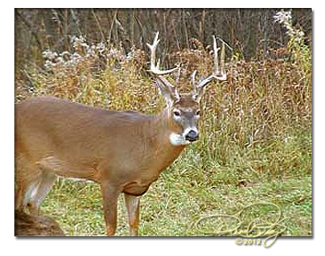
There's always a chance a big buck will investigate a grunt call
photo courtesy Dave Richey Outdoors ©2012
If you've never used a grunt tube to call bucks, you may be surprised in two ways: the call, properly used at the correct time, can call a buck within easy bow range.

The second way to be surprised is the sounds the call will make. It vaguely reminds one of ... ah, how can I put this delicately? Ah, ah, let's see ... ah, well, ah, sort of like someone four hours after eating a big plate of refried beans.

There, that's out of the way. For a first-time buck grunter, one often spends the first sequence of calling smiling and silently giggling. Just often enough, a grunt call will effectively pull a nice buck close enough for a decent shot.


A grunt tube sounds obnoxious but it does work...sometimes


There are two things to bear in mind about using a grunt call. No sounds you can make will scare deer away. The second thing is that it works best when you can see a buck.

Here's the scenario. You are sitting in a ground blind or tree stand, and spot a buck some distance away. A low grunt, breathe and grunt again for three or four seconds may stop a buck if he hears the call.
If the wandering buck stops, appears indecisive about what to do, wait and see what it does do. An amazing thing about grunt calls is that one buck will come to the call, and another one won't. You always work on the basic philosophy that this antlered critter is one that will. Feel it and believe in it.

Watch the deer. The animal knows precisely where the sound comes from, and may work his way cautiously or come on a dead run toward you. If the buck walks, trots or runs in your direction, do nothing but get prepared for a shot.


Pay attention to how a buck reacts to a call; Don't over-call


However, if the buck looks around and acts as if it doesn't know what it heard, wait. If the buck turns, and starts walking away, blow another sequence of calls but do so softly. If the buck stops, turns around and looks, wait to see if he will come. If he turns to walk away, give another calling sequence but even softer and shorter than before. Make it sound as if a doe or another buck is walking away.

That often is all it takes to turn a deer around. Watching how a buck reacts to the deer call is very important. Once they start coming in your direction, get ready for a shot because the buck may move to within 10 feet of your position.

There are any number of grunt calls available. There are calls that a hunter can blow into, but they can freeze up in cold weather. Other grunt calls work by inhaling air through the calls. A few have both features where authentic sounding calls can be made by inhaling and exhaling. This gives a very realistic tending buck grunt.


Try using an extension to position your call on the ground


One company believes that most big bucks are never found in trees, and it has an inhale tube that passes through 18 feet of rubber tubing so the call appears to be coming from ground level. This call appeals to me simply because it come from ground level, and a buddy of mine never sits over 15 feet off the ground and he calls bucks to him regularly.

According to my friend the best time to call bucks is prior to the rut. Bucks, he says, pay little attention to a grunt call during the rut and post-run periods. But other hunters disagree with that philosophy. They feel grunting may work anytime during the hunting season. Nothing about a grunt call  will frighten deer so I believe in using them whenever I but bucks within sight can come if they hear the call. It really can pay off at any time of the season.

Grunting with a nearby deer decoy can be deadly early in the season until just before the rut begins. This same man, who shall remain anonymous by his wishes, uses a deer decoy and a long-tubed grunt call at the same time.


Adding a deer decoy improves the effectiveness of a grunt call


He positions the deer decoy where to whether he plans to shoot a buck or a doe. Bucks will almost always circle and come to a doe decoy from the rear. He uses a small strip of white towel, and tacks it to the hind end of his doe decoy. The cloth is saturated with some type of doe-in-heat lure, and he strings 6-pound mono from him to a screw eye to an overhanging branch near the decoy's rump. He ties one end of the mono to the white cloth strip, runs it through the screw eye(s), and to his position in the tree.

If a buck is spotted, he gives one or two grunt sequences, making them soft and guttural sounding. Once the buck looks his way, he gently pulls on the mono line, and the combination of a grunt, the sex lure and a moving white strip of cloth on the doe's rump, makes it looks like a doe flicking its tail. Bucks often move in with caution.

My buddy thinks calling can be overdone. He begins with a short and soft muffled grunt that last one or two seconds, a pause, another longer and slightly louder drawn-out grunt that lasts several seconds, another pause, and a soft and short grunt, and that's it. If needed, repeat the sequence again, but call every 30 minutes. Sometimes blind calling will attract a buck passing through the area even though it is out of sight.

Using a grunt call isn't for everyone. If you feel self-conscious, leave it home. It the sounds doesn't bother you, and you wish to add two more tools to your deer-hunting arsenal, give a grunt call and doe decoy a try.

Nothing ventured, nothing gained.

Monday, August 20, 2012

Savor the memories of those now gone

DRO - George Richey, fondly remembered
George Richey with a nice Texas whitetail and a ghostly image
photo courtesy Dave Richey Outdoors ©2012
A number of people who have been near and dear to me may have taken life for granted at one time or another. Most of them, in the final days of their life, realized their mistake.

In other situations, some of us don't take things for granted, but life can still step up and blind-side us.

None of us are infallible, and none of us are invincible, no matter how strongly we believe it. Life can begin and end on a moment's notice.


The death of a person can come suddenly; without notice


My life has been blessed in so many ways, and I took my vision for granted until I began losing it. Now, every day is a precious commodity to be wisely considered and lived with a fervent passion.

The problem is that none of us know how much time we have to live. My father, who died of old age, had prostate cancer for years. It didn't kill him but 94 years of life did.

Twin brother George lived life to its fullest. He did nearly everything in life he really wanted to, and learned one Saturday that he had incurable cancer and he died the following Wednesday.

He didn't go to his Maker kicking and screaming. Hours before he passed away, he told me: "I have no regrets. I've lived a good life, and now I'm ready to go."


Life is meant to be lived to its fullest; Death is permanent


A good friend of mine died two days later in Oregon. He had made it through perhaps ten years in a wheelchair, and died after having lived a full life before a stroke kept him from walking.

Brother George had seven different kinds of cancer, and his pain levels were mild compared to that of others. Why does this happen? Why do so many people die of this disease in agonizing misery while others have an occasional ache or twinge of pain?

My aunt, who died years ago at the age of 84, was a very religious woman. She never smoked or drank, but battled cancer for many years. She attended church two or three times a week, and still the disease finally wore her down.

My first wife died at the age of 40 from cancer. She didn't visit the doctor as often as she should have, but no one deserves such a painful and undignified death.

Three good friends died early. Two had families, but died of self-inflicted gun-shot wounds. Only one was physically ill, and he had inoperable cancer and chose his own time of death.


I talked with him three days before his death


All of these people, with the exception of the two suicides, had cancer. It wreaked havoc on their bodies, and in the end, the pain and the debilitating effects of chemotherapy and radiation probably hastened their demise.

My good childhood friend Fred Houghton died quietly. He loved to fish for walleyes and yellow perch on Saginaw Bay, was married the second time about four years before his death, and kept himself in great shape.

Physical conditioning doesn't bar the way to cancer. It can come calling, as it did with him, and now my old friend is gone. I remember many fishing days from when we both went to Clio High School, and we spent many days over many years hunting ducks and geese.

He lived a good life, retired fairly early, and had everything going his way except for a cancer he didn't know about until it required surgery. He was pronounced cancer-free, as he told me several months before his death, but the disease took him from us all too soon.

I attended a birthday party for a friend who just turned 90 years old. I've thought about him and another 90-year-old friend all day, remembering their contributions to my success as a photographer and writer. One man died 30 minutes after me and my wife visited him.

I remember while duck hunting on Wigwam Bay near Standish in the late 1950s, when brother George and I were hunting from a sneak boat. My childhood buddy was hunting in the cattails, got cold and tried to climb into our boat.

It didn't work, and the boat finally sank beneath the waves as he tried to clamber aboard. I was the only one without waders (who knows why) but I went down with the ship, and got soaking wet and cold during an early November storm.

My buddy always had a much different version of that story, and we argued long and hard about the merits of his or my version. But the boat went down, and in a good-natured way, I always told him it was his fault. He blamed me, and we both had a good laugh about me getting wet.

That story, now that he is gone, was part of the glue that held us together as friends for over 60 years. As is so true with all of us, one day we will all have run our race.

Fred's race sadly ended early, and I shall cherish his memory and that of my brother and father. He was a good man, a kind and considerate friend, and cancer took him much too early.


Ted Trueblood was an outdoor writer of note and a wise man


I will miss my dear friends, family and relatives, even a man named Ted Trueblood, who was one of my childhood heroes as a kid. I found myself in Boise, Idaho one day, and on impulse, looked in the phone book. There was Trueblood's name and number, and I called him.

He was affable, but told me he could only talk for a few minutes because he had cancer, and had to take pills for the pain. We talked for about 30 minutes, and he knew who I was. We chatted about outdoor writing until he had to sign off. A few days later I read where he had died suddenly. I think of him often, and wonder why some people must die of dreaded diseases.

All of these people, both relative and friends, are now gone, and those of us who remain behind, are stuck with good and sad memories. So I enjoy them as memories are meant to be cherished, with great fondness, and leave the sadness behind where it belongs.

Sunday, August 19, 2012

Hunting New Deer Country

DRO _hunting in new deer country
This big buck came close but not close enough for a shot
photo courtesy Dave Richey Outdoors ©2012
A first-time deer hunter in new terrain is at a major disadvantage if he doesn't have someone to help him locate a good spot to hunt. They don't know the country, and have little clue where deer travel.

Coming into new deer country is always somewhat exciting. Those of us who have been involved in bow hunting for many years, always study the lay of the land. We note the thick cover, obvious funnels, saddles or low spots between two high hills, and we start check out everything about the land.

We know that the normal morning travel cycle is from feeding areas to bedding zones, and in the evening, deer leave normal thick bedding cover and work their way toward farm fields, oak flats, food plots or big corn fields.

Looking around, and checking for deer sign and travel, is required


Given an hour of looking around, most hunters with several years experience will have found deer trails, and they've separate the well traveled routes from other seldom used trails.

They pay particular note of the wind direction, and how that wind would carry human scent to the deer. This may be of the utmost importance because once winded, a hunter is not likely to see anything more than the south end of a deer heading north.

But sizing up a hotspot involves considerably more investigation. Given time, we can locate the bedding and feeding areas, and from there draw on our knowledge of deer travel habits to find key spots to ambush the animal. It's easy to be a bit off on the first night, but careful study often can predict the most likely route for deer to take.

A buddy once hunted Tara, an island in the middle of the Mississippi River, in the great deer state of Mississippi, and he hadn't been there 15 minutes before he spotted the ideal tree within 100 yards of a thick palmetto swamp. He had a self-climbing stand, and the tree was straight with no low branches. Up he went, forearms leaning on the handles, and he quietly lifted his feet. Up and up he went to a height of about 20 feet.

Once he found the best spot, he used a self-climbing stand


He made very little noise, and since he was hunting during the rut, he felt the soft noise of climbing the tree might sound like two bucks banging their antlers together. He got into position, fastened his full-body harness to the tree, and sat down after pulling his bow up into the stand.

He nocked an arrow, pulled down his face mask, and sat without movement. The tree had little cover, but it offered a panoramic view of the bedding area and trails leading out of the palmettos toward an open green field.

Two hours later as the sun began dipping toward the western horizon he spotted a doe moving fast out of the palmettos. It crossed a tiny nearby creek with one splash, and then came the unmistakable sound of a tending buck grunt.

His bow was up and ready and his body was positioned so he could draw and shoot with the bow limb outside of his left leg. The first doe squirted out on a dead run, and then came another mature doe being tended by a big 10-point buck. If they followed the same trail as the first doe, the other doe and the buck would cross at a quartering-away angle at 15 yards.

His set-up was absolutely perfect, but as is true with many hunts, Mr. Murphy of Murphy's Law raised his ugly head. This law states that if anything can go wrong, it will.

Murph was in the saddle that night. The doe and big buck passed within an easy 15 yards of his stand, and they had to pass a big magnolia tree. When they did, and he was screened from their sight, he made a silent draw.

The only problem was the doe was on the side closest to the bow hunter. He was at full draw but the buck, oblivious to any danger, was perfectly screened by the doe. They marched quickly off in lock-step, and the episode passed without a clean shot.

Common sense is important when hunting an area the first time


He had never hunted that island before, had little clue of anything but the bedding area and where the food plot was located. He was downwind of the deer, and he had done everything according to the rules of common sense, but there is no predicting how deer will line up when they walk past a hunter.

Each new area requires study, and the same attention to detail should be noted if someone places you in a stand. Note possible travel routes, the wind, and if you play your cards properly, the buck will walk past and not be screened by a doe or heavy brush.

But, it's just the luck of the draw. That's why they call this hunting rather than killing.

Saturday, August 18, 2012

Catching deep-water roach

DRO_catching summer roach
Summer deep-water roach (bull bluegills) head for deep water
photo courtesy Dave Richey Outdoors ©2012
The tug from deep water was soft but easily identifiable as a strike. My rod tip bowed slightly toward the stern, and when I hooked the fish, there was an old and unmistakable feeling I hadn't experienced in many years.

There was a good fish on my line, and it was putting up a fight equal to that of a fish twice its size. This wasn't a crank-'em-in thing; this was a scrap that required some finesse, patience and skill on light line. It was no place for a heavy-handed angler.

This was on a Traverse City area lake that shall go nameless for many reasons. A husband and wife team who read my daily blogs has told me about some of their catches. Their fishing method is identical to mine.

Look for a clean lake bottom in 25-30 feet of water


Pick a lake with bluegills, and that means any number of lakes in this state. Look for the deepest water with a fairly open lake bottom, and line up the boat with the prevailing breeze, and start drifting downwind.

Setting up to bottom-fish a lake is quite easy. The terminal rigging is simple.

Run six-pound line through a light egg sinker, tie it to one end  of a small barrel swivel. Tie a three-foot leader of four-pound-test, with a long-shank bronze No. 10 hook, and then tie the opposite end to other end of the barrel swivel.

Hook a cricket, and lower it over the side and send the egg sinker and bait to the bottom. Tighten up the line, and if you can't feel bottom, let out more line. The cricket will float up slightly off bottom at a perfect depth for bottom-hugging 'gills.

Back when I was a kid, we called these big bluegills deep-water roach. The name is still heard in some areas, but they are nothing more than big bluegills that have learned to head for deep water once the spring spawn ends and the surface water warms up.

This means hunt-and-peck fishing. Bluegills often gather in certain deep-water locations, and it's up to the fisherman to find them. A slow wind drift works perfectly. Let out enough line to keep the egg sinker bumping along bottom.

Light line means just one thing; within reason, the lighter the line, the more bluegills you'll hook, but a big 'gill on two-pound line may be lost unless the ultimate in care is used while fighting the fish. Four-pound or six-pound line may produce slightly fewer hook-ups but an angler has a better chance of landing a fish.

Slow wind-drifting with crickets on bottom pays off


The secret means slow-drifting with your bait bumping along bottom. Bluegills usually tap-tap the bait, and then pull the rod-tip down. Set the hook gently, and be prepared for a spirited fight.

The fish will try to stay deep, and will turn broadside to the pull of the line, and it is a battle all the way to the boat. A slow drift is preferable to a fast trip down the lake because it becomes too difficult to keep the bait nudging bottom where the larger 'gills will be found.

The middle of the lake often is good, and bull bluegills with the pug noses are usually caught in 20 to 30 feet of water. Fish along the outside edges of weed beds, and keep prospecting for fish. It may be likely that all the big fish will be concentrated in one small section of the lake, and it's up to you to find them.

Anglers who find a bull-bluegill hotspot in deep water should never keep a limit. It takes years for a bluegill to grow to 10 to 12 inches, and a lake can literally be cleaned out of big 'gills in a season by a greedy fisherman.

Find a good lake, don’t keep many and don’t tell your buddies


Keep one or two, and if it's lots of fish you want to eat, work the shallower water for a bunch of six-inchers. They are better to eat than the big fish, and you'll be doing the lake a favor by removing some of the small but competitive and hungry fish.

Not all lakes hold big bluegills. In fact, an angler may wind-drift a dozen bluegill lakes before finding one that holds a decent number of big 'gills. Once you find such a spot, keep it as secret as one would their favorite grouse or woodcock coverts or a secret beaver pond where foot-long brook trout are caught.

Lakes with a fishable number of deep-water roach are something to protect from greedy fishermen. Anglers who find such a lake are duty-bound to keep their silence and never speak of big bluegills around anyone. Never take and show photos of big 'gills, and never fish it often.

To do otherwise is to destroy the very thing that made this inland lake so desirable to you and the fish. It's the personal ego stroke that leads to heavy catches that soon dwindle down to nothing.

Wednesday, August 01, 2012

Praying for rain

DRO_drought blights deer as well as land
A buck walks through drought-ravaged fields in search of food
photo courtesy Dave Richey Outdoors ©2012
Rain is a necessary commodity. It has many uses other than messing up the vacation plans of tourists.

The Great Lakes are still low, as are many inland lakes. The woods were bone dry, and when it's as dry as it has been, the chance of a wild fire (once called a forest fire) goes up.

Farmers have been looking for rain, and what we've been given in the past several days hasn’t ended our drought conditions. A drought occurs when the ground is baked dry, and dust puffs up with every step. It's what we've dealt with for months.


Fields are dust-bowl dry


The rain, including that which rumbled through the area about midnight two nights ago, was a heavy downpour. The problem with that is it fell so hard and fast that little soaked into the ground. It's better to get a steady rain that slowly soaks the ground than a deluge.

My food plots look miserable, and I'm hoping rain comes in time to save this years crop. Two or three clover patches look awful, especially during our two-week spate of dry 90-degree weather.

If some rain comes in a few days, as is forecast, we may still have decent food plots. My Imperial Whitetail Clover, Brassica and Purple-Top turnip plantings were almost burned up by the hot sun two and three weeks ago. I'm keeping a close watch on it. Drought conditions just do not produce the quality of food plots that most of us desire.

Many farmers wonder if they will get a decent second-cutting of hay this year. Cornfields are not growing well but some feel a second cutting of hay isn’t in the cards this year either. It's much the same with clover and other things planted as food plots.

Some state areas have had plenty of rain while other locations, such as around Traverse City, has suffered. I'd counted on making three or four plantings but that didn’t work out.

I will hold off on other plantings until next spring, and see how my plots make it. I'd been thinking of some winter wheat planted on some of my woods trails to give the deer some greenery to eat this fall, and it could come up and provide an early source of easy-to-find nourishment. Such a planting this fall is now in doubt.


I’m not a farmer but do the best I can with my food plots


I've said this before, and will say it again, but I'm not well learned in planting and growing things. I discuss my food plots with people I trust, and then hope the weather conditions are suitable for producing good crops.

It's one of these late-in-life situations where I hope to put something back into the resources, provide better cover and food for the animals and birds. I'm learning that Mother Nature has a somewhat perverted sense of humor: she teases us with rain, and then sends it north or south. To add insult to injury, she often decides to send us more snow.

My eyes are peeled for my Imperial Whitetail Clover plantings. Some seems to be greening up a bit, but most of our crop was brown and down. We did the soil tests, planted at the proper time, had a bit of rain early, and then the drought began just as it did several years ago.

It's difficult watching a crop go downhill, but I now have a better understanding of what farmers go through on a yearly basis.  A drought serves no one, whether a farmer growing crops for market or a sportsman who plants crops for the wildlife.


Food plots from other years came up; Not this year


Nature and the weather can be incredibly cruel at times. We invest our sweat equity into seed, fertilizer and lime, and hope for the best, which would be to have a mediocre crop, and it will only happen with even more rain, sunshine and warm weather.

I'm keeping my fingers crossed for much more rain. I try to be optimistic in all things, but it’s very hard to think that way this year about food plots.

Time will soon tell whether we will give the land a good drink or if drought condition will continue.

Sunday, July 29, 2012

Stacking time in the deer woods

DRO_stack-time-in-woods
Whitetail bucks have a way of keeping a hunter honest
photo courtesy Dave Richey Outdoors ©2012
This doesn’t mean my valued readers are dishonest. It simply means that deer have the ability to make hunters learn new things on a regular basis.

They also can make those hunters who think they know everything about deer a pretty humble group of sportsmen. Hunters who feel superior often learn a humbling lesson at the hands of a savvy buck.

There's not much a hunter can't learn if he pays attention to deer.

One thing I’ve learned over many years is to watch other hunters. It doesn’t take long to determine who the great sportsmen are, and who are braggarts. I’ve hunted in a good many camps over the last 60 years, and the loudest and most aggressive hunters are usually the ones who make the dumbest mistakes.

An old saying goes like this: it’s better to keep your mouth shut and be thought a fool than to open it and remove all doubt. The best rule is to keep the mouth closed and pay
attention those who really know what they are doing.

Picking people’s brains, and learning what they know, is fun and can provide valuable information. Savvy hunters never venture an opinion unless they know what they are talking about. That is especially true when talking about hunting whitetail deer.

Southern folk have some great sayings. They’ve been distilled from years of hard work and minding their manners. One saying that has a whole bunch of learning in it is “My momma didn’t raise no fools.”


Don't belong to the foolish group. Learn by studying deer


Folks who gather around savvy hunters should keep that thought in mind. That means do less talking and a lot more listening.

Last year a man brought his son up for a hunt. The boy would come up to the house, make a dumb remark about deer hunting while several of us planned our evening hunts. We were tossing about ideas, and discussing where everyone would sit, and discussing the present wind conditions.

The boy kept nattering on and on. He was taking up precious planning time by constantly interrupting.

One of my friends eventually spoke up rather bluntly and loudly, and said: “Boy, you better learn more about deer hunting before speaking your mind. You want to learn about hunting, sit down, shut up and listen. You’ll learn more that way than you will talking nonsense about a topic you know nothing about.”


When intelligent and good hunters talk, others should pay attention


The boy sat and listened for a minute, spoke up, and my buddy looked hard at him, and the kid went running out the door. His daddy had money, and it’s almost certain that no one had ever talked that way to him before.

I’ve been around whitetails all my life, and spent many years hunting and studying the critters, but there are many others who know many things I don’t know. I listen intently to them and learn.

There are countless ways to learn things but in-the-field experience is the best teacher when it comes time to learn about whitetails. Hunting the animals, and studying them as you hunt, and during the off-season, is the best way to accumulate knowledge. Reading about it, and absorbing that knowledge and putting it to good use, is another way.

What is most important is the hunter can convert that knowledge into an action plan that works in the woods.

Experience will put a fine point on your acquired knowledge. Some of my early deer-hunting knowledge came from talking to old-time hunters and guides, and using some of that information on my personal hunts.

The more days spent afield each year will continue to add to a solid foundation, and one day after learning a great deal about deer hunting, you’ll know you’ve come a long ways in your gathering of deer-hunting knowledge.

That will be the day when you can honestly look yourself in the morning mirror, and confess: “I don’t know as much about deer hunting as I thought I did.

It's called stacking time. And then you go out and stockpile another dozen years of in-the-field experience. No matter how much you think you know, deer always have a way of teaching us a new trick or two.

Friday, July 27, 2012

Max, the smallmouth bass

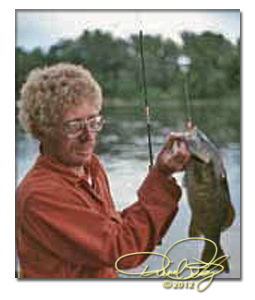
DRO-MaxBass-Dave
Me and Max years ago;  I no longer lip-lift or gill-lift fish to avoid possible injury
photo courtesy Dave Richey Outdoors ©2012
TUSCOLA, Mich. – Tucked down deep in a smooth run near a tangle of tree roots on the Cass River was a smallmouth bass – a special fish, because he was an old friend.

Mind you, when we first met, the fish was just a feisty one-pounder. He was all a’glitter with greenish-brown scales, a hint of red in his eye and the built-in temperament of a barroom bully with a belly full of bad brew.

He liked to scrap, and, like some fighters, he always seemed to lose. After two years of striking a variety of lures that hung from his lip when belly-lifted from the water, I named him Max, which seemed the proper name for a born fighter.

We had numerous dust-ups over a few years.


We were buddies years ago, and it’s been a long time since I thought about him.  This year’s bass opener brought him to mind, the same way we recall other old friends.

Max had a split in his dorsal fin, and was easily recognized/ He would come out and play each time I floated the Cass River, and once we finished our little fight, I would release him back to his favorite haunt. A little tired, perhaps, but losing a fight never seemed to bother the bronze-back – he’d be there, ready and eager to scrap each tune I  came into his life.

Max would come out to play whenever I canoed that section of river. I returned him each time he was landed, knowing he’d be there again whenever I returned. Few people ever fished that stretch of river because of all the uprooted trees across the river. One had to work hard to get through that section of river, but I always returned for another fight and he was most accommodating.

Max lived under a submerged root-wad in the Cass River


An old weathered maple had toppled into the river where he lived. The submerged root-wad offered him the security any fish needed to survive. The river poured over the roots, and the bass grabbed any lure, minnow or other morsel.

His only failing was that he was too easy. I never caught another smallie in that location, just my old buddy.
Three summers passed, and with two or three trips each summer on the river. I guess he was whipped by me a dozen times. Each time we tested the others’ mettle, and Max was getting bigger and more pugnacious.

I soon gave up lip-lifting him because I was concerned that such a method may break his mouth, and prevent him from eating, even though he could easily swim away. (See drawing.)

It was during the fourth season that I felt Max had become a solid four-pounder, but I couldn’t find him.. The canoe was eased into a small back-eddy of moving water, and I arched a cast into the new spot and the Beetle Spin came back without a strike.

The lure was changed, and several more casts were made without a strike.. He just wasn’t there.

It came time to analyze the situation. The area where Max had called home had changed during spring’s high water. Sand and silt had built up in the spot he’d called home, and either he left for another location or he had been caught and kept.

My spirits soared as the canoe was eased downstream 20 yards to another hole that was not sand and silted in. The canoe was tethered again to an overhanging tree limb. Ah, just right for an easy cast to his suspected new home.

The lure twinkled downstream with the current, bumping against some bottom debris, and stopped with a sudden jolt. A fish had sucker punched the lure, and I snapped the rod tip up to set the hook. A bundle of fishy dynamite known as a smallmouth bass, brook the river current with an explosive leap.

The bass cleared four feet of water in a head-to-tail jump


The split dorsal fin was easily seen, and Max now was red-eyed and wild as he surged downstream before skippering into the air again with another jump. He dove for bottom and tried to drive his way back into the submerged debris.

The six-pound monofilament hummed under the strain, and judging from his appearance, he had wintered well. He was a robust four pounds, and any stream smallie that size is a genuine trophy.

We settled into a bare-knuckle scrap. I’d give a bit; Max would take line and then falter slightly, and I’d press the advantage.

It was give-and-take as the battle seesawed for five minutes before Max began fining slowly, just out of reach. He was tired, and he knew he was whipped as I belly lifted him from the water.

He seemed to glare balefully as the hook was worried from his jaw. I held him for an instant, and briefly admired his sleek form. Then planted a smooch on his nose before lowering him into the river.

“Goodbye, old friend, and good luck,” I said as I gave him his freedom.  He whirled in the water, splashed a final salute with his tail and was gone.

I never saw Max again. I heard later that summer that a local kid had caught a five-pound smallie from the river. Was it Max? Who knows, but I never saw that bass with the split dorsal fin again.

I floated the river again a few years ago, and caught a two-pounder, which was belly-lifted while supported in the water and released. I named him Max, Jr.

Maybe I’ll try for him again this summer. He may like to come out and play.
-----
Read: Lip Grip is OUT! , an informative article from the O'fieldstream Journal about the dangers of the old-time Lip Grip. Plus, O'fieldstream provides solid advice to insure the bass you release has a far greater chance of surviving to live and fight again.