Showing posts with label death. Show all posts

Monday, August 20, 2012

Savor the memories of those now gone

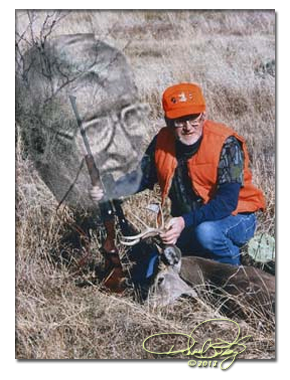
DRO - George Richey, fondly remembered
George Richey with a nice Texas whitetail and a ghostly image
photo courtesy Dave Richey Outdoors ©2012
A number of people who have been near and dear to me may have taken life for granted at one time or another. Most of them, in the final days of their life, realized their mistake.

In other situations, some of us don't take things for granted, but life can still step up and blind-side us.

None of us are infallible, and none of us are invincible, no matter how strongly we believe it. Life can begin and end on a moment's notice.


The death of a person can come suddenly; without notice


My life has been blessed in so many ways, and I took my vision for granted until I began losing it. Now, every day is a precious commodity to be wisely considered and lived with a fervent passion.

The problem is that none of us know how much time we have to live. My father, who died of old age, had prostate cancer for years. It didn't kill him but 94 years of life did.

Twin brother George lived life to its fullest. He did nearly everything in life he really wanted to, and learned one Saturday that he had incurable cancer and he died the following Wednesday.

He didn't go to his Maker kicking and screaming. Hours before he passed away, he told me: "I have no regrets. I've lived a good life, and now I'm ready to go."


Life is meant to be lived to its fullest; Death is permanent


A good friend of mine died two days later in Oregon. He had made it through perhaps ten years in a wheelchair, and died after having lived a full life before a stroke kept him from walking.

Brother George had seven different kinds of cancer, and his pain levels were mild compared to that of others. Why does this happen? Why do so many people die of this disease in agonizing misery while others have an occasional ache or twinge of pain?

My aunt, who died years ago at the age of 84, was a very religious woman. She never smoked or drank, but battled cancer for many years. She attended church two or three times a week, and still the disease finally wore her down.

My first wife died at the age of 40 from cancer. She didn't visit the doctor as often as she should have, but no one deserves such a painful and undignified death.

Three good friends died early. Two had families, but died of self-inflicted gun-shot wounds. Only one was physically ill, and he had inoperable cancer and chose his own time of death.


I talked with him three days before his death


All of these people, with the exception of the two suicides, had cancer. It wreaked havoc on their bodies, and in the end, the pain and the debilitating effects of chemotherapy and radiation probably hastened their demise.

My good childhood friend Fred Houghton died quietly. He loved to fish for walleyes and yellow perch on Saginaw Bay, was married the second time about four years before his death, and kept himself in great shape.

Physical conditioning doesn't bar the way to cancer. It can come calling, as it did with him, and now my old friend is gone. I remember many fishing days from when we both went to Clio High School, and we spent many days over many years hunting ducks and geese.

He lived a good life, retired fairly early, and had everything going his way except for a cancer he didn't know about until it required surgery. He was pronounced cancer-free, as he told me several months before his death, but the disease took him from us all too soon.

I attended a birthday party for a friend who just turned 90 years old. I've thought about him and another 90-year-old friend all day, remembering their contributions to my success as a photographer and writer. One man died 30 minutes after me and my wife visited him.

I remember while duck hunting on Wigwam Bay near Standish in the late 1950s, when brother George and I were hunting from a sneak boat. My childhood buddy was hunting in the cattails, got cold and tried to climb into our boat.

It didn't work, and the boat finally sank beneath the waves as he tried to clamber aboard. I was the only one without waders (who knows why) but I went down with the ship, and got soaking wet and cold during an early November storm.

My buddy always had a much different version of that story, and we argued long and hard about the merits of his or my version. But the boat went down, and in a good-natured way, I always told him it was his fault. He blamed me, and we both had a good laugh about me getting wet.

That story, now that he is gone, was part of the glue that held us together as friends for over 60 years. As is so true with all of us, one day we will all have run our race.

Fred's race sadly ended early, and I shall cherish his memory and that of my brother and father. He was a good man, a kind and considerate friend, and cancer took him much too early.


Ted Trueblood was an outdoor writer of note and a wise man


I will miss my dear friends, family and relatives, even a man named Ted Trueblood, who was one of my childhood heroes as a kid. I found myself in Boise, Idaho one day, and on impulse, looked in the phone book. There was Trueblood's name and number, and I called him.

He was affable, but told me he could only talk for a few minutes because he had cancer, and had to take pills for the pain. We talked for about 30 minutes, and he knew who I was. We chatted about outdoor writing until he had to sign off. A few days later I read where he had died suddenly. I think of him often, and wonder why some people must die of dreaded diseases.

All of these people, both relative and friends, are now gone, and those of us who remain behind, are stuck with good and sad memories. So I enjoy them as memories are meant to be cherished, with great fondness, and leave the sadness behind where it belongs.

Wednesday, February 01, 2012

Michigan's deer herd has had an easy winter

This snow isn’t too deep for deer; belly-deep snow exhausts the animals

deerinsnow
A study of deer facts can make anyone a better bow, muzzleloader, rifle or shotgun hunter. Here are some things to bone up on during the off-season.

A deer's home range is the area that annually covered by deer while eating, mating, resting or caring for fawns after birth. The radius of a home range usually is less than a mile in diameter.

Home ranges often are elongated, and may decrease in size as animal populations increase. One exception occurs during the rut when a dominant buck travels widely. A buck's home range decreases in size as the animal grows older or as the local deer population increases.

The theory of migrating whitetails was once ignored by wildlife biologists, but too much evidence exists of migratory patterns in northern ranges, especially during a severe winter. A case in point are whitetails along the Lake Superior drainage system once fall weather starts acting like winter.

Deer do migrate in some parts of the state

In a bad winter (which can coincides with the firearm deer season), deer may travel many miles to find shelter and food. If deep snow falls during the hunting season, look for migration trails that will cross state highways and back roads into heavy conifers or other dense yarding areas. Migrations from the Lake Superior shoreline gains strength as snow piles up, and deer move into huge yarding areas like the Hulbert or Tahquamenon swamps near Newberry, Michigan. during bad winters.

Such has not really been the case in many areas,. Most of Michigan this winter has dealt with little snow. Near Traverse City,  for instance, we often have 80-100 inches of snow by New Year's Day and it just keeps piling through February and March.

The last I knew, about a week ago, the area had received about 25 of snow, and then it melts and disappears.

Deer in southern counties seldom yard up because of severe weather, but such is not true in northern areas. Once snow reaches a depth of 12 or more inches, and cold winds howl, deer head for yarding areas by the most direct route.

Deer yards are often in thick cover with thermal conditions

They choose evergreens (balsam, cedar and pine) where cold, snow and wind have less impact on them, and the dense cover provides some thermal protection against body heat loss. In Michigan, deer-yard confinement is considered to be 20 weeks during a bad winter and 12-14 weeks in milder weather.

Some deer movement is normal except in severe conditions

Deer often bed in thick brushy cover during the day and near feeding areas in the evening. During snowy winter months, deer may venture from a deer yard briefly to feed but return to its confines during the coldest parts of the day or night or whenever snow becomes too deep for easy travel.

Deer require up to one bushel of browse daily to survive the winter. A matriarch doe often leads groups of three to five animals to feeding areas, but if weather is severe and browse is in short supply, does will kick fawns away before they can eat. This is one reason why deer mortality among young-of-the-year deer is very high in bad weather.

A dominant buck will lose 25-30 percent of its body weight during the rut, and that weight must be regained before heavy snows fall or it will likely perish.

Falling temperatures often put deer on the move. However, the reverse is also true in Michigan's northern areas during winter months. The colder the temperature during November and December, the more deer will move to stay warm.

Deer activity decreases in high winds and heavy snow storms. During lengthy snows, deer may be inactive for up to three or four days with very cold temperature says, and will move heavily once a storm passes through. That's the time to go hunting if the season is still open.

Watch the weather forecasts, and see what the 24-hour forecast will be. Hunting is often good immediately before a storm front moves in providing it brings a sudden drop in temperature. If a major winter storm is predicted, it might pay to be afield earlier in the day than normal to take advantage of a whitetails predictable feeding patterns.

An active scrape features a strong urine smell, hoof prints and antler tine marks. Hunt 30-40 yards downwind of an active deer scrape during the first three days of the firearms season. Most but not all scrape activity has ended by the firearm season opener as the rut winds down.
Those does are ready to be bred, and this knowledge can help a hunter fill a buck or doe tag.

Food choices are widespread among whitetails. They favor natural browse and farm-grown crops, and some deer researchers believe Michigan's deer are fairly divided between natural browse and farm crops.

Acorns rate high in nutrition and are easily found during the fall if the mast crop is good, but some years oak mast fails. Most of the state's corn fields have been picked except in southern counties, but a standing corn field will attract deer all winter if it is near heavy bedding cover.

Does often stomp their fawns to death during a bad winter. It's a bad thing to watch, but it's nature's way of allow the strong to survive and the weak animal eventually waste away with no marrow in their bones and a fuzzy face. That's when the coyotes come calling, and a deer yard takes on the appearance of an abattoir.

Wednesday, October 19, 2011

Remembering my father


Jack Duffy (left) lands a 10-pound brown for Dad.


Oct. 13 is a hard day to remember and a very tough one to forget. Ninety-nine years ago last week, my father was born, kicking and screaming, into an era filled with world turmoil.
Germany was fighting much of Europe when Dad came squalling into this world. Money was tight, and his father, David J. Richey, my namesake, owned a cigar making business and a barbershop in Flint, Michigan. He also owned a pool room behind the barbershop which he ruled with an iron fist.

Things were far more more raw in those days than now, and Gramps carried two .32 pistols in his pockets. He was born with a bad case of club feet, and one leg was several inches shorter than the other. He made do with his disability, and many people gave my grandpa a wide berth although he wasn't a physically intimidating man.

Gramps had problems, and didn't suffer fools well.


People who knew my Gran'pa knew he didn't take any guff from anyone.  He'd had maore than his share of problems, and anyone who caused him any grief paid deadly.

Pool cues were effective when a fight threatened to destroy Gramps' business. He'd crack heads and take names later.

Dad grew into the barber business naturally. He began cutting hair for his father in 1926 when he was 14 years old, and kept his barber license going for over 60 years.

Dad shared Grandpa's disdain for foolish-acting people.


There is a bit of feistiness in Clan Richey, and Dad was no stranger to it. Clio, where we lived in the 1940s and 1950s, had some Ku Klux Klan members. I remember one summer in the late 1940s when 50 or more white-robed and hooded Klansmen marched through downtown Clio on their way to a nearby cross burning.

"Damn bunch of foolish people," Dad said, his scissors clicking rapidly as he stared angrily at the hooded night riders. "They are a terrible waste of skin."

He spoke out, and no one ever faced him and demanded a retraction of his statement. Had someone tried, my father probably would have stuck their head in a used spittoon.

He fished and hunted some, and seemed to enjoy it when he went out with brother George or I. But the outdoors had been tempered out of him by the need to work six days a week to put food on the table and to raise twin boys.

His age and dementia combined to take my father away.


Dad lived a good life -- all 94 years of it -- but at the end he found little enjoyment in his last six months of life. He lived here with Kay and I for five years, and during that period he was as happy as anyone can be under such circumstances.

"I'd like to live to be 100 years old," he would say at least once a week. "It would be a lot better if I could still drive my car. Sure do miss that car."

Dad suffered terribly from dementia, and I don't know anyone who can sit and silently watch a loved one slowly lose their mind and whatever dignity that might remain of their life without being mentally scarred as well.

We would quiz him to keep his mind as nimble as the years would allow, and some of his answers were bang-on while many missed the mark. One day he would be as sharp as a brand new tack, and the next it was doubtful he knew us.

But, for the most part, he knew us and knew we were laboring on his behalf. I'd tell him jokes that he had heard many times before, and each time he would laugh and roar as if he had never heard them before.

One night, perhaps two weeks before his death, he was frightened and we sat on his bed, held him close, told him that we loved him, and soon he would settle down. There I was, both flanks on the edge of his bed in the darkened bedroom, when out of nowhere came a large bony fist that connected with my shoulder and knocked me to the floor.

"Hey, Pop, why did you hit me?" I asked. He muttered something under his breath that I didn't understand as he continued to talk to Kay. I sat back down on the bed but made certain I was out of the range of his flailing fist.

I casually mentioned it the next day, and he was shocked that he had hit me. I never spoke of it to him again, and hadn't thought about it again until now. That is the problem of this accursed disease; those who are affected forget, and those who survive, live on with good and bad memories.

Dad passed away on Oct. 13, 2006 in his sleep. The funeral home in Clio sent a hearse to Traverse City, picked up my father, and the driver asked if I wanted his face covered.

"Hell, no," I said. "He knows where he has been and maybe he would like to see where he is going. After 94 years, he deserves the opportunity to travel to his just rewards in the best possible manner and with the greatest dignity. There is no dignity in traveling anywhere with one's face covered."

And so he rode to Clio, hopefully gazing out the hearse window, and seeing for the last time our family home and the site of his beloved barbershop. And hopefully, twin brother George was there to help guide him home.

It's been just over five years since Dad passed, and I hope he knows we truly miss him and think of him every day.