Showing posts with label archery. Show all posts

Tuesday, August 13, 2013

Grunt Up a Buck


You might have missed this chance, but with a
well-placed call, you stopped him dead-in-his-tracks
and in your sights.

The 8-pointer was slowly making his way along the edge of a thick tag alder run, and was crosswind to me. I gave one short, and one slightly longer grunt. Both were rather obnoxious sounding.

Not to the buck, though. He stopped in his tracks, swiveled his head in my direction, and slowly turned in my direction. There is only one big-time rule to follow when using a grunt call for deer.

If the buck heads in your direction, don't call again. If the animal comes 50 or 100 yards, stops and looks around, turn your head away from the deer, and give one soft and muffled call. The buck is looking for a direction, and you can say "Over Here" with one grunt. Put the call away and get ready for a shot.

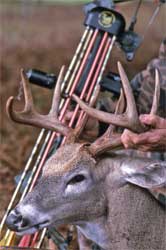
On came the deer, and he swaggered to within eight yards, and stopped. He milled around for a minute or so, snuffling the air, and then turned broadside. My First Cut 90-grain broadhead took him behind the front shoulder and exited the brisket. He went 40 yards and folded up.

I've used calls on coyotes, deer, ducks, elk, foxes, geese and wild turkeys. If any one thing holds true, it is that animals and birds can determine almost exactly where the call is coming from.

I've used many calls from a tree until three years ago. I've used all types of deer calls including those made by A-Way, Knight & Hale, Primos, Stratton Game Calls, Woods-Wise and many others.

One problem I've always had is that I know deer and other critters can pinpoint a call's location. Who has ever seen a deer calling from an elevation position. I haven't.

H&M Archery Products of Willis, Michigan. has a novel call that I've been using for three years. Their philosophy is that deer don't climb trees so why should a hunter call from a tree.

They produce a call with a 14-foot length of coil-kink resistant rubber latex tubing that another 12-foot length of tubing can be attached to, and a hunter can sit 15 feet up a tree and lay out the other 11 feet of rubber tubing, and call from a tree but the grunt comes from ground level where it sounds most natural.

Any condensation occurs in the tubing, not in the call. This helps eliminate freeze-up in cold weather.

I began with the 14-foot length but soon added another 12-foot length that allows the call to be places off to one side of the tree where an investigating buck will be properly positioned for a shot.

The nice thing is this tubing arrangement will fit most tube-type calls. It puts the sound at ground level where it is most effective.

Many hunters blow a sequence of grunts that is much too long. I keep my grunts short, pause and grunt again for several seconds, and then stop. Ten minutes later try calling again.

There are many different types of deer vocalizations but the grunt call works well. I've had no success with a fawn bleat, and only minimal success with a doe bleat.

One thing that works is to grunt if you see a buck. I've called in numerous bucks that were unseen, but calling works well on visible bucks. It gives hunters a chance to judge the deer's reaction to the call, but if they stop coming, muffle the call and grunt softly one more time. If they keep coming, do nothing but get ready to draw and shoot.

One of the most exciting things about deer hunting is grunting in a good buck. The noises that come out of an inhale, exhale or inhale-exhale call may sound like your hunting buddy in camp after a plate of refried beans, but the grunt call works.

As is true with everything else about bow hunting whitetail bucks, nothing is 100 percent except for Uncle Sam tapping you for a yearly donation and that someday you will pass on to your just rewards. That said, grunt in a good buck and if he charges in with his neck hairs standing up, you will be a convert.

Trust me, it works ... on a fairly regular basis.

Tuesday, August 16, 2011

Bow Quivers ... On Or Off

Bow quiver on when shot is taken. Replace quiver after the shot.


Life is about making personal choices and decisions. None of us must do everything as others do. We can dare to be different if we choose.

This blog post applies to bow hunters. Every stick and string hunter worthy of the name has his or her way of doing things, and often they turn out right. We all learn from our best teacher, experience.

Bow quivers are a case in point. Should hunters leave the quiver on the bow while sitting in a stand and shooting or should they take the quiver off to minimize weight and to remove one unnecessary item that could easily tangle in tree limbs and mess up a shot?

Hunters swing both ways on bow quivers but not me.


I'll go first, and throw my hat in the ring and voice my opinion. I climb into a tree stand after attaching my full-body safety harness to the tree and my body, I sit down, and use the haul rope to raise my bow from ground level. The bow quiver is then removed and placed elsewhere on the tree after an arrow is removed and then nocked. I often hang the quiver on a nearby limb where it will help break up my silhouette but be out of my way.

Once the quiver in hung, I unscrew the broadhead and attach my Game Tracer string behind the 100-grain FirstCut broadhead, and screw it into my Maxima carbon arrow shaft.

I attach the release to the bow string, stuff the lower limb of my C.P. Oneida Black Eagle bow into my left boot, and relax. I hunt and shoot sitting down, and my stands are positioned so bucks usually come from behind me and on my left side.

I shoot sitting down, and stow my bottom limb in my rubber boot.

If the buck follows his normal pattern, he will approach from behind and on my left side. I'm right-handed, so when the buck comes within bow range, and looks the other way, I start my draw and as I reach full draw, the lower limb clears my boot and is clear of my leg, the stand or any tree branches.

This allows for a minimum of movement, is very quiet, and oh so effective once a hunter becomes used to it. This method of drawing a bow wouldn't be possible if my bow quiver was still attached.

The arrow shafts, vanes or even the quiver could get caught up in clothing, limbs or branches. But there is another reason why my quiver comes off my bow when I begin hunting.

It reduces the overall bow weight. Not much, mind you, but when hunting in a variety of locations, sooner or later a bow quiver is going to hang up on something. I remove all possibilities of that happening by taking it off and hanging it some place where it is out of my way.

I want my bow in my hands at all times with my release on the string.


Whenever I watch a television show, or hunt with someone who always leaves his or her quiver on their bow, it makes me wonder how many lost opportunities have occurred because of that quiver.

A bow is a one-shot piece of archery equipment. It's not like hunting with a bolt, pump or semi-automatic firearm. Unless the wind is very strong and noisy, second shots at a buck are so rare as to almost be nonexistent.

A bow quiver on a bow, doesn't speed up getting off a second shot at a deer. It is somewhat awkward to reach to the quiver, pull out another arrow, reach across the bow to nock the arrow and prepare to shoot. Chances are, any self-respecting buck with heavy headgear will be long gone if you miss the first shot.

I often use my bow to help camouflage my upper body and head. I wear a face mask while hunting, and can still turn the bow inside my left boot so the handle and upper limb breaks up my silhouette. If a deer offers a shot, a simple and slow half-turn of the wrist will point the bow toward the animal as the hunter comes to full draw.

A full draw should make your bow and arrow unencumbered by anything.


Such a movement may or may not be necessary, and that is a debatable point, but it would be impossible to do with a bow quiver attached. For me, that is a strong reason for removing the quiver.

Whenever I watch outdoor TV shows, each person is checked to determine if their quiver is on or off. It seems quite evenly divided as to their preference. Those who stand all the time usually have the quiver on while those who sit to shoot take the quiver off.

Many hunters, including some of the television hunters, hang their bow. A deer approaches, and they risk being caught by a sharp-eyed deer. Me, my preference is to hold my bow where there wasted movements that could spook the animal. Holding a bow with quiver attached becomes just too awkward to hold during the hunt.

The slight added weight of a bow quiver (even a three-arrow quiver like I use) can allow a hunter to unknowingly cant the bow to that side. Is it enough, under the pressure of a nearby buck, to throw the arrow off its intended course?

I don't know and don't care to test the theory. My preference is to shoot a bow unencumbered by a quiver. It's my thought that it simplifies things, reduces weight, eliminates canting, drops a few ounces of weight and besides ... it works for me.

Anyone willing to plead their case for keeping a bow quiver on a bow while hunting is encouraged to contact me. You won't change your mind, I won't change mine, but I'd love to hear your philosophy.