Showing posts with label stand. Show all posts

Friday, August 24, 2012

Start deer scouting soon

DRO_deer scouting success
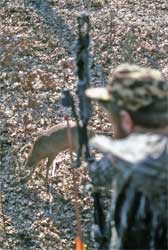
The author with a nice buck he scouted after the season opened
photo courtesy Dave Richey Outdoors ©2012
There is nothing better than putting down boot leather when it comes to learning a new hunting area, and that is what most people do. A few take this "learning-the-land" proposition two steps further.

The use of topographical maps is one key element of learning new land, and aerial photographs is still another. Combine these strategies, and a hunter will have a recipe for possible success.

To properly scout an area, it's vitally important to prevent your scent from drifting downwind to a whitetail bedding area. Play the wind like a fine violin, stay downwind of bedding areas, move through the area while checking ground sign for trails, food areas and bedding spots.


There is just a bit more than a month to scout before the opener


Nothing is 100 percent when it comes to hunting whitetail deer, but having a firm grip on the terrain is very important. There is a quarter-mile field that runs mostly north and south on my land, and through this open field are a series of small rolling hills and dips in the land. Deer have learned to use those tiny valleys and tiny hills to sneak through the open terrain.

Walking such an area is one way to learn how deer travel, and doing it with some snow on the ground is even better. There are places where bucks can enter the field on the west side, and by moving left and right, they can stay down in the dips and out of sight of most hunters.

What I've done is build hunting coops and they are strategically placed so that most of these travel routes can be covered. Deer often move east in the evening and west in the morning, and hunters can place themselves in key positions to waylay the animals as they pass.

However, when hunting strange land that you've never hunted before, topo maps and aerial photographs, when combined with walking the terrain will enable hunters to determine good spots to hunt.


Use time wisely to learn where deer travel; Do it now


Funnels are an absolute deadly spot to hunt. A funnel is created by a narrowing of heavy cover. It can be a brushy fence-row that connects a wood lot and swamp, two wood lots, a wood lot and a pine plantation, and other such thick and narrow places like creek beds where deer movements are funneled through a narrow area. They are natural travel corridors that deer use.

The bases of hills are another hotspot. Often the thicker cover is at the lower elevations, and if there are three hills, only one will be vitally important to hunters. Deer often choose the one that offers the easiest access and exit routes to heavy cover, and they will ignore other nearby hills.

Field corners that border on swampy or wooded areas are great, Again, only one field corner is most likely to produce deer, and again, it is usually the thickest corner that still provides animals with a good view of a distant field.

Saddles or breaks in flat or low-lying areas or ridges that allow easy access to feeding fields are good spots. Such locations may have one good trail that leads from higher ground, down through the saddle, and through swampy or wooded areas that border the crop lands.

Dry or wet creek or river bottoms are especially good because there is a good deal of cover, the possibility of mast crops such as acorns and beech nuts, most bottom land areas are thick with berry bushes and other cover.


Don't ignore aerial maps or topographical maps; They can help


Walking this land is fine, but putting aerial photos and topo maps together enable hunters to obtain a birds-eye view, and the topo maps will show contour changes. Most topo maps have contour lines and special colors or symbols that indicate hills, wooded areas, swamps, creek or river beds and much more.

Spot the funnels, saddles and other topographical features, find their relationship to the aerial maps, and plot the best method of moving into these areas to hunt. Find such key locations, determine the bedding and feeding areas, and then begin scouting for active deer sign.

Locate the food source, and then find the bedding area, and the trails deer use will be relatively easy to find. Determine the prevailing wind direction, and start looking for good trees for a stand.

Finding hotspots in new areas isn't terribly difficult but it requires some scouting time. Most of all, carry a compass or GPS, and know how to use them. Finding such out-of-the-way areas, where other people seldom hunt, and you'll have your own little gold mine for deer.

Thursday, October 20, 2011

In the air or on the ground?

On the ground or in the air. Both work & it depends on you.


It's an eternal question that is always being contemplated by bow hunters. Which is best: hunting on the ground or up in an elevated coop or tree stand.

An elevated coop or a tree stand wins me over every time. I like the increased visibility that hunting from a tree provides, and I'm not bothered by height except in a high wind. After many years of experience, my preference is for a stand at about 15 feet. Going higher can increase the chance of a fatal fall.

Many hunters prefer hunting from a cedar or pine tree, and if I have a choice, it's one or the other for me. However, I often hunt from maple trees. There are a lot of maples on my property, and my first decision is where is the best stand location?

Personal preference plays a big role on how you bow hunt for deer.


If a cedar or pine offers the best spot to ambush a moving buck, that's where I will hunt. However, if the key area to ambush a whitetail is from a maple tree, you'll find me up one of them. Trees make little difference to me but location, as with real estate, is everything.

Some stands are permanent wood platforms and others are more confined. Some are ladder stands, and others are fixed-position stands that I reach by going up limbs or tree steps. It makes little difference to me: I go where the deer want to go.

It doesn't take much room to shoot a deer from a tree providing the stand is properly positioned and downwind of the deer travel route. The trees on my land are there to provide possible stand locations, and although it's not legal on state or federal land, I nail or use sturdy screws to hold my permanent tree stands in place.

I have a few places where a big stand isn't feasible, and some of them are no more than two halves of a sheet of marine plywood painted gray or dark brown. A narrow platform just big enough to sit down on is nailed to the tree, the two side panels are nailed or screwed into place and a narrow piece of plywood serves as a roof. These stands are narrow at the end where people enter the stand and slightly wider where they will sit or stand to shoot.

Deer seldom pay attention to them, and they are very productive if the hunter can sit still. They are not made for a claustrophobic person, however.


All of my stands, at home and elsewhere that I hunt, are strategically placed, and some designs are unlike any I've seen before. Some stand outside in the rain and snow, and we check them two or three times each year to determine if they are still reliable and safe.

Any stand that is no longer safe is torn down. I'm not a risk-taker, and if I won't hunt from a stand, no one else will hunt there. Such stands are quickly slated for demolition.

Take down any unsafe tree stand.


Hunting from a tree stand appeals to me. It's possible to see deer come from many different routes, and it allows hunters to study the animals as they approach the area. Some deer dash right in, others come cautiously and slow, and a few wise old does and big bucks often try to slip in on the downwind side to check for potential danger.

Some hunters dislike shooting down at an angle toward a deer. It is a part of hunting that must be practiced, and years ago, I would get with someone else and take turns on the ground. One would position a target at varying distances and angles, and the person in the tree would shoot a dozen arrows. He would climb down and we would change jobs. Frequent practice at shooting from a tree stand makes handling these shots as routine as ground-level shots.

Tell your friends, neighbors and relatives about my weblog. I plan to do this for a long time, and am willing to share my knowledge of what works and why it works for me. Do them a favor and give them my weblog address.

I'm a realist. Ground blind hunting can be very productive, especially in places where almost everyone hunts from a tree. I've preached the use of safety harnesses when hunting from an elevated position, but there are still people who feel wearing a "sissy" harness isn't for them. A doctor friend of my buddy learned a sad lesson this fall he fell and broke both legs, and was very luck it wasn't his back or neck.

Let's face it: some people are NOT meant to hunt from high places.


For such people, it's my personal recommendation to hunt from a ground blind. Believe me, I've been in and out of ground blinds and pit blinds all of my life, and have yet to see anyone get busted up by falling out of a ground blind.

Use the same logic when choosing a ground blind location. The proper spot is everything, and it must be downwind of where deer travel. It's possible to make a ground blind almost air-tight by installing slide-open windows. The glass can be covered with camo cloth or painted to eliminate the shine, and a motionless hunter is nearly impossible to see when sitting in a darkened hunting coop with the walls painted dark brown or black.

I favor ground blinds in windy weather or when it is cold, rainy or snowing. Properly positioned, a ground blind can blend in with root-wads of fallen trees, against a backdrop of standing corn or in an oak forest.

Everyone has their own likes or dislikes. Whether you hunt from a tree or from the ground, just remember to have the wind in your face, don't move until its time to shoot, and when you shoot, shoot once and shoot straight. And don't miss.

Saturday, July 30, 2011

How to approach your hunting stand without spooking deer


A truck is the best way to approach a blind. Truck drops off and picks up hunters.


OK, folks, which is the best way to walk to your deer-hunting stand? Skulk along like you are trying to sneak up on the deer or just walk straight-forward without trying to sneak from one tree to the next?

In this country, opinions are like elbows: everyone has at least one. You may disagree with my thoughts, and I may take issue with yours, but we should each respect the other for the right to speak up for their choice.

My vote goes to grabbing the bow and walking directly to the blind. Climb into it, settle down, get ready for deer activity, and it seems to work for me. A deer that may observe me walking along, and ducking into a blind, isn't frightened by my actions. I do nothing to frighten the animal.

Walk with head up, don't look at deep, and don't appear to be sneaking along.


The deer may circle the area, pick up a tiny bit of scent, but not enough to spook them. It goes on about its business without being unduly alarmed. People on foot are common in the deer woods.

A sneaking or skulking hunter, one who tiptoes toward the hunting blind while darting from bush to bush, attracts far more attention from deer. An upright man may cause deer to run off 50 yards and stop in heavy cover to see what happens, and when nothing does, their fear disappears.

A hunter that acts suspicious, and causes deer to become alarmed, do themselves more harm than anything else. They literally drive deer away by their actions.

The sportsman who wishes to reach his blind as quickly as possible, should walk steadily (don't run or sneak), and when he reaches the ground blind, elevated coop or tree stand, should get into position with a minimum amount of noise, sit down and sit still.

Once the hunter reaches his hunting area without incident, disappears from sight into the blind or stand, he is soon forgotten. They don't seem to pose any danger to the deer, and the animals soon revert back to normal feeding patterns.

Climb into position in a tree or open the door to a ground blind. Don't make noise.


A moving pickup truck is always studied by nearby deer, and as long as it moves along steadily and the people inside stay inside when the truck stops, it doesn't unduly frighten the animals.

There are times when a truck can pull up to a blind, a hunter can ease out and get into the stand, and then the truck pulls away. Deer can't count. The truck pulls in, stops for a half-minute, and then moves on. Just don't slam the truck door or make noise getting your gear out of the truck bed.

People may think getting into a stand scares deer. It doesn't as long as everything acts natural and there are no loud and unexpected noises. It's noise that deer might hear a hunter make from inside the blind or from a tree stand that will drive deer crazy. An unexpected sneeze or a cough will trigger the alarm button.

Moving directly to the stand in a normal walking pace is the best way to get there. It's the straight-line rule between two points that is important; providing the sportsman doesn't have to walk through a bedding area.


If deer are seen on the way to the stand, don't stop to look at them, but keep moving forward without breaking stride. Hunters who stop to look at the deer will cause them to snort and alert all other deer in the area.

Ignore any deer and walk at a normal pace to the blind.


A person who ignores the deer and walks at a steady pace to his blind often cause the deer to bound away but they usually do not snort and spook.

This year, just to prove it to yourself, try walking right along without lifting your head or stopping to look at deer, and climb into the stand and sit still. If that doesn't convince you, try sneaking from bush to bush and tree to tree, stopping frequently, and skulking about, and see how often you get snorted at.

You'll soon learn what works best and what does not. It takes many things coming together to make a deer hunt end with a shot at a good buck.

It makes little sense to do anything that may draw attention to your presence on stand. Just walking steadily to a blind makes a great deal of sense to me.

Tuesday, December 28, 2010

Safe tree stand hunting


The CDS system described below works and I feel safe in tree stands.


It’s time to share a bit of my past, present and future. I’m a tree stand hunter, and I’m really not afraid of falling from a tree stand but now I’m ready if it does happen.

Where my one greatest fear exists is falling and really hurting myself. I’ve broken my back twice in falls that were not associated with tree stands, but  what terrifies me is the thought of falling and becoming a paraplegic or a quadriplegic. I’m afraid to see my deer hunting come to an end because of a mistake.

A short history on my four falls from a tree stand.


I’’ve fallen four times from a tree, and all were all at least 10 years ago. While bow hunting in the December cold, i was coming down a ladder and cold hands and feet caused me to lose my balance. The snow was deep, and I jumped, landed, rolled in the snow and was not hurt.

The next time I took another hunter’s word about a tree stand. He said it and the steps nailed to a tree on private property were safe. I passed up a nice buck that evening, and at the end of shooting time, I began climbing down. One step broke beneath my feet, and I plunged through the second step, and pushed away from the tree. I fell 10 feet but wasn’t injured,

The third time I was climbing down from a ladder stand. I don’t know what happened, but I busted down through cedar branches and hit the ground hard, I was badly shaken but again, managed to escape serious injury. The last time was while climbing up into an elevated box blind, and who knows what happened. I don’t know, but me and the ladder came unglued.

Now, at the age of 71, I still love tree stand hunting for whitetails. However, I’ve come full circle when it comes to personal safety this year. The older we get, the more brittle our bones become and I don’t see how I could survive breaking my back again and become paralyzed for life. That thought brought on my fear of falling.

I spent a lot of time last winter studying safety harnesses, and this past winter I contacted the folks from Mountaineer Sports in Keyser, West Virginia.  Go to <www.mountaineer-sports.com>, and inquire about trademarked Rescue One ‘CDS.’ They also can be reached at (304) 298-4343.

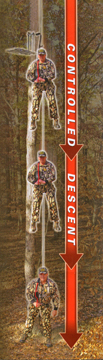
The instructions for the safety harness and other gear are lengthy but not terribly complicated, and a CD helps a hunter work through the various steps. This easy-to-use system allows safe, controlled descent to the ground from heights up to 30 feet. The super-strong light-weight harness is easy to put on, to adjust and to install on any tree.

Follow the detailed instructs rather than the abbreviated ones here.


The low-profile, OSHA approved dual lock, netal safety buckles and special shock absorbing system lessens shock if one does fall. In a fall, it keeps a hunter in an upright position, and it comes with an attached Reserve Suspension Relief Strap, lineman’s safety rope and a tree stand anchor strap.

The Rescue One ‘CDS’ (controlled descent system) personnel feel that tree stand accidents occur when climbing up to a stand, getting into or out of the stand, and while climbing down. And, as I can swear to, accidents do can and happen. It’s not so much whether an accident will happen but when, and that means that hunter should be fully protect from the ground to the stand and back down again ... every time.

Now is as good a time to discuss suspension trauma as any. Make no mistake: you can fall from a tree, and if left suspended without adequate means of regaining access to the stand or the ground within a few short minutes, blood will collect in your legs and feet, hampering circulation, and death can occur. Few harnesses manufacturers want to warn hunters of this danger. A rapid decline in blood pressure results, and in as little as five minutes, a person could lost consciousness or die.

This safety harness that I’ve worn all season has a Reserve Suspension Relief Strap  to allow the user to use a foot loop in which to stand to eliminate blood pooling in the legs. This strap is  used to allow the hunter to stand upright during a controlled descent to the ground. The Protector full-body harness system prevents you from hitting the ground during a fall.

The harness may be worn over or under clothing. There are dual lock safety buckles on both leg straps, and across the chest and waist. It includes a Lineman’s Safety Rope with a prussic knot and two carabineers. This rope is placed around the tree, and is attached to a Lineman’s Loop to steady the hunter when climbing up or down the tree or when placing or taking down a stand.

Peace of mind is as simple as using this safety harness while in a tree.


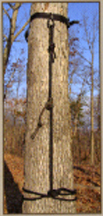
A tree stand anchor strap and carabineer is used to attach the harness tether line loop to the tree. The tree stand ascent and descent safety line with prussic knot provides additional security while climbing into or our of the stand. Thirty feet of soft ½-inch double braided nylon rope has a 5,000-pound breaking strength with a prussic knot made of stiff 8mm prussic cord. Attach the  safety strap to the safety line when climbing up or down. In the event of a fall, the prussic knot grabs the ascent-descent safety line, and the  strap plays out of the harness and insures a safe and slow descent to safety or the ground. Always use a one hand and two feet, or two hands and one foot, means of contact with the tree or stand while climbing.

I used this safety harness and other equipment every time I climbed into any of my tree stands. Going up or coming down was always a concern before, but  it no longer bothers me. I feel safe and secure when I begin climbing up and down, and while sitting in the stand.

There no longer is that gnawing worry about a possible fall. I feel secure, and am secure, and that makes hunting from a tree much easier and safe. It is said that falling from a tree is not a matter of if you fall, but when.

This system keeps you in contact with the tree at all times, and if the manufacturer’s instructions are followed to the letter, you’ll have a safe hunting experience next year.

Posted via email from Dave Richey Outdoors

Monday, November 15, 2010

No deer seen on the firearm opener


A buck like the one on the right was my goal today.


Weather-wise, in the northern Lower Peninsula at least, it was a great firearm deer opener. A bit cool, a bit of morning sleet and snow, a fair number of rapid-fire shots that seldom produce, but for me it was nothing special.

I hunted all day, first in a tree stand and then in a one-man pop-up tent, and never saw a deer. People with crop damage permits put the big hurt on some does, and I only heard of one buck being taken from my circle of friends.

Many of us were looking for something a bit larger than a year-and-a-half-old buck. Most favor a buck with substantial bone on their head, and such bucks are in a minority in the counties I hunt -- Benzie, Grand Traverse, Kalkaska and Wexford. Our doe and buck numbers are low in this region, and it shows little chance of getting better.

The northwest corner of the Lower Peninsula has a shortage of deer.


I hunted hard with Old Faithful -- my pre-1964 Winchester Model 70 in .264 Winchester Magnum. It can, and has on countless occasions, delivered an air-mail 140-grain package to a nice buck. That didn’t happen today although 15 more days of firearm season, more bow hunting and a brief muzzleloader season is on tap for next month. There’s still lots of time for a shot.

There are a number of open fields, cut corn fields and the like in my area. My land is mostly heavily wooded, and most of the morning was spent watching a field between two woodlots, and this strategy has paid off in past years but not this time around. The afternoon was spent hunting a high hill overloooking a thick swale and bedding area.

The thick stuff is usually better for a good buck, but today wasn’t the day for any bucks or does me to see. The deer seemed to be on some state land west of us, and that’s where the heaviest pressure was and the most shooting. This flies in the face of the fact that private land has held more deer than public land for two or three decades. So … maybe it’s  the state-land hunter’s turn to see the most deer.

Is a return to limited baiting on tap for next year. It does draw more hunters.


It’s not my style to go looking for something to argue about, but we are entering our third year of a three-year moratorium on baiting, and many people I speak to are adamant in their desire to return to a limited brand of baiting for those who wish to do so. Hunters have switched around from setting for two hours, and then still-hunting in the past decades. Now, most people are setting in coops and elevated blinds, and they don’t move. With no bait and no moving hunters, there isn’t much to keep the deer up and moving about.

Now a one-man pop-up tent doesn’t offer much room, and the funniest thing that happened to me today was a big header. There I was, in my tiny pop-up stand, and I leaned a bit too far to the right to check out  a run-way 40 yards away. I could tell it when I shifted my weight that everything was going down, and the little tent began to lean, and over we went. I cradbled Old Faithful in my arms like a new-born child, and the landing was soft and easy.

I was laughing about it on the short fall to the ground, and the hardest thing about it was extricating my rifle and body from the twisted-up tent. No injuries, no harm to the rifle or tent, and it felt good to chuckle about my own mishap.

But now the hour is getting late, and I’m beginning to nod off at the keyboard, and that’s never a good thing. So, if you’ll excuse me now, it’s time for a bit of shut-eye.

Z-z-z-z-z-z.

Posted via email from Dave Richey Outdoors

Friday, October 30, 2009

A Hunting Trick Worth Trying

Hunters can do all the preseason scouting they wish. They can have tree stands conveniently placed, and ground blinds in strategic locations, and make every effort to be scent-free while staying downwind from the hunting location.
Still, there are times when bucks just will not cooperate. We can have a nice buck patterned, arrive early because we know the buck is as spooky as a house cat in a dog kennel, and still our best-laid plans can and do go awry.

Bucks can be very unpredictable

Sometimes the bucks won't show up because of something we've done, and there are other occasions when someone else spooks them unwittingly, but the bottom line is that bucks seldom play by our rules.
They play by their own game plan, and until we learn how to crawl inside a buck's head and determine what makes him tick, and do this or that, we must live with the prospects of being foiled again and again by an animal that doesn't show up as we often predict he will. That's another reason why they call this hunting.
Last year I had a nice buck that had been seen using a specific runway through heavy cover. One of the elevated stands was at the far end of the trail and back in thick cover, and my thought was to sit up on him at that location. I eased into the area, climbed up into the stand, and kicked back to relax.
I knew when he moved, and knew where he moved, and he was as regular as a glass of prune juice. Except for that night ...

He took the trail least travelled

He avoided the area like it was the last place on earth he wanted to be. I saw several does and a couple of small bucks, and some fawns, but the big rascal failed to make an appointment. He took a totally different trail out of the beddinh cover.
The next evening, we went through the same procedure, and again he didn't show up. The rut wasn't on yet, but this flaky buck was breaking his habits. I tried a third night, with equally unsuccessful results, and decided to hunt elsewhere.
My new spot produced the sighting of a nice buck, much too far out of range, but that animal captivated my attention for several days before another hunter took him from a different stand. Where to go now?
My decision seemed easy. I planned to go back and try for the other buck. A friend had seen him moving about in that area, and I slipped into the stand noiselessly. The wind was perfect, and again he didn't show up.
My mind usually tells me the buck is bedded down in the immediate area, and has spotted me going to the stand or leaving it. This, I feel, was the answer but how to solve the problem. This could be a test of wills, mine versus his.

A sneaky way in for a hunter

Other stands were hunted for several days, and I finally decided to have a friend drop me off with his truck. My thought was the buck was probably being spooked by me walking in, so why not let the pickup truck do the spooking.
The friend drove me to the stand, and I was up the ladder like a fox squirrel heading for the tree-tops. He puttered around a little bit until I was in the stand and out of sight, and then he slowly drove off down a nearby two-track and the woods settled down to silence.
As the afternoon turned into early evening there were several does, fawns and two or three small bucks moving through. The big buck still hadn't showed up, and I was beginning to think he had moved out of the area and taken up temporary residence elsewhere.
Thirty minutes before sundown, the slanting muted rays of late sunlight were seen glinting off polished white antlers. The deer stood up, moved forward, and stepped into the tiny clearing near the stand. He looked around, especially where the truck had come from and the direction it had gone, and seemed satisfied it was gone.
The animal had been bedded down just 40 yards from the stand. The buck, completely fooled by my arrival by truck, strode confidently out in front of me.
The bow eased back to full draw, and the buck lowered his head to sniff the scent of one of the does, and my arrow slid in behind the shoulder. The buck humped up slightly, kicked his legs back, and ran off.
It was a good hit, I knew, and moments later I walked up to the fallen buck. During the field dressing, I found the heart with a two-blade wound through the center of it. Being hit in the heart often makes deer hump up and kick, and the animals die quickly.
Hunters must recognize that big bucks often bed down near a stand where they can watch hunters come and go. Having another person drop them off, and stay there with the motor running until the hunter is out of sight in the stand, can pay big dividends.
It's a trick I've since used for many years, and this tactic particularly holds true when hunters use bait after snow covers the ground. Bucks and does often bed near the food source, and being dropped off and picked up with a motorized vehicle can work wonders for hunters.
Deer can't count the number of people in a truck or on a four-wheeler. Sometimes it gives hunters an edge and sometimes it doesn't. Nothing works all the time on whitetails, and that is why whitetail deer are such fascinating animals to hunt.