Showing posts with label people. Show all posts

Tuesday, January 24, 2012

Follow hunting and ethical rules and treat non-hunters with courtesy

Two hunters with snowshoe hares and with a U.P. black bear

uphunters
All people are bound by the laws of man to live by a code of ethics, but sportsmen have additional values to be considered if we are to be judged by what we believe are ethical actions.

Hunter ethics are more far reaching than many believe. They include a feeling and a deep appreciation for the animals and birds we hunt, the outdoor environment we and wildlife need and share, and the deep inner stimulation we feel when pursuing our pastime in an ethical, legal and well regulated manner.

This personal ethics policy hinges on those deeply-seated feelings sportsmen must have for the well being and continued health, welfare and habitat improvement of game animals and birds, as well as non-game animals and birds. Hunters must care deeply about what happens to all wildlife, and not just those species for which there is an open or closed hunting season.

Everything in nature serves at least two masters

The habitat that the small Kirtland’s warblers call home is every bit as important to everyone as that used by ducks, geese, pheasants, ruffed grouse, wild turkeys and woodcock.

But hunting ethics go far beyond this simple, yet personal, concept that govern our actions. Michigan laws place additional ethical demands on hunters, making our special-interest outdoor group the most regulated in the state.

Young, beginning hunters no longer can pick up a firearm and head for the woods, fields or marshes without lengthy and well supervised Hunter Education training and parental or other adult supervision. The same rules apply to anyone born on or after Jan. 1, 1960. Any first-time hunter born on or after that date must possess a hunter education certificate to purchase their first hunting license.

They must take a certified Hunter Safety Program, pass a rigorous examination and satisfy qualified instructors on their capability to practice hunting safely without endangering others, themselves and the property of landowners. They must understand the laws that govern their conduct while hunting, and people should be signing up for such classes as soon as they become available prior to next fall. The DNR can provide information on classes.

These training classes teach students how to handle bows and firearms safely, give explanations of wildlife management, teach game laws, and make certain that students understand the laws of safe hunting. These rules are common-sense thoughts that can help keep everyone safe.
All are necessary to obtain an in-depth knowledge of hunter safety, but ethics -- personal ethics -- are almost spiritual inner feelings, something that must come from deep within each individual. They are as much a part of hunting as carrying a firearm or hunting from a tree stand with a bow.

Hunting, and the freedom to hunt, is a part of our American heritage that should be as rich and deep as love of our family and this great country. The American Constitution guarantees us the right to keep and bear arms, but those arms must be used in a civilized and lawful manner.

This constitutional guarantee obligates sportsmen to abide by local, state and federal fish and game laws, and to have respect for themselves, the lives and property of others, and obviously, for the wildlife they pursue.

Recreational hunting is a sound game management policy designed to keep wildlife around in desirable numbers for the enjoyment of future generations of hunters and those who have no desire to hunt but enjoy the recreational value of viewing deer, elk and other game.

No longer is there room for slob hunters and deadbeats in our woods

Hunting satisfies a deep personal need for many people, and it can be a deeply moving experience. But it is as individual as our fingerprints. Each of us who hunts has a different viewpoint on how we should view our days afield.

Ethics, and the feelings hunters have for their sport and the wildlife we hunt, is an emotional package so deeply seated and meaningful that it's difficult to put into words so non-hunters or anti-hunters would understand.

We, as hunters, must develop our own personal code of ethics which goes beyond those laws and rules established by any sporting agency or group. Our sport will be judged by its personal and collective ethics, and the public actions of its many individuals.

Hunting actions and needs require a code of personal ethics to survive ... not only now but well into the future. How hunters behave now will determine whether we will have hunting in the not-so-distant future.

The public acceptance of  hunting and hunters by the public at large is critical  to continuation of our legal hunting pursuits. Act like a slob around non-hunters, and you may find yourself facing rules that shouldn’t be necessary. Idiots don’t deserve the right to hunt or to ruin others chances to spend time outdoors in a legal environment.

Friday, January 28, 2011

Are you a giver or taker?


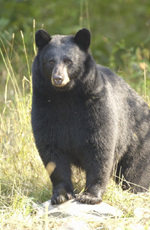
Where wil bear and deer go when there are no more wild places?


Are you a giver or a taker? It's a very simple question that goes far beyond a one-word yes-no answer.

The bottom line here, in the event this question surprises you, is very simple. Do you take more from your fishing or hunting experiences than you give back?

The purchase of a fishing or hunting license grants us no more than a chance to legally fish or hunt or trap in season. It is a privilege but not a guaranteed God-given right.

It promises opportunities, not limit catches or a heavy game bag.


In days of old, when knights were bold, landowners also owned the fish and game. They owned the river water that flowed through their properly, and Heaven help any soft-headed peasant who poached one of the king's red deer stags, a brown trout or an Atlantic salmon.

The population 300 years ago was far less than today, and peasants were kept in their places and ruled with an iron fist. People caught poaching were severely punished, and any fish or game illegally taken was confiscated.

Things are much different these days. We have flowing springs, but bottled-water plants are tapping into the aquifers. They take our ground water but put nothing back. There are developers ready to quickly fill wetlands, and they operate on the premise that it's easier to apologize later, if caught, than seek permission first.

These are trying times, and everyone wants and needs some outdoor recreation. We need to smell the roses, but what will happen when the roses no longer bloom? What will happen when former trout streams become a turgid trickle before drying up because a bottling plant has shipped our water out of state for corporate profit, and the trout have disappeared because bottlers have drained and sold our water?

Stand up and speak for what you believe in.


How many people are speaking out? Are you standing up to face big business, and asking the hard questions: Is sale of our water a right and proper thing to do? What happens to Great Lakes water when Arizona, New Mexico and Texas want their share? What will we do then?

God help us if the Asian carp gain entrance to the Great Lakes. Out new Carp Czar says he doesn’t think it will happen, but while people stand around and wring their hands about the problem, some of those fish could be moving through Chicago’s canals and waterways. Are you following that problem and pushing for immediate action? I(f not, why not?

Who among us speaks out about urban sprawl in the Traverse City area? Or near Charlevoix and Gaylord areas? On the Petoskey-Harbor Springs region? If you haven’t looked lately, the northwestern corner of Lower Michigan is spreading out at a rapid pace, traffic is horrid, and it reminds me of Detroit.

How many people will take a few minutes from their busy lives to ask why this is happening and how can it be controlled? Why does state government allow this to occur? Why are cities like Detroit becoming an empty maze of cluttered and unsafe streets, boarded up crack houses, and why has 1.2 million people fled Detroit over the past 20 years? Why is the same thing happening in Flint and other once prosperous southern cities?

What will become of our open fields, marshlands, hardwoods and conifers that now provide cover for game and non-game animals and birds? Has anyone paid attention to the downsizing of Michigan's deer herd and our Department of Natural Resources? The marked decrease in snowshoe hares and various game birds such as ruffed grouse has become alarming?

What will happen to our environment and wild game if no one cares?


As alarming, what’s happening to the hoped-for increase in hunter numbers? Baiting died three years ago in the Lower Peninsula, and hunter numbers went with it. At the same time, baiting continued in the Upper Peninsula. Is this fair and equitable treatment to Lower Peninsula hunters?

Is it fair that private landowners get preferred treatment from the DNRE for spring turkey tags, but private landowners in the Northern Lower Peninsula cannot get such a permit. How fair is that?

The answer is simple. We're talking about habitat loss in most parts of the state. We're talking greedy businessmen. How, I wonder, can Exxon and other gas companies declare such huge profits for shareholders while the average motorist breaks his back trying to stay solvent in a credit-card society that is rife with foreclosures. We have Medicare programs that no one understands. It's bureaucracy at the worse possible level.

Granted, what has happened in the past several years to our deer herd is not easy to cope with or accept. But take a hard look at some of the problems.

Urban sprawl is eating away at the land needed for deer to thrive. People move north, buy five or 10 acres of paradise, and disrupt deer travel routes. Homes are built where deer once crossed roads. As more people move in, buy land and build homes, the terrain becomes fragmented. The deer soon disappear to another area that has yet to be exploited, but how long will that area be safe?

People are seeing bears where bruins have never been seen before. The animals need a place to live, but humans have taken over. My wife and I own 20 acres we bought 30 years ago, and admit that we added to the problem. However, we did it long before the big northern invasion began, and since then, plant food plots every year to help wildlife.

Deer numbers in our area are way down so we hunt elsewhere at times. Does this solve the problem? Of course not, it just puts a bit more hunting pressure on an area that hasn't yet felt the full force of land development like what has taken place around Traverse City and other northern cities.

Thirty years ago Traverse City was a quaint northern Michigan town with about 8,000 people. Look at it now. We have the same problems as southern cities have faced for many years. Drugs, embezzlement, robbery, murder. Such things now live on our doorstep, and paradise no longer glimmers.

Twenty or 30 years from now, when Traverse City has expanded southeast past Kingsley to Fife Lake, southwest to Copemish and Thompsonville, northwest to fill the entire Leelanau Peninsula and Benzie County, and northeast to meet Charlevoix and Gaylord that are expanding southward, we'll have the same problems that people fled when they moved north.

The difference is those who moved north brought their heavy baggage with them, and now they want this area to be like their home area once was. Folks, it doesn't happen that way.

When will many people learn to care for other things and not be selfish?


When will people look around, see the slow but sure decay and destruction of this area, and wonder how and why it has happened? Of course, the answer is easy: we are too busy raising our family, pinching pennies because half our pay is a view of the bay, and if we live long enough, we'll learn that if we aren't part of the solution, we must be part of the problem.

Meanwhile, paradise has been turned into another drug store, gas station, bank or a cement-carpeted parking lot. And one must look hard to find a rose to smell, a deer to see, or that wonderful silence at night when the northern lights dance and glow in the heavens and the coyotes howl at the moon.

The problem is we've taken what we feel is ours and given nothing back. How sad is that, and when will we learn? Sadly, I’m sure many people will be asking that question after it’s too late to change our ways.

Posted via email from Dave Richey Outdoors

Friday, October 30, 2009

A Hunting Trick Worth Trying

Hunters can do all the preseason scouting they wish. They can have tree stands conveniently placed, and ground blinds in strategic locations, and make every effort to be scent-free while staying downwind from the hunting location.
Still, there are times when bucks just will not cooperate. We can have a nice buck patterned, arrive early because we know the buck is as spooky as a house cat in a dog kennel, and still our best-laid plans can and do go awry.

Bucks can be very unpredictable

Sometimes the bucks won't show up because of something we've done, and there are other occasions when someone else spooks them unwittingly, but the bottom line is that bucks seldom play by our rules.
They play by their own game plan, and until we learn how to crawl inside a buck's head and determine what makes him tick, and do this or that, we must live with the prospects of being foiled again and again by an animal that doesn't show up as we often predict he will. That's another reason why they call this hunting.
Last year I had a nice buck that had been seen using a specific runway through heavy cover. One of the elevated stands was at the far end of the trail and back in thick cover, and my thought was to sit up on him at that location. I eased into the area, climbed up into the stand, and kicked back to relax.
I knew when he moved, and knew where he moved, and he was as regular as a glass of prune juice. Except for that night ...

He took the trail least travelled

He avoided the area like it was the last place on earth he wanted to be. I saw several does and a couple of small bucks, and some fawns, but the big rascal failed to make an appointment. He took a totally different trail out of the beddinh cover.
The next evening, we went through the same procedure, and again he didn't show up. The rut wasn't on yet, but this flaky buck was breaking his habits. I tried a third night, with equally unsuccessful results, and decided to hunt elsewhere.
My new spot produced the sighting of a nice buck, much too far out of range, but that animal captivated my attention for several days before another hunter took him from a different stand. Where to go now?
My decision seemed easy. I planned to go back and try for the other buck. A friend had seen him moving about in that area, and I slipped into the stand noiselessly. The wind was perfect, and again he didn't show up.
My mind usually tells me the buck is bedded down in the immediate area, and has spotted me going to the stand or leaving it. This, I feel, was the answer but how to solve the problem. This could be a test of wills, mine versus his.

A sneaky way in for a hunter

Other stands were hunted for several days, and I finally decided to have a friend drop me off with his truck. My thought was the buck was probably being spooked by me walking in, so why not let the pickup truck do the spooking.
The friend drove me to the stand, and I was up the ladder like a fox squirrel heading for the tree-tops. He puttered around a little bit until I was in the stand and out of sight, and then he slowly drove off down a nearby two-track and the woods settled down to silence.
As the afternoon turned into early evening there were several does, fawns and two or three small bucks moving through. The big buck still hadn't showed up, and I was beginning to think he had moved out of the area and taken up temporary residence elsewhere.
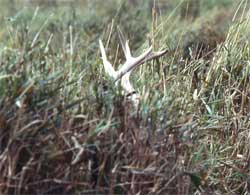
Thirty minutes before sundown, the slanting muted rays of late sunlight were seen glinting off polished white antlers. The deer stood up, moved forward, and stepped into the tiny clearing near the stand. He looked around, especially where the truck had come from and the direction it had gone, and seemed satisfied it was gone.
The animal had been bedded down just 40 yards from the stand. The buck, completely fooled by my arrival by truck, strode confidently out in front of me.
The bow eased back to full draw, and the buck lowered his head to sniff the scent of one of the does, and my arrow slid in behind the shoulder. The buck humped up slightly, kicked his legs back, and ran off.
It was a good hit, I knew, and moments later I walked up to the fallen buck. During the field dressing, I found the heart with a two-blade wound through the center of it. Being hit in the heart often makes deer hump up and kick, and the animals die quickly.
Hunters must recognize that big bucks often bed down near a stand where they can watch hunters come and go. Having another person drop them off, and stay there with the motor running until the hunter is out of sight in the stand, can pay big dividends.
It's a trick I've since used for many years, and this tactic particularly holds true when hunters use bait after snow covers the ground. Bucks and does often bed near the food source, and being dropped off and picked up with a motorized vehicle can work wonders for hunters.
Deer can't count the number of people in a truck or on a four-wheeler. Sometimes it gives hunters an edge and sometimes it doesn't. Nothing works all the time on whitetails, and that is why whitetail deer are such fascinating animals to hunt.