Showing posts with label arrow. Show all posts

Sunday, November 20, 2011

What will it be, Mister?

Dave Richey checks carbon (left) and aluminum Robin Hoods.


Archery shop owners invariably ask the same question when hunters come in to buy arrow. What will it be, Mister?

There is very little discussion these days about arrow shaft construction. There are only three basic choices, and from there, several secondary choices to be made.

Aluminum, carbon or wood? Only some long bow and recurve bow shooters still shoot wood arrows although many have switched to either one of the other two choices. The secondary choices are manufacturer, size, weight and length.

Choose which shaft is best for your archery use.


Compound bow hunters are locked into a choice between aluminum and carbon, and there is little to discuss. Very few compound shooters still shoot aluminum shafts these days.

I still like aluminum shafts for bow hunting but much of the time carbon arrows are in my bow quiver. There was a time 15-20 years ago when aluminum arrows had a death grip on the  arrow market but times have changed.

In most archery shops, at least 90 percent of arrow sales are now carbon. Some other shops report 95 percent carbon over aluminum arrows.
Years ago there were plenty of arguments against carbon shafts, and many were unfounded. Some of the early carbon arrows were too skinny, some had ugly out-serts that attached to the shaft, and the broadhead screwed into the out-sert. Another argument that has passed by the boards was that carbon arrows would shatter inside a deer.

Believe me on this: some people resented carbon arrows and resisted using them. I told a friend he'd lose arrow sales if he didn't stock carbon, and soon I noticed that people were passing up his aluminum shafts and going elsewhere to buy carbon arrows. He soon learned he was losing money.

It took some time but he eventually began to stock carbon, and began shooting these new shafts. They flew extremely well, and that settled the argument for me. He now stocks and sells carbon arrows.

Carbon shafts, in testing, out-perform arrow shafts of other materials.


Why shoot carbon? One excellent reason is the arrows are extremely straight, and tolerance levels are much tighter (less than half of one percent) than with aluminum, in most cases. Several years ago Archery Business magazine found carbon arrows were more perfectly formed, more precise, and in most cases, stronger than aluminum.

The magazine said that Carbon Express shafts, and especially their Maxima and other shafts, had the tightest tolerances in the arrow industry. It means, that with practice, a hunter or target archer can become a better shot with these arrows.

Carbon arrow companies have relegated the skinny carbon shafts of yesteryear to the back shelf, and are producing shafts with much the same diameters as aluminum.

The bigger shafts help increase down-range energy, and this allows the arrow to hit with greater force. The down-range force produces better penetration, and with increased accuracy, this means a  chance for more killing shots.

Carbon arrows require a properly maintained and tuned bow. A bow that is out of whack won't shoot any arrow well.

This means the hunter needs a well-tuned bow, a quality bow rest, and a good mechanical release. They will help produce far more accurate shots than most people ever felt possible.

Most quality archery shops can do a fine job of tuning your bow, and it's common for people to bring their bows to any high quality archery shop for an annual tune-up.

A properly tuned compound bow and carbon arrow should be paper tuned. A properly tuned arrow will cut a perfect hole when shot through paper. Out-of-tune bows will cut or tear ragged holes with feathers or vanes cutting high, low, right or left when they go through the paper.

I've shot Carbon Express for years. No reason to change.


This requires further tuning, and when the rest, nocking point and other factors jell, there is a perfectly round hole. And, with the great line-up of bows which are now available, the straight-nock travel produced by these bows make for the most accurate compound bows on the market.

Some people continue to fight the trend toward carbon arrows. Some folks simply resist change.

A well-tuned bow, quality carbon shafts, a good rest, and a broadhead suited for that shaft, will make any bow hunter a much better shot at deer and targets.

Tough? A buddy of mine shot a black bear, Quebec-Labrador caribou and whitetail deer with one arrow. That's right -- one carbon arrow. He re-sharpened the broadhead after each kill, and the arrow was still straight after killing three big-game animals in one year.

One thing is that people who shoot carbon, or any other arrow shaft for that matter, must avoid shooting an arrow that has be dented or dinged by another arrow during practice. They could shatter. Check any arrow before shooting, and then shoot with confidence.

My belief in carbon shafts, with the proviso noted immediately above, puts a capital T and A on the two words -- Tough Arrows.

Sunday, January 09, 2011

Draw your bow daily


Practice now, and next fall when a buck like this shows up, you’ll be ready.


Many people from all over the state have told me they shoot in an archery league to stay sharp during the winter. Others  have developed some rather ingenious ways to conduct winter practice.

The primary function here is to shoot enough to pick up the bow, draw, aim and shoot without feeling any discomfort. Stay away from shooting of any kind for a month or more, and the bow often feels a bit uncomfortable in your hands. The trick is to stay comfortable with a bow in your hands all winter.

My basement has a 20-yard archery range in it. I can shoot every day if the mood moves me, which it often does.

Shooting a few arrows makes the bow feel five pounds heavier than it really is, and the back and shoulder muscles get sore easily. Shooting is the best cure for any of these problems, and it makes accurate shooting much easier.

Consistent practice, whether just drawing or shooting, is more comfortable.


If a person just has no place to shoot, they can still draw their bow and develop some strength training. Here are several examples of things one can do during winter months to stay comfortable drawing a bow.

A buddy does his shooting out in his cavernous garage. A target is set up at one end of the garage, and he can shoot at distances from 15 to 25 yards. Of course, on a bitter cold day, five or six shots is about all he can handle.

Another friend has a 17-yard archery range in his basement. He is talking about cutting a hole in the wall which would allow him to shoot at 25 yards, and it would more closely simulate shooting from an enclosed hunting blind.

He practices standing up and sitting down while shooting, and this is good. As a rule, he normally shoots while sitting. He can don some fairly heavy clothing similar to what he would wear for December hunts or he can wear lighter clothing to simulate shooting in October.

Still another gent I know does shoot some, but he walks around his house, comes to full draw, centers the sights on the nearest light bulb, telephone or drawer pull, and he finds it is excellent practice.

Just draw and aim at different household objects without shooting.


Most people when they draw on a deer have to fiddle around a bit to get their sight pin on target. All of that uses up time, and if the buck is walking away, it makes people hurry. When they hurry, they usually make a mistake and take a bad shot.

Not this guy. He practices all winter drawing an empty bow and concentrating on putting the sight where he wants the arrow to go. He works hard at it, and when he is shooting he will do the same thing with an arrow on the string. The bow comes up and back, and the arrow is on its way. This only comes from perfect practice.

Such practice makes target acquisition quick and easy. He always nails his anchor point, and if he is on his anchor point and the sight is on the target, a twitch of the finger on a release sends the arrow downrange to where he wants it to go.

Practice can take many forms, but it's important to become somewhat committed to handling your bow during the winter months. I shoot as often as possible, as I follow my no-nonsense method of drawing, achieving my anchor point, aiming and shooting.

How you practice is up to you, but practice is very important when shooting deer.


It gives me the daily practice that I want, and the result is that when it comes time to shoot a deer during bow season, I am ready. My muscles are tuned up, my eyes are sharp, and when I hit my anchor point, a slight adjustment tweaks my aim and the arrow is gone.

Many hunters wait until two or three weeks before the season opens, to start practicing. It's better than nothing, but the people who are the finest shots practice shooting on a regular basis.

Their muscles are all peaked out at a comfortable draw weight, and their eyes automatically center on the aiming point, and all it takes is to touch the trigger, and the arrow goes where it should. It's simple once you begin to practice on a regular basis.

Friday, February 26, 2010

Shooter Versus Hunter

Hunting deer with a bow, someone once said, is the most fun you can have while wearing camouflage clothing.

If bow hunting is so much fun, is it any wonder that it is the fastest growing segment of deer hunting today? And if that is true, how do we tell the difference between a deer shooter and a deer hunter?

It's really quite simple. Hunters, like trout fishermen, go through three stages. They want to shoot deer on a regular basis; then they want to shoot the biggest buck possible; and the third stage is one of trying to outwit a deer in a one-on-one challenge of skills and keen instincts.

This is not a good shot and a true hunter would wait for the deer to turn.

The deer shooter doesn't understand the intricate sense of balance between them, the deer and the environment. They belong to that old and outdated group of hunter who subscribe to that awful philosophy: "If it's brown, it's down."

The hunter views the hunt as a wonderful event in nature where they can learn about deer, study the animals as they breed, feed, hide and roam at will. They have come to understand that the more they know about whitetail deer, the more successful they will become. And after a time, they progress to the third stage where the hunt becomes a very large and difficult challenge, one they know they will probably lose.

The shooter seeks the shortest distance between two points. There is no need for study because they know what a deer looks like. "Show me a buck and I'll shoot it" becomes their motto.

The hunter might complain about two days of east wind, but they are grateful for the opportunity to be afield and to hunt from a ground blind or tree stand. They know that many countries do not allow private ownership of firearms, and they see hunting as a privilege.

The shooter complains about everything: too much east wind, too much high pressure centers; too many bugs early in the season; not enough bucks; too many does; and they blame others for their misfortunate of missing a decent buck. They are into immediate gratification, and a dead deer is the only thing that gives it to them. To them, hunting is a God-given right, a thought that is not true.

Most shooters complain about everything, and blame others when something goes wrong.

The hunter studies the rut, knows that all bucks are not stupid during the breeding season, and they are wise enough to know that if you can fool the doe, the buck trailing behind is easy... if they decide to shoot.

The shooter seldom thinks about the doe but focuses solely on the buck. If they forget about the doe, and make any mistake, there will be no shots at the buck. They are impatient while hunters must be patient.

The hunter, thinking always of giving a buck an even chance, will pass up a marginal shot. He will remain still and silent, and allow a good buck to ease through if he is not 100 percent certain of his bow shot.

The shooter is a firm believer in the "Hail Mary" shot that may or may not make it into the vitals. They take a shot, often a low-percentage shot that only wounds the animal and often allows it to get away only to die in some secluded thicket. These deer have been wasted.

The hunter delights in a well-placed shot and shows the deepest respect for the animal they take. They are keenly aware of having killed an animal, and many may shed a silent tear for that  deer's death. They treat it with the utmost respect, even in death, and pay their final tribute to a beautiful creature by having it mounted.

A nice buck in the snow can be an easy shot in open terrain.

The shooter, if he scores, whoops it up and disgraces his killing act by talking about "happiness is a warm gut pile." The buck becomes nothing more than an ego stroke, a dead critter that grants them bragging rights over their buddies.

The hunter recalls each hunt, whether they are successful or not, with pleasure. They enjoy nature, marvel at beautiful sunrises and sunsets, and worship the areas where whitetail deer live.

The shooter recalls only the kill, and occasionally the miss, and could care less about the weather, the color of the autumn leaves and everything else about the hunt. For them, the kill is all they care about, and all that matters to them is a messy blood trail with a hair-covered corpse at the end of it.

There must be more to hunting than what the shooter sees. Hunters take in and thoroughly understand the magic of the hunt, where that outing with bow in hand becomes far more important than the kill.

Sadly, shooters seldom advance past that first level. They miss all that is fine and wonderful about the hunt, and revel only in a dead animal.

How sad!

Posted via email from Dave Richey Outdoors

Friday, October 30, 2009

A Hunting Trick Worth Trying

Hunters can do all the preseason scouting they wish. They can have tree stands conveniently placed, and ground blinds in strategic locations, and make every effort to be scent-free while staying downwind from the hunting location.
Still, there are times when bucks just will not cooperate. We can have a nice buck patterned, arrive early because we know the buck is as spooky as a house cat in a dog kennel, and still our best-laid plans can and do go awry.

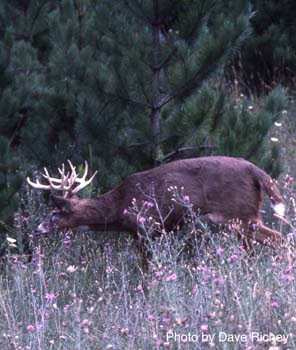
Bucks can be very unpredictable

Sometimes the bucks won't show up because of something we've done, and there are other occasions when someone else spooks them unwittingly, but the bottom line is that bucks seldom play by our rules.
They play by their own game plan, and until we learn how to crawl inside a buck's head and determine what makes him tick, and do this or that, we must live with the prospects of being foiled again and again by an animal that doesn't show up as we often predict he will. That's another reason why they call this hunting.
Last year I had a nice buck that had been seen using a specific runway through heavy cover. One of the elevated stands was at the far end of the trail and back in thick cover, and my thought was to sit up on him at that location. I eased into the area, climbed up into the stand, and kicked back to relax.
I knew when he moved, and knew where he moved, and he was as regular as a glass of prune juice. Except for that night ...

He took the trail least travelled

He avoided the area like it was the last place on earth he wanted to be. I saw several does and a couple of small bucks, and some fawns, but the big rascal failed to make an appointment. He took a totally different trail out of the beddinh cover.
The next evening, we went through the same procedure, and again he didn't show up. The rut wasn't on yet, but this flaky buck was breaking his habits. I tried a third night, with equally unsuccessful results, and decided to hunt elsewhere.
My new spot produced the sighting of a nice buck, much too far out of range, but that animal captivated my attention for several days before another hunter took him from a different stand. Where to go now?
My decision seemed easy. I planned to go back and try for the other buck. A friend had seen him moving about in that area, and I slipped into the stand noiselessly. The wind was perfect, and again he didn't show up.
My mind usually tells me the buck is bedded down in the immediate area, and has spotted me going to the stand or leaving it. This, I feel, was the answer but how to solve the problem. This could be a test of wills, mine versus his.

A sneaky way in for a hunter

Other stands were hunted for several days, and I finally decided to have a friend drop me off with his truck. My thought was the buck was probably being spooked by me walking in, so why not let the pickup truck do the spooking.
The friend drove me to the stand, and I was up the ladder like a fox squirrel heading for the tree-tops. He puttered around a little bit until I was in the stand and out of sight, and then he slowly drove off down a nearby two-track and the woods settled down to silence.
As the afternoon turned into early evening there were several does, fawns and two or three small bucks moving through. The big buck still hadn't showed up, and I was beginning to think he had moved out of the area and taken up temporary residence elsewhere.
Thirty minutes before sundown, the slanting muted rays of late sunlight were seen glinting off polished white antlers. The deer stood up, moved forward, and stepped into the tiny clearing near the stand. He looked around, especially where the truck had come from and the direction it had gone, and seemed satisfied it was gone.
The animal had been bedded down just 40 yards from the stand. The buck, completely fooled by my arrival by truck, strode confidently out in front of me.
The bow eased back to full draw, and the buck lowered his head to sniff the scent of one of the does, and my arrow slid in behind the shoulder. The buck humped up slightly, kicked his legs back, and ran off.
It was a good hit, I knew, and moments later I walked up to the fallen buck. During the field dressing, I found the heart with a two-blade wound through the center of it. Being hit in the heart often makes deer hump up and kick, and the animals die quickly.
Hunters must recognize that big bucks often bed down near a stand where they can watch hunters come and go. Having another person drop them off, and stay there with the motor running until the hunter is out of sight in the stand, can pay big dividends.
It's a trick I've since used for many years, and this tactic particularly holds true when hunters use bait after snow covers the ground. Bucks and does often bed near the food source, and being dropped off and picked up with a motorized vehicle can work wonders for hunters.
Deer can't count the number of people in a truck or on a four-wheeler. Sometimes it gives hunters an edge and sometimes it doesn't. Nothing works all the time on whitetails, and that is why whitetail deer are such fascinating animals to hunt.