Showing posts with label bow hunting. Show all posts

Saturday, April 21, 2012

Caribou in the snow

Caribou moving in the snow
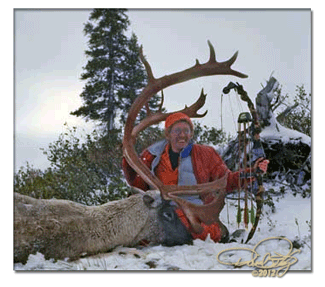
Caribou hunting, a most enjoyable outting into Quebec and a world away of eduction.
I'll never forget my first caribou bull with a bow, in that remote snow-covered land of northern Quebec.
photo Dave Richey ©2012
One of the most fascinating things about northern Quebec is how many lakes and rivers there are, and how few people inhabit the region. Some Montaignais Indians and a small group of Inuit from the sub-Arctic coast, and that's it for thousands of square miles of bush country.

My first Quebec-Labrador caribou hunt took place in 1971, and it left much to be desired. I saw two caribou, dropped the only bull with one shot, and that was it.

My next hunt was in 1974, and it was far different than my first outing. It was on the George River, north of Schefferville, Quebec, and near the Torngat Mountains. My Montaignais Indian guide, Peter Wanish, spoke very little pidgin English, a bit of French, but we managed to communicate with hand signals and a few spoken words.

Sign language proved useful between my guide and I

As all hunters can do, we learned to communicate.

We headed upstream through a series of rapids above Wedge Hills Lodge, and the sky was the color of soft putty. A cold wind blew out of the north, and we came to an area where the mighty river narrowed. My compound bow was ready, and we took up a position 10 feet uphill from the river bank as we kneeled behind some low-growing trees. We were near the edge of the tree-line, and our meager cover would have to do.

The weather turned colder, and then it began to snow. An hour later there was 12 inches of snow on the ground, and my Bushnell spotting scope was trained on the opposite shore a quarter-mile away. It wasn't needed.

Wanish muttered a guttural "Caribou!" and lifted his finger just off his lap and pointed. Caribou were filtering down toward the river, and stood there looking across. We didn't move, and the caribou stood at the waters edge, and more caribou began to pile up behind them.

The snow gained in intensity, and much of the time the animals could not be seen. And then, a stray gust of wind would flatten out the snow, and through the gauze-like haze of huge snow flakes, we would see them increasing in numbers on the opposite shore. I lifted my Bushnell  binoculars, and when next the snow cleared, there was a steady string of 'bou filtering down through the few trees off the hillside, and the animals just kept coming.

The heavy snow caused thousands of caribou to cross near us. This was an age-old migration route, and trails had been cut deep in the shorelines where generations of Quebec-Labrador caribou had traveled.

Now, after many such caribou hunts, and having taken 28 big ‘bou with double-shovels, I'm convinced that only three things make caribou move: Cold temperatures, heavy snow fall and because the animals decide they want to do so. Cold and snow is what hunters can depend on if the weather cooperates. Migration routs like this can be a hit or miss situation in this country in August and September, if the animals decide to move. It is with eagerness and a madly beating heart when they do.

His whispered warning: “Get ready, they’re coming. No move.”

We watched the animals pile up on the opposite side of the river, and then Wanish grunted again. "Caribou. In water. Swimming!"

He looked at me, signaled for me to get up on one knee and get ready for a close shot. He motioned me to stay behind our skimpy shoreline cover.

I looked across the river, and at least 1,000 caribou were in the river, swimming our way. Their heads were sweeping our shoreline with their eyes, their antlers interlocking with those of other bulls, and on they came as we remained motionless. We were where the animals wanted to go.

They would disappear from sight through the thick snow, and then we'd see them again. The current was swift but the caribou are strong swimmers, and their hollow hair serves as insulation and they seem to bob like a cork on the water.

I singled out a bull with a good rack and a white mane and waited

Once they were within 100 yards of us, they became more visible. A big white-main bull with long main beams, good mass on top, good bez tines and a double shovel was clearly the largest one that would make landfall near us. The other caribou was allowed to swim ashore and leave.

My attention remained riveted on that bull, and as he reached shallow water, he lurched slowly up near shore. Dozens of caribou had already walked past us, and we were just downwind of them. They climbed the hill behind us and disappeared.

The bull stepped ashore, stood on the sand and rocks, shook himself like a Labrador retriever shaking himself off after retrieving a duck, turned broadside to me, and I came to a full draw. Aiming, I had to wait for a cow to pass in front of me, and then made a smooth release on the bull.

The arrow disappeared behind the near-side front shoulder, and the animal stood there for several moments, and started up the hill and fell. From shot placement to death took less than five seconds. It didn't bother the other 'bou, and they just passed by his position on either side, and for 15 minutes it was a steady parade of caribou walking past.

That bull was mounted but his rack was never scored, and years later, I had another bull scored that was slightly smaller, and it made it into the Boone & Crockett record books. This animal is a bit wider, a bit higher, and has more scoreable points. One day I may have it mounted but it’s not necessary.

One day, that caribou may get scored but each time I look at him, all I see in my mind's eye is a huge snow fall, strong winds, and a massive caribou migration that put 2,000 to 3,000 animals past us that day. Believe it or now, hitting the caribou migration isn't easy.

Memories of other hunts may be come or go, or may be forgotten, but I'll never forget my first caribou bull with a bow, on a lonely northern Quebec rive shoreline, when the snow fell and the caribou just kept coming. It was a wilderness spectacle that  has stayed with me for many years, and will never go away.

Wednesday, February 09, 2011

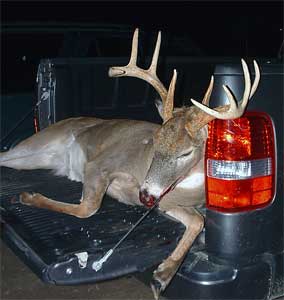
Big bucks don't come easy

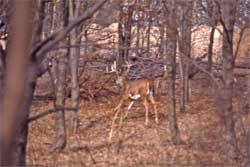
This is what hunters see when they make big-buck mistakes.

Shooting a big whitetail buck with a bow isn't easy. If it was, everyone would be doing it.

First of all, unless a person hunts on a trophy deer ranch like many of them around the state, it's difficult to shoot trophy bucks with any consistency on private property or state land. People who are purported to shoot huge bucks in the open range, year after year, are subject to some scrutiny.

There are a few really good deer hunters who hunt land where no one else can gain access, and such spots can produce big bucks. Hunters who have such areas, and hunt them often for trophy bucks, have one thing in common.

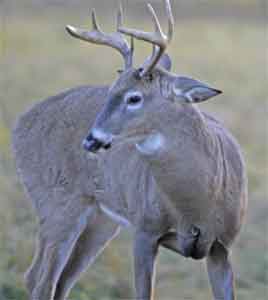
Big bucks don't come easy but require great skill.

They have a particular mindset that allows them to focus only on a trophy buck. They never make a movement unless they know what the consequences of those actions will be.

Almost every one of them know their bow better than they know the neighborhood they live in. They also know the country they hunt every bit as well as the bucks they pursue.

They know the early season can be a great time to waylay a big buck. They are long on preseason scouting, and are careful not to bump or spook does or big bucks. They approach their scouting with the same degree of caution  and skill as when they are actually hunting.

They know where big bucks travel, and often have them pinpointed so well they know exactly what time the deer will move in specific areas. This mindset has no time for studying habits of small basket-rack bucks. They ignore the small bucks.

Hunt alone, scout thoroughly and pass on small bucks.

A big-buck hunter is almost always a loner. He is as silent as a ghost in the field, is never heard talking, and his mind is always thinking about a big buck. He doesn't allow himself to think about little bucks, does or fawns.

It's not that he ignores other deer but uses them and their actions to alert him to the presence of a large buck. He knows that big bucks often do most of their chasing of does, and most of their breeding, in cover so thick that is where they often hunt.

Early in the rut these sportsmen may hunt field edges because bucks are moving through such areas, eternally on the lookout for an estrus doe. He goes where the bucks will eventually come: to wherever the largest number of adult does are found. And that is usually near food sources.

Bypass those areas that harbor small deer before the rut.

The big-buck hunter eliminates those areas where mostly smaller bucks are found. These hunters are always looking for an edge, something that will tip the odds slightly in their favor.

They hunt with their eyes and ears, and often hear a big buck coming before it gets within bow range. They listen intently for a soft twig snap or any sound that could possibly be made by a trophy buck. Rather than looking at the cover, they try to look through it to spot a big rack.

They don't burden themselves with unnecessary equipment or gear, and know where a buck will travel. They don't cut huge shooting lanes in several directions; instead they set up with one primary place to shoot, and they study the area for anything that could deflect an arrow.

They know they may, if very lucky, have only one shot at a trophy buck. They know that in order to succeed, they must be vigilant and ready for a shot at any time. Hanging a bow on a limb has saved many bucks lives.

They have trained themselves to control their emotions. They don't get rattled when a trophy buck shows up; they come to full draw, aim carefully and shoot accurately. There are no excuses with big bucks; you shoot and kill them cleanly or grieve in silence.

Most big-buck hunters hunt alone. They don't need a crowd nearby, and they try to keep their hotspot hidden from others. They may walk a mile out of their way to enter the woods downwind of deer, and they travel noiselessly. They can erect a stand in absolute silence, and if that area doesn't feel right, they give up a night of hunting to keep from spooking a buck.

They are like secret lovers. They don't discuss the deer they shoot, never reveal their hunting locations, and are on red alert whenever they prepare for a hunt. Some watch for cars that may follow them, and will deliberately lead them astray.

Many big-buck hunters are very secretive about their hunting areas.

There are few deer hunters with the necessary time available to invest in hunting one specific big buck. Those that do are close-mouthed about their hunting prowess, and that enables them to move among other hunters, listen to the gossip, and locate big bucks that other people have overlooked.

Hunting trophy bucks isn't easy. One must learn to pass up a nice buck, knowing it will be even bigger next year. They also know that to shoot a trophy whitetail buck is an accomplishment, and it's what makes them skilled at what they do.

They also know they may go a year or two or three between good bucks, but that is OK with them. The skill required and the chance to arrow a trophy buck doesn't come often, but when it does, they are ready and up to the task.

Posted via email from Dave Richey Outdoors

Wednesday, September 15, 2010

Fall is almost here


Autumn comes each year with a balmy day, breezy weather, days when a sweater feels just fine when greeting the dawn, and on the odd day, fall rains pelt us with cold water that will soon turn to snow.

There is something magical that offers to show its pretty face right after Labor Day. The hordes of tourists have abandoned northern Michigan, and once they leave, the frantic pace of living slows down and the residents can take stock of their outdoor lives.

Mine revolves, as it always has, around fishing and hunting. It's just that these outdoor loves speak a bit more provocatively to me, and I willingly imbibe in everything that epitomizes the best and worst of autumn weather.

Autumn weather means river fishing for salmon and steelhead.

It might be enough for most people just to watch the brief flurry of autumn colors as the days grow shorter and the weather cools. It starts with a gradual blend of orange, purple, red and yellow colors. They quickly intensify in the depth of their beauty, and brilliant sunshine seems to make each color jump out, making them more attractive.

There are one or two days each fall when the brilliant sunshine combines with just the right angle of the sun to make each color stand out in stark contrast against any nearby cedars or pines. I've yet to see a pine tree whose beauty wasn't intensified by its close proximity to aspens, maples or oaks in full color.

Those days are when I stop the car, step outside, and bask in the glory of the autumn hues. I love the sight of the leaves in full color on the trees, and frown slightly once they lose their sparkle, and fall dead and spent to the forest floor and a mess to clean up from the yard.

I love the cool, clear days, and find a steady diet of fall rain a bit to somber for this time of year. Daily rains make me anxious for the sun.

Fall means a changing of the season. Thank God for four seasons.

I love running water. The sight and sound of a trout stream twisting through the woods and gurgling around a log jam, makes me happy to be alive. I often pause, during an autumn day, to idly sit on a river bank to watch the ritual of recreation as Chinook salmon move onto a spawning redd and work hard to renew their kind.

The old adage about Pacific salmon always holds true: It states that fall salmon are born orphans, and die childless. Think about it, and it's another marvel of nature that requires too much thought to explain. It's enough to know that it is true.

Autumn means testing my mettle against the thunderous flush of a ruffed grouse, the corkscrewing flight of the woodcock towering over an alder run, or the quick flush of a snipe from the edge of a wooded water puddle. These game birds, although I seldom run into snipe  these days, provide something very important to me. It matters not that my wing-shooting skills dimished when my vision started to go.

These months often deliver a day of fine dog work. It's wonderful to watch a brace of pointers or setters work the cover, singly or in tandem, moving into the wind, cutting the breeze at a 45-degree angle, and suddenly slamming to a rock-hard point, their bodies quivering.

They stiffen in position, one dog backing the other, and hold steady as we move in. Calming words of "easy now" are muttered softly as a hand gently touches the dog's head or shoulder to steady them up, and the hunter moves in. His eyes aren't on the ground but a few feet above the ground, a built-in hedge against being startled by the flush, which inevitably still does that job even though we expect it.

Watching a good dog work great bird cover is more fun than shooting.

The bird is up and away, and a shotgun barrel swings through the grouse or woodcock, and when everything looks right, a shot is fired.
Sometimes, for me at least, the bird commits suicide, diving into a shot string of No. 8 bird shot early in the season and slightly larger shot once the leaf drop ends.

It is sitting still in a tree stand, marveling at the fall splendor of color along the oak ridges, and watching a buck ease through a saddle and become backlit by the setting sun or a back drop of blazing color.

Autumn is knowing I can kill a buck with my bow, and having the intestinal fortitude to forego the shot because it isn't necessary. There are times, once I draw down on a buck, and then let off without taking a shot, that I know that buck could be killed. Knowing it and doing it are two different philosophies, and I endorse both thoughts.

This next two months are the finest of the year. They provide me with everything I need to feel whole. They stroke my one-eyed vision, offer me daily glimpses of some of the most colorful sunrises and sunsets an angler or hunter could ever hope to see.

Fall is my time. It is the best time of my life, and just think, it starts this month and I can't wait. I'm ready, quivering like a dog on point, and panting to be afoot in the woods again.

Being there, once again, moves me in such an exquisite way that words to describe my awe often fail me. But then, I'm sure you know what I mean.

Posted via email from Dave Richey Outdoors

Saturday, September 11, 2010

Admitting some bow-hunting errors


The crunch time is approaching. I've done most of my preseason deer scouting, put up a couple of tree stands in key locations, built a pit blind, and am waiting to see just how much more rain we are going to get in the near future.

Invariably, no matter how hard I think about things, I'll forget one key element in my deer-hunting equation. Hell, I once drove 60 miles to one of my hunting spots and got my plastic lidded tub of Scent-Lok clothes out of the car, as well as my rubber boots, and reached in for my bow. It wasn't there, and then I remembered taking it into the house to dry it out after a rain the previous day.

It was dry when I got home that night. Instead of hunting, I spent the evening watching other spots and located a good buck that I shot a week or so later when all of my equipment was in my hands or on my back.

Make certain you have everything in your baackpack or pockets.

Forgetting things is easy, and it happens to everyone. Once, I was hunting a cedar tree where there was no time to put up a stand. My bow was laid on the ground with my haul rope attached to a belt loop. Normally, my backpack is worn into my stand and it always contains a spare release.

The path up to where I could watch the trail and shoot if necessary was a tight fit so I left my backpack 150 yards away near the field edge. I'd pick it up on the way out. Up I go, like an arthritic monkey, got positioned on a large and sturdy tree limb, leaned back against another sturdy tree limb, and hoisted my bow into the tree after attaching my full-body harness.

I settled back to wait, and I always leave my release on the string. Here comes a dandy 9-pointer, and I'm prepared to shoot when he hits a little dogleg in the trail. It will provide a quartering-away shot at 17 yards. The bow is slowly raised into position, and guess what?

A tiny twig hit the trigger, and the release fell to the ground. The buck heard the noise in the leaves, stopped, looked around and walked to the dogleg and stood in the most perfect place. I could have shot with my fingers, but it had been years since I had done so, and I couldn't remember whether to pull with three fingers under the nock or one over and two fingers under. Rather than risk a bad shot, I didn't shoot but never saw that buck again.

I've lost enough things while hunting to stock some small sporting goods stores. All have been lost because of dumb moves on my part. I'm like the pool hustler: I know how to sink the shot, and play position pool to set up for an easy shot on the next ball, but knowing how to do it and doing it are two mighty different things.

Think ahead, and plan for any eventuality.

The same applies to hunting gear. A buddy found a pair of binoculars I had left in a blind. I thought they came out in my backpack, but goofy me, I forgot them and tore my car and house apart looking for my optics. The next person that sat in that stand walked out after dark and said "here are those binoculars you lost. You left them on the seat in the coop."

I've lost expensive and highly prized knives, flashlights and what not. Stuff falls out of my pocket or backpack, and I can think of at least two releases that have been lost in the woods.

Even knowing my proclivity for losing things, I still run through a checklist, and try to keep everything I may need in my backpack.

Paying attention to what goes in and what is taken out of the backpack or one's pockets is an obvious first step to keeping track of gear. But, as is true with many people, we get thinking about something else, and forget a sorely needed item.

I took my quiver off my bow several years ago, took them inside to retouch the edge on my broadheads. I touched them up, added a light coating of oil to postpone the onset of rust, and set the quiver next to the door. I was starting out the door when the phone rang.

Don’t let other things distract you.

I grabbed the phone, hung up, turned on the security system, and out the door I went. Drove to the hunting spot, grabbed my bow, looked all over for my arrows, and realized this was another head-slapper night.

So there are my stories of some nitwit moves and stupid actions. It's my suspicion that others forget things on occasion, but I seldom hear from people willing to admit to their dumb tricks.

Now, having confessed some of my silly stunts, perhaps I'll remember everything this year. You think?

Posted via email from Dave Richey Outdoors

Sunday, September 05, 2010

Shoot once and straight, and don’t miss


Many years ago several of us adopted a basic bow-shooting philosophy, and it is every bit as important to us today as it was back then. We called it the Shoot Once, Shoot Straight And Don't Miss philosophy.

It is a philosophy to aspire to, and we've taught it to thousands of bow hunters over the years. The philosophy is easily understood, simply stated, and if archers follow it beginning a little over three weeks when the bow-deer season opens, there would be fewer wounded deer.

Here is the whole philosophy pulled together as concisely as possible.

*Shoot Once -- How can there be any misunderstanding about this one? Bow hunting is vastly different than hunting with a firearm where one or more shots can be easily taken.

A bow hunter, 99 percent of the time, will have only one shot at a deer. A miss or a wounded animal will send the deer in hasty retreat. About the only time a second shot might be taken is to finish off a mortally wounded animal.

*Shoot Straight -- This and the next basic tenet of this philosophy are most important. Shooting with accuracy only comes from consistent and perfect practice. If the practice is faulty, the shot will be faulty as well.

This means controlling your breathing and nerves, drawing when the buck is unaware of your presence, hold your head up with both eyes fixed on the proper spot for a killing shot, aiming properly once you've achieved a firm and consistent anchor point, making a smooth release, and holding your bow steady without moving it (follow through) until the arrow hits your aiming point.

There is little excuse for error unless the arrow hits an unseen twig, but it's up to the hunter to know that twig is there and to take a clean broadside or quartering-away shot. All other shots are low-percentage opportunities, and should never be taken. If you don't have a high-percentage shot, wait for another opportunity. Don't trust to luck.

Work up a step-by-step checklist of all the things to do before shooting.

*Develop a mental checklist, and run through it in order before releasing  the arrow. If you plan to hunt from a tree, practice shooting from an elevated position.

*Know your limitations. If you can't consistently hit the kill zone on a deer at 25 yards, but can hit it at 20 yards, a 20-yard shot is your maximum effective shooting distance. Know what you can and cannot do, and never exceed your limitations. A miss, or even worse a wounded deer, can be the only two plausible results of exceeding your effective shooting range.

Shooting a deer is easy if you do everything right in sequential order.

*Don't Miss -- This is the culmination of all of these facets of this hunting philosophy. If the above two facets are followed to the letter, and you never exceed your limitations, and always achieve a firm anchor point and aim properly (and don't drop your bow arm at the shot), you will hit and kill that deer.

This simple philosophy is easy to write about but a bit more difficult to put into practice. It requires total hunter concentration, complete focus on all of the minute details, and it means knowing your bow and at what distance is your limit of accurate shooting.

Follow these simple rules -- Shoot Once, Shoot Straight & Don't Miss -- and you'll be eating venison this fall and admiring the antlers of a nice buck. You can bet on it.

Posted via email from Dave Richey Outdoors

Sunday, August 15, 2010

Not all wounded deer die


The obvious answer to the title is "no." Some deer will die if injured and others will not, and this often depends on the type of injury, where it is located, whether vital organs are involved, and other things.

I've encountered numerous injured deer over the years. Some are the result of a doe kicking one of her fawns, others have been gored in a buck fight, and a few have been wounded by a hunter.

A leg injury may put a deer on the mend for a few days, and recovery is possible if the animal can lick the wound and keep it clean.  Deer wounded or injured by another animal may not make it if the injury is in a location where it can't be licked.

These replaceable-blade broadheads were found in a previously wounded buck.

Two decades ago we had a few hunters on our lease who couldn't shoot straight. Me, my wife Kay and close friends, would hunt those wounded animals. If they looked like it would lead to a fatality, we would shoot the deer to end its suffering.

Some years ago Minnesota conducted tests to prove the fatality of wounded deer, and they found it wasn't nearly as high as some people thought. Three years ago we had a very nice buck that had been hit high in the shoulder, and several of us saw the buck, but the animal was always too far away. One hunter saw the wound was filled with pus, and the order went out that anyone who saw that buck within easy shooting range, must shoot it.

This animal looked like a hunchback. Every time the right front leg would go forward, the hump high on the shoulder would raise six or eight inches when it took a step. The wound was where the buck couldn't lick it.

Two days after I suggested killing that buck, one of my friends tagged it. The deer had been hit high in the shoulder, and the animal  lived long enough to grow the hump. It was never seen eating but was always on the move.

A deer hit in a front leg usually survives. They lick the leg, and keep an infection from forming, and soon the deer is up and moving around without a problem.

Some bucks have been shot, and the arrow zipped through the chest cavity without hitting the heart or lungs, and such bucks often survive. It may lay the deer up for a week or two, but death doesn't always follow a pass-through shot.

An arrow can pass between the lobes of the lung, missing lungs and heart, and live.

Several years ago I passed up a buck that walked down a trail near my stand, and it appeared to have a slight limp but was moving fine. I let him pass, and noticed some hair was missing from the off-side front shoulder.

The next day found me in the same tree, and here comes the same buck on the same trail. When the buck presented a high quality shot, I drew and shot, killing it.

The reason for the limping buck was obvious. Another hunter had shot from a tree stand, and the replaceable-blade broadhead had hit high. It missed the spine, and caught the buck high in the shoulder but near the spine, and the buck couldn't get to it.

I skinned out around the earlier wound, and it was filled with pus and the shoulder was green with gangrene. It would have eventually died from the wound, but was still moving well when I shot it. Interestingly enough, two of the three replaceable blades broke off and littered the wound area.

A thin blood trail with bright red blood usually means a minor muscle wound that will eventually clot and stop bleeding. Most shots hit the brisket or the inside or outside of a front leg. The chance of recovering such a deer is  very slim.

Knowing where an arrow hits can tell hunters whether to wait two or three hours or take the trail immediately. An obvious wound in the paunch, far back from the lungs, can mean a long trailing job unless a vital organ such as the liver is hit.

Know where you hit the deer. Many people really don’t know where an arrow hits.

Leave gut-shot deer alone for several hours and hope the coyotes don't pick up its blood trail. After a lengthy wait, a deer will travel only 100 yards or less, lay down and stiffen up or die. Push gut-shot deer, and it can travel long distances and may never be found.

This points to one reason why a hunter should  know how his bow shoots, where the animal was hit, and with some experience, most wounded deer can be found. Those with a minor nick on the leg or brisket will live to become a much wiser buck in the future.

Posted via email from Dave Richey Outdoors

Wednesday, August 11, 2010

What's new about deer hunting?


Trying to come up with a new angle for bow hunting whitetails is a pretty tall chore. Every writer I know, and many new ones that I don't know, are looking for new and deadlier hunting methods to write about.

Does any new stuff come along? Not really. Native Americans hunted deer with bows before Columbus set sail, and since outdoor writers have been writing about the sport, very little new has come about.

Bow hunting is somewhat like playing baseball. Everything happens in each sport in much the same manner as it did 100 years ago. There may be equipment improvements but very little is really new.

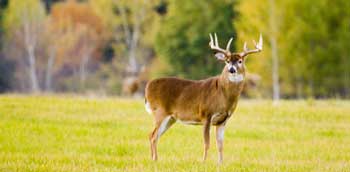
Everyone wants to shoot a big buck. Superb hunting skills are needed.

Some things have changed, and the biggest change of all was the invention of the compound bow. And back about 20 years ago I brought a red-dot sight back to Michigan from an Outdoor Writers conference, and when I let Claude Pollington borrow it, that was an innovative new change for bow hunters. It was a legal sight that works very well.

Pit blinds have been in use for countless years, but it's only been in the last 30 years that more and more people have learned that shooting bucks from a hole in the ground is pretty easy. But new, it's not.

There are continuous changes in bows. New cams, wheels, dampeners, string silencers and much more, and although every bow manufacturer puts some new bell or whistle on their bow every year or make a small change so they can offer an upgraded model, most of the change may smooth out the draw curve, help a hunter gain another 10 feet-per-second arrow speed, but the changes are seldom revolutionary. In some cases, they are cosmetic at best.

New arrow rests, sights and releases come on the market every year, but one can ask this question: what benefit is there in switching? In some cases, depending on the hunter, there can be great benefit.

Tree stands seem to be a bit lighter than before, and most of those manufacturers subscribe to the theory that all tree stands must be safe and sturdy. So, other than perhaps being a few ounces lighter, and locking more rigidly to a tree, there isn't much change. There has been vast improvements in safety harnesses, however, and hunters who don't use one are risking life and limb.

New tricks aren't needed but basic skills are important.

Where change must come is from the hunter. Attitudes about deer hunting must change. The day of the taking any possible shot at a deer is slowly dying out, and none too soon. Forget about the awful bow shots taken by television "pro" hunters because many of them take whatever shot the deer offers, and often they are low percentage shots. I recently watched one shot where the hunter made a bad hit, and admitted it to his viewers. That was a first, and long overdue.

Hunters, facing fewer deer in Michigan now than 20 years ago, must become better hunters. This means studying deer habits more, and putting in more preseason scouting time. They must learn to rely more on skill and less on luck.

These sportsmen are learning much more about eliminating human odor. There are many odor eliminating sprays on the market, and Scent-Lok clothing has made great strides in recent years. More and more people I see are wearing Scent-Lok clothing, and more of them have become better deer hunters because of it.

There seems to be greater strides being made in learning the true art of bow hunting. I refuse to get into debates over bows. If the bow being used is legal by DNR statutes, it's fine by me. I shoot a compound bow these days, but once hunted for many years with a recurve. Never could shoot a long bow well, and have never shot a crossbow at a deer but that may change unless my bad back and shoulders don't improve.

Today's hunters are wising up. They realize that hunting methods come and go, but none of them are new. Hunting deer in a corn field has been around forever although some hunters are just coming to realize that properly done, a hunter can be very effective inside a corn field. Again, it's not new but may be new to some people.

Tons of stuff comes out every year about hunting the rut, and the significance of hunting rub lines and scrapes. Again, hunters have been doing this for years but many younger hunters are hearing about it for the first time and think it is something new. I hunted downwind of active scrapes and rub-lines 45 years ago.

Go back to the basics and learn from scratch. Take only perfect shots.

Few people did back then, but I spotted a nice buck working a scrape and I watched him shag an estrus doe out of sight. That taught me some things about scrape hunting, and I learn more each year.

The question is: what's new? Nothing much is truly new, but more people are learning about deer hunting by reading about it, whether on my weblog, that of other blogs or magazine articles written by savvy writers.

What is new is the willingness of many hunters to learn. Many have cast aside some of the old folklore that was never true in the first place.

I try to learn something new about deer and deer hunting every day. Sometimes I take note of something that is new to me, and as we continue to learn, we continue to grow in stature as a bow hunter.

Once a hunter stops learning about deer hunting, they stop being effective at it.

Posted via email from Dave Richey Outdoors

What's new about deer hunting?


Trying to come up with a new angle for bow hunting whitetails is a pretty tall chore. Every writer I know, and many new ones that I don't know, are looking for new and deadlier hunting methods to write about.

Does any new stuff come along? Not really. Native Americans hunted deer with bows before Columbus set sail, and since outdoor writers have been writing about the sport, very little new has come about.

Bow hunting is somewhat like playing baseball. Everything happens in each sport in much the same manner as it did 100 years ago. There may be equipment improvements but very little is really new.

Everyone wants to shoot a big buck. Superb hunting skills are needed.

Some things have changed, and the biggest change of all was the invention of the compound bow. And back about 20 years ago I brought a red-dot sight back to Michigan from an Outdoor Writers conference, and when I let Claude Pollington borrow it, that was an innovative new change for bow hunters. It was a legal sight that works very well.

Pit blinds have been in use for countless years, but it's only been in the last 30 years that more and more people have learned that shooting bucks from a hole in the ground is pretty easy. But new, it's not.

There are continuous changes in bows. New cams, wheels, dampeners, string silencers and much more, and although every bow manufacturer puts some new bell or whistle on their bow every year or make a small change so they can offer an upgraded model, most of the change may smooth out the draw curve, help a hunter gain another 10 feet-per-second arrow speed, but the changes are seldom revolutionary. In some cases, they are cosmetic at best.

New arrow rests, sights and releases come on the market every year, but one can ask this question: what benefit is there in switching? In some cases, depending on the hunter, there can be great benefit.

Tree stands seem to be a bit lighter than before, and most of those manufacturers subscribe to the theory that all tree stands must be safe and sturdy. So, other than perhaps being a few ounces lighter, and locking more rigidly to a tree, there isn't much change. There has been vast improvements in safety harnesses, however, and hunters who don't use one are risking life and limb.

New tricks aren't needed but basic skills are important.

Where change must come is from the hunter. Attitudes about deer hunting must change. The day of the taking any possible shot at a deer is slowly dying out, and none too soon. Forget about the awful bow shots taken by television "pro" hunters because many of them take whatever shot the deer offers, and often they are low percentage shots. I recently watched one shot where the hunter made a bad hit, and admitted it to his viewers. That was a first, and long overdue.

Hunters, facing fewer deer in Michigan now than 20 years ago, must become better hunters. This means studying deer habits more, and putting in more preseason scouting time. They must learn to rely more on skill and less on luck.

These sportsmen are learning much more about eliminating human odor. There are many odor eliminating sprays on the market, and Scent-Lok clothing has made great strides in recent years. More and more people I see are wearing Scent-Lok clothing, and more of them have become better deer hunters because of it.

There seems to be greater strides being made in learning the true art of bow hunting. I refuse to get into debates over bows. If the bow being used is legal by DNR statutes, it's fine by me. I shoot a compound bow these days, but once hunted for many years with a recurve. Never could shoot a long bow well, and have never shot a crossbow at a deer but that may change unless my bad back and shoulders don't improve.

Today's hunters are wising up. They realize that hunting methods come and go, but none of them are new. Hunting deer in a corn field has been around forever although some hunters are just coming to realize that properly done, a hunter can be very effective inside a corn field. Again, it's not new but may be new to some people.

Tons of stuff comes out every year about hunting the rut, and the significance of hunting rub lines and scrapes. Again, hunters have been doing this for years but many younger hunters are hearing about it for the first time and think it is something new. I hunted downwind of active scrapes and rub-lines 45 years ago.

Go back to the basics and learn from scratch. Take only perfect shots.

Few people did back then, but I spotted a nice buck working a scrape and I watched him shag an estrus doe out of sight. That taught me some things about scrape hunting, and I learn more each year.

The question is: what's new? Nothing much is truly new, but more people are learning about deer hunting by reading about it, whether on my weblog, that of other blogs or magazine articles written by savvy writers.

What is new is the willingness of many hunters to learn. Many have cast aside some of the old folklore that was never true in the first place.

I try to learn something new about deer and deer hunting every day. Sometimes I take note of something that is new to me, and as we continue to learn, we continue to grow in stature as a bow hunter.

Once a hunter stops learning about deer hunting, they stop being effective at it.

Posted via email from Dave Richey Outdoors

Tuesday, August 10, 2010

Bow hunting: Mental or physical?


It often occurs to me that hunting is more mental than physical. Granted, we walk into the woods, climb into a tree stand, and if a nice deer walks by and stands in the best possible spot, we draw and shoot.

If our aim is on, and we don't miss, we track down the animal. It is field-dressed, loaded into the bed of a pickup truck, and hung up to chill out. That's the physical part, and dragging the buck out is the most strenuous portion of the hunt.

Ah, but the mental aspects of a archery deer hunt is a much different story. My claim is that a hunt is more mental than physical. How so?

Think about it. Hunting is much more mehtnal. Read on!

My belief is that almost everything about a hunt is mental. We must determine where to go, when to hunt, and which tree is the best one to use under present conditions. We must consider the wind, and wonder if our clothing is really scent-free or not.

Long before we climb into a tree stand, we've had to mentally decide how much draw weight is comfortable for us. We must choose from a wide range of bows, make the decision to shoot aluminum or carbon arrows, and we must think constantly about how to set up on that big buck we've seen several times while preseason scouting. Our choice of broadheads to use can tax our brain as we consider various brands.

We've defined our hunting area, climbed into position, and then must consider where we can and cannot shoot. It's a mental and slightly physical effort to scan the area for unseen twigs that could deflect an arrow, and should the buck show up, we must mentally calculate when to draw, aim and release the arrow.

We must mentally calculate the distance, decide whether this is a dead-on shot, or whether to allow the buck to pass while hoping for another chance on another day.

There are so many things to think about when hunting.

We must mentally prepare ourselves for a long or short wait. Only our mind can allow us to believe that the branch stub poking at our left hip really doesn't hurt. We must always be aware of what the wind is doing, and a wind shift, no matter how subtle, can spook a buck if he catches any scent.

The mental gymnastics increase when a buck shows up, because as likely as not, there will be a doe and fawn(s) nearby. We must mentally condition ourselves to watch all nearby deer, and not just the buck.

It makes little sense to do everything right up until the time comes to take a shot. If we forget about watching not only the buck but the other nearby deer, the chances are excellent that one of the other animals will spot the movement made while drawing a bow. If that happens, the game is up.

We must mentally calculate angles caused by shooting toward the ground from an elevated position. Once our mind computes the angle and distance, we must then focus on the precise point of impact where we want the arrow to hit. It's all mental except drawing the bow.

Drawing on a deer is both mental and physical, and the mental picture of locking in on the heart-lung area forces us to see that spot whether we shoot instinctively, with sights or a red-dot sight. Our mind must translate what our eyes see, and relay that information to our hands and eyes, and allow us to properly aim and concentrate on that precise spot.

Do you see the point? Physical is only walking in & dragging out a deer.

Our mental image of the deer in the right position, at a known distance and angle, must be maintained even if the animal moves. We must calculate any changes that must be made, and be ever alert to the one deadly enemy of shooting arrows: we must mentally concentrate on not lifting our head as we make the release.

To do so causes the arrow to go high, and it can result in a missed shot, or even worse, a wounded deer.

Mental concentration must be maintained until we see the arrow hit the deer, and then another mental exercise comes into play. Our mind must tell us exactly where the arrow hit the animal, and our mind must prevent us from saying it was a heart shot when in fact the deer was hit in the lower leg.

Hunting is much more mental than physical although few hunters ever see it that way. For many, it is idle time spent waiting for a shot. The true deer hunter knows better.

Success or failure is in your head. It's wise to think about this issue long before a shot is taken.

Posted via email from Dave Richey Outdoors