Showing posts with label pass. Show all posts

Sunday, February 05, 2012

Choosing between shooting or not shooting a buck

deershootnoshoot

This nice buck pauses within easy bow range but I didn’t shoot

A hard northwest wind came moaning through the pines last fall, driving the snow horizontally across the newly whitened horizon, and making me wish for the comfort of home and hearth.

The pines were draped with snow, and only the foolish or hungry were afoot in this foul weather. I belonged to the first category, and was hoping a few deer from the second group would filter past my tree. My stand, 15 feet up a pine tree, offered a vast panoramic view of the nearby woods, tag alders and open feeding field. Several inches of new snow covered the ground, and a nearby tag alder thicket provided the only decent cover where deer could wait out the storm.

My glasses were almost useless because they were covered with melted snow, and periodic cleaning of my specs helped some, and the movement was necessary if I were to loose an arrow if and when a buck showed up.

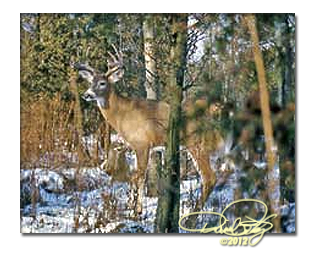
It wasn't a nice day that year to be out, but bucks were moving

The wind sliced through the nearby bedding area like a knife through warm butter. It came gusting across the field, sandblasting my face with hard snow, when a buck stepped hesitantly into view.

The 8-pointer seemed to have come from nowhere. The animal appeared like gray smoke scudding ahead of the wind, moving dark against white from the tag alders into the snow-covered open woodlot.

It traveled downwind, and stopped at random to check the wind, and then seemed to drift slowly across the whitened woodlot. It was the epitome of a whitetails strength to survive in all types of weather and ensure perpetuation of the species. Deer must be tough to survive for long in this type of weather.

It also was the stuff of calendar photos: a snowy scene, green topped pines and a motionless, majestic buck alertly surveying his surroundings. I raised my bow as the buck stepped methodically through the deepening snow to within 30 yards, knowing I wouldn't shoot until it moved to within 15 yards and offered a high-percentage shot at a no-miss range.

It's a close shot or nothing because of my vision problems

The buck began to forage, and conflicting thoughts sent electrical currents coursing through me. Live or die, it's late in the second bow season. I may not have another opportunity to take a buck before the season finally ended.  Besides, it would be a tough drag for one man to get the animal out of the woods to where I could pull it to my car with the four-wheeler. It would be a back-breaking chore just to lift it into my vehicle.

Conflicting emotions offered the thrill of taking a nice 8-pointer while testing my mettle against a savage late-season snow storm. The buck fed closer, browsing on something just off the ground, and my mind was forcing me into a confrontation with myself over the sanity and wisdom of shooting or not shooting this buck.

Give in, and just do it, came one mental command. The flip side said no, it will be too tough physically and there will always be another opportunity.

Flip a coin or do something; I chose to pass on this buck

The buck solved my mental deliberations. It gradually fed into a thick tangle of second growth from a cutting made 10 years before, and it slowly disappeared from sight.

I trudged through the building snow to my vehicle, cased my bow, and prepared to head out. Within moments, the vehicle was filled with welcome warmth, and I calmly reflected on my ambivalence.

Was I too wishy-washy? Had I lost the killer instinct?

The questions pinged around like metal balls in a pinball machine. Minutes of inner reflection told me that the answer was a definitive no to both questions.

There's something about a nasty storm, and hunting in bad weather, that satisfies my mental needs. There also is something about taking an animal's life, or not taking it, that causes great deliberation. It's easier to kill the animal than to allow it to walk away.

Granted, venison is one of my favorite meats. I take deer every year with bow, muzzleloader, rifle or shotgun, and each year I pass up many bucks that could have been harvested.

But, darn it, it feels good to let one live another year and to recall the decision many times over a long winter.

That's why it was simple not to pull the trigger on my bow release. That decision made it easier to yank the four-wheel-drive lever into low-lock and ease down the rutted and slippery two-track for a snowy journey back to civilization where my decision to not shoot made even more sense.

The power of granting life or death over an animal had been satisfied once again, and this time, the buck lived to furnish many fine memories. The thoughts of passing on that buck will live longer in my mind than it would have if the buck had been killed.

Knowing I had made a wise decision based on my personal feelings and simple logic was enough to turn this hunt into a successful one.

Posted via email from Dave Richey Outdoors

Wednesday, February 09, 2011

Big bucks don't come easy

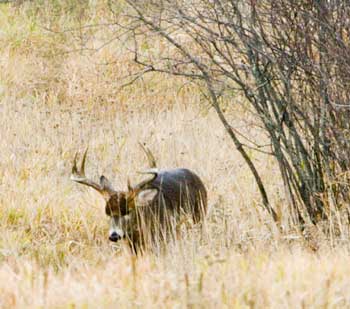
This is what hunters see when they make big-buck mistakes.

Shooting a big whitetail buck with a bow isn't easy. If it was, everyone would be doing it.

First of all, unless a person hunts on a trophy deer ranch like many of them around the state, it's difficult to shoot trophy bucks with any consistency on private property or state land. People who are purported to shoot huge bucks in the open range, year after year, are subject to some scrutiny.

There are a few really good deer hunters who hunt land where no one else can gain access, and such spots can produce big bucks. Hunters who have such areas, and hunt them often for trophy bucks, have one thing in common.

Big bucks don't come easy but require great skill.

They have a particular mindset that allows them to focus only on a trophy buck. They never make a movement unless they know what the consequences of those actions will be.

Almost every one of them know their bow better than they know the neighborhood they live in. They also know the country they hunt every bit as well as the bucks they pursue.

They know the early season can be a great time to waylay a big buck. They are long on preseason scouting, and are careful not to bump or spook does or big bucks. They approach their scouting with the same degree of caution  and skill as when they are actually hunting.

They know where big bucks travel, and often have them pinpointed so well they know exactly what time the deer will move in specific areas. This mindset has no time for studying habits of small basket-rack bucks. They ignore the small bucks.

Hunt alone, scout thoroughly and pass on small bucks.

A big-buck hunter is almost always a loner. He is as silent as a ghost in the field, is never heard talking, and his mind is always thinking about a big buck. He doesn't allow himself to think about little bucks, does or fawns.

It's not that he ignores other deer but uses them and their actions to alert him to the presence of a large buck. He knows that big bucks often do most of their chasing of does, and most of their breeding, in cover so thick that is where they often hunt.

Early in the rut these sportsmen may hunt field edges because bucks are moving through such areas, eternally on the lookout for an estrus doe. He goes where the bucks will eventually come: to wherever the largest number of adult does are found. And that is usually near food sources.

Bypass those areas that harbor small deer before the rut.

The big-buck hunter eliminates those areas where mostly smaller bucks are found. These hunters are always looking for an edge, something that will tip the odds slightly in their favor.

They hunt with their eyes and ears, and often hear a big buck coming before it gets within bow range. They listen intently for a soft twig snap or any sound that could possibly be made by a trophy buck. Rather than looking at the cover, they try to look through it to spot a big rack.

They don't burden themselves with unnecessary equipment or gear, and know where a buck will travel. They don't cut huge shooting lanes in several directions; instead they set up with one primary place to shoot, and they study the area for anything that could deflect an arrow.

They know they may, if very lucky, have only one shot at a trophy buck. They know that in order to succeed, they must be vigilant and ready for a shot at any time. Hanging a bow on a limb has saved many bucks lives.

They have trained themselves to control their emotions. They don't get rattled when a trophy buck shows up; they come to full draw, aim carefully and shoot accurately. There are no excuses with big bucks; you shoot and kill them cleanly or grieve in silence.

Most big-buck hunters hunt alone. They don't need a crowd nearby, and they try to keep their hotspot hidden from others. They may walk a mile out of their way to enter the woods downwind of deer, and they travel noiselessly. They can erect a stand in absolute silence, and if that area doesn't feel right, they give up a night of hunting to keep from spooking a buck.

They are like secret lovers. They don't discuss the deer they shoot, never reveal their hunting locations, and are on red alert whenever they prepare for a hunt. Some watch for cars that may follow them, and will deliberately lead them astray.

Many big-buck hunters are very secretive about their hunting areas.

There are few deer hunters with the necessary time available to invest in hunting one specific big buck. Those that do are close-mouthed about their hunting prowess, and that enables them to move among other hunters, listen to the gossip, and locate big bucks that other people have overlooked.

Hunting trophy bucks isn't easy. One must learn to pass up a nice buck, knowing it will be even bigger next year. They also know that to shoot a trophy whitetail buck is an accomplishment, and it's what makes them skilled at what they do.

They also know they may go a year or two or three between good bucks, but that is OK with them. The skill required and the chance to arrow a trophy buck doesn't come often, but when it does, they are ready and up to the task.

Posted via email from Dave Richey Outdoors

Saturday, October 23, 2010

Choosing when to shoot


The buck was a nice animal. It was an adult 2 ½-year-old with eight points, the beginning of a really nice rack, and he wasn't rut-crazed just yet. This rack, while still thin and spindly, had an inside spread of 16 inches with good brow points.

The buck came to me early in the evening with plenty of shooting light, and stopped at 18 yards and stood at an extreme quartering-away angle for long minutes. It was a tempting shot possibility.

Questioning my desire

Did I want to shoot that buck? You know, I really can't answer that question. Undecided, I did as I often do, and came back to full draw. The tiny sight settled low behind the front shoulder, but the shot would have to be precise and I tweaked my aim a bit more.

It's too shallow of an angle, I thought. Too much margin for error. I held the bow back longer, waiting for him to turn. Finally the bow was eased down, and that buck stood in that position for several more minutes before shifting just a bit to turn directly away from me.

I continued to watch him, all the while asking myself: do you really want to shoot this buck? He is nice, but he isn't that nice. Another year of life would make this a really fine animal if someone else didn’t shoot him this fall.

The result was that my inner self talked me out of that buck until five minutes later when he turned slightly to watch another deer. I raised the bow, put the sight on the proper spot, and held it there.

That animal had no clue I was anywhere in the area. For me, much of my deer-hunting enjoyment comes from fooling the animals. I don’t need to kill a buck to have had a good hunt. But … this guy was very tempting.

If I touched the trigger of my release this would be a dead 8-point. I laid my index finger on the trigger, refined my aim just a tad and didn't pull it. Deep down, I really didn’t want to shoot this deer.

No shot and my reason

The bottom line was the buck wasn’t  exactly what I wanted. It was nice, to be sure, but not that nice. Besides, it was too early in the season for me to shoot a buck. I had time to wait for something bigger.

The buck walked away minutes later, completely unaware of how close he had come to getting shot. It was turned just right so I wasn't looking into its eye, and it wasn't fidgety. It was completely unaware of my predatory presence, and I let that buck walk.

Thirty minutes later an even larger 8-point walked down the wooded trail. This guy stood broadside, and offered an easy 17-yard shot. I aimed, held the red-dot on the vitals for 30 seconds and eased up.

Shoot or don’t shoot?

It was useless. I knew, in my heart, that I had no intention of shooting this animal that evening. He was a nice buck, but still didn't have quite what I wanted.

It occurred to me that I was having a problem identifying what it was I did want. Trophy hunting doesn't appeal to me, but after a half-century of deer hunting and shooting many basket-rack bucks and some other really nice animals, shooting what suits me is very important. Some years I don’t shoot a buck, and that is my choice. I certainly see enough antlered bucks within range that I can afford to be a bit picky with my choice.

I then agonized over trying to identify what it was I wanted, and got no further down that trail before I realized that a buck was important but it was nearly impossible to identify what unique requirements were needed to satisfy my need to release an arrow at the animal.

A lesson from the past

It reminded me of a conversation I'd had 30 years earlier with a magazine editor as we discussed his magazine’s photographic needs and how I could help him reach those goals. He said: "I don't know what I want but I'll recognize it when I see it."

My buck-shooting problem is similar to his photo problems: I probably won't recognize what it is I’m looking for until I see it, and then all of my motor skills will allow me to come to a full draw, aim with precision, and let loose a killing arrow providing the animal is within my clear and well defined shooting range.

Once, some years ago, I could see a big buck easing along the edge of an oak ridge. His position in relation to mine made it impossible to see both sides of this rack.

The buck sneaked along an overgrown fence line at the edge of the woods, and he would lift his head on occasion to look ahead for danger before lowering his head again. I heard a soft grunt coming from his direction, and I knew he was scent-trailing a hot doe.

He would come within easy bow range of my tree stand, but still the right side of his antlers wasn’t visible. He was a shooter, no doubt, if the right side was as good as the left.

Here he came, walking gently as if he was stepping through broken glass, and he paused 20 yards away. It was just a bit too far to shoot with unfailing accuracy. His head was down and out of sight, and he would be at 15 yards when both sides of his rack would be visible. Just wait, suck a bit more air, and settle down. The bottom line in all such cases is he will come closer or he won’t. Wishful thinking doesn’t work at placing deer at the preferred location.

He eventually took a few more steps toward me, stepped out into the open, and stood with his head held high. I looked at the right and left side as I drew and prepared to  aim. I soon let off on my draw, and knew I wouldn’t shoot this buck.

The right side had three antler tines broken off as a result of scrapping with another buck. His rack had been damaged in a fight, and if I am to shoot a big buck, his antlers will go on the wall. This old boy got a break on this day although another person shot him on the opening day of the firearm deer season.

A mental crossroads

My problem is I'm at some type of mental crossroads. I'm well past the point where I must shoot another buck. I'm not out looking for massive antlers although I'd probably shoot if that kind of buck walked in front of me at my preferred shooting range, but more than anything, outwitting a good buck seems much more of a personal challenge than just shooting a nice animal.

And I suspect it's one of the reasons I didn't shoot either one of those bucks. The time wasn't right, and whatever it is I seek in a whitetail buck, just wasn't there. Perhaps, both shots would have been too easy or perhaps the reason is the challenge just wasn't intense enough to excite me.

That said, the opportunity is out there. I know of a big 10-pointer in one of my hunting areas. Being there at the right time, with the right temperament, and within easy bow range might tempt me into taking a shot.

Will I take it? Only time will tell, because for me, the hunt is far more important than antler or skull size. Something must challenge my personal skills, and mental moods, and if the challenge isn’t there, neither is the need to shoot.

Many people think hunting is easy. This simply proves that for some people, hunting is far more difficult than one might believe.

Posted via email from Dave Richey Outdoors