Showing posts with label remember. Show all posts

Wednesday, April 11, 2012

Always be prepared for a bow shot

The Boy Scouts of America have a famous motto: Always Be Prepared

buckwhitetail
To best the better deer, operate on the Boy Scout motto: "Always Be Prepared"
photo Dave Richey ©2012

That same motto should certainly apply to bow hunters, especially those who hunt the December archery season. Bucks are does can appear and disappear without warning, and hunters who have their bow hanging off a limb or hook are not really prepared.

One of my friends told me last fall that a pair of does snuck in on her, and before she could lift her bow off a nearby limb, the buck and both does had vamoosed. She didn't spook them; the buck was keeping the does away from the food source, and when they left he was pulled along in their wake.

"What did I do wrong?" she asked. She wanted the truth but wasn't really prepared for my answer.

Her problem was the same of most people: not being ready

"You weren't ready," I told her. "I learned many years ago to always be prepared for a shot. The hunter must always be ready, and it's one reason why shooting bucks is easy for me."

If a buck is within range, and offers a broadside or quartering-away shot, from the first sighting of the animal until the arrow slices in behind the front shoulder, is a matter of five seconds or less.

Many hunters tire easily of holding their bow. It fatigues arm, shoulder and back muscles, and stiff muscles are slow to respond.

I often lay my bow across my lap while sitting down, and the release is always on the string. Too many people tell me it takes them 10-15 seconds to get the release on the string when a buck shows up. For most of them, the buck is out of range as they fumble and make small noises while trying to put the release on the string.

They get all jittery at the sight of a buck within bow range, Their heart beat speeds up, they make useless movements and make noise and waste time, and by the time they are ready the buck is gone.

Get into a proper shooting position in your stand, and ready the bow. That means having the release on the string from the beginning to the end of the hunt. Trying to pull a release out of a pocket when a deer is nearby is a lesson in frustration and futility.

Being ready  means a shot is imminent and all things are in place

If my bow rests across my lap, all I have to do is rotate the bow upright, and begin making the draw when the moment is right. Missing that right moment is easy when the hunter isn't mentally and physically prepared.

A friend of mine, who bow hunts about 85 days per year, wears tall knee-high rubber boots as we all do to cut down on human scent. He has developed a novel way of always being ready for a bow shot.

"I sit while hunting, and being right-handed, will stick the lower limb of my C.P. Oneida Black Eagle bow into the top outside edge of my boot," he said. "A buck walks in, and the bow is upright, and I begin my draw (the release is already on the string) while sliding the lower limb out of my boot.

By the time I'm at full draw, my red-dot sight is tracking the animal. When it stops or provides me with an ideal shot, the arrow is released. It takes about two seconds to draw, aim and shoot, and there is very little movement to spook wary deer."

What many hunters don't realize about late-season hunting is that bucks are hungry, and are trying to regain weight lost while in rut. This is a vital concern for them, and if does are traveling with a buck, he may drive them away so he can feed.

Some hunters will pass up a 4-, 6- or small 8-point buck in order to help serve as a steward of our natural resources, and will try to shoot a doe. The does are flighty because bucks are hooking at them with their antlers, and they come in and out and seem to be in constant motion.

Just remember that Boy Scout motto while hunting

Hunters like the woman who missed her opportunity tonight must learn to be ready at all times. It requires paying constant attention. Deer can appear and vanish within a few seconds, and hunters who are reaching for their bow or fumbling with a release are usually too late.

I tend to daydream a bit while on stand but my mind is always aware of what is going on around me. I can slip from an idle daydream into drawing my bow in an instant, and hunters who can do this time after time seldom miss an opportunity to shoot at a buck or doe.

They, like a true Boy Scout, are always prepared for action.

Posted via email from Dave Richey Outdoors

Tuesday, March 27, 2012

Always be prepared for a bow shot

The Boy Scouts of America have a famous motto: Always Be Prepared

buckwhitetail
To best the better deer, operate on the Boy Scout motto: "Always Be Prepared"
photo Dave Richey ©2012
That same motto should certainly apply to bow hunters, especially those who hunt the December archery season. Bucks are does can appear and disappear without warning, and hunters who have their bow hanging off a limb or hook are not really prepared.

One of my friends told me last fall that a pair of does snuck in on her, and before she could lift her bow off a nearby limb, the buck and both does had vamoosed. She didn't spook them; the buck was keeping the does away from the food source, and when they left he was pulled along in their wake.

"What did I do wrong?" she asked. She wanted the truth but wasn't really prepared for my answer.

Her problem was the same of most people: not being ready

"You weren't ready," I told her. "I learned many years ago to always be prepared for a shot. The hunter must always be ready, and it's one reason why shooting bucks is easy for me."

If a buck is within range, and offers a broadside or quartering-away shot, from the first sighting of the animal until the arrow slices in behind the front shoulder, is a matter of five seconds or less.

Many hunters tire easily of holding their bow. It fatigues arm, shoulder and back muscles, and stiff muscles are slow to respond.
I often lay my bow across my lap while sitting down, and the release is always on the string. Too many people tell me it takes them 10-15 seconds to get the release on the string when a buck shows up. For most of them, the buck is out of range as they fumble and make small noises while trying to put the release on the string.

They get all jittery at the sight of a buck within bow range, Their heart beat speeds up, they make useless movements and make noise and waste time, and by the time they are ready the buck is gone.

Get into a proper shooting position in your stand, and ready the bow. That means having the release on the string from the beginning to the end of the hunt. Trying to pull a release out of a pocket when a deer is nearby is a lesson in frustration and futility.

Being ready  means a shot is imminent and all things are in place

If my bow rests across my lap, all I have to do is rotate the bow upright, and begin making the draw when the moment is right. Missing that right moment is easy when the hunter isn't mentally and physically prepared.

A friend of mine, who bow hunts about 85 days per year, wears tall knee-high rubber boots as we all do to cut down on human scent. He has developed a novel way of always being ready for a bow shot.

"I sit while hunting, and being right-handed, will stick the lower limb of my C.P. Oneida Black Eagle bow into the top outside edge of my boot," he said. "A buck walks in, and the bow is upright, and I begin my draw (the release is already on the string) while sliding the lower limb out of my boot.

By the time I'm at full draw, my red-dot sight is tracking the animal. When it stops or provides me with an ideal shot, the arrow is released. It takes about two seconds to draw, aim and shoot, and there is very little movement to spook wary deer."

What many hunters don't realize about late-season hunting is that bucks are hungry, and are trying to regain weight lost while in rut. This is a vital concern for them, and if does are traveling with a buck, he may drive them away so he can feed.

Some hunters will pass up a 4-, 6- or small 8-point buck in order to help serve as a steward of our natural resources, and will try to shoot a doe. The does are flighty because bucks are hooking at them with their antlers, and they come in and out and seem to be in constant motion.

Just remember that Boy Scout motto while hunting

Hunters like the woman who missed her opportunity tonight must learn to be ready at all times. It requires paying constant attention. Deer can appear and vanish within a few seconds, and hunters who are reaching for their bow or fumbling with a release are usually too late.

I tend to daydream a bit while on stand but my mind is always aware of what is going on around me. I can slip from an idle daydream into drawing my bow in an instant, and hunters who can do this time after time seldom miss an opportunity to shoot at a buck or doe.

They, like a true Boy Scout, are always prepared for action.

Sunday, March 13, 2011

Making gobbler-hunting plans

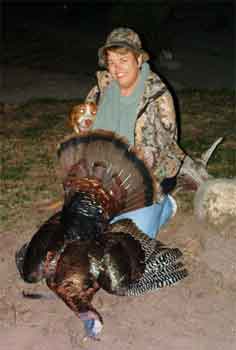
Nancy Kerby of Honor, Michigan, poses with a nice gobbler.

This happened several years ago but it's a prime example of why I love hunting spring gobblers.

The big Tom was 75 yards away and moving fast through the spring woods toward us.

He was fixated on Henrietta, my sad-looking and gobbler-hooked old hendecoy, and he seemed committed to a quick romantic dalliance with the old hussy.

The longbeard was almost within shooting range when the hunter in front of me asked, rather loudly: "Is it time to shoot?"

The strutter was just educated by someone who should know better.


The gobbler heard the human voice, hit the skids, hung an immediate hop to the left, ducked behind a tree, and quickly disappeared from sight. He was as lost as last year's Easter egg from that time on. I was never able to locate him again.

Granted, turkey season is still more than a month off but savvy sportsmen are planning their hunting strategies now. Knowing the benefits of solitary hunting can play an important role in future hunting success. The time to learn how to avoid mistakes is now so it won't happen later.

Turkey hunting is considered a one-man game. On occasion I'll take one or two people hunting, but dislike taking more than one. And frankly, I'd much rather hunt alone than with someone although it makes me feel great when I can call a big strutter to the firearm of a first time turkey hunter.

Hunting turkeys is solitary business


The sad fact is that turkey hunting, which begins in mid- to late-April and early May, is not meant to be a community effort. It's not meant to be a social affair, a gathering of friends with similar hopes and desires. It means absolute silence, no movement, and a keen knowledge of how to set up on a bird and how to call it in.

Seldom will two hunters score during the same hunt. A guide and one hunter can work but one guide and two hunters soon becomes a lesson in frustration.

There is much to be said for turkey hunting alone. You choose your hunting spot, and if the birds head the opposite direction, the hunter gets up, starts running while hoping to get ahead of them without being seen. It occasionally works, believe it or not.

It's not easy, but it's much easier for one person than for two or three. Me and two others tend to get in each other's way, and often someone will move when they should be sitting perfectly still. A fidgety hunter will spook every turkey long before they walk within shotgun range.

Often someone wants to talk, and even though an occasional whisper may not be detected, a hunter who is somewhat hard of hearing will attempt to whisper. He whispers loud enough so he can hear himself, and the result is a low conversational tone that is easily heard 100 yards away by a sharp-eyed, keen-eared bird. A group of three hunters wind up making far too much noise, and all too often, both hunters are talkative gents intent on impressing each other.

Some hunters want to idle away slow time by talking. I don't want people talking to me because I must listen, and don't need to hear stories of past hunts, what he expects from this hunt, or to answer hunting questions when we should be motionless and silent.

My idle time is spent trying to get someone into a bird. Sometimes it just doesn't work, and other times, the gobbler comes to the call like I have a rope tied to his neck. Now may be the time to state that I am not a for-hire guide. I only take family and good friends hunting.

Perhaps the finest outdoor writer of all time put the problem this way: "One boy is all boy; two boys is half a boy, and three boys is no boy at all." The man who wrote these words of wisdom was the late Robert Ruark, and his homespun philosophy is worth noting.

Loosely translated, it means that one sportsmen can hunt well alone. Two hunters make twice as much noise and movement, and three hunters are as conspicuous as a black eye.

Hunting alone has much going for it, and frankly, it pleases me immensely. It allows me to go where I want, make decisions whenever they become necessary, and there's no need to worry about someone else and their feelings, whether real or imagined.

One might say it's selfish of me, but who cares? It's my hunt, it's my time, and if I choose solitary hunting, so be it. It's not a case of being antisocial; it's a matter of knowing that one turkey hunter is far more effective than two or more people hunting together.

The odds improve greatly for solitary hunters. The only reason I take another person out for wild turkeys is that I enjoy watching them shoot their first gobbler. Both hunting alone and calling a bird for another hunter are selfish actions. I do them reasonably well on calm birds and with people who pay attention and don't move or talk, and do trips my trigger.

I tell hunters what I expect from them. To me, this turkey hunting is serious business. Don't talk to me when I'm calling, listening, and don't do anything but what you are told to do.

People know I have bad vision, and they are counted on to help me spot incoming or circling birds. No words need to be spoken. An elbow nudge gets my attention, and the movement of a relaxed finger gives me the direction. The birds often are spotted first, but it doesn't always happen in a wooded area with heavy vegetation.

My instructions are simple, and should be easily understood. Sit still, don't move, sit with your back to a shoulder-wide tree, pull your knees up, rest the shotgun against your shoulder and across your knees, don't shot until I tell you to, and listen to what is whispered to you.

I tell them that as the birds approach us or my decoys that they cannot move, even if they have the mother of all charley horses. Be still, don't make a sound and wait for the gobbler to move directly in front of the shotgun at 20 to 35 yards.

A sharp but barely audible putt is made when the gobbler is in the right position for a killing shot. The sound makes the bird stop, and its head goes up to look for danger. Be ready, and shoot the gobbler where the head and neck join. Hunters are warned to keep their cheek down on the shotgun stock, and don't lift their head when they pull the trigger or the shot will go high.

I say when to aim and shoot


There will be plenty of time to palaver and talk once we leave the hunting area. Often other turkeys will have been with the dead gobbler, including other gobblers. Shoot the bird, sit still and don't move, and let the other birds wander off on their own.

Doing it this way doesn't alert them to humans in their midst. A shot could be confused with thunder, which turkeys hear all the time. It's the motion and noise of a moving hunter that jumps out from in front of a tree that sends birds heading for the next township.

Hunting alone removes all of these potential problems. It's one man, going one-up with a gobbler, and without any consideration for anyone else. It's making personal decisions, and living with them whether they prove right or wrong.

The case has been made for hunting alone, and although I take hunters out every spring, I haven't figured out how to hunt error-free yet. Maybe I should hire me a guide and learn something new.

But I won't because I enjoy the quiet solitude. It's what keeps me focused and willing to put up with too little sleep during the spring turkey season. I rarely have it any other way.

Friday, March 04, 2011

Tricks to bow-shooting deer

Know how, when & where bucks travel and figure out how to outsmart them.

How about you? Are you like most bow hunters who are always looking for a shortcut. They continually wonder: what can I do to make each trip more successful?

First of all, don't expect every trip to be successful in terms of killing a deer. It won't be, and besides, if such a thing was possible, deer hunting would soon lose some of its appeal and become rather boring and tedious.

I've come today with a list of things hunters can do to increase their success rate, but I'll probably forget a few and that will make for another blog on another day.

Several tips to increasing bow hunting success.

  • Practice shooting every day if possible. Learn your bow, what it will do, and practice often with it. Everything else in these tips will fall apart unless you can hit what you are shooting at.
  • Hunting isn't just from October through November. It should be a year 'round activity. Of course, you can only shoot in season, but scouting is often overlooked by lazy hunters. Spend time in the field every week, and especially from mid-August through the end of September. In early spring, as the snow melts, look for those seldom-used trails that bucks often use to avoid hunters.
  • Pick ground blind areas and tree stand sites with the utmost care. Know why deer move to those spots, where they come from and where they are going. Learn their bedding and feeding areas, and how to get in and out without spooking the animals.
  • Don't go above 15 feet in a tree stand. The downward angles become more acute, and missing or wounding a deer become more likely for many people. Those deer shot at nose-bleed elevations on the television could have been shot from 15 feet just as effectively. This hunter in a Summit (1) tree stand prepares for a bow shot.

Become scent-free with a Scent-Lok suit.

  • Learn how to be scent-free. Above all else, hunt downwind of where deer travel. If the wind switches so you are not downwind of the deer, move before they get your scent. Wear clean, tall rubber boots to hunt in, and stay away from gasoline or cooking odors. My Scent-Lok suit goes on every day, and my tall rubber boots are sprayed daily to eliminate any odors. I dress outdoors away from any odors.
  • Sitting still is so crucial, and yet many hunters fidget and wiggle around, making noise and spooking deer. Learn how to focus your mind and body into silence without movement. Make a movement only when deer are feeding or looking away, and move in slow motion. Herky-jerky movements are easily spotted by nearby deer and they tend to create more noise.
  • Learn to see deer. Forget about those calendar photos of a big whitetail buck. Often, bucks are first seen by a flicking tail, moving ear, sunlight off antlers, but often the first sighting is just a piece of the horizontal body outline. Look as deep into thick cover as possible, and anything that moves in-between will be seen. Learn how to pick apart the cover in search of deer.
  • Learn how to get to and from a stand without scaring deer. Each stand should have at least two entrance and exit routes, and mix them up. Go in one way and out another, and try not to use the same stand two days in a row. You must pattern deer; don't let them pattern you.

A deer’s body language tells you about it so to hunt accordingly.

  • Study deer at every opportunity. Watch and study their actions and body language, and get accustomed to seeing deer at close range. Buck fever is a fear of failure, and the best way to get rid of that problem is to find a place where deer can be studied at close range. The more deer seen, the less often buck fever will occur.
  • Pick a spot. Good deer hunters never shoot for the center of mass; instead, they pick an exact and precise place where they wish to hit.
  • Always take high-percentage shots. This means taking only broadside or quartering-away shots. Wait for the deer to give you the shot opportunity you want. Don't take the first shot a buck offers. Allow them to move and turn, and present you with the optimum shot opportunity. Shoot once, shoot straight and don’t miss.

A hunter in a Summit tree stand comes to full draw & prepares to shoot.

  • Always know what other deer in the area are doing. Don't get so focused on one animal that you forget that other deer may be looking around for danger. Keep track of the deer, and know that one with its head down and feeding or looking at other deer are preoccupied. If the animal is in the proper position, aim, pick the exact spot, and don't lift your head until the arrow hits and the Game Tracker string flutters out. Always use a Game Tracker because it will help you recover a wounded deer.
  • Listen to your gut instincts. If you have bad feelings about taking a shot, or worry about missing, don't shoot. Your gut instincts are always right, and if you ignore them, a wounded deer may be the result.
  • Hunters have five senses. Use them all if necessary. Use your senses of hearing, seeing, and smelling. Those three senses are what a deer will be using to try to stay alive once hunting season begins.
  • Believe in yourself, your bow, and your shooting ability. Confidence is an important part of hunting, and if you feel confident, you will be. If you dither over choosing a spot to hunt, forget it.

There are many other tips, but these are enough to start with. Master these, and we'll think about a graduate course in the near future.

Posted via email from Dave Richey Outdoors

Saturday, September 11, 2010

Admitting some bow-hunting errors


The crunch time is approaching. I've done most of my preseason deer scouting, put up a couple of tree stands in key locations, built a pit blind, and am waiting to see just how much more rain we are going to get in the near future.

Invariably, no matter how hard I think about things, I'll forget one key element in my deer-hunting equation. Hell, I once drove 60 miles to one of my hunting spots and got my plastic lidded tub of Scent-Lok clothes out of the car, as well as my rubber boots, and reached in for my bow. It wasn't there, and then I remembered taking it into the house to dry it out after a rain the previous day.

It was dry when I got home that night. Instead of hunting, I spent the evening watching other spots and located a good buck that I shot a week or so later when all of my equipment was in my hands or on my back.

Make certain you have everything in your baackpack or pockets.

Forgetting things is easy, and it happens to everyone. Once, I was hunting a cedar tree where there was no time to put up a stand. My bow was laid on the ground with my haul rope attached to a belt loop. Normally, my backpack is worn into my stand and it always contains a spare release.

The path up to where I could watch the trail and shoot if necessary was a tight fit so I left my backpack 150 yards away near the field edge. I'd pick it up on the way out. Up I go, like an arthritic monkey, got positioned on a large and sturdy tree limb, leaned back against another sturdy tree limb, and hoisted my bow into the tree after attaching my full-body harness.

I settled back to wait, and I always leave my release on the string. Here comes a dandy 9-pointer, and I'm prepared to shoot when he hits a little dogleg in the trail. It will provide a quartering-away shot at 17 yards. The bow is slowly raised into position, and guess what?

A tiny twig hit the trigger, and the release fell to the ground. The buck heard the noise in the leaves, stopped, looked around and walked to the dogleg and stood in the most perfect place. I could have shot with my fingers, but it had been years since I had done so, and I couldn't remember whether to pull with three fingers under the nock or one over and two fingers under. Rather than risk a bad shot, I didn't shoot but never saw that buck again.

I've lost enough things while hunting to stock some small sporting goods stores. All have been lost because of dumb moves on my part. I'm like the pool hustler: I know how to sink the shot, and play position pool to set up for an easy shot on the next ball, but knowing how to do it and doing it are two mighty different things.

Think ahead, and plan for any eventuality.

The same applies to hunting gear. A buddy found a pair of binoculars I had left in a blind. I thought they came out in my backpack, but goofy me, I forgot them and tore my car and house apart looking for my optics. The next person that sat in that stand walked out after dark and said "here are those binoculars you lost. You left them on the seat in the coop."

I've lost expensive and highly prized knives, flashlights and what not. Stuff falls out of my pocket or backpack, and I can think of at least two releases that have been lost in the woods.

Even knowing my proclivity for losing things, I still run through a checklist, and try to keep everything I may need in my backpack.

Paying attention to what goes in and what is taken out of the backpack or one's pockets is an obvious first step to keeping track of gear. But, as is true with many people, we get thinking about something else, and forget a sorely needed item.

I took my quiver off my bow several years ago, took them inside to retouch the edge on my broadheads. I touched them up, added a light coating of oil to postpone the onset of rust, and set the quiver next to the door. I was starting out the door when the phone rang.

Don’t let other things distract you.

I grabbed the phone, hung up, turned on the security system, and out the door I went. Drove to the hunting spot, grabbed my bow, looked all over for my arrows, and realized this was another head-slapper night.

So there are my stories of some nitwit moves and stupid actions. It's my suspicion that others forget things on occasion, but I seldom hear from people willing to admit to their dumb tricks.

Now, having confessed some of my silly stunts, perhaps I'll remember everything this year. You think?

Posted via email from Dave Richey Outdoors