Showing posts with label five. Show all posts

Thursday, April 28, 2011

Me and Mr. Murphy and the turkeys


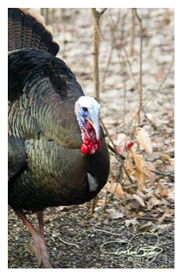
Watching jakes is fun but watching adult gobblers is something special.


Remember Murphy's Law? I wrote about it a week or so ago.

This quirky rule states that when hunting wild turkeys, if anything can go wrong, it will. Yesterday's hunt could serve as a great example.

It had rained a bit during the night, the skies were overcast, it was darker than the inside of a black cat, and I was walking across an open field on my way to a wooded ridge line. I woke up at 4:45 a.m., and not wanting to wake my wife, I fumbled in the closet for some pants and a shirt. I grabbed some jeans, pulled on a shirt and some sox, went out and got the newspaper, came back inside and dressed for the hunt.

Oops! Something was wrong.


I was midway across the field when it became obvious that I'd pulled on some jeans that were really too loose. I seldom wear a belt, but with every step, it was becoming more of an issue about my britches. I was 100 yards from my destination when I finally had to stop.

My trousers, underneath my rain gear, were down around my knees, and I was walking like a waddling duck. It may have been more meaningful if I hadn't been wearing rain pants, and if it hadn't been dark. I laid down the decoys and my Remington 870 pump shotgun, unhitched my rain gear, dropped those pants, pulled up my jeans, got an owl hoot (perhaps by an all-seeing owl), and continued on to my hunting spot.

The shame of it all. My unintentional strip tease in the misty rain seemed to set the stage for things yet to come. A quarter-mile away, in the black stillness of night, I heard a turkey crash down off his roosting limb, and it was followed by strong wing beats fading away into the night. Apparently one unseen bird was frightened from his roost by a half-naked stranger.

That thought put a weird smile on my face.

Moving in where I'd roosted birds the night before.


I reached my naturally camouflaged blind, put my shotgun flat on the ground where I wouldn't knock it down while wiggling in among some tree trunks, and then returned to the field to set up the decoys. I'd killed gobblers here before, and knew where the birds would come from, and placed the decoys with the jake-fake 35 yards out in front of me and the hen decoys about 45 yards out. This should make any live gobbler walk out in front of me and produce a good shot.

I put down my butt pad, wiggled around like an old lady pulling on her girtle, balanced the shotgun across my knees, and dug out a slate and box call, and laid them on a brown wash cloth next to my left leg. I leaned back, comfortable, and remembered pulling up my drawers in the middle of the field. I guess you had to have been there to appreciate it.

Thirty minutes passed before the tweetie birds began talking, and the first crow of the day flew over, cawing like a mad man, when a gobbler sounded off with a distant gobble. Another bird, much closer and behind me, joined in with a deep rumbling gobble, that shook the early-morning stillness.

I sat still, my calls and shotgun at the ready, and waited. I didn't want to join this party just yet. I wanted to see how many birds were nearby. Within 15 minutes, I'd located five gobblers, and they were mixed in with several muttering hens.

I held off calling until all five gobblers were dialed in.


I rasped out a soft little yelp, one that seemed nearly impossible to hear, but the keen-eared gobblers caught the faint sound and all five tuned in. I wouldn't answer, and waited five more minutes until one love-sick gobbler couldn't take it anymore. He gobbled lustily, and I called softly again, and he cut me off with a roar. I returned the favor with another soft yelp, and suddenly all five gobblers were cranked up.

Each Tom called to me, and I teased each one in turn, and finally only two birds -- obviously both without a hen -- remained. All of this had taken up more than an hour, but the two birds were still interested in coming to visit. They came in behind and downhill from me, and were close enough to hear their spitting and drumming. I did a tiny J-stroke on the slate just as the skies opened up and the rain poured down. The monsoons had arrived.

That didn't deter them. If anything, it seemed to re-ignite their fire, and both birds shook the ground with their gobbles. My shotgun was to my shoulder and steady across my knees when I heard the snap of a semi-dry twig. I was expecting it, didn't move, and then the landowner came over the nearby ridge with his tractor and manure spreader, tossing turds out onto the ground.

A tracker and manure spreader spooked them and I didn't get a shot.


It was too much for the skittish gobblers. They apparently whirled around and hauled tail feathers for someplace else. Just that quick, what had been an entertaining day was wrecked by Mr. Murphy and his weird sense of humor. I never saw the birds nor did I hear any other gobbles after that.

I was soaked to the skin by the time I got home. No turkeys, no shots, but one interesting and rather funny day afield. I thought perhaps you might be interested in how Mr. Murphy messed up my hunt but he didn't ruin my day. There's more to turkey hunting than shooting one, and my experience yesterday is proof of that.

Friday, March 04, 2011

Tricks to bow-shooting deer

Know how, when & where bucks travel and figure out how to outsmart them.

How about you? Are you like most bow hunters who are always looking for a shortcut. They continually wonder: what can I do to make each trip more successful?

First of all, don't expect every trip to be successful in terms of killing a deer. It won't be, and besides, if such a thing was possible, deer hunting would soon lose some of its appeal and become rather boring and tedious.

I've come today with a list of things hunters can do to increase their success rate, but I'll probably forget a few and that will make for another blog on another day.

Several tips to increasing bow hunting success.

  • Practice shooting every day if possible. Learn your bow, what it will do, and practice often with it. Everything else in these tips will fall apart unless you can hit what you are shooting at.
  • Hunting isn't just from October through November. It should be a year 'round activity. Of course, you can only shoot in season, but scouting is often overlooked by lazy hunters. Spend time in the field every week, and especially from mid-August through the end of September. In early spring, as the snow melts, look for those seldom-used trails that bucks often use to avoid hunters.
  • Pick ground blind areas and tree stand sites with the utmost care. Know why deer move to those spots, where they come from and where they are going. Learn their bedding and feeding areas, and how to get in and out without spooking the animals.
  • Don't go above 15 feet in a tree stand. The downward angles become more acute, and missing or wounding a deer become more likely for many people. Those deer shot at nose-bleed elevations on the television could have been shot from 15 feet just as effectively. This hunter in a Summit (1) tree stand prepares for a bow shot.

Become scent-free with a Scent-Lok suit.

  • Learn how to be scent-free. Above all else, hunt downwind of where deer travel. If the wind switches so you are not downwind of the deer, move before they get your scent. Wear clean, tall rubber boots to hunt in, and stay away from gasoline or cooking odors. My Scent-Lok suit goes on every day, and my tall rubber boots are sprayed daily to eliminate any odors. I dress outdoors away from any odors.
  • Sitting still is so crucial, and yet many hunters fidget and wiggle around, making noise and spooking deer. Learn how to focus your mind and body into silence without movement. Make a movement only when deer are feeding or looking away, and move in slow motion. Herky-jerky movements are easily spotted by nearby deer and they tend to create more noise.
  • Learn to see deer. Forget about those calendar photos of a big whitetail buck. Often, bucks are first seen by a flicking tail, moving ear, sunlight off antlers, but often the first sighting is just a piece of the horizontal body outline. Look as deep into thick cover as possible, and anything that moves in-between will be seen. Learn how to pick apart the cover in search of deer.
  • Learn how to get to and from a stand without scaring deer. Each stand should have at least two entrance and exit routes, and mix them up. Go in one way and out another, and try not to use the same stand two days in a row. You must pattern deer; don't let them pattern you.

A deer’s body language tells you about it so to hunt accordingly.

  • Study deer at every opportunity. Watch and study their actions and body language, and get accustomed to seeing deer at close range. Buck fever is a fear of failure, and the best way to get rid of that problem is to find a place where deer can be studied at close range. The more deer seen, the less often buck fever will occur.
  • Pick a spot. Good deer hunters never shoot for the center of mass; instead, they pick an exact and precise place where they wish to hit.
  • Always take high-percentage shots. This means taking only broadside or quartering-away shots. Wait for the deer to give you the shot opportunity you want. Don't take the first shot a buck offers. Allow them to move and turn, and present you with the optimum shot opportunity. Shoot once, shoot straight and don’t miss.

A hunter in a Summit tree stand comes to full draw & prepares to shoot.

  • Always know what other deer in the area are doing. Don't get so focused on one animal that you forget that other deer may be looking around for danger. Keep track of the deer, and know that one with its head down and feeding or looking at other deer are preoccupied. If the animal is in the proper position, aim, pick the exact spot, and don't lift your head until the arrow hits and the Game Tracker string flutters out. Always use a Game Tracker because it will help you recover a wounded deer.
  • Listen to your gut instincts. If you have bad feelings about taking a shot, or worry about missing, don't shoot. Your gut instincts are always right, and if you ignore them, a wounded deer may be the result.
  • Hunters have five senses. Use them all if necessary. Use your senses of hearing, seeing, and smelling. Those three senses are what a deer will be using to try to stay alive once hunting season begins.
  • Believe in yourself, your bow, and your shooting ability. Confidence is an important part of hunting, and if you feel confident, you will be. If you dither over choosing a spot to hunt, forget it.

There are many other tips, but these are enough to start with. Master these, and we'll think about a graduate course in the near future.

Posted via email from Dave Richey Outdoors

Tuesday, January 18, 2011

Michigan’s 20 largest inland lakes


Big pike are found in all 20 of these lakes. Fish near submerged weedbeds.


The outdoors is much more than just fishing and hunting. There is a vast store of knowledge about various aspects that I know too little about, and I take pride in my knowledge.

For instance: one glaring error in my outdoor education is my knowledge of bushes and trees. Sure, I know what beech, birch, maple and oak trees and their leaves look like, but throw an oddball tree my way and ask me to identify it, I'm as lost as last year's Easter egg.

I started thinking today about a question one of my kids asked 30 years ago. David asked: "Dad, have you fished every lake and stream in the state?"

A probing question from my oldest son.


The answer then and still is "no." I've fished a good number of them over my half-century of prowling this state, but there are many I haven't fished and may never try. Time is against me or most people who would try to accomplish such a daunting feat.

That thought brought me to today's topic. Someone emailed me this morning, and asked if I knew the largest inland lakes in the state. By sheer good fortune, I knew the five top lakes in terms of size, and could even name them in order; Houghton, Torch, Charlevoix, Burt and Mullett lakes. Beyond those five, I was lost and began doing some intense research.

An obscure DNR booklet named Michigan's 20 Largest Inland Lakes was found tucked away in a file cabinet, and the topic proved fascinating. Fifteen of the largest lakes are in the Lower Peninsula and five are found in the Upper Peninsula.

What follows is that list, ranging from No. 1 to No. 20, the county or counties where they are found, the size in acres, and the miles of shoreline (which includes islands) around it.

*1. Houghton Lake is in Roscommon County. It has 20,044 acres and has 30.0 miles of shoreline.

*2. Torch Lake is located in Antrim and Kalkaska counties, and has 18,770 acres. There are 40.8 miles of shoreline.

Some lakes have more shoreline miles because of points and other land features.


*3. Lake Charlevoix is in Charlevoix County. It has 17,260 acres, and the shoreline covers 56.0 miles.

*Burt Lake is in Cheboygan County. It covers 18, 120 acres, and the shoreline measures 30.1 miles.

*5. Mullett Lake also is in Cheboygan County. It has 16,630 acres, and the shoreline measures 31.6 miles.

*6. Gogebic Lake, the Upper Peninsula's largest inland lake, is found in Gogebic and Ontonagon counties. It covers 13,380 acres, and has 34.4 miles of shoreline.

*7. Big Manistique Lake, rests in Luce and Mackinac counties, and it is tied for 7th place with 10, 130 acres. It has 26.5 miles of Upper Peninsula shoreline.

*8. Black Lake in Cheboygan and Presque Isle counties, also has 10, 130 acres. It has 18.7 miles of shoreline.

*9. Crystal Lake in Benzie County is one of the state's most beautiful lakes. It has 9,711 acres and 20.8 miles of shoreline.

*10. Portage Lake in Houghton County was one of the last strongholds for sauger in this state. Fisheries biologists feel the sauger have disappeared. The lake has 9, 640 acres with 55.9 miles of shoreline.

*]11. Higgins Lake in Crawford and Roscommon counties has 9,000 acres. It has 21 miles of shoreline.

*12. Fletcher Floodwaters is located in Alpena and Montmorency counties. It has 8,970 acres with 24.7 shoreline miles.

*13. Hubbard Lake is located in Alcona County. It has 8,850 acres and 19.3 miles of frontage on the lake.

I’ve fish all 20 of Michigan’s largest lakes. It’s always fun learning a new lake.


*14. North and South Lakes Leelanau in Leelanau County covers 8,320 acres. It has 40.2 miles of shoreline.

*15. Indian Lake is found in Schoolcraft County. It has an even 8,000 acres with 16.7 miles of shoreline.
*16. Elk Lake in Antrim and Grand Traverse counties has 7,730 surface acres. It measures 25.8 miles around the lake.

*17. Michigamme Reservoir is located in Iron County. It features 7,200 acres but has 78.0 miles of shoreline.

*18. Glen Lake in Leelanau County includes the east and west basins, and covers 6,285 surface acres. It only has 17.0 miles of shoreline.

*19. Grand Lake in Presque Isle County. It covers 6,660 acres with 35.5 miles of shoreline.

*20. Long Lake in Alpena and Presque Isle counties has 5,652 acres. It has 25.3 miles of shoreline.

Keep this list handy, and it can settle any type of bar bet or resolve discussions with other anglers.

Posted via email from Dave Richey Outdoors

Friday, January 07, 2011

A new look at winter


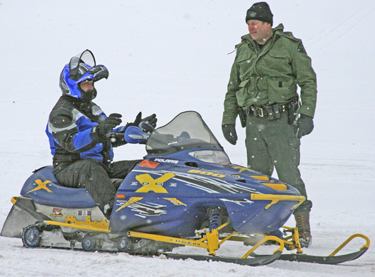
Use common sense on snowmobile. The DNRE is checking trails.

Yesterday and today, with their cold temperature and several inches of blowing snow, seems so typical of our annual two or three really nasty storms. For once, the county Road Commission was on the ball removing snow and icy crud from back roads.

It was a day most of us would like to forget. Frigid temps made it sheer misery to be outdoors. But outside I went, along with tens of thousands of other families in northern Michigan, to remove the residue of yet another heavy snow fall from our driveways.

The only saving factor today featured a pale lemon-yellow winter sunrise with lots of sunlight, and I stood outdoors for 20 minutes  watching the sun creep above the horizon and turn into a sunny morning before it began falling apart with more snow late this morning.

Live it up and enjoy the stark beauty of a fresh snow fall.


Winter, the coldest and nastiest of our four seasons, is much more than inclement weather. It's more than cold snaps or knee-deep snow, and snotty roads.

It's much more than felt-lined boots, ice spuds or two-pound monofilament humming from the pull of a bull bluegill in 12 feet of water under six inches of ice. It means more than Gore-Tex lined gloves, wool scarves, down-filled jackets or ear muffs. It is an attitude; a thought process; a willingness to live with the cold and snow, and still find it enjoyable ... most of the time.

Winter is a season of the senses. It's a time to use our eyes, ears, nose, touch, and yes, even our taste buds to better realize all the pleasures that the winter months can offer..

I'm a tracker, and always have been. It's fun to trail a fox or rabbit on fresh snow, and 60 minutes of walking the track of an animal can teach a hunter more about the critter than years of hunting.

Hearing is important, and for sportsmen, the finest sound is silence, which is nothing but the absence of noise. Nothing can compare with the soft hush of a cedar swamp or an evergreen plantation during a soft snow fall.

The swish of cross-country skis or snowshoes on snow is a delight that stimulates the senses. Silence on the ice is something to be treasured.

Paying attention to our five senses while outdoors can help us admire the winter.


Days when snow flakes  as big as half-dollars drift lazily down from a leaden sky makes me think of winter. It's easy to spend hours or days searching your soul in a cedar swamp looking for a snowshoe hares being chased by a long-legged beagle.

It's easy to overlook the clamor of a beagle pack (in itself a pleasing sound), and equally easy to forego the pleasant task of heading off the circling snowshoe hare. It's just as much fun listening to hounds in full cry as anything I can think of.

Many hunters find it easy to fall in love with winter during a long period of winter silence. It delivers a tonic for the soul which can't be found elsewhere.

Other winter sounds are common. The croak of a raven, and the early dusk hooting of an owl, are but two that trigger my winter thoughts.

Winter smells come to an outdoorsman clean, fresh and sharp. The air smells purer and less polluted now, and all smells appear stronger. A wood fire at home, and the scent of burning maple and oak is a winter tonic as it wafts across our nostrils.

Taste is one sense few sportsmen think about. I delight in the savory taste of a winter cookout, and it's always possible to catch a mess of bluegills for some of the finest eating in the world.

Hickory nuts are present in many winter areas, and if one can beat squirrels to them, the mast can offer a winter taste treat. They often seem a bit more winter-sharpened after lying beneath a mantle of snow for two or three months.

Touch ... it's a friend of the winter outdoorsman. Remember the first fox squirrel or red fox or cottontail rabbit you bagged? Chances are you stroked the soft fur and guard hairs, and felt a tiny twinge of remorse.

Snowmobiling can be a great time. Leave the booze home and be courteous and safe.

Winter is much more than cold, ice and snow. It’s a time to enjoy the outdoors.


Winter means more than a hunting, cross-country skiing or fishing trip. It offers the opportunity to get closer to nature and to see a side of winter wildlife that very few people know exist.

Search out the hidden wonders of nature, and use all five senses. You'll soon learn just how much fun winter can be, and it's not always necessary to fish or hunt. Living through a winter can be a good time.

Posted via email from Dave Richey Outdoors