Showing posts with label fishing. Show all posts

Sunday, September 23, 2012

Missing my twin brother

DRO-Missing my twin brother George.
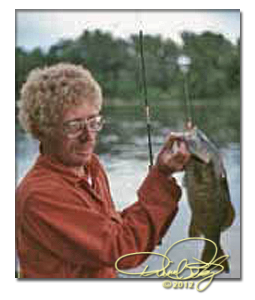
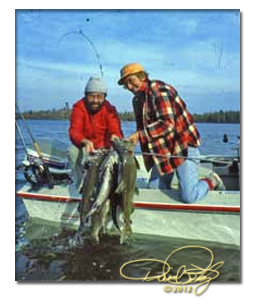
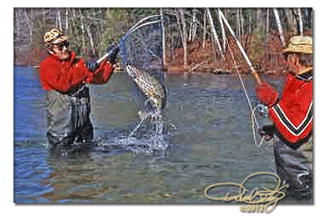
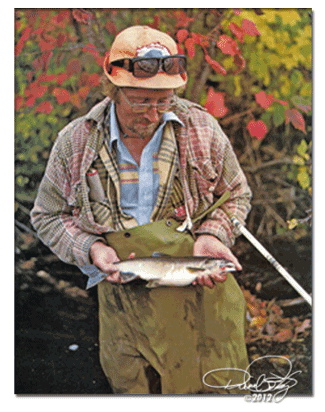
George Richey (both photos) landing and holding a big king salmon
photo c. Dave Richey Outdoors ©2012

September 10 is a day I won’t likely forget. It’s the first day of Michigan’s Upper Peninsula black bear season, but that’s not why I remember it even though I’ve shot a bear on that day on several occasions.

Yesterday was the ninth anniversary of my twin brother George’s death. It happened nine years ago. He was taken ill and learned he had seven different kinds of cancer, and four days later died in Traverse City’s Munson Hospital.

He faced his impending death bravely, didn’t quibble about the outcome he knew was coming, and greeted death on an optimistic note. I lay in his hospital bed, clinging to him while staring at the heart monitor. The flat line seemed meaningless because of the gravity of his various cancers. It simply spelled an end to a great life.

He didn’t fear death but embraced it

You see, George and I began steelhead fishing many years ago in the early 1950s, and we traipsed all over the Upper and Lower peninsulas in search of steelhead once we became old enough to drive. We were always together in the early years, and we could read each other’s mind. He could start a sentence and I could finish it. Twins often have such gifts.

We both loved the same things. First it was steelhead, and then jumbo brown trout in numerous locations, and then salmon came along in the mid-1960s. George jumped on the lure bandwagon by manufacturing a wide variety of Michigan Squids, Michigan Sparkle Flies and other trolling flies for salmon.

George’s son – Casey Richey of Frankfort – has taken over the fly business, and has expanded on many of his father’s ideas. Casey held the brown trout state record for a short time before it was beat by a larger fish caught in the Manistee River.

George had a long run with his lure business, and lived to age 63. He died just five months after I retired from The Detroit News as their staff outdoor writer-photographer, We made plans for countless fishing and hunting trips, and we both looked forward to retracing our earlier study of Lake Superior tributaries for steelhead.

We’d planned a more leisurely assault on such rivers as the Big Two Hearted, Huron, Middle Branch of the Ontonagon, Mosquito, and many others that we’d fished in the late 1960s. We’d planned a pilgrimage to the Rock River for pink salmon as we’d done in the early 1970s.

He had caught more than his share of Chinook and coho salmon during our 1967-1976 guiding career on Lake Michigan tributaries, and during his lengthy career in the lure business. He also tied fishing flies for added income, and came up with several flies that he formulated to work on clear and dark-watered streams.

George had a great deal of fun with big salmonids but he and I shared a secret love for back-of-beyond jump-across creeks and silt-laden beaver ponds for brook trout, and wee little ponds and lakes for bluegills.

He loved small fish as well, and loved bluegills and brook trout

He didn’t share in my love of big game hunting, but he would go on such trips just so we could share another memorable event together. He shot mule deer and whitetails in Texas, was on a one-shot big whitetail hunt in Quebec where we saw only one whitetail over a four-day hunt. He shot two caribou in northern Quebec, and one was a cow caribou, which he proclaimed, as “having a bigger spread than any whitetail he ever shot. That netted him a good razzing from others in camp, but George didn’t care.

“If they are picking on me,” George said, “they are leaving someone else alone.”

That was George. Many people knew him, everyone liked him, and those who knew him through his lure collecting, admired the depth of his research for his books Made In Michigan Lures and Made In Michigan Lures II. Both editions are available from me, and the first edition is rare and very collectible.

He was a picker. He could look through a mountain of old lures, often a pile that had been picked by another collector, and find the proverbial diamond in a coal mine. His skill at uncovering old Michigan-made fishing lures was legendary. His skill at identifying old Michigan-made lures was an enviable one.

In many respects, George was a legend in his own time. Not only as a fly tier, fishing lure maker, fishing guide, angling and lure historian as well as an outdoor writer.

George Richey had many loves and most of all were his old lures

Brother George and I grew up in a little town north of Flint (Clio) and moved north after years of barbering in Clio and Flint. He was a well-known hunter and angler, and many people came to pick his brain on a variety of topics.

He liked people, people cared for him, and he made a lasting impression on others. Readers often write me to ask if George and I were related, and when they learned we were twins, they didn’t know how there really could be two of us.

We were proud of being twins, and we each praised the other when such praise was needed. He’s gone now, but will never be forgotten by me or those who knew him, and I guess I may now  have to do the steelhead assault on the Upper Peninsula streams alone. It just won’t be the same without him but it will give us something new to talk about  when I meet him again up yonder.

I still miss him and that empty hole in my heart is where he lives.

Posted via email from Dave Richey Outdoors

Sunday, September 02, 2012

Come along on an outdoor adventure

DRO - King salmon caught on a Michigan Squid in the early fall
A nice king salmon caught in early fall on a Michigan Squid
photo c. Dave Richey Outdoors ©2012
The above title asks a good question, and it's been tossed my way for nearly nine years by many readers. My answer is invariably the same: why not?

Anglers and hunters can understand a column, which is nothing more than a bit of self-indulgence plus some solid fishing or hunting experience and information. Columns are about what I think, feel, do, believe in, rant against, etc.

The same thing can be said about a blog. A blog (short for weblog) is a daily journal of sorts. It covers the wide range of my daily emotions, and how I look at things through a bleary and somewhat biased or jaundiced eye. You may sense a touch of anger, animosity, joy, sorrow or other human emotions. My feelings on a wide variety of things is never far from the surface nor am I adverse to bluntly speaking my mind.


I've been writing a daily weblog since I retired from The News


You'll almost always feel my love for the environment, the animals, birds and fish that we hunt or try to catch, and you'll feel my sense of betrayal and delusion when some sorry dude levels perfectly wonderful wildlife habitat and then builds a shopping mall or hard-scrabble subdivision.

Readers will read my unabashed feelings on brook trout that invariably turn me on in their watery little trickles, and the litter that invariably turns me off when I must look at it. You'll note, hopefully with a righteous indignation like mine, when I bare my soul about the destruction of an ever-decreasing amount of wild land.

Hopefully, you'll share my glee when the DNR does something really great or get ticked off when they continue to do something utterly stupid like depriving you and me of the opportunity to obtain private-land turkey permits in Region II while granting such permits to people in the Upper Peninsula and southern Lower Peninsula.


My blog runs daily except when something happens to my computer


My weblog runs daily, and I've only missed a few days since November, 2003, and then only because some piece of crud hacked my website. My archives are available to one and all, and I urge readers to dust off some of them and see what you've missed.

You'll share my pain when my beloved twin brother George died on Sept. 10, 2003. You'll get as excited as I did when catching a 30-pound muskie, writing about the Christmas Tree Bomber, and other true tales. I invite you to walk with me when we go into a bear swamp for a hunt, and what is even more fun, when we walk out in the darkness. Jump into my tree stand as we bow-hunt for whitetails, and whisper in my ear when it's time to shoot a dandy buck or tell me to draw down on him and let up, giving him a life he could have lost had I shot.

Come along as we wade belly-deep into an area steelhead stream during those cold March days, and grab the net when we slug it out with hefty Chinook salmon in the fall. Let's take a walleye fishing trip on Long or Platte lakes, a bluegill outing to Arbutus Lake, and we can trudge through the January snow in search of cottontails and snowshoe hares.


Sharing the outdoor life with each other


Do you feel up to laying flat on the ground as Canada geese hover overhead, honking loudly, as our belly muscles tighten and we lever our way to a sitting and shooting position? Is there anyone out there who doesn't thrill to the loud and clattering flush of a ruffed grouse as the October dew dries on the ready-to-fall golden leaves?

Does any upland gunner fail to rejoice to the towering flight of woodcock as they dart and twist ever upward out of the alders before quickly plummeting to earth before we can swing and shoot

Calling predators with that high-pitched squeal of a dying rabbit is a heap of fun during the winter months as the coyote darts out of a thicket, and begins circling to a downwind location. We know a shot may be possible but it's nerve wracking to watch the animal close in on a spot straight downwind. Will we get a shot?

Fishing and hunting has been a major part of my life for more than 60 of my 73 years, and I eagerly await each new season and every new adventure. You ask me: why do I write a daily weblog?

I write because I have a strong need within me to do so. There is a deep need to write, and a need to share my love of fishing and hunting with my readers. I don't have to write for the money although I wish this blog and website paid more; instead, writing about the outdoors makes me feel good, makes me feel whole and helps smooth out all the rough spots in my life.

You and me, we can go places and do things. We can discover new places to fish or hunt, and learn more about what pulls us ever onward to another wonderful outdoor adventure. People who stay indoors, and watch idiotic game shows on television have my sincere sympathy.

Me, I'd rather be outdoors with a bow or rod in my hand and enjoying all that nature has to offer. How about you?

Friday, July 27, 2012

Max, the smallmouth bass

DRO-MaxBass-Dave
Me and Max years ago;  I no longer lip-lift or gill-lift fish to avoid possible injury
photo courtesy Dave Richey Outdoors ©2012
TUSCOLA, Mich. – Tucked down deep in a smooth run near a tangle of tree roots on the Cass River was a smallmouth bass – a special fish, because he was an old friend.

Mind you, when we first met, the fish was just a feisty one-pounder. He was all a’glitter with greenish-brown scales, a hint of red in his eye and the built-in temperament of a barroom bully with a belly full of bad brew.

He liked to scrap, and, like some fighters, he always seemed to lose. After two years of striking a variety of lures that hung from his lip when belly-lifted from the water, I named him Max, which seemed the proper name for a born fighter.

We had numerous dust-ups over a few years.


We were buddies years ago, and it’s been a long time since I thought about him.  This year’s bass opener brought him to mind, the same way we recall other old friends.

Max had a split in his dorsal fin, and was easily recognized/ He would come out and play each time I floated the Cass River, and once we finished our little fight, I would release him back to his favorite haunt. A little tired, perhaps, but losing a fight never seemed to bother the bronze-back – he’d be there, ready and eager to scrap each tune I  came into his life.

Max would come out to play whenever I canoed that section of river. I returned him each time he was landed, knowing he’d be there again whenever I returned. Few people ever fished that stretch of river because of all the uprooted trees across the river. One had to work hard to get through that section of river, but I always returned for another fight and he was most accommodating.

Max lived under a submerged root-wad in the Cass River


An old weathered maple had toppled into the river where he lived. The submerged root-wad offered him the security any fish needed to survive. The river poured over the roots, and the bass grabbed any lure, minnow or other morsel.

His only failing was that he was too easy. I never caught another smallie in that location, just my old buddy.
Three summers passed, and with two or three trips each summer on the river. I guess he was whipped by me a dozen times. Each time we tested the others’ mettle, and Max was getting bigger and more pugnacious.

I soon gave up lip-lifting him because I was concerned that such a method may break his mouth, and prevent him from eating, even though he could easily swim away. (See drawing.)

It was during the fourth season that I felt Max had become a solid four-pounder, but I couldn’t find him.. The canoe was eased into a small back-eddy of moving water, and I arched a cast into the new spot and the Beetle Spin came back without a strike.

The lure was changed, and several more casts were made without a strike.. He just wasn’t there.

It came time to analyze the situation. The area where Max had called home had changed during spring’s high water. Sand and silt had built up in the spot he’d called home, and either he left for another location or he had been caught and kept.

My spirits soared as the canoe was eased downstream 20 yards to another hole that was not sand and silted in. The canoe was tethered again to an overhanging tree limb. Ah, just right for an easy cast to his suspected new home.

The lure twinkled downstream with the current, bumping against some bottom debris, and stopped with a sudden jolt. A fish had sucker punched the lure, and I snapped the rod tip up to set the hook. A bundle of fishy dynamite known as a smallmouth bass, brook the river current with an explosive leap.

The bass cleared four feet of water in a head-to-tail jump


The split dorsal fin was easily seen, and Max now was red-eyed and wild as he surged downstream before skippering into the air again with another jump. He dove for bottom and tried to drive his way back into the submerged debris.

The six-pound monofilament hummed under the strain, and judging from his appearance, he had wintered well. He was a robust four pounds, and any stream smallie that size is a genuine trophy.

We settled into a bare-knuckle scrap. I’d give a bit; Max would take line and then falter slightly, and I’d press the advantage.

It was give-and-take as the battle seesawed for five minutes before Max began fining slowly, just out of reach. He was tired, and he knew he was whipped as I belly lifted him from the water.

He seemed to glare balefully as the hook was worried from his jaw. I held him for an instant, and briefly admired his sleek form. Then planted a smooch on his nose before lowering him into the river.

“Goodbye, old friend, and good luck,” I said as I gave him his freedom.  He whirled in the water, splashed a final salute with his tail and was gone.

I never saw Max again. I heard later that summer that a local kid had caught a five-pound smallie from the river. Was it Max? Who knows, but I never saw that bass with the split dorsal fin again.

I floated the river again a few years ago, and caught a two-pounder, which was belly-lifted while supported in the water and released. I named him Max, Jr.

Maybe I’ll try for him again this summer. He may like to come out and play.
-----
Read: Lip Grip is OUT! , an informative article from the O'fieldstream Journal about the dangers of the old-time Lip Grip. Plus, O'fieldstream provides solid advice to insure the bass you release has a far greater chance of surviving to live and fight again.

Wednesday, July 18, 2012

When big-water salmon disappear

These two anglers with a big salmon catch. A great fishing day!
photo courtesy Dave Richey Outdoors ©2012

These two anglers with a big salmon catch. A great fishing day!

It seems to happen almost every summer. There comes a period of a week or so when the salmon fishing slows down or seems to stop altogether.

Who knows why it happens. That part is not as important as knowing that it will occur. The major question is when it will happen. Salmon fishing has been hot up and down Lake Michigan.

Obviously, on any given day, a person or boat filled with people can get skunked or have a very poor showing. That part never bothers me now because fishing is just one more of many reasons to get outdoors and breathe some fresh air.

If the fish bite, that’s great. If they don’t, there will be no sad looks on my face. It is what it is, and we may not have any control over these things. Let’s not whine about it.

Forget about it, already!

However, I look at such days as an opportunity knocking on my door. It’s a day that suddenly is freed up. It allows us to change our plans.

Perhaps, weather permitting, we can arrange a fishing trip on an inland lake or stream. There are countless lakes in the Traverse City area where I can go to fish for bass, bluegills, crappies, northern pike, sunfish, trout or walleyes … just to name a few game fish species.

So what if these fish may not be as big as a lake trout or salmon? It doesn’t make any difference as long as I can find something out there that will pull my string, and make my heart do a flip-flop or two.

Mind you, years ago I would have been devastated by not catching some great huge salmon. The froth would be running from my mouth like saliva from a rabid skunk.

I’d kick the tackle box two or three times just for good measure. The problem is that outdoor writers need action and photos to produce magazine stories. No photos, no story, and no money. It’s that simple.

No unemployment for me. I could work my butt off, but hard work was no guarantee the weather would cooperate or the fish would bite or deer would move. Go for a week or two with no money coming in, and it’s enough to make a gent like me a bit testy.  I lived this life style for many years before taking a steady paying newspaper job.

Well, guess what; I’m retired now

I have been for more than nine years, and my fishing attitude has changed. There are no hard and fast rules. If I don’t get tonight’s blog done tonight, I’ll do it tomorrow and back-date it.

There was other work to be done. I was putzing around with an old Shakespeare bait-casting reel and took it in to get it  to get repaired. It needed a new handle, and the repair guy had one. Quick-like, it was done!

There is more stuff around my house that needs attention, and it’s time to find a home for some of it. I joined the Outdoor Writers Association of America in 1968, and they began sending me monthly newsletters. The paper edition continued until two years ago when OWAA went digital, and she has 34 years of the bulletin. Multiply both numbers by 12, and it amounts to lots of paper and the loss of more than a few trees.

I’ve still got them but need some room so two large plastic tubs were bought and it took both of them to handle the load. Now, they are so heavy I must partially empty them to move them into a storage unit. That would be almost a one-day operation, and my back is sore from tugging the heavy tubs around.

Someone with more time on his hands once came up with the saying: If life deals you lemons, make lemonade. There’s some sort of logic there.

To paraphrase that: If life robs you of a fishing day, find something else to do. Clean a reel, sharpen hooks until your eyes cross, put new line on reels that need it changed, and try to clean up things.

I may be insulting it by calling it a work-bench

I have what some might call a work-bench. That gives me too much credit for working or for needing a bench to work at. However, I start looking for something that often is on my work-bench, and in the process of looking, other things get placed there.

Eventually, it would take a small back-hoe to move stuff off my work-bench. So, when the opportunity presents itself with bad fishing or hunting days, I clean it off and put most of the stuff where it belongs.

Sadly, I think my home is infested with gremlins with nothing better to do than make a mess of all of my old fishing and hunting gear. I put lures back into the proper tackle boxes, strip old line off reels, and prepare them to have line added some other day.

Can’t do all of this at one time. Do that too often, and the meaning of having stuff to clean up and put away will be lost. We must be orderly, and remember what my first-grade teacher tried to pound into the minds of his six-year old students.

“There is a place for everything,” he lectured, “ and everything should be in its place.” Kind of sweeps over you, doesn’t it?

It didn’t make much sense back then, and still doesn’t. Being a pack rat means I enjoy a certain amount of clutter. It gives me something to do on rainy or windy days, and this should be things that are far more important that putting up screens or storm windows.

A wise man knows where his priorities lie.

Tags: Dave Richey, Michigan, outdoors, big-water, fishing, clean, gear, location, salmon, fish, success, skunked, Lake Michigan, away

Posted via email from Dave Richey Outdoors

Find a beaver pond and protect it

The late John Voelker, a.k.a. Robert Traver, casting delicately to brookies on his beloved Frenchman's Pond
photo courtesy Dave Richey Outdoors ©2012

My several experiences fishing Frenchman's Pond with the late John Voelker, a.k.a. Robert Traver, taught me many things about fishing for brook trout.

The Bard of Frenchman's Pond always believed in a calm and delicate fly presentation, and he believed these great game fish respond best to a cautious and delicate approach.

I think of the old Judge often, especially when fishing a back-of-beyond beaver pond where getting to the thing is two-thirds of the battle. The other third revolves around finding a receptive taker. Some beaver ponds are sterile.

Follow a creek upstream and maybe you’ll find a beaver pond

Voelker once wrote that the environs where brook trout are found are invariably beautiful but much of what man has created is not, and if Judge Voelker was right about anything, it was his thoughts that Man could screw up a one-car parade.

Brook trout fishing is occasionally too easy which is why gluttons and other fools who would take a limit of fish today, return to do the same spot tomorrow, and clean up what is left on the third day, should never fish such waters because it is inherently wrong. As wrong as it is, many fishermen subscribe to the theory that if the trout are there, they are meant to be caught.

Such thinking has sounded the death knell for many once-thriving beaver ponds and small streams. The fish simply are too gullible in tiny waters to pass up any chance for a meal.

Show me a beaver pond that holds brook trout, and if the word is spread around, it no longer will be a beautiful, unsullied, fish-producing piece of wonderful water. Sadly, many people subscribe to the "Me first" attitude where the first person in to a pond deserves the spoils. It reminds me of Genghis Khan's philosophy of rape and pillage.

I've been known to park my car two miles away and hike in to a beaver pond to hide its identity and location. I once fished a tiny pond that produced some 14-inch bookies, and the hiding place for my car was between two huge white pines where the boughs obscured my vehicle. I was never found in that location.

Many little jump-across creeks that flow out of a cedar swamp are destroyed; if not by human pressure, than by the worm containers and beer cans or bottles people leave behind. Such things weigh much less when carried out empty than when carried in full.

Beaver ponds come in all shapes and sizes

I began fishing brook trout at a tender age of 11 on some tiny Michigan streams. I began by using bait, and garden hackle threaded onto a hook with one split-shot above, was all it took to catch trout in those long-ago days.

It's all that is needed to catch brookies today. The bad thing is that undersize brook trout love worms, and they will swallow the bait. Easily two-thirds of the fish caught on live bait are killed before they reach legal size.

These days, if the area being fished is too confined for fly fishing, I'll use a number 0 Mepps spinner. Two of the three hooks are cut off, and far fewer fish are hooked too deep. A treble hook simply requires too much time to remove without killing the fish.

Beaver ponds are like rare jewels that sparkle in the distance when glimpsed through heavy conifers. They are generally small and very fragile ecosystems, where the removal of too many trout will cause it to decline into a silt and marl-bottomed pond with no redeeming features.

Don’t tell anyone about a beaver pond; Keep it a personal secret

Some of the best brook trout fishing I've had came on the land of a friend's friend. The man never invited anyone in to fish except my buddy, and he would run others off with threats of calling the police.

My buddy knew that his friend had a fondness for strong drink, and whenever we showed up, a pint of whiskey would change hands. He'd make some excuse to his wife about why we were fishing the pond, and our fishing trips usually began at dark.

We'd carry in our fly rods, waders, swim fins and a belly boat. Wading the edges of that pond was a death trap. We would set off into the darkness, sitting in the belly boat, and cast flies here and there along shore. My friend usually caught the largest fish because he concentrated on the deepest water near the beaver dam.

On occasion, we would speak to each other, but for the most part we silently fished in the dark. Most of those brookies were at least 10 inches long, and we caught a few 16-inchers. We would keep one or two of the smaller fish -- if we kept any at all -- and fished that pond only once or twice a year. The pond went out in a spring freshet when snow melt and heavy rain washed out the dam.

Beaver ponds are like that. They survive between being washed out, and once they are gone, the brook trout go with them. It's while they are vibrant and still alive that they can be the things of which anglers dream of but seldom find.

Posted via email from Dave Richey Outdoors

Sunday, July 15, 2012

Ethics: Rules to live by

Television personality Jerry McKinnis with a river salmon
photo courtesy Dave Richey Outdoors ©2012

Outdoor ethics are a bit like marriage vows. They are those hard-to-explain things that keep sportsmen from breaking fish or game laws if we think someone might be watching us.

That's fine, as far as it goes, but it's a gross oversimplification of a very complex issue. And, these issues baffle many sportsmen.

Stated another way, if you must look over your shoulder or around you before doing something, chances are you will be breaking a fish or game law. Perhaps, if you find yourself doing this bit of odd behavior, you might wish to rethink the situation.

Be aware of some ethical acts and those that are not

Outdoor ethics are those complex but unquestionable rules that sportsmen must follow whether others are watching or not. They are rules we must endorse if fishing and hunting will survive this century.

Want a few examples; Consider these

I had six chances to arrow a big 10-point a few years ago this October. He always showed up five minutes after shooting time ended. No one was within 500 yards of me, and no one would have known if I cheated and taken a late shot at that buck.

No one, that is, except me. It would have chewed at my guts like a malignant cancer until the taking of that big 10-point would have been reduced to a humiliating experience. It would have ruined my hunt.

One night last fall I climbed into my bow stand, tried to remove my wallet from my back pocket, and it wasn't there. My bow license was home on the dresser. I had a valid license but it wasn't in my immediate possession so my bow was stowed away in its case.

The evening was spent watching deer through binoculars. It was fun even without a bow in my hands.

A big problem with outdoor ethics is they are impossible to legislate and very hard to enforce. Only one person–you or me–can deal with ethical situations whenever they arise.

For instance: we shoot a rooster pheasant and it glides across a fence and falls on posted property. Does winging this bird give us the right to pursue it without landowner permission? Nope.

We're fishing in flies-only water for trout and a stiff breeze puts down the hatch. Is it ethical to fish worms here? The answer is no.

Or, as I mentioned earlier about the10-point buck, could I have cheated and shot? Sure, but I would have had to deal with my emotions and my personal sense of right, wrong and/or guilt.

It is legal to shoot a grouse on the ground but it's not ethical

Mallards pinwheel down on a freshening breeze to spill into bobbing decoys. It's a perfect morning, and five minutes before legal shooting time. Hunters in a nearby blind have shot and dropped two hen mallards. Does that make it legal for us to shoot early as well?

The answer is an obvious “No” but some hunters would shoot any way, and could be ticketed by a Federal or state conservation officer.

Ethics prevent us from doing illegal or quasi-illegal acts. Hunters don't shoot ducks on the water unless they've been wounded or shoot grouse on the ground. We don't snag fish, and we don't keep undersized fish or fish over our limit.

Know the rules; Read annual fishing-hunting digests

Buying a fishing or hunting license is no guarantee of a full game bag, a trophy buck, a hefty creel or a brace of pheasants. The license only grants us an opportunity to fish or hunt during the legal season. It offers sportsmen nothing more and nothing less.

Ethical behavior is a topic as personal as the color of our morning toothbrush. It also serves as the bare-bones foundation on which our sporting ethics are built. We are judged by our conduct, and those who wink at fish or game law violations or encourage any breach of ethical conduct, do themselves and other sportsmen a real disservice.

Posted via email from Dave Richey Outdoors

Friday, July 06, 2012

Troubled times and the written word

Dave Richey and his books
Dave Richey looks through book files for a certain book
photo courtesy Dave Richey Outdoors ©2012
Folks, no one needs to tell us that these are troubled times.

Many jobs are in peril. Job security is questionable or even doubtful. Many folks are out of work, and homes have been foreclosed on and lost.

Management in some areas don’t worry about the worker. Insurance rates are rising, as are prescription drugs, and many wonder how long they can hang on to their job.

Amid all these worries is the desire to fish and hunt more, and spend time outdoors. The cost of travel has skyrocketed with $3.75-per-gallon (or more) gas, and fuel prices don't show any sign of going down soon. Jobs are leaving this state daily, and billions of dollars go overseas while our workers wonder about their future.

Sportsmen want to fish and hunt more. We find it difficult to justify a trip north for a two- or three-day fishing or hunting trip because we'll easily spend $150 or more for gas, another  $100-175 for a motel for one night, add another $75-100 for food, and suddenly the
price of fishing and hunting becomes very expensive.

A wealth of knowledge is just waiting for you to discover it


What can anglers and hunters do to take the edge off their outdoor cravings. It's simple, and much like my need for a fishing or hunting fix when as a kid. If a round-the-world trip cost only $10, I couldn't get out of Clio, my hometown.

Each year I managed to squirrel away money to pay for subscriptions to Field & Stream, Outdoor Life and Sports Afield magazines. I devoured every word, and then as my meager job paid a bit more money or I took a second job, I joined the now-defunct Outdoor Life Book Club. Once a month would come a notice about an upcoming book, and if I thought I'd like it, the book would be ordered.

Mind you, being entertained in your mind through the magic of the written word and a wonderful photograph isn't quite the same as actually fishing or hunting, but it provided an escape for those of us who couldn't shake loose $200 or more for a weekend fishing or hunting trip.

Books can provide that mental escape we need to visit another world, to a place where fish bite and where big bucks are abundant. It can take us to places where big browns sip flies off the surface, where grouse and woodcock inhabit tag alder runs and dogwood thickets, to places where rooster pheasants cackle in mid-air, and a wedge of bluebills skim the tops of white-flecked waves under a pewter-grey sky.

It was an inexpensive way to escape the humdrum of an era 55 years ago when the economy was shaky. Car sales were poor, and I lived in Clio, a bedroom community north of Flint. Most people worked for General Motors in Flint, and many people were out of work.

Books carried me along on a voyage of discovery, to a place where vicariously, we fished alongside Ernie Schwiebert, listened to the tales of Robert Ruark's Old Man talking to the boy. Now, because of books, we can learn about Louis Spray and the meanderings of his life, to the Green Hills of Africa with Ernest Hemingway, to the wonderfully written books of the incomparable George Bird Evans and William H. Foster.

Some literary giants wrote fishing-hunting stories


We can read and inherit the love of hunting from the late Jack O'Connor, whose books are steadily increasing in value. O'Connor has almost as many fans now as he did 50 years ago, and his skill at writing hunting stories was legendary. He was the real thing, and not a young wanna-be outdoor writer trying to sell his wares today.

Book catalogs that deal with fishing and hunting titles are wondrous things and I get a few every month.  Name the genre, and there are books out there to fit the wallet of every sportsman. Muskie fishing and turkey hunting are my two passions, and I spend time looking for those books on these topics that I don't have or simply can't afford.

I maintain lists of books I need. Some books are author signed, and many are not. Some books I need are low-priced and common and a few are expensive. Books allow people who can't afford a fishing or hunting trip to pour themselves into a good book and come out the other side knowing they've experienced something grand and wonderful while learning something they didn't know before.

Most of you know I buy and sell fishing and hunting books. I still read, everything from a cereal box to a mystery to a nonfiction fishing or hunting book. Some people don't know what they want, and they contact me and we discuss it by email.

Books are the gift that keeps on giving. Christmas is a long way off but a good book can be read over and over again, and instead of a goofy power tie for work, take Dad’s mind off work worries with a book on a topic of interest to him. Buying gifts now removes the panic that sets in if you forget to shop.

Forget TV; Books energize the mind; eMail me for help.


Take a look at my books on Scoop's Books.  On the Landing Page, scroll down and click on Scoop's Books Catalog, and take a look around.

If you need a specific title that isn't listed, email and ask if I have it. If you are thinking of selling fishing or hunting books, contact me. I buy books all the time, and you may have what I'm looking for, especially if it is on turkey hunting.

If you need help with a certain book purchase, contact me for assistance. Reading a good book may not be quite as exciting as actually catching a fish or taking a big buck with a bow, but when travel to do these things become almost cost-prohibitive in these economic doldrums, reading about fishing and hunting beats whatever else comes in second-best.

Wednesday, June 27, 2012

Homer Circle: A Legend Among Legends

HOMER CIRCLE

I’ve been a member of the Outdoor Writer’s Association of American since 1968, a year after I began writing outdoor magazine articles for Sports Afield and other major outdoor magazines. I needed a member to sponsor me for OWAA membership, and since Homer Circle, angling editor of that magazine was one of my favorites, I asked if he’d do me that favor.

Uncle Homer, as he was known to millions of anglers, quickly agreed. A month or two later, I was accepted as a member. A year later I attended my first OWAA annual conference, which was held in Duluth, Minnesota.

I attended my first conference that year and met the great man in person. We chatted about fishing, and over many years we became good friends. That friendship continued until last Friday when Homer Circle passed away at the age of 97. Now, more than four decades later, I could Homer’s sponsorships as a major highlight in my life.
Meet My Friend, HOMER CIRCLE
photo courtesy Bass Research Foundation

He had fished in many places, and written many magazine articles, but I remember Homer for one specific talk we’d had at a later OWAA conference.

We had covered each other’s lives, and caught imaginary fish together, and he was a walking encyclopedia of fishing information…  and a joker. He was known for telling some pretty corny jokes, but then we settled into our conversation, and it was one most people never share with others, but one that often drifts my way.

Death was the topic that day, one that rarely is discussed, and over many years we happened to drift back to cover our tracks. I’ve had such chats with John Voelker (Robert Traver), Dale Earnheart, Homer Circle, and several others. Homer led the way on this day, and it soon became apparent that he had given this topic great thought.

“I’m getting old,” he said, “and will be in my early 80’s this years. I expect I’ll have some of the normal miseries that come with old age.”

“Like what,” I asked, thinking that he was as sharp as a carpet tack.
“Ah, the usual things like arthritis, forgetting things, aches and pains in my body … that sort of thing. The brain is still working fine.”

“Sounds to me like the normal process of growing older.”

“I guess, but I’ve got all my plans laid out. My old buddy Tom Mann, and I have chatted about the hereafter, and for me, I’ve decided to be cremated. It’s a big decision, and I wanted to make certain everything is set right and proper before the need arises.”

“How so,” I muttered half aloud, wondering how a living legend went about setting up plans for his own death and cremation.”

“Tom and I have worked out a plan. Once they toast me up nice and proper and turn me into five pounds of ashes, Tom is going to mix up some of that goo he uses to make plastic worms. He is in charge of tossing my ashes in and stirring them up.”

And that’s where his story got more than a little interesting.

“Tom will set up a special fishing lure campaign. It will be called the Uncle Homer Fishing Program, and once these special worms are all cooked up with my ashes mixed in, he will make a news release.

“It will be called Uncle Homer’s Bassin’ Worm, and they will be made in several colors. On the outside of the package will be a picture of me, a short write-up, and an invitation to Take Uncle Homer Bass Fishing Again by buying and using these special worms to catch bass.”

“Uh, yea, I guess that would work,” I said. “I’d bet lots of people would buy those Uncle Homer-dosed-up lures.”
And then, the topic slowed to a stop and we began talking about other things. The odd thing is over the years that followed, the topic never came up again.

That was his story, and now we must wait to see if such a magical plastic worm comes onto the market or whether Homer Circle, with his marvelous sense of humor, was just telling another story and using himself as the focal point.

So, until we meet again up yonder, I’m still on a high lope, and can only say: Go With God, Homer. Millions of your fans and I will miss you, and, if Tom Mann makes such a lure, I’ll buy one and take you bass fishing again.

HOMER CIRCLE (1915-2012)

Thursday, June 14, 2012

Muskie Fishing’s Oldest Guide

BOB BRUNNER


Legendary is an honorary distinction bestowed only on a few fishing guides each year. It is an acknowledgement that a person has attained legendary status: a man who has made a visible impact on fishing over a period of many years.

The National Fresh Water Fishing Hall of Fame in Hayward, Wisconsin awarded Bob Brunner of Utica, Michigan, this distinctive honor several years ago. He was inducted into the Hall as a Legendary Guide.

Competition among people who lobby for their nominees can be intense, and those who are granted this high status by the Hall's voting committee are richly deserving of such an honor.

A lifetime of muskie fishing on Lake St. Clair


Brunner has been a muskie-fishing guide on Lake St. Clair for many years. And, unlike other guides, he does his fishing in a most uncommon way on this great body of water near Detroit: he chooses to cast rather than troll, unlike 99.9 percent of the other muskie anglers on that fish-rich body of water between Lake Huron and Lake Erie.

"I've fished Lake St. Clair since 1929 and caught my first muskie in 1931 when I was six years old," Brunner told me. "Dad and I fished the lake every Sunday for many years, but now at the tender age of 89, I still have people ask me to teach them how to cast for muskies. I rarely troll for them because I feel I can get my clients into much bigger fish by working the weed beds where trolling is very difficult to do."

Bob Brunner with a 50-pound muskie he caught a few years ago

Lake St. Clair is, beyond any doubt, the best muskellunge lake in North America. There are more muskies per water surface area than anywhere in muskie country. This is why Brunner chooses to guide on this shallow lake. The chances of catching one of the big girls is better on Lake St. Clair than on any other lake that holds these grand game fish.
The largest muskies of all are always females. Male muskies do not grow as large as females, and they are what he fishes for.

"I have never run an ad and I'm still booked most of the season," Brunner said. "People come from all over to fish with me because they know I work hard to put them on big fish. If a person is willing to travel 50 or 2,000 miles to fish with me, it's my job to put them on a big fish so they will hopefully catch the muskellunge of a lifetime.”

He loves to fish for most game fish species but muskies are the love of his life. That is one reason he has written numerous books about how and where to catch Great Lakes muskellunge. Brunner has developed a strong cult following among muskie anglers, and his methods differ greatly from guides who troll.

"I want people to be able to catch these great fish and enjoy life as much as I have," he said. "My books are not all about muskie fishing but some of them are focused just on these great fish while some cover other species as well.  I believe my book, Casting: The Feast Or Famine Of Fishing, is my best work. It explains where to fish, which lures and methods to use and where to use them."

Brunner is the author of several muskie-fishing books


Sadly, most of his books are long out of print and are very collectible. I have a few duplicate copies, if anyone is looking for a copy. I don’t have duplicates of all of his books but do have several of the highly sought-after titles. Contact me at dave@daverichey.com

Brunner says his best times on the water are those spent teaching kids how to fish. He enjoys having kids on his boat, but as long as he can put someone into fish, he's in his glory.

His first business card said "On-water lessons available at reasonable rates." His first two clients were a father and son for the boy's 14th birthday. After they spent a few hours casting around several Anchor Bay areas, the kid hooked and landed his first muskie. It was a fat 40-incher caught on a spoon and the boy was hooked for life.

"I knew then that I had to get more children and their parents out fishing," he said. "So here I am, many years later, and still trying to get kids and people involved in this sport. I have been releasing muskies since the early 1970s.

"When I teach someone how to catch fish I feel I'm doing what the Big Guy wants me to do. The look on a kid's face while he tries to reel a 48-inch muskie to the boat is something that words cannot describe. It makes me feel warm and fuzzy to see a child so happy because he caught a fish where I said one would be. I feel blessed to have helped so many kids land their first muskellunge."

Brunner feels that muskie fishing has exploded over the past 15 years and it is hard to keep up with the many changes.  He feels saddest that now his life's journey is nearing its end he won't be able to fish the many other great muskie hotspots that he has fished over for so many years.

"I have met some really great people in my life and some have taught me some very valuable lessons," he said. "Two are the Richey brothers -- Dave and George. We lost George nearly nine years ago to cancer, and he was a great person and a skilled fisherman.

“George fished with me once a year for over 10 years. He taught me that we are all the same, and he was great company on the boat. He was one of the very few anglers that could beat me casting for the big girls."

Legendary guides aren’t common but Bob Brunner fits into this category


There is no doubt about it: Bob Brunner was well qualified for induction into the Hall of Fame as a legendary muskie-fishing guide. He rightfully deserves this recognition, and I look forward to fishing with him this fall for one of his "Big Girls."

I hope we can make our schedules fit. He is a special person in my life of muskie fishing. The fish in the photo above is of Brunner’s biggest muskie, one that weighed about 50 pounds.

It’s obvious there are more small muskies than big ones, but the one thing about muskie fishing is it is addictive. Catch one big fish, and doing so may turn an angler into a die-hard fisherman that lives for the next vicious strike from one of Brunner’s “Big Girls.” It’s a risk than many anglers are prepared to take when fishing with this Legendary Muskie Guide.

To Contact Bob:

Friday, April 27, 2012

Buying old turkey hunting books

Scoop's Books sells antique, rare and hard-to-find sporting literature
Unique, Rare and Hard-to-Find books are what Scoop’s Books deals in: looking for and For Sale. Contact us today to Buy or Sell.
photos by Dave Richey
I spent just enough time outdoors today to go to the doctor, say hello to my neighbor and bask in the warming breezes. I’m trying to work some nasty knots out of my back, and it’s not working very well.

At 45 degrees, the weather seems almost balmy. I spent some time arranging and rearranging books that will be for sale on my Scoop’s Books website. Some titles are once-in-a-lifetime acquisitions for any sportsmen and some are moderately priced. I may have a new address for my new book website soon. I hope to have 1,000 or more fishing and hunting books up very soon.

These fishing and hunting books are meant to provide two specific things for book buyers: education and information.

I also am placing some books on eBay for auction purposes. Feel free to check them out.

I want to buy your old turkey hunting & duck decoy books

It's obvious that not all sportsmen like to read books, and that is OK. They just don't know what they are missing. There are so many fine fishing and hunting books available and listed on Scoop's Books. Find a book cover that interests you, and email me at the above email address to see if the book is still available.

A hunter might ask: why buy a book on deer hunting? I already know how to deer hunt. Good question but a poor answer. Anyone who doesn't study deer regularly will know something about hunting these animals, but won't know enough about how to hunt them when the going gets tough.

It's the same with turkey hunting books. I buy as money as I can afford for my collection, and still need some others. If you have any turkey titles, and might consider selling them, send me a list of the book titles and the author's name, and I'll get with you soon.

Lots of people can cast a fly, but there are countless books available that can help with casting more accurately but also can teach us how to read the river, determine which insect is hatching, and which patterns will help fool the fish. Nothing is ever guaranteed except paying taxes until you die, but reading can broaden your horizons and help people learn new skills.

I'm constantly looking for fishing or hunting books to buy. I need to buy books in order to sell books, and I'm picky about condition but pay fair prices. So just what am I looking for and hope to buy from you?

I'm primarily interested in turkey hunting titles now. The scarcer they are, the better. Common turkey hunting books I don't need.
The easiest answer is for you to tell me the author's name, the title of the book, and whether it is a paperback or hard-bound book with a dust jacket. From that tiny bit of information, I can usually determine whether I may be or am not interested in buying that title.

Contrary to popular belief, all fishing and hunting books are not scarce. Most also are not worth big money. Many books I turn down are not worth $5, and I have no need for them. But for you, the potential seller, I will pay within reason what it takes to buy books in good shape that I want for resale.

Books with damaged covers, childish scribbles, underlined passages, highlighted sentences, damp-stained covers or those with other faults are not worth offering. I never buy musty, mildewed or ex-library books because they usually aren't worth owning.

Anything noted immediately above is what I don't want

So, c'mon Richey, what exactly are you interested in? I seldom buy new titles. I never buy Readers Digest or condensed books. I prefer books that state 1st edition or 1st printing on the copyright page. I absolutely will not buy print-on-demand books.

Topics of interest to me include Atlantic salmon, muskie, brook trout, tarpon, fly tying, bamboo rod building and other types of fishing books work for me. I crave good books on hunting ruffed grouse, deer, ducks, geese, upland game, wild turkey, woodcock and other hunting books. I have a mild interest in African hunting books but am picky about what I buy. I do pick up books on duck decoys.

Some hunting authors that I'm collecting. Please save this list. There are certain authors I collect.

Robert Austin Fred Bear Havilah Babcock Larry Benoit Wayne Bledsoe
Stewart Bristol Bob Brunner Nash Buckingham Doug Camp Thomas C. Chubback Burns
Peter Hathaway Capstick
(first editions only)
Russell Chatham Wally Chodak Thomas C. Chubb Malcomb Commer
Wingbone Cryer Eugene Connett Ralf Coykendall Paul Dalke Henry Davis
Jack Dudley John Duff George Bird Evans J. Wayne Fears Bill Harper
William Harnden Foster Percy Haver Marv Heeler Vic Jansen John Knapp
Dana Lamb Homer LeBlanc J. Stockley Ligon Doyle Loadholtz John Lowther
Thomas McGuane John Minor Art Moraski Richard Nissley Jack O'Connor
Hoffman Phiilip W. H. Purser John Pusztay Larry Ramsell George Richey
Robert Ruark Ernest Schwiebert Louie Spray Bob Swineheart Robert Traver
Jack L. Turner Ted Vogel Alfred Weed

and many more.

I'm always interested in any books written by Michigan turkey hunters like Denny Geurink. State published turkey hunting, management, ecology, roosting habits, food habits, etc. are needed.

People have nothing invested in offering me books for possible purchase. If I can't or won't buy your books, I'll be happy to explain why. If I do buy, know that I will give you the highest possible price, and hope then to be able to resell the books for a modest profit but that doesn't always happen.

I've never cheated anyone, and don't plan on starting now. My reputation is excellent, and I sell books off my website and some by mail order sales. It's in my best interest to pay the highest possible price, and still realize a potential profit.

I grade books fairly, charge a fair price and pay a fair price when I buy. I've been buying and selling books for 43 years, and one doesn't stay in this kind of business for long by cheating people.

Give me a try. The nasty winter weather is behind us, but late spring rains may stall your outdoor activities.  Take a bit of that time to dig through that pile of fishing and hunting books stashed in the attic, barn, basement, cellar, closet, garage or wherever, write down the author's name, the book title, and whether paperback or hardcover with dust jacket. If you can read this, you can certainly email me and tell me what you have for sale.

It's that easy. And who knows? The book you sell could be valuable or not, but the payment may allow you to purchase some fishing or hunting equipment. Try me and let's see what happens.

Wednesday, April 18, 2012

Apathy describes many anglers and hunters

What would spring fishing be like without steelhead?

Apathy is killing our outdoor heritage activities. Speak UP for hunting and angling activities. If we don't we'll loose them.
photo Dave Richey ©2012
Does apathy adequately describe many of Michigan's anglers and hunters? I think it does. For those who haven't visited a dictionary, apathy means a lack of emotion or feeling or a sense of indifference.

An election in 2006 proved that most hunters didn't care much about a Michigan dove hunt. The measure got whipped in a bad way, and few hunters seemed very upset about it. No one seemed to care.

Folks, believe it or not, but that vote for a Michigan dove season went much deeper than keeping state sportsmen from shooting mourning doves. It was the first big step in a long parade of other items that can and one day will be stuck on the ballot. The next one might directly affect something you feel strongly about.

Would apathy keep people from fighting for their country?

How would you feel if it was put to a vote to end archery hunting. Or,  the next vote may be to prohibit firearm hunting for deer and/or other game species. It might come to a vote to outlaw dogs while hunting which would affect most bird hunters and bear, bobcat, coyote and fox hunting. Don't think so? Dream on!

Does anyone out there understand that the anti-hunters whupped us on the dove issue? Why, because many hunters are apathetic. They don't care enough to get involved. They wait for others to fight their battles for them. Read again the definition of apathy. It's present here.

I know a guy who whined about the dove season being defeated. The man has never voted for anything (including presidential elections) in his life, never discussed hunting issues with anyone other than his buddies, and he was most upset when I told him he didn't deserve the opportunity to whine and gripe. That behavior is reserved for those who have enough courage and gumption to vote.

People who don't vote on issues of importance to anglers and hunters should have no say in how a democracy is run. And trust me on this: anti-hunters know that sportsmen are unwilling to take a stand, and many folks claim to be too busy to vote. Say what?

Who among these unenlightened sportsmen is willing to wake up and see what goes on around them. They gripe and complain about a possible raise in license fees, but when the sporting segment of this country needs help to fight anti-hunting measures, where are these folks? They are too busy to care. Apathy reigns supreme.

Many avoid the voting booth as if the curtains were coated with asbestos. The day of letting others fight our battles is over. People who want to hunt, now and in the future, had best realize that forces are underway to eliminate all types of hunting. Wake up!

The deer kill was down last year. It also was down the year before last, and likely will be down again this year. Do you care? As a hunter, aren't you concerned about a declining deer herd? You should be

Will the same people who are against legalized hunting want to ban ownership of firearms? What will happen to our wildlife if the DNR has no money to manage it, which has already happened. Will the United States become neutered like Australia and Great Britain? Does anyone care? People need to get a grip on reality soon.

An out-of-control deer herd is entirely possible. The state has worked hard for years to reduce the herd size, and in many areas, they did their job too well and the deer numbers are way down. We saw the results of this problem the last two years. Each person can make a difference but they must get off their backside, learn what the really important issues are and get involved.

Michigan United Conservation Clubs, the state's largest conservation organization, is trying to fight the good fight. They keep people posted on what is happening, but MUCC membership rolls have shrunk dramatically from their highs of 20-30 years ago.

Why? The short and ugly answer is public apathy. Sportsmen no longer care about joining groups. They often say they don't have time or money to be a member. And for some that is probably true.

Others have different priorities. Where fishing and hunting was once their good time, bowling and golf may have replaced some of the leisure time activities. Others simply are not joiners, and care little about joining Delta Waterfowl, Ducks Unlimited, National Rifle Association, Trout Unlimited and many other excellent organizations that are trying to fight for all sportsmen.

Where do we go from here? I'm one man, preaching to the choir and to those who enjoy reading about the outdoors and who has nothing against hunting, but I'm only one man. I'm not a one-man army.

Speak up and show some true American spirit

Others must stand up and be heard. They must stand and fight the good fight. Are you willing to step up to the plate for our fishing and hunting and wise management of those resources?

I've heard it many times at a conservation club, Kiwanis meetings, or in other places. People actually ask me to fight their battles for them. I'm just one man with one voice, but they must make their voices heard. Sportsmen must become involved before it is too late.

Hunters of all stripes, whether bird hunters or a bear and deer hunter, must unite under one common banner to endorse all forms of legal hunting and be prepared to vote on critical issues. If one method of hunting is lost, as happened on the dove issue, anti-hunters will go after the next least defensible hunting method. Will it be bow hunting as many believe?

It could be dog ownership which would hurt hunters who use a pooch for their sport. If they don't support bear and deer hunting, and treeing coons with a hound or chasing bunnies with a beagle, than it is quite likely their lack of action will help future anti-hunters win.

The past issue was supposedly about dove hunting. That's nonsense. It was simply the first nail in the coffin of legalized hunting in this state, and hundreds of thousands of hunters stood by and watched it happen.

How sad. And who will feel sorry for you when your favorite fishing or hunting sport comes up on a ballot, and one by one, our outdoor pleasures and heritage are taken away from us because apathetic sportsmen don't care enough to become involved?

Or because they are too lazy, and cannot comprehend what is happening to them. It's time for many people to wake up, smell the coffee brewing, pull on their boots and fight for our hunting heritage.

It really is worth fighting for. Grow up, wake up, and fight. And if we lose part of outdoor heritage because of apathy, don't come whining to me to fight even harder. I've fought this battle for more than 50 years.

What exactly have you done?

Tuesday, April 17, 2012

Looking forward to the trout opener

Sometimes I enjoy big-water fishing off the beach

Michigan trout opener, harbinger of new fishing season
Michigan's trout opener hits the waterways the last Saturday in April. Grear up for another great year of fishing.
photo Dave Richey ©2012
My memories of the general-season trout opener are strung out now over 60 years, back to those days when my late twin brother George and I would have a visual race. It was to see who would be the first to spot the Sturgeon River glinting through the late-April sunlight.

Spotting the river first was as much fun as hooking a fish. We would count down the days to the opener, and in those days, a desperate anticipation overcame us. We were ready, and had been primed for the opener for many lean months.

It became a visceral thing. We could feel it coming, and each check mark on the calendar brought us one day closer to when we could fish our beloved Sturgeon River between Wolverine and Indian River in Cheboygan County.

We could sense the thrill and excitement deep in our guts

We could easily remember the first cold chill of the river current gripping our skinny little legs. We'd pick the brain of George Yontz, the steelhead guru of Hillside Camp, three miles north of Wolverine on old M-27.

We had fresh six-pound line on our reel, sharp No. 6 or 8 Eagle Claw gold hooks, and carried our treasured jars of Atlas salmon eggs. They sold for a buck a jar in those days, but salmon eggs produced better than worms or other bait.

Those early days meant a limit catch of 10 trout per day, and the Wolverine Hatchery and its hatchery truck planted fish just before the opener. It took years of catching lots of small trout in Phase 1 of our trout-fishing education before we arrived at Phase 2. That was when we'd had enough of the tiddlers and wanted more than a flip-flopping small trout.

We were primed and ready. It was an adventure for us

We wanted bigger fish, and it wasn't long before we were catching our fair share of steelhead. That phase of catching big fish stuck with us for many years before we graduated to accepting the challenge of meeting and greeting our trout in tough places where catching any trout -- large or small -- was a difficult challenge.

Many opening days have passed with the speed of an old man racing headlong through life, each year passing even faster than the previous one. To think that 60 years have gone by, and I've been out there for every opener to capture the moment with fly rod, spinning rod of camera, is a testament to my devotion to these grand game fish.

There have been a few openers where the Blue Wing Olives and Hendrickson's hatched well, but more often, the opener produced high winds, rain, and very often snow, and the fishing wasn't worth beans.

Art Neumann of Saginaw always handled the countdown

However, trout fishing isn't all about catching fish. It means meeting old friends, discussing past openers, learning who had fished around their last bend, who was ill and couldn't fish, and where the hot-spots might be later in the day.

For 23 years I covered the opener for the newspaper, and that usually meant very little fishing. Sometimes, if the action was good, I could shoot photos and write my copy, and still have time to fish for an hour or two.

Trout fishing also was George's love, and we shared so many wonderful days together on so many Michigan streams, and each one brought both of us a sense of peace and tranquility. We often didn't talk because twins know what the other is thinking. It's true in many cases, and especially for us. We didn't need to speak.

George and I could always communicate without talking

Many times I'd nod my head, George would spot the Hendrickson lift off the surface, and we both marveled at this transformation from a nymph to a flying insect. Sometimes a grunt and a look would indicate a mink running the bank or the flash of a trout under a sweeper.

We spent so many years greeting the dawn somewhere on a trout stream. We both loved the Holy Waters of the AuSable and Manistee rivers, but sometimes we would be on a steelhead stream or fishing a back-of-beyond beaver pond. Tiny cedar-shrouded jump-across creeks and brook trout were on the agenda at times, and occasionally we would fly-fish trout lakes.

Trout fishing, unlike a sport where a score is kept, was much closer to being a deeply religious experience to us. It was something we felt strongly about, and although in George's later years he would rather fly fish for bluegills than trout, he never lost his love of trout, trout fishing and the places where these game fish live.

It's up to me to carry on that tradition alone or perhaps with my son, David. But even that is out of the question this year as he heads for Florida to fish for tarpon.

I still enjoy fishing alone, do so often

It's OK, because sometimes fishing alone puts a person in a much different mood. We become more humble, easily satisfied, and we thrill to the magic of a rise, and we always are blessed to just be there for one more trout opener.

And just think, we have less than two weeks before the state-wide season opens on the last Saturday in April. I don't know where I'll be, but it will be on trout water, somewhere. Bet on it!

Wednesday, April 11, 2012

Missing my twin brother

George Richey hold his former State (MI) Record pink salmon
George Richey, holding his former, 2lb. 7oz., Michigan State Record pink salmon.
photo Dave Richey ©2012
It was one of those mid-September days when it felt right to be going through my deer-hunting backpack and sharpening broad-heads. It was something to do while waiting for my next trout fishing trip to arrive.

So I was puttering with my bow quiver of sharpened heads when a memory jolted me as it entered my mind without me thinking. It was of brother George, and he was coming down the Little Manistee River in high water in early April with a rampaging steelhead on his line.

"Try and get a net under this guy," he hollered. "I hooked him a quarter-mile upstream, but he's riding the current broadside. Stick your net in the water, and I'll put him head-first into the net. Ready?"

We'd done this for each other and both knew what to do

My net was pulled from under my belt behind my back, and my rod butt went in underneath the belt. The fish was 10 feet upstream as my net went into the water, and George leaned back on the rod to get the fish up onto the surface, and just at the right time, he dropped the rod tip and the fish dove right into the net. My job was to lift it from the water.

"Good dip," he said, as we waded ashore. The steelhead, a red-sashed male with bright cheeks and gill covers, was 16 pounds of broad-beamed raw power. George worked the No. 4 wiggler fly free, eased the big guy into the river, and with a mighty splash it was gone.

Another time George and I hunted Le Chateau Montebello, a famous resort in Quebec. We were there to hunt deer, and the guide told us we would be lucky to see a deer. If we did, he said, it would be a shooter.

The guy put on one-man drives, and I've been involved in deer drives for most of my life. I can tell good from bad, and this guy was an expert. He walked softly, yipped like a beagle puppy on occasion, and he never hurried the deer. They just moved slowly ahead of him.

We driven deer for years, and this guy was the best I'd seen

Far off, on the third day, I heard him yip softly to let us know he was coming. It was a large area to watch, but 10 minutes later a white-antlered 8-pointer eased from the woods and stood, side-lit by the afternoon sun against a pine, and he was a beautiful sight to behold.
He turned to look the opposite way at George, and I slowly raised the rifle and aimed. He went down at the shot, and George almost beat me to that buck. It was the only deer either of us saw on that hunt, but he wasn't disappointed not to get one. He loved listening to the wolves howl at night, and was happy that one of us shot a good buck.
"Good shot, good buck, and where's the guide?" He asked. "This buck weighs well over 200 pounds, and we will need help to move it far."
The guide showed up, we boiled a kettle to have hot tea with our sandwiches, and then had us a four-mile hike back to his truck and he drove up to the dead animal. It is the only whitetail I've taken in Quebec, but it's important to me because George and I shared the hunt in a unique part of Canada.

Ours was never a competitive thing. We just had fun

Neither of us have ever been truly competitive with each other, but years ago before I wrote the first story about runs of pink salmon in Upper Peninsula streams, George was with me to share what might or might not be an adventure. We didn't know if we'd find the pink salmon.

We would fish pink salmon in the morning and hunt bears in the afternoon, and we found some fish in the Big Huron River. They usually spawned during September on odd-numbered years and we found hordes of them on the first gravel patch above the river-mouth.

We'd been guiding river fishermen for a few years, and started catching pinkies of flies. An orange fly tied on a No 6 hook seemed to produce best, and they were some of George's tried-and-true steelhead and salmon patterns. The fish weren't big but they were aggressive.

"Here's another one," he said. "I'm taking it in to the store to get it weighed. I figure it to be just over two pounds. There's no state record for these fish so one of us should set the record."

Back he came, and it weighed 2 lbs., 3 oz., and so I tried to beat him. Mine weighed 2 lbs., 4 oz. The next day we caught fish of 2 lbs., 5 oz, and then 2 lbs., six oz. It was on the last day that George caught one that weighed 2 lbs., 7 oz., and it became the state record that held up for many years.

I was tickled for him, and he got a Master Angler award, and the mounted fish hung in the DNR offices in Lansing for years before his record was broken. He didn't care. He'd had his "15 minutes of fame."

And that was the neat thing about brother George. He could go with the flow, be happy doing anything outdoors, and greet each new day with a smile on his face. He had the capacity to make people feel good.

He's been gone for nearly nine years, and I miss him greatly. I'd trade many of my tomorrows for a single yesterday, doing something outdoors with him.

Thursday, March 29, 2012

Me and Max fish the AuSable River

Besides trout, Max Donovan loved to hunt ducks and geese

Max Donovan, consumate sportsman and mentor
Max Donovan, consumate outdoorsman and mentor, admires one element of the beauty of waterfowling.
photo Dave Richey ©2012
Some 55 years ago, my long-time mentor -- Max Donovan of Clio -- took pity on the scrawny blond-haired kid with glasses, and took me north to fish the mainstream AuSable River for trout.

"We're going to be fishing near a place called Wa-Wa-Sum," Max said. "It don't make no difference what fly is hatching today. We'll be using the Adams, a No. 12 or 14, I suspect."

Now, a bit of background history. Max was a hemophiliac, a bleeder. He would bleed for a week or more if he nicked his chin while shaving. He also was, at the time, the oldest living hemophiliac who had part of a leg amputated. His "wooden leg," as he called it, worked quite handily and he could wade well at the time.

He also had forgot more about fishing than many know

The drive proved a lesson in history about the inventor of the Adams fly, which we would soon be using. Max had it down pat.

"This here is my favorite fly and I can catch any kind of trout on it that rises to the surface to feed," and after having shared many fishing trips with Donovan, I knew he could do it. "This fly looks like many other flies, and drift it drag-free over a feeding fish, they will take it like they were starving.

"OK, Len Halladay of Mayfield (just north of Kingsley), invented the Adams fly in 1922 to fish on Mayfield Pond and streams such as the Boardman River. He named the fly after his friend, Judge Charles Adams of Ohio."

The fishing was perfect on a great day

Some feel the Adams closely imitates some mayflies and stoneflies. The fly, born at the Mayfield Hotel and first used on Mayfield Pond, has been imitated but Halladay's original creation, is a wonderful catcher of trout.

"Now, listen up, don't you worry about me," Donovan said after his Len Halladay-Adams  one-sided discussion. "I'm heading downstream. I know this stretch of water well, and know where the deeper spots are. I know where the trout hold and where they don't.

"Got any Adams flies," he asked, knowing full well I didn't. "Here are a half-dozen. Lose them all in the trees and it will be a long day. Watch your back cast, don't pitch the flies into the trees, and find a feeding fish. There will be a quiz later about what you've learned while fishing alone."

His lecture on the Adams fly was forgotten as I headed upstream

Off he went, with a little hitch in his git-along, and he would drill casts under over-hanging branches to fish water most anglers could never reach. I watched him fish around the bend and out of sight, and then headed upstream along the bank.

I was looking for rising fish, and soon found some. I'd work into position, cast so the No. 14 Adams landed a few feet above the rising trout. I mended the line like Max had taught me, and soon hooked a 12-inch brown. Into my creel it went, this being well before the catch and release restrictions.

Mind you, this was in the days of yore, long before this stretch near Wa-Wa-Sum became catch-and-release. For me, at the time, fishing was a philosophy of catch-and-keep.

The fish were fairly easy, and I caught several and put a few down with a sloppy cast. One was a beautiful 14-inch brown, and being young and needing praise from the master, the fish was kept.

Time dragged on as the sun started lowering into the west, and I fished back downstream to the end of Thendara Road where we had parked.

There was just enough rising trout to keep me interested

A good fish rose just upstream from the road-end at Wa-Wa-Sum, and I worked him patiently. I erred on the side of caution on my approach, and eventually worked myself close enough to the fish to drift a fly. I switched to a No. 12, a  larger fly, and knew I'd have but one or two casts.

The brown moved to the fly, tipped up and sipped it off the surface. The fish jumped once, settled into a midstream scrap, and he was finally landed.

Some clapping was heard, and Max stood by the car watching, and offered a "Good job. Let's take a look at him."

Max had a way of making me look better than him

He said he never caught a fish but I didn't believe him, but I showed off five fish including two really nice ones. He studied them and me, asked it I'd had a good day, and he was told that it had been a wonderful day.

Then came the quiz. "When did Len Halladay invent the Adams? I had forgotten about the date and the quiz.

"That's great," he said. "In view of your exceptionally good luck and my poor luck, and because you failed the test, I'm going to let you clean all those fish. We will eat them tonight as we think of our trout fishing day, Len Halladay, the Adams fly, and how you really made me look bad.

"For that, you also get to wash and dry all the dishes. My bum leg is getting a bit tender, so I have get off it, and because I'm all gimped up and can't get away, I suppose you'll torture me to death about your fish-catching prowess."

Somehow, I knew I'd get stuck with the cooking and dishes. But that was the price of admission to learn about trout fishing and fly-tying history from the master.

Bless him. He's been gone for nearly 30 years but it's amazing how many memories I have of me and Max fishing and hunting. All are treasured, and will be trotted out occasionally. Stay tune for another at some future date.

Sunday, February 19, 2012

Living life to the fullest

Two great friends -- my son David (left) and Mark Rinckey of Honor

goodfriends
Life is a very precious commodity, and speaking only of myself, I try to live each day to its fullest.

There are many ways to live, but my life has been built on a strong foundation of honesty, hard work and helping others whenever possible. Those thoughts will be with me tonight, tomorrow and forever.

I consider myself a very lucky man. Hard work, they say, never hurts anyone and I suppose that is true. I've been fortunate in my life. It hasn't all been easy, and the money I needed to run my businesses hasn't always been there, but somehow we've always made it through.

It hasn't all been easy, but no one ever guaranteed an easy life

My business life, like that of others who are in business, has been a series of ups and downs, high and low points. My writing has always fluctuated with the moods of the stock market and the automobile industry, and there was never anything I could do to cure that except drum up more markets when business slowed down.

I've always believed in delivering the best possible product. If a story need two or three rewrites, that's what it got. I often went out to shoot specific photographs for a special story.

A magazine wrote a story once about me, saying I was an honest man. It wasn't an ego stroke for me. It's something I've always believed in all of my life. Honesty is the hallmark of every man, and as my Daddy once said, we come into life buck naked and with a good reputation and I want to leave it the same way.

There is much to be thankful for. My children and grandchildren and great-grandchildren work hard and are honest, and I'm almost always surrounded by family. They enable me to live my life as I choose.

My choice has always been to work, grow my writing business, and hunt as often as possible. My bills always got paid, my family eats well, and when it becomes necessary to reduce my workload, I made necessary changes.

My avocation also is my vocation; Few can say the same

Few people can say that they've had a job they loved. Many folks can't stand their boss or their job, but that has never been my problem because i am my own boss and my worst critic. I love meeting people, and my weblog gives me a great opportunity to meet some of the finest people in the world.

How many people can say they do what they wish to do. Many of my years were spent working for others, and then I began my machine shop and became my own boss. It gave me the freedom to work when I wanted, hunt whenever possible, and be a productive citizen.

My life, for the most part, has been spent being productive at a job I loved and wanted to do. Designing new bows, striving for the ultimate compound bow, and working constantly toward that goal is difficult but refreshing. We reach a certain point, encounter a problem, and then it takes time to solve it. Solving problems became a theme for me.

And it has made me stronger

I look at my life, and that of my family and close friends, and feel good about my place in society. If I had it to do over again, I would probably live my life the same way.

Such thoughts will surround me as we work our way toward Easter and spring weather, and I will give thanks for a long and fruitful life. I've lived it my way, and that means a great deal to me.

I've written thousands of magazine articles, newspaper columns, and daily weblogs, and it's you -- the reader -- on an individual and collectively, to produce good copy and fine photos. That I've done, and over 72 years, I've done things my way.

My reward in life is not measured by a large bank account, and a big beautiful car, and an expensive home but by the acceptance and occasional good and kind words of gratitude by my reading audience. I do this, not only for you, but also for myself.

Saturday, February 18, 2012

Feeling good was good enough

Feeling Good Was Good Enough In The Old Days

olddayscockpheasant
Today was a great day to be alive. The air was pleasant at 7 a.m., and it's that little touch of coolness that brings out strong urges for fall hunting.

The first of the autumn color will start showing up in another few weeks, and the color spectacle ripens like a tomato on the vine until it splashes forth in full glory. And then, as if a silent reminder to one and all, the color glows briefly, the leaves fall, and we are soon left with many months before fall color graces our lives again.

Today is the kind of day when I remove my Winchester 101 over-under from the gun safe, stroke the fine walnut stock, run a Hoppe's No. 9 soaked patch through the barrel a few times even though it doesn't need it. Hoppe's No. 9, with just one whiff of this famous odor, is enough to bring back a half-century of wing-shooting memories.


More game and far fewer hunters in the old days

I remember my first rooster pheasant exploding in my face from a Genesee County cornfield, and it rose, wings cupping the air, and cackling like some poor demented soul, and my shotgun barrel pushed ahead of the bird. I kept the barrels swinging, and down he came.

Close examination of that pheasant's feathers, the bone-white ring around its neck, the glistening red head, and oh, those long barred tail feathers. This was a bird as beautiful as an autumn sunset.

Quick to mind came a memory of Fritz, a German shorthair pointer of mine, that was steady to wing and shot, and came with a snuffling nose that could ferret out pheasant scent like a Hoover vacuum chasing dirt. That dog could hunt for me, for the neighbor kids, and if a rooster existed, he could find it, work it into a corner, where the only possible opportunity for escape was to flush.

He and I were a pretty good team. He'd point them, and I'd shoot, and if he was of a mind to do so, he would retrieve. Most times, he'd lead me to the bird, and work off to find another one. My job, apparently because I shot it, was to pick it up. He was too busy hunting to care.

Back to the forefront of my memory was a dandy 8-point buck I shot on Oct. 2 one year. I was hunting from a pit blind, and it was a day much like today. Two bucks showed up, and there was an 8-point and a 10-point, and they began getting pretty wound up. Heads would drop, and together they would come, antlers clashing as they pushed each other back and forth. They kept at it for 15 minutes, and the smaller buck was as strong as the bigger one, and they raged on.

Me, I was waiting for a good shot at the biggest buck

I had the chance on a dozen occasions to shoot the 8-point but kept holding out for the 10-point. The problem was the larger buck was quartering toward me all the time while his sparring partner was quartering-away. Both were wonderful bucks, and the distance was 12-15 yards. I finally gave in to temptation, and when they separated and both stood 10 feet apart, their chests heaving from the exertion, I drew, aimed and shot the big 8-pointer. He ran 40-50 yards before dropping.

Days like today bring back memories of many days spent hunting ducks. Those days with hard stiff winds, lowering skies, and a breeze with a bite to it. The ducks would come like feathered speed demons, screaming in low over the cattails before flaring up, turning into the wind, and pitching into the decoys.

I can remember the days before the point system began. There were ducks a hunter could shoot, and some w couldn't. We knew how many birds we could take, and we went about our business in a methodical fashion. The shooting was good some days, poor on others, but there were real duck hunters in those potholes. If they worked a bird, and it passed over us, we would let it go and they would do the same for us. Now, it seems that it’s every man for himself and duck hunting is much the poorer for that stupid reasoning.

It doesn’t take much these days to make them good days

Those were the days, my friend, we thought they'd never end, but sadly, many of them have. I hunt daily now, not so much to feed my family as I did before, but to experience the glory of the outdoors.

There were fewer anglers and hunters back then, more room to move around in, and sportsmen respected each other. Some of that still exists among the older hunters, but some young hunters need to spend time with an old-timer and learn about peaceful coexistence and mutual respect.

Days like this morning bring a flood of memories. And oddly enough, most of them are absolutely wonderful. It's not all about fish caught or game killed, but it's more about just being there to experience the day.

And frankly, that was good enough for most of us. We knew that if we fished and hunted enough., we’d have our share of good and poor days.  Most of us just felt that being was enough; having some occasional good luck was just frosting on the cake.