Showing posts with label brother. Show all posts

Sunday, September 23, 2012

Missing my twin brother

DRO-Missing my twin brother George.
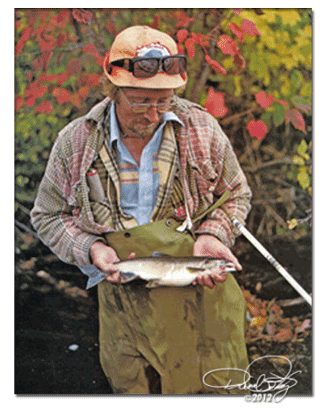
George Richey (both photos) landing and holding a big king salmon
photo c. Dave Richey Outdoors ©2012

September 10 is a day I won’t likely forget. It’s the first day of Michigan’s Upper Peninsula black bear season, but that’s not why I remember it even though I’ve shot a bear on that day on several occasions.

Yesterday was the ninth anniversary of my twin brother George’s death. It happened nine years ago. He was taken ill and learned he had seven different kinds of cancer, and four days later died in Traverse City’s Munson Hospital.

He faced his impending death bravely, didn’t quibble about the outcome he knew was coming, and greeted death on an optimistic note. I lay in his hospital bed, clinging to him while staring at the heart monitor. The flat line seemed meaningless because of the gravity of his various cancers. It simply spelled an end to a great life.

He didn’t fear death but embraced it

You see, George and I began steelhead fishing many years ago in the early 1950s, and we traipsed all over the Upper and Lower peninsulas in search of steelhead once we became old enough to drive. We were always together in the early years, and we could read each other’s mind. He could start a sentence and I could finish it. Twins often have such gifts.

We both loved the same things. First it was steelhead, and then jumbo brown trout in numerous locations, and then salmon came along in the mid-1960s. George jumped on the lure bandwagon by manufacturing a wide variety of Michigan Squids, Michigan Sparkle Flies and other trolling flies for salmon.

George’s son – Casey Richey of Frankfort – has taken over the fly business, and has expanded on many of his father’s ideas. Casey held the brown trout state record for a short time before it was beat by a larger fish caught in the Manistee River.

George had a long run with his lure business, and lived to age 63. He died just five months after I retired from The Detroit News as their staff outdoor writer-photographer, We made plans for countless fishing and hunting trips, and we both looked forward to retracing our earlier study of Lake Superior tributaries for steelhead.

We’d planned a more leisurely assault on such rivers as the Big Two Hearted, Huron, Middle Branch of the Ontonagon, Mosquito, and many others that we’d fished in the late 1960s. We’d planned a pilgrimage to the Rock River for pink salmon as we’d done in the early 1970s.

He had caught more than his share of Chinook and coho salmon during our 1967-1976 guiding career on Lake Michigan tributaries, and during his lengthy career in the lure business. He also tied fishing flies for added income, and came up with several flies that he formulated to work on clear and dark-watered streams.

George had a great deal of fun with big salmonids but he and I shared a secret love for back-of-beyond jump-across creeks and silt-laden beaver ponds for brook trout, and wee little ponds and lakes for bluegills.

He loved small fish as well, and loved bluegills and brook trout

He didn’t share in my love of big game hunting, but he would go on such trips just so we could share another memorable event together. He shot mule deer and whitetails in Texas, was on a one-shot big whitetail hunt in Quebec where we saw only one whitetail over a four-day hunt. He shot two caribou in northern Quebec, and one was a cow caribou, which he proclaimed, as “having a bigger spread than any whitetail he ever shot. That netted him a good razzing from others in camp, but George didn’t care.

“If they are picking on me,” George said, “they are leaving someone else alone.”

That was George. Many people knew him, everyone liked him, and those who knew him through his lure collecting, admired the depth of his research for his books Made In Michigan Lures and Made In Michigan Lures II. Both editions are available from me, and the first edition is rare and very collectible.

He was a picker. He could look through a mountain of old lures, often a pile that had been picked by another collector, and find the proverbial diamond in a coal mine. His skill at uncovering old Michigan-made fishing lures was legendary. His skill at identifying old Michigan-made lures was an enviable one.

In many respects, George was a legend in his own time. Not only as a fly tier, fishing lure maker, fishing guide, angling and lure historian as well as an outdoor writer.

George Richey had many loves and most of all were his old lures

Brother George and I grew up in a little town north of Flint (Clio) and moved north after years of barbering in Clio and Flint. He was a well-known hunter and angler, and many people came to pick his brain on a variety of topics.

He liked people, people cared for him, and he made a lasting impression on others. Readers often write me to ask if George and I were related, and when they learned we were twins, they didn’t know how there really could be two of us.

We were proud of being twins, and we each praised the other when such praise was needed. He’s gone now, but will never be forgotten by me or those who knew him, and I guess I may now  have to do the steelhead assault on the Upper Peninsula streams alone. It just won’t be the same without him but it will give us something new to talk about  when I meet him again up yonder.

I still miss him and that empty hole in my heart is where he lives.

Posted via email from Dave Richey Outdoors

Wednesday, April 11, 2012

Missing my twin brother

George Richey hold his former State (MI) Record pink salmon
George Richey, holding his former, 2lb. 7oz., Michigan State Record pink salmon.
photo Dave Richey ©2012
It was one of those mid-September days when it felt right to be going through my deer-hunting backpack and sharpening broad-heads. It was something to do while waiting for my next trout fishing trip to arrive.

So I was puttering with my bow quiver of sharpened heads when a memory jolted me as it entered my mind without me thinking. It was of brother George, and he was coming down the Little Manistee River in high water in early April with a rampaging steelhead on his line.

"Try and get a net under this guy," he hollered. "I hooked him a quarter-mile upstream, but he's riding the current broadside. Stick your net in the water, and I'll put him head-first into the net. Ready?"

We'd done this for each other and both knew what to do

My net was pulled from under my belt behind my back, and my rod butt went in underneath the belt. The fish was 10 feet upstream as my net went into the water, and George leaned back on the rod to get the fish up onto the surface, and just at the right time, he dropped the rod tip and the fish dove right into the net. My job was to lift it from the water.

"Good dip," he said, as we waded ashore. The steelhead, a red-sashed male with bright cheeks and gill covers, was 16 pounds of broad-beamed raw power. George worked the No. 4 wiggler fly free, eased the big guy into the river, and with a mighty splash it was gone.

Another time George and I hunted Le Chateau Montebello, a famous resort in Quebec. We were there to hunt deer, and the guide told us we would be lucky to see a deer. If we did, he said, it would be a shooter.

The guy put on one-man drives, and I've been involved in deer drives for most of my life. I can tell good from bad, and this guy was an expert. He walked softly, yipped like a beagle puppy on occasion, and he never hurried the deer. They just moved slowly ahead of him.

We driven deer for years, and this guy was the best I'd seen

Far off, on the third day, I heard him yip softly to let us know he was coming. It was a large area to watch, but 10 minutes later a white-antlered 8-pointer eased from the woods and stood, side-lit by the afternoon sun against a pine, and he was a beautiful sight to behold.
He turned to look the opposite way at George, and I slowly raised the rifle and aimed. He went down at the shot, and George almost beat me to that buck. It was the only deer either of us saw on that hunt, but he wasn't disappointed not to get one. He loved listening to the wolves howl at night, and was happy that one of us shot a good buck.
"Good shot, good buck, and where's the guide?" He asked. "This buck weighs well over 200 pounds, and we will need help to move it far."
The guide showed up, we boiled a kettle to have hot tea with our sandwiches, and then had us a four-mile hike back to his truck and he drove up to the dead animal. It is the only whitetail I've taken in Quebec, but it's important to me because George and I shared the hunt in a unique part of Canada.

Ours was never a competitive thing. We just had fun

Neither of us have ever been truly competitive with each other, but years ago before I wrote the first story about runs of pink salmon in Upper Peninsula streams, George was with me to share what might or might not be an adventure. We didn't know if we'd find the pink salmon.

We would fish pink salmon in the morning and hunt bears in the afternoon, and we found some fish in the Big Huron River. They usually spawned during September on odd-numbered years and we found hordes of them on the first gravel patch above the river-mouth.

We'd been guiding river fishermen for a few years, and started catching pinkies of flies. An orange fly tied on a No 6 hook seemed to produce best, and they were some of George's tried-and-true steelhead and salmon patterns. The fish weren't big but they were aggressive.

"Here's another one," he said. "I'm taking it in to the store to get it weighed. I figure it to be just over two pounds. There's no state record for these fish so one of us should set the record."

Back he came, and it weighed 2 lbs., 3 oz., and so I tried to beat him. Mine weighed 2 lbs., 4 oz. The next day we caught fish of 2 lbs., 5 oz, and then 2 lbs., six oz. It was on the last day that George caught one that weighed 2 lbs., 7 oz., and it became the state record that held up for many years.

I was tickled for him, and he got a Master Angler award, and the mounted fish hung in the DNR offices in Lansing for years before his record was broken. He didn't care. He'd had his "15 minutes of fame."

And that was the neat thing about brother George. He could go with the flow, be happy doing anything outdoors, and greet each new day with a smile on his face. He had the capacity to make people feel good.

He's been gone for nearly nine years, and I miss him greatly. I'd trade many of my tomorrows for a single yesterday, doing something outdoors with him.

Saturday, September 10, 2011

Some thoughts about brother George


I woke up this feeling a mite peckish. I wasn't hungry, the morning paper lacked any luster, and even the decaf coffee failed to generated any enthusiasm. I just felt out of sorts.

A return to the paper was a start. That was it. It wasn't the paper so much as it was the date.

It was eight years ago today when my twin brother George passed away. Besides losing a twin brother, I lost my best friend and my life had suddenly changed. Even after this long there is a terrible sense of loss.

We were inseparable since our 1939 birth. We grew up during World War II, and being little kids we had no concept of bombs but we used to stand outside our home in Clio and try to hear them explode. Thank God we never did.

We began fishing in lovely Clio Creek, which is a facetious statement, and caught a few bluegills, carp, suckers and sunfish, but we were at a tender age. We had our first jobs at age six, and have never been out of work. We collected newspapers in the late 1940s, sold them in Flint, and it took all summer to make enough to buy our own bicycles.

Dad was a barber, didn't make much money, but he provided us with the incentive to work toward buying our own bikes, and they were better than any that the other kids had. Ours were a top-of-the-line Schwinn, and they had a horn, fender-feelers and go-fasters.

We spent summers camping and fishing on the Sturgeon River in Cheboygan County. No one would let their kids fend for themselves as pre-teenagers now, but our parents trusted us and we had a wonderful time.

George and I both played baseball, but I quit early because I had eczema, which was aggravated by getting dirty. But I learned how to catch steelhead, and quickly taught him, and again we were inseparable on the water. We could catch more steelhead than almost anyone from the Sturgeon River in the mid-1950s. It was pretty heady stuff.

We prowled Luzerne Pond for brown trout, made forays for big browns to the upper Rifle River, and were soon fishing most of the major steelhead streams long before the salmon were planted. We pioneered guiding in Great Lakes tributaries, and were the first fly-fishing guides in the state.

We developed flies and fly fishing methods back in 1967 that are still in use today. Fishing two flies for steelhead came about in 1967, and there are people today who claim they invented the system but they are wrong.

We traveled together in the off-season, giving seminars on fly fishing for lake-run brown trout, chinook and coho salmon, and steelhead when most people thought it was in its infancy. Again, they were wrong because we'd been catching browns and steelhead on flies for many years.

George loved fishing more than hunting, but would willingly go hunting with me because he enjoyed my company. For me, George was more than a brother and a great friend, he was my soul mate. We were often together late in his life, and once we learned he had cancer (while at the Wood-n-Water Outdoor Weekend show), we spent his final four days and nights together.

We played "Remember When." I'd ask is he remembered catching his first steelhead, as well as when and where the event took place. He nailed that one. I asked if he remembered making that great long-range shot on a trophy desert whitetail in southwest Texas, and again, even though his body was failing, he remembered the event.

He remembered the night we fished for big browns after dark on the Sturgeon River, and both caught a pair of fish between seven and nine pounds each. He also remembered celebrating at the old Meadows Bar with a cold beer and a hot burger.

George was widely loved by all who knew him. He could ferret out fishing lures like a beagle with a cold nose, and he was an expert at tying flies, something he did commercially for many years. He invented several steelhead flies that are still in use today, and invented the Michigan Squid, Laser Squid, Crinkle Fly, Sparkle Fly and many others, and for years his squids and trolling flies were the best on the Great Lakes for salmon. They still are.

He was a well-known lure collector and historian. He wrote three books -- Made in Michigan Fishing Lures, Made In Michigan Fishing Lures II, and Dodgers & Squids For Larger Salmon & Trout. He co-authored the revised edition of The Royal Frontenac Hotel with Pete Sandman. He wrote countless lure collecting stories for Woods-n-Water News, edited the National Fishing Lure Collectors Club Gazette for many years, and wrote many other magazine articles.

People thought the world of George, and he reciprocated. He was always ready to help a new lure collector get started, and was known far and wide for his vast store of knowledge about lures made in this state and many others.

He was an icon, a person people respected and looked up to. His sense of humor was infectious, and it's easy to find people all over this state who have their favorite George Richey stories. I've shared a few of mine here, and there will be others in the future.

I loved my twin brother, love my memories of him, and today I had to write something about the man who meant so much to me. To pay a public tribute to his 64 years of life, and to show people how much I truly miss him. He's gone but far from being forgotten.

Thank you for reading this small tribute. It means a great deal to me, and doing so pulled that monkey off my back this morning. I feel better.

Saturday, March 26, 2011

Some memories of brother George


George Richey with a 30-pound Chinook salmon caught on a fly


It was one of those mid-September days when it felt right to be going through my deer-hunting backpack and sharpening broadheads. It was something to do while waiting for Oct. 1 to arrive..

So I was puttering with my bow quiver of sharpened heads when a memory jolted me as it entered my mind without me thinking about it. It was of brother George, and he was coming down the Little Manistee River in high water in early April with a rampaging steelhead on his line.

"Try and get a net under this guy," he hollered. "I hooked him a quarter-mile upstream, but he's riding the current broadside. Stick your net in the water, and I'll put him head-first into the net. Ready?"

George and I always helped each other, and here I helped him land a big steelie


My net was pulled from under my belt behind my back, and my rod butt went in underneath the belt. The fish was 10 feet upstream as my net went into the water, and George leaned back on the rod to get the fish up onto the surface, and just at the right time, he dropped the rod tip and the fish dove right into the net. My job was to lift it from the water.

"Good dip," he said, as we waded ashore. The steelhead, a red-sashed male with bright cheeks and gill covers, was 16 pounds of broad-beamed raw power. George worked the No. 4 wiggler fly free, eased the big guy into the river, and with a mighty splash it was gone.

Another time George and I hunted Le Chateau Montebello, a famous resort in Quebec. We were there to hunt deer, and the guide told us we would be lucky to see a deer. If we did, he said, it would be a shooter.

The guy put on one-man drives, and I've been involved in deer drives for most of my life. I can tell good from bad, and this guy was an expert. He walked softly, yipped like a beagle puppy on occasion, and he never hurried the deer. They just moved slowly ahead of him.

Far off, on the third day, I heard him yip softly to let us know he was coming. It was a large area to watch, but 10 minutes later a white-antlered 8-pointer eased from the woods and stood, side-lit by the afternoon sun against a pine, and he was a beautiful sight to behold.

George liked to deer hunt, and loved hunting from an elevated stand


He turned to look the opposite way at George, and I slowly raised the rifle and aimed. He went down at the shot, and George almost beat me to that buck. It was the only deer either of us saw on that hunt, but he wasn't disappointed not to get one. He loved listening to the wolves howl at night, and was happy that one of us shot a good buck.

"Good shot, good buck, and where's the guide?" He asked. "This buck weighs well over 200 pounds, and we will need help to move it far."
The guide showed up, we boiled a kettle to have hot tea with our sandwiches, and then had us a four-mile hike back to his truck and he drove up to the dead animal. It is the only whitetail I've taken in Quebec, but it's important to me because George and I shared the hunt in a unique part of Canada.

Neither of us have ever been truly competitive with each other, but years ago before I wrote the first story about runs of pink salmon in Upper Peninsula streams, George was with me to share what might or might not be an adventure. We didn't know if we'd find the pink salmon.

We would fish pink salmon in the morning and hunt bears in the afternoon, and we found some fish in the Big Huron River. They usually spawned during September on odd-numbered years and we found hordes of them on the first gravel patch above the river-mouth.

We'd been guiding river fishermen for a few years, and started catching pinkies on flies. An orange fly tied on a No 6 hook seemed to produce best, and they were some of George's tried-and-true steelhead and salmon patterns. The fish weren't big but they were aggressive.

"Here's another one," he said. "I'm taking it in to the store to get it weighed. I figure it to be just over two pounds. There's no state record for these fish so one of us should set the record.

It was brother George who held the Michigan pink salmon record for many years


Back he came, and it weighed 2 lbs., 3 oz., and so I tried to beat him. Mine weighed 2 lbs., 4 oz. The next day we caught fish of 2 lbs., 5 oz, and then 2 lbs., six oz. It was on the last day that George caught one that weighed 2 lbs., 7 oz., and it became the state record that held up for many years.

I was tickled for him, and he got a Master Angler award, and the mounted fish hung in the DNR offices in Lansing for years before his record was broken. He didn't care. He'd had his "15 minutes of fame."

And that was the neat thing about brother George. He could go with the flow, be happy doing anything outdoors, and greet each new day with a smile on his face. He had the capacity to make people feel good.

He's been gone for nearly eight years, and I miss him so much. I'd give anything to go back in times and experience several new experiences with him again.