Showing posts with label love. Show all posts

Sunday, September 23, 2012

Missing my twin brother

DRO-Missing my twin brother George.
George Richey (both photos) landing and holding a big king salmon
photo c. Dave Richey Outdoors ©2012

September 10 is a day I won’t likely forget. It’s the first day of Michigan’s Upper Peninsula black bear season, but that’s not why I remember it even though I’ve shot a bear on that day on several occasions.

Yesterday was the ninth anniversary of my twin brother George’s death. It happened nine years ago. He was taken ill and learned he had seven different kinds of cancer, and four days later died in Traverse City’s Munson Hospital.

He faced his impending death bravely, didn’t quibble about the outcome he knew was coming, and greeted death on an optimistic note. I lay in his hospital bed, clinging to him while staring at the heart monitor. The flat line seemed meaningless because of the gravity of his various cancers. It simply spelled an end to a great life.

He didn’t fear death but embraced it

You see, George and I began steelhead fishing many years ago in the early 1950s, and we traipsed all over the Upper and Lower peninsulas in search of steelhead once we became old enough to drive. We were always together in the early years, and we could read each other’s mind. He could start a sentence and I could finish it. Twins often have such gifts.

We both loved the same things. First it was steelhead, and then jumbo brown trout in numerous locations, and then salmon came along in the mid-1960s. George jumped on the lure bandwagon by manufacturing a wide variety of Michigan Squids, Michigan Sparkle Flies and other trolling flies for salmon.

George’s son – Casey Richey of Frankfort – has taken over the fly business, and has expanded on many of his father’s ideas. Casey held the brown trout state record for a short time before it was beat by a larger fish caught in the Manistee River.

George had a long run with his lure business, and lived to age 63. He died just five months after I retired from The Detroit News as their staff outdoor writer-photographer, We made plans for countless fishing and hunting trips, and we both looked forward to retracing our earlier study of Lake Superior tributaries for steelhead.

We’d planned a more leisurely assault on such rivers as the Big Two Hearted, Huron, Middle Branch of the Ontonagon, Mosquito, and many others that we’d fished in the late 1960s. We’d planned a pilgrimage to the Rock River for pink salmon as we’d done in the early 1970s.

He had caught more than his share of Chinook and coho salmon during our 1967-1976 guiding career on Lake Michigan tributaries, and during his lengthy career in the lure business. He also tied fishing flies for added income, and came up with several flies that he formulated to work on clear and dark-watered streams.

George had a great deal of fun with big salmonids but he and I shared a secret love for back-of-beyond jump-across creeks and silt-laden beaver ponds for brook trout, and wee little ponds and lakes for bluegills.

He loved small fish as well, and loved bluegills and brook trout

He didn’t share in my love of big game hunting, but he would go on such trips just so we could share another memorable event together. He shot mule deer and whitetails in Texas, was on a one-shot big whitetail hunt in Quebec where we saw only one whitetail over a four-day hunt. He shot two caribou in northern Quebec, and one was a cow caribou, which he proclaimed, as “having a bigger spread than any whitetail he ever shot. That netted him a good razzing from others in camp, but George didn’t care.

“If they are picking on me,” George said, “they are leaving someone else alone.”

That was George. Many people knew him, everyone liked him, and those who knew him through his lure collecting, admired the depth of his research for his books Made In Michigan Lures and Made In Michigan Lures II. Both editions are available from me, and the first edition is rare and very collectible.

He was a picker. He could look through a mountain of old lures, often a pile that had been picked by another collector, and find the proverbial diamond in a coal mine. His skill at uncovering old Michigan-made fishing lures was legendary. His skill at identifying old Michigan-made lures was an enviable one.

In many respects, George was a legend in his own time. Not only as a fly tier, fishing lure maker, fishing guide, angling and lure historian as well as an outdoor writer.

George Richey had many loves and most of all were his old lures

Brother George and I grew up in a little town north of Flint (Clio) and moved north after years of barbering in Clio and Flint. He was a well-known hunter and angler, and many people came to pick his brain on a variety of topics.

He liked people, people cared for him, and he made a lasting impression on others. Readers often write me to ask if George and I were related, and when they learned we were twins, they didn’t know how there really could be two of us.

We were proud of being twins, and we each praised the other when such praise was needed. He’s gone now, but will never be forgotten by me or those who knew him, and I guess I may now  have to do the steelhead assault on the Upper Peninsula streams alone. It just won’t be the same without him but it will give us something new to talk about  when I meet him again up yonder.

I still miss him and that empty hole in my heart is where he lives.

Posted via email from Dave Richey Outdoors

Wednesday, January 25, 2012

My love of great outdoor writing

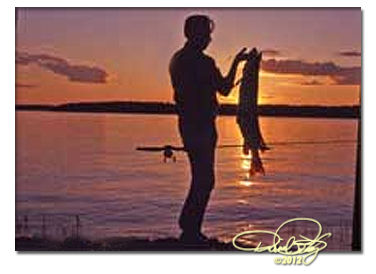
It doesn’t get any better than a big northern pike at sundown

outdoors-love

I've been in this outdoor writing business for 44 years, and over that period I've met most of the greatest outdoor writers of our time.
Men like ...
John Amber Erwin Bauer Havilah Babcock
Nash Buckingham Chuck Cadieux John Cartier
Gordie Charles Ben East Charlie Elliott
Corey Ford Ben Hur Lampman Nick Lyons
Gordon MacQuarrie John Madson Jack O'Conner
Edmund Ware Smith Norm Strung Robert Traver
Ted Trueblood Lamar Underwood Charley Waterman

and many others.

All had one thing in common: they loved the outdoors.

It wasn't so much they loved to kill fish or game, but they enjoyed being out there and matching wits with fish or game. Things were a good bit different in those bygone days. Outdoor writers wrote stories that people loved to read. The how-to or where-to stories weren't in vogue a half-century ago.

No knock on current outdoor writers but many of those in the 1950s were great

They called that earlier brand of writing "Me & Joe stories." If a reader read close he could spot some how-to and where-to stuff, but what gave these stories legs was the writers could pull the reader into the story and make them read it.

We felt as if we were hunting sheep with Jack O'Connor, catching big trout with Joe Brooks, shooting ducks or geese with Lynn Bogue Hunt or Van Campen Heilner. We hung on the words of Robert Ruark as he sat at the Old Man's knee and absorbed some of the wisdom that old-timers handed down to the young 'uns.

Corey Ford was another favorite back in the 1950s and 1960s, and his Tales of The Lower Forty were funny but also shared some fishing or hunting wisdom.

Ben East, who lived near Holly, Michigan, was a friend and I spent hours watching him work his red pencil magic over a manuscript, cutting and splicing, turning words of some wisdom into pearls of wisdom. I thoroughly enjoyed my many conversations with John Madson, and believed that few outdoor writers could match up.

He did a great deal of work for Winchester and the Olin Corporation, and he could make the ingredients of breakfast cereal read well. He was a master of turning phrases, of setting scenes, and of working his brand of literary magic on a story. When he finished, the piece was a gem.

Ben East and John Madson were two or the best wordsmiths

Madson was arguably the finest true outdoor writer of the mid-1900s, and we spent many hours together before his death. I have a healthy-sized stack of his letters, and a common letter from one buddy to another became a piece of art when Madson put his hand to it.

There seems to be something that has gone missing when an article just tells the reader how to catch fish or shoot deer, or even worse, where to do it. The old-time outdoor writers did all of that but they also told readers why they should do it.

They wrote from the heart. They invoked our five senses and said why they should be important to sportsmen, and they knew how to drag the reader into the story and leave them at the end wanting more. That's the sign of a truly good writer.

Outdoor magazines no longer have strong editors. I sold my first "Me and Joe" story to Outdoor Life magazine in 1970, and back then, editor Bill Rae was an editor. Editors below his lofty position could offer their opinion, but Rae was a one-man editorial staff. If he wanted a story, he got the story, and suffered no nonsense from junior editors.

I sold a number of stories to Bill Rae, and he happily bought them because I could give him what he wanted and what he knew his readers wanted to read. Now, it's different; there is such a thing as "editing by committee," which doesn't bode well for the writer because many editors don't know what they want. Many want two or three rewrites from a professional outdoor writer. Things have changed and not for the better.

I sell many fishing and hunting books, and some old outdoor magazines on my website Scoop's Books, and I figure if a book is a good read for me, it will probably appeal to many of my readers. I enjoy going back to some of the earlier writers, and although some of their copy was stilted at times, they knew how to grab the reader's attention.

My personal method writing outdoor copy is simple: inform and entertain

It's always been my intention to write from the heart: to drag readers into the story; to offer them something that is nearly impossible to find today in the how-to, where-to world of outdoor writing, and I'm not ashamed to admit to a mistake. I tweak my readers five senses, and they seem to enjoy it.

What comes through in my writing is a deep and abiding love of the outdoors and of fishing and hunting. I know our natural resources needs some restraints, and I know that being afield is part of why we go fishing or hunting.

We share the outdoors with other user groups, and those of us who love these outdoor pastimes, are perhaps the last of our breed. And just think: all of this rhetoric is about our respect for the fish and game we catch and kill, and a deep love for being outdoors.

And it has all come to pass because of another love. A love of reading is what makes the long wait between fishing and hunting trips bearable, and that is why so many people visit this site every day.

I may be the luckiest person of all because I have a deep urge to write what people want to read. And for that, I'm genuinely thankful for my many readers. Keep reading and I'll keep writing, and tell your friends, neighbors and relatives about my website.

I thank you, in advance, for that consideration.

Saturday, August 28, 2010

Why do you hunt?


When you are fed up with the troublesome present, take your gun, whistle for your dogs, go out to the mountain." -- Jose Ortega Y Gassett, Spanish philosopher and author of "Meditations On Hunting".

The Spanish philosopher had it right. He lived through war-torn Europe in the 1930s and 1940s, and those hunting thoughts probably offered some solace while the whole world was going crazy.

Hunters today live in troubled times, and we face problems more immediate than having to listen to political hype and the mind-bending thoughts of coping with complex issues such as the upcoming political spin just before an election. We face a world of increasing numbers of hunters, decreasing acres of land available to sportsmen, a global need for fuel and the anti-hunter's wrath.

For many, there is a very real fear of losing a job. For others, the high cost of medicine is a troubling issue. For some, finding enough food to eat or staying cool in blistering heat is a never-ending problem. And then there is the fate of our armed forces trying to keep peace in a land that has seldom known peace. I support our troops and hope you do, too.

Perhaps it’s time to define why we personally choose to hunt.

Each year, I deliberately confront myself with the question of why I hunt, and the problems facing hunters. Hunting seasons open soon, and this is a time when hunters should take stock in themselves. I ask myself: Do I hunt for the meat, which is invariably delicious, to pit desk-weary skills against a wild animal, or do I hunt solely for the kill?

Few hunters I know feel a driving need to personally address such personal questions. Many wander through life turning their back on delicate, psyche-probing questions in favor of immediate gratification with a bow or firearm by killing a wild animal.

For many, the quick kill -- to hell with hunting a week -- is more in tune with today's fast-paced society and is favored by many sportsmen. But, is the quick kill right?

That's a question best answered by each individual only after intense soul-searching and addressing the question of why we hunt. We must learn, as human predators of wild animals and birds, to look deep within ourselves to determine just what hunting is and what it means to each of us.

I can't answer those questions for you, and refuse to have you speak for me. Our reasons for hunting may vary, but only the more intelligent and far-thinking of us, will ever know and understand our personal motives.

Man’s social functions of family, home and work place greater demands on people today than ever before. Peers, whether we like it or not, can force many hunters into the world of the quick kill. Because of business and family commitments, for instance, many hunters don't have much time to hunt.

There are many reasons I hunt and they are outlined here. How about you?

The Department of Natural Resources caters, albeit indirectly and probably unintentionally, to that sort of hunter attitude. It has managed deer, in large part, for the sake of quantity rather than quality for many years while making a determined effort to keep whitetail deer within reasonable bounds of their environment, food supply and social needs.

Why you hunt or why I hunt is an age-old question that cannot be answered simply with a bland statement that “we like venison or enjoy a few days with the boys.” The meaning is far more deeply rooted. It is buried deep within our ancestry, and goes back to a time when hunting was accepted by those who wanted to eat and when hunting was something everyone did as a matter of dire necessity.

Today’s sportsmen seldom hunt for food (I do because my family thrives on a wild fish and game diet); instead, perhaps it's a prehistoric feeling or need in each of us to relive our ancestry by hunting for food, for pleasure and for the kill.

The pleasure of today’s hunt is an intangible thing; it's a mix of cool air, sunrises, snow, wood smoke, a hint of winter, being with friends, hunting alone, being outsmarted by a wise old buck, and the kill, although the latter is anticlimactic in most cases.

These are just a few of the reasons why I hunt, but the strongest of all is to pit my skills against those of a wild animal I deeply respect. Yes, I kill deer (I hate the current buzzword "harvest" because we're not harvesting a corn field); we're talking about killing deer and other game animals and birds each year. Although that animal or bird dies by my hand, it gives and sustains my life and that of my family.

I don’t hunt to kill but kill to have hunting.

I live through the animals I hunt. I learn about survival because of them. I learn to think more like the predatory animal I've become. I respect each animal and bird's life as much as my own.

Hunting should never be confused solely with killing. One can hunt without killing, although I'm not sure why anyone would choose to do so. We can hunt without firing a shot, but we can't be a complete hunter without killing an animal because all predators kill other animals so they may live.

Ortega said it best, and I thoroughly agree with his statement: "I don't hunt to kill; I kill to have hunted."

How about you?

Posted via email from Dave Richey Outdoors