Showing posts with label salmon. Show all posts

Wednesday, July 18, 2012

When big-water salmon disappear

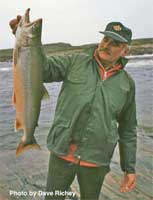
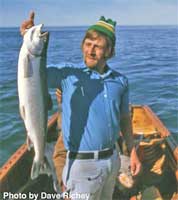
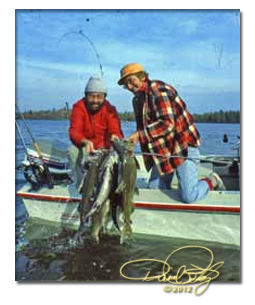
These two anglers with a big salmon catch. A great fishing day!
photo courtesy Dave Richey Outdoors ©2012

These two anglers with a big salmon catch. A great fishing day!

It seems to happen almost every summer. There comes a period of a week or so when the salmon fishing slows down or seems to stop altogether.

Who knows why it happens. That part is not as important as knowing that it will occur. The major question is when it will happen. Salmon fishing has been hot up and down Lake Michigan.

Obviously, on any given day, a person or boat filled with people can get skunked or have a very poor showing. That part never bothers me now because fishing is just one more of many reasons to get outdoors and breathe some fresh air.

If the fish bite, that’s great. If they don’t, there will be no sad looks on my face. It is what it is, and we may not have any control over these things. Let’s not whine about it.

Forget about it, already!

However, I look at such days as an opportunity knocking on my door. It’s a day that suddenly is freed up. It allows us to change our plans.

Perhaps, weather permitting, we can arrange a fishing trip on an inland lake or stream. There are countless lakes in the Traverse City area where I can go to fish for bass, bluegills, crappies, northern pike, sunfish, trout or walleyes … just to name a few game fish species.

So what if these fish may not be as big as a lake trout or salmon? It doesn’t make any difference as long as I can find something out there that will pull my string, and make my heart do a flip-flop or two.

Mind you, years ago I would have been devastated by not catching some great huge salmon. The froth would be running from my mouth like saliva from a rabid skunk.

I’d kick the tackle box two or three times just for good measure. The problem is that outdoor writers need action and photos to produce magazine stories. No photos, no story, and no money. It’s that simple.

No unemployment for me. I could work my butt off, but hard work was no guarantee the weather would cooperate or the fish would bite or deer would move. Go for a week or two with no money coming in, and it’s enough to make a gent like me a bit testy.  I lived this life style for many years before taking a steady paying newspaper job.

Well, guess what; I’m retired now

I have been for more than nine years, and my fishing attitude has changed. There are no hard and fast rules. If I don’t get tonight’s blog done tonight, I’ll do it tomorrow and back-date it.

There was other work to be done. I was putzing around with an old Shakespeare bait-casting reel and took it in to get it  to get repaired. It needed a new handle, and the repair guy had one. Quick-like, it was done!

There is more stuff around my house that needs attention, and it’s time to find a home for some of it. I joined the Outdoor Writers Association of America in 1968, and they began sending me monthly newsletters. The paper edition continued until two years ago when OWAA went digital, and she has 34 years of the bulletin. Multiply both numbers by 12, and it amounts to lots of paper and the loss of more than a few trees.

I’ve still got them but need some room so two large plastic tubs were bought and it took both of them to handle the load. Now, they are so heavy I must partially empty them to move them into a storage unit. That would be almost a one-day operation, and my back is sore from tugging the heavy tubs around.

Someone with more time on his hands once came up with the saying: If life deals you lemons, make lemonade. There’s some sort of logic there.

To paraphrase that: If life robs you of a fishing day, find something else to do. Clean a reel, sharpen hooks until your eyes cross, put new line on reels that need it changed, and try to clean up things.

I may be insulting it by calling it a work-bench

I have what some might call a work-bench. That gives me too much credit for working or for needing a bench to work at. However, I start looking for something that often is on my work-bench, and in the process of looking, other things get placed there.

Eventually, it would take a small back-hoe to move stuff off my work-bench. So, when the opportunity presents itself with bad fishing or hunting days, I clean it off and put most of the stuff where it belongs.

Sadly, I think my home is infested with gremlins with nothing better to do than make a mess of all of my old fishing and hunting gear. I put lures back into the proper tackle boxes, strip old line off reels, and prepare them to have line added some other day.

Can’t do all of this at one time. Do that too often, and the meaning of having stuff to clean up and put away will be lost. We must be orderly, and remember what my first-grade teacher tried to pound into the minds of his six-year old students.

“There is a place for everything,” he lectured, “ and everything should be in its place.” Kind of sweeps over you, doesn’t it?

It didn’t make much sense back then, and still doesn’t. Being a pack rat means I enjoy a certain amount of clutter. It gives me something to do on rainy or windy days, and this should be things that are far more important that putting up screens or storm windows.

A wise man knows where his priorities lie.

Tags: Dave Richey, Michigan, outdoors, big-water, fishing, clean, gear, location, salmon, fish, success, skunked, Lake Michigan, away

Posted via email from Dave Richey Outdoors

Saturday, November 19, 2011

Dreams of big Quebec char


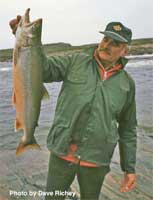
Doug Knight (left) and the author with a lightly colored & silvery char


The dream began sometime late last night. Many of my better dreams are remembered, and some are savored and occasionally one will haunt me for a day or two. This one was weird but true, as are most tales of fishing or hunting dreams from the far north.

My dreams often deal with fishing or hunting, and the odd thing is that many are dreams about things I’ve experienced sometime in the past. Last night’s dream was from 30 years ago and it's as vivid as it had just happened. It was my first trip where Arctic char were available, and it was a wonderful week spent catching the occasional Atlantic salmon, brook trout and char.

There was Ed Murphy from Sports Afield magazine, a man I'd sold many magazine articles to. He and the late Doug Knight, a freelance writer, and I were fishing at Bobby Snowball's camp at the mouth of Quebec's Tunulik River. Mind you, the Tunulik literally throws itself over a waterfall about 300 yards up-river from salt water, and the stream gradient from the falls to the salt is steep with haystacks of standing white water.

Getting to this area of Quebec’s Ungava Bay is a long plane ride.


I was accustomed to sight-fishing for visible fish, and Arctic char were our quarry. A few Atlantic salmon were mixed in with the char, and it took a heavy Dardevle to get down to the char holding at the edge of the fast water.

Bobby Snowball, an Inuit from Quebec's Ungava Bay region spoke fluent English as he met the plane. I'd made all the arrangements for the three of us on this trip, and he escorted me up the dock to the cabins where we would sleep. Children were throwing balls, and one of the balls bounced off a dead Inuit woman laying on the ground beside my tent.

"Uh, Bobby," I asked, trying not to be offensive but needing to know, "what's up with the dead woman?"

"Oh, that's my mother," he said. "She died three days ago and we're waiting for an airplane to come in and take her back to town. Hopefully, she will go out tomorrow."

The dead lady was a bit troubling but the feeling soon passed.

The fishing was nothing short of sensational. Large orange- or silvery-flanked fish held below the falls in the rushing white water, and by casting into the falling water and feeding six feet of slack line into the cast, the Dardevle was soon wobbling past their noses. Every tenth cast or so, a char would peel out of the group and savagely maul the lure.

These fish are uncommonly strong, and when swimming downstream, it took them 20 seconds to peel off line and make it to salt water. On the hook-up, I jumped from rock to rock (some as big as a single-story house), and to say I was leaping like a gazelle would be wrong. I felt more like a young hippo, and it had to have been a roller coaster ride for the fish.

Of all the char we caught only one jumped and it was at best a feeble attempt. However, the fight on 10-pound line was as tough a struggle as any angler could hope to experience. If a 12-pound char and a 15-pound Chinook salmon were tied tail to tail, the char would drag the salmon to its death. There is no quit in their fight, and once we reached salt water, the fish were still full of energy and every fight turned my wrist into a weary joint that became more weakened by the day.

The Inuit were a quiet but fun-loving group, and when we stopped for shore lunch, I soon learned to cook my own lunch of Arctic char. Bobby and his friends and neighbors would fare well at today's sushi bars. Their fish, wrapped in tin foil and tossed into the fire, weren't even warm in the middle when they began eating. We decided to cook our own fish, and the red flesh was delightful when cooked until done but not overcooked.

Fresh fish cooked on the rocky shoreline were tasty.


One fish would feed Knight, Murphy and me, and once we began cooking our own, we were soon hooked on the delicate flavor.

One sea-run brook trout was caught and I tangled with and landed two Atlantic salmon on spoons but they were returned. The Inuit told me they were legal to keep, but legal only for the Native People and not for visitors. For us, if one could be caught on a fly, it would have been a legal catch.

This particular trip was recalled in its entirety last night, and relayed here. The fishing was next-door to the best I've ever seen, and there is something haunting about watching herds of caribou migrate by within 50 yards while we battled fish with flanks the color of orange-pineapple ice cream.

And, best of all, the elderly dead lady vanished from outside my tent wall late the second day and I mentally wished her a safe journey, and I slept like a baby that night while dreaming of crimson-sided wilderness fish.

Thursday, September 01, 2011

A good reason to go fishing

Walleyes and brook trout make good eating for the elderly.


Fishing seems to be one of those pastimes where some people need a reason to go fishing. They need a jump-start, and oddly, since the birth of salmon fishing in this state, the reason many go is to catch big fish.

I've nothing against catching big fish that can stretch my line on 100-yard runs, but it's not necessary to catch a big fish every time.

There were a few days during my 10-year guiding career chasing browns, Chinook and coho salmon, and steelhead, that things just didn't work out right. I remember taking two gents out for spring steelhead, and both men limited out the first day and wanted a new challenge.

The river was full of suckers. Fish to six pounds, and these guys had never caught one so I asked if they thought these fish could be caught on flies.

They didn't think so, so a friendly little wager ensued, and I caught the first sucker on a fly. It was landed, and I taught both men how to roll an orange fly along bottom. The suckers were protecting their spawning bed, and they hooked one sucker after another.

One man tossed a sucker 20 feet up the bank where it flopped around. I asked if he planned to keep that fish, and he said no. I sent him scurrying up the bank to retrieve the fish and put it back in the river. He sulked a bit, and I got him aside, and explained that his behavior only encourages others to do the same thing.

I told him those suckers hatch, grow, and get eaten by game fish such as bass, perch, muskies, northern pike, walleyes and all species of salmon and trout. I also said that spring suckers from clean water make great eating when canned and made into fish patties.

He got right into that program, and although I probably cleaned two-dozen of them for him, I was happy to do it. I didn't mind him keeping them if they would be properly used. He also apologized for his earlier actions.


Need an excuse to go fishing? Here is one that will help the environment.


Walk some of the streams and try for stream trout. Perhaps you'll bump into one of the Skamania steelhead that continue to pop up on rare occasions, but use the fishing trip to wade the river and fill your landing net with worm boxes, discarded line, beer cans, juice bottles and other stuff left behind by slobs.

Want another reason to go fishing? Take a kid with you. He can be young or old, a neophyte or an older and experienced angler. Choose what you both wish to fish for, and go out and enjoy the day and the outdoors. Any fish caught would be a bonus.

I have a couple of elderly ladies I share my catch with. If I know they want fish, and I hadn't planned on keeping any, I will keep one for each of them. A channel catfish I caught last week went to a neighbor, and she was delighted with fresh fish.

I never give them more than one fish each, and sometimes I take turns giving them a fish. They know that many days I put all the fish back or keep an occasional fish for Kay and I, but this they accept because no one else they know is giving away fish.

It's something I do that makes me feel good and makes the women feel good. Both have sons who seldom fish, and they eat what they catch, so the Good Samaritan strikes again. One lady can still clean her fish but the other cannot so I fillet, bone and skin her fish.

Some days, like yesterday or today, are wonderful days to hit the river. No need to worry about big fish or other anglers because most of the stream fishermen are now waiting for the water to cool  that will trigger other fall salmon and trout runs.

I like not having to share the water with others although I readily do so if I encounter another loner like myself. We chat, and invariably he is like me -- a person happy to be able to wade a river, cast a fly or spend a few happy hours alone with the whisper of the wind, a just-right  breeze and the quiet gurgle of water washing around a sweeper and sending soft and lovely river sounds in my direction.

That is a good enough reason for me to go fishing ... anytime.

Wednesday, July 27, 2011

The Richey Twins on the outdoor trail


George with a 30-pound-plus king salmon.

It was a nice day and it felt good to be cleaning steelhead rods and reels. This job seemed better than working on the computer.

I was puttering with a reel with 4-pound line when a memory jolted me like an electric shock. It was about my late brother George, and he was coming down the Little Manistee River years ago fighting a rampaging steelhead.

"Try and get a net under this guy," he hollered. "I hooked him a quarter-mile up-river, but he's riding the current broadside. Stick your net in the water, and I'll put him head-first into it."

This was the moment of truth with this big steelhead.


My net was pulled from under my belt behind my back. The fish was 10 feet upstream as my net went into the river, and George leaned back to get the fish up on the surface, and at just the right time, he dropped the tip and the fish dove into the net. My sole job was to lift it out of the water.

"Good dip," he said, as we waded ashore. The steelhead, a red-slashed male with bright cheeks and gill covers, was 16 pounds of broad-beamed raw power. George worked the No. 4 wiggler fly out, eased the big guy into the river, and with a splash he was gone. Our trips came and went like that fish.

Several years before George died in 2003, I took him caribou hunting in northern Quebec. From home to Montreal, I told him there were two things you don't do: never shoot the first caribou bull seen, and never shoot a cow caribou. They do have very small antlers.

We hunted together, and I ran him down the sprawling lake in a square-stern canoe with a small outboard motor, pointed to the top of a tall and open "baldie," a treeless hill-top where long-range visibility was superb.

He would use binoculars, and study any caribou seen. My plan was to scout the lake's south end. I found an area where caribou had traveled, and the trail looked like a cattle path. I was looking for a good downwind spot to sit when a shot rang out.

It could only be George. The others in our party were far to the north. I returned to the canoe, motored over to where I'd dropped him off, and saw him trudging down the hill, carrying something. The closer he got, the more it looked like a cow caribou head.

"Didn't I say not to shoot a cow?" I asked. He bowed his head in mock shame, and said: "But I'll have the biggest cow caribou rack in camp."

George admitted shooting a cow caribou and took the razzing.


The other hunters teased him about it, and he made up for it by shooting a very nice bull two days later. The razzing didn't bother him, and he had fun.

Another time we hunted Le Chateau Montebello, a famous Quebec resort. We were there to hunt whitetails, and our guide said we'd be lucky to see a deer. If we did, he said, it would be a shooter.

The guy put on one-man drives, and I've worked deer drives for many years. I can tell good drives from bad, and this guy was an expert. He walked softly, yipped like a beagle puppy occasionally, and never hurried the deer. They just moved slowly ahead of him.

Far off, on the third day, I heard him yip softly to let us know he was coming. It was a large area to watch, but 10 minutes later a white-antlered 8-pointer eased from the woods and stood, side-lit by the sun against a pine tree. It was a beautiful sight.

The buck came out, turned away from me, and I took the close shot.


He turned to look the opposite way, and I slowly raised the rifle and shot. He went down, and George almost beat me to the buck. It was the only deer we saw, but he wasn't disappointed. He loved listening to the wolves howl at night, and was happy that one of us took a good buck.

"Good shot, good buck, and where's the guide?" He asked. "This buck weighs well over 200 pounds, and we will need help moving it."

The guide showed up, we boiled a kettle for tea with our sandwiches, and walked four miles to his truck. It is the only whitetail I've taken in Quebec, but it's important because we shared the hunt in a unique Canadian location.

Neither of us have ever been competitive, but years ago before I wrote the first story about pink salmon runs in Upper Peninsula streams, George was with me to share what might be an adventure. We didn't know if we'd find the humpback salmon or not.

We fished pink salmon in the morning and hunted bears in the afternoon, and soon found fish in the Big Huron River. They usually spawn on odd-numbered years and we found hordes of them on the first gravel bar above the river-mouth.

We'd guided river fishermen for 10 years, and began catching pinkies on flies. An orange fly tied on a No 6 hook produced best, and they were some of George's tried-and-true original steelhead and salmon patterns. The fish weren't big but were aggressive.

Dueling it out for a Michigan state pink-salmon record.


Here's another one," he said. "I'm taking it to the store to weigh it. I figure he'll be just over two pounds. There's no state record for pink salmon so let's set one."

Back he came, and it weighed 2 lbs., 3 oz., and so I tried to beat him. Mine weighed 2 lbs., 4 oz. The next day we caught fish of 2 lbs., 5 oz, and then 2 lbs., six oz. On the last day George caught one that weighed 2 lbs., 7 oz. and it became a state record that stood for several years.

I was tickled for him, and he got a Master Angler award, and the mounted fish hung in the DNR offices in Lansing for years before his record was broken. He didn't care. He'd had his "15 minutes of fame."

And that was the neat thing about brother George. He could go with the flow, be happy doing anything outdoors, and greeted each day with a smile on his face. He had the capacity to make others feel good and feel as if they were the most important person in his life on that day.

He was game for almost anything. I set up a bear hunt in the Upper Peninsula one year, and although he had hunted bruins near St. Helens, he wanted an Upper Peninsula bruin.

We hunted near Marquette and near the Laughing Whitefish River, and it was there on a nice September day that he took a good animal.

It walked in, stopped near the edge of the swamp, stood up to survey the bait site, and slowly dropped to all fours. The bear was cagey and moved slowly to circle the bait. There was no wind, and scenting conditions were bad, but the bruin was cautious.

After catching pink salmon, George shot a nice black bear.


George could see the animal at times, watched the bracken ferns move as it walked through them, but could never see enough for an accurate shot. Finally, apparently satisfied that all was well, the bear strolled slowly into the bait site and stood facing him.

He waited until it turned and offered a broadside shot, and one shot from his 30-06 took out the heart and lungs, and broke the off-side shoulder. His bear weighed a bit over 200 pounds, and it was a wonderful animal for him.

George and I shared 64 years of great fishing and hunting adventures, and I made sure he could accompany me on some of these fishing and hunting trips. Summer is a great time to remember, and these fond memories of the Richey twins on the outdoor trail will always stick with me.

Perhaps one day soon, I'll tell of many other fishing and hunting trips where he and I had wonderful times outdoors, together and sharing our common love for the outdoors. He was a great companion, and I certainly miss him.

Saturday, January 29, 2011

Dreaming of Quebec's Arctic char


Doug Knight left and guide on Tunulik River & Knight with nice fish.


The dream began sometime late last night. Many of my better dreams are remembered, and some are savored and occasionally one will haunt me for a day or two. This one was weird but true, as are most tales of fishing or hunting dreams from the far north.

My dreams often deal with fishing or hunting, and the odd thing is that many are dreams about things I’ve experienced sometime in the past. Last night’s dream was from 30 years ago and it's as vivid as the photo above. It was my first trip where Arctic char were available, and it was a wonderful week spent catching the occasional Atlantic salmon, brook trout and char.

There was Ed Murphy from Sports Afield magazine, a man I'd sold many magazine articles to. He and the late Doug Knight, a freelance writer, and I were fishing at Bobby Snowball's camp at the mouth of Quebec's Tunulik River. Mind you, the Tunulik literally throws itself over a waterfall about 300 yards up-river from salt water, and the stream gradient from the falls to the salt is steep with haystacks of standing white water.

Getting to this area of Quebec’s Ungava Bay is a long plane ride.


I was accustomed to sight-fishing for visible fish, and Arctic char were our quarry. A few Atlantic salmon were mixed in with the char, and it took a heavy Dardevle to get down to the char holding at the edge of the fast water.

Bobby Snowball, an Inuit from Quebec's Ungava Bay region spoke fluent English as he met the plane. I'd made all the arrangements for the three of us on this trip, and he escorted me up the dock to the cabins where we would sleep. Children were throwing balls, and one of the balls bounced off a dead Inuit woman laying on the ground beside my tent.

"Uh, Bobby," I asked, trying not to be offensive but needing to know, "what's up with the dead woman?"

"Oh, that's my mother," he said. "She died three days ago and we're waiting for an airplane to come in and take her back to town. Hopefully, she will go out tomorrow."

The dead lady was a bit troubling but it soon passed.

The fishing was nothing short of sensational. Large orange-colored fish held below the falls in the rushing white water, and by casting into the falling water and feeding six feet of slack line into the cast, the Dardevle <www.eppingerdardevlelures.com> was soon wobbling past their noses. Every tenth cast or so, a char would peel out of the group and savagely maul the lure.

These fish are uncommonly strong, and when swimming downstream, it took them 20 seconds to peel off line and make it to salt water. On the hook-up, I jumped from rock to rock (some as big as a single-story house), and to say I was leaping like a gazelle would be wrong. I felt more like a young hippo, and it had to have been a roller coaster ride for the fish.

Of all the char we caught only one jumped and it was at best a feeble attempt. However, the fight on 10-pound line was as tough a struggle as any angler could hope to experience. If a 12-pound char and a 15-pound Chinook salmon were tied tail to tail, the char would drag the salmon to its death. There is no give-up in their fight, and once we reached salt water, the fish were still full of energy and every fight turned my wrist into a weary joint that became more weakened by the day.

The Inuit were a quiet but fun-loving group, and when we stopped for shore lunch, I soon learned to cook my own lunch of Arctic char. Bobby and his friends and neighbors would fare well at today's sushi bars. Their fish, wrapped in tin foil and tossed into the fire, weren't even warm in the middle when they began eating. We decided to cook our own fish, and the red flesh was delightful when cooked until done but not overcooked.

Fresh fish cooked on the rocky shoreline were tasty.


One fish would feed Knight, Murphy and me, and once we began cooking our own, we were soon hooked on the delicate taste.

One sea-run brook trout was caught and I tangled with and landed two Atlantic salmon on spoons but they were returned. The Inuit told me they were legal to keep, but legal only for the Native People and not for visitors. For us, if one could be caught on a fly, it would have been a legal catch.

This particular trip was recalled in its entirety last night, and relayed here. The fishing was next-door to the best I've ever seen, and there is something haunting about watching herds of caribou migrate by within 50 yards while we battled fish with flanks the color of orange-pineapple ice cream.

And, best of all, the elderly dead lady vanished from outside my tent wall late the second day and I mentally wished her a safe journey, and I slept like a baby that night while dreaming of crimson-sided wilderness fish.

Posted via email from Dave Richey Outdoors

Thursday, October 07, 2010

Beating up on the salmon


Hundreds of coho salmon were holding in the clear current of the Platte River near Honor, Mich., and as guide Mark Rinckey and I looked around, we never saw another fishermen.

Anglers were conspicuous by their  absence. He handed me a jar of spawnbags, and take my choice. The jar contained pink spawnbags and yellow ones.

"Take your pick," he said. "Yesterday's guide trip produced lots of salmon on the yellow bags. Pick your favorite."

Pink or yellow-mesh spawnbags work best.

So my choice was pink, and I hooked a two-pound jack coho (a precocious two-year-old fish) on the first cast. The fish fought the limber rod and four-pound line before coming to the net.

"These silvery youngsters are really good to eat," he said, unhooking the fish and placing it on the string. "We're catching a mixed bag of Chinook salmon, cohos and the occasional steelhead. The best of the steelhead fishing will begin in about 10-14 days as the salmon run ends.

"For now, it's mostly salmon. Once in a while we catch some adult 9-10-pound cohos, and they are pretty wild.

We were using lightweight 10-foot rods, the four-pound mono and a No. 8 hook with spawnbags. Two or three small splitshot are crimped to the line about 18-24 inches above the baited hook.

I baited up again, and sticking with what worked before, threaded a pink spawnbag on the line. It took several casts before an adult coho picked up the bait rolling along bottom, and as a tap was felt on the line, the hook was set.

An adult male ripped off on a 20 yard run, jumped once, turned and ran back downstream, switched directions again, and headed back upsteam. He wallowed on the surface, and unexpectedly the hook pulled free.

Hard hits and short runs are the rule right now.

"I haven't had a strike on yellow," he said, "pink seems to be the color. I'll keep trying it because I know it works."

I was into another jack coho, and this guy was two pounds of high-stepping dynamite and fought like a fish three times his size. One thing is true about river guide Mark Rinckey of Honor: it's possible to get ahead of him, but look out when he  works things out.

We never compete against each other when we fish on a busman's holiday -- a day when he doesn't have a trip -- but the man is a magnet for fish. He promptly hooked a big adult male coho, fought it hard for 10 minutes, and then it burrowed into a beaver house along the bank, crocheted the line through a maze of small alder sticks and broke off.

"I lost a coho and Chinook salmon to the beaver house yesterday, and if a big fish wants to go there, it's hard to stop them on four-pound line. Many of the adult fish are still silvery from Lake Michigan. The trick, if possible, is keep the fish away from debris in the water."

He then hooked another jack, fought it to a standstill, netted it, and added it to the stringer. I then hooked another good fish, and lost it after a five-minute struggle as it rolled in the line and broke free.

Seven fish for four hours, and several lost fish, is common.

Time passed as we went through one dry spell after getting hits and failing to hook up. The salmon were cooperating, but were hitting light. The soft takers were hard to hook well.

The sun was well up in the sky, shining bright and full on the water, and the wind died for a spell. Action slowed until the wind picked up slightly, riffled the water, and the salmon began hitting again.

We fished hard for about four hours, and landed seven salmon including one of about eight pounds. The jacks averaged from two to three pounds, and we danced with the fish during the morning. Eventually, as with many things in life, all good things must come to an end.

Dances with salmon can be a pleasant interlude for river fishermen before the fall steelhead runs pick up in a couple of weeks. Until them, anyone looking to book a guided salmon trip on the Betsie or Platte rivers, can call Mark Rinckey at (231) 325-6901. He also is booking steelhead trips for late-September, October and November.

Light line, nice fish and autumn color go together like bacon, eggs and toast. Some dates are still available, and anglers are advised to call soon to arrange a great fishing trip.

Posted via email from Dave Richey Outdoors

Tuesday, August 24, 2010

Doubting anglers just dont understand


A friend stopped by the other day with a buddy of his. The other gent wanted to meet me, and have a discussion about steelhead fishing.

The chat began mildly enough when we shook hands, and we made small talk for a few minutes. Then, in a burst of what seemed like pent-up anger, he questioned me about my past steelhead fishing.

"You've written that you have caught 100 steelhead in one day, and another time you wrote that you'd probably landed nearly 10,000 steelhead in your life," he said. "I think both statements are a crock. No one can catch that many steelhead these days.

The guest who wanted to argue his views in my home.

Mind you, this dude was a guest in my home. I don't take kindly to insults, and statements that I might be lying.

I agreed that he was probably right. It would be most difficult, if not impossible, these days to catch 10,000 steelhead in a lifetime. I also added that he must have missed something from both stories he’d read. I learned years ago that people read what they want to in a story, and then wish to argue their mistakes when they are wrong.

"First of all, Bud, I wrote that two of us caught 100 steelhead in one day, and will gladly introduce you to the other man who has a much shorter fuse than mine," I said in an even voice. " Call him or me a liar, and you'll find yourself with a rocky future."

"But ... but," he stammered. And I then told him it's not polite to interrupt someone when they are speaking. He quickly shut up.

I told him he should go back and re-read each story before mouthing off.

I explained that the 100-fish day happened over 25 years ago, on a cold and snowy day with lots of wind, and most steelhead fishermen were home or working. We happened to find a big school of fish, and it seemed as if none had eaten in a month. Almost every orange-colored fly we pitched to them resulted in a strike.

We quit fishing once with nearly 60 fish that we had caught and released unharmed. We went for breakfast, checked another stream, and headed back to the hotspot for a second round. We were up to about 85 fish when my buddy tripped and fell, got soaking wet and headed for the car and some  welcome heat.

I stuck with it, caught what it took to hit 100 fish, and kept only one small male steelie that had inhaled a fly through his mouth and was hooked in the gills from the inside. The fish was bleeding heavily and would die so I kept it. My hand on 10 Bibles on that one.

And then, the case of approximately 10,000 steelhead. I'm 71 now, and began steelhead fishing at age 11. By the time I was 15, I was catching between 100 and 200 steelies each year, and that was from the Sturgeon River between Indian River and Wolverine. Mind you, that was back in the early 1950s.

My steelhead fishing career now spans 60 years.

By the time I was 18 in 1957, I was fishing even more often, and the fish numbers shot up to about 300 steelhead per year. Some of those fish were caught during a "temperature run" during the summer months, which caused these Burt Lake fish to seek comfort in the cold river water. Competition? There wasn't any.

By my mid-20s, I was fishing steelhead along the Lake Michigan shoreline. Favorite streams were the Betsie, Little Manistee and Platte rivers, and those rivers held lots of fish and very few anglers.

It was really amazing, and seldom would I keep a fish. I would have six or eight 30-fish days each year, and always put the fish back. A quick, hard fight, and a swift release and no harm to the fish.

I began guiding salmon fishermen in 1967 when the spawning runs first began, and most of my clients cared nothing about steelhead. Everyone wanted salmon, so I'd give them lessons and once they learned how to cast, I'd "go check for other hotspots." I always carried my Black Beauty fly rod, and I always looked for steelhead holding downstream of spawning salmon where they gobbled free-drifting salmon eggs and were suckers for an orange fly.

Those fish were always caught and released, and I'd return in a few minutes to check on my people and lead them to new batches of salmon. I guided for 10 years, spring and fall, and not once did my clients go home without a limit of fish. Not only was I the first fly-fishing wading guide in the state for anadromous browns, salmon and steelhead, but I pioneered this fishing and developed many of the tactics in common use today.

Whenever I had a free day, I would check rivers to keep track of the runs, and the best way to do that was to fish. There were countless days, especially in November and December when the rivers were full of steelhead and everyone else was deer hunting, working or at home, close to some heat. Those months can be brutal on a steelhead stream but it doesn’t bother the fish.

I could easily say I personally landed 400 to 500 steelhead each year during my guiding years, which would mean 4,000 to 5,000 fish during those 10 years. One also must remember the limit back then was five fish daily, and seldom would I not catch my limit. Again, more than 99 percent of those fish were released.

One also must remember that the big push by the Michigan Steelheaders really didn't get underway until the mid-1970s. Back then, people who had caught three or four steelhead in a lifetime were introducing their friends to the sport.

Years ago there were more steelhead than anglers to fish for them.

High steelhead numbers held through the early 1980s, and although I no longer was guiding, I was still fishing hard in the spring and fall. It was great: I'd fish for steelhead in the morning, and bow hunt for whitetails in the afternoon and early evening. It was great fun.

Do I know precisely how many steelhead I've landed? I had caught over 8,000 steelhead by 1976 when I quit guiding. I know I've caught well over 2,000 fish since then, and if it hasn't reached 10,000 by now, I'd be very surprised.

I'd consider myself a fish hog and a poacher if I'd kept everything I caught, but nearly all fish were released after a fast, spirited fight. Most spring steelhead are soft-fleshed and not tasty, and they don't freeze well. I only fished for male steelies in the spring, and never bothered fishing for the females. I avoided hooking the hens, and that kept the males near the females.

Nowadays, with my vision problems, I don't fish steelies as hard or nearly as often as I once did, and that is a good thing. Bowlers become expert by rolling 20 games or more each week, and steelhead fishermen become better anglers by fishing daily.

I courteously ushered the head-shaking gent to the door and on his way. I don't know whether he believed any of this or not, and it really didn't matter if he did or didn’t. All I know is that for many years the numbers of river steelhead caught far outnumbered the anglers who were qualified to fish for and catch them.

Those who could, did. Those who couldn't, bad-mouthed the hot sticks. There's nothing new about jealousy among anglers.

Posted via email from Dave Richey Outdoors

Tuesday, February 23, 2010

I'm Not Very Handy With Tools

OK, folks. It's true confessions time.

There are many things I may or may not be, but a handy man is not one of them. My tolerance level for all things mechanical is very low. In fact,  I detest machinery that doesn't work.

Mind you, me and tools are a dangerous combination. The height of my anger and frustration levels are off the charts when things stop working for no apparent reason.

Same boat and motor as mentioned below. Good thing the fuse didn't go with the kids aboard.

I buy a car, and it's expected to run. We do our part by getting oil changes every 3,000 miles. We take our rides in for scheduled maintenance, and put new tires on long before the need-to-do-so phase arrives. That means I expect the thing to work.

So this morning I jumped into my fishing car or hunting car (as the seasons dictate) and expect mt battered old ride to move out of the way of the snow blower, and it wouldn't start. So what if it hasn't been started in a month. I demand reliability.

I seldom really get angry but a personal weakness is when an expensive item stops working for no apparent reason. You've seen those film clips where a person takes a sledge hammer to his vehicle.

That could be me but I'm smart enough to realize this problem, and control my anger. But, the frustration level is there. I've never done anything really stupid, but the temptation is always present when mechanical item prove obstinate.

I have an outdoor-writing buddy in Colorado, and he'd had enough of a recalcitrant portable computer. He propped it up on the back side. drew a red bulls-eye on the cover, and shot three rounds from his elk rifle throught it. It didn't help it run at all but now he knew why it wouldn't.

Never had the urge to be a shade-tree mechanic or a person who makes a living wrenching. I know what hammers and screwdrivers are, have a minor working knowledge of a hack saw and wood saw, but beyond that, my knowledge level about using tools falls apart. I suspect my knowledge level is on the same plane as my want-to-know level.

Fortunately, only a buddy was along on this trip.

Once, far from port on Lake Michigan, the motor conked out. My buddy didn't even know what a screwdriver was so he was of no help. We'd boxed a number of chinook salmon, and all of a sudden the motor died.

I was smart enough to have two batteries aboard. One to start the outboard, and another for my marine electronics and downriggers.

I knew it had to one of two things (I hoped): it was either electrical or we'd run out of gas. The gas was no problem, and the gas line from tank to motor was fine. I was getting a spark, but still it wouldn't start.

Stupid me, I ran down one battery trying to start the engine. Failing that because the battery soon ran out of juice, I switched batteries. That other battery soon ran down without turning over the motor.

Now, I had a 50 horsepower Evinrude on the stern, and decided to try hand-cranking the motor. Ever try to start a big engine with a starter rope by hand? No?

Well, don't. I was in my 30s, in good shape, and began pulling. Then the rope would be wrapped around fly wheel (at least that's what someone told me it was), and it would be pulled again. Nothing happened.

We drifted aimlessly along on a soft breeze as other boaters steered clear of us, apparently assuming we were fighting a fish. The engine sat idle, and we drifted some more. I thought about putting a line out, but we weren't moving fast enough to make even a FlatFish work.

No power meant the marine radio wouldn't work. Several hours into our drift, a buddy's boat was spotted and I waved him over. He came along side, and I explained our predicament. He asked about a fuse.

Fuse? What fuse? Boat motors have fuses? He explained that engines indeed have fuses, for what reason I've forgotten, so he jumped aboard my boat, pulled off the engine cover, and showed me my fuse. You got it. It was blown.

It never occurred to me that a boat engine would need fuses. I've learned that lesson.

He jumped back into his boat, located his spare fuses, and came back aboard. He took out the bad fuse, put in a new one, and then he took something out of his boat I'd never seen in any motorized vessel.

A pair of jumper cables were attached from his boat battery to mine. I turned the key and the engine roared to life. It was all rather amazing.

This business of engines was all rather baffling to me. The lessons learned from that episode forced me to have the right fuses aboard, and when all else fails, check the fuse. And to carry jumper cables, and not be stupid.

There have been times when I could put a capital S on the word stupid. And some of those dumb stunts of mine cost me plenty of fishing time.

There are other examples of mechanical things in my life that have gone wrong but I refuse to belabor my ignorance any further. I buy a car, and put gas in one end, oil in the other, and when the ignition key is turned, I expect to hear a running motor.

My boat problem was solved by someone else, and I suspect the car problem also will be fixed by someone else once we get it started and take it in for service. Chances are the problem is one of those head-slappers where I should have known what to do but didn't.

Duh!

Posted via email from Dave Richey Outdoors

Monday, November 02, 2009

TresAmigos: Fly-FishingGuides

Those anglers who began steelhead fishing in the last several years missed some of the finest river fishing ever seen back in the late 1960s and early 1970s. Good numbers of steelhead were being planted all around the state, and the Betsie and Platte rivers offered great sport that was certainly was as good as it could ever be.
There was some natural steelhead reproduction 40 years ago, and the DNR was planting fish as well. The number of anglers who knew how to catch steelhead were few, and the fish numbers were very high.
My guiding career began in 1967, and brother George joined me in guiding fly fishermen to salmon, steelhead and broad-shouldered brown trout. John McKenzie became the third member of Tres Amigos, and we cut a wide swath through runs of spring and fall-spawning salmonids.

Left-right: George Richey, John McKenzie and Dave Richey -- the Tres Amigos -- years later.
Snagging was rampant  in those days, but not for us. We fished with No. 4, 6 and 8 single-hook flies, and it may sound like bragging but it's not: we were good anglers and guides, and there was no need to snag fish. We fair-hooked fish on a regular basis. The sheer numbers of fish meant if we spooked fish in one spot, a short hike upstream or down would show us other willing fish. Spook one, and it was easy to find others in different locations.
The steelhead runs were huge in the late 1960s and early 1970s, and I can remember days on the Little Manistee River when we could hook 30 steelhead in a day. Not all fish were landed, but George and John tied the flies we used while I handled the guide bookings for all three of us.
We were a busy bunch, and were on the river every day. We knew where the salmon, steelhead or browns would be found from day to day, and we had little competition. We came and went, and sometimes Tres Amigos were all on the same stream, and at times we would be spread out across three different rivers. We'd compare notes at night, and decide who would fish where the next day.
John, 13 years younger than George and I, was a good-looking guy. I often paired him with husband-and-wife teams or father-and-daughters, and his great talent -- besides catching fish -- was being able to teach people how to fish. He was patient, and clients easily learned from him.
George and I were older, and by nature, seemed to attract the older anglers or the chief person who brought a crew up to fish with us. We treated everyone the same; we'd fish from sun-up to sun-down if clients wanted to spend that much time on the river, and we cleaned and froze fish at night and would be up early the next day.
Guiding fishermen was a way of life for Tres Amigos, and we were very good at what we did. We could spot fish, coax anglers into putting the fly in exactly the right spot so it would be scratching gravel when it passed the fish. They would hit, and we'd have a big fishy battle on our hands.

John McKenzie unlooks spring steelhead for client.

One thing captivated the three of us: putting people into big fish for the first time. The smiles that crossed their face when they fought a 15-pound steelhead for the first time; got hooked into a 30-pound chinook salmon; or was trying to land a big hook-jawed male brown trout weighing 12 to 18 pounds. It's been many years since those faces broke out into a smile, but we vividly remember most of them.
There wasn't anything we wouldn't do for each other. John was known to tie flies by hand on the river bank if we ran out. George was always there to coax anxious anglers into following a big fish downstream, and I was the guy that made it all work with the precision of a fine Swiss watch. All of us had a job to do, and we greeted each peach-colored dawn with a smile on our face and a jump in our step.
For 10 years we were Tres Amigos -- three friends -- who made a living in the best possible way -- being outdoors, on the river, and with a client holding tight to a big fish jumping in the river.
We often went without eating, found ourselves upside down in the river current trying to net a client's fish for them, and we looked out for each other. We also paid attention to our clients, catered to their every wish that was ethical and legal, and we coaxed more out of our client's skill levels than they knew they possessed.

George Richey nets a 25-pound chinook salmon in fast water.

We put people into fall-spawning rainbows that had tiny tails, fat waists, and a 23-inch fish would weigh 13 pounds. The browns, especially the big males, were a golden-bronze with big spots; the steelhead were mint-silver and high jumping; the chinook salmon were avid tackle busters, and some mighty battles would cover a half-mile of river. The coho salmon were seldom finicky about a fly: put it to them at their level, and they would hit.
It was a magical 10 years, and now brother George is gone. John McKenzie still avidly fishes, and he and I occasionally take trips down memory lane. We were there for the finest salmon and trout fishing this state has ever seen, and we pride ourselves on being the first river fly-fishing guides during those halcyon days.
And that, my friends, was pretty heady stuff years ago and it's something we'll never forget.