Showing posts with label good. Show all posts

Saturday, February 18, 2012

Feeling good was good enough

Feeling Good Was Good Enough In The Old Days

olddayscockpheasant
Today was a great day to be alive. The air was pleasant at 7 a.m., and it's that little touch of coolness that brings out strong urges for fall hunting.

The first of the autumn color will start showing up in another few weeks, and the color spectacle ripens like a tomato on the vine until it splashes forth in full glory. And then, as if a silent reminder to one and all, the color glows briefly, the leaves fall, and we are soon left with many months before fall color graces our lives again.

Today is the kind of day when I remove my Winchester 101 over-under from the gun safe, stroke the fine walnut stock, run a Hoppe's No. 9 soaked patch through the barrel a few times even though it doesn't need it. Hoppe's No. 9, with just one whiff of this famous odor, is enough to bring back a half-century of wing-shooting memories.


More game and far fewer hunters in the old days

I remember my first rooster pheasant exploding in my face from a Genesee County cornfield, and it rose, wings cupping the air, and cackling like some poor demented soul, and my shotgun barrel pushed ahead of the bird. I kept the barrels swinging, and down he came.

Close examination of that pheasant's feathers, the bone-white ring around its neck, the glistening red head, and oh, those long barred tail feathers. This was a bird as beautiful as an autumn sunset.

Quick to mind came a memory of Fritz, a German shorthair pointer of mine, that was steady to wing and shot, and came with a snuffling nose that could ferret out pheasant scent like a Hoover vacuum chasing dirt. That dog could hunt for me, for the neighbor kids, and if a rooster existed, he could find it, work it into a corner, where the only possible opportunity for escape was to flush.

He and I were a pretty good team. He'd point them, and I'd shoot, and if he was of a mind to do so, he would retrieve. Most times, he'd lead me to the bird, and work off to find another one. My job, apparently because I shot it, was to pick it up. He was too busy hunting to care.

Back to the forefront of my memory was a dandy 8-point buck I shot on Oct. 2 one year. I was hunting from a pit blind, and it was a day much like today. Two bucks showed up, and there was an 8-point and a 10-point, and they began getting pretty wound up. Heads would drop, and together they would come, antlers clashing as they pushed each other back and forth. They kept at it for 15 minutes, and the smaller buck was as strong as the bigger one, and they raged on.

Me, I was waiting for a good shot at the biggest buck

I had the chance on a dozen occasions to shoot the 8-point but kept holding out for the 10-point. The problem was the larger buck was quartering toward me all the time while his sparring partner was quartering-away. Both were wonderful bucks, and the distance was 12-15 yards. I finally gave in to temptation, and when they separated and both stood 10 feet apart, their chests heaving from the exertion, I drew, aimed and shot the big 8-pointer. He ran 40-50 yards before dropping.

Days like today bring back memories of many days spent hunting ducks. Those days with hard stiff winds, lowering skies, and a breeze with a bite to it. The ducks would come like feathered speed demons, screaming in low over the cattails before flaring up, turning into the wind, and pitching into the decoys.

I can remember the days before the point system began. There were ducks a hunter could shoot, and some w couldn't. We knew how many birds we could take, and we went about our business in a methodical fashion. The shooting was good some days, poor on others, but there were real duck hunters in those potholes. If they worked a bird, and it passed over us, we would let it go and they would do the same for us. Now, it seems that it’s every man for himself and duck hunting is much the poorer for that stupid reasoning.

It doesn’t take much these days to make them good days

Those were the days, my friend, we thought they'd never end, but sadly, many of them have. I hunt daily now, not so much to feed my family as I did before, but to experience the glory of the outdoors.

There were fewer anglers and hunters back then, more room to move around in, and sportsmen respected each other. Some of that still exists among the older hunters, but some young hunters need to spend time with an old-timer and learn about peaceful coexistence and mutual respect.

Days like this morning bring a flood of memories. And oddly enough, most of them are absolutely wonderful. It's not all about fish caught or game killed, but it's more about just being there to experience the day.

And frankly, that was good enough for most of us. We knew that if we fished and hunted enough., we’d have our share of good and poor days.  Most of us just felt that being was enough; having some occasional good luck was just frosting on the cake.

Wednesday, November 17, 2010

Firearms and common sense go together


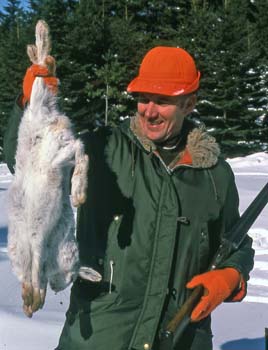
Chuck Lunn with two snowies taken on a hunt. He didn’t shoot me.


Outdoor writing has been my personal livelihood  for 44 years. One would think over that period of time that I’d seen everything in the outdoors.

Today’s newspaper carried a short blurb. A deer hunter did something foolish, and managed to shoot and kill himself. It makes me wonder what’s wrong with people.

I have probably written at least 100 stories, and perhaps more, about the many ways in which Michigan hunters have managed to kill or wound themselves or others over the years. You’d think after awhile people would quit taking idiotic chances. Quit thinking that hunting accidents only happen to other people, but I learned differently about 20 years ago.

Accidents can and do happen, but are usually the result of poor judgment.


Today’s account of yesterday’s fatality detailed how the unlucky hunter had climbed into his tree stand, and was in the process of pulling his loaded rifle into the tree. No one knows for sure  exactly what caused this tragedy, but the barrel was pointing up when it went off. The bullet from his rifle killed him, and the police are supposedly investigating the accident.

If anyone out there is hunting from a tree stand or any other elevated platform, for God’s sake, don’t load the firearm ahead of time. Even an unloaded rifle, muzzleloader or shotgun should be raised into the stand butt-first. Use a stout rope, tied a firm knot around the firearm, and don’t load the silly thing until you have it in the blind.

A loaded firearm can catch the trigger on a twig on the way up, and boom, it blows off half your face. Or the shot goes off, and hits you in various parts of your body. I used to investigate such stories for The Detroit News as part of my job, and some of the ways people injure or kill themselves would amaze most sportsmen who have more than a little bit of common sense.

Here are a few examples, including one that happened to me.


One guy stopped to fire up a smoke while hunting. He stopped walking, rested the muzzle of his shotgun on one foot while lighting up, and the shotgun went off, blew away his toes and part of his foot. Now there is another reason to stop smoking. Now the guy hobbles around.

Two guys hunting together paused to have lunch. They met, leaned their loaded deer rifles against a tree, and started going through their brown-bag lunch. One guy accidentally bumped a rifle, it fell to the frozen ground, went off, and the survivor had to break the bad news to the other man’s wife about how an accident killed his best friend.

Another nimrod was duck hunting from a boat. He and his friend built a framework of wood and chicken wire around around the boat. They cut cattails, wove them into the wire, and went hunting. They saw some ducks coming, one man stuck the muzzle of his 3-inch 12 gauge through the wire to shoot. The ducks swerved, he pulled back on the shotgun stock, but the front bead was caught on the wire. So he reaches through the wire with a couple of fingers, and pushed the barrel backwards while pulling the stock back with the safety off and his finger on the trigger. They now call him Stubby after shooting off two fingers.

I was shot in the hand and wrist by a snowshoe hare hunter in my party who had become lost, and was firing three-shot bursts from his 12 gauge, as I went back to get him. He was firing wildly in a panic, and just as I found him, he shot in my direction. Many pellets him me but didn’t penetrate my Hunter Orange shooting coat, but some pellets did go into one gloved hand.

Take no chances, think before shooting, identify your target, and use caution.


These accidents occur because some people don’t pay attention, use very poor judgment, have little or no common sense, and seem willing to take chances while hunting. There were no firearm fatalities last year, but we’ve already had our first in 2010. One death is one too many.

Engage brain before picking up and using any firearm. The life you save could be your own.

Posted via email from Dave Richey Outdoors

Saturday, November 13, 2010

Not the right night to shoot


Bucks often bed down in open grassland where visibility is good.


The buck minced along a fence line in no hurry to enter the field before dark last night. It stopped every 10 feet, lifted its head to look around and sniff for danger before moving slowly toward the dinner table.

The day, still warm but overcast, threatened rain. The buck, more wary than it should have been, wasn't in a rush to leave the heavy cover. It poked along, feeding along the edge of a corn field, after leaving a thick swale where it and several other deer had been bedded down.

The buck, sporting six points in a small basket rack, was only 1 1/2 years old. It was plenty old enough to know enough to stay with other deer his age and not get mixed up with larger, older bucks. However, he had taken to hanging out with some big bucks.

Looking for a good buck, not a 1 1/2 year old.


My stand was 15 feet up a towering maple. The buck was still on the same path it had used during August, September and October, and apparently saw no reason to deviate from its chosen course.

Would it follow the same trail again? Yeah, it would because he always traveled the same morning and evening routes, and it would soon pass within easy bow range of my tree stand. My stand wasn't too far from my wife's covered pit blind.

The does and other yearlings had already passed by and continued on into an open field 200 yards away. The buck, moving slowly and daintily like his feet hurt, was taking all the time in the world. He was in no rush to go anywhere.

Many things would have to come together before a bow shot could be taken, and I knew I wouldn't shoot him. The buck seemed to be buddies with some trophy bucks. Now, some of those boys were shooters.

The problem with hunting big bucks is few shooting opportunities.


Would I be ready if one of the big bucks showed up? Daily practice and well over a half-century of studying big whitetail deer at close range had chased away any possible jitters. My mind and gear was ready.

The buck moved a few steps closer. He stopped to sniff where his sister, mother and cousins had paused, and the young buck looked around as its mother had done countless times before. He wasn't running with Mom now but was in the big leagues with the big guys.

My bow, sighted in to be dead-on at 20 yards from 15 feet up a tree, was waiting. An arrow was nocked, and it was ready to use when and if the right time arrived. I was ready for one of the big bucks, not Junior.

The six-pointer hopped over a single strand of barbed wire, and paused again to study the upcoming terrain. Other deer, 300 yards away, were heading out to feed as the sun began to sink in the western sky.

It would have been an easy shot on the little guy.


And then I saw them. Three big bucks were using an adjacent trail. They were only 40 yards away from me but the thick brush would deflect any arrow sent their way, and besides I don't shoot that far.

The young buck turned again, and slowly stepped a few feet closer to my tree. Its head came back, and its nostrils flared as it snuffled the air for danger. None was detected, and satisfied, the buck began to move again, now toward the big bucks.

My tree stand was directly downwind from the buck, and it couldn't smell me. Rubber boots and a downwind position and my Scent-Lok suit kept the buck from detecting my presence.

The buck bent forward, nibbled on a few sprigs of grass, and moved again. The buck was only 20 yards away and quartering toward me. It wasn't a shot I would take even if the buck had been huge. Patience would now become a factor as I waited for the animal to turn and head for the other deer. I could only hope a big buck was lagging behind.

I'd watched that small buck walk to that exact place many times before, and knew he would turn slightly and offer a quartering-away shot at 10 yards. I didn't move, and the buck followed the same pattern he had traveled for months.

The buck slowly turned, quartering away, and my bow came up. It felt like an old friend in my left hand, and as it came up the arrow was cautiously drawn back as my eyes tracked the buck.

An easy shot but again I passed on this buck.


The bow was held back at full draw, and my sight settled low behind the buck's near-side shoulder. One more ounce of pressure on the release would send the Maxima carbon arrow through the buck's chest.

He stopped momentarily to look around, and my finger softly caressed the release trigger without applying the pressure needed to send the arrow on its deadly flight. Slowly, as the buck began walking off again, I eased up on the bow and let the buck walk away, unaware and unharmed.

No other bucks came along that trail. For whatever reason, the bigger animals had taken a different route and were far out of range.

Patterning this animal was easy. His buddies were much more difficult.


I really didn't want to shoot, and patterning this six-pointer and his friends had been relatively easy. Trying to work a bit closer in the days and weeks to come was on my agendam and hopefully one of the bigger bucks would mosey my way..

This exercise was good practice. It provided me with superb outdoor recreational experience, numerous deer sightings, and the chance for a close shot at a nice young buck.

Who knows? Perhaps next time my finger will put that extra ounce of pressure on the release trigger. And then again, I will again choose not to shoot but wait for a larger animal.

It's always this unknown question: whether to shoot or not to shoot, and it's my deep respect for the deer I hunt, that allows me the wonderful opportunity to acknowledge the magical difference between hunting and killing.

For me, on this hunt, it just wasn't the right time or right deer to shoot.

Posted via email from Dave Richey Outdoors

Friday, October 15, 2010

The right attitude for hunting


It's difficult to do many things that require skill unless one has the proper attitude and dedication. One thing I find about some hunters is they lack any drive or motivation, and this usually comes from not having an attitude.

There are good attitudes and bad 'tudes, and a bad one isn't conducive to being an effective deer hunter. Hunters with a bad 'tude are constantly griping about the weather, the lack of deer, too many does, too many hunters, and on and on.

Can't remember the name of the guy but years ago he held classes that praised the power of positive thinking. He believed that thinking in a positive way made a major difference, and I completely agree.

Putting a positive attitude on your deer hunt gives one confidence.

Think of deer hunting the same way. You climb into a tree stand or ground blind, feeling good about yourself and your ability to sit still and shoot straight. You know you can shoot that buck if it comes your way, and offers a high percentage shot.

This positive thinking attitude doesn't work every time. If it did, we would all soon tire of deer hunting, rolling a 300 game while bowling, or clobbering two home runs in the local softball game.

What this positive thinking does do is allows a hunter to do everything else right. A buck starts heading your way, and you spot it immediately. You sit still and don't wiggle around, and you've got the wind in your favor at all times.

This positive attitude allows hunters to scout more efficiently, pinpoint key buck areas, and to be in the right spot at the right time. This occurs because they believe in themselves.

Hunting means you must believe in yourself, your abilities and hunting skills. If you think negatively, chances are good you'll be daydreaming about the boss you intensely dislike, and a buck will sneak past and be out of range or back in thick cover before it is seen. You've blown perhaps the best chance of the season!

Daydream long enough, and a buck will slip in behind you, squire a doe, and she will lead him past your stand too fast for a shot. You won't shoot because your bow was not in your hand where it should have been, and you were ill prepared to take a shot.

Pay attention, stay alert & don’t daydream.

Turn this whole scenario around, and you head into the woods with hope in your heart, and a good feeling about hunting. There is a feeling that you sense more than feel, that today will be a day when a nice buck will offer a shot. You can sense that buck, and you sit tight with bow in hand, and when he shows up, you are fully capable and prepared to shoot it.

The power of positive thinking is something that many people rarely think about. They might be thinking about a beer after the hunt, and be thinking of that brew when they should be thinking about a buck that just slipped by without a shot being taken.

This is a mental concept that is very difficult to explain, and in all honesty, hunters must have a few bucks under their belt to make it work. They must know their way around the deer woods, and must learn to think like a deer. If I was a deer, where would I enter this area from and why? You study the terrain, figure it out, and sure enough, on many occasions the deer will travel the trails you've puzzled out.

Hunters with a positive attitude have their game face on whenever they enter a stand. They are out there to hunt, not just spend time outdoors, and they are constantly running the angles through their brain. They are, without knowing it, trying to will a buck to them.

That is a bit of a stretch, and although I'm not saying a person can will a deer to them, I believe the hunter with the right attitude will do more things right than hunters with an indifferent mind-set.

Make your own luck by working harder than the next guy.

Hunters often refer to those people who always shoot a nice buck as being "lucky." They are not lucky in the normal sense of the word; instead, by having the proper attitude, and the willingness to think things through and do everything right, they make their own luck.

I can't teach you or anyone else how to develop the proper deer-hunting attitude. You either have it or you don't, and those that do, know what I'm talking about.

Those that don't will never know unless they put this column aside and read it every day before they go hunting. Then, maybe with a tiny bit of common sense and the right attitude, a buck may walk within range of a hunter who is mentally and physically prepared to shoot it.

Posted via email from Dave Richey Outdoors