Showing posts with label still. Show all posts

Friday, March 30, 2012

Sitting Still is an art. Learn now.

Calm your mind before starting to hunt; Don’t think!

sitstill
Sitting still is an art. Sit like you're asleep, but don't. Watch closely and learn.
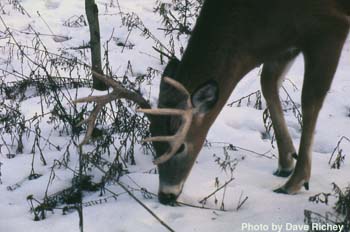
photo Dave Richey ©2012
There is an art to sitting still. Not only motionless but doing so without making a sound.

It may sound easy but it is a very difficult thing to do. Everyone fidgets at times, moving around, easing that tree stub that pokes you in the back, and swatting at mosquitoes.

Trust me, sitting still is an art. Not everyone can do it, and I can set like a statue but nothing like I could 20 years ago. Age brings with it knowledge and more aches and pains.

Learn some of the sitting-still methods before bow season

The knowledge is what allows me to tune out the sore back, hips, legs and other body parts. Knowledge is the key to becoming a successful deer hunter.
Anyone who ever studies deer should have learned two things very quickly. Stay downwind of the deer, and  learn how to sit still.

It is not easy to sit still. Those who think they are being motionless and silent are, in many cases, moving far too much and making some noise in the process.

How do you sit still? The best way to learn is to go where deer are plentiful, and sit in a tree or a ground blind. See how long it takes before the hunter spooks deer.

Many feel that only spooked deer snort. Lots of deer simply melt back into cover, and leave the area silently. They are spooked but do not snort.

Watch deer, and see how often they stop and look around for danger. I've watched large numbers of deer over the years stand motionless for 30 minutes to an hour after detecting the presence of a hunter. Not a muscle, ear, eye or anything will move it they've  been alerted to nearby human  presence.

One of my hunting friends used to hunt a funnel leading out of a cedar swamp to open hardwoods. The swamp was full of water, and it was easy to tell where the deer were coming from. Deer that were wet clear up to their belly were coming through the swamp. Those deer could be heard coming for 15 minutes as the water sloshed around as they moved slowly.

Develop your own method for clearing your mind

Once he spotted a buck moving slowly, and then it stopped. It was 200 yards away but there was an open spot he could see through with binoculars, and he knew there was a hunter upwind of the deer. That animal stood  in cold November water for over an hour without moving. Dusk came and went, and the buck still stood in the water, as motionless as a statue.

How do you sit still? Part of it comes through practice but much of it comes from a total state of mental relaxation. Put your mind at ease, forget about aches and pains and that stiff little stub poking into your rump.

Tune it out. The more you think about it the more it will bother you. The same is true of mosquitoes early in the bow season; forget about them, and the less you move the less they will bother you.

Think good thoughts about good friends. Leave business problems at the office, and dismiss them from your mind. Mentally think about something calm and pleasing. Put your mind in a relaxed state. Forget missed phone calls or upcoming doctor appointments. Clear your mind of anything and everything, relax and don't think.

Purge your mind of all thoughts and picture yourself somewhere lovely, a spot where you feel a gentle sense of peace, and where nothing can affect you. A friend imagines himself on a calm pond where no wind is felt, no sound is heard, and in his mind he lays back against a boat cushion, stares up at the clouds and his breathing slows down. He keeps seeing that gentle pond in his mind's eye, and he sits quietly and without motion.

Time seems to pass slowly, and almost as if from a haze, out steps a buck. The animal is upwind, sniffing and looking for danger. Sensing none, he steps forward two or three more paces, and stops.

Don’t fall asleep but act like you are; Pay attention to deer

Relaxed, the deer looks around and watches his back trail. As the deer looks away, the hunter slowly and quietly comes to full draw, aims and kills that deer.

It was easy because the hunter was relaxed. A relaxed sportsman, at peace with body and soul, doesn't move and doesn't make a sound.

It takes practice but then so do many other thing in life. Sit in the woods during the summer months, and practice the art of sitting motionless and silent, but realize you needs practice. Do it now, and you'll be ready for the hunting season when it arrives.

Saturday, April 30, 2011

Hunting gobblers will teach a hunter how to sit still


A decoy can help divert some attention away from a caller.


My preaching about sitting still without making noise has become a mantra. Some people might think I keep repeating myself, but this is a most important thing for hunters to keep in mind.

Perhaps I do natter on a bit about it but there is a very good reason for my tedious repetition. If some folks aren't reminded, they tend to forget this very important part of hunting.

Move at the wrong time, and a deer has you pegged. If you are very lucky the deer will run off without blowing and snorting or spooking every deer within hearing.

Sitting still is second nature to me but not to many deer and turkey hunters.


The same thing holds true with making any noise. Click an arrow against the bow, or have brass cartridges rattling around in your pocket, and it's enough to send whitetails bolting for cover a half-mile away. It's just their nature to be jumpy.

Some people believe that because they are in an elevated stand or inside a ground coop that they are well concealed. That's not true. They may be somewhat concealed but movement or sounds are seen or heard.

Anyone who really wants to get an education on sitting without making a movement or noise should practice on wild turkeys. These birds seem to have X-ray vision, and their ability to hear sounds is second to none.

Some friends hunt turkeys with a bow. They are accustomed to sitting still in a deer blind, and it is second nature for them to sit still while turkey hunting.

I've often watched other people hunt birds, and almost all of them wind up spooking the gobbler long before Ol' Longbeard strolls within 100 yards. Think of it this way: all wild animals have the ability to tell almost precisely where a call they hear is coming from. It's almost uncanny how they determine a sense of place where a call originated.

Even a bull moose can pinpoint the position of a call.


Use a deer call on a whitetail passing 100 yards away, and if that buck comes, he will come to within 10 feet of where the call came from. If deer can do that, if moose or elk can do that, so can a turkey.

That bird may come fast or slow, but he will be coming directly to the hunter's location if possible. Some may try to circle a bit but they head straight for the call. So what happens when the bird is 100 yards away, and you decide to reposition yourself for a shot at the wrong time?

The gobbler will have you spotted in a heartbeat. There is an old adage about hunting gobblers that goes: If you can see the gobbler, the gobbler can see you. If a move is necessary, do so when his head is behind a big tree. Don't get caught when he is out in the open.

Cheating on a gobbler involves waiting until the bird goes behind a thick bush or a big tree. If a move must be made, make if fast, smooth and without noise ... and when the bird cannot see you. Never attempt any type of move if a bird is within 35 yards.

Eliminate all movement by being properly positioned for a shot at all times.


OK, if the bird is coming directly to your call, all you need to do is line up on the bird's head. You do have the shotgun stock to your shoulder and the fore-end braced on the palm of your hand and resting on your knees, don't you? It's like having the bow in your hand, the other hand on the release, and being back at full draw and waiting for the shot.

Success at turkey hunting means being prepared, doing everything right, and sitting still. A moving hunter or one that makes a noise other than that made by a hen turkey will probably scare off the bird. Once a turkey is spooked, he's not coming back for a visit any time soon.

That same analogy applies equally well to deer hunting. The sportsman that can't set still for an incoming turkey won't be able to sit still when the buck of a lifetime approaches his stand.

It's great training for those hunters who drew a spring turkey permit. If you didn't draw one, don't practice your sitting still exercises when other people may be in the woods. There is little sense in ruining someone else's hunt.

If you want a top-end experience of learning what and what not to do when game approaches. hunt gobblers. Make one mistake, and you'll have learned your first lesson, which should never be repeated.

Saturday, February 19, 2011

Sitting still is an art


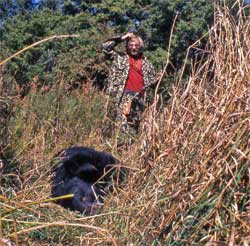
The author shot this bear from the ground at a range of six feet.

Anyone who has bow hunted more than a few days should know the importance of sitting still. Knowing that, and doing it right, are two entirely different things.

Sitting still means at least two different things. It means being motionless and quiet. One without the other makes little sense, and it will spook game.

I seldom hunt with another person, but in the past when my kids and grandkids were young, they would go out with me. Most adults can't sit still, and even fewer children can do so.


Solitary hunters often do better at bow hunting than will two or three buddies.

One of my grandchildren was fidgeting when I whispered to him to sit still. He whispered back that he was sitting still.

I told him his idea and my idea of being motionless and quiet were not the same.It's taken years to master the art of silent sitting. I've taken more black bears than I have fingers and toes, and have learned some of the tricks to sitting as still as a stone for long periods of time.

"The first bear I shot," another savvy hunter told me, "was on Sept. 10, opening day of Upper Peninsula bear season. This was well over 30 years ago, and tree stand hunting wasn't legal. I sat alongside but downwind of an active bear trail with my back against a big cedar root-wad on a warm autumn day. The trail was only six feet away.

"Sometime later, I awoke from my dozing and cracked one eye lid to see a black bear walking past. I made a smooth draw and an clean bow shot that took the bruin behind the front shoulder. It ran only 25 yards into tall marsh gras and dropped."

The hunter said he was absolutely motionless when the bear walked by because he was sound asleep. He admits it was an accident, but he's since learned to sit without movement or sound for long periods of time.

Over many years of hunting bears and deer, I've discovered the trick to being still is to be comfortable, and a hunter must learn how to relax and be at ease with himself and his surroundings if he hopes to be motionless and quiet. The first step is to remove anything that can cause discomfort while sitting

My primary problem is it's necessary to remove my billfold from my back pocket. If it is left in, my sitting time is 30 minutes or less before my hip begins to hurt from an old injury. No one can sit still if their butt is painfully sore.


Find a place where the human body can be comfortable and then relax.

Sit on the ground, and a root an inch under the dirt will put a crease in your butt, and you'll start moving to get comfortable. I make certain if I'm in a tree stand that no branch stub is digging into my hip, ribs or spine. A stone in the dirt under you hind end will feel like a boulder after 30 minutes.

Check out each spot wherever you hunt. Remove offending branches or broken branch stubs. Many tree stands have uncomfortable seats because the seat is too low, and your knees are up under your chin and that makes for an uncomfortable seat. Just as bad or worse is a seat that is too high, and you have to sit on the edge of the seat to keep your feet steady on the platform. This cuts off blood flow to your legs, and your toes and feet go to sleep, which leads to more movement.

Learn to get physically comfortable first, and then learn to relax your body and mind. A man told me once that he meditates while in a stand, and although his eyes may be closed and his heartbeat and respiratory system slows down, he can hear the rustle of bear hair against bracken ferns or the faint twig snap of a wandering buck.

This isn't recommended for someone unaccustomed to meditation. What works for most of us is to free our brain of all thought, to feel comfortable and relaxed, and to will yourself to being motionless. I've had bucks approach to within several feet of me without seeing any movement, and that is part of the secret. Keep your mind uncluttered by unnecessary details, and it's much easier to remain still.

One trick of mine is to fix your attention on a distant object, and stare at it. It will blur, come back into focus, and blur again. Stick with it, and don't think of deer or work or anything else, and try to become one with your surroundings. Get comfortable and don't feel like an intruder in the woods.

That works for me and some other people I know, but it may not work for you without a great deal of concentrated practice. The first and foremost thing is to be comfortable. Once the human body is comfortable, start working on the mind.

Soon, with continuous practice, it will be possible to sit motionless for 30 minutes. Then start working on being motionless for an hour. If you can get up to two or three hours, many of your hunting problems will be solved.


Expect sudden noises like flushing grouse, snorting deer or chattering squirrels.

Learn to expect sudden noises, such as a red squirrel chattering. Don't be startled when a bear or deer steps through dry leaves. Be alert but motionless and still. Sooner or later whatever made the noise will step into view. Never turn to look behind you.

The old Negro League pitcher 59 years ago  -- Satchell Paige -- had it right when he once said: "Don't look back. Something might be gaining on you." That thought should be considered by hunters who wish to remain motionless.

If you are not moving, you won't be making noise (unless you snore). Without movement or noise, the only thing you must worry about is being winded. Stay downwind of where bear or deer travel, and you will have removed most of the key things that can spook animals.

Turkey season opens in a couple of month, and movement or  sound (except a turkey call) will spook birds. Their vision is like you or me looking through 10-power binoculars. I wear a camo face mask that covers  my face, ears and glasses, and wear brown gloves on my hand. The trick to shooting a gobble-bird is to be ready for a shot when he steps within range. Sit with the shotgun across your knees, and try to raise it and aim at a bird, abd all you'll see will be tailfeathers going away.

Practice now, long before turkey or bow season opens, to sit still and motionless in a non-hunting environment. If you can pull that off for two hours, and you follow the other common-sense hunting rules, there won't be a bear, deer or gobbler that will be safe around you.

Sitting still and not moving any part of your body except your eyes is simply a case of mind over matter. Humans do have a brain, and once they condition it to silent inactivity, their hunting skills will go up.

Saturday, February 12, 2011

Never guess about tree stand placement


Fall or winter, draw on a buck when he is occupied with feeding. Be patient.


It's a common problem for most deer hunters. They find themselves in unfamiliar territory, and begin trying to puzzle out where to hunt. Which tree will best suit their needs.

Many hunters take a wild flying guess based on minimal input from gazing at trails, and pick a spot. Often, it may look good but in reality, it is a hurry-up and poor guess that will never pay off.

Having said that, we can answer the question of choosing the right tree. I prefer a spot where two or more trails come together to form a main trail. I prefer a cedar tree if possible, but will settle for any tree that fits my needs providing it has some cover (tree branches, leaves, etc.) to break up the hunter's silhouette. It also needs at least two ways to gain access to the tree, and two ways out once the hunting day is done.

It sounds fairly simple but it involves much more thinking than guessing.


I personally prefer deer to approach my stand from behind, and if possible since I'm right-handed, I want the deer coming from behind and on my left side. It enables me to shoot sitting down, and offers both broadside and quartering-away shots, the ones a bow hunter should consider. I don't want the deer coming head-on at me, and I don't want the deer crossing from left to right or right to left in front of me.

Knowing where to hunt is always better than guessing. Knowing comes from a constant familiarity with the area being hunted. Let's put it another way: We travel to Alabama in mid-January when the rut is in full swing, and we hunt on private club land.

Someone acts as a guide, and will drive us to a stand where deer are known to pass, and with some luck, we shoot a buck. If we don't shoot a buck, it means that none were seen, none were of the size we wanted or a buck did show up but didn't offer a chance for an accurate shot. If we see no bucks, one must wonder if it's a good spot. Try to be discreet in asking a guide if the area usually produces bucks. Ask that question firmly, and the guide may question whether you are questioning his judgment. It never pays off to question a guide too strongly. He can make it happen where you won't see a nice buck. Tread softly with this line of questioning.

We will hunt again in the evening, and will be placed in a key location where we should see deer. No one can always make deer move to the hunter, and no one can guarantee that a hunter can and will sit still or see a buck. Guides have a responsibility to try to put their hunters in the best spot, but no one can guarantee that an earlier hunter didn't spook game away.

If we should hunt this way, with others telling us where to hunt, it's a wise move to pay close attention to the terrain in which we hunt. There are always things that offer subtle clues about each location and whether deer are using the area. Look for tracks, rubs, scrapes, feeding or bedding areas, and ask questions in a whisper. Pick a guide's brain because you are paying him to hopefull teach you something about picking tree stand locations.

Look for deer sign. Ask yourself if this looks like good deer country.


Deer often will be found in fringe cover, that area between thick heavy cover and open land. Of course, a ground blind or tree stand may be located anywhere in-between, and it's up to the hunter to learn why one spot is better than another. If hunting in Alabama,, as we suggested at the beginning, you will probably be hunting palmetto swamps near a creek or river. Be sure your stand is high enough to enable you to look over the palmettos because you can't look through them. A deer can move through the ground foliage but it does make some noise so be prepared to listen and look in all directions without moving too much.

One of my favorite spots is on a low hillside near thick cover with heavy cover on three sides with open land on one side. The prevailing wind should blow down through the open cover, and the stand can be cross-wind to approaching deer.

The only way a deer can pick up a hunter's scent here is when the person climbs into or out of the stand. The stand must be high enough on this small hill to blow scent over the surrounding thick cover.

One thing hunters must do is look at terrain the way a deer would look at it. Where is the food source? Where are the key bedding areas? Which trails connect those two key locations? How can deer, especially the larger bucks, travel back and forth without being on trails? I try to stay at least 50 yards back in cover away from the field edge.

Other key factors include:

•How does the wind blow in each location, and does it swirl backwards when hitting a woodline?

•How can a hunter get into and out of the area without bumping into deer?

•Does the hunting area have two or three way to enter and exit to avoid traveling the same route time after time?

•Have a choice of where to enter or leave the stand can help prevent bucks from patterning you.

•Know how to get in and out without spooking deer.


More chances are lost by running into a deer that for any other reason.


Which type of stand is best suited to that area? Which would work best: a ground blind, pit blind, tree stand or elevated coop? How high is high enough for elevated stands?

I've found that a tree stand elevation of 15 to 18 feet is usually high enough under most circumstances. I've got one stand that is close to 30 feet in the air, and it is a consistent producer but steep-angle shots are not a good bet when a hunter must make up his mind in a hurry, and take a quick well-aimed shot.

Many of my stands are at 14-15 feet. That places a standing bow hunter at roughly 20 feet in the air. A stand at 18 feet puts the hunter has roughly 24 feet. Each stand has special requirements, and hunters must solve these problems long before the season opens. Match stand height to the best natural features of a tree.

Hunters will have far better success if they know why a hunting location is the best spot. Guessing implies that one is trusting to luck or fate. With a guess, the hunter will have a 50-50 chance of guessing right.

Of course, this also means a 50-50 chance of guessing wrong. There is nothing worse than a stand that requires hours of effort and time to prepare only to learn it is not in the right spot.

This year, don't guess. Know where the hotspots are long before the season opens. Doing so beats guessing every time.

Saturday, November 13, 2010

Not the right night to shoot


Bucks often bed down in open grassland where visibility is good.


The buck minced along a fence line in no hurry to enter the field before dark last night. It stopped every 10 feet, lifted its head to look around and sniff for danger before moving slowly toward the dinner table.

The day, still warm but overcast, threatened rain. The buck, more wary than it should have been, wasn't in a rush to leave the heavy cover. It poked along, feeding along the edge of a corn field, after leaving a thick swale where it and several other deer had been bedded down.

The buck, sporting six points in a small basket rack, was only 1 1/2 years old. It was plenty old enough to know enough to stay with other deer his age and not get mixed up with larger, older bucks. However, he had taken to hanging out with some big bucks.

Looking for a good buck, not a 1 1/2 year old.


My stand was 15 feet up a towering maple. The buck was still on the same path it had used during August, September and October, and apparently saw no reason to deviate from its chosen course.

Would it follow the same trail again? Yeah, it would because he always traveled the same morning and evening routes, and it would soon pass within easy bow range of my tree stand. My stand wasn't too far from my wife's covered pit blind.

The does and other yearlings had already passed by and continued on into an open field 200 yards away. The buck, moving slowly and daintily like his feet hurt, was taking all the time in the world. He was in no rush to go anywhere.

Many things would have to come together before a bow shot could be taken, and I knew I wouldn't shoot him. The buck seemed to be buddies with some trophy bucks. Now, some of those boys were shooters.

The problem with hunting big bucks is few shooting opportunities.


Would I be ready if one of the big bucks showed up? Daily practice and well over a half-century of studying big whitetail deer at close range had chased away any possible jitters. My mind and gear was ready.

The buck moved a few steps closer. He stopped to sniff where his sister, mother and cousins had paused, and the young buck looked around as its mother had done countless times before. He wasn't running with Mom now but was in the big leagues with the big guys.

My bow, sighted in to be dead-on at 20 yards from 15 feet up a tree, was waiting. An arrow was nocked, and it was ready to use when and if the right time arrived. I was ready for one of the big bucks, not Junior.

The six-pointer hopped over a single strand of barbed wire, and paused again to study the upcoming terrain. Other deer, 300 yards away, were heading out to feed as the sun began to sink in the western sky.

It would have been an easy shot on the little guy.


And then I saw them. Three big bucks were using an adjacent trail. They were only 40 yards away from me but the thick brush would deflect any arrow sent their way, and besides I don't shoot that far.

The young buck turned again, and slowly stepped a few feet closer to my tree. Its head came back, and its nostrils flared as it snuffled the air for danger. None was detected, and satisfied, the buck began to move again, now toward the big bucks.

My tree stand was directly downwind from the buck, and it couldn't smell me. Rubber boots and a downwind position and my Scent-Lok suit kept the buck from detecting my presence.

The buck bent forward, nibbled on a few sprigs of grass, and moved again. The buck was only 20 yards away and quartering toward me. It wasn't a shot I would take even if the buck had been huge. Patience would now become a factor as I waited for the animal to turn and head for the other deer. I could only hope a big buck was lagging behind.

I'd watched that small buck walk to that exact place many times before, and knew he would turn slightly and offer a quartering-away shot at 10 yards. I didn't move, and the buck followed the same pattern he had traveled for months.

The buck slowly turned, quartering away, and my bow came up. It felt like an old friend in my left hand, and as it came up the arrow was cautiously drawn back as my eyes tracked the buck.

An easy shot but again I passed on this buck.


The bow was held back at full draw, and my sight settled low behind the buck's near-side shoulder. One more ounce of pressure on the release would send the Maxima carbon arrow through the buck's chest.

He stopped momentarily to look around, and my finger softly caressed the release trigger without applying the pressure needed to send the arrow on its deadly flight. Slowly, as the buck began walking off again, I eased up on the bow and let the buck walk away, unaware and unharmed.

No other bucks came along that trail. For whatever reason, the bigger animals had taken a different route and were far out of range.

Patterning this animal was easy. His buddies were much more difficult.


I really didn't want to shoot, and patterning this six-pointer and his friends had been relatively easy. Trying to work a bit closer in the days and weeks to come was on my agendam and hopefully one of the bigger bucks would mosey my way..

This exercise was good practice. It provided me with superb outdoor recreational experience, numerous deer sightings, and the chance for a close shot at a nice young buck.

Who knows? Perhaps next time my finger will put that extra ounce of pressure on the release trigger. And then again, I will again choose not to shoot but wait for a larger animal.

It's always this unknown question: whether to shoot or not to shoot, and it's my deep respect for the deer I hunt, that allows me the wonderful opportunity to acknowledge the magical difference between hunting and killing.

For me, on this hunt, it just wasn't the right time or right deer to shoot.

Posted via email from Dave Richey Outdoors

Friday, October 08, 2010

Controlling human scent


Humans have some funny notions, and oddly enough, some people believe them. Our beliefs often are very strong about things concerning hunting, and we sometimes believe them even if they are not true.

The problem is our Daddy or Gran'daddy told us those hoary old thoughts were true. Some of these myths have been passed down from one generation to the next, and most lack any basis in fact.

For instance: we may think we smell just dandy after a bath or shower using a liberal dose of shampoo and soap. We think we smell as natural and pretty as a rose garden, and it's possible that we may smell dandy to ourselves and other humans, but a whitetail deer would probably think we stink.

To a deer, people stink no matter how clean they are.

To a deer, we probably smell as bad as Peppy La-Pew, the skunk, after a face-to-face with a speeding 18-wheeler and getting squashed. We, as humans, can smell the pungent odor of roadkill skunk. Deer, if they get downwind of us, can smell us as easily as we smell Peppy's lingering odor.

I used to be able to smell a fox if I was within 50 yards downwind of the animal, and then in a teen-age quarrel with a beefy guy much larger than myself, I hit him in the fist with my nose and my sniffer hasn't worked right since. Nor have my fighting abilities, so that fight at age 19, was my last. Sadly, the nose still doesn't work right.

But, this is about fooling deer. A reader wrote today and asked what scent eliminating sprays work. I advised him that he had several options, and one was to buy a Scent-Lok suit. It's the route I choose even though my Scent-Lok suit is now old and tattered and about wore out.

He wanted to know what he personally could do to eliminate his personal odor. He was looking for a shortcut to success without saying so, and even when using the scent-eliminating sprays or Scent-Lok clothing, it is not a cure-all for all of a person's hunting ills.

However, scent-eliminating sprays and Scent-Lok suits can work in much the same way as deer scent or fishing lures do. If the angler or hunter believes in them, their use will usually make that person a better sportsman because hunters are more likely to take the necessary precautions to avoid being winded than other hunters.

Drawing down on deer is great practice as a loudmouth once learned.

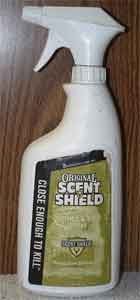
Many years ago, while toiling for The Detroit News back when they still had a weekly Outdoor Page, I was sent some Scent Shield scent-eliminating spray. Me and several other sportsmen were hunting deer in the Club Country of Montmorency County as the guest of a good friend.

A guy I invited on the hunt shot a button-buck the first night as it stood 12 yards away, staring at him, and he was bragging on his bow-shooting prowess. He asked what I saw, and I told him I'd drawn down on 15 different deer that night, including two antlered bucks, and chose not to shoot for a variety of reasons. The important reason I didn't shoot was because both animals were small 1 1/2-year-old bucks.

One thing led to another, and he as much as called me a liar, saying that no one can draw on a deer without getting spotted or winded. I told him that he was dead wrong, and he wanted to bet some big money.

"OK, sport, you've been bragging up your new video camera," I said. "I'll prove it tomorrow night. I'll draw down on every deer I see within my shooting range, and you can videotape the action but don't be spooking my deer. I'll be a nice guy and not take your money but I'll teach you a lesson about opening your mouth before engaging your brain."

I climbed up into an oak tree. I'd seen a bunch of deer follow a trail on the far side of a rundown fence next to the big oak. I donned my old Scent-Lok suit, sprayed my boots, groin, legs, torso, butt, back, arms and gloves. I sprayed the Scent Shield on the inside and outside of my cap and my face mask.

The guy was crosswind along a fence-row about 50 yards away where he could see me and the deer as they stepped over the fallen fence. Each time one came by, I drew on the animal and aimed at it as if I was going to shoot before letting up. The first 26 animals were all button-bucks, does and doe fawns, and as the herd began to build 25 yards downwind of me, it became tougher to draw without one of the deer spotting my super-slow movements.

I successfully drew on all 26 deer, one at a time as they passed my tree, and No. 27 was a decent buck. He walked out, I drew, aimed and killed that animal.

I drew on 26 deer without being spotted, and shot the 27th deer, a nice buck.

The joker now had to believe it could be done. He had videotaped me drawing on all 27 deer as they stood directly downwind of me. I wrote that story for The Detroit News, and Scent Shield, the first maker of scent-eliminating sprays, was off and running, and Michigan sporting goods stores sold out of the product overnight.

Lately I've been using Vanishing Hunter spray, which is made by Buck Fever Synthetics in nearby Manton, Michigan. Phone them at (888) 824-9894. I'm also using Scent Killer from Wildlife Research Center in Ramsey, Minn. I go through the same ritual day after day: everything gets sprayed good, and I don't get winded. However, in all fairness, I'm either in an elevated coop or downwind of the travel trails.

I'll also trickle some milkweed fibers into the breeze every few minutes. If any drift downwind to the trail I'm hunting, I pick up and head elsewhere or won't hunt. Getting winded ruins more hunts than anything else.

I know how to sit still, and haven't spooked an incoming buck or doe in many years. Scent-eliminating sprays and Scent-Lok suits certainly have a major place in a hunter's repertoire but nothing can beat being downwind of deer.

I keep all of my hunting clothing and knee-high rubber boots in an air-tight plastic tub. I take the tub out of the car, carry it 50 yards away, sit on a folding chair, and either wear my Scent-Lok suit in cooler weather or lightweight camo clothing in warm weather. I stay away from the car once I've sprayed down my clothing.

Walking hard and fast to a hunting stand can get a guy (or gal) all sweaty, and  that isn't good. The moisture soaks into clothing, and although we may not be able to smell ourselves, it's dead certain that a deer can smell us. I'd rather take an extra 10 minutes to reach my stand, and be cool and collected, than rush and have my clothing saturated with perspiration.

Whenever I use scent-eliminating sprays, everything is sprayed. The front and back of my hunting pants and shirt, my boots, gloves, face mask and hat. I stay away from gasoline and exhaust fumes, and I'm clean when I head into the field. Some people kid me about my fetish for being scent-free but I shoot more and bigger bucks than they do and have more opportunities for good shots.

The key thing is to pay particular attention to those areas that are most likely to get sweated-up during a walk. This would include the head, underarms, groin, rump and feet. Such areas get sprayed thoroughly before every outing, and since I usually hunt seven days a week, my hunting clothing is washed on a regular basis.

Washing camo clothing should be done in Atsko SportWash. It has a gentle cleansing action and does not contain brighteners. Tide and other common household detergents used to wash our clothes contain brightening agents that "make whites look whiter." Me, I want my camo to look dull so it blends in. I don't want bright-looking camo clothing.

I've seen people wearing old camo clothing that has been washed so many times that it is faded out and almost glows in sunlight. I have poor vision, but if it looks bright to me, it must look like a blinking neon light to an incoming deer. The animal may not see the hunter but it can probably see the unusual light-colored blob in the tree. Guess what? That light-colored blob happens to be you. It may be time for new camo clothing.

Using the proper cleansing agent and the proper scent-eliminating spray can help hunters score providing they are properly set up in a good spot, play the wind, do not move, know when to draw, and don't make any noise.

Neither Scent Shield, Vanishing Hunter, Scent Killer or even Scent-Lok clothing can keep hunters from making that one mistake that can and will spook deer. If they get pegged by deer, nothing will enable them to salvage a shot at a wary animal.

These hunter accessories can only make good hunters better. And you've got to be plenty good and scent-free to keep shooting good bucks, year after year, and you can take that little tidbit to the bank.

Posted via email from Dave Richey Outdoors