Showing posts with label avoid. Show all posts

Saturday, July 07, 2012

Avoid high temperatures, and fish at night

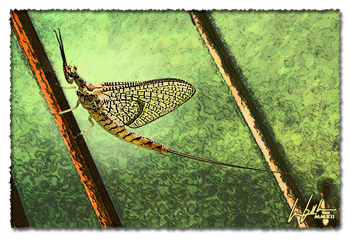
Moon glow Hex
Hexagenia limbata (giant Michigan mayfly) produce heavy trout feeding patterns
llustration (HexMoon Glow) courtesy Les Booth ©2012
It must be something in my genes. I’m apparently wired different than most people.

Michigan has four seasons -- spring, summer, fall and winter. It’s not that I dislike summer; it’s that I hate summer!

Now, hate is a pretty nasty word when used in any form.

Sadly, I can think of no better way to sum up my feelings. Granted, I could probably find something to do after sundown, like fish for big brown trout in the
AuSable or Manistee rivers. It can help take my mind off the constant heat.

I’ve done that for many years during other brutally hot summers. It was OK, but I actively dislike that sticky feeling when I perspire too much. And, there-in lies part of my problem. I don’t perspire like most people.

Sometimes hot days produce hot fishing at night


Very little perspiration comes off my head. Nor does my underarms dampen my shirt.  It comes out in other places too delicate for a family oriented blog to discuss.

The higher the temperature, the higher my frustration level, and the more noxious insects try to bore holes in my body to suck my blood.

I’ve learned not to swat at flying insects, day or night. It moves the air, makes me even hotter than before and all the bugs whistle up their buddies to come and join the feast.

It’s at this time of year when many major fly hatches come off. The sun goes down, and insects that have spent the day maturing in stream-side foliage, decide to reproduce their kind in a mating dance over the river. It begins with a soft audible hum before becoming a full-blown hatch.

Mayflies land on nose, ears and hands, and balance delicately on the brim of my cap. I look out over the river. Clouds of insects hover over the river, and above the audible hum of thousands of insect wings, comes the sound of trout rising from narrow seams of flowing water.

There are the splashy slurps of small trout. Experienced anglers have learned to determine locations by their sound, and from that comes the knowledge of about how far away the fish is feeding, and then we extrapolate that into making a cast that positions our fly upstream from the fish. Big browns sip flies off the surface without much noise.

There is a science to locating big fish at night; You listen for them feeding


We then determine the length of time between when the trout rises to take a fly and the next time he rises to feed. We count the seconds “one-thousand-one, one-thousand-two, one-thousand-three” until he rises again.

We make our cast at the “one-thousand-two” count. This gives us a narrow window to make the cast; at the “one-thousand-two” count; and allowing that final second for the cast, and drift, of the fly over the feeding trout.

That’s the way it’s supposed to work. Often a rising trout will sip a natural insect off the surface, and by chance take one of the many that surround your fly. It doesn’t always work.

Often they ignore our offering, and anglers can switch fly patterns or sizes, and that may make a difference. Sometimes when a blanket hatch occurs, there are simply two many insects on the water. The trout can swim with their mouth open and fill their belly fast.

The odd thing about a hot night and a good hatch is we often forget about the oppressive heat. We false-cast once or twice to dry the fly, and keep trying for that one fish that continues to rise, but a blanket hatch soon puts the fish down. They’ve ate their fill, and retire to a quiet spot in the water to rest.

In the distance, a tree of heat lightning flickers across the sky, and one can easily determine its line of travel as it flickers again. Slowly, a calm settles over the water, and it’s possible to hear other night sounds.

Learn to listen for feeding fish, and to tell big fish from small ones


Owls hoot, night hawks boom, and frogs croak near shore. Suddenly, one becomes aware that the awesome heat of the day has lessened and we drift the river slowly casting dry flies or casting and stripping line fast to work a big streamer through deep holes and runs near shore. This latter method, if done on a nonstop basis, may produce a big fish but all of the effort will set you to sweating again.

One must chose their poison. I had a heat stroke once while changing a car tire, and since that time, I conveniently find something to do inside my air conditioned office.

So, if you are like me, I choose to stay in when we have three-digit temperatures occur during mid-day, and if I choose to fish at night, I wait until two hours after sun down before I head out. It may limit my catch at times, but it does allow me to fish in some semblance of comfort.

Saturday, July 30, 2011

How to approach your hunting stand without spooking deer


A truck is the best way to approach a blind. Truck drops off and picks up hunters.


OK, folks, which is the best way to walk to your deer-hunting stand? Skulk along like you are trying to sneak up on the deer or just walk straight-forward without trying to sneak from one tree to the next?

In this country, opinions are like elbows: everyone has at least one. You may disagree with my thoughts, and I may take issue with yours, but we should each respect the other for the right to speak up for their choice.

My vote goes to grabbing the bow and walking directly to the blind. Climb into it, settle down, get ready for deer activity, and it seems to work for me. A deer that may observe me walking along, and ducking into a blind, isn't frightened by my actions. I do nothing to frighten the animal.

Walk with head up, don't look at deep, and don't appear to be sneaking along.


The deer may circle the area, pick up a tiny bit of scent, but not enough to spook them. It goes on about its business without being unduly alarmed. People on foot are common in the deer woods.

A sneaking or skulking hunter, one who tiptoes toward the hunting blind while darting from bush to bush, attracts far more attention from deer. An upright man may cause deer to run off 50 yards and stop in heavy cover to see what happens, and when nothing does, their fear disappears.

A hunter that acts suspicious, and causes deer to become alarmed, do themselves more harm than anything else. They literally drive deer away by their actions.

The sportsman who wishes to reach his blind as quickly as possible, should walk steadily (don't run or sneak), and when he reaches the ground blind, elevated coop or tree stand, should get into position with a minimum amount of noise, sit down and sit still.

Once the hunter reaches his hunting area without incident, disappears from sight into the blind or stand, he is soon forgotten. They don't seem to pose any danger to the deer, and the animals soon revert back to normal feeding patterns.

Climb into position in a tree or open the door to a ground blind. Don't make noise.


A moving pickup truck is always studied by nearby deer, and as long as it moves along steadily and the people inside stay inside when the truck stops, it doesn't unduly frighten the animals.

There are times when a truck can pull up to a blind, a hunter can ease out and get into the stand, and then the truck pulls away. Deer can't count. The truck pulls in, stops for a half-minute, and then moves on. Just don't slam the truck door or make noise getting your gear out of the truck bed.

People may think getting into a stand scares deer. It doesn't as long as everything acts natural and there are no loud and unexpected noises. It's noise that deer might hear a hunter make from inside the blind or from a tree stand that will drive deer crazy. An unexpected sneeze or a cough will trigger the alarm button.

Moving directly to the stand in a normal walking pace is the best way to get there. It's the straight-line rule between two points that is important; providing the sportsman doesn't have to walk through a bedding area.


If deer are seen on the way to the stand, don't stop to look at them, but keep moving forward without breaking stride. Hunters who stop to look at the deer will cause them to snort and alert all other deer in the area.

Ignore any deer and walk at a normal pace to the blind.


A person who ignores the deer and walks at a steady pace to his blind often cause the deer to bound away but they usually do not snort and spook.

This year, just to prove it to yourself, try walking right along without lifting your head or stopping to look at deer, and climb into the stand and sit still. If that doesn't convince you, try sneaking from bush to bush and tree to tree, stopping frequently, and skulking about, and see how often you get snorted at.

You'll soon learn what works best and what does not. It takes many things coming together to make a deer hunt end with a shot at a good buck.

It makes little sense to do anything that may draw attention to your presence on stand. Just walking steadily to a blind makes a great deal of sense to me.

Thursday, May 05, 2011

Slow down, drive defensively, save money, fuel & a deer's life

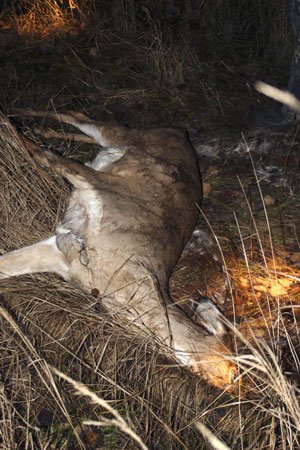
A tag is needed to keep a car-killed deer.


A buddy called today, and his spring deer report wasn't good. He was shocked by the carnage on Michigan's highways.

He'd driven from near Cadillac down highway M-115 to US-10, and then east to Bay City, down I-75 to Flint and back, all in one day. What he saw over 300 round-trip miles was sad.

He saw deer. Dead dead. Lots and lots of dead deer & other animals.


"There were dead animals everywhere," he said. "Leaving Cadillac, I began counting carcasses and major bloody pieces of pavement where deer and other critters had been hit. There were an incredible number of flattened deer.

"I saw 67 dead deer, coons, possums, and other critters between Cadillac and the US-10 expressway. Many were nothing but bloody lumps of hair and large blood stains. Some deer were hit, and bounced off to the side of the road, and I'd wager there were more deer and other animals that I didn't see."

He said it was equally bad between the M-115 and the US-10 freeway junction, and I-75 at Bay City. He counted well over 60 deer in that stretch. Some were so destroyed by an impact with an 18-wheeler and other vehicles as to be near unrecognizable except for their size.

"There were deer in the median, dead deer on the shoulders, and in two or three places I had to swerve to avoid dead deer in the road. It seems such a tragic waste, but no one appears to be slowing down.

And therein is the problem. The past several nights have been reasonably warm, and deer come up to graze on grasses and weeds growing alongside the highways. People, in their perpetual rush to go somewhere and get there fast, slam into them without much warning.

Most car-deer crashes come without any warning. One must stay alert.


Car-killed deer often litter road-sides.


A friend that lives in the north delivers newspapers after midnight, seven days a week. He killed three deer during the winter months, and had several near misses. Speed in this case was not the cause. The deer often run down driveways in the dark, and bang into his car.

Normally, the deer die in this uneven contest an easily moved animal being hit by a speeding vehicle. Occasionally, deer hurtle up over the hood and through the front windshield. Every year thousands of car-deer accidents occur, and in some cases, humans get injured or killed in these wrecks.

Spring months are almost as deadly as the autumn when rut-crazed deer cross roads without stopping. There are some basic rules for safe driving if only people will heed this advice.

Gas is too costly to waste by driving fast, and speed kills deer & some people.


  • Slow down. Besides saving gasoline, which when last I looked, was $4.15 per gallon, and increasing the miles-per-gallon ratio, also would allow more braking time if a deer jumps in front of the vehicle.
  • Those "deer crossing" signs erected along state highways serve a greater purpose than as road ornaments to amuse bored drivers. They are placed in certain locations because it is a well-used deer crossing site. Such areas funnel deer movements, and the animals can quickly jump out in front of a vehicle without warning.
  • Newly growing grasses and weeds attract feeding deer. Areas where salt has been used also attract deer to road edges. Does, soon to drop this year's fawns, frequent roadsides at night.
  • Speed Kills means more than running head-on into another vehicle. Too much speed, and a collision with a deer, is due cause for many accidents and injuries every year. In some cases, the vehicle doesn't have to hit the deer. The driver swerves, misses the animal, and loses control, rolls over, hits a tree or nose-dives into a ditch. All can be hazardous to your health.
  • Driving defensively applies as much to deer as it does to watching for stupid drivers who drive too fast, swerve in and out of traffic, and who pay little attention to traffic and road signs. To drive defensively in deer country (which now covers the entire state including the Detroit area) means slowing down, using caution, looking ahead and to both sides of the road for deer eyes that are reflected in the headlights. If one deer crosses the road in front of you, slow down because there often are others coming behind, and beware of the deer that stands transfixed in the headlights. That deer is confused, and may run in any direction.
  • Dawn and dusk are key times for high deer movement. However, many deer are hit in broad daylight as well. The defensive driving suggestion applies to daylight hours as well as during the evening.
  • Some drivers believe in those little deer whistles that mount on the vehicle's grille. Do they work? It depends on who you talk to, but I don't use them but that doesn't mean you shouldn't.

Follow these tips when driving in deer country.


Car-deer accidents are a fact of life in this and many other states with high deer numbers. Not only is killing the deer a terrible waste (except for feeding crows, eagles and other scavengers), it is very costly. Car insurance rates are high enough without smashing up a vehicle by hitting a deer.

Highway carnage is a problem every year when one or two tons of vehicle meets 100 or more pounds of deer. The impact is predictable in most cases: the deer dies, the vehicle gets busted up, insurance companies whine and raise their rates, and if humans are lucky, no one gets injured or dies in the crash.

Slow down and take it easy in deer country. The life you save may be your own.

Saturday, February 12, 2011

Never guess about tree stand placement


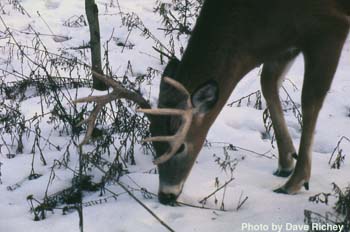
Fall or winter, draw on a buck when he is occupied with feeding. Be patient.


It's a common problem for most deer hunters. They find themselves in unfamiliar territory, and begin trying to puzzle out where to hunt. Which tree will best suit their needs.

Many hunters take a wild flying guess based on minimal input from gazing at trails, and pick a spot. Often, it may look good but in reality, it is a hurry-up and poor guess that will never pay off.

Having said that, we can answer the question of choosing the right tree. I prefer a spot where two or more trails come together to form a main trail. I prefer a cedar tree if possible, but will settle for any tree that fits my needs providing it has some cover (tree branches, leaves, etc.) to break up the hunter's silhouette. It also needs at least two ways to gain access to the tree, and two ways out once the hunting day is done.

It sounds fairly simple but it involves much more thinking than guessing.


I personally prefer deer to approach my stand from behind, and if possible since I'm right-handed, I want the deer coming from behind and on my left side. It enables me to shoot sitting down, and offers both broadside and quartering-away shots, the ones a bow hunter should consider. I don't want the deer coming head-on at me, and I don't want the deer crossing from left to right or right to left in front of me.

Knowing where to hunt is always better than guessing. Knowing comes from a constant familiarity with the area being hunted. Let's put it another way: We travel to Alabama in mid-January when the rut is in full swing, and we hunt on private club land.

Someone acts as a guide, and will drive us to a stand where deer are known to pass, and with some luck, we shoot a buck. If we don't shoot a buck, it means that none were seen, none were of the size we wanted or a buck did show up but didn't offer a chance for an accurate shot. If we see no bucks, one must wonder if it's a good spot. Try to be discreet in asking a guide if the area usually produces bucks. Ask that question firmly, and the guide may question whether you are questioning his judgment. It never pays off to question a guide too strongly. He can make it happen where you won't see a nice buck. Tread softly with this line of questioning.

We will hunt again in the evening, and will be placed in a key location where we should see deer. No one can always make deer move to the hunter, and no one can guarantee that a hunter can and will sit still or see a buck. Guides have a responsibility to try to put their hunters in the best spot, but no one can guarantee that an earlier hunter didn't spook game away.

If we should hunt this way, with others telling us where to hunt, it's a wise move to pay close attention to the terrain in which we hunt. There are always things that offer subtle clues about each location and whether deer are using the area. Look for tracks, rubs, scrapes, feeding or bedding areas, and ask questions in a whisper. Pick a guide's brain because you are paying him to hopefull teach you something about picking tree stand locations.

Look for deer sign. Ask yourself if this looks like good deer country.


Deer often will be found in fringe cover, that area between thick heavy cover and open land. Of course, a ground blind or tree stand may be located anywhere in-between, and it's up to the hunter to learn why one spot is better than another. If hunting in Alabama,, as we suggested at the beginning, you will probably be hunting palmetto swamps near a creek or river. Be sure your stand is high enough to enable you to look over the palmettos because you can't look through them. A deer can move through the ground foliage but it does make some noise so be prepared to listen and look in all directions without moving too much.

One of my favorite spots is on a low hillside near thick cover with heavy cover on three sides with open land on one side. The prevailing wind should blow down through the open cover, and the stand can be cross-wind to approaching deer.

The only way a deer can pick up a hunter's scent here is when the person climbs into or out of the stand. The stand must be high enough on this small hill to blow scent over the surrounding thick cover.

One thing hunters must do is look at terrain the way a deer would look at it. Where is the food source? Where are the key bedding areas? Which trails connect those two key locations? How can deer, especially the larger bucks, travel back and forth without being on trails? I try to stay at least 50 yards back in cover away from the field edge.

Other key factors include:

•How does the wind blow in each location, and does it swirl backwards when hitting a woodline?

•How can a hunter get into and out of the area without bumping into deer?

•Does the hunting area have two or three way to enter and exit to avoid traveling the same route time after time?

•Have a choice of where to enter or leave the stand can help prevent bucks from patterning you.

•Know how to get in and out without spooking deer.


More chances are lost by running into a deer that for any other reason.


Which type of stand is best suited to that area? Which would work best: a ground blind, pit blind, tree stand or elevated coop? How high is high enough for elevated stands?

I've found that a tree stand elevation of 15 to 18 feet is usually high enough under most circumstances. I've got one stand that is close to 30 feet in the air, and it is a consistent producer but steep-angle shots are not a good bet when a hunter must make up his mind in a hurry, and take a quick well-aimed shot.

Many of my stands are at 14-15 feet. That places a standing bow hunter at roughly 20 feet in the air. A stand at 18 feet puts the hunter has roughly 24 feet. Each stand has special requirements, and hunters must solve these problems long before the season opens. Match stand height to the best natural features of a tree.

Hunters will have far better success if they know why a hunting location is the best spot. Guessing implies that one is trusting to luck or fate. With a guess, the hunter will have a 50-50 chance of guessing right.

Of course, this also means a 50-50 chance of guessing wrong. There is nothing worse than a stand that requires hours of effort and time to prepare only to learn it is not in the right spot.

This year, don't guess. Know where the hotspots are long before the season opens. Doing so beats guessing every time.