Showing posts with label high. Show all posts

Sunday, April 03, 2011

Naming some past turkeys


Some turkey gobblers are so special they deserve to be named.


Naming some of the gobblers we hunt lends a certain auro to them. The names also can identify certain Toms, and help us to remember where they were taken or shot at and missed. This practice of naming gobblers seems more prevalent down South than here in Michigan, but I often try to hang some kind of moniker to special birds.

What makes some of these gobblers so special? Many reasons come to mind, but difficulty in hunting them is a primary reason. Names become more common when more than one person knows the location of a particular bird.

Tonight's blog names some special birds I've hunted in Michigan. Countless can make a certain gobbler special.

The Ghost Gobbler


A special bird is the one I called the Ghost Gobbler. As one might expect from it's name, this bird lived for at least four years, and he was an odd bird. I hunted him for three years, and the reason I knew it was him was because he always seemed to show up unexpectedly and alone.

One of his traits was I saw him only once with another bird. He always seemed to travel alone, and he was never vocal. I watched him for two days from a distance of a quarter-mile, and saw him breed one hen. It's the only time I ever saw him with another bird. He actually seemed to avoid other gobblers.

He often roosted some distance from other birds. Once, I was working a different gobbler that eventually came to my shotgun along with two hens. I heard a rustle in the spring leaves behind me, and rather than turn and look, I concentrated on the incoming gobbler. The bird appeared at 20 yard, went into a full strut, and I shot him. Then I wheeled around, not to shoot but to see what was behind me, and it was the solitary heavy-weoght gobbler with a 12-inch beard.

He didn't gobble, and one day I set up in several different locations, trying to get in front of him without being seen or heard. I saw the bird three times that day, and although I did get in front of him, invariably he would go elsewhere. Three seasons passed, and I saw the same lone bird each year, but he never came to the call. He seems to have disappeared last year, and this is the only gobbler I've seen that would breed a hen and vanish. I never heard him utter a sound, and only once was he observed with a hen, and he was breeding her. He was the largest gobbler in 10 square miles, and I never heard of anyone ever taking that bird. He truly was a ghost gobbler.

The High Ridge Gobbler


This bird was one of a large group of turkeys that hung close to a ridge overlooking one of Michigan's major trout streams. Me and another guy hiked in to a spot well before daybreak, and sat and waited quietly. As the tweetie birds began chirping and a crow passed overhead, one gobbler on that ridge gobbled. That single gobble triggered gobbles from a half-dozen other nearby Toms. By the time the last one answered, the first bird double-gobbled, and each bird in turn would double-gobble.

The sound worked up and down the ridge like thunder from a summer storm, and then a solitary gobble came from across the river, and all six longbeards on our side had to answer. The ground=shaking roar of the birds was a wild cacophony of turkey talk that sent shivers up and down my spine. Then, we heard the sounds of heavy bodies breaking tree branches as the six birds flew down 100 yards away.

"Sit there," he whispered softly, pointing to a tall and wide stump. I'll get over behind yonder tree to call. The birds will walk right past you for an easy shot."

That didn't happen. The birds circled around, down the ridge and out of sight, and came up the hill at 75 yards. They spread out, and the biggest bird headed for where my buddy lay, belly on the ground, sweet-talking the birds. They circled around, keeping my ground-hugging friend between me and then. There was no chance for a safe shot.

They kept coming, and the biggest gobbler was double-gobbling, spitting and drumming, and I sat back to watch the show. That bird walked up to my prone partner, stood right between his legs, and gobbled lustily in his ear. I kid you not: my buddy seemed to instantly levitate about two feet off the ground, which spooked all the gobblers. I laughed so hard I was crying, and once the birds had disappeared, he asked: "Why didn't you shoot?"

I was laughing too hard. One more step, and that gobbler would have been standing on his butt. He didn't think it was funny but it was worth not shooting just to watch him jump.

The Cemetery Gobbler


This bird always roosted just behind a very old family cemetary right next to state. Tombstones were crumbling, names were faded, and it appeared to be a homesteader's plot far back from any road. I'd glassed the area from afar, and it was surrounded by state land.

I hunted that bird at dawn, but he seemed to favored an open field some distance away to strut for any nearby hens. This bird was cagey, and one day he would choose a strut zone in one location, and the next day he'd be in another part of the field. There was no pattern to where he would meet the hen at mid-morning.

It was the last day of my season, and I decided to sleep in. That afternoon, I hiked into the area near the cemetary, and since I knew which tree he roosted in, I moved to a spot he always seemed to pass before flying up to roost. It would put me into the right area at the right time, well before sundown.

There would be no calling this day. I was in place for two hours when I saw him moving slowly through the woods to his fly-up point. He walked past me at 20 yards, I checked my time, and I was fine with plenty of legal shooting time left. The bird stopped at 35 yards, and looked around. I put the crosshairs of my Bushnell scope on his head-neck area, clicked off the safety, and whispered "Hey!" His head went up like a periscope, and it was an easy shot. That Michigan gobbler weighed 20 pounds.

There are many other turkey tales about birds I've named, and more will have to wait for another time. Hopefully, these will whet your appetite for the upcoming spring turkey season. Remember this turkey-hunting advice: shoot once, shoot straight and don't miss.

Saturday, February 12, 2011

Never guess about tree stand placement


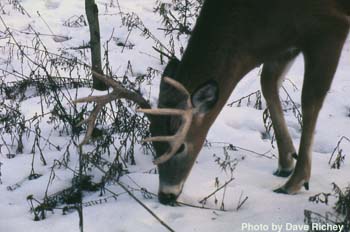
Fall or winter, draw on a buck when he is occupied with feeding. Be patient.


It's a common problem for most deer hunters. They find themselves in unfamiliar territory, and begin trying to puzzle out where to hunt. Which tree will best suit their needs.

Many hunters take a wild flying guess based on minimal input from gazing at trails, and pick a spot. Often, it may look good but in reality, it is a hurry-up and poor guess that will never pay off.

Having said that, we can answer the question of choosing the right tree. I prefer a spot where two or more trails come together to form a main trail. I prefer a cedar tree if possible, but will settle for any tree that fits my needs providing it has some cover (tree branches, leaves, etc.) to break up the hunter's silhouette. It also needs at least two ways to gain access to the tree, and two ways out once the hunting day is done.

It sounds fairly simple but it involves much more thinking than guessing.


I personally prefer deer to approach my stand from behind, and if possible since I'm right-handed, I want the deer coming from behind and on my left side. It enables me to shoot sitting down, and offers both broadside and quartering-away shots, the ones a bow hunter should consider. I don't want the deer coming head-on at me, and I don't want the deer crossing from left to right or right to left in front of me.

Knowing where to hunt is always better than guessing. Knowing comes from a constant familiarity with the area being hunted. Let's put it another way: We travel to Alabama in mid-January when the rut is in full swing, and we hunt on private club land.

Someone acts as a guide, and will drive us to a stand where deer are known to pass, and with some luck, we shoot a buck. If we don't shoot a buck, it means that none were seen, none were of the size we wanted or a buck did show up but didn't offer a chance for an accurate shot. If we see no bucks, one must wonder if it's a good spot. Try to be discreet in asking a guide if the area usually produces bucks. Ask that question firmly, and the guide may question whether you are questioning his judgment. It never pays off to question a guide too strongly. He can make it happen where you won't see a nice buck. Tread softly with this line of questioning.

We will hunt again in the evening, and will be placed in a key location where we should see deer. No one can always make deer move to the hunter, and no one can guarantee that a hunter can and will sit still or see a buck. Guides have a responsibility to try to put their hunters in the best spot, but no one can guarantee that an earlier hunter didn't spook game away.

If we should hunt this way, with others telling us where to hunt, it's a wise move to pay close attention to the terrain in which we hunt. There are always things that offer subtle clues about each location and whether deer are using the area. Look for tracks, rubs, scrapes, feeding or bedding areas, and ask questions in a whisper. Pick a guide's brain because you are paying him to hopefull teach you something about picking tree stand locations.

Look for deer sign. Ask yourself if this looks like good deer country.


Deer often will be found in fringe cover, that area between thick heavy cover and open land. Of course, a ground blind or tree stand may be located anywhere in-between, and it's up to the hunter to learn why one spot is better than another. If hunting in Alabama,, as we suggested at the beginning, you will probably be hunting palmetto swamps near a creek or river. Be sure your stand is high enough to enable you to look over the palmettos because you can't look through them. A deer can move through the ground foliage but it does make some noise so be prepared to listen and look in all directions without moving too much.

One of my favorite spots is on a low hillside near thick cover with heavy cover on three sides with open land on one side. The prevailing wind should blow down through the open cover, and the stand can be cross-wind to approaching deer.

The only way a deer can pick up a hunter's scent here is when the person climbs into or out of the stand. The stand must be high enough on this small hill to blow scent over the surrounding thick cover.

One thing hunters must do is look at terrain the way a deer would look at it. Where is the food source? Where are the key bedding areas? Which trails connect those two key locations? How can deer, especially the larger bucks, travel back and forth without being on trails? I try to stay at least 50 yards back in cover away from the field edge.

Other key factors include:

•How does the wind blow in each location, and does it swirl backwards when hitting a woodline?

•How can a hunter get into and out of the area without bumping into deer?

•Does the hunting area have two or three way to enter and exit to avoid traveling the same route time after time?

•Have a choice of where to enter or leave the stand can help prevent bucks from patterning you.

•Know how to get in and out without spooking deer.


More chances are lost by running into a deer that for any other reason.


Which type of stand is best suited to that area? Which would work best: a ground blind, pit blind, tree stand or elevated coop? How high is high enough for elevated stands?

I've found that a tree stand elevation of 15 to 18 feet is usually high enough under most circumstances. I've got one stand that is close to 30 feet in the air, and it is a consistent producer but steep-angle shots are not a good bet when a hunter must make up his mind in a hurry, and take a quick well-aimed shot.

Many of my stands are at 14-15 feet. That places a standing bow hunter at roughly 20 feet in the air. A stand at 18 feet puts the hunter has roughly 24 feet. Each stand has special requirements, and hunters must solve these problems long before the season opens. Match stand height to the best natural features of a tree.

Hunters will have far better success if they know why a hunting location is the best spot. Guessing implies that one is trusting to luck or fate. With a guess, the hunter will have a 50-50 chance of guessing right.

Of course, this also means a 50-50 chance of guessing wrong. There is nothing worse than a stand that requires hours of effort and time to prepare only to learn it is not in the right spot.

This year, don't guess. Know where the hotspots are long before the season opens. Doing so beats guessing every time.

Saturday, January 15, 2011

Winter has returned


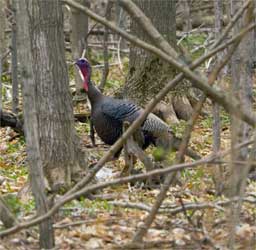
One hopes this and other gobblers make it through the winter.


A few days ago it was 40 degrees. The storm we are now experiencing began last night with strong winds and snow amounts up to 12 inches.

Earlier today the strong wind started filling up with even more snow, and the westerly blow is a tough wind in our neighborhood. It whips across open fields, and buries our driveway.

One look at it at breakfast made me realize that tomorrow morning means another two hours or more on the snow-blower. Lots of time. Lots of snow. Cold temperatures.

It’s part of living up north where lake-effect snow is measured by the feet.


Do I dislike it? No, as a matter of fact, I enjoy snow-blowing. However, the Weather Channel says there is more snow and wind snaking through Minnesota and Wisconsin and down from Canada, and the storm is supposed to continue through tomorrow.

What I dislike most is having to snow-blow during a storm. However, if I don't do it in the morning, and wait as more drifting snow blows through the Traverse City region, the drifted snow will turn into something as hard as concrete.

The other problem also means sticking the nose of the snow-blower out into the road where someone with a car or truck or speeding snowmobile could run into me. I wear some blaze orange clothing, but if the wind continues to blow hard, the visibility may make seeing anything very difficult or impossible.

It is storms like this that can wreak havoc on deer and turkey numbers.


A big, fat, apparently pregnant fox squirrel came to visit the bird feeder today. Squirrel season is still open, and I could have easily shot the bushytail, but that would be like shooting ducks on the water. I let her feed, which may be a mistake when she comes visiting next summer with her brood in tow, and I may then be sorry. However, I figured she had enough problems to cope with being out and on the prowl for food in this kind of weather. Why add to her problems?

My neighbor called and asked me to guess what he was looking  behind his house.

"Turkeys," I said.

"Nope," he said, "ducks. What are they doing in what's left of my cornfield on a day like today? Shouldn't they be somewhere near water?"

I suggested that very little open water is available now except in certain streams. And, I offered, the birds probably were out looking for food, spotted his cornfield and dropped in to see if there were any corn kernels left.

"Six ducks," he muttered, "six mallards. I can't hardly believe it."

I told him about the she-squirrel grubbing for something to eat under my bird feeder, and he agreed that the storm must be making all kinds of critters a little goofy.

The squirrel surely came from my woods or the woods across the street. The ducks probably have some little pocket of open water somewhere on Grand Traverse Bay or on one of the nearby lakes or streams.

The turkeys seem to be conspicuous by their absence this winter. I've seen just one small flock of birds, and that was several days ago but thei seen to have disappeared. They are probably keeping their heads down until the storm blows through. A few deer are moving through the snow but they aren't traveling very far.

If the storm continues tonight, stay off the roads and stay safe.


Tomorrow is another day, and with any kind of luck, we won't get buried in snow overnight. Blowing snow isn't too bad with a foot of the white stuff, but if it gets any deeper than that, even my tractor and snow-blower has to work too hard. Heavy, compacted snow is hard on a blower.

And that goes for the guy driving the thing. Stay warm and dry tomorrow, and ride out the storm. Stay home, and off the roads, and remain safe while saving gasoline.

Hopefully, if the storm continues, snowmobilers will stay off the roads and trails. It's during these near white-out conditions that snowmobile accidents can happen.

Cars, trees and parked vehicles often seem to jump out in front of a snowmobiler during a bad storm, and survival in such cases is questionable at any kind of speed. And if you must travel through the storm, carry heavy clothing, snowshoes, shovel, boots, a strong flashlight plus food and water. Two or three blankets or sleeping bags can keep you toasty warm. Get some blaze orange surveyer's tape, and tie it to your car in hopes of it being seen before it run over by one of the over-zealous County road plows that travel nonstop at 60 miles per hour. I don't how they can see anything at the speeds they drive when plowing.

Fighting a nasty winter storm with high winds is never a good idea. If you go into a ditch, stay with the vehicle. Don't be a hero and try to walk out for help. That is how people die in severe winter storms.

Posted via email from Dave Richey Outdoors