Showing posts with label turkeys. Show all posts

Thursday, April 12, 2012

Location is KEY

Big gobblers, like the left one, must be played carefully
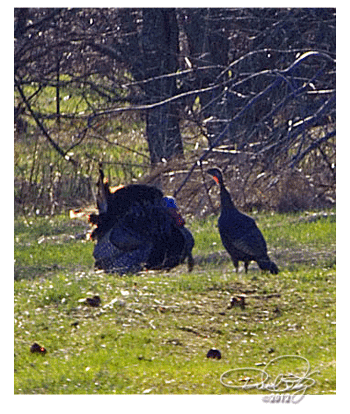
Timing and Location play key roles in turkey hunting success
Big tom turkey's don't get old or big by being easily fooled. Timeing and location play key roles in turkey hunting success.
photo Dave Richey ©2012
There's an old real estate adage that almost everyone knows. The key thing to remember is  location, location, location. Where the land or home is located means almost everything.

This old saying also holds true for turkey hunters. Location means everything, and if a hunter is going to have any kind of success with a big gobbler, he must be in the right spot at the right time.

So far, I've talked to just two people with a first-season turkey tag, and neither man has found gobblers yet. Both cite high winds, rain and on again, off again cold weather and snow as various excuses.

We had some snow on the ground yesterday

One guy was looking for birds near home, and his brother was scouting a nearby area. My buddy checked where he'd seen a gobbler fly up to roost the night before, and estimated he was 150 yards away.

He waited for dawn, listened to the bird gobble once from the roost tree at about 6:30 a.m., and called twice, and that was all it took.

That bird might have come to him if he'd called, but the season is still about two weeks away," he said. "The bird flew down from the tree, and shut up."

His brother, who had not seen or heard a bird, and had traveled to what would be a new hunting location when their season opened. They walked into the area, sat down with their backs to adjacent trees, and began to listen for birds.

"I soon heard a bird that wasn't very far away," he said. "I listened to him for 40 minutes. He seemed to have a couple of hens and lesser gobblers with him. We sat still and never spooked the birds.

That's one way to play the pre-season scouting game

"At first we thought there was just one bird but it turned out to be two adult gobblers traveling together. Finally, one split away from the other, and came our way only to be spooked by a roaming coyote. Those birds should still be around when the next season opens."

Well, that just might be a bit of wishful thinking. All scouting does right now is show and tell you where the birds are today. They could be, and quite likely will be, two miles away when the season opens. The birds often do return to an area eventually if they are not badly spooked.
I've heard it mentioned many times by turkey hunters that they believe gobblers and hens may be spooking from decoys. If there is no wind, and the decoy doesn't move, the bird won't come in. Obvious, this isn't an across-the-board belief, but some birds seem definitely afraid of one or more decoys, and a scouting hunters should never put out decoys before the season opens.

More and more people are using decoys now than ever before. It stands to reason that some birds are spooked by the fakes.

Being in the right spot at the right time is crucial to success. I don't consider myself a great caller, but I know enough not to call too much once my season opens. Finesse the birds a little, don't call too loud so the bird gets spooky, and chances are good you can close the deal on a gobbler. The trick is to be patient, and don't call too loud or too often.

Years ago, my wife and I drew first-season hunting tags, and we got set up early, and she wanted to take her gobbler with a bow. I had her sitting inside a hunting coop. I had three decoys -- two hens and a jake -- positioned in front of her with the jake only 15 yards away.

I sat outside with my back to a big tree and waited for the first gobbler to sound off. A few crows called, and then he tuned up the volume and rattled the trees in that woodlot. I gave a soft tree yelp, and he gobbled again and again while I remained silent. It's part of the teasing process.

Here's a bit of good advice to try on a solitary gobbler

As a southern buddy used to tell me: "Tell 'em what you think they want to hear, but give them a pack of lies. Make your calls sound too good to be true, be patient and they may come."

Five minutes passed, and the longbeard gobbled again, and I gave a soft tree yelp, waited until he quit gobbling, slapped my pant legs a few quick times to simulate a bird flying down, and could hear that bird busting branches as he flew to the ground.

He gobbled again on the ground, came walking through the woods, walked within three feet of my boots and strutted out to whup on that jake decoy. I could hear him drumming and spitting, and he gobbled out a challenge to the jake decoy, and walked in to smack the fake bird around.

The gobbler offered Kay a good shot, and that was the end of that bird. It wasn't the largest gobbler she has killed, but doing it with a bow was a major accomplishment.

A year earlier, much the same thing played out as I called in a nice gobbler for her, and she took it with a shotgun. In fact, I've called in most of her gobblers over the past twenty years.

A person can be the best caller in the world, but if he is in the wrong spot, there will be no birds racing in his direction. Personally, I'd rather know where the bird is roosted, and be a mediocre caller, than to be in the wrong spot with championship calling skills on my side.

Location to a turkey hunter, as it is to a real estate agent, is the most important part of the hunting equation. It's what can put a tasty bird on a turkey platter this spring.

Just make certain your scouting efforts don't spook birds out of the area, and for Heaven's sake, be smart enough to leave your calls at home while scouting before the season opener. The birds don't need more of an education than they already have, and it pays to scout with binoculars or a spotting scope. Find the birds, drive away, and know where a few birds may be when your turkey season opens.

Tuesday, April 10, 2012

Avoid these turkey hunting mistakes

Do everything right, and avoid Mr. Murphy, and you can shoot a bird

Hunt wild turkeys long enough and you're gonna make a blunder or two. That's bankable.
photo Dave Richey ©2012
"Keep your powder dry" was the motto in the 1700 and 1800s when muzzleloading hunters and frontiersmen roamed parts of North America. Those who failed to follow that sage advice often went hungry or had their hair lifted and cut off below the roots.

My list of hunting mistakes with game, especially turkeys, is endless. Years ago, while hunting in a heavy rain with a muzzleloader, I forgot to cover the muzzle. I set my front-loader against a tree with the powder and shot charge in the barrel but the shotgun wasn't primed.

I set out my decoy, retreated to my chosen spot, and primed the muzzleloading shotgun. A large number of gobblers and hens came, and milled around in a tight circle near the decoy, and I couldn't shoot for fear of killing more than one bird. They eventually left, and I called again.

Make certain to learn the exact location of a roosted longbeard

A lone gobbler a half-mile away answered, and I sweet talked him with a soft yelp and some hen jabber with a push-pull call. He came running up. I saw him first at 30 yards, and then he dropped into a little dip in the ground, and popped up again at 20 yards and stopped. The shotgun was up, and when I pulled the trigger, the primer went off with a pop. The powder did not.

I'd forgotten to put a balloon or anything else over the muzzle to keep my powder dry. The Pyrodex was a black semi-liquid. It was a lesson well learned and never forgotten.

I took a guy out one day, late in the season, and spotted a jake 150 yards away. This guy wanted to shoot a gobbler, and beard length didn't matter. It took 30 minutes to bring the jake within 80 yards, and the guy was aiming at the bird.

"He's too far away," I whispered. "Don't shoot yet. Let him get to within 35 yards." He said the bird was only 35 yards away, aimed and shot.
The young gobbler hauled tail feathers into the woods. The man maintained the bird was only 35 yards away until I asked him to give me a prominent landmark where the bird had been standing. He said the bird was right near that little bush that stood three feet high.

He was urged to pace it off in approximately 36-inch steps as I walked beside him counting the paces. I got 80 steps and he got 77 steps, and then he realized the mistake he had made. It was the last gobbler we saw that day.

Pay attention to distance and don't take long shots

This didn't happen to me but to a friend. He knew, within 50 yards of where a gobbler had roosted the night before. He snuck in the next morning, and stopped well short of the roosting area to wait for the first gobbles of the morning. The sun came up and all was silent.

He gave a very soft tree yelp or two but nothing responded. He stuck with it, and finally with a great deal of impatience, he uncorked a loud yelp on his box call and something happened. A big gobbler bailed out of the tree he was sitting under, and it flew 75 yards, hit the ground a'runnin', and that was it. He had set up directly under the gobbler and missed his big chance.

Two friends, on their first gobbler hunt, went looking before dusk and spotted several dark birds on the ground. Just before dark they flew up into a tree. These guys knew about roosting birds and were happy.

Be positive roosted birds are wild turkeys

They returned the next morning well before dawn, set up about 100 yards away, and waited for the day to wake up. Tweety birds tweeted, crows cawed, and they yelped on box calls. They could see several dark forms in the trees, and called again and again.

Eventually the birds flew down, and went to where the hunters had seen them the previous night. No amount of calling seemed to work, so one of them slowly eased his binoculars from his backpack, and with infinite patience, eased them up to his face and studied the birds.

The birds they had roosted the night before were not real turkeys. They were turkey vultures, and they were feeding on carrion on the ground. They admitted it, and took their share of ribbing.

There is only one sure thing when turkey hunting. Murphy's Law always applies, and simply stated: If anything can go wrong, it will. Keep Mr. Murphy in mind, try to outguess him, and sometimes the gobblers react as you plan and the hunt is a success.

Of course, when we mess up, it's still good for a laugh even when we don't feel much like laughing at our silly mistakes. Trust me on this: if you hunt wild turkeys long enough, you too will make a blunder or two.

Friday, August 12, 2011

Plant It Right And The Deer Will Come

Dave Richey (left) checks his clover plot.


More and more people are putting in food plots every year. Some people use them to attract deer so they can watch the animals from their house, and some people hunt over them. Either way, putting in a food plot is good for all wildlife in the area.

So what is a perfect food plot? Perfect means it grows well and provides extra nutrition.
This question was put to Bruce Grant of Rogers City. He’s become the expert at putting in large and small food plots in the northeastern part of the Lower Peninsula, in the so-called Club Country.

Food plots can grow well in northern counties if properly planted.


"What is a good plan for a year 'round food source?" Grant asks, before answering his own question. "Some type of plan that will carry our wildlife, such as deer and wild turkeys, through all four seasons and still provide an excellent food source during hunting season.

"We need a plan and must keep good records. We need to know what does and doesn't work. Remember, it takes a whole growing season to learn what may have went wrong."
Grant breaks down his food plots in various ways. Alfalfa/clover is high in food value and important for fawn development and antler growth. It is good in the spring, and most valuable in January and February. He does not cut his crop after Aug. 1 because he wants all the growth possible before cold weather and snow sets in. His alfalfa/clover fields provide a food source while annual plantings are getting started.

He wants his ground pH to be at 6.5-7.0, and warns people not to buy seed in the spring. It often is last year's inventory and may be outdated. Chicory is a good crop but requires 18 months to produce. It doesn't grow real well the first year. He also warns sportsman that a primary diet of pure clover can cause deer to bloat. He suggests mixing clover with orchard grass.

In early May, Grant works the fields he wants to plant by June 1. This could be a small patch of rape and turnips. His major spring planting will be a soybean, forage peas and brassica mix. It grows fast and makes an excellent summer and early fall mix. It also keeps the deer off new alfalfa/clover or chicory plantings. Soybeans and forage peas have a protein rating of 38 percent, much higher than corn.

He said that in early May he works all the fields he plans to plant, and lets them sit for two or three weeks before reworking the fields to be planted. He spreads fertilizer and seeds the same day in hopes of getting ahead of the weeds. He uses herbicides, but only on new fields to be established.

Fall plantings should be planted sometime in August, and the earlier the better.


Fall plantings, he said, begin in early August when oats, wheat or rye mature. He will disc them, spread 200 pounds of fertilizer per acre and let them grow. This is a soil building crop.

This crop also will provide excellent fall grazing. Oats and wheat planted in the fall, and handled in this manner, offer a place for spring fawns and turkey poults to hide. It also is a great food source.

Aug. 1-30 is when he does his fall plantings. He works his fields two to three weeks prior to planting for weed control. His major fall crop will be a brassica mix.

Dwarf Essex rape and purple top turnip are the magic crops for many hunting camps. It they are planted by the first of August, by October 1, there will be a very good crop of rape and turnips. Deer normally will not eat this crop until the first heavy frost. After that first frost, the animals won't stay out of it.

Kay Richey poses with a nice 12-point.


Grant said deer first eat the turnip bulbs and tops. They also feed in a brassica field until the ground freezes so hard that they can no longer dig or they have completely destroyed the field, usually by early January.

"Fall is a great time to plant a mix of winter wheat and oats," he said. "The oats come up first and fast. The first hard frost freezes out the oats but the wheat will be the first green crop next April.

Plant a mix of annuals and perennials for attractive food plots.


"A good plan includes both annuals and perennials. When you consider the cost to maintain perennials, like mowing, fertilizing and weed control, I believe the cost between annuals and perennials is a toss-up."

He is a strong believer in diversification. He says it is best to rotate crops between areas, and change what is planted in each field from year to year.

"Go plant it," he said. "The deer and turkeys will come. Diversify, maintain and rotate. Just don't expect a perfect food plot the first year. It often takes two years to get growing well. Hope for some rain and warm weather."

Friday, April 22, 2011

Location, Location, Location


A majestic gobbler lit up by the early sun. Shoot straight!


There's an old real estate adage. Everyone preaches ... Location, Location Location!  Where the land or home is located means almost everything.

This old saying also holds true for turkey hunters. Location means everything, and if a hunter is going to have any kind of success with a big gobbler, he must be in the right spot at the right time.

So far, I've talked to just two hunters with a first-season turkey tag, and neither man has found gobblers yet. Both cite high winds, rain and on-again, off-again cold weather and snow as excuses.

Hunting has been slow during the first turkey season. Blame it on the weather.


One was checking for birds near home, and his brother was hunting in a nearby area. My buddy checked where he'd seen a gobbler fly up to roost the night before, and estimated he was 150 yards away.

He waited for dawn, listened to the bird gobble once from the roost tree at about 6:30 a.m., and called twice, and that was all it took.
"That bird came to me, got to within 25 yards, and then turned and ran off," he said. "The bird flew down from the tree, came on a direct line to me, and then spooked as if frightened by my decoys."

I'm more inclined to think he was spooked by the presence of a hunter toodling on his turkey call. Guys who educate birds by calling outdoors before the season opens deserves to have all his calls taken away.

His brother, who had not seen or heard a bird, and had traveled to what would be a new hunting location when their season opened. They walked into the area, sat down with their backs to adjacent trees, and began to listen for birds.

"I soon heard a bird that didn't wasn't far away," he said. "I listened to him for 40 minutes. He seened to have a couple of hens and lesser gobblers with him. We sat still and never spooked the birds.

At first he thought there was just one bird but it turned out to be two adult gobblers traveling together. Finally, one split away from the other, and came our way only to be spooked vy a roaming coyote. Those birds should still be around when the next season opens."

Turkeys in some hunting areas may be spooked by decoys.


I've heard it mentioned many times by many hunters that they believe gobblers and hens may be spooking from decoys. If there is no wind, and the decoy doesn't move, the bird won't come in. Obvious, this isn't an across-the-board belief, but some birds seem definitely afraid of one or more decoys, and scouting hunters should never put out decoys before the season opens.

Being in the right spot at the right time is crucial to success. I don't consider myself a great caller, but I know enough not to call too much once my season opens. Finesse the birds a little, don't call too loud so the bird gets spooky, and chances are good you can close the deal on a gobbler. The trick is to be patient, and don't call too loud.

Years ago, my wife and I drew a first-season hunt, and we got set up early, and she wanted to take her gobbler with a bow. I had her sitting inside a hunting coop. I had three decoys -- two hens and a jake -- positioned in front of her with the jake only 15 yards away.

I sat outside with my back to a big tree and waited for the first gobbler to sound off. A few crows called, and then he tuned up the volumn and rattled the trees in that woodlot. I gave a soft tree yelp, and he gobbled again and again while I remained silent. It's part of the teasing process.

Five minutes passed, and he gobbled again, and I gave a soft tree yelp, waited until he quit gobbling, slapped my pant legs a few quick times to simulate a bird flying down, and could hear that bird busting branches as he flew to the ground.

Be patient while waiting for a gobbler to close the distance.


He gobbled again on the ground, came walking through the woods, walked within three feet of my boots and strutted out to whup on that jake decoy. I could hear him drumming and spitting, and he gobbled out a challenge to the jake decoy, and walked in to smack the fake bird around.

The gobbler offered Kay a good shot, and that was the end of that bird. It wasn't the largest gobbler she has killed, but doing it with a bow was a major accomplishment.

A year earlier, much the same thing played out as I called in a nice gobbler for her, and she took it with a shotgun. In fact, I've called in most of her gobblers over the past decade.

A person can be the best caller in the world, but if he is in the wrong spot, there will be no birds racing in his direction. Personally, I'd rather know where the bird is roosted, and be a mediocre caller, than to be in the wrong spot with championship calling skills on my side.

Location to a turkey hunter, as it is to a real estate agent, is the most important part of the hunting equation. It's what can put a tasty bird on a turkey platter this spring.

Just make certain your scouting efforts don't spook birds out of the area, and for Heaven's sake, be smart enough to leave the calls at home while scouting. The birds don't need more of an edge than they already have, and it pays to scout with binoculars or a spotting scope.

Find the birds, drive away, and know where a few birds are when your turkey season opens.

Wednesday, April 13, 2011

Turkey Hunting


What does turkey hunting mean to me? It can be a rather difficult question to answer, but for many spring hunters, it means shooting a gobbler.

Well, that can be more easily said than done. During the spring season, only gobblers can be killed and often they are with hens. Those drab-looking hen-birds are notoriously wary, and are every bit as alert as an old whitetail doe.

There are many things that attract sportsmen to this past-time. It is, in fact, the only spring hunting season. With the opener of the first gobbler season on April 18, many camouflaged hunters will be afield.

Turkey hunting is a way of life for many spring hunters.


The rules are the same for everyone, and are detailed in the 2011 Michigan Spring Turkey Hunting Guide It’s important that all sportsmen hunt in the specific area they chose for a spring turkey hunt. Hunting times are from 30 minutes before sun-up to 30 minutes before sundown. The limit is one bearded bird, and note that some hens may have a visible beard.

I’ve seen some of the decoys available that can move by pulling a string or with the aid of battery power. Only wind movement is legal when turkey hunting. No electronic calls may be used to replicate the sounds that real turkeys make.

It is illegal to shoot turkeys roosted in a tree. It also is illegal to use or carry bird shot larger than a No. 4 shot. The most common sizes are No. 4, 5 and 6. shot. It also is legal to hunt wild turkeys with a bow, and hunting with bow-arrow from an elevated position is legal.

Scouting for birds is encouraged before the season opens, but hunters also are encouraged to leave their turkey calls home while scouting. Do not call during the scouting season, and I consider scouting by car as the least invasive method. Drive slowly, look for birds, note the time of day, and knowing the time can be useful. It possible, locate a gobbler (often with hens) just before they fly up to roost, and return to that area long before dawn. Don’t shine lights or talk, and don’t call to the roosted birds before shooting time begins.

Absolute quietness and stillness are two keywords to remember. Find a comfortable place to sit, and park yourself behind a tree as wide as your shoulders. Whenever possible, never get into a calling match with other hunters. It is a way to be accidentally shot by someone else. If you feel you are verbally dueling with another hunter, give up and leave without moving in the direction of the other hunter.

Leave calls at home if you are not confident. Use a hen turkey decoy.


If you lack experience or skill at calling, keep turkey calls in your pocket or at home, and rely on a turkey decoy. Set it up about 25-30 yards away, and if using a hen and gobbler decoy, place the gobbler fake near you so an approaching bird must pass in front of you to get to the decoy.

Turkey hunting requires a number of outdoor skills: woodsmanship, sense of direction, being able to gauge distance, good hearing, learning to sit still, being able to shoot straight, and much more. Most important of all is to learn how to sit without moving.

The challenges of being successful are many, and the odds in favor of success are lower than the odds of failing. Murphy’s Law states that “if anything can go wrong, it will.” Turkeys have added their stamp of approval to that known rule, and have gone on to establish countless other  ways they can use to further confuse hunters into making stupid mistakes.

There are many good things in favor of taking up turkey hunting. It occurs in the spring when no other hunting takes place. Sportsmen can find wild turkeys throughout most of the state, but rules apply when application is made for a spring turkey license. One must choose which hunting seasons they wish to be considered for, but the first hunt tags for most areas are difficult to draw. Choose an area you know well.

Wild turkeys are big birds and certainly can be easily seen. On most occasions, however, they are accomplished at quiet travel, remaining out of sight if they sense danger, and because they are big, the human brain seems to tell us the bird is closer than he really is. So, we miss.

I have literally hundreds of turkey calls. Most are diaphragm calls, but I also own scads of box calls, push-pull calls, a fairly large number of  pot calls with surfaces of aluminum, crystal, glass and slate. We should carry only those calls that we use most often, but a niggling little doubt causes us to second-guess ourselves, and that leads to more calls than we need. The result is we tend to lose calls, in one way or another, and those lost always seem to be our favorites.

Two or three turkey decoys are plenty. One hen decoy can do the job.


At most, I carry three decoys -- a jake and two hen decoys. Some folks I know may carry a half-dozen decoys, and putting out that many usually takes longer in the dark than we plan for, and it’s easy to make too much noise. Two or three decoys are plenty, and a single hen decoy can work on most gobblers.

We can take savage delight in being afield on a pitch-black morning, and get to watch nature come alive. The tweetie birds call at sunrise  as they begin to move around, and we’re often treated to deer sightings. Occasionally a late-hunting owl will be seen.

It’s the sights and sounds of dawn that invigorate my soul. It’s watching the rising sun give off shafts of brilliant yellow, orange and reds, and then a black cloud can be seen as it changes from black to a deep and vibrant purple. The sounds of a crow, an owl hooting, or a fence gate squeaking, can make gobblers rattle the woods with their roaring gobbles. Hens often call softly, but can start badmouthing and trash talking a gobbler for no apparent reason.

Turkey gobbles, whether near or far, never fail to stir my blood. In my mind’s eye, I see a gobbler with a white head, strutting around trying to impress the hen. We have our decoys out and well placed, and our calls, and we begin calling. The gobbler answers, and if things are meant to be, the longbeard will begin strutting in your direction.

The hunt is far more important than the kill.


We look forward to it, and if all goes right, will soon see a snowball-white head bobbing through the woods. Then we see the bird displaying, and our heart beat is like a triphammer, pounding in our chest and we can hear the blood pulsing in our ears. We may start sucking air, hyperventilating and often wonder why the bird can’t hear it. Closer and closer the bird comes, and then, there the gobbler is with his head held high as he looks for the hen.

As we place our shotgun sight where his head and neck join, a sudden thought goes through our head and we realize we’ve done everything right to reach this point in time. We also realize that there is so much more to turkey hunting than pulling the trigger.

Shooting a gobbler is anticlimactic. It’s only the icing on a turkey hunter’s cake. The actual hunt, everything that leads up to the shot, is the real thing and is why we hunt these birds.

Try not to confuse the issues and believe a dead bird is the sole reason for hunting. Do that, and forget what went before, and turkey hunting will soon lose its charm.

Friday, April 08, 2011

Winding my spring clock


A beautiful sunset with a big pike in hand is a wonderful outdoor experience.


There is a driving need for some people to delve deeply into their inner being, and learn basic lessons about how to enjoy their outdoor life. Everything in nature lives, and it dies, as shall we when our day comes.

Fishing and hunting has been a major part of my 71 years, and there is something buried so deep within my being that I can't remember when it wasn't there. There is this need -- a deeply felt need -- to taste the sweetness of the outdoor life as often as possible.

It's not enough for me to just go fishing or hunting. I've never had to force myself into the outdoors to experience this. My life just needs to sample some part of the outdoors every day, regardless of weather.

I try to immerse myself -- body and soul -- into all of nature’s complexities.


Sportsmen seldom speak of little birds. Song birds cannot be hunted, as we all know, but I enjoy watching them at the bird feeder. I'm not sure I know, nor care, how many 50-pound bags of sunflower seeds are purchased each year to feed them. Numbers really don't matter.

I sat along the banks of the Betsie River two days ago watching a hen steelhead spawn with three males that seemingly took turns darting in to squirt milt on a golden spill of released eggs. I didn't view that hen as an object of angling desire, something to hook, land and take home. Instead, watching those fish was symbolic of all good things in nature that tug ever harder at my need to become even closer to it.

There is something about wild animals, birds and fish I find fascinating.

Nothing stirs my soul more than the roaring thunder of a spring gobbler making himself loudly known to every hen within earshot. He stands as the epitome of spring sounds that make me smile, feel alive and in tune with nature.

What can be more relaxing on a golden spring day when the temperature soars to almost 70 degrees, and we sit on the ground under a cedar, and drink thirstily of this delightful scent. We hear the peenting of male woodcock impressing a hen, listen as a ruffed grouse drum-rolls out his love song on a fallen log. Sometimes we even nap on such a warm day, and it's not laziness but a complete surrender to spring.

Become one with nature and live a life of outdoor pleasure.


I yearn for a day on a jump-across creek, bubbling from deep within a cedar swamp, and seek Robert Traver's little speckled beauties as he did on his pilgrimages to Frenchman's Pond. I love to burrow into such dense swamps, fish between tree roots in deep little pockets, and catch one or two brookies with white piping along their fins. That day will come on the last Saturday in April when the statewide trout season opens.

I need to feel the cold, firm and smooth skin of a brookie in my water-moistened hand. There is a burning need to look upon the stark beauty of tiny red and blue haloed spots that glint in filtered sunlight like rare jewels. There are times when I keep one or two for a long-awaited lunch of picking pink meat from the bones, and knowing I should have let these trout live. I've escaped the nagging need to eat a brook trout for eight or nine years although I fish for them often, but the old craving for one or two is tempting my taste buds.

Deep within me is another urge which I will put off for a few more weeks, but then I'll succumb to fishing bluegills on their spawning beds. I won't take many, because filling a limit is something that disappeared from my angling life many years ago. Instead, I need to feel that sideways pull on my fly line as a pug-nosed 10-inch bluegill swims in tight circles in the clear water. Holding a slab bluegill in my hands, and admiring the fish momentarily before freeing the hook and the fish is what my twin brother George and I used to do. I'll do it again, and hope he is watching me catch a fish or two on his behalf.

Nature brings about urges, and like eating brook trout, we back away to save our fish.


Old friends, people who enjoy what I enjoy, and feast ravenously on the bounty of the great outdoors are fun to spend time with. We find that as time passes, and as we mellow, spending time on the water or in the woods is a blessing. We enjoy the day whether we catch fish or not, and in some cases, talking and recalling past trips are more meaningful than catching fish.

Perhaps it's the weather, the time of year when spring gives birth to a new season, and casting about in search of different reasons and ways to spend time outdoors, is what appeals to me. I cherish days spent fishing with my son, David, and they are most important to me.

I look at him, and see myself as a hard-charging younger angler who is willing to pause along the way, sniff the ripening fragrance of newly sprouted leeks, and think of leek soup. David seems to understand The Old Man and his moods, and we can go for long periods without speaking, because we know that nature is silently speaking to us.

Spring is a gift, and I hope to pass it along to like-minded people who realize there is more to fishing or hunting than catching and killing.

There is life, and a love of nature, for any who wish to pause long enough to look, listen, smell, taste and touch.

Spring is what keeps winding my outdoor clock.

Saturday, February 19, 2011

Sitting still is an art


The author shot this bear from the ground at a range of six feet.

Anyone who has bow hunted more than a few days should know the importance of sitting still. Knowing that, and doing it right, are two entirely different things.

Sitting still means at least two different things. It means being motionless and quiet. One without the other makes little sense, and it will spook game.

I seldom hunt with another person, but in the past when my kids and grandkids were young, they would go out with me. Most adults can't sit still, and even fewer children can do so.


Solitary hunters often do better at bow hunting than will two or three buddies.

One of my grandchildren was fidgeting when I whispered to him to sit still. He whispered back that he was sitting still.

I told him his idea and my idea of being motionless and quiet were not the same.It's taken years to master the art of silent sitting. I've taken more black bears than I have fingers and toes, and have learned some of the tricks to sitting as still as a stone for long periods of time.

"The first bear I shot," another savvy hunter told me, "was on Sept. 10, opening day of Upper Peninsula bear season. This was well over 30 years ago, and tree stand hunting wasn't legal. I sat alongside but downwind of an active bear trail with my back against a big cedar root-wad on a warm autumn day. The trail was only six feet away.

"Sometime later, I awoke from my dozing and cracked one eye lid to see a black bear walking past. I made a smooth draw and an clean bow shot that took the bruin behind the front shoulder. It ran only 25 yards into tall marsh gras and dropped."

The hunter said he was absolutely motionless when the bear walked by because he was sound asleep. He admits it was an accident, but he's since learned to sit without movement or sound for long periods of time.

Over many years of hunting bears and deer, I've discovered the trick to being still is to be comfortable, and a hunter must learn how to relax and be at ease with himself and his surroundings if he hopes to be motionless and quiet. The first step is to remove anything that can cause discomfort while sitting

My primary problem is it's necessary to remove my billfold from my back pocket. If it is left in, my sitting time is 30 minutes or less before my hip begins to hurt from an old injury. No one can sit still if their butt is painfully sore.


Find a place where the human body can be comfortable and then relax.

Sit on the ground, and a root an inch under the dirt will put a crease in your butt, and you'll start moving to get comfortable. I make certain if I'm in a tree stand that no branch stub is digging into my hip, ribs or spine. A stone in the dirt under you hind end will feel like a boulder after 30 minutes.

Check out each spot wherever you hunt. Remove offending branches or broken branch stubs. Many tree stands have uncomfortable seats because the seat is too low, and your knees are up under your chin and that makes for an uncomfortable seat. Just as bad or worse is a seat that is too high, and you have to sit on the edge of the seat to keep your feet steady on the platform. This cuts off blood flow to your legs, and your toes and feet go to sleep, which leads to more movement.

Learn to get physically comfortable first, and then learn to relax your body and mind. A man told me once that he meditates while in a stand, and although his eyes may be closed and his heartbeat and respiratory system slows down, he can hear the rustle of bear hair against bracken ferns or the faint twig snap of a wandering buck.

This isn't recommended for someone unaccustomed to meditation. What works for most of us is to free our brain of all thought, to feel comfortable and relaxed, and to will yourself to being motionless. I've had bucks approach to within several feet of me without seeing any movement, and that is part of the secret. Keep your mind uncluttered by unnecessary details, and it's much easier to remain still.

One trick of mine is to fix your attention on a distant object, and stare at it. It will blur, come back into focus, and blur again. Stick with it, and don't think of deer or work or anything else, and try to become one with your surroundings. Get comfortable and don't feel like an intruder in the woods.

That works for me and some other people I know, but it may not work for you without a great deal of concentrated practice. The first and foremost thing is to be comfortable. Once the human body is comfortable, start working on the mind.

Soon, with continuous practice, it will be possible to sit motionless for 30 minutes. Then start working on being motionless for an hour. If you can get up to two or three hours, many of your hunting problems will be solved.


Expect sudden noises like flushing grouse, snorting deer or chattering squirrels.

Learn to expect sudden noises, such as a red squirrel chattering. Don't be startled when a bear or deer steps through dry leaves. Be alert but motionless and still. Sooner or later whatever made the noise will step into view. Never turn to look behind you.

The old Negro League pitcher 59 years ago  -- Satchell Paige -- had it right when he once said: "Don't look back. Something might be gaining on you." That thought should be considered by hunters who wish to remain motionless.

If you are not moving, you won't be making noise (unless you snore). Without movement or noise, the only thing you must worry about is being winded. Stay downwind of where bear or deer travel, and you will have removed most of the key things that can spook animals.

Turkey season opens in a couple of month, and movement or  sound (except a turkey call) will spook birds. Their vision is like you or me looking through 10-power binoculars. I wear a camo face mask that covers  my face, ears and glasses, and wear brown gloves on my hand. The trick to shooting a gobble-bird is to be ready for a shot when he steps within range. Sit with the shotgun across your knees, and try to raise it and aim at a bird, abd all you'll see will be tailfeathers going away.

Practice now, long before turkey or bow season opens, to sit still and motionless in a non-hunting environment. If you can pull that off for two hours, and you follow the other common-sense hunting rules, there won't be a bear, deer or gobbler that will be safe around you.

Sitting still and not moving any part of your body except your eyes is simply a case of mind over matter. Humans do have a brain, and once they condition it to silent inactivity, their hunting skills will go up.

Wednesday, January 19, 2011

Checking winter’s impact on critters


A nice long-bearded gobbler moves easily over deep winter snow.


I spent some time outdoors today, as I do most days when or after it snows, and found myself wondering what to do. The weather was the pits, sharp northwest wind, and bone-chilling cold. The good news was it wasn't snowing at the time.

One of the best things to come from this spate of nasty,  anowy weather that has bombarded us for the past week was there weren't any  drifts in the driveway.  However, walking around outside means fighting through deep snow in a vain search for deer that are looking for something to eat. Most of the animals are holed up where enough thermal cover exists so they won't freeze to death.

The snow everywhere in my neighborhood is almost hip-deep with a thin crusts below the snow, and although deer seldom stray too far from thick cover, there is little food available to them. Most of the deer movement comes after dark but a few grouse are feeding on catkins.

Deep snow everywhere in the northern counties.


This weather isn't a blessing for deer although turkeys can easily walk on top without breaking through. Small deer often starve to death during the winter because they are too small to move through deep snow. They become easy pickings for coyotes.

With the weather in the low-20s during the day, the weather and lack of nutritious food doesn't offer bucks a chance to regain lost weight and stamina. Pregnant does are hoping to find food to build up their fat reserves if the winter continues to be ugly, and fawns born last spring will soon be starving to death if the weather doesn't improve.

There are very few standing corn fields this year. The fall weather allowed farmers to complete their harvest, and most of the grain left behind is gone.

Hunting pressure, for the most part, was minimal or nonexistent  through December. Some bow hunters like me hunted the last couple of days of the season, but we were treated to an almost daily diet of heavy snow for 10 days. Most deer didn't move until long after dark.

There doesn't seem to be many turkeys around, and they are widely scattered with the deep winter snow. I've seen a few in recent days, and they always seem to be on the move. Gobblers, hens and poults are trying to feed as they travel in an endless pattern trying to find food, and watching them cross a field is a lesson in watching heads bob up and down. There is a lot of pecking but little food to eat.

Song birds are coming to the feeders at the house, and there is a constant parade of various birds. What I'm not seeing this winter, which is fine by me, are the large groups of mourning doves that waste more bird seed than they eat.

Turkeys moving easily on top of the deep snow.


These birds often use the back part of my deck as a place to roost for the night, and they poop constantly. Cleaning the deck is difficult during most winters, and this year, they aren't here. Perhaps they only roost on my deck when the weather turns nice.

Fishing pressure on area rivers has about dried up, and although there still are some steelhead in some of the rivers, there doesn't seem to be much interest. Everyone is ice fishing, but catches seem to be down on many lakes.

Lakes like Big Glen, Crystal, Higgins, Houghton and others are slow to freeze. Deep snow still covers many lakes, and it acts like an insulating blanket.

ice fishing has been spotty with frequent storms.


Live bait dealers are hurting a bit because ofinconsistent conditions, but the skiing and snowmobiling industries are happy with the snow conditions. The high price of gasoline does seem to be having an impact on snowmobilers.

One thing about it, I've been riding my snowblower too much so far this winter. I'm not sure this kind of weather really appeals to me.

It makes for a long winter once the snow gets too deep for predator and rabbit hunting. But one thing always holds true with Michigan weather: if you don't like it, wait until tomorrow, it will probably change.

Posted via email from Dave Richey Outdoors

Saturday, January 15, 2011

Winter has returned


One hopes this and other gobblers make it through the winter.


A few days ago it was 40 degrees. The storm we are now experiencing began last night with strong winds and snow amounts up to 12 inches.

Earlier today the strong wind started filling up with even more snow, and the westerly blow is a tough wind in our neighborhood. It whips across open fields, and buries our driveway.

One look at it at breakfast made me realize that tomorrow morning means another two hours or more on the snow-blower. Lots of time. Lots of snow. Cold temperatures.

It’s part of living up north where lake-effect snow is measured by the feet.


Do I dislike it? No, as a matter of fact, I enjoy snow-blowing. However, the Weather Channel says there is more snow and wind snaking through Minnesota and Wisconsin and down from Canada, and the storm is supposed to continue through tomorrow.

What I dislike most is having to snow-blow during a storm. However, if I don't do it in the morning, and wait as more drifting snow blows through the Traverse City region, the drifted snow will turn into something as hard as concrete.

The other problem also means sticking the nose of the snow-blower out into the road where someone with a car or truck or speeding snowmobile could run into me. I wear some blaze orange clothing, but if the wind continues to blow hard, the visibility may make seeing anything very difficult or impossible.

It is storms like this that can wreak havoc on deer and turkey numbers.


A big, fat, apparently pregnant fox squirrel came to visit the bird feeder today. Squirrel season is still open, and I could have easily shot the bushytail, but that would be like shooting ducks on the water. I let her feed, which may be a mistake when she comes visiting next summer with her brood in tow, and I may then be sorry. However, I figured she had enough problems to cope with being out and on the prowl for food in this kind of weather. Why add to her problems?

My neighbor called and asked me to guess what he was looking  behind his house.

"Turkeys," I said.

"Nope," he said, "ducks. What are they doing in what's left of my cornfield on a day like today? Shouldn't they be somewhere near water?"

I suggested that very little open water is available now except in certain streams. And, I offered, the birds probably were out looking for food, spotted his cornfield and dropped in to see if there were any corn kernels left.

"Six ducks," he muttered, "six mallards. I can't hardly believe it."

I told him about the she-squirrel grubbing for something to eat under my bird feeder, and he agreed that the storm must be making all kinds of critters a little goofy.

The squirrel surely came from my woods or the woods across the street. The ducks probably have some little pocket of open water somewhere on Grand Traverse Bay or on one of the nearby lakes or streams.

The turkeys seem to be conspicuous by their absence this winter. I've seen just one small flock of birds, and that was several days ago but thei seen to have disappeared. They are probably keeping their heads down until the storm blows through. A few deer are moving through the snow but they aren't traveling very far.

If the storm continues tonight, stay off the roads and stay safe.


Tomorrow is another day, and with any kind of luck, we won't get buried in snow overnight. Blowing snow isn't too bad with a foot of the white stuff, but if it gets any deeper than that, even my tractor and snow-blower has to work too hard. Heavy, compacted snow is hard on a blower.

And that goes for the guy driving the thing. Stay warm and dry tomorrow, and ride out the storm. Stay home, and off the roads, and remain safe while saving gasoline.

Hopefully, if the storm continues, snowmobilers will stay off the roads and trails. It's during these near white-out conditions that snowmobile accidents can happen.

Cars, trees and parked vehicles often seem to jump out in front of a snowmobiler during a bad storm, and survival in such cases is questionable at any kind of speed. And if you must travel through the storm, carry heavy clothing, snowshoes, shovel, boots, a strong flashlight plus food and water. Two or three blankets or sleeping bags can keep you toasty warm. Get some blaze orange surveyer's tape, and tie it to your car in hopes of it being seen before it run over by one of the over-zealous County road plows that travel nonstop at 60 miles per hour. I don't how they can see anything at the speeds they drive when plowing.

Fighting a nasty winter storm with high winds is never a good idea. If you go into a ditch, stay with the vehicle. Don't be a hero and try to walk out for help. That is how people die in severe winter storms.

Posted via email from Dave Richey Outdoors

Monday, March 08, 2010

Learn how to sit still

Anyone who has bow hunted more than once knows the importance of sitting quiet and still. Knowing that, and practicing it while hunting, are two entirely different things.

I seldom hunt with another person, but in the past when my kids and grandkids were young, they would go out with me. Most adults can't sit still, and even fewer children can do so.

One of my grandchildren was fidgeting when I whispered to him to sit still. He whispered back that he was sitting still.

Your idea and my idea of being motionless and quiet may not jibe. It's taken years to master the art of silent sitting. I've taken more black bears than I have fingers and toes, and have learned some of the tricks to sitting as still as a stone for long periods of time. Doing so can lead to success.

"The first bear I shot," another savvy hunter said, "was on Sept. 10, opening day of the Upper Peninsula bear season. This was well over 30 years ago, and tree stand hunting wasn't legal. I sat alongside but downwind of an active bear trail with my back against a big cedar root-wad on a warm day.

This black bear was only 10 yards away when I took this photo. He never knew I  was nearby.

"Sometime later, I awoke from dozing and cracked one eye to see a black bear walking past at eight feet. The animal walked past, and a smooth draw and an clean bow shot took that bruin behind the front shoulder. It ran only 25 yards and dropped."

The bear didn't go far, and the hunter said he was absolutely motionless when the bear walked by because he was asleep. He admits that was an accident, but he's since learned to sit without movement or sound.

Over many years of hunting bears and deer, I've found one trick to being still is to be comfortable, and a hunter must learn how to relax and be at ease with himself and his surroundings if he hopes to be motionless and quiet. The first step is to remove anything that can cause discomfort while sitting. My primary problem is it's necessary to remove my wallet from my back pocket. If it is left in, my sitting time is 30 minutes or less before my hip hurts. No one can sit still if their butt is painfully sore.

Sit on the ground, and a root an inch under the dirt will put a crease in one butt cheek, and you'll start moving to get comfortable. I make certain if I'm in a tree stand that no branch stub is digging into my ribs or spine. A stone in the dirt under you butt will feel like a boulder after 30 minutes.

One big secret to sitting still is to be comfortable.

Check out each spot wherever you hunt. Remove offending branches or broken branch stubs. Many tree stands have uncomfortable seats because the seat is too low, and your knees are up under your chin and that makes for an uncomfortable seat. Just as bad or worse is a seat that is too high, and you have to sit on the edge of the seat to keep your feet steady on the platform. This cuts off blood flow to your legs, and your toes and feet go to sleep, which leads to more movement.

Learn to get physically comfortable first, and then learn to relax your body and mind. A man told me once that he meditates while in a stand, and although his eyes may be closed and his heartbeat and respiration slows down, he can hear the rustle of bear hair against bracken ferns or the faint twig snap of a wandering buck. One day, while following his example, I sat still all day within 20 feet of a bear bait, and nine different bears came to visit but none knew I was there.

This isn't recommended for someone unaccustomed to meditation. What works for most of us is to free our brain of all thought, to feel comfortable and relaxed, and to will yourself to be motionless. I've had bucks approach to within several feet of me without seeing any movement, and that is part of the secret. Keep your mind uncluttered by unnecessary details, and it's much easier to remain still.

One trick of mine is to fix my attention on a distant object, and stare at it. It will blur, come back into focus, and blur again. Stick with it, and don't think of deer or work or anything else, and try to become one with your surroundings. Get comfortable and relaxed, and don't feel like an intruder. Relax and become one with nature.

That works for me and some other people I know, but it may not work for you without a great deal of concentrated practice. The first and foremost thing is to be comfortable. Once the human body is comfortable, start working on the mind.

Sitting motionless and quiet is nothing but mind over matter. Start practicing now and you'll be ready for a nice spring gobbler or a buck this fall.

Soon, with continuous practice, it will be possible to sit motionless for 30 minutes. Then start working on being motionless for an hour. If you can get up to two or three hours, many of your hunting problems will be solved.

Learn to expect sudden noises, such as a red squirrel chattering or running through the leaves. Don't be started when a bear or deer steps through dry leaves. Be alert but motionless and still. Sooner or later whatever made the noise will step into view. Never turn to look behind you.

The old Negro League and big league pitcher, Satchell Paige, had it right when he once said: "Never look back. Something may be gaining on you." That thought should be considered by hunters.

If you are not moving, you won't be making noise (unless you snore). Without movement or noise, the only thing you must worry about is being winded. Stay downwind of where bear or deer travel, and you will have removed most of the key things that spook animals.

Turkey season opens in a bit more than a month, and movement or any sound (except a turkey call) will spook birds. Their vision is like you or me looking through 10-power binoculars. I wear a camo mask that covers  my face, ears and glasses, and wear brown glove on my hands. The trick to shooting a gobble-bird is to be ready for a shot when he steps within range. If you sit with the shotgun across your lap, and try to raise and aim at a bird, all you'll probably see will be tailfeathers rapidly getting further away.

Practice now, long before turkey or bow season opens, to sit still and motionless in a non-hunting environment. If you can pull that off for two hours, and you follow the other common-sense hunting rules, there won't be a bear, deer or gobbler that will be safe around you.

Sitting still and not moving any part of your body except your eyes is simply a case of mind over matter. Humans do have a brain, and once they condition it to silent inactivity, their hunting skills will increase.

Posted via email from Dave Richey Outdoors

Saturday, February 13, 2010

Give Birds A Helping Hand

I feed the birds all winter. My belief is it is a great and wonderful thing to do.

It also helps me give something back to the birds that provide me with so much enjoyment all year. Food plots were planted, and they feed deer and other animals and birds from the first green-up until winter.

The birds get fed every day at the feeders. There are sunflower seeds and thistle seed feeders. The woodpeckers get a big chunk of suet, and some of the other birds peck at it a bit.

Pileated woodpecks are large birds and often much larger than this one.

Seventy-five yards behind my house is one of my food plots. There's not much to it now that deep snow has covered the ground although deer occasionally paw through the snow and nibble at the old clover. It becomes a major source of nutrition during the spring months.

It satisfies all the rules that pertain to winter feeding. I no longer can distribute carrots, corn and sugar beets over the once-prescribed 10 X 10-foot area, and each day when I went out, there would be deer tracks everywhere but adding some corn to the winter deer diet is now illegal because of the Chronic Wasting Disease scare.

So far there is no sign of wild turkeys near us, and I seldom see them until the winter weather turns harsh. Right now, our area seems to be inhabited by a few does and young fawns from last spring although it's possible  a buck that has lost his antlers may be coming in, but in all honesty, since the no baiting, no-feeding law went into effect late last August, the deer have not been coming to my food plot.

Mind you: before our brief warm-up two weeks ago, the snow had been too deep for easy deer travel. We seldom see deer once the snow gets knee-high to a human. The deer vacate such upland country and head for traditional low-lying deer yards.

Frankly, I'm not 100 percent sure what comes to dine on the food plot behind the house.  Deer are common in early and late winter, and so too are rabbit and squirrels. On a warm sunny day we occasionally see a 'possum or raccoon waddling about in the melting snow.

Seeing an occasional wild turkey is great fun.

We've enjoyed having wild turkeys stop by in the past, and one winter we helped feed a flock of 40 birds. One, a bird with a 12-inch paint brush for a beard, brought his harem of hens and little ones in every day for a feeding visit.

The birds would fly up onto the deck of our house and try to eat seed from the bird feeder, and they would walk up and down the deck. They usually roosted in trees behind the house but often would roost on the peak of our house roof or the peak of the garage roof.

The big gobbler was having a bad time of it, and a ball of ice as big as a golf ball covered his middle toe. He quit coming for a few days and I was afraid a coyote had pulled him down, but when he showed up, the ball of ice and middle toe were gone. The toe had frozen and broke off.

Hosting a flock of turkeys  was great fun.

The birds came in January and were still here in April. One day, some idiot poached that big gobbler from his car window, ran onto my land, grabbed the flopping bird, threw it into the trunk and rapidly drove away. Those birds never came back to my land.

Birds will come to the winter handout, but once it is started, it must continue. To abandon feeding, especially during a bad winter, will cause irreparable damage to our wildlife.

The largest bird that visits our bird feeders (primarily the suet feeder) is a pileated woodpecker. We have both the male and female of that species, and see them almost every day. Flickers also visit, and they are a fairly large bird. We also get chickadees, goldfinches, grosbeaks, juncos, nuthatches, sparrows and a raft of the smaller downy and hairy woodpeckers.

We feed to help give something back to the wildlife community. It can be a major expense, but I've found that it makes me feel good. And watching the birds as they feed is far more entertaining than watching the soaps on television.

But then, that's just one man's peckish wintertime opinion.

Posted via email from Dave Richey Outdoors