Showing posts with label wild. Show all posts

Monday, November 21, 2011

Choose quality optics and spend more glassing for game

My vision is only fair at best but when snow covers the tag alders, and a deer stands motionless back in this heavy cover, they are tough for me to see.

Quality optics means everything to a deer hunter. The difference between good and bad optics is like the difference between a good apple and a worm-filled one.
I've always believed in good optics, and also believe that a person gets what they are willing to pay for.

I have a pair of Swarovski binoculars, and I'd rather leave home without my bow release (I do bow hunt during the firearm season at times) than without my binoculars. I know that I can still shoot with my fingers and make a killing shot, but I don't have the same confidence in my vision without quality glass around my neck.

Hunting skills are only as good as your quality optics.


A friend of mine returned to Michigan many years ago from a hunt in southern Alabama. He and his wife were hunting with some Louisiana Cajun shrimpers from the Mississippi River delta country, and they all carried big, heavy binoculars and scopes."What's up with the big binoculars," he asked the Cajun hunters. He was quickly given a demonstration of the difference between his and theirs. That difference was simply amazing.

"Our binoculars and rifle scopes give us another 15 minutes of quality hunting time once your binoculars no longer work," he said, once shooting time had ended. "Look yonder. Can you see that deer standing 10 yards inside the cover by that lightning-blasted pine stump?"

My buddy couldn't see the animal and could just barely make out the fuzzy image of the stump. The Cajun offered his Swarovski binoculars, and he quickly spotted the buck. That short demonstration offered him more light-gathering qualities, greater magnification and a much greater ability to see deeper into the thick brush. Had it still been legal to shoot, it would have been and easy shot on that buck.

Alabama is wrapped up in deer, but once they get into thick cover along the edge of the green fields, they are virtually invisible without great optics.

My ability to see deer enables me to better plan on how to hunt them. In some cases, it means allowing the bucks to come to you; in other situations, it may allow the hunter to make tactical changes in how he hunts that particular animal.

It goes without saying that seeing deer before they see you is of paramount importance. Quality optics can help make that happen. For instance, a few years ago I saw some snow fall off a tag alder.

I wondered why that happened. I studied the area from my stand, and it took several minutes but then the beam of one antler came into focus. I kept studying the spot, and the buck was bedded down inside the alders where he thought he was invisible.

He wasn't, and he came my way and offered an easy shot. I didn't shoot because I was waiting for a bigger buck. He didn't show up, and I proved to myself again why I shelled out a big chunk of money for those high-quality binoculars, rifle scopes and spotting scopes.

Quality binoculars are important. Without them, there is much you won't be able to see. Binoculars aren't only for deer hunting. I always carry a good pair of binocs when wild turkey hunting. If I catch a glimpse of a gobbler heading into the woods, my binoculars come up and I can keep and eye on the longbeard's travel direction. It's amazing just how easy it can be to pick a hole through the brush as the bird approaches the call.

Glassing for game is more of the same. My optics come in handy on elk and mule deer hunts, and I've separated a Boone and Crockett bull from grey-colored rocks in northern Quebec and elk from the alpine ridges of Arizona, Colorado, Idaho and New Mexico.

Spot the animals, and your hunt can be made much easier. It's possible to cover and help point the way to move to intercept a big bull without being winded in the prospect.

I do much of my spring turkey scouting from my car while driving back roads. Stop often, and glass open woodlots and pasture land. Often, about 10 a.m., gobblers head for their strut zones to impress the hens.

Find the birds, keep them in sight, and move carefully into position to call. Hunters will soon learn that quality optics can make hunting a little easier, and believe me, there are times when you'll need all the help you can find to be successful.

Monday, August 08, 2011

Bear hunting season opens next month


The author’s first bear with a bow. Sometimes, this is all one sees of a bear.

Me and black bears go back a very long time. There have been a large number of close encounters with bruins over 45 years, and some potentially dangerous confrontations have taken place and I’m still respectfully writing about them.

Bears are very curious but can be very dangerous animals and are among my favorite wildlife species to hunt. Granted, they can do great bodily harm and can kill a guy if they choose, and if the opportunity presents itself, but mostly they want to be left alone. They can be downright curious, just like people, but after more than  four decades of making a full-time living as an outdoor writer, it's been my pleasure to have crossed paths with bruins on many occasions.

My hunts began in the late 1960s. No permit application was needed back then. A hunter walked into a store, bought a bear license, and went hunting.

Now, with new and different rules, there are more bears moving into new areas.


Those early hunts were fun because I sat on the ground, usually within 20 feet of an active bear bait, and hunting from tree stands were not legal for bear or deer hunters at the time. The first bruin I killed was with a bow at six feet. It wheeled, ran off into tall marsh grass, and I was right behind it, clueless and stupid in the middle of a dense Upper Peninsula swamp.

The animal went down on its back, and as I came running through the tall marsh grass behind it, my right foot came down two inches from its open mouth as it let out a death moan. My next step, I swear, was a 20-foot jump. It really wasn't that far but that animal scared me silly under those circumstances. Circling back, the bear was approached from behind, but it was dead.

Another time I saw nine different bears on opening day of the fall bear season. A big bruin frequented the area but wasn't seen the first day although nine smaller bears showed up to feed at various times from dawn to dusk. The larger bear came to visit the second day, and offered an easy shot.

There have been several close calls with bruins of various sizes.


There have been some close scrapes with bruins including a stand-off with a sow with three cubs in Saskatchewan 10 years ago. Another close encounter came in the Northwest Territories as a foraging bruin was spotted and photographed from a distance of 20 feet. The bear approached to within three feet of me, circled all around as I stood my ground and kept turning to face the animal, and it never did anything except turn and walk away. Its ears didn’t go back, its neck hairs didn’t go up and there was none of that teeth-gnashing business.


Another close call came when a grizzly was encountered in Glacier National Park during an early snow storm as I hurried down the mountain ahead of this violent storm that threatened to close the mountain passes. We eyed each other at 20 feet for what seemed like long minutes but the standoff probably didn't last over 10 seconds, and the big bear ran off.

A few years later grizzlies went on the rampage one year and killed partially ate parts of some of the tourists. It was a nasty piece of business, and those big bears were hunted down and killed.

Another time, while hunting on British Columbia's Vancouver Island with Jim Shockey, my guide and I saw over 30 black bears on one mountainside at one time. We probably saw 60 different bears in one day, including one with a 22-inch skull that would have placed high in the Boone & Crockett record books.

I passed on that big bear for purely personal reasons.


That bear was not shot by me. I passed on it because the only thing that would have made the animal appealing to anyone was its huge skull. It had rub spots on both front legs like it had been wearing manacles, two huge bald patches were on its hips, and assorted other problems made that animal truly ugly. It was an old boar, probably in its last year of life, and I let him live.

I knew if I shot that bear the only reason for its death would have been the big skull. I left that bruin to feed after stalking to within 60 yards with my Knight .50 muzzleloader. I didn't need a record-book black bear that bad.

Outdoor writer/photographer Judd Cooney and I hiked into one of his bear baits in northern Saskatchewan several years ago, sat down 20 yards from a bear bait, and took photos. A sow with a pair of young cubs came to visit, and he asked if I wanted the sow to turn our way. I nodded affirmatively.

"Hey, bear, over here!" Cooney hollered. The bear backed up a step or two, turned to look our way, and I started shooting photos. Cooney repeated this exercise three times, and then the cubs came over for a visit. They sniffed my boots, crawled over our legs, and walked back to their mother.

Had any cub squalled we would have had an irate sow black bear all over us. The cubs behaved themselves, as did we, and they soon wandered off, making it a thrilling  adventure.

Hunting and being around bears all these years has been fun. There have been a few anxious moments when I’ve hunted down and killed bears that had been wounded by other people who were too frightened to go after the animal. I didn’t want a wounded bear in the woods that could cause serious injury or death to someone unfortunate enough to get too close to it.

There has never been a problem during my encounters or when hunting down those injured animals, but anytime a person gets within 50 yards of a wild bear, there always is an element of danger.

So far, I’ve been lucky. Now, with bad vision dogging ny trail, my memories of those times when bears got too close, are still vivid. Each time provided an adrenaline surge that exceeds even that of when a big whitetail buck walks within bow range.

There is a special kind of magic to bear hunting. One only has to remember that this animal you hunt is fully capable of putting you in a casket or a hospital bed. That, my friends, adds some adventure and spice to the hunt.

Face a real or false charge  from a tooth-clacking, foot-pounding, enraged black bear, and you’ll experience something that may wake you from a sound sleep for many years to come as you relive that hunt. Bears have the capability of putting the fear of God into a person, and it’s always wise to remember that.

Wednesday, April 13, 2011

Turkey Hunting


What does turkey hunting mean to me? It can be a rather difficult question to answer, but for many spring hunters, it means shooting a gobbler.

Well, that can be more easily said than done. During the spring season, only gobblers can be killed and often they are with hens. Those drab-looking hen-birds are notoriously wary, and are every bit as alert as an old whitetail doe.

There are many things that attract sportsmen to this past-time. It is, in fact, the only spring hunting season. With the opener of the first gobbler season on April 18, many camouflaged hunters will be afield.

Turkey hunting is a way of life for many spring hunters.


The rules are the same for everyone, and are detailed in the 2011 Michigan Spring Turkey Hunting Guide It’s important that all sportsmen hunt in the specific area they chose for a spring turkey hunt. Hunting times are from 30 minutes before sun-up to 30 minutes before sundown. The limit is one bearded bird, and note that some hens may have a visible beard.

I’ve seen some of the decoys available that can move by pulling a string or with the aid of battery power. Only wind movement is legal when turkey hunting. No electronic calls may be used to replicate the sounds that real turkeys make.

It is illegal to shoot turkeys roosted in a tree. It also is illegal to use or carry bird shot larger than a No. 4 shot. The most common sizes are No. 4, 5 and 6. shot. It also is legal to hunt wild turkeys with a bow, and hunting with bow-arrow from an elevated position is legal.

Scouting for birds is encouraged before the season opens, but hunters also are encouraged to leave their turkey calls home while scouting. Do not call during the scouting season, and I consider scouting by car as the least invasive method. Drive slowly, look for birds, note the time of day, and knowing the time can be useful. It possible, locate a gobbler (often with hens) just before they fly up to roost, and return to that area long before dawn. Don’t shine lights or talk, and don’t call to the roosted birds before shooting time begins.

Absolute quietness and stillness are two keywords to remember. Find a comfortable place to sit, and park yourself behind a tree as wide as your shoulders. Whenever possible, never get into a calling match with other hunters. It is a way to be accidentally shot by someone else. If you feel you are verbally dueling with another hunter, give up and leave without moving in the direction of the other hunter.

Leave calls at home if you are not confident. Use a hen turkey decoy.


If you lack experience or skill at calling, keep turkey calls in your pocket or at home, and rely on a turkey decoy. Set it up about 25-30 yards away, and if using a hen and gobbler decoy, place the gobbler fake near you so an approaching bird must pass in front of you to get to the decoy.

Turkey hunting requires a number of outdoor skills: woodsmanship, sense of direction, being able to gauge distance, good hearing, learning to sit still, being able to shoot straight, and much more. Most important of all is to learn how to sit without moving.

The challenges of being successful are many, and the odds in favor of success are lower than the odds of failing. Murphy’s Law states that “if anything can go wrong, it will.” Turkeys have added their stamp of approval to that known rule, and have gone on to establish countless other  ways they can use to further confuse hunters into making stupid mistakes.

There are many good things in favor of taking up turkey hunting. It occurs in the spring when no other hunting takes place. Sportsmen can find wild turkeys throughout most of the state, but rules apply when application is made for a spring turkey license. One must choose which hunting seasons they wish to be considered for, but the first hunt tags for most areas are difficult to draw. Choose an area you know well.

Wild turkeys are big birds and certainly can be easily seen. On most occasions, however, they are accomplished at quiet travel, remaining out of sight if they sense danger, and because they are big, the human brain seems to tell us the bird is closer than he really is. So, we miss.

I have literally hundreds of turkey calls. Most are diaphragm calls, but I also own scads of box calls, push-pull calls, a fairly large number of  pot calls with surfaces of aluminum, crystal, glass and slate. We should carry only those calls that we use most often, but a niggling little doubt causes us to second-guess ourselves, and that leads to more calls than we need. The result is we tend to lose calls, in one way or another, and those lost always seem to be our favorites.

Two or three turkey decoys are plenty. One hen decoy can do the job.


At most, I carry three decoys -- a jake and two hen decoys. Some folks I know may carry a half-dozen decoys, and putting out that many usually takes longer in the dark than we plan for, and it’s easy to make too much noise. Two or three decoys are plenty, and a single hen decoy can work on most gobblers.

We can take savage delight in being afield on a pitch-black morning, and get to watch nature come alive. The tweetie birds call at sunrise  as they begin to move around, and we’re often treated to deer sightings. Occasionally a late-hunting owl will be seen.

It’s the sights and sounds of dawn that invigorate my soul. It’s watching the rising sun give off shafts of brilliant yellow, orange and reds, and then a black cloud can be seen as it changes from black to a deep and vibrant purple. The sounds of a crow, an owl hooting, or a fence gate squeaking, can make gobblers rattle the woods with their roaring gobbles. Hens often call softly, but can start badmouthing and trash talking a gobbler for no apparent reason.

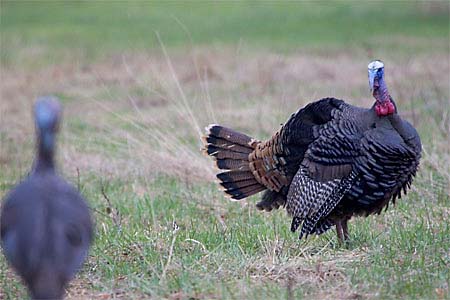
Turkey gobbles, whether near or far, never fail to stir my blood. In my mind’s eye, I see a gobbler with a white head, strutting around trying to impress the hen. We have our decoys out and well placed, and our calls, and we begin calling. The gobbler answers, and if things are meant to be, the longbeard will begin strutting in your direction.

The hunt is far more important than the kill.


We look forward to it, and if all goes right, will soon see a snowball-white head bobbing through the woods. Then we see the bird displaying, and our heart beat is like a triphammer, pounding in our chest and we can hear the blood pulsing in our ears. We may start sucking air, hyperventilating and often wonder why the bird can’t hear it. Closer and closer the bird comes, and then, there the gobbler is with his head held high as he looks for the hen.

As we place our shotgun sight where his head and neck join, a sudden thought goes through our head and we realize we’ve done everything right to reach this point in time. We also realize that there is so much more to turkey hunting than pulling the trigger.

Shooting a gobbler is anticlimactic. It’s only the icing on a turkey hunter’s cake. The actual hunt, everything that leads up to the shot, is the real thing and is why we hunt these birds.

Try not to confuse the issues and believe a dead bird is the sole reason for hunting. Do that, and forget what went before, and turkey hunting will soon lose its charm.

Saturday, April 09, 2011

Murphy’s Law and Turkey Hunting


A turkey decoy (left) and a jake gobbler we passed up on that day.


It was the nicest day of my second turkey season in Area K several years ago. It was clear and cool when we got into a good spot to listen at dawn. My buddy Arnie Minka was giving me a break: no turkey talking for me today. He would do the calling on the last day of my season.

There was no wind, which was a blessing after all of the wind of the past two weeks, and we sat quietly waiting to see if any gobblers sounded off at daybreak. Dawn was a pink blemish on the eastern horizon when the first bird gobbled nearly a mile away.

Five minute later another bird gobbled, hit a double-lick, and then single-gobbled to punctuate his earlier comment. Two minutes later the bird, perhaps 250 yards away, gobbled again and then another bird gobbled a half-mile to the west.

Wild gobblers calling at dawn


We sat patiently, waiting for another gobble, and weren't disappointed. The only thing is this bird was off in the woods several hundred yards away, and the hens were talking up a storm. Arnie let him gobble again, and then stroked out a soft yelp on a box call.

Two birds gobbled hard, took a breath and gobbled again. I'm thinking this is a little bit of alright. Arnie was grinning under his face mask.
He switched, just to see if it would work, to a slate call. The peg rasped out a soft purr and whine, and both birds lit up again. He didn't want to rush the calling too much. He wanted to let it get a bit brighter so it would be easier for me to see an approaching bird.

He picked up the slate call again, drew the peg in a soft J-stroke and the soft yelp turned on one of the birds. He rasped out a throaty gobble, roaring hard, and that forced the bird 250 yards away into a similar respon

Here we were on this wooded hilltop, approximately halfway between two lusty gobblers. The bird farthest away gobbled once, and it sounded as if he was closing the gap. Arnie gave another soft yelp on the slate call, and both birds answered. This was getting pretty exciting.

The neat thing was we were working two birds, and their male ego or whatever turkeys possess wouldn't let either bird give in. Box call or slate, it made no difference to them. Both birds were coming, and he softly teased them with another soft yelp and purr.

Suddenly, both gobblers shut up. Murphy’s Law had struck again.


They gobbled, each bird now within 200 yards, and the furthest bird double-gobbled and I thought I could see him approaching the tempting hen decoy. The other bird gobbled, rattling the woods, and Arnie whined softly on the box call, and that lit him up like a July 4th fireworks display.

All of a sudden, there was no noise. Not a turkey gobble, not a crow cawed, and Arnie hit another soft lick on the box call and slate. Nothing. The birds had gone mysteriously silent.

Why, I wondered, he hadn't hit any bad notes with his calls. Something had to have frightened the birds.

Two people were tending to farm chores. It wasn't hunter harassment, but more like Murphy's Law crimping our style.

We quickly moved our base of operations 100 yards, and tried again. There was no gobbles, no nothing. It was as if the ground had opened up, and swallowed both birds.

There was a vantage point another 100 yards away where we could see where the other bird had been, and we made our way to it. I laid my shotgun aside, and we spent 20 minutes glassing woodlots and open fields on both sides of the road.

We sat back, thought about it, and began glassing an area across the road. A gobbler stood out in the field at least 500 yards away, and was watching the road. He was a half-mile away from us, and there was only one way that might put us within shotgun range.

It would be a mile hike, and we dropped off our hill top vantage point, studied the terrain where the other bird had been, and saw nothing. We moved through the woods, across plowed fields, crossed the road and entered the woods.

We moved slowly and silently through the wet woodlot, and eventually got to within 200 yards of where the bird had been. That joker had disappeared. We walked through a woodlot, and never saw him again.

Several other spots were tried, and we took a long scouting ride, but there were no more turkeys.  We saw one jake with a two-inch beard, and he never received any consideration from me. I'd let him grow into something bigger for next year.

My season ended early that spring when four hens and two jakes were spotted crossing a field and heading for their roosting area. They offered us a brief thrill but we both realized that Mr. Murphy had ridden our backs all day. He proved, once again, that if anything can go wrong on a turkey hunt, it will.

The good thing was our hunt was fun while it lasted.

Wednesday, April 06, 2011

Don’t make the mistake: take the jake


One must wait when a bunch of turkeys are present to avoid shooting two birds.

This is one of those unenforced rules that turkey hunters should always consider. The wild turkey is a very beautiful bird, and it's North America's largest game bird, and many hunters get caught up in all the beauty that is turkey hunting.

Everyone wants to hunt and shoot a great huge trophy. They want a bird with a beard as thick as a paintbrush and one that drags the ground, and preferably with hooks 1 ½-inch around the curve and a bird that tops 20 pounds.

Such birds are out there although spurs that long are often found only on the oldest gobblers. But it's all these things that attract gobbler hunters, and not every one will shoot a great big bird. In fact, very few of us will shoot a big gobbler when the season begins.


The decision isn't easily made until it presents itself, and you must move fast.


So the time-honored catch phrase “don't make the mistake: take the jake” can be excellent advice. Oh, yeah, I know: it's fine to hold out for Big Bird to show up, but as a general rule, those old Ground Shakers seldom show up when you want them to.

So, that makes the old catch phrase more meaningful. As often happens, especially when using calls and decoys, the first birds on the scene are the younger jakes with their itty-bitty two-inch beards. The big limb-walkers hold back, and watch the youngsters with all their eagerness, dash in to sweet-talk the hen decoys and then get shot.

It's one way to ensure that a gobbler grows up, grows a big beard, and develops some hook to his spurs. They let the little guys run in, while they strut and posture, and it just takes strutters longer to get moving sometimes. Capturing a bunch of hens from another gobbler's harem is always the idea, there's just no rush to it.


Try to think this problem through before it happens, and try to reach a decision.


Often, hunters can tell if the strutters are interested. They strut and dance, stick their heads out to call, turn around in little circles while displaying their strutting skills, and they move in slow. I like to wait and see what the longbeards plan to do.

Often, the strutters hang back with the hens they've already corralled, and they look for danger. Then the hens that run with gobblers are like doe deer; they are suspicious about anything that looks out of place. Suddenly, if a jake and two hens are in one spot, and not moving, it makes old hens skittish. Once the jakes get into the decoys, it piques the interest of the old gobblers.

Slowly, the older gobblers will finish their inspection, and move toward the jake decoy. This, obviously, is what many hunters want to see. Well, folks, sometimes it happens that way and other times it doesn't.

My advice if the big longbeard hangs back, the hunter can do one of two things: wait to see if the big boys move closer, but there is no way to tell if they will. Usually, if a longbeard plans to jump a hen decoy, it usually does it while the jakes are thinking about doing it. However, if the longbeard holds back, he's suspicious. If he walks away, and no longer answers the call, he's on his way out of Dodge City.

Now is the time when you make the final decision. No one can make it for you. Do you shoot the jake, and end your season by tying your tag to one of the legs, or do you pass up an easy shot in hopes of calling in another heavy gobbler? Only you can solve that problem.

Longtime hunters can tell when adult gobblers are about ready to skate out of there. The staked-out hen decoys aren't moving as a live bird would, and the big gobblers are holding back. The only target of opportunity is a jake.


Just don't move when turkeys are within shotgun range. Shoot or wait.


Mind you, there are no stigmas attached to shooting a jake. Only personal thoughts keep this from happening. The question that turkey hunters all over North American must ask themselves is this: I can kill that jake or I can wait and try for a larger birds. It can be a tough decision to make.
Only you can answer the question. I've shot lots of gobblers over the years, so it's my decision to shoot or wait, and I always wait. For first-time hunters or those who haven't shot many birds, my advice is simple. Don't make the mistake: take the jake.

Sunday, March 13, 2011

Memorable turkey blunders

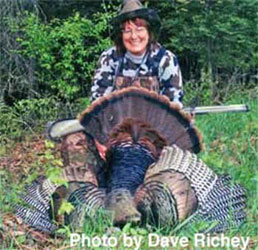
Cathy Beutler with a dandy gobbler she shot while hunting with me.

"Keep your powder dry" was the motto in the 1700 and 1800s when muzzleloading hunters and frontiersmen roamed parts of North America. Those who failed to follow that sage advice often went hungry or had their hair lifted and cut off below the roots.

My list of hunting mistakes with game, especially turkeys, is endless. Years ago, while hunting in a heavy rain with a muzzleloader, I forgot to cover the muzzle. I set my front-loader against a tree with the powder and shot charge in the barrel but the shotgun wasn't primed.

I set out my decoy, retreated to my chosen spot, and primed the muzzleloading shotgun. A large number of gobblers and hens came, and milled around in a tight circle near the decoy, and I couldn't shoot. They eventually left, and I called again.

Good thing a desperado wasn’t trying to take my money.

A lone gobbler a half-mile away answered, and I sweet talked him with a soft yelp and some hen jabber with a push-pull call. He came running up. I saw him first at 30 yards, and then he dropped into a little dip in the ground, and popped up again at 20 yards and stopped. The shotgun was up, and when I pulled the trigger, the primer went off with a pop. The powder did not.

I'd forgotten to put a balloon or anything else over the muzzle to keep the powder dry. The Pyrodex was a black semi-liquid. It was a lesson well learned and never forgotten.

I took a guy out one day, late in the season, and spotted a jake 150 yards away. This guy wanted to shoot a gobbler, and beard length didn't matter. It took 30 minutes to bring the jake within 80 yards, and the guy was aiming at the bird.

"He's too far away," I whispered. "Don't shoot yet. Let him get to within 35 yards." He said the bird was only 35 yards away, aimed and shot.

The young gobbler hauled tail feathers into the woods. The man maintained the bird was only 35 yards away until I asked him to give me a prominent landmark where the bird had been standing. He said the bird was right near that little bush that stood three feet high.

That bush was much farther away than he thought. He shouldn’t have shot.

He was urged to pace it off in approximately 36-inch steps as I walked beside him counting the paces. I got 80 steps and he got 77 steps, and then he realized the mistake he had made. It was the last gobbler we saw that day.

This didn't happen to me but to a friend. He knew, within 50 yards of where a gobbler had roosted the night before. He snuck in the next morning, and stopped well short of the roosting area to wait for the first gobbles of the morning. The sun came up and all was silent.

He gave a very soft tree yelp or two but nothing responded. He stuck with it, and finally with a great deal of impatience, he uncorked a loud yelp on his box call and something happened. A big gobbler bailed out of the tree he was sitting under, and it flew 75 yards, hit the ground a'runnin', and that was it. He had set up directly under the gobbler and missed his big chance.

The author carries a nice longbeard out od the woods to his car.

Two friends, on their first gobbler hunt, went looking before dusk and spotted several dark birds on the ground. Just before dark they flew up into a tree. These guys knew about roosting birds and were happy.

They returned the next morning well before dawn, set up about 100 yards away, and waited for the day to wake up. Tweety birds tweeted, crows cawed, and they yelped on box calls. They could see several dark forms in the trees, and called again and again.

A big surprise was in store for those two turkey hunters.

Eventually the birds flew down, and went to where the hunters had seen them the previous night. No amount of calling seemed to work, so one of them slowly eased his binoculars from his backpack, and with infinite slowness, eased them up to his face and studied the birds.

The birds they had roosted the night before were not real turkeys. They were turkey vultures, and they were feeding on carrion on the ground. They admitted it, and took their share of ribbing.

There is only one sure thing when turkey hunting. Murphy's Law always applies, and simply stated: If anything can go wrong, it will. Keep Mr. Murphy in mind, try to outguess him, and sometimes the gobblers react as you plan and the hunt is a success.

Of course, when we mess up, it's still good for a laugh even when we don't feel much like laughing at our silly mistakes. Trust me on this: if you hunt wild turkeys long enough, you too will make a blunder or two.

Posted via email from Dave Richey Outdoors

Thursday, February 10, 2011

Two deer stands for each hunting spot?


East-wind stands must be properly placed for them to work.


It's certainly not an original idea. Many hunters, myself included, have long toyed with the notion of having two stands for each hunting spot. One for the prevailing wind direction and another that would work well for most other winds.

I've thought about it at great length, and have pretty much decided that the most problematic wind is from the northeast, east and southeast. Such winds can stall deer travel.

Would a stand for a prevailing westerly-northwesterly wind, and one for an easterly wind work? What are the pros and cons?

Is the two-stand idea adaptable for most deer hunting?


It probably would work if  the cover (meaning trees for tree stands) were available for those winds. The reason most of us never have put up stands for an east wind is that we never used to get as much of them as we have over the last 10 years.

I have a few places where I can go when an east wind blows. One is a pitblind at the base of a small hill, and an east wind blows right into the opening where bow shots are taken. Deer, as a general rule, do not approach from behind the pit blind, and it's very difficult for a deer to wind the hunter.

A couple of elevated coops are situated so an east wind isn't too bothersome, but many of my stands are placed strategically for the prevailing westerly wind direction.

However, going back to the plausibility of two stands for each hunting area. It could work, if the terrain features and available trees are present, but there is the additional cost of doing so.

Say we're hunting a big buck and we want to set up on him when the wind is out of the east, it can be done but it's not something one jumps into when we already have some stands out. If we could, that would mean building or buying many more stands.


The cost of buying or building more stands can become cost-prohibitive.


Most of our stands are permanent fixtures, especially elevated coops built into trees. If we were to do it at all locations, the woods would lose its good looks and begin looking like a scattering of urban tenements in the trees. That would spoil the aethetics of the hunting area.

What probably makes more sense than anything is to build four or five stands for use strictly on an east wind. That might mean two or three new stands along the western edge of our property where the likelihood of a deer catching the hunters scent would be minimal.

If two or three stands were positioned with the west fence line just a short distance away, the chance of a deer circling next to the fence and picking up human odor would be minimized.

The other alternative would be to build an air-tight coop with one shooting window strategically placed. If it was just large enough to shoot through, and could be opened without a sound, it would probably work.

Too many windows in a coop allow the hunter to be silhouetted against the light entering another window. And, the more windows there are, the more likely someone will try a shot at a circling buck or open the windows to look around. All this would do is distribute more human odor.


Fighting an east wind is becoming more prevalent. This could solve the problem.


Fighting the east wind is something bow hunters must put up with, and in some cases, we can do something about it. In other cases, the wind may beat us.We're putting our collective heads together this winter, and are trying to figure out how to beat the October east-wind problem. Will it be two blinds in one hunting spot or air-tight blinds with only one small shooting window?

Will it be one or two more pit blinds that back up to a hill? Will it be stands close to our line fence to keep deer from circling behind the hunters?

It may well be a combination of all of these things although having two blinds covering one hunting spot is not one of my favorite ideas. If one was an elevated coop and the other was a pitblind, it could work without cluttering up the skyline.

One thing is certain: whatever we do must be accomplished during the spring, or at the very latest, by June or early July. I like all changes to be made long in advance of the bow season.

Tuesday, October 12, 2010

Hunt natural foods as well


Bow hunters have a deeply ingrained habit. They hunt the food sources.

For many, that means the edge of a corn field where bucks and does move in and out. It could mean a huge soy bean field where deer are conspicuous as the only upright objects in the field.

If you hunt the beechnut trees and the oak flats, and good mast is laying on the ground, this is a pretty good bet as well. Oak mast, and to a lesser degree, beechnuts are a staple in the diet of deer that roam near such nut trees.

There are more deer food than corn, soy beans & other truck crops.

However, many hunters overlook other deer food. The forget about the less common stuff. Years ago I had a stand where I could see deer approaching for 200 yards from their bedding area as they moved to a nearby soy bean field.

The bean field was huge, and there weren't many deer in the area back then, and I had the opportunity to watch this buck come. It took him an hour to reach my stand area only 75 yards from the field.

I had a pit blind next to an uprooted tree, and my pit was in the soft earth ripped up when the tree went down. One side of the root wad hung three feet over my head, and shielded me from the sun and rain, and covered me in shadow.

The buck, one step above a basket rack, fed every night in the beans. This boy was as regular as the 11 o'clock news, and I watched him walk out of the brushy swale where he bedded down. He moved 10 yards out, stopped to browse on something, poked around a bit more, moved closer, and browsed on something else, and with every few steps he would get closer to me and the bean field.

This buck was feeding, and at the time I didn't know what it was. I made up my mind that if I shot the buck that night or didn't shoot it, I was going to learn what that deer was feeding on before he reached the dining table loaded with high-protein soy beans.

He kept coming, and if he stayed his course, he would cross 15 yards from me and offer a quartering-away shot. I relaxed, watched for other deer, but again, there were far fewer deer in those days. Little did I know I would be learning a trick that few people know they know.

Thirty minutes later he nibbled at something, lifted his head, took several more steps and stood, quartering-away and looking off toward the field. It was easy to make my draw, take my time aiming, and make a smooth release.

Watch what natural browse deer eat in your hunting area.

The buck kicked up his back legs, and darted out of there in a panicked 75-yard run before collapsing near the field edge. Two or three does were in the field, and they looked up, studied the area for a moment, and went back to munching soy beans.

That buck taught me more than just about deer feeding in a soy bean field. He could have been heading for an alfalfa, barley, cabbage, clover, corn, oats, potatoes. rape, rye, rye grass, sugar beet, winter wheat or any other farm crop to have dinner. Deer are catholic in their appetite, and will munch on almost anything.

Protein levels are high in clover and legumes, such as soy beans. But a deer's appetite goes far beyond these truck crops. It's some of the wild stuff that grows and that deer eat, that can provide the often overlooked other food source for people to hunt.

Deer make wise use of the aforementioned acorns and beechnuts. They also eat wild apples and pears. There used to be one single pear tree near my home, and a nearby fence row was 15 yards away and it held one gnarly old oak. It didn't produce acorns anymore, but it offered a spot for a tree stand. More than one buck met his fate by coming to eat on the pears.

Deer are often known as random tip browsers. They will nip a bud off a twig here, one over there, and they have a wide range of things they will eat besides farm crops, fruit and nuts.

Some examples of what Michigan deer eat beside truck crops.

Michigan deer will eat balsam, basswood, cherry, dogwood, dwarf sumac, blackberry leaves, black cherry, ground hemlock, orchard grass, red maple, red osier, spruce, tag alder tips, white cedar, wild grapes and the leaves. Many other wild growing weeds also serve as fodder for a browsing whitetail deer.

Find a neighbor who has ornamental shrubs planted around the house, and watch it for a few days in December. You'll soon learn which trails deer use to come to feed on the shrubs, and a savvy bow hunter can set up on them very easy. Stay away from the houses because of Michigan's "safety zone," which is 450 feet, and ambush them as they move down a trail to feed.

Hunters who can locate a wild food source has found the banquet table. Some wild foods are eaten only in the winter, but many are a mainstay at other times of the year.

Learn these foods, spend some time checking for deer movement around these natural food sources, and it can pay off. If deer are slow or reluctant to come to croplands, go looking for wild-growing foods.

It can pay off ... big-time.

Posted via email from Dave Richey Outdoors