Showing posts with label early. Show all posts

Sunday, July 15, 2012

Ethics: Rules to live by

Television personality Jerry McKinnis with a river salmon
photo courtesy Dave Richey Outdoors ©2012

Outdoor ethics are a bit like marriage vows. They are those hard-to-explain things that keep sportsmen from breaking fish or game laws if we think someone might be watching us.

That's fine, as far as it goes, but it's a gross oversimplification of a very complex issue. And, these issues baffle many sportsmen.

Stated another way, if you must look over your shoulder or around you before doing something, chances are you will be breaking a fish or game law. Perhaps, if you find yourself doing this bit of odd behavior, you might wish to rethink the situation.

Be aware of some ethical acts and those that are not

Outdoor ethics are those complex but unquestionable rules that sportsmen must follow whether others are watching or not. They are rules we must endorse if fishing and hunting will survive this century.

Want a few examples; Consider these

I had six chances to arrow a big 10-point a few years ago this October. He always showed up five minutes after shooting time ended. No one was within 500 yards of me, and no one would have known if I cheated and taken a late shot at that buck.

No one, that is, except me. It would have chewed at my guts like a malignant cancer until the taking of that big 10-point would have been reduced to a humiliating experience. It would have ruined my hunt.

One night last fall I climbed into my bow stand, tried to remove my wallet from my back pocket, and it wasn't there. My bow license was home on the dresser. I had a valid license but it wasn't in my immediate possession so my bow was stowed away in its case.

The evening was spent watching deer through binoculars. It was fun even without a bow in my hands.

A big problem with outdoor ethics is they are impossible to legislate and very hard to enforce. Only one person–you or me–can deal with ethical situations whenever they arise.

For instance: we shoot a rooster pheasant and it glides across a fence and falls on posted property. Does winging this bird give us the right to pursue it without landowner permission? Nope.

We're fishing in flies-only water for trout and a stiff breeze puts down the hatch. Is it ethical to fish worms here? The answer is no.

Or, as I mentioned earlier about the10-point buck, could I have cheated and shot? Sure, but I would have had to deal with my emotions and my personal sense of right, wrong and/or guilt.

It is legal to shoot a grouse on the ground but it's not ethical

Mallards pinwheel down on a freshening breeze to spill into bobbing decoys. It's a perfect morning, and five minutes before legal shooting time. Hunters in a nearby blind have shot and dropped two hen mallards. Does that make it legal for us to shoot early as well?

The answer is an obvious “No” but some hunters would shoot any way, and could be ticketed by a Federal or state conservation officer.

Ethics prevent us from doing illegal or quasi-illegal acts. Hunters don't shoot ducks on the water unless they've been wounded or shoot grouse on the ground. We don't snag fish, and we don't keep undersized fish or fish over our limit.

Know the rules; Read annual fishing-hunting digests

Buying a fishing or hunting license is no guarantee of a full game bag, a trophy buck, a hefty creel or a brace of pheasants. The license only grants us an opportunity to fish or hunt during the legal season. It offers sportsmen nothing more and nothing less.

Ethical behavior is a topic as personal as the color of our morning toothbrush. It also serves as the bare-bones foundation on which our sporting ethics are built. We are judged by our conduct, and those who wink at fish or game law violations or encourage any breach of ethical conduct, do themselves and other sportsmen a real disservice.

Posted via email from Dave Richey Outdoors

Thursday, August 25, 2011

Scout now for an October’buck

Start Preseason Scouting Soon


Anyone who greets the dawn in the field is getting a big jump on the day, and will most likely find game animals and birds moving about. Do it just right, and it can be a kick-off to your preseason deer scouting.

I visited one of my hunting spots two days ago, and it was fairly cool. It felt good to be a bit chilly, and I walked in to a high hill where I could watch for whitetails without being spotted or winded.

The sun was still blushing the eastern horizon when a doe with two fawns wandered by, stopping here and there to nibble on alfalfa. They walked along the edge of a nearby winter wheat field, and sniffed at some new green growth, apparently to see if it was ripe enough to eat.

Scouting means finding bedding areas, food, sanctuary and water.


Two bucks, both fuzzy-antlered with velvet, cut the corner of a fallow field, dipped down into a gully, came out the other end and disappeared into the woods. They were quickly followed by a spike-horn that had got sidetracked along the line, and was now playing catch-up with his buddies.

The sun was above the horizon when I spotted a veritable gold-mine of turkey gobblers. Six gobblers were moving like a combat platoon as they came across the top of the hill and crossed within 20 yards of me. I was sitting on the ground, knees up and Swarovski binoculars to my eyes. I had to lower the binoculars to better see the gobblers.

Look for deer crossing fields & through bottlenecks.


One bird had an honest 12-inch beard, and two had 10-inch beards, two had 7 1/2 to 8-inch beards, and the other was a jake. The sunlight glistened off their feathers, turning the colors from russet to gold to black and back again. They didn't know I was there, and they passed within 20 yards and headed down into an open field where they were out of sight of a nearby road.

I saw a glimpse of some animal, and never could see it well, but it appeared to be a coyote heading for a place to lay up.

I didn't spend much over an hour sitting, and it become apparent the critters were done moving. I walked the edge of an alfalfa field where drying mud remained from an earlier rain, and checked it for tracks.

One big splay-hoofed deer track was visible, and it looked two-thirds larger than any other deer track seen. Buck or doe? Hooves splay out in mud, and that could account for some of the size, but it could have been a deer of either sex. I knew of a very large doe in that area last year, and had heard reports of a good buck as well.

I used to hunt with a man who claimed he could tell the difference between a buck and doe track, and under certain circumstances, I believe I can too. But, tracks in mud never seem to offer quite enough clues to its sex, and I need something more to go on than a widened track in soft mud.

Scouting is fun, instructional and can lead to a successful hunt.


Was today a scouting day? Absolutely. I could determine where the bucks entered the woodlot in the morning, and with a westerly breeze, even picked out a perfect tree. I'll have to watch in the morning more often, and then get serious about a stand once I know the bucks are using the same trail every morning.

I learned years ago, when hunting bucks in southern counties, that farmland deer will travel one of two or three trails in a given area. We sometimes had to flip a coin to determine which of two trails to choose from, and often the coin would lie to us.

Preseason scouting doesn't need to be a major investment in time nor does it have to be done every day, but hunters should spend time scouting three or four times a week whenever possible. Keep track of directional travel changes when the wind moves to a different quarter. Being downwind of deer is one of the first steps to a successful hunt.


Scouting is not only an important part of deer hunting, but it can be fun. My wife used to sit in a stand, watch the deer and videotape them during the summer. By early September, she would have the buck of her choice on tape, and she would later lay claim to it with a well-placed arrow.

She always shot the buck she videotaped, and that proves that preseason scouting, from the spring on, does work. The more effort one puts into it, the more successful one may be.

Sunday, April 24, 2011

Take common sense into the turkey woods tomorrow


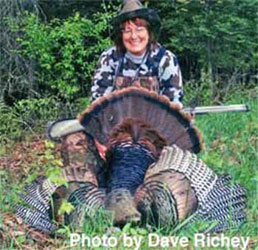
Cathy Beutler with a nice gobbler she shot while hunting with me.


Turkey hunting mistakes and the shotguns we use don't necessarily go together, but in many cases, they may come together whether we like it or not. People with much better eyesight than me can get along just fine, thank you, with just the bead on the front end of a shotgun.

They believe there is no reason to trick out their shotgun. That doesn't work for me or my wife. I use a scope while she uses a Bushnell Holographic sight. Each one works well for us.

My 3-inch magnum 12 gauge shotgun wears a scope with crosshairs. It more than allows me to aim with confidence at an incoming gobbler. A well identified gobbler can be seen with the naked eye but the scope helps me pick a hole in the brush through which I can positively identify and shoot my bird. It helps reduce wounding of a turkey as well.

Hoping that today's weather holds for tomorrow's turkey opener.


Kay's Holographic sight has a red ring that can be placed on the gobbler's head and neck, and the brightness can be turned up or down to match her needs on a bright or very cloudy day.

They were both sighted in a month ago, and we'll add new batteries just before our second-season hunt begins. We are fine as long as we don't fall or bang the scope or sight off a tree limb or a big rock. I once fell while hunting in southwest Texas, and knocked my scope so far out of kilter that I couldn't have hit the inside of a barn if I'd been standing inside it.

Several states are under my belt when it comes to turkey hunting. And even though the Michigan turkey season will be opening tomorrow, anyone who ventures out for wild turkeys this spring  should have some type of checklist. It certainly will help prevent forgetting some key element that is needed. I made that mistake once, got into my position well before the dawn, and reached  for my shotgun shells and they weren't there.

I then remembered leaving them sitting on the table as my coffee was hurriedly quaffed. My hunting vest was pulled on, my empty and cased shotgun was picked up, and out the door I went. It was a wonderful morning, and two longbeards slipped in to within 35 yards even though I wasn't calling and there were no decoys set out.

I sat still, watched the birds without spooking them, and still had a wonderful time. But hunting is not quite the same without a bow or loaded shotgun in hand.

In the heat of the moment, it's easy to forget where items are or which pocket they were put in the turkey vest for safe keeping. I generally go through a mental or written checklist the day before a hunt, put everything in my car, and it stays there until I finish hunting that season.

A mistake made on opening day several years ago.


I write occasionally about turkey hunting mistakes. Here is one of mine. I took off one morning, drove to my hunting area, got there long before sun-up in preparation for a half-mile hike to my chosen hunting area, slipped on my turkey vest and reached for my shotgun. It wasn't there.

It had rained the previous day while hunting, and I took the shotgun in the house to dry it off, clean it up, and forgot to put it back in its case and in the car. So, by the time I drove home, the sun was well up and another great turkey-hunting opportunity had been wasted.

What should this turkey hunting checklist contain? Obviously, it should have everything you'll need for turkey hunting. Once pulled together, leave all gear locked in the vehicle to avoid a problem like mine.

We'll start with the bare essentials. This would include

  • camouflage clothing
  • face mask, boots
  • camo cap
  • gloves
  • turkey vest
  • bow or shotgun

    Don't forget the shotgun shells and rain gear if needed. Of great importance is your spring turkey hunting license. It must be carried with you while hunting. Don't leave it in the car or truck.

    Next comes the less obvious but very important items. Anyone who checks many places for bird sign, and has patterned turkeys in several areas, should have a map showing these locations along with details of where birds roost, travel at dawn, move during the day, and how they return to their roost site. A handheld GPS unit can store a bunch of turkey hotspots, and it doesn't take up much room.

    Decoys have become an important part of a turkey hunter's gear, and don't forget them. Some people roll them up and stuff two hens and one jake decoy in the back of their hunting vest. I don't because if they stay folded for too long, it's a pain to heat them to pop the decoy back into its original shape.

    Hen and jake decoys are important items for many hunters.


    My old decoys have newspaper rolled up and stuffed inside the body and neck cavities. It makes them a bit slower to move on the stake during a breeze. A fast-moving decoy tends to scare approaching gobblers. I also cut several arrow shafts, glue in an insert and use a target point to stick it into the ground. The opposite end that goes through a decoy that has a washer that fits against the inside hole for the stake. Another target point and washer is placed at the top of the decoy, and the point is screwed into the insert. This allows the decoy to move. Paint these washers black. Just remember that a stiff breeze can still blow them around but there is a cure.

    Two stakes are cut from old aluminum arrow shafts, and have a target point screwed in. These stakes are used to prevent a decoy from spinning completely around on a breezy day. It allow the decoy to swivel 12-14 inches in one direction and that much in the other direction, and this provides the best results for me. It provides some decoy movement that can help sell the deal.

    Make certain any box calls are wrapped in an old dark-colored washcloth with one layer of cloth between the lid and box of the call to prevent unexpected squeaks. Keep all strikers for slate calls rubber-banded together to prevent them from clicking together in your vest. Know where each call is in your vest, and it doesn't hurt to bring a brown towel to lay on the ground. Place all calls to be used on the towel next to your leg for easy access when needed.

    Common sense and hunter safety must be practised while turkey hunting.


    A Hunter Orange cap or vest can be worn when walking into and out of the woods, especially in the predawn darkness. Once you get to the hunting area, take it off. It adds a wee bit of extra hunting safety to your day in the woods.

    Touch up any shiny object with brown, black or green spray paint. Carry shotgun shells, one each in different pockets, to prevent them from clicking together and making an untimely noise.

    Carry a cell phone but turn the thing off. Carry a topographical map of the area if one exists, but stow it somewhere so it doesn't crinkle and make noise as a gobbler approaches. A handheld GPS unit can mark your vehicle's location, the best place to set up, and tell you how to return to the vehicle when hunting strange land. A flashlight is always handy, as is a good compass.

    A foam rubber camouflaged butt pad is a luxury, and I carry one in the back of my vest. The small foam pad that folds down to be used as a seat is left up and in place and used to cushion my bad back.

    I'm still dithering about taking my Ten-Point crossbow or my shot. Bow hunting for turkeys is legal from a treestand, and I'm thinking of trying it tomorrow.

    What else? Anything else that you may need. I carry a turkey wing to slap against a tree or pant legs to simulate the fly-down sound of a bird coming out of a roost tree at dawn. A candy bar, cookies or a sandwich, and a bottle of water, are handy on an all-day hunt but pack them so they make no noise.

    The last two things a turkey hunter should take into the woods on opening day is a combination of common sense and optimism. Go forth with common sense telling you what to do or not do, and the optimistic thought that this is the day you'll take that husky longbeard. Think positively, and good things can happen.

    Wednesday, April 13, 2011

    Turkey Hunting


    What does turkey hunting mean to me? It can be a rather difficult question to answer, but for many spring hunters, it means shooting a gobbler.

    Well, that can be more easily said than done. During the spring season, only gobblers can be killed and often they are with hens. Those drab-looking hen-birds are notoriously wary, and are every bit as alert as an old whitetail doe.

    There are many things that attract sportsmen to this past-time. It is, in fact, the only spring hunting season. With the opener of the first gobbler season on April 18, many camouflaged hunters will be afield.

    Turkey hunting is a way of life for many spring hunters.


    The rules are the same for everyone, and are detailed in the 2011 Michigan Spring Turkey Hunting Guide It’s important that all sportsmen hunt in the specific area they chose for a spring turkey hunt. Hunting times are from 30 minutes before sun-up to 30 minutes before sundown. The limit is one bearded bird, and note that some hens may have a visible beard.

    I’ve seen some of the decoys available that can move by pulling a string or with the aid of battery power. Only wind movement is legal when turkey hunting. No electronic calls may be used to replicate the sounds that real turkeys make.

    It is illegal to shoot turkeys roosted in a tree. It also is illegal to use or carry bird shot larger than a No. 4 shot. The most common sizes are No. 4, 5 and 6. shot. It also is legal to hunt wild turkeys with a bow, and hunting with bow-arrow from an elevated position is legal.

    Scouting for birds is encouraged before the season opens, but hunters also are encouraged to leave their turkey calls home while scouting. Do not call during the scouting season, and I consider scouting by car as the least invasive method. Drive slowly, look for birds, note the time of day, and knowing the time can be useful. It possible, locate a gobbler (often with hens) just before they fly up to roost, and return to that area long before dawn. Don’t shine lights or talk, and don’t call to the roosted birds before shooting time begins.

    Absolute quietness and stillness are two keywords to remember. Find a comfortable place to sit, and park yourself behind a tree as wide as your shoulders. Whenever possible, never get into a calling match with other hunters. It is a way to be accidentally shot by someone else. If you feel you are verbally dueling with another hunter, give up and leave without moving in the direction of the other hunter.

    Leave calls at home if you are not confident. Use a hen turkey decoy.


    If you lack experience or skill at calling, keep turkey calls in your pocket or at home, and rely on a turkey decoy. Set it up about 25-30 yards away, and if using a hen and gobbler decoy, place the gobbler fake near you so an approaching bird must pass in front of you to get to the decoy.

    Turkey hunting requires a number of outdoor skills: woodsmanship, sense of direction, being able to gauge distance, good hearing, learning to sit still, being able to shoot straight, and much more. Most important of all is to learn how to sit without moving.

    The challenges of being successful are many, and the odds in favor of success are lower than the odds of failing. Murphy’s Law states that “if anything can go wrong, it will.” Turkeys have added their stamp of approval to that known rule, and have gone on to establish countless other  ways they can use to further confuse hunters into making stupid mistakes.

    There are many good things in favor of taking up turkey hunting. It occurs in the spring when no other hunting takes place. Sportsmen can find wild turkeys throughout most of the state, but rules apply when application is made for a spring turkey license. One must choose which hunting seasons they wish to be considered for, but the first hunt tags for most areas are difficult to draw. Choose an area you know well.

    Wild turkeys are big birds and certainly can be easily seen. On most occasions, however, they are accomplished at quiet travel, remaining out of sight if they sense danger, and because they are big, the human brain seems to tell us the bird is closer than he really is. So, we miss.

    I have literally hundreds of turkey calls. Most are diaphragm calls, but I also own scads of box calls, push-pull calls, a fairly large number of  pot calls with surfaces of aluminum, crystal, glass and slate. We should carry only those calls that we use most often, but a niggling little doubt causes us to second-guess ourselves, and that leads to more calls than we need. The result is we tend to lose calls, in one way or another, and those lost always seem to be our favorites.

    Two or three turkey decoys are plenty. One hen decoy can do the job.


    At most, I carry three decoys -- a jake and two hen decoys. Some folks I know may carry a half-dozen decoys, and putting out that many usually takes longer in the dark than we plan for, and it’s easy to make too much noise. Two or three decoys are plenty, and a single hen decoy can work on most gobblers.

    We can take savage delight in being afield on a pitch-black morning, and get to watch nature come alive. The tweetie birds call at sunrise  as they begin to move around, and we’re often treated to deer sightings. Occasionally a late-hunting owl will be seen.

    It’s the sights and sounds of dawn that invigorate my soul. It’s watching the rising sun give off shafts of brilliant yellow, orange and reds, and then a black cloud can be seen as it changes from black to a deep and vibrant purple. The sounds of a crow, an owl hooting, or a fence gate squeaking, can make gobblers rattle the woods with their roaring gobbles. Hens often call softly, but can start badmouthing and trash talking a gobbler for no apparent reason.

    Turkey gobbles, whether near or far, never fail to stir my blood. In my mind’s eye, I see a gobbler with a white head, strutting around trying to impress the hen. We have our decoys out and well placed, and our calls, and we begin calling. The gobbler answers, and if things are meant to be, the longbeard will begin strutting in your direction.

    The hunt is far more important than the kill.


    We look forward to it, and if all goes right, will soon see a snowball-white head bobbing through the woods. Then we see the bird displaying, and our heart beat is like a triphammer, pounding in our chest and we can hear the blood pulsing in our ears. We may start sucking air, hyperventilating and often wonder why the bird can’t hear it. Closer and closer the bird comes, and then, there the gobbler is with his head held high as he looks for the hen.

    As we place our shotgun sight where his head and neck join, a sudden thought goes through our head and we realize we’ve done everything right to reach this point in time. We also realize that there is so much more to turkey hunting than pulling the trigger.

    Shooting a gobbler is anticlimactic. It’s only the icing on a turkey hunter’s cake. The actual hunt, everything that leads up to the shot, is the real thing and is why we hunt these birds.

    Try not to confuse the issues and believe a dead bird is the sole reason for hunting. Do that, and forget what went before, and turkey hunting will soon lose its charm.

    Wednesday, February 09, 2011

    Scout wild turkeys now

    Scout from a car or truck and stay inside to glass. Look for big gobblers like this one.

    Hunters have plenty of time to think about the upcoming spring turkey season. That time can be well spent looking around right now.

    Turkeys are gathered together in large flocks, and some flocks number 60 to 100 birds. Occasionally a big gobbler will be with them, or will be found nearby, but many of these huge flocks are hens and last year's poults.

    It's somewhat easy to do a bit of really early preseason scouting. We don't really try to single out an exceptional gobbler, but if one is seen, it pays to remember where it was found. Each time we go for a drive, and look for birds, keep a mental or physical written note on where birds are found, the time of day, and approximate size of the flock.

    A short drive allowed us to find a large number of birds. Keep track of them.

    My wife and I was driving home a week ago when a dozen gobblers scooted across the road and flew. When we were 100 yards away, we saw a large number of hens and poults cross the road and they studied us as we drove by.There were two or three really large Toms in the original group, and the group of hens and poults had some little jakes with their perky two-inch beards. They were casually noticed, and the location remembered. I know a guy that owns that land, and it's likely I can get permission to hunt it if the birds stick around that long.

    Obviously, no one knows whether they will draw a first- or second-season tag this spring, but those that applied for the guaranteed last season will get a permit.

    Another thing that we don't know is whether those big gobblers we saw will be within five miles of where they were seen last week. Winter birds hang pretty tight to areas where they are being fed, or where food is found, but they seldom stick around much after April Fool's Day. They may continue to be very close if there is a large number of hens, but if the hens split for another area, it's a sure bet the gobblers will follow.

    This mid-winter scouting for turkeys is no more than an excuse to spend some time looking for birds. Most hunters know the birds will be scattered before the season opens, but it gives us a chance to pursue our sport without harming the birds.

    Mid-winter scouting is easy but keep good notes on where gobblers are seen.

    It's always a wise idea not to crowd the birds. I have a window-mount for my Bushnell spotting scope and also carry a good pair of Bushnell (1) binoculars. I drive the back roads, and if birds are spotted, out comes the binoculars and spotting scope, and the turkeys are studied from a distance.

    There is no need to get out of the car, and it's wise to keep conversations low. Turn off the car, sit still, don't talk with the window down, and study the birds. Draw a map of five or 10 square miles, and mark where birds are seen.

    Note the number of gobblers seen and approximate beard length. Count the number of jakes seen, and note the locations and time of day. Turkeys often develop a pattern of feeding, moving, displaying, dusting and all the other things they do.

    In due time, these maps showing date, time of day, number of gobblers seen, travel route etc. will form the basis of a pattern for these birds. As turkey hunting season gets closer, study maps and times to pin down where the birds are found at specific times of day.

    If they are seen flying up to roost, note with specific detail where these roost trees are located. If it appears the birds will still be there when your hunting season opens, check with landowners for permission if the birds are roosting on private land.

    Turkey scouts become quite adept at hiding their whereabouts. I know a guy that leaves one man in the car, and another outside (away from the birds sight) who appears to be getting ready to change a tire. Hunters who sit motionless, with two pair of binoculars trained on an open field or woodlot, will attract attention from passing motorists.

    Do your best to avoid being seen glassing for gobblers. It doesn’t pay to advertise.

    I've watched other turkey scouts lay down in the seat to avoid being seen by people in cars passing by. They don't want people to see them studying distant birds.

    Looking for birds is a fun way to pass the day, and doing some of it now and again just before the season opens, can be of great help when the season does open. Just make sure to do it often enough so you know where the birds will be on opening day.

    And ... don't trespass without permission. Stay in your car, watch, make notes but leave your turkey calls at home. People who sit in a car with the window down, and call to visible birds simply educate them, and there is no sense in doing that because it will just hurt your hunting success.

    Posted via email from Dave Richey Outdoors