Showing posts with label start. Show all posts

Sunday, April 24, 2011

Take common sense into the turkey woods tomorrow


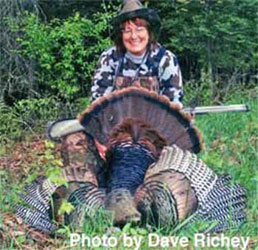
Cathy Beutler with a nice gobbler she shot while hunting with me.


Turkey hunting mistakes and the shotguns we use don't necessarily go together, but in many cases, they may come together whether we like it or not. People with much better eyesight than me can get along just fine, thank you, with just the bead on the front end of a shotgun.

They believe there is no reason to trick out their shotgun. That doesn't work for me or my wife. I use a scope while she uses a Bushnell Holographic sight. Each one works well for us.

My 3-inch magnum 12 gauge shotgun wears a scope with crosshairs. It more than allows me to aim with confidence at an incoming gobbler. A well identified gobbler can be seen with the naked eye but the scope helps me pick a hole in the brush through which I can positively identify and shoot my bird. It helps reduce wounding of a turkey as well.

Hoping that today's weather holds for tomorrow's turkey opener.


Kay's Holographic sight has a red ring that can be placed on the gobbler's head and neck, and the brightness can be turned up or down to match her needs on a bright or very cloudy day.

They were both sighted in a month ago, and we'll add new batteries just before our second-season hunt begins. We are fine as long as we don't fall or bang the scope or sight off a tree limb or a big rock. I once fell while hunting in southwest Texas, and knocked my scope so far out of kilter that I couldn't have hit the inside of a barn if I'd been standing inside it.

Several states are under my belt when it comes to turkey hunting. And even though the Michigan turkey season will be opening tomorrow, anyone who ventures out for wild turkeys this spring  should have some type of checklist. It certainly will help prevent forgetting some key element that is needed. I made that mistake once, got into my position well before the dawn, and reached  for my shotgun shells and they weren't there.

I then remembered leaving them sitting on the table as my coffee was hurriedly quaffed. My hunting vest was pulled on, my empty and cased shotgun was picked up, and out the door I went. It was a wonderful morning, and two longbeards slipped in to within 35 yards even though I wasn't calling and there were no decoys set out.

I sat still, watched the birds without spooking them, and still had a wonderful time. But hunting is not quite the same without a bow or loaded shotgun in hand.

In the heat of the moment, it's easy to forget where items are or which pocket they were put in the turkey vest for safe keeping. I generally go through a mental or written checklist the day before a hunt, put everything in my car, and it stays there until I finish hunting that season.

A mistake made on opening day several years ago.


I write occasionally about turkey hunting mistakes. Here is one of mine. I took off one morning, drove to my hunting area, got there long before sun-up in preparation for a half-mile hike to my chosen hunting area, slipped on my turkey vest and reached for my shotgun. It wasn't there.

It had rained the previous day while hunting, and I took the shotgun in the house to dry it off, clean it up, and forgot to put it back in its case and in the car. So, by the time I drove home, the sun was well up and another great turkey-hunting opportunity had been wasted.

What should this turkey hunting checklist contain? Obviously, it should have everything you'll need for turkey hunting. Once pulled together, leave all gear locked in the vehicle to avoid a problem like mine.

We'll start with the bare essentials. This would include

  • camouflage clothing
  • face mask, boots
  • camo cap
  • gloves
  • turkey vest
  • bow or shotgun

    Don't forget the shotgun shells and rain gear if needed. Of great importance is your spring turkey hunting license. It must be carried with you while hunting. Don't leave it in the car or truck.

    Next comes the less obvious but very important items. Anyone who checks many places for bird sign, and has patterned turkeys in several areas, should have a map showing these locations along with details of where birds roost, travel at dawn, move during the day, and how they return to their roost site. A handheld GPS unit can store a bunch of turkey hotspots, and it doesn't take up much room.

    Decoys have become an important part of a turkey hunter's gear, and don't forget them. Some people roll them up and stuff two hens and one jake decoy in the back of their hunting vest. I don't because if they stay folded for too long, it's a pain to heat them to pop the decoy back into its original shape.

    Hen and jake decoys are important items for many hunters.


    My old decoys have newspaper rolled up and stuffed inside the body and neck cavities. It makes them a bit slower to move on the stake during a breeze. A fast-moving decoy tends to scare approaching gobblers. I also cut several arrow shafts, glue in an insert and use a target point to stick it into the ground. The opposite end that goes through a decoy that has a washer that fits against the inside hole for the stake. Another target point and washer is placed at the top of the decoy, and the point is screwed into the insert. This allows the decoy to move. Paint these washers black. Just remember that a stiff breeze can still blow them around but there is a cure.

    Two stakes are cut from old aluminum arrow shafts, and have a target point screwed in. These stakes are used to prevent a decoy from spinning completely around on a breezy day. It allow the decoy to swivel 12-14 inches in one direction and that much in the other direction, and this provides the best results for me. It provides some decoy movement that can help sell the deal.

    Make certain any box calls are wrapped in an old dark-colored washcloth with one layer of cloth between the lid and box of the call to prevent unexpected squeaks. Keep all strikers for slate calls rubber-banded together to prevent them from clicking together in your vest. Know where each call is in your vest, and it doesn't hurt to bring a brown towel to lay on the ground. Place all calls to be used on the towel next to your leg for easy access when needed.

    Common sense and hunter safety must be practised while turkey hunting.


    A Hunter Orange cap or vest can be worn when walking into and out of the woods, especially in the predawn darkness. Once you get to the hunting area, take it off. It adds a wee bit of extra hunting safety to your day in the woods.

    Touch up any shiny object with brown, black or green spray paint. Carry shotgun shells, one each in different pockets, to prevent them from clicking together and making an untimely noise.

    Carry a cell phone but turn the thing off. Carry a topographical map of the area if one exists, but stow it somewhere so it doesn't crinkle and make noise as a gobbler approaches. A handheld GPS unit can mark your vehicle's location, the best place to set up, and tell you how to return to the vehicle when hunting strange land. A flashlight is always handy, as is a good compass.

    A foam rubber camouflaged butt pad is a luxury, and I carry one in the back of my vest. The small foam pad that folds down to be used as a seat is left up and in place and used to cushion my bad back.

    I'm still dithering about taking my Ten-Point crossbow or my shot. Bow hunting for turkeys is legal from a treestand, and I'm thinking of trying it tomorrow.

    What else? Anything else that you may need. I carry a turkey wing to slap against a tree or pant legs to simulate the fly-down sound of a bird coming out of a roost tree at dawn. A candy bar, cookies or a sandwich, and a bottle of water, are handy on an all-day hunt but pack them so they make no noise.

    The last two things a turkey hunter should take into the woods on opening day is a combination of common sense and optimism. Go forth with common sense telling you what to do or not do, and the optimistic thought that this is the day you'll take that husky longbeard. Think positively, and good things can happen.

    Wednesday, February 09, 2011

    Scout wild turkeys now

    Scout from a car or truck and stay inside to glass. Look for big gobblers like this one.

    Hunters have plenty of time to think about the upcoming spring turkey season. That time can be well spent looking around right now.

    Turkeys are gathered together in large flocks, and some flocks number 60 to 100 birds. Occasionally a big gobbler will be with them, or will be found nearby, but many of these huge flocks are hens and last year's poults.

    It's somewhat easy to do a bit of really early preseason scouting. We don't really try to single out an exceptional gobbler, but if one is seen, it pays to remember where it was found. Each time we go for a drive, and look for birds, keep a mental or physical written note on where birds are found, the time of day, and approximate size of the flock.

    A short drive allowed us to find a large number of birds. Keep track of them.

    My wife and I was driving home a week ago when a dozen gobblers scooted across the road and flew. When we were 100 yards away, we saw a large number of hens and poults cross the road and they studied us as we drove by.There were two or three really large Toms in the original group, and the group of hens and poults had some little jakes with their perky two-inch beards. They were casually noticed, and the location remembered. I know a guy that owns that land, and it's likely I can get permission to hunt it if the birds stick around that long.

    Obviously, no one knows whether they will draw a first- or second-season tag this spring, but those that applied for the guaranteed last season will get a permit.

    Another thing that we don't know is whether those big gobblers we saw will be within five miles of where they were seen last week. Winter birds hang pretty tight to areas where they are being fed, or where food is found, but they seldom stick around much after April Fool's Day. They may continue to be very close if there is a large number of hens, but if the hens split for another area, it's a sure bet the gobblers will follow.

    This mid-winter scouting for turkeys is no more than an excuse to spend some time looking for birds. Most hunters know the birds will be scattered before the season opens, but it gives us a chance to pursue our sport without harming the birds.

    Mid-winter scouting is easy but keep good notes on where gobblers are seen.

    It's always a wise idea not to crowd the birds. I have a window-mount for my Bushnell spotting scope and also carry a good pair of Bushnell (1) binoculars. I drive the back roads, and if birds are spotted, out comes the binoculars and spotting scope, and the turkeys are studied from a distance.

    There is no need to get out of the car, and it's wise to keep conversations low. Turn off the car, sit still, don't talk with the window down, and study the birds. Draw a map of five or 10 square miles, and mark where birds are seen.

    Note the number of gobblers seen and approximate beard length. Count the number of jakes seen, and note the locations and time of day. Turkeys often develop a pattern of feeding, moving, displaying, dusting and all the other things they do.

    In due time, these maps showing date, time of day, number of gobblers seen, travel route etc. will form the basis of a pattern for these birds. As turkey hunting season gets closer, study maps and times to pin down where the birds are found at specific times of day.

    If they are seen flying up to roost, note with specific detail where these roost trees are located. If it appears the birds will still be there when your hunting season opens, check with landowners for permission if the birds are roosting on private land.

    Turkey scouts become quite adept at hiding their whereabouts. I know a guy that leaves one man in the car, and another outside (away from the birds sight) who appears to be getting ready to change a tire. Hunters who sit motionless, with two pair of binoculars trained on an open field or woodlot, will attract attention from passing motorists.

    Do your best to avoid being seen glassing for gobblers. It doesn’t pay to advertise.

    I've watched other turkey scouts lay down in the seat to avoid being seen by people in cars passing by. They don't want people to see them studying distant birds.

    Looking for birds is a fun way to pass the day, and doing some of it now and again just before the season opens, can be of great help when the season does open. Just make sure to do it often enough so you know where the birds will be on opening day.

    And ... don't trespass without permission. Stay in your car, watch, make notes but leave your turkey calls at home. People who sit in a car with the window down, and call to visible birds simply educate them, and there is no sense in doing that because it will just hurt your hunting success.

    Posted via email from Dave Richey Outdoors