Showing posts with label gobbler. Show all posts

Saturday, May 26, 2012

The season's last bird

Last ditch effort to salvage a turkey season. Not the best way to do this, but it can work. Maybe...
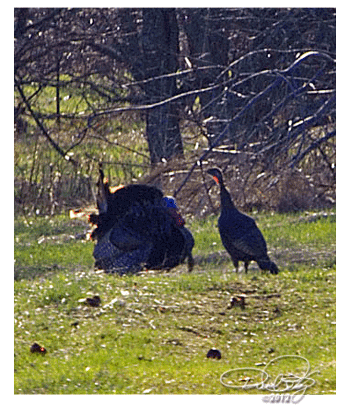
Two gobblers crossed the road ahead of the car as my neighbor and I headed for town and a dental appointment. Both birds had long beards, and were traveling together.

I've thought of them the last few hours. They were heading for a distant woodlot, and it's likely they will roost in those woods tonight. Would it be possible to call one in on the last day of the spring turkey season?

It would be a last-ditch effort. My computer has been messed up for three days, and we think the system got zapped by lightning. Who knows what caused the problem, but until today, turkey hunting has been the farthest thing from my mind.

I'm thinking of making an early-morning foray to the woodlot tomorrow. I can get close by sticking near a combination fence line-hedge row, and maybe I can pinpoint their roosting location. If so, there is a chance this late in the season that one or the other will come to the call.

It will be a quick in-and-out hunt. Approach closely, work into position under cover of darkness. sit still and whisper a love-sick hen call at dawn. I'll give them a chance to gobble if they choose to, but if they don't make a sound, I'll see if I can stir a gobble or two out of them. If that doesn't work, I'll be ready for one to come sneaking in to the call.
It's highly likely they won't be there. I should be out right now trying to roost the birds, but computer problems have messed up my schedule. I've just seen too many situations where the birds can travel a mile or two in the last hour or two before dark.

These Toms have been around here all season, and some hens have already had their little feather-ball babies, so perhaps a gobbler or two will come to visit a sexy-sounding hen. And again, maybe they won't move my way at all.
It will be me, light-weight camo clothing, camo hat, face mask, brown gloves and my Remington Model 870 3-inch magnum 12 gauge shotgun stoked with No. 5 copper-plated shot.

If things go as planned, and the gobblers walk out to me and my neighbor (haven't figured out yet whether to take a hen decoy or not), he aims to be ready. This is my last-chance day to call in a bird for him, and I want it to be as good as it can be.

There is no room for errors, and if this hunt works, it will be a first for me. I've never shot a gobbler on the last day of the season, but then again, I've never had to worry about this problem.

Hunting this late in the season has never been necessary. If my buddy is to shoot a bird, I almost always have done it on the first or second day of my hunting season. This year, my golden opportunity was wrecked by two people walking down the road.

I'm not mad at them because they have as much right to be there as I had being where I was at, but I had a gobbler in front of me and another behind me, and both were heading for the hen. It can be the best spot to be in, and it was obvious I hadn't factored in the walkers.

So that took care of my best opportunity. Whatever happens tomorrow morning will be the result of a last-ditch effort.
The gobblers may respond or they may be a mile or two away. I don't know, and I don't care, but I know one thing:
Unless lightning is flashing, and a storm is passing overhead, come dawn tomorrow, I'll be back-up to a big tree, and whining, cutting, purring and yelping for all I'm worth ... if that's what it takes to call in a gobbler.

Because the season ends very soon, and there will be no more chances until next year, so I'll do the best job possible. It will either be good enough to lure a gobbler within 40 yards or it won't. Hopefully, my neighbor's  hunting season will end with a bang.

If not, I've had a good season trying to work birds afflicted with a bad case of the shut-mouth. I like to pretend it's all about skill, but come morning, my buddy will be hoping for a bit of luck.

Friday, April 13, 2012

Big gobblers attract attention

This is one of the big boy's smaller buddies

Smaller buddy of the big-boy tom
This jake can kickstart the adrenaline flow, but the truly 'Big Boys', attract attention; and no small amount of worry for the hunter(s!), hot-on-their-trail.
photo Dave Richey ©2012
One thing about turkey gobblers is true. There are far fewer big old longbeards running around northern Michigan than jakes.

The other day I spotted a huge longbeard in a field about 15 miles from home. The bird was wandering alone although two or three hens weren't very far away.

What struck me about this bird, besides his larger than normal size, was his beard. The beard was at least 10-12 inches in length, and appeared to be as wide as a big paint brush. It hung ponderously off his chest, and swayed from side to side as he walked.

Big longbeards like that cause traffic jams

I noted the time of day, drove a half-mile down the road and out of sight of the gobbler, turned around and drove past him for another look. From this angle the bird looked even larger, and the beard was dragging the dirt whenever he bent over to feed.

This was a gobbler of extraordinary proportions. Such birds are difficult to keep hid because he seemed bound and determined to stand out in the open where he could be seen by every vehicle that traveled the busy road.

We drove away, and the next day we went back looking for this Monarch of the open fields. Sure enough, he was in the same field, walking the edge of a wood lot, and about 100 yards off the paved road.

The question is how long will he stay there? If he keeps showing himself, every turkey hunter west of Interlochen and north of US-31 will be trying to hunt him. The bird is on private land, and seems enthralled with the area.

It's my assumption that the big gobbler and some hens are roosting nearby. I see him about two hours after sunrise, and the birds never stray too far from this spot.

My bet is the bird will be scared by human activity

Company came and spent three days here, and I didn't have any chance to go out checking on the big gobbler. I know for certain that at least two other hunters know about him, and suspect he has now been seen  by many more people.

The burning question is whether he will still be around when turkey season opens. I spotted another car parked along the road, and figured he was watching the bird.

He had binoculars to his face when I pulled up. He turned, saw me and whispered "Big bird." I nodded in agreement.

The bird walked off into the woods, and he asked if I had known the bird was there. I told him I'd been watching the gobbler for a few days.
"Are you planning to hunt him?" he asked. I told him that I might if he sticks around.

"Do you think he will still be in this area when the season opens," he asked. "I just spotted him on my way home,  and I've never seen a beard like that before."

His was a valid question. Would this bird still be in the area when the turkey season opens? It's not very likely.

I felt the big gobbler would disappear before the opener

"I doubt if he will still be here then," I said, being honest with the guy. "A bird that big attracts a great deal of attention, and I suspect people pressure will force him to move on.

"How far he and the hens will move is just a guess. I'd expect him to breed those hens before the season opener, and then he will be off in search of other hens. He could be several miles away when the season kicks off."

Would I hunt him? Certainly, if I could get hunting permission for that land. However, my guess is he will be gone in a week or less because other people now know where he is, and if cars continue to stop and watch him, the pressure will force him to get on his way.

And, perhaps that is a good thing. Such big birds are tempting, and poachers often figure a way to shoot such birds out of season. That is one reason why I didn't say how far west of Interlochen Corners or how many miles north.

I may go looking for him again tomorrow, but it wouldn't surprise me if he is gone already. Perhaps I'll be lucky and find him again, and then, I may never see that gobbler again.

The next time I spot him, if there is a next time, there will not be any notations in my blog. The only reason I've written about the bird is because of his size and because I know he won't hang around there long.

He will shove off, move elsewhere, and it's likely he will take over the hens of a smaller gobbler, and soon he will be following the hens. They will keep him moving, and the more nearby eyes and ears there are, the safer that bird will be.

Thursday, April 12, 2012

Location is KEY

Big gobblers, like the left one, must be played carefully

Timing and Location play key roles in turkey hunting success
Big tom turkey's don't get old or big by being easily fooled. Timeing and location play key roles in turkey hunting success.
photo Dave Richey ©2012
There's an old real estate adage that almost everyone knows. The key thing to remember is  location, location, location. Where the land or home is located means almost everything.

This old saying also holds true for turkey hunters. Location means everything, and if a hunter is going to have any kind of success with a big gobbler, he must be in the right spot at the right time.

So far, I've talked to just two people with a first-season turkey tag, and neither man has found gobblers yet. Both cite high winds, rain and on again, off again cold weather and snow as various excuses.

We had some snow on the ground yesterday

One guy was looking for birds near home, and his brother was scouting a nearby area. My buddy checked where he'd seen a gobbler fly up to roost the night before, and estimated he was 150 yards away.

He waited for dawn, listened to the bird gobble once from the roost tree at about 6:30 a.m., and called twice, and that was all it took.

That bird might have come to him if he'd called, but the season is still about two weeks away," he said. "The bird flew down from the tree, and shut up."

His brother, who had not seen or heard a bird, and had traveled to what would be a new hunting location when their season opened. They walked into the area, sat down with their backs to adjacent trees, and began to listen for birds.

"I soon heard a bird that wasn't very far away," he said. "I listened to him for 40 minutes. He seemed to have a couple of hens and lesser gobblers with him. We sat still and never spooked the birds.

That's one way to play the pre-season scouting game

"At first we thought there was just one bird but it turned out to be two adult gobblers traveling together. Finally, one split away from the other, and came our way only to be spooked by a roaming coyote. Those birds should still be around when the next season opens."

Well, that just might be a bit of wishful thinking. All scouting does right now is show and tell you where the birds are today. They could be, and quite likely will be, two miles away when the season opens. The birds often do return to an area eventually if they are not badly spooked.
I've heard it mentioned many times by turkey hunters that they believe gobblers and hens may be spooking from decoys. If there is no wind, and the decoy doesn't move, the bird won't come in. Obvious, this isn't an across-the-board belief, but some birds seem definitely afraid of one or more decoys, and a scouting hunters should never put out decoys before the season opens.

More and more people are using decoys now than ever before. It stands to reason that some birds are spooked by the fakes.

Being in the right spot at the right time is crucial to success. I don't consider myself a great caller, but I know enough not to call too much once my season opens. Finesse the birds a little, don't call too loud so the bird gets spooky, and chances are good you can close the deal on a gobbler. The trick is to be patient, and don't call too loud or too often.

Years ago, my wife and I drew first-season hunting tags, and we got set up early, and she wanted to take her gobbler with a bow. I had her sitting inside a hunting coop. I had three decoys -- two hens and a jake -- positioned in front of her with the jake only 15 yards away.

I sat outside with my back to a big tree and waited for the first gobbler to sound off. A few crows called, and then he tuned up the volume and rattled the trees in that woodlot. I gave a soft tree yelp, and he gobbled again and again while I remained silent. It's part of the teasing process.

Here's a bit of good advice to try on a solitary gobbler

As a southern buddy used to tell me: "Tell 'em what you think they want to hear, but give them a pack of lies. Make your calls sound too good to be true, be patient and they may come."

Five minutes passed, and the longbeard gobbled again, and I gave a soft tree yelp, waited until he quit gobbling, slapped my pant legs a few quick times to simulate a bird flying down, and could hear that bird busting branches as he flew to the ground.

He gobbled again on the ground, came walking through the woods, walked within three feet of my boots and strutted out to whup on that jake decoy. I could hear him drumming and spitting, and he gobbled out a challenge to the jake decoy, and walked in to smack the fake bird around.

The gobbler offered Kay a good shot, and that was the end of that bird. It wasn't the largest gobbler she has killed, but doing it with a bow was a major accomplishment.

A year earlier, much the same thing played out as I called in a nice gobbler for her, and she took it with a shotgun. In fact, I've called in most of her gobblers over the past twenty years.

A person can be the best caller in the world, but if he is in the wrong spot, there will be no birds racing in his direction. Personally, I'd rather know where the bird is roosted, and be a mediocre caller, than to be in the wrong spot with championship calling skills on my side.

Location to a turkey hunter, as it is to a real estate agent, is the most important part of the hunting equation. It's what can put a tasty bird on a turkey platter this spring.

Just make certain your scouting efforts don't spook birds out of the area, and for Heaven's sake, be smart enough to leave your calls at home while scouting before the season opener. The birds don't need more of an education than they already have, and it pays to scout with binoculars or a spotting scope. Find the birds, drive away, and know where a few birds may be when your turkey season opens.

Friday, April 22, 2011

Location, Location, Location


A majestic gobbler lit up by the early sun. Shoot straight!


There's an old real estate adage. Everyone preaches ... Location, Location Location!  Where the land or home is located means almost everything.

This old saying also holds true for turkey hunters. Location means everything, and if a hunter is going to have any kind of success with a big gobbler, he must be in the right spot at the right time.

So far, I've talked to just two hunters with a first-season turkey tag, and neither man has found gobblers yet. Both cite high winds, rain and on-again, off-again cold weather and snow as excuses.

Hunting has been slow during the first turkey season. Blame it on the weather.


One was checking for birds near home, and his brother was hunting in a nearby area. My buddy checked where he'd seen a gobbler fly up to roost the night before, and estimated he was 150 yards away.

He waited for dawn, listened to the bird gobble once from the roost tree at about 6:30 a.m., and called twice, and that was all it took.
"That bird came to me, got to within 25 yards, and then turned and ran off," he said. "The bird flew down from the tree, came on a direct line to me, and then spooked as if frightened by my decoys."

I'm more inclined to think he was spooked by the presence of a hunter toodling on his turkey call. Guys who educate birds by calling outdoors before the season opens deserves to have all his calls taken away.

His brother, who had not seen or heard a bird, and had traveled to what would be a new hunting location when their season opened. They walked into the area, sat down with their backs to adjacent trees, and began to listen for birds.

"I soon heard a bird that didn't wasn't far away," he said. "I listened to him for 40 minutes. He seened to have a couple of hens and lesser gobblers with him. We sat still and never spooked the birds.

At first he thought there was just one bird but it turned out to be two adult gobblers traveling together. Finally, one split away from the other, and came our way only to be spooked vy a roaming coyote. Those birds should still be around when the next season opens."

Turkeys in some hunting areas may be spooked by decoys.


I've heard it mentioned many times by many hunters that they believe gobblers and hens may be spooking from decoys. If there is no wind, and the decoy doesn't move, the bird won't come in. Obvious, this isn't an across-the-board belief, but some birds seem definitely afraid of one or more decoys, and scouting hunters should never put out decoys before the season opens.

Being in the right spot at the right time is crucial to success. I don't consider myself a great caller, but I know enough not to call too much once my season opens. Finesse the birds a little, don't call too loud so the bird gets spooky, and chances are good you can close the deal on a gobbler. The trick is to be patient, and don't call too loud.

Years ago, my wife and I drew a first-season hunt, and we got set up early, and she wanted to take her gobbler with a bow. I had her sitting inside a hunting coop. I had three decoys -- two hens and a jake -- positioned in front of her with the jake only 15 yards away.

I sat outside with my back to a big tree and waited for the first gobbler to sound off. A few crows called, and then he tuned up the volumn and rattled the trees in that woodlot. I gave a soft tree yelp, and he gobbled again and again while I remained silent. It's part of the teasing process.

Five minutes passed, and he gobbled again, and I gave a soft tree yelp, waited until he quit gobbling, slapped my pant legs a few quick times to simulate a bird flying down, and could hear that bird busting branches as he flew to the ground.

Be patient while waiting for a gobbler to close the distance.


He gobbled again on the ground, came walking through the woods, walked within three feet of my boots and strutted out to whup on that jake decoy. I could hear him drumming and spitting, and he gobbled out a challenge to the jake decoy, and walked in to smack the fake bird around.

The gobbler offered Kay a good shot, and that was the end of that bird. It wasn't the largest gobbler she has killed, but doing it with a bow was a major accomplishment.

A year earlier, much the same thing played out as I called in a nice gobbler for her, and she took it with a shotgun. In fact, I've called in most of her gobblers over the past decade.

A person can be the best caller in the world, but if he is in the wrong spot, there will be no birds racing in his direction. Personally, I'd rather know where the bird is roosted, and be a mediocre caller, than to be in the wrong spot with championship calling skills on my side.

Location to a turkey hunter, as it is to a real estate agent, is the most important part of the hunting equation. It's what can put a tasty bird on a turkey platter this spring.

Just make certain your scouting efforts don't spook birds out of the area, and for Heaven's sake, be smart enough to leave the calls at home while scouting. The birds don't need more of an edge than they already have, and it pays to scout with binoculars or a spotting scope.

Find the birds, drive away, and know where a few birds are when your turkey season opens.