Showing posts with label bird. Show all posts

Saturday, May 26, 2012

The season's last bird

Last ditch effort to salvage a turkey season. Not the best way to do this, but it can work. Maybe...
Two gobblers crossed the road ahead of the car as my neighbor and I headed for town and a dental appointment. Both birds had long beards, and were traveling together.

I've thought of them the last few hours. They were heading for a distant woodlot, and it's likely they will roost in those woods tonight. Would it be possible to call one in on the last day of the spring turkey season?

It would be a last-ditch effort. My computer has been messed up for three days, and we think the system got zapped by lightning. Who knows what caused the problem, but until today, turkey hunting has been the farthest thing from my mind.

I'm thinking of making an early-morning foray to the woodlot tomorrow. I can get close by sticking near a combination fence line-hedge row, and maybe I can pinpoint their roosting location. If so, there is a chance this late in the season that one or the other will come to the call.

It will be a quick in-and-out hunt. Approach closely, work into position under cover of darkness. sit still and whisper a love-sick hen call at dawn. I'll give them a chance to gobble if they choose to, but if they don't make a sound, I'll see if I can stir a gobble or two out of them. If that doesn't work, I'll be ready for one to come sneaking in to the call.
It's highly likely they won't be there. I should be out right now trying to roost the birds, but computer problems have messed up my schedule. I've just seen too many situations where the birds can travel a mile or two in the last hour or two before dark.

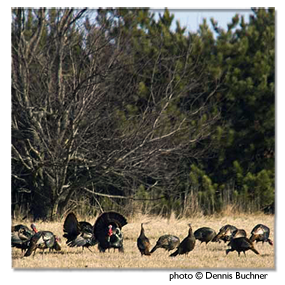
These Toms have been around here all season, and some hens have already had their little feather-ball babies, so perhaps a gobbler or two will come to visit a sexy-sounding hen. And again, maybe they won't move my way at all.
It will be me, light-weight camo clothing, camo hat, face mask, brown gloves and my Remington Model 870 3-inch magnum 12 gauge shotgun stoked with No. 5 copper-plated shot.

If things go as planned, and the gobblers walk out to me and my neighbor (haven't figured out yet whether to take a hen decoy or not), he aims to be ready. This is my last-chance day to call in a bird for him, and I want it to be as good as it can be.

There is no room for errors, and if this hunt works, it will be a first for me. I've never shot a gobbler on the last day of the season, but then again, I've never had to worry about this problem.

Hunting this late in the season has never been necessary. If my buddy is to shoot a bird, I almost always have done it on the first or second day of my hunting season. This year, my golden opportunity was wrecked by two people walking down the road.

I'm not mad at them because they have as much right to be there as I had being where I was at, but I had a gobbler in front of me and another behind me, and both were heading for the hen. It can be the best spot to be in, and it was obvious I hadn't factored in the walkers.

So that took care of my best opportunity. Whatever happens tomorrow morning will be the result of a last-ditch effort.
The gobblers may respond or they may be a mile or two away. I don't know, and I don't care, but I know one thing:
Unless lightning is flashing, and a storm is passing overhead, come dawn tomorrow, I'll be back-up to a big tree, and whining, cutting, purring and yelping for all I'm worth ... if that's what it takes to call in a gobbler.

Because the season ends very soon, and there will be no more chances until next year, so I'll do the best job possible. It will either be good enough to lure a gobbler within 40 yards or it won't. Hopefully, my neighbor's  hunting season will end with a bang.

If not, I've had a good season trying to work birds afflicted with a bad case of the shut-mouth. I like to pretend it's all about skill, but come morning, my buddy will be hoping for a bit of luck.

Saturday, November 05, 2011

Grouse hunting interest pick up after the leaf drop

Grouse numbers are decent is many areas and very good in others.


Fall may be my favorite time of year but it lasts such a short time. The leaves peak in color by mid-October, the rain and high winds come, and soon all the beautiful color has lost its sparkle and lay dead and spent on the ground.

The leaf drop is over, and bird hunters are getting active. Grouse season runs through November, and from Dec/ 1-Jan. 1.

Most sportsmen know the next logical step is the first snow flurries, and in northwestern Lower Michigan, we'll usually have snow on the ground before Nov. 15.

Between now and the firearm deer season should offer good hunting.


But for now, after the leaf drop has ended, and the woods open up as the bracken ferns die off with the first heavy frost, other things come to life. Grouse hunters revel in this period.

This is a time for bird dogs, well oiled shotguns, sunlight glinting of birch and popple trees, and a brown and gray landscape as it prepares for winter. This is a time when ruffed grouse feed heavily on wild grapes, and the longer the fruit hangs on, the more pungent they become and the sooner we see wildly flying grouse. Some believe those birds that fly into houses and kill themselves are slightly addled by the grapes.

It's a time when a good pointer can lock up on a grouse holding 20 yards away, and if the dog is staunch, one foot will be held high and the tail, as rigid as a fireplace poker, will be pointing at the sky. The dog will be quivering from the strain and pent-up excitement.

Open woodlots make grouse hunting fun now.


The flush is anticlimactic, the ending punctuation mark of a wonderful sequence of dogs criss-crossing the cover, following tiny ribbons of birdy scent before slamming to a solid point. The nose is wafting draughts of grouse scent, and the bird holds until his human friend walks in and puts the bird up.

At the shot, some birds will fall and others will fly a zig-zag pattern through the trees, twisting and turning as they put more distance between them and the shot charge that will follow. Often they will fly head-high through the woods while at other times they skim close to the ground in their bid for escape.

Ruffed grouse never fail to surprise me with the fury of their explosive flush. I'm startled even though I expect it, and that delay in my reaction time always allows the bird to get much farther away before I can recover and shoot.

As much as I love grouse hunting, I also enjoy hunting woodcock but few are still around now. They tend to sit much tighter than grouse, and when flushed, can perform all sorts of aerial evasive tactics. These birds look lopsided, and seem to fly about like a knuckleball. They wobble, dip, dart, seem to fall sideway out of the sky, and on rare occasions, they will tower like a hovering helicopter over the tag alders.

Just as they start to tower, the hunter jerks off a shot at the same instant the bird falls unharmed to the ground. Following the bird, and trying for a second flush will work on occasion, but often the bird will flush wild, far from the gun, on the second try.

Hunt wild foods like wild grapes and you’ll find some birds.


There is something about hunting the tag alder runs and 10-foot-high popples, often growing so closely together it's difficult to bring the shotgun into play. Sometimes a woodcock seems like he would be easy to hit with a scattergun, and the next moment hunters wonder how they ever manage to knock one down.

The flight birds, down from Canada and the Upper Peninsula will often arrive in another eight or 10 days, and are much different than locally raised birds. Sure, they look much the same, but when a flight settles into a covert, and the hunter is lucky enough to be in the right spot at the right time, hunting these birds can be a delight.

I've had days (three that I remember well) where me and another hunter and one dog, would flush 100 woodcock in a morning. We'd often flush two or three grouse and a few snipe as well. We never shot a limit of woodcock each, even when the limit was five birds daily, and it wasn't important to do so.

It was always after a cold rain, the woods were drenched, both of us took a number of pratfalls on slippery downed brush, and we came away from each hunt well pleased with the dog work. Our work, manning the shotguns, left something to be desired, but that is woodcock hunting.

The next few weeks, including early December, will provide the best grouse hunting of the season, and although I find it difficult to see those flushing birds these days, it doesn't diminish my love of gunning and being afield with a brace of fine pointers.

Monday, April 25, 2011

My turkey opener was slow


Gobblers hit their strut zones from 8 to 10 a.m. Locate these areas and hunt.


Hunting conditions seemed perfect. Just a soft breeze, and a bit of lingering fog as the sun bathed the woods with sunlight. I was in place long before daybreak, put out my decoys within 150 yards of the roosted birds, and sat back for everyone to wake up.

It took a long time, and as best as I could determined, there was only one gobbler. He gobbled mightily from the roost, but this bird wasn't where I'd bedded down the others. Those birds had a bad case of shut-mouth.

The bird that gobbled was a half-mile away, on a piece of land that I don't have permission to hunt, and we traded sweet-nothings twice. I gave him some time before calling the third time, and he didn't respond.

Roost gobbling and then silence


I'd talked with a pair of hunters with first-season turkey tags, and they had ended their hunt yesterday. Today was my opening day, and only one thing could have made it more delightful -- seeing a bird. There was no way for me to know for certain, but my chat with the other hunters gave me a clue.

They told me each bird they would put to bed would gobble once or twice from the roost tree, fly down and shut up for the rest of the day. I've seen such situations on other occasions, but it's often weather related.

The early period after fly-down, is often when gobblers are vocal as they patrol one to four or five strutting zones. Temperamental longbeards may have several strut zones where they go to meet up with the hens, and this is usually a great time to work a bird.

However, it's been my experience not to call much unless a gobbler is rattling the trees with loud gobbles. Often, if many of the hens have been bred, they quickly move away from the big Toms to head back to their nest.

Sleep in and hunt the mid-day hours with minimum calling


What works? Try hunting at mid-day, don't call too much, and if you have a response, don't get too eager to reply. If a bird gobbles the second time, give him a soft call, sit back and be patient. A bird might come running in looking for a hen, but chances are equally good that they might sneak in without making a sound. Don't get too antsy about calling.

It goes against a gobbler's basic nature to come to a call. They expect the hen to come to them, which means hunters must be patient, and wait for him to edge closer. Play these birds with a cool hand, and don't try to hurry them.

Take a page out of the gobbler's book, and take your time. I've occasionall spent two hours patiently wooing a lusty gobbler away from other hens. It can be done but all sorts of things must fall into place.

Proceed slowly and don't try to hurry a gobbler


Rushing a bird at this point can lead to failure. But, using my example today, I try not to call to a roosted bird. Sometimes it helps, more often I think it hurts your efforts, and wait for the bird to fly down. Talk to him a little bit on the ground, and don't try to hurry up the process.

If he comes, there's a good chance he'll come all the way to you. Get up and move too early, and you may lose your only chance of the season.