Showing posts with label grouse. Show all posts

Saturday, November 05, 2011

Grouse hunting interest pick up after the leaf drop

Grouse numbers are decent is many areas and very good in others.


Fall may be my favorite time of year but it lasts such a short time. The leaves peak in color by mid-October, the rain and high winds come, and soon all the beautiful color has lost its sparkle and lay dead and spent on the ground.

The leaf drop is over, and bird hunters are getting active. Grouse season runs through November, and from Dec/ 1-Jan. 1.

Most sportsmen know the next logical step is the first snow flurries, and in northwestern Lower Michigan, we'll usually have snow on the ground before Nov. 15.

Between now and the firearm deer season should offer good hunting.


But for now, after the leaf drop has ended, and the woods open up as the bracken ferns die off with the first heavy frost, other things come to life. Grouse hunters revel in this period.

This is a time for bird dogs, well oiled shotguns, sunlight glinting of birch and popple trees, and a brown and gray landscape as it prepares for winter. This is a time when ruffed grouse feed heavily on wild grapes, and the longer the fruit hangs on, the more pungent they become and the sooner we see wildly flying grouse. Some believe those birds that fly into houses and kill themselves are slightly addled by the grapes.

It's a time when a good pointer can lock up on a grouse holding 20 yards away, and if the dog is staunch, one foot will be held high and the tail, as rigid as a fireplace poker, will be pointing at the sky. The dog will be quivering from the strain and pent-up excitement.

Open woodlots make grouse hunting fun now.


The flush is anticlimactic, the ending punctuation mark of a wonderful sequence of dogs criss-crossing the cover, following tiny ribbons of birdy scent before slamming to a solid point. The nose is wafting draughts of grouse scent, and the bird holds until his human friend walks in and puts the bird up.

At the shot, some birds will fall and others will fly a zig-zag pattern through the trees, twisting and turning as they put more distance between them and the shot charge that will follow. Often they will fly head-high through the woods while at other times they skim close to the ground in their bid for escape.

Ruffed grouse never fail to surprise me with the fury of their explosive flush. I'm startled even though I expect it, and that delay in my reaction time always allows the bird to get much farther away before I can recover and shoot.

As much as I love grouse hunting, I also enjoy hunting woodcock but few are still around now. They tend to sit much tighter than grouse, and when flushed, can perform all sorts of aerial evasive tactics. These birds look lopsided, and seem to fly about like a knuckleball. They wobble, dip, dart, seem to fall sideway out of the sky, and on rare occasions, they will tower like a hovering helicopter over the tag alders.

Just as they start to tower, the hunter jerks off a shot at the same instant the bird falls unharmed to the ground. Following the bird, and trying for a second flush will work on occasion, but often the bird will flush wild, far from the gun, on the second try.

Hunt wild foods like wild grapes and you’ll find some birds.


There is something about hunting the tag alder runs and 10-foot-high popples, often growing so closely together it's difficult to bring the shotgun into play. Sometimes a woodcock seems like he would be easy to hit with a scattergun, and the next moment hunters wonder how they ever manage to knock one down.

The flight birds, down from Canada and the Upper Peninsula will often arrive in another eight or 10 days, and are much different than locally raised birds. Sure, they look much the same, but when a flight settles into a covert, and the hunter is lucky enough to be in the right spot at the right time, hunting these birds can be a delight.

I've had days (three that I remember well) where me and another hunter and one dog, would flush 100 woodcock in a morning. We'd often flush two or three grouse and a few snipe as well. We never shot a limit of woodcock each, even when the limit was five birds daily, and it wasn't important to do so.

It was always after a cold rain, the woods were drenched, both of us took a number of pratfalls on slippery downed brush, and we came away from each hunt well pleased with the dog work. Our work, manning the shotguns, left something to be desired, but that is woodcock hunting.

The next few weeks, including early December, will provide the best grouse hunting of the season, and although I find it difficult to see those flushing birds these days, it doesn't diminish my love of gunning and being afield with a brace of fine pointers.

Monday, October 03, 2011

The glory of fall

A touch of fall color while fly-fishing for Chinook salmon.

Autumn comes each year with a balmy day  like today, breezy weather, like yesterday, and days when a sweater feels dandy while greeting the dawn, and on those odd day when fall rains pelt us with cold water that will soon turn to snow.

There is something magical that offers to show its pretty face right after Labor Day but this year autumn was a bit late in coming. The hordes of tourists have abandoned northern Michigan, and once they leave, the frantic pace of living slows down and the residents can take stock of their lives.

Mine revolves, as it always has, around fishing and hunting. It's just that these outdoor loves speak a bit more provocatively to me, and I willingly imbibe in everything that epitomizes autumn weather.

It might be enough for most people just to watch the brief flurry of autumn colors as the days grow shorter and the weather cools. It starts with a gradual blend of orange, purple, red and yellow colors. They quickly intensify in the depth of their beauty, and brilliant sunshine seems to make each color more vibrant.

There are one or two days each fall when the brilliant sunshine combines with just the right angle of the sun in the sky to make each color stand out in stark contrast against any nearby cedars or pines. I've yet to see a pine tree whose beauty wasn't intensified by its close proximity to aspens, maples or oaks in full color.

Those days are when I step outside, and bask in the glory of the autumn hues. I love the sight of the leaves in full color on the trees, and frown slightly once they lose their sparkle, and fall dead and somber to the forest floor.

I love running water. The sight and sound of a trout stream twisting through the woods and gurgling around a log jam, makes me happy to be alive. I often pause, during an autumn day, to idly sit on a river bank to watch the ritual of recreation as Chinook salmon move onto a spawning redd and renew their kind.

The old adage about Pacific salmon holds true: They are born an orphan, and die childless. Think about it, and it's another marvel of nature that requires too much thought to explain. It's enough to know that it is true.

Autumn means testing my mettle against the thunderous flush of a ruffed grouse, the corkscrewing flight of the woodcock towering over an alder run, or the quick flush of a snipe from the edge of a wooded water puddle. These game birds, although I seldom run into snipe  these days, provide something very important to me.

These months often deliver a day of fine dog work. It's wonderful to watch a brace of pointers or setters work the cover, singly or in tandem, moving into the wind, cutting the breeze at a 45-degree angle, and suddenly slamming to a rock-hard point, their bodies quivering in anticipation of sudden flush.

They stiffen in position, one dog backing the other, and hold steady as we move in. Calming words of "easy now" are muttered softly as a hand gently touches the dog's head or shoulder to steady them up, and the hunter moves in. His eyes aren't on the ground but a few feet above the ground, a built-in hedge against being startled by sharp sounds of strong wings grabbing air.

The bird is up and away, and a shotgun barrel swings through the grouse or woodcock, and when everything looks right, a shot is fired.

Sometimes, for me at least, the bird commits suicide, diving into a long shot string of No. 8 bird shot early in the season and slightly larger shot once the leaf drop occurs.

It is sitting still in a tree stand, marveling at the fall splendor of color along the oak ridges, and watching a buck ease through a saddle and become backlit by the setting sun and a back drop of blazing color.

Autumn is knowing I can kill a buck with my bow, and having the intestinal fortitude to forego the shot because it isn't necessary. There are times, once I draw down on a buck, and then let off without taking a shot, that I know that buck could be killed. Knowing it and doing it are two different philosophies.

This next two months are the finest of the year. They provide me with everything I need to feel whole. They stroke my one-eyed vision, offer me daily glimpses of some of the most colorful sunrises and sunsets that an angler or hunter could ever hope to see.
Fall is my time. It is the best time of my life, and just think, it just started this month and I can't wait. I'm ready, quivering like a dog on point, and panting to be afoot in the woods again.

Being there, once again, moves me in such an exquisite way that words to describe my awe often fail me. But then, you know what I mean.

Friday, July 01, 2011

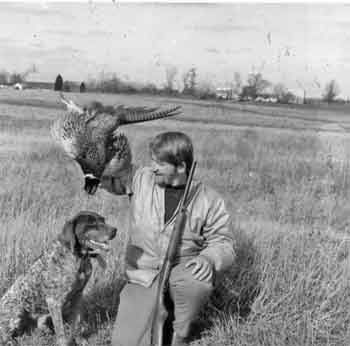
Fritz, The Wonder Dog.


The author and Fritz on what was his last pheasant hunt in the early 1970s.


There is something very special that happens to your heart when a solid-as-Sears pointer slams to a stop, lifts a front foot, abd his stubby tail goes rigid as he locks up on a solid point. If I ponder on it long enough, it's easy to get all teary-eyed remembering certain points from 40 years ago.

It has happened many times to me, and I never fail to feel blessed by memories. I'd walk in behind a great pointer, shotgun at port arms, and look in front of and over the dog and five to 10 yards away. Too many people study the ground in front of the dog, and a pointer may be on a bird that is 10 yards ahead or to either side, and sometimes they are much further away. Fine field work is what endears good dogs to their owners.

The pleasures of owning a great dog died with my German shorthair, Fritz, who came with some truly great Royal bloodlines and who died many years ago. There were many reasons why no others have entered my life, and losing an old friend was the major one.

Most dog men live a long life and feel lucky to own one great dog. Fritz was mine.


Fritz, like many German short-hair pointers, was bullheaded and stubborn to a fault. He could get into more trouble than a 12-year-old kid with a new $20 bill, and he always thought he was hunting for himself. For two years, he didn't realize he was supposed to hunt with me in return for his daily meals and show some respect to the man who had brought him to this dance.

He was a terror, and his idea of hunting was to be a half-mile and three fallow fields ahead of me. I'd work him on a long leash, and he'd sit, heel and was steady to wing and shot as long as the rope snugged him in at about 25 yards. Take the lead off, and he attempted to set a new speed record for crossing three open fields and busting one pheasant after another along the way. Mind you, this was back in the day when pheasants were plentiful during the early 1960s.

Finally, in desperation, catching him after a long gut-busting sprint, I loosened his collar a bit, stuck one of this dark front paws through the collar, and turned him loose. He made one step and fell over whining. I got him back up on three legs, and he tried to run off again. He was scolded and told to hunt close.

An hour later, feeling sorry for my beloved pooch, I pulled his foot out and off he went like he had a booster rocket under his tail. Another long-winded sprint, and my feelings of regret changed to one of quickly solving this problem. The next two days he hunted on three legs, and wasn't happy about it but he stayed within 25 yards of me.

He worked the cover slow and cast from side to side, nosing into the wind, and we put up hens and roosters over his rather lop-sided points, and I'd praise him in person and to anyone who would listen, and after two days of punishment, we went out the third day.

He and I had a heart-to-heart chat about his past behavior, and more recent ways of staying close, and he seemed to pay attention. It was a gamble worth taking, and I slipped his foot from his collar. He looked at me, and I patted his head and said "Hunt close," and he began hunting into the wind. He cast back and forth, and never exceeded the 25-yard maximum. A soft "Whoa" was all I needed to steady him at his outer limits.

My face-to-face talk was a loving, full of meaning and veiled threat to shape up.


He locked onto point, and I whispered "Whoa" to him, lifted his tail, and he looked like a granite carving. I stepped in front, saying "Steady now," and he was rock solid. The ringneck pheasant lifted into the air with a raucous cackle, his long-barred tail streaming out behind, and I swung with the bird and down he came.

Fritz, after his introduction to a lead rope and the foot through the collar trick, never gave me another problem. He hunted grouse, pheasant and woodcock, and his expertise was superb. He would hunt with the neighbor kids, and there were only two rules: hunt safely and don't shoot at low-flying birds.

The last year of his life was a painful ordeal for us. His hips were shot from arthritis, and he always begged me to take him. We'd hunt near home, and he would gimp through the fields. His hips were bad but it didn't affect his hearing or nose.

He'd zero in on cackling roosters at dawn, and we'd move on them when shooting time opened. With luck we'd take two quick roosters, and then it was a slow and painful trek home for a dog in great pain. I'd pat his head, tell him I loved him, and he'd wag his bobbed tail. The vet had no words of encouragement. I didn't want to put him down.

His end was near, and it wasn't a pretty sight. I was sick to my stomach.


Our last hunt came a few days later. A magazine deadline was met, I grabbed my shotgun, got Fritz up and we headed out. He slowly worked two different birds, both roosters, and my shooting was better than average. Fritz pointed, and I shot both birds, and then he sat down. I kneeled beside my old friend as he whined and shivered with pain, and I picked him up and carried him home, knowing that he'd run has last race in prime pheasant habitat.

Two days later, during the second week in October as cold winds blew down from the north, Fritz left me and went to that area where all good bird dogs and close friends go when they die. He was buried along a fencerow that often produced a rooster, and on occasion I think I can hear him snuffling a big ringneck 10 feet in front of him.

It isn't, of course, but there is the deeply-seated memory of a bird dog that never knew the meaning of the word quit. He could out-hunt me, and it's the biggest reason I've never owned another hunting dog. A new dog could never measure up to Fritz, and it would be unfair to expect him to.

So I live with my deeply-held memories of Fritz. He was the finest bird dog I've owned, and I'll never see the likes of him again. There's a place tucked back in the corner of my mind where I go looking for lost friends and bird dogs, and when the memory machine registers a hit on man or dog, I reach up, dust off a fond reminder and trot it out for the world to think about whenever they hunt with a great pointer.

This has been just one of my favorites.

Thursday, February 24, 2011

Sportsmen name almost everything


Lea Lawrence (left)  & I chat about a grouse hunt at the Church covert.

What’s in a name? It depends on how anglers and hunters use the name to communicate with other sportsmen. Names can and do play an important role in how we feel and think about the outdoors.
They may remind us of a favorite trout pool with mist rising off it or a secret woodcock covert where white splashings cover fallen leaves, and names often play a major part in identifying where we fish or hunt.
Mind you, I’ve been banging around the outdoors for about 60 years. During those years I’ve learned some things about a good many places and things, and it’s fun to talk about these different spots to like-minded sportsmen with our special name codes. Of course, other folks may have developed their own names to confuse other anglers or hunters.

Naming locations is a great way to keep them a secret from strangers.

The Platte River has long been one of my favorite salmon and trout streams. I guided fishermen on it and several other streams in our northern counties for 10 years, and have fished it for 50 years.
The Platte has many local  names that help anglers pinpoint specific locations. For instance, the old Rope Hole, just upstream from the mouth, was the first spot salmon and steelhead would pause on their way upstream to spawn. It was known by this name by many anglers.
The Hole Where It Never Rains was a hotspot until the outlaws began going under the M-22 Bridge to snag fish. The conservation officers also knew where this spot was, but few people had the knack of fishing it.
The trick to fishing this hole was to wait until broad daylight. Any fish in the hole at dawn would stay there. Those people who went under the bridge in the dark would spook the fish upstream or down. The hole would be empty of fish at dawn if anglers tried fishing at night.
There was the Goose Pasture (also called the Goose Grounds), a campground on the upper Platte River off Goose Road. It was always good in the old days when more fish were available than anglers.
There was the Swimming Hole in Honor, the Doctor’s Hole and the Nurse’s Hole, all upstream from Honor. Two favorite spots years ago was the Grade. There were two: the Upper Grade between Haze Road and US-31 and the Lower Grade, downstream from Haze Road. These grades were where an old logging train once crossed the river. Some of the old pilings still remain but the only thing they are noted for now are gravel bars for spring and fall spawning fish.

We named everything. We had a river we named The Crick but no one knew it.

Think about it. Two anglers in a restaurant are talking about where to fish, and one would be heading for the Rope Hole while the other was heading for the Upper Grade. Few other anglers would know what we were talking about.
My Home Stream was the Sturgeon River in Cheboygan County between Wolverine and Indian River. I began fishing it at the age of 11, and spent every summer camping there to escape the downstate pollen that affected my hay fever. It too is rich in angling history and place names that were rather odd.
I can close my eyes, and think of The Snow Hole, and the spot instantly comes into focus in full color. The river flows downstream, dropping into a deep hole in front of the old Snow Cabin, and then it makes a sharp 90-degree bend to the left. It then splits into two current flows as it goes around a tiny island before both threads of current connect.
My late twin brother George and I laid claim to the Snow Hole while others who fished the Sturgeon had their favorite spots. The Sturgeon is a wild and free-flowing stream, and it holds steelhead and brown trout.
It also holds the ashes of my brother and of a very fine gentleman and good friend named Russ Bengel. He donated large sums of money to Ducks Unlimited, and loved the river like he loved life itself. One day when my last fishing trip has been taken, and my last hunt has ended, my ashes will mingle with theirs in my beloved Snow Hole.

Snow Hole, Five Sisters Hole -- all were secrets to all my twin and a few others.

The Sturgeon is filled with names. Take the White Road Bridge. One might figure the bridge to be painted white, but it was painted red. Go figure. It was easy to throw people off our tracks if we mentioned going to fish the Five Sisters Hole. We seldom shared these secret names.
It wasn’t a hole, but a smooth run along the opposite bank, and at the head of the run were five aspen trees growing from a single trunk. The Rain Hole was immediately downstream, and it always paid off with a fish just before a rain.
You know how it is before a rain. You can smell it on the air. We would race off to the Rain Hole, and if we beat the rain, it always delivered a nice steelhead. It was one of the surest bets on the Sturgeon River.
Then there were the Meadows  pools, the Clay Hole, Yontz’s Hole, Eddie’s Pool, Railroad Bridge and many others. Knowing the whereabouts of these named locations gave some anglers a heads-up on others who were out of the loop.
Names also applied to hunting, and nowhere was it more pronounced than with grouse or woodcock coverts. Upland bird hunters were more close-mouthed than mushroom pickers and trout fishermen, and the names they gave to each of their favorite coverts were known only to them and two or three close friends who had been sworn to secrecy.
A good friend always starts hunting at the Church covert. This bit of tag alder swale was noted for October woodcock, and among those of us who knew its location, we kept it a secret for years. Actually, the secret didn’t come out until the aspen and tag alders grew too high, and it became useless habitat for migrating birds.
The Caboose covert was on private land, and was surrounded by 40 acres of aspen and bracken fern bordered by an old pasture on one side, a road on the other, and the edge of a damp cedar swamp. It produced wonderful grouse and woodcock hunting for many years, and its name was derived from a train caboose sitting in the woods. Don’t ask me why, but it was there for many years. A few of us were allowed to hunt the area for birds, and we flushed more than one grouse from under the caboose.
Then there were key grouse hotspots such as the Grape Arbor Run, the Split Rail Fence, and Old Baldy. The area 20 feet below Old Baldy was grown up to a smorgasbord of grouse foods, and it held plenty of grouse until wild turkeys moved in and took over. They used Old Baldy’s sand to dust in, and the grouse moved out.
Another spot that always comes to mind even though shooting grouse has become more difficult in recent years. I called it Dave’s Double, in reference to one of those memorable days when the shooting gods smile and two grouse flush. I took the farthest one first, and then swung on the closer bird, and he fell in a puff of feathers. It was my first double on ruffed grouse, and the spot deserved a name.
In fact, such locations are named for a variety of reasons. Some make sense while others do not, but there it is. We accept such things, and when the whim strikes, we name another location.
Many such spots are meaningless except to us, and then only because something caused them to stand out in our mind. Naming our hotspots is as much a part of fishing and hunting as carrying a rod and reel or toting a shotgun into the woods.
And less you think all such places are good, I’ll close with one where I won’t be when the deer season open Oct. 1. I won’t be in the Willow Tree stand. I tried it once, the wind kicked up, and the willow blew six feet in one direction in a gust, and six feet back. A nice 8-pointer showed up, and I came to full draw and couldn’t keep the sight on the deer.
I gave up and climbed down. Later that night, part of the willow tree broke off and fell to the ground. It smashed up my stand but I was long gone by then, and much wiser for the experience.

Monday, December 27, 2010

Keep your pets at home


Ruffed grouse are killed in winter by cats sneaking around houses.


The cat tracks came creeping around my back steps. Mourning doves often roost on my deck at night, and 30 feet away was a pile of bloody feathers in pristine snow where a stray had feline had killed a dove during the night.

Wild running cats and dogs spell trouble for winter wildlife, and the animals do what often comes natural to them. It’s in the nature of cats, and some dogs, to kill anything they can catch. A similar thing happened one day last week.

The day was brilliant with strong sunlight reflecting off the snow, and when I went out for the paper, cottontail rabbit tracks were everywhere in front of and behind the house.

A brief walk turns up a winter casualty.


The rabbits had been active. I donned some boots, and forgot about my shotgun and blaze orange, and just went for a short walk.

It was to see how many bunnies were living near the house and in nearby brush piles. One rabbit can make plenty of tracks at night, and I knew there were at least two bunnies nearby. I've seen them outside after dark as they scamper around looking for food.

It appeared there were four cottontails. Two were the adults I'd seen on many occasions, and the other two made smaller tracks. Perhaps the smaller two were from the most recent litter.

They weaved in and out of nearby brush piles left from the last timber cutting, wandered through downed tree-tops, and there were many tracks where we feed deer. They've nibbled a bit on the old dead clover, and there were two deer tracks as well. One was an adult, most likely an adult doe, and the other was a fawn.

We often see cottontail rabbits where sunflower seeds are knocked from the feeder. The bunnies don't mind sniffing through the seeds for some that are still intact.

My short little walk wasn't much over 150 yards, and in one spot was the unmistakable sign of the death of a young rabbit. The animal had made a serious mistake by moving into the open and away from nearby brush and heavy ground cover, and nature’s story was painted on the white snow.

A few drops of blood on the snow spelled the demise of a cottontail.


An owl had swooped down from the sky during the night, gliding in on hushed wings, and a few spots of blood on the snow showed where the bird had run his talons through the cottontail. There were faint signs of wing-tip  feathers dusting the snow as the bird grabbed the young bunny and flew away with his nightly dinner.

Avian predators are a major concern for wildlife. We often see hawks  take songbirds and ruffed grouse during the day, and if they hit a grouse, nothing is left behind but a pile of russet feathers drifting on the breeze.

We've had cottontails around as long as we've lived here. They stay in the shrubs, venture out after dark to feed, and we see signs of their presence as they chew on ornamental bushes and shrubs.

Cats are silent predators, and they prey heavily on songbirds and grouse when the snow is deep. There's no telling where these cats come from, but if we see a strange car or truck, we will probably find cat tracks later.

People who no longer want these critters turn them loose in someone else's neighborhood, and then we must deal with the problem. Today, there was one lone dog track behind my house, and one pooch often meets a sad fate when it encounters one or two hungry coyotes.

These large predators will kill every dog or cat they catch. Cats occasionally escape by climbing a tree, but coyotes are brazen animals. They've been known to pluck a small cat or dog off the back porch.

Rather than take unwanted cats to the Humane Society and let them deal with the problem, people dump them. They feel sorry for the cat, and often these animals slowly die of starvation or provide a nourishing snack for a drifting coyote.

Cats are born killers, and I don’t want or need discarded felines.


A cat is a killing machine, and often kill for the sake of killing. People should keep pet cats and dogs inside at night where they belong or in a kennel. Too often they lack the guts to accept this responsibility, or are unwilling to take them to the pound. Those of us who live beyond city lights do not deserve these canine or feline discards on our property.

Unwanted cats are destructive during winter months. I frighten them away, but many people either set live traps or kill the cats on sight. Cats may be pets, but they belong indoors or under human control at all times.

Those left to roam at night often disappear. Although I don't agree with the Three S's doctrine (shoot, shovel and shut up), I can easily understand why some landowners treat every free-roaming cat with suspicion and a quick death.

Those that appear to be hunting game or song birds are summarily dispatched. This can be cause for a citation, a fine and perhaps a jail sentence, but no one I know wants free-roaming cats in their neighborhood.

Free-roaming dogs often attack deer in deep snow, and many think that turning Fido out for the night is the right thing to do. Two, three or four dogs, turned out by their masters at night, form a pack, and will chase and kill deer.

The place for pet cats and dogs is inside the house or locked in a kennel where they belong at all times unless they are hunting dogs. They need to be under human control even when outside. Free-roaming animals are pests, and it's up to pet owners to control their animals at all times or others may do the job for them.

Sad words but many people don’t pay attention to their critters. All too often someone else chooses to solve the problem for them. It may not be right or legal, but there it is.

Posted via email from Dave Richey Outdoors

Friday, September 10, 2010

A good dog makes the hunt


Fritz, my German Shorthair pointer, was casting back and forth across a stubble field over 30 years ago. Nothing fast or fancy, but his stubby bobbed tail was wiggling and that meant he was getting birdy.

The dog had a vacuum cleaner for a nose, and he always worked the wind and made certain he was between heavy cover and the bird. This old ringneck pheasant had cackled several times that morning, and we were a team: he was old enough to know what I wanted and how to deliver it.

The sun was just up on the eastern horizon when Fritz pinned one of the nearby  roosters at the corner of an open field. The bird had run out of cover, and the dog was rock solid on point with the ringneck only 10 feet away.

Watching a good dog on point is one of life’s satisfying moments.

"Whoa, boy, easy now, whoa-a-a," I whispered, moving in front of the quivering dog. He was a bit off-balance on a slightly sloping side-hill, and the rooster was a bit downhill of the dog.

The gaudy rooster lifted into flight with a raucous cackle, and I swung on him at 30 yards, and with one shot the bird fell to the ground. Fritz made a perfect retrieve, looked up at me, and I waved for him to start hunting after a pat on the head.

That pointer and I teamed up on countless roosters back in those halcyon days when pheasants were quite common game birds in Michigan's southern counties. He would hunt with anyone, and some of the older neighbor kids would come to borrow him if I was unable to hunt because I was packaging books to be mailed or on a magazine deadline.

The joys of pointing dogs was something I learned many years ago. Name the breed, and I've hunted over them at one time or another. Some of the key moments of my upland bird hunting career has come while following the wanderings of a fine-hunting pointer, retriever or setter.

I've thrilled to the off-balance points, the birds that held off to one side of the dog that results in a rather lopsided point, and some of those times when the conditions are just right and the pointer did his thing from 20 to 30 yards away.

It never ceases to amaze me what a good bird dog can teach a hunter if that person only pays attention. I've watched dogs work a field, hesitate for a moment, and continue to comb the field for scent. Suddenly, after long minutes without finding a bird, the dog slams into a point as stiff and rigid as a stone statue in the local park.

A good hunting dog can teach hunters more about their sport if they pay attention.

There's just something about a pointer that makes me smile. Miss a bird, and some of the better pointers look back as if to say "how could you miss such an easy shot." Other dogs seem to take the frequent or occasional miss in stride. It's those dogs that look at you after a miss that always make me wonder what is going through their head.

Once Fritz was gone, I decided not to buy another hunting dog. I was constantly on the road in those days, chasing stories for the outdoor magazines. I knew that to own another dog would mean the animal would be subjected to languishing in its kennel most of the year.

That's wouldn't be fair to a good dog. It was easier to hunt with other people who did own a good pointer, which gave me ample opportunities to watch lots of good (and bad) dog work.

I hunted once with the honorable Charlie Elliott, a common name among readers of Outdoor Life magazine. Charlie was in his 70s back then, and the two pointers combed through the pea fields and in nearby low cover for quail, and it didn't take us long to find a covey.

Hunting Georgia quail with Charlie Elliott.

"Go get 'em," Charlie said, and I had just stuffed two 12-gauge shotgun shells into my new Winchester 101. I walked in front of the lead dog as the other pointer backed him, and both were as motionless as if cast in marble. A covey of quail went up, and I knew enough not to try flock shooting.

I spotted one quail scooting off to the left, swung on it, shot and the bird fell. Next the shotgun caught up with a late-flushing bird heading off to starboard, and I swung through the bird and dropped him at 35 yards.

"Nice shooting," Elliott said. Little did he know that those two shots were the first out of my new shotgun. The compliment was graciously delivered, and accepted. Elliott then proceeded to give me a sound lesson in shooting quail birds.

There have been grouse, pheasant, quail and woodcock hunts, and often the dogs of choice were pointers. Some are as flashy as a new movie star, and others are old and dependable as well-trained dogs should be.

It's not the game birds taken that make the hunt for me. It's the joys received by watching good pointers work the cover like a well-oiled machine.

They have a job to do, and of late, they handle their assignment far better than I handle mine. What these pointers don't know is that over 59 years of bird hunting with dogs, it's watching fine dog work that pleases me most.

Shooting a game bird during the open season is really anticlimatic to a wonderful hunt.

Posted via email from Dave Richey Outdoors

Friday, March 19, 2010

Hunting is a privilege

Dawn was blushing the eastern sky with a blaze of fiery color when a drake and hen mallard slanted down over the treetops, lost altitude in a banking left turn and settled to the river in front of me.

One day soon, I thought, we may meet again during the duck hunting season. Those thoughts carried me back to past hunts where I asked myself why I hunt.

It's a question hunters quiz themselves about. Few can answer for others, butt simply stated,  hunting means different things to different people.

Hunting is a matter of choice for those who love the outdoors.

Some hunt to enjoy the whisper of duck wings ghosting over a marsh before dawn; others like the damp, musty odor of the autumn woods; and others seek the challenge of spotting and stalking wild game.

The challenge of pitting knowledge and skill against a wild animal is part of the reason, but other factors often enter the picture. For many,  it can mean the chance to eat wild game at every meal.

Perhaps it's knowing that the hunter's role in conservation has always been one of keeping game bird and animal populations in line with their food supplies and habitat requirements, and protecting them if needed.

Michigan's hunting seasons are winding down but they offer millions of licensed sportsmen the freedom to work the woods and fields, lawfully carry a firearm or bow and arrow, and peaceably follow a pastime as old as man himself.

Hunting means many things to me, as it does to almost anyone that shares my love of wild places and wild things. The out-of-doors has so much to offer,  both to hunters and non-hunters alike.

Hunting is a privilege that most sportsmen hold dear.

Hunting has never contributed to the decline of any game animal or bird during modern times. Many times hunter license dollars and taxes on equipment have been used to increase game habitat, hunter education, fund studies or any number of other wildlife-related programs.

An overpopulation of any wild game results in death by starvation, surely a less humane way to perish than by a hunter's arrow or bullet.

But the actual killing of wild game is something I've never been terribly comfortable with although I've taken my share of bear, bobcat, caribou, coyotes, deer, elk, grouse, hares, moose, muskox, quail, pheasants, rabbits, sharptails, squirrels, waterfowl and woodcock.

The tinge of remorse I feel doesn't mean I am against hunting, but it means I hold my hunted animals in deep respect. My belief is that hunting plays a definite role in wildlife conservation. Man cannot be a sophisticated hunter without respect and love for the wild game we hunt.

Hunting is a serious feeling, something described by many as a deep inner experience. Man, as the ultimate predator, holds the power of life and death in his hands. Hunters know and accept this honorably.

This power means that hunters must know their equipment, know what it can do, and be skilled enough to place a shot so the animal or bird is killed cleanly, without suffering. It also means that hunters must know and obey hunting laws and respect the rights and property of others.

A hunting license gives no one the right to a full game bag, or a two-buck limit. It grants sportsmen the opportunity and privilege of hunting ... nothing more, nothing less.

Hunting promises nothing except the opportunity to be outdoors with bow or firearm in hand.

I hunt because I need to hunt. It satisfies a need within myself to go afield in pursuit of wild game and enjoy the wonders of nature.

It offers me the thrill of an exciting stalk through thin cover, the fleeting glimpse of a wide-antlered buck, the explosive sound of a ruffed grouse thundering from an alder run, or simply the chance to hunt and be afield.

The taking of game is secondary, ranking far below the mental and physical experience of the hunt.

The hunt, and not the kill, is what hunting is all about. And it is enough for me.

Posted via email from Dave Richey Outdoors