
 |
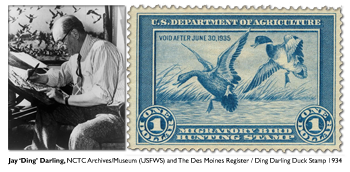
| Jay 'Ding' Darling, at his drawing table doing what he did best, brought to the early 20th Century a sense of Conservation embodied in the emotive of the wildlife art format he created; the Duck Stamp. photo/stamp NCTC Archives/Museum (USFWS) |
None of it is valuable. One thing that captured my fancy for a few minutes was an old 1984 press release celebrating the 50th anniversary of the Federal "Duck Stamp." This stamp is required of all waterfowl hunters in the United States.
The first Migratory Bird Hunting Stamp, as it was called in 1934, cost one dollar. It was drawn for the Federal government by Jay "Ding" Darling, the Des Moines Register's editorial cartoonist.
Early "Duck Stamps" are valuable if not canceled
Darling led the campaign that convinced Congress to authorize an annual Migratory Bird Hunting Stamp, and his cartoons stuck a painful barb in the hides of greedy swamp drainers, fillers of duck nesting ponds, on-the-take politicians, and others who would destroy our natural resources.Habitat loss, railed Darling in his scathing editorial cartoons, was a major problem, especially with ducks. Those early stamps, especially Darling's first ever stamp, are worth thousands of dollars for one that has not been canceled by a hunter writing his name across the front or being stamped by the post office. According to old statistics 635,000 of these stamps were sold the first year, and those dollars went into preserving and purchasing waterfowl habitat.
As of 1984, famous waterfowl artist Maynard Reece had the winning duck stamp entry five times -- in 1948, 1951, 1959, 1969 and 1971. Many years ago more than 119 million federal duck stamps had been sold.
Waterfowl have been featured on these stamps every time, except for one. John Olin's King Buck was featured on the 1959 federal duck stamp. Olin was the president of Winchester/Western for many years, and owned Nilo Farms. Nilo is Olin spelled backwards. That stamp of King Buck, a black Labrador retriever, was a big hit with hunters.
These old stamps and stamp-prints are priceless
It's been said that winning the Federal Waterfowl Stamp contest can and will make the artist a millionaire. Not from the stamp sales, but from sale of other work. It boosts an artist into the upper echelon of waterfowl artists, and their other drawings sell well.Proceeds from the sale of these "federal duck stamps" continue to help provide better and more waterfowl habitat, now and into the future. They are available from U.S. Post Offices across the country.
My twin brother George was the lure collector in the family. If I ever had anything of any value, George would trade me a book I wanted for a lure he wanted.
I found an old Super Duper lure, and can remember buying my first one in 1956 from Wanigas Rod Company in Saginaw. It was touted as being one of the best trout lures available, and demand for these "clothes pin" lures was strong. They looked like a metal clothes pin, and their shape is apparently what provided the trout-catching action.
Other treasures of a lifetime
Rattling around in the bottom of an old box filled with some old outdoor magazines was a 12 gauge brass shotgun shell. It was a rather nice find although there is little demand for them these days except as a collector's item. I have two.Talking of old outdoor magazines I found perhaps 1,000 old timers ranging from the 1950s back to the 1920s. I love the art work on those old covers, and there is a rather brisk trade among avid sportsmen for such magazine covers. I have several listed on my Scoop's Books site where I sell them and old books.
Be warned: some different books are being added starting today and tomorrow, and I'm offering some very good deals on books that I'm overstocked with. If you're looking for some hard-to-find items, email me: Dave Richey, and tell me what you want. Chances are good I have it or can find it.
Sadly many of the old magazine covers get cut off the magazine, and the cover is matted and framed for use as a wall decoration at fishing and hunting camps. Many lure collectors buy these old mags to search for ads for specific lures. Some lures were in and out of business in less than a year, and a magazine advertisement is collectible in its own right. Old magazines with great color cover art, especially by artist with a national reputation, are no longer cheap. Their value has increased in recent years.
I've found several knives stuck in stumps from when a hunter shot a buck, gutted the deer and then cleaned his hands, and struggled off dragging the deer. Often, the knife was left behind in all the excitement of a successful hunt.
One of those knives was found today in a box. It had once been a pretty knife, but the test of time spent out in the elements dulled the blade and turned it into an object best thrown out with the trash.
But, I kept this blade for what it had been, not for what it was today. I know what it's like to lose a good hunting knife, and I hope anyone who has found one or two of mine did so before the were ruined. It's my hope they care for my knives as I care for those I find.
Stuff in a box may be junk to one person but it may be a treasure to a pack rat like me. My awe is overwhelming whenever old things from an earlier era are found.
Such days may me very happy.

