Showing posts with label color. Show all posts

Friday, July 13, 2012

From Okavango to the Plains of East Africa

book
This is a great new book on hunting African big game
From the Okavango to the Plains of East Africa

author: Christenson

TITLE: From the Okavango to the Plains of East Africa
(Sub-title: Hunting In Africa In The Latter Part Of The Twentieth Century)
AUTHOR: Christenson
DETAILS: 465 pages, color photos, 1st edition, hardcover, gilt titles, color photos & maps
SIZE: 7x10 inches, limited to 1,000 copies PUBLISHER: Safari Press
DIST
RIBUTOR: Safari Press
[NOTE: Books are not sold in stores, and are available only from Safari Press Inc.]


CONTACT:

Safari Press
15621 Chemical Lane
Building B
Huntington Beach, CA
92649-1506


WEBSITE:
Safari Press
eMAIL: info@safaripress.com
PHONE:
Phone (714) 894-9080
COST:
$100.00 + S/H;

Many African hunting books were published years after the events portrayed actually happened, but such is not the case here. The author began his African hunting career in 1977 with the noted and professional hunter Willie Engelbrecht In Botswana. This is a record of those hunts. In some cases, the book wasn’t written until long after an author’s death.

It was a dream come true for the author. It was one fascinating adventure after another.

First the hunter took a 10-foot maned lion from the bush country, and then a native tracker was attacked by a leopard. He took three safaris with Willie, and then he hunted with legendary PH Harry Selby.

Christenson hunted most of Africa, and received what he considered superb mentoring from other professionals such as Wally Johnson, George Angelides and others for a variety of large and small game/ His tales include elephant hunts, and trips for buffalo, leopard and lion,

Mixed in with the big game are notes from his side trips to hunter smaller game such as the Abbott duiker, sable, sitatunga, nyala. Lord Derby eland. Greater kudu, gemsbok, blue wildebeest, red lechwe, impala, oryx, wildebeest, bushbuck, zebra, klipspringer, Robert’s gazelle and others were taken on many of Christenson’s thrilling safaris.

This is a book to get lost in. It’s big, heavy and filled with anecdotes that would help anyone planning an African hunt. There is plenty of excitement, some fun, information on the native trackers and gun bearers.

Perhaps even more exciting than great color photos of elephants, lions, leopards and Cape buffalo are the color maps of the areas being hunted. Wonderful color silhouette photos reach out and grab you with their deep colors. These maps certainly set off this book in grand fashion, and they enable the reader to keep track of where the author is hunting. They fill a much-needed hole in most African books.

It’s easy to keep up with the author because he mentions hunting in various locations, and these maps help a great deal. I’ve always wondered why many African hunting books do not have maps. I wonder no longer, and project we’ll see more maps in other upcoming Safari Press books. and an African spiral-horn appears on the front cover. A gilt title, author’s name and gilt rules decorate the spine. It’s a lavish book, and certainly worthy of its price. It is one of only 1,000 copies, and is destined to become a collectible item.

Posted via email from Dave Richey Outdoors

Monday, October 03, 2011

The glory of fall

A touch of fall color while fly-fishing for Chinook salmon.

Autumn comes each year with a balmy day  like today, breezy weather, like yesterday, and days when a sweater feels dandy while greeting the dawn, and on those odd day when fall rains pelt us with cold water that will soon turn to snow.

There is something magical that offers to show its pretty face right after Labor Day but this year autumn was a bit late in coming. The hordes of tourists have abandoned northern Michigan, and once they leave, the frantic pace of living slows down and the residents can take stock of their lives.

Mine revolves, as it always has, around fishing and hunting. It's just that these outdoor loves speak a bit more provocatively to me, and I willingly imbibe in everything that epitomizes autumn weather.

It might be enough for most people just to watch the brief flurry of autumn colors as the days grow shorter and the weather cools. It starts with a gradual blend of orange, purple, red and yellow colors. They quickly intensify in the depth of their beauty, and brilliant sunshine seems to make each color more vibrant.

There are one or two days each fall when the brilliant sunshine combines with just the right angle of the sun in the sky to make each color stand out in stark contrast against any nearby cedars or pines. I've yet to see a pine tree whose beauty wasn't intensified by its close proximity to aspens, maples or oaks in full color.

Those days are when I step outside, and bask in the glory of the autumn hues. I love the sight of the leaves in full color on the trees, and frown slightly once they lose their sparkle, and fall dead and somber to the forest floor.

I love running water. The sight and sound of a trout stream twisting through the woods and gurgling around a log jam, makes me happy to be alive. I often pause, during an autumn day, to idly sit on a river bank to watch the ritual of recreation as Chinook salmon move onto a spawning redd and renew their kind.

The old adage about Pacific salmon holds true: They are born an orphan, and die childless. Think about it, and it's another marvel of nature that requires too much thought to explain. It's enough to know that it is true.

Autumn means testing my mettle against the thunderous flush of a ruffed grouse, the corkscrewing flight of the woodcock towering over an alder run, or the quick flush of a snipe from the edge of a wooded water puddle. These game birds, although I seldom run into snipe  these days, provide something very important to me.

These months often deliver a day of fine dog work. It's wonderful to watch a brace of pointers or setters work the cover, singly or in tandem, moving into the wind, cutting the breeze at a 45-degree angle, and suddenly slamming to a rock-hard point, their bodies quivering in anticipation of sudden flush.

They stiffen in position, one dog backing the other, and hold steady as we move in. Calming words of "easy now" are muttered softly as a hand gently touches the dog's head or shoulder to steady them up, and the hunter moves in. His eyes aren't on the ground but a few feet above the ground, a built-in hedge against being startled by sharp sounds of strong wings grabbing air.

The bird is up and away, and a shotgun barrel swings through the grouse or woodcock, and when everything looks right, a shot is fired.

Sometimes, for me at least, the bird commits suicide, diving into a long shot string of No. 8 bird shot early in the season and slightly larger shot once the leaf drop occurs.

It is sitting still in a tree stand, marveling at the fall splendor of color along the oak ridges, and watching a buck ease through a saddle and become backlit by the setting sun and a back drop of blazing color.

Autumn is knowing I can kill a buck with my bow, and having the intestinal fortitude to forego the shot because it isn't necessary. There are times, once I draw down on a buck, and then let off without taking a shot, that I know that buck could be killed. Knowing it and doing it are two different philosophies.

This next two months are the finest of the year. They provide me with everything I need to feel whole. They stroke my one-eyed vision, offer me daily glimpses of some of the most colorful sunrises and sunsets that an angler or hunter could ever hope to see.
Fall is my time. It is the best time of my life, and just think, it just started this month and I can't wait. I'm ready, quivering like a dog on point, and panting to be afoot in the woods again.

Being there, once again, moves me in such an exquisite way that words to describe my awe often fail me. But then, you know what I mean.

Monday, August 22, 2011

Old outdoor magazines bring fishing and hunting to life

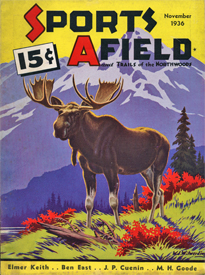
Magazines with great art covers are wonderful mementos from the past.

Reliving some old outdoor passions is easy. Simply dip back in time with an old outdoor magazine and have your brain gently nudged again by something great from the past.

Kick back, dig into my old blogs, and choose those articles that are most appealing. Heaven knows, there are plenty of choices of fishing-hunting things to read about.

Do you really think reading is a dying art? If so, I'd suggest you think again. If that were so, there wouldn't be the number of people reading my daily weblog as there are. Many people who have read me for 23+ years at The Detroit News followed me after I retired from the paper, and are now reading my daily weblog in seven different venues including FaceBook and Twitter.

There are too many magazines to list and photograph. Email me and query.


Reading a blog is like reading my column every day; it's primarily for the Michigan fishermen and hunter, although people from all over the world read it.

Anyone want to read old outdoor magazines? The answer is quite simple: Many people do. It's cheap and super entertainment, especially when some of my magazines date back to the early 1920s. Some are worth good money.

Many years ago I inherited Ben East's records, memoirs, files, letters and outdoor magazines after his death 20 years ago. I've kept his magazine collection intact even thought he told me I could use any of the files, including his magazines, in any way I chose.

I've wrestled with the prospect of selling this huge stash of old outdoor magazines. After having stored them for 20 years, walked around the many plastic tubs filled to the gunwales, I've decided to share at a reasonable price, these treasured magazines. Most have articles by master outdoor writer Ben East, and most of them contain stories that are about fishing or hunting in Michigan.

There's an old saying I'm fond of. It state's that it's impossible to know where you are going if you don't know where you've been. I've been at this writing business for 45 years, and Ben East was at it for more than 60 years. There are many things of his that I won't sell, but 1,000 magazines take up a great deal of room.

These magazines, ranging from 1922 to the early 1950s, covered the hey-day of outdoor writing and outdoor magazine art. All of these magazines, with the exception of perhaps only a few, are illustrated with an artist's painting or sketch. Those drawings and paintings that appeared on the front covers were great pieces of period art.

They do what today's magazine covers can't do – they capture the moment, a short but defining period in time when something great, sad, death defying or just the marvel of a bird dog pointing a grouse, pheasant, snipe or woodcock, occurred. The artist captures the emotions of the hunter and of the dog as it stands quivering, tail as stiff as a fireplace poker, and waits for his master to walk in to flush the bird.

Art covers capture moods far better than photos.


Magazine covers were drawn by hand, and the artist captures the magic of that precise moment when blue-wing teal zip low and fast over the decoys or when pintails whiffle down out of the sky. Or as a bunch of Canada geese approach the decoys, their feet grabbing for land or water, their heads arched down as they scan ahead for danger while their wings cup the air as they descend to a landing or fall as the nearby hunters shoot.

There are covers, lots of them, that deal with trout fishing. These magazines are sorted by categories such as...
  • Atlantic Salmon
  • Bass
  • Bear
  • Brook Trout
  • Comic or Mood Scenes
  • Deer Hunting
  • Ducks & Geese
  • Elk Hunting
  • Esquire
  • Exotic Wild Game
  • Game Birds
  • Hunting Dogs
  • Lake Fishing
  • Misc. Outdoor Action
  • Moose Hunting
  • Muskellunge
  • People
  • Rabbit Hunting
  • River Fishing
  • Saltwater Fishing
  • Various Wildlife
  • World War II-related fishing and hunting topics
The covers of these magazine which are, for the most part, in fine to mint condition bring out the raw emotions of a day on the water or afield with or without a dog. They elicit feelings that a mere photograph cannot capture. People soon grow tired of seeing a photo of a big buck on the cover. Scoop's Books, offers not only fishing and hunting books but old outdoor magazines as well.

Please remember: some of these magazines are 60 to 80 years old, and many look as if they were printed yesterday. They are not $5 each as some people seem to think they should be. An average price of $25-30 is about right, and magazines with superb cover art by the masters artists of that era, can range up to $125 or more. Most of these magazines, although not all, have a Ben East story inside.

One thing is very important, and I stress it here. Most of these items are one-of-a-kind. Email me to determine if a specific item still exists. Do not send money without checking with me first. People do it all the time, and I have to email them back, and ask specifically what they are buying. Check ahead avoids disappointment when an item sold just before your order arrived.

I take bank money orders, cashiers checks, company or personal checks, and PayPal. I do not take credit or debit cards. Business and personal check must clear my bank before any magazines are sent.

Postage, as we all know, has gone up. My postage rates may seem high at $5 each, but I usually ship in boxes, and each book is well padded. I ship with insurance in most cases, and purchase delivery confirmation. You don't have to be home to get the package but the delivery confirmation notes that the package has been delivered. There can be no squabble over whether or not books or magazines were delivered. I will know precisely what time delivery took place.

If possible, send all available information for what you'd like to buy.


Some folks may think that some of these magazines are unfairly priced. Prices hinge on many things:
  • overall condition of the magazine
  • quality of the cover artwork
  • author's reputation
  • whether the cover artist did any drawings or sketches inside the magazine
  • names of the various writers
  • whether magazines are collectible because of those names
Some artists are very collectible because of their quality work. People such as...
  • William Harnden Foster
  • W. H. Hinton
  • Lynn Bogue Hunt
  • Edwin Megargee
and a wide assortment of others can push the cost of an old magazine ever higher. Some magazines sold becomes more expensive because of their content, and as is true with most antiques, provenance is important. Each magazine will come with a letter from me attesting to the fact these magazines once belonged to the Ben East estate. That provenance, if provided with the magazine if it is ever sold, will keep the proof of these magazines belonging to Ben East clear. Note that East obtained some magazines from other people, as proven by an address label.
These magazines, and many other things such as signed Ben East letters, and letters sent to Ben East, are further proof. I still own one of Ben's old four-drawer file cabinets and it still houses some of his extensive files.

People collect old outdoor magazines for many reasons. They like to read about what went before, and they come to love the old artwork that can and will capture the soul of true sportsmen. Many people horde these magazines as a link to their outdoor past.

I'd be remiss if I didn't mention this basic truth. Some people, whether I like it or not, have no love for the magazines but collect the old ones for their covers or as a hedge against inflation. Many who own fishing or hunting camps clip the cover off a magazine and put up a moose or trout cover and use the rest of the magazine to start a wood fire.

We need to communicate to make this work.


My job isn't to be the fire marshal or the magazine police to watch over people to see how they treat these treasured magazines. If a person wants to clip a cover or cut out an article, slit out fishing or hunting ads, that's up to them. I'd hate to think it would happen but I'm not so naïve to believe it won't.

I welcome e-mails asking for specific issues or requests for particular authors or artists or artwork. I will try to accommodate. Feel free to write and ask the price ahead of time. Don't be scared off by the high price because there aren't many of those magazines left.

Here's a chance to travel down memory lane with an imaginary rod and reel or firearm over your shoulder. It can be a thrilling adventure to read some of the magazines from your youth or your father's youth. Or, it can be a major thrill to take a tour of yesteryear, and learn what it was really like back in the Good Old Days.


Wednesday, November 03, 2010

An exception to the rule


Pyramid pit blinds like this are warm & dry at all times.


Those who know me realize that sitting in a tree stand is my favorite deer hunting method. However, there are exceptions to every rule, and last night found me doing something different for a change.

It was a night for me to make an exception. There are two reasons to own hunting coops: one is for those people who dislike sitting exposed to inclement weather in a treestand. The other reason is they like to stay warm and not fight windy weather.

Inclement weather yesterday meant a dfairly steady on and off-again rain. Kay and I  hunted two widely separated locations, and it was a wet and windy day and evening although the rain stopped just before dark. Granted, I  could have worn rain gear and toughed it ouut, but I've been fighting the sniffles and didn't need to get wet and feel even worse for the rest of the rut.

Rain & sniffles can lead to a bad cold, which I don’t need now.


Was it a great hunting night? Of course. Any night when a person can hunt is a good night, but as the old joke goes, some nights are better than others.

No bucks came to me nor Kay, and there were no does sneaking in late through our area as they headed elsewhere. In fact, neither of us saw a deer of either sex

It seems on nights like that most deer stay close to their bedding area in thick cover, and wait for the rain to peter out. Wet ground makes for silent travel, and some bucks may go for a hike to see what is new and different on their home turf but many animals just wait it out. They seem to know that rain will take the crunchy noise out of dry leaves.

I don't hunt from a coop every night it rains but I do enjoy the stillness of a dry coop 20 feet in the air. It gives me greater visibility, and although there was nothing moving in our hunting area, it proved that sitting inside a warm and dry coop has some things going for it. I'd much rather be outside in the weather but Ma Richey didn't raise any fools.

I want to be hunting during the rut’s peak, not in bed with a cold.


A hunting buddy several miles away saw two nice bucks but none came any closer than 80 yards, and the high and wide eight-pointer he saw was hugging the tree line. He showed no inclination to cross an open field. The second and smaller buck, also an eight-pointer, was traveling with a doe. I suspect he better have some fun siib before a larger buck takes his girlfriend away, and leaves him with a hole or two in his hide.

The other hunter saw no does, even at the end of shooting time, and all was silent after the two bucks moved through. As he put away his equipment for the hike back to his truck, a crashing in the brush revealed a she-coon trying to move away from him.

Each of us had the same thoughts tonight. It's impossible to be a successful deer hunter while sitting in the house. That means we were out in the weather tonight, but all of us chose to sit in a dry coop.

We all all stayed dry and warm. That’s why I made an exception last night.


My friend and I may not be the smartest gents in the world, but we're savvy enough to come in out of the rain. Which is probably what our mothers hoped we would learn after they had harped at us for years about being smart enough to get in out of bad weather.

See, Ma, I did pay attention ... once in a while.

Posted via email from Dave Richey Outdoors