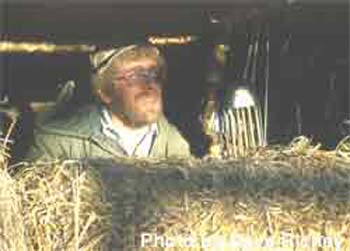
Showing posts with label warm. Show all posts

Sunday, March 13, 2011

Dressing right for winter bow hunts

Winter weather means bow hunters must be prepare for cold, wet weather.

Some years ago I hunted with an old friend, and he rattled on and on about the benefits of bow hunter being properly dress for the cold December bow season.

His basic philosophy was that "only stupid people who don't dress properly get too cold to hunt." I've seen the guy out on days when only he and I would hunt because we knew how to stay warm.

A December hunt last year was a bitter cold evening, and I was able to take it in stride because many years ago I learned how to dress for cold, nasty weather. Before we left to hunt, I checked out the old gent, and we were dressed almost alike. The only difference was he had a wool scarf. Mine had been forgotten and left home.

I would have traded a couple of arrows for my wool scarf that night.

It was damp that night with a temperature in the low teens with a strong northwest wind that seemed to bite through clothing and chill a person to the bone. I used to suffer with cold feet, clothing that let cold winds blow over my back and chest, but with age comes some common sense. Hunting every night means being able to handle whatever nature dishes out, and that means dressing properly for the existing conditions.

I started with long underwear, light wool and heavy wool socks, and a heavy wool shirt and my jeans. Many hunters like bib overalls, and they work fine for many hunters but I prefer a heavy, soft and quiet suit of wool or some of that new insulation that doesn't make noise.

It is similar to a snowmobile suit in some respects but it is very quiet where snowmobile suits crinkle and make noise. The hard shell finish on most snowmobile suits make them impossibly noisy for bow hunting. My suit is just getting broken in after many years of continuous use.

Heat loss occurs through your head, and I wear an old-fashioned insulated hat with fuzzy ear flappers that tie under my chin. Insulated boots keep my feet warm, and it doesn't bother me to put hand-warners in each pocket, toe warmers in my boots, and I'm about ready to hunt.

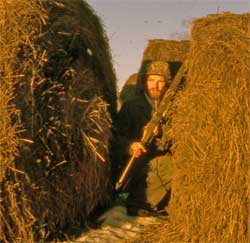
This bow hunter heads for a ground blind. He's dressed for cold weather.

On this evening I didn't have a scarf but my buddy did. A heavy wool scarf is wrapped once or twice around the neck to keep those chilly drafts from blowing on a warm neck or down the back. Pull your hat brim down low, and you don't need a mask if you can sit still. That wool scarf is one of the handiest items of clothing a hunter can wear when cold December winds blow. I've found that when the winter chill factor is reaching for zero, I can wrap my nose and face in one layer of my scarf, and it stays warm too. A warm head, hands and feet make it possible for a hunter to keep warm lonh enough to shoot a buck.

Warm gloves are a necessity. If they get cold, you're all done.

A good pair of wool gloves help keep my hands warm, and a pair of insulated or leather mittens top everything off. This outfit works well for me although some hunters like the wicking qualities of polypropylene underwear. I own two pair of o-l-d wood choppers mittens.

I seldom carry a little tiny heater but my buddy does. It runs off a small canister of bottled gas, and that heater can be a lifesaver. He uses it to warm his fingers before taking a shot, and if hunting from an elevated coop, it can take the chill off a cold and drafty wood shooting box.

This heater is small, compact and efficient. It doesn't bring the air temperature up very much, but it takes some of the winter bite out of an icy wind in his hunting coop.

"The deer can't hear if, apparently can't smell it although I am downwind of the deer," he said, "and it doesn't cast a bright red glow inside the coop that could attract the attention of an approaching buck."

I can certainly remember the many evenings spent in an open tree stand, waiting for a good buck to walk closer. It's easy to recall the numbed fingers and toes, and my questioning my personal sanity for being out on such nights.

Dressing warmly, using a small heater, and knowing how to stay warm is one of the luxuries of attaining a bit of age. We learn from our earlier mistakes, realize we no longer have to prove how tough we are, and we can relax and be comfortable.

I'm not saying I never get cold, but the number of bitter cold days I experience now are few and far between. Hunting is supposed to be fun, and hunters who make themselves sick because they are poorly dressed, have no one to blame but themselves.

My buddy, more curmudgeonly than me, quickly dismisses people who get cold.

My buddfriend, several years older than my 71 years, told me that "only ignorant people get cold during a winter hunt. If they learned how to dress, they might be a close match for me and you."

Dressing warmly is within the budget of anyone who can afford to be a bow hunter. Me, I prefer being cozy warm. My days of freezing ended many years ago, and I still wonder why I put up with icy fingers and toes for so long.

If I can change, so can you. Warm bow hunters are more efficient bow hunters, especially in the December bow season. Ma Richey didn't raise no dumb kids, but I paid my dues in the past and now I can set out in the coldest weather for two hours to hunt winter whittetails.

That's plenty enough time to shoot a nice buck.

Posted via email from Dave Richey Outdoors

Sunday, February 06, 2011

Hunter from the hay


An uncovered haybale blind and covered one.

It’s time for a quick question and answer session. What is the warmest blind for winter deer hunting?

The deadliest and most unconventional but warmest blind in the deer hunting woods seems to have escaped the attention of many hunters. At first guess, many late November and December hunters feel a heated on-the-ground or elevated stand is best.

Not to my way of thinking. For my money, a hay-bale blind beats whatever else comes in second-place. It has many advantages, and one disadvantage. Hunters afflicted with hay fever shouldn't hunt from a hay-bale blind.

Haybale blinds are great for coyoe, deer and fox hunting.

These blinds are like dipping snuff. It can leave you rather sneezy, but you won’t be sold.

The solid points in favor of these blinds are many and all are valid. Here are solid reasons to use such a blind.

1. Hay-bale blinds can be constructed from big round bales or the smaller and more manageable rectangular bales.

2. A round bale blind is made by putting two round bales together at an angle to form a capital "V". Put a sheet of one-inch marine plywood over the top, and stack six or eight rectangular bales on top to provide a warm and dry roof over your head.

3. Hatbake blinds can be made without a top although there is a slightly greater chance of deer or predators catching your scent when hunting from an uncovered blind.
  • The trip here is to stay back in the shadows to remain hidden.
  • I always wear a face mask and brown Jersey gloves.
  • Avoid movement when hunting haybale blinds because often are close.
4. A rectangular blind requires quite a few rectangular bales.
  • Pile as many bales up on the left and right sides, and behind you, and put a chair inside to sit on.
  • Stack the bales at least two high in the front, and leave just enough room to crawl over and to shoot through.
  • Cover the top with plywood and more bales, and you are set.
    • The disadvantage of this blind is if one or two bales get bumped, the blind can fall like a house of cards.

Hunters stay back from shooting window.

Of the two, my favorite is made of two round bales. Five minutes with a tractor to move the two round bales together, laying a sheet of plywood on top and several rectangular bales on top and in front to form a shooting window, and the blind is completed.

Any hay blind placed early in the fall in a key location where deer regularly travel will pay off when November and December rolls around. The deer get used to it, and by the time the winter archery season rolls around, it will entice deer to your area.

Key spots for a hay-bale blind is near the edge of a cornfield, in an open field where two or more trails converge, or back in the woods where a good trail carries a great deal of deer traffic. Wooded hay-bale blinds are much more difficult to construct. Most people place them in open fields or close to heavy cover.

Put haybale blinds in key locations and don’t near them until hunting season.

5. This blind is warm. Unless the shooting window faces directly into the wind, this is the warmest blind possible. Wet hay builds a certain amount of heat, and hunters can stay warm in the most brutal weather.

Human odor isn't a problem with hay blinds. The heavier odor of hay serves to cover human odor inside the blind.

6. Of major importance to me, and to others who use such blinds, is they offer straight-out, horizontal shots at whitetails. There is none of the problems of shooting downward while sitting or standing in a cold tree stand or elevated coop, and deer often walk within six feet of a hay-bale blind. The shots can be easy to make unless the hunter suffers from buck fever.

The hay absorbs almost any noise. I've coughed, sneezed, and done other noisy things in a hay-bale blind without having nearby deer hear it. Of course, any movement visible through the narrow shooting window can be seen.

Deer often take three or four days, and sometimes as much as a week, to become accustomed to the blind. Even though it’s best to put hay-bale blinds in place early, it can be done anytime.

If I were a hunter with a new hay blind, I would not sit in it for a week. The one exception to that would be if a major winter storm was due to hit that morning or evening. Every deer in the area will be on the prowl before the storm hit, and I'd suggest being in the new stand early before a storm hits.

If snow falls before the deer move, so much the better. It will help cover any human scent, and it can produce the occasional big buck.

Hay-bale blinds are not difficult to make, and they provide everything a December bow hunter could want:
  • no scent
  • being as warm as toast
  • good visibility when properly placed
Winter deer hunting just doesn't get much better than that. An added bonus is that these blinds are great places to call coyotes and foxes.

Thursday, December 30, 2010

Changing weather patterns


Will changing weather patterns affect a trophy buck’s patterns?


Anglers and hunters who yearn for spring need only step outside. Our winter weather is so mixed up that no one knows what to expect.

Here it is, the end of December and the snow is melting tonight in 38-degree evening temperatures. The forecast is for possible rain showers tonight and tomorrow.

Possible snow? The chance for snow flurries? Chances are like betting on the roll of a pair of dice. Maybe it will snow a bit later this week, but perhaps it won't. Where is our normal cold weather.

It seems the possibility of a culprit may be at hand. The weather service hints that El Nino is at fault. It seems that several years ago El Nino took the blame for something else. Something must be wrong.

Predicting weather is supposed to be scientific but forecasts often are wrong.


Folks, the changing weather patterns are goofy, and have been for many years. Is it the fault of greenhouse gas? Is carbon monoxide to blame? How about flatulence in cattle? Some years ago they were blaming the gas used in aerosol spray cans caused weather changes.

Our planet is no bigger now than it ever was but there are more people on Earth than ever before. They breathe in oxygen (and smog) and breathe out carbon dioxide. More people, more carbon dioxide, and more diesel and gasoline fumes. More smog in our cities, and more weather problems. And less we forget, remember the cows.

The problem will only get worse. I read where ice is melting at a faster rate in polar regions, and the earth is warming up. So, what does this mean for you and me?

Will New York and Los Angeles soon be under water as ocean levels rise? Will more people be moving inland away from the oceans, buy land on a mountain, and stay high and dry? Who knows? Will an earthquake topple the Pacific Rim into the ocean, resulting in a staggering loss of life and trigger tsunamis?

Every time one of the world's many volcanos blows its top, and spews tons of ash, debris and smoke into the air, the worse things become. Every time an earthquake rattles the ground, and some buildings and bridges topple, things get progressively worse.

Is the weather all wrong? Is it changing or are people just learning how to adapt?


Should we be like Chicken Little and run scared? No, I don't think so yet, but as mankind continues to overpopulate the earth in an ever increasing manner, more people must breathe and travel to work. Hydrocarbons are released into the atmosphere vy the gazillion, and as more gasses pollute the upper atmosphere, the warmer it wil get.

There will become a greater need for water, and the arid southwest would like some of our Great Lakes. We have water bottling plants that suck millions of gallons of state water from the earth so people can pay Coca-Cola, Pepsi and Nestle money for their bottled water. As the earth warms, and water becomes more precious, this demand will grow.

Much talk was made of making ethanol from corn some years ago. We have lots of corn, but if the atmosphere changes, and the tendency for warmer temperatures increases, will the rain and snow pattern we've seen the past month continue? Most likely it will dwindle, and it's hard to grow corn in a dust bowl but people back in the 1920s and 1930s faced that problem.

Then the weather changed around, rain began to fall again, and soon corn grew where years before the ground had been baked solid. Are we in for more troubling weather ahead?

I'm not an alarmist but I think things will continue to change, and some of these changes may be irreversible. Weather has become quite unpredictable. It may become even more so in the years to come.

I’m more curious about future weather patterns than anything else.


Will this affect me? At 71, I doubt seriously it will have a major impact on me except for how the weather will affect my fishing and hunting.

If the weather continues to gradually grow warmer, there will be a greater desire among some fast-buck artists to sell Great Lakes water. If we start selling our water, we will have jumped onto a slippery slope that will dramatically lower water levels. For every change we see, there will probably be a greater impact on our weather patterns.

If South America's rain forests continue to be eliminated at a rapid pace as trees are cut, what will happen then? What will happen if springs start to go dry because water bottlers are taking our water? How long will it take for every human being in this state and this country and this world to be impacted by the consequences of any mistakes made now?

Once the springs that feed our tiny trout streams are sucked dry, where will our trout go? Where will we go?

Man, left to its own greedy devices, will eventually be responsible for despoiling this planet until there is nothing useful left. I won't be around to see it, and perhaps my children will dodge this climatic bullet, but future generations will suffer for the mistakes made by past, present and future generations.

And just think: here we sit griping about the weather. The winds of change are blowing today, and those costly mistakes will one day be the cause of the death of this planet.

It's not a cheery thought but I'll be gone by then, and thankful for what this life has given me. Writing about changes has been a way of life for the past 44 years.

Someone once said: the more things change, the more they remain the same. It's up to people to protect what we have, and move forward in a positive manner, if Planet Earth is to prosper in the future.

Posted via email from Dave Richey Outdoors

Tuesday, November 23, 2010

Cold-weather deer hunting


This is a good buck, quartering away and within easy bow range. Take him!


Yesterday was a bitter cold evening, and I was able to take it in stride because many years ago I learned how to dress for cold, bad weather.

It was cold tonight with a temperate in the 20s with a strong wind that bit through clothing and chilled a person to the bone. I once suffered with cold feet, clothing that let cold winds blow over my back and chest, but with age comes some common sense. Hunting every night means being able to handle whatever nature hands out, and that means dressing properly for the existing conditions.

I start with long underwear, light wool and heavy wool socks, and a heavy wool shirt and my jeans. Many hunters like bib overalls, and they work fine for many hunters but I prefer a heavy, soft and quiet suit of coveralls.

Scent-Lok camo is warm, dry and helps keep deer from getting your scent.


I'm also a big fan of scent control so this year picked up a great suit of Scent-Lok clothing that consists of heavy-duty (and quiet) bibs, coat, gloves and hat. I wear long underwear underneath, jeans and a wool shirt, and find that it's possible to set out in almost anykind of weather than Michigan can through at us during November and December.

Throw it into the dryer for 45 minutes to reactivate the garment's ability to prevent scent from forming, and I've had deer straight downwind of me, and they never caught my scent. I wear shin-high rubber books, and spray them with any scent-killing spray.

My Scent-Lok suit similar to a snowmobile suit in some respects but it is quiet and helps prevent human odor from drifting on the breeze. The hard shell finish on most snowmobile suits make them impossibly noisy for bow hunting. My suit is just getting broken in after almost two months of continual use.

Heat loss occurs through your head, and I wear a Scent-Lok hat, and a wool stocking cap that keeps my head warm and covers my ears. Insulated boots keep my feet warm, and it doesn't bother me to put hand-warners in each pocket, toe warmers in my boots, and I'm about ready to hunt.

I like a heavy wool scarf on my neck when conditions really get cold and nasty.


A heavy wool scarf is wrapped once or twice around my neck on really cold day to keep chilly drafts from blowing on my neck or down my back. That wool scarf is one of the handiest items of clothing a hunter can wear when cold December winds blow. I've found that when the winter chill factor is dropping near zero, I can wrap my nose and face in one layer of my scarf, and it stays warm.

I also carry a little tiny heater for those times when I hunt from a enclosed coop or ground blind. It runs off a small canister of bottled propane, and that heater can be a lifesaver. I use it to warm my fingers before shooting at a deer, and if hunting from an elevated coop, it can take the chill off a cold wood building.

This heater is small, compact and efficient. It doesn't bring the air temperature up very much, but it takes some of the winter bite of an icy wind out of my hunting coop. The deer can't hear if, apparently can't smell it although I am downwind of the deer, and it doesn't cast a bright red glow inside the coop that could attract the attention of an approaching buck.

I can certainly remember the many evenings spent in an open tree stand, waiting for a good buck to walk closer. It's easy to recall the numbed fingers and toes, and my questioning my personal sanity for being out on such nights.

The old days may have featured more deer but today’s clothing is far superior.


Dressing warmly, using a small heater when absolutely necessary, and knowing how to stay warm is one of the luxuries of attaining a bit of age and wisdom. We learn from our earlier mistakes, realize we no longer must prove how tough we are, and we can relax and be comfortable while hunting during nasty weather.

I'm not saying that I never get cold, but the number of bitter cold days I experienced over the years now are few. Hunting is supposed to be fun, and hunters who make themselves sick because they are poorly dressed, have no one to blame but themselves.

Dressing warmly is within the budget of anyone who can afford to be a bow hunter. Me, I prefer being cozy warm. My days of freezing ended many years ago, and I still wonder why I put up with icy fingers and toes for so long.

If I can change, so can you. Warm bow hunters are more efficient bow hunters, especially in December, and the Scent-Lok clothing certainly helps me control my human scent.

Posted via email from Dave Richey Outdoors

Saturday, November 20, 2010

Try a late-season hay-bale blind


Two type of hay-bale blinds. Usually the hunter sets farther  back in each one.


The deadliest, most unconventional and warmest hunting blind in the deer woods has escaped many hunters. At first guess, many firearm hunters or December bow or muzzleloaders might feel a heated on-the-ground or elevated stand is best.

Not me. For my money, a hay-bale blind blind beats everything else. It has so many advantages, and only one disadvantage. Hunters afflicted with hay fever shouldn't hunt from this type of blind.

The solid points in favor of them are many and all are valid. Here are some great reasons to use such a blind in lake November and December.

A hay-bale blind is warm as toast as long as the wind doesn’t blow in.


*Hay-bale blinds can be constructed from big round bales or the smaller and more manageable rectangular bales.

*A round bale blind is made by putting two round bales together at an angle to form a capital "V." Put a sheet of one-inch plywood over the top, and stack six or eight rectangular bales on top to provide a warm roof over your head.

*A rectangular blind requires quite a few rectangular bales. Pile as many bales up on the left and right sides, and behind you, and put a chair inside to sit on. Stack the bales at least two high in the front, and leave just enough room to shoot. Cover the top with plywood and more bales, and you are set. The disadvantage of this blind is if one or two bales get bumped, the blind will fall like a house of cards.

*Of the two, my favorite is made from round bales. Five minutes with a tractor to move the two round bales together, laying a sheet of plywood on top and several rectangular bales on top and in front to form a shooting window will complete the blind.

*Any hay blind placed before October in a key location will pay off when late-November and December rolls around. The deer will soon get used to it, and by the time the winter archery season rolls around, it will entice deer to your area.

Place hay-bale blinds close to a food source such as a corn field near a trail.


*Key spots for a hay-bale set is near the edge of a cornfield, in an open field where two or more trails converge, or back in the woods where a good trail carries a great deal of deer traffic.

*This blind is warm. Unless the shooting window faces directly into the wind, this is the warmest blind there is. Wet hay builds a certain amount of heat, and hunters can stay warm in the most bitter weather.

*Human odor isn't a problem with hay blinds. The heavier odor of hay serves to cover any human scent inside the blind.

*It would be difficult to consider a hay-bale blind as a bait site although deer occasionally mat eat some of it while the hunter is inside but that's not something one can count on happening.

*Of major importance to me, and to others who use such blinds, is they offer straight-out, horizontal shots at whitetails. There is none of the problems of shooting downward while sitting or standing in a cold tree stand or elevated coop, and deer often walk within six feet of a hay-bale blind. The shots can be impossibly easy to make unless the hunter suffers from buck fever.

These blinds produce heat and absorb most small noises.


*The hay absorbs almost any noise. I've coughed, sneezed, and done other noisy things in a hay-bale blind without having nearby deer hear me. Of course, any movement visible through the narrow shooting window might be spotted.

*Is it too late to build a hay-bale blind? It depends on deer numbers in your area, the available food supply, and how quickly the blind can be constructed. Deer often take three or four days, and sometimes as much as a week, to become accustomed to the blind. But hay bales often are found around field, and often are covered with plastic.

If I were a hunter with a new hay bale blind, I would not sit in it for a week. The one exception to that would be if a major winter storm was due to hit that evening. Every deer in the area will be on the prowl before dark, and I'd suggest being in the new stand no later than 2 p.m.

If snow falls before the deer move, so much the better. It will help cover any human scent, and it can produce the occasional big buck.

Hay-bale blinds are not difficult to make, and they provide everything a late-season bow hunter could ask for: no scent, being as warm as toast, and being in a blind while the deer travel close to it

It doesn't get much better than that.

Posted via email from Dave Richey Outdoors

Wednesday, November 03, 2010

An exception to the rule


Pyramid pit blinds like this are warm & dry at all times.


Those who know me realize that sitting in a tree stand is my favorite deer hunting method. However, there are exceptions to every rule, and last night found me doing something different for a change.

It was a night for me to make an exception. There are two reasons to own hunting coops: one is for those people who dislike sitting exposed to inclement weather in a treestand. The other reason is they like to stay warm and not fight windy weather.

Inclement weather yesterday meant a dfairly steady on and off-again rain. Kay and I  hunted two widely separated locations, and it was a wet and windy day and evening although the rain stopped just before dark. Granted, I  could have worn rain gear and toughed it ouut, but I've been fighting the sniffles and didn't need to get wet and feel even worse for the rest of the rut.

Rain & sniffles can lead to a bad cold, which I don’t need now.


Was it a great hunting night? Of course. Any night when a person can hunt is a good night, but as the old joke goes, some nights are better than others.

No bucks came to me nor Kay, and there were no does sneaking in late through our area as they headed elsewhere. In fact, neither of us saw a deer of either sex

It seems on nights like that most deer stay close to their bedding area in thick cover, and wait for the rain to peter out. Wet ground makes for silent travel, and some bucks may go for a hike to see what is new and different on their home turf but many animals just wait it out. They seem to know that rain will take the crunchy noise out of dry leaves.

I don't hunt from a coop every night it rains but I do enjoy the stillness of a dry coop 20 feet in the air. It gives me greater visibility, and although there was nothing moving in our hunting area, it proved that sitting inside a warm and dry coop has some things going for it. I'd much rather be outside in the weather but Ma Richey didn't raise any fools.

I want to be hunting during the rut’s peak, not in bed with a cold.


A hunting buddy several miles away saw two nice bucks but none came any closer than 80 yards, and the high and wide eight-pointer he saw was hugging the tree line. He showed no inclination to cross an open field. The second and smaller buck, also an eight-pointer, was traveling with a doe. I suspect he better have some fun siib before a larger buck takes his girlfriend away, and leaves him with a hole or two in his hide.

The other hunter saw no does, even at the end of shooting time, and all was silent after the two bucks moved through. As he put away his equipment for the hike back to his truck, a crashing in the brush revealed a she-coon trying to move away from him.

Each of us had the same thoughts tonight. It's impossible to be a successful deer hunter while sitting in the house. That means we were out in the weather tonight, but all of us chose to sit in a dry coop.

We all all stayed dry and warm. That’s why I made an exception last night.


My friend and I may not be the smartest gents in the world, but we're savvy enough to come in out of the rain. Which is probably what our mothers hoped we would learn after they had harped at us for years about being smart enough to get in out of bad weather.

See, Ma, I did pay attention ... once in a while.

Posted via email from Dave Richey Outdoors