Showing posts with label dry. Show all posts

Tuesday, November 23, 2010

Cold-weather deer hunting


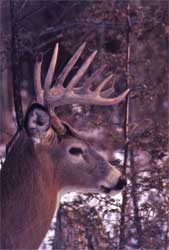
This is a good buck, quartering away and within easy bow range. Take him!


Yesterday was a bitter cold evening, and I was able to take it in stride because many years ago I learned how to dress for cold, bad weather.

It was cold tonight with a temperate in the 20s with a strong wind that bit through clothing and chilled a person to the bone. I once suffered with cold feet, clothing that let cold winds blow over my back and chest, but with age comes some common sense. Hunting every night means being able to handle whatever nature hands out, and that means dressing properly for the existing conditions.

I start with long underwear, light wool and heavy wool socks, and a heavy wool shirt and my jeans. Many hunters like bib overalls, and they work fine for many hunters but I prefer a heavy, soft and quiet suit of coveralls.

Scent-Lok camo is warm, dry and helps keep deer from getting your scent.


I'm also a big fan of scent control so this year picked up a great suit of Scent-Lok clothing that consists of heavy-duty (and quiet) bibs, coat, gloves and hat. I wear long underwear underneath, jeans and a wool shirt, and find that it's possible to set out in almost anykind of weather than Michigan can through at us during November and December.

Throw it into the dryer for 45 minutes to reactivate the garment's ability to prevent scent from forming, and I've had deer straight downwind of me, and they never caught my scent. I wear shin-high rubber books, and spray them with any scent-killing spray.

My Scent-Lok suit similar to a snowmobile suit in some respects but it is quiet and helps prevent human odor from drifting on the breeze. The hard shell finish on most snowmobile suits make them impossibly noisy for bow hunting. My suit is just getting broken in after almost two months of continual use.

Heat loss occurs through your head, and I wear a Scent-Lok hat, and a wool stocking cap that keeps my head warm and covers my ears. Insulated boots keep my feet warm, and it doesn't bother me to put hand-warners in each pocket, toe warmers in my boots, and I'm about ready to hunt.

I like a heavy wool scarf on my neck when conditions really get cold and nasty.


A heavy wool scarf is wrapped once or twice around my neck on really cold day to keep chilly drafts from blowing on my neck or down my back. That wool scarf is one of the handiest items of clothing a hunter can wear when cold December winds blow. I've found that when the winter chill factor is dropping near zero, I can wrap my nose and face in one layer of my scarf, and it stays warm.

I also carry a little tiny heater for those times when I hunt from a enclosed coop or ground blind. It runs off a small canister of bottled propane, and that heater can be a lifesaver. I use it to warm my fingers before shooting at a deer, and if hunting from an elevated coop, it can take the chill off a cold wood building.

This heater is small, compact and efficient. It doesn't bring the air temperature up very much, but it takes some of the winter bite of an icy wind out of my hunting coop. The deer can't hear if, apparently can't smell it although I am downwind of the deer, and it doesn't cast a bright red glow inside the coop that could attract the attention of an approaching buck.

I can certainly remember the many evenings spent in an open tree stand, waiting for a good buck to walk closer. It's easy to recall the numbed fingers and toes, and my questioning my personal sanity for being out on such nights.

The old days may have featured more deer but today’s clothing is far superior.


Dressing warmly, using a small heater when absolutely necessary, and knowing how to stay warm is one of the luxuries of attaining a bit of age and wisdom. We learn from our earlier mistakes, realize we no longer must prove how tough we are, and we can relax and be comfortable while hunting during nasty weather.

I'm not saying that I never get cold, but the number of bitter cold days I experienced over the years now are few. Hunting is supposed to be fun, and hunters who make themselves sick because they are poorly dressed, have no one to blame but themselves.

Dressing warmly is within the budget of anyone who can afford to be a bow hunter. Me, I prefer being cozy warm. My days of freezing ended many years ago, and I still wonder why I put up with icy fingers and toes for so long.

If I can change, so can you. Warm bow hunters are more efficient bow hunters, especially in December, and the Scent-Lok clothing certainly helps me control my human scent.

Posted via email from Dave Richey Outdoors

Saturday, November 20, 2010

Try a late-season hay-bale blind


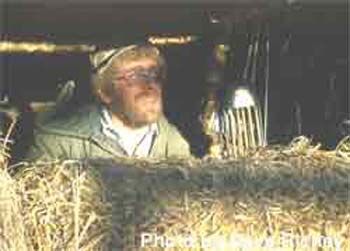
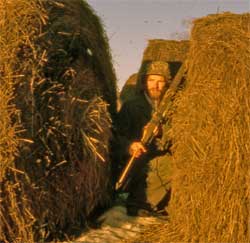
Two type of hay-bale blinds. Usually the hunter sets farther  back in each one.


The deadliest, most unconventional and warmest hunting blind in the deer woods has escaped many hunters. At first guess, many firearm hunters or December bow or muzzleloaders might feel a heated on-the-ground or elevated stand is best.

Not me. For my money, a hay-bale blind blind beats everything else. It has so many advantages, and only one disadvantage. Hunters afflicted with hay fever shouldn't hunt from this type of blind.

The solid points in favor of them are many and all are valid. Here are some great reasons to use such a blind in lake November and December.

A hay-bale blind is warm as toast as long as the wind doesn’t blow in.


*Hay-bale blinds can be constructed from big round bales or the smaller and more manageable rectangular bales.

*A round bale blind is made by putting two round bales together at an angle to form a capital "V." Put a sheet of one-inch plywood over the top, and stack six or eight rectangular bales on top to provide a warm roof over your head.

*A rectangular blind requires quite a few rectangular bales. Pile as many bales up on the left and right sides, and behind you, and put a chair inside to sit on. Stack the bales at least two high in the front, and leave just enough room to shoot. Cover the top with plywood and more bales, and you are set. The disadvantage of this blind is if one or two bales get bumped, the blind will fall like a house of cards.

*Of the two, my favorite is made from round bales. Five minutes with a tractor to move the two round bales together, laying a sheet of plywood on top and several rectangular bales on top and in front to form a shooting window will complete the blind.

*Any hay blind placed before October in a key location will pay off when late-November and December rolls around. The deer will soon get used to it, and by the time the winter archery season rolls around, it will entice deer to your area.

Place hay-bale blinds close to a food source such as a corn field near a trail.


*Key spots for a hay-bale set is near the edge of a cornfield, in an open field where two or more trails converge, or back in the woods where a good trail carries a great deal of deer traffic.

*This blind is warm. Unless the shooting window faces directly into the wind, this is the warmest blind there is. Wet hay builds a certain amount of heat, and hunters can stay warm in the most bitter weather.

*Human odor isn't a problem with hay blinds. The heavier odor of hay serves to cover any human scent inside the blind.

*It would be difficult to consider a hay-bale blind as a bait site although deer occasionally mat eat some of it while the hunter is inside but that's not something one can count on happening.

*Of major importance to me, and to others who use such blinds, is they offer straight-out, horizontal shots at whitetails. There is none of the problems of shooting downward while sitting or standing in a cold tree stand or elevated coop, and deer often walk within six feet of a hay-bale blind. The shots can be impossibly easy to make unless the hunter suffers from buck fever.

These blinds produce heat and absorb most small noises.


*The hay absorbs almost any noise. I've coughed, sneezed, and done other noisy things in a hay-bale blind without having nearby deer hear me. Of course, any movement visible through the narrow shooting window might be spotted.

*Is it too late to build a hay-bale blind? It depends on deer numbers in your area, the available food supply, and how quickly the blind can be constructed. Deer often take three or four days, and sometimes as much as a week, to become accustomed to the blind. But hay bales often are found around field, and often are covered with plastic.

If I were a hunter with a new hay bale blind, I would not sit in it for a week. The one exception to that would be if a major winter storm was due to hit that evening. Every deer in the area will be on the prowl before dark, and I'd suggest being in the new stand no later than 2 p.m.

If snow falls before the deer move, so much the better. It will help cover any human scent, and it can produce the occasional big buck.

Hay-bale blinds are not difficult to make, and they provide everything a late-season bow hunter could ask for: no scent, being as warm as toast, and being in a blind while the deer travel close to it

It doesn't get much better than that.

Posted via email from Dave Richey Outdoors

Thursday, November 11, 2010

Ambush locations that produce firearm bucks


Don’t be surprised by the possibility of some snow on Monday.


Finding a firearm opening-day hotspot can be easy if you follow some of these hard-earned instructions. Good places to hunt go begging because no one wants to move, so instead of hoping deer show up while you set on your butt, try this.

There's no secret about it. Firearm deer hunters often sit in a nice warm coop, and wait for the deer to pay them a visit. If the deer don't move, because no one is out moving around to cause the animals to move as they try to hide, both hunters and deer can take a snooze.

It's easy to find some of the key areas to hunt. Get in to such spots early in the morning, long before the other hunters come stumbling in at dawn. Move early, get in place, pay attention to the wind, and sit tight. Dress for the weather, and don't forget to wear as much hunter orange clothing as possible. Give some of these spots a try on Monday, the only day of  the year when you can hear the sunrise.

These several hunting locations can officer very good firearm hunting.

*Creek or river bottoms -- Such spot often have thick cover, and deer follow these ground depressions when moving from one spot to another, usually through heavy cover. Check the surrounding countryside, and locate some trails that lead into the bottom land. Find a spot downwind of where active deer trails meet that will offer a good view, and sit tight and don't wiggle around.
Hunt downwind of used trails.

*Funnels -- Funnels can be large or small. If one is too big to cover adequately with one man, bring your buddy along. A funnel that connects a bedding spot  with a feeding area or that connects two patches of thick cover is what you want. Sit downwind of the funnel in natural cover, and wait for other hunters to push deer out of one spot. They will use the funnel, and you'll be waiting there for them.

*Drainage ditches aren't as common in the north as in southern counties, but these ditches through farm fields act somewhat like a funnel. Deer will run the bottom of the ditches, which allow them to stay low and out of sight. Again, play the wind and be careful. The breeze may blow one direction above ground but often will be blowing a different way down in the ditch. Hunt near heavy cover areas or woodlots, and any nearby marsh will often hold deer. Find the key spot to sit, and stay down in the ditch to avoid being sky-lighted.

*Swamps -- These spots come in all shapes and sizes. Some are dry while others are wet. Some have a creek flowing through them, and some are connected by a funnel to other thick cover. Learn now where deer travel when the opening-day guns go bang, and figure out how to get back into the swamp well before daylight.

A good way is to wear waders or hip-boots to move into the swamp, and find a nice high and dry area. Deer don't mind getting wet but they prefer to lay up in a dry spot. A cattail marsh is another good bet, and bucks often hole up by stretching out on a muskrat house. Few people look for deer in such locations, and thereby overlook some except hunting areas.

Arrive well before sunrise, hunt all day, and stay alert.

*Dry lake beds -- These areas often grow up to tall grass, and a deer can sneak through the grass without ever being seen. Their fall coat is about the same color as the tall grass, and the best spot to set up an ambush is downwind of where they enter or leave the heavy cover. An elevated coop or tree stand nearby can be an asset because the height allows a hunter to look into the grass from a higher angle. It makes deer somewhat easier to see.

*Abandoned orchards -- Such areas are overgrown with brambles and briars, and the are tough locations for a human to get through. Deer have little trouble sneaking through it, and most of these places are right behind a house or barn. People tend to overlook such spots because they are too close to human settlement, but they can be a true hotspot. The problem is how to hunt them, and the best way is to watch it to see which way a buck goes. Learn his travel route before the firearm season opens, and set up downwind from it. It's the easiest way because getting inside it without spooking the deer is most difficult.

*Hilly country -- Any area with hills will have corresponding valleys. The steeper the hill-sides, the more rugged it will be and the more that big bucks will use such areas. Look for heavy hill-side cover, thick brush in the low spots, and if the country has some craggy outcroppings, bucks will often climb into such areas where they can check their back-trail and pick up scent. The best way to hunt such areas is to be above the deer, and often you'll hear them climbing into position to bed down.
The trick will be to find a hole to look through, and to spot and shoot the deer.

*Islands in lakes or streams -- Whitetail aren't afraid to swim if necessary, and if a lake or stream has an island, it is a good spot to find bucks on or after opening day. Make certain the island isn't privately owned, and if it is, get permission before hunting it. The island doesn't have to be any larger than a high and dry spot surrounded by water for a deer to bed down in thick cover. Islands often are overlooked by many hunters, and they can provide some great sport.

Find a good spot, and try not to be seen checking it out.

Spend some time over the next couple of days, and see if it’s possible to find a nice well-used traveled trail going through it. Get there early, be prepared to hunt all day, and stay alert. Your firearm of choice should be well suited to the habitat being hunted.

Find a few of these hotspots between now and Nov. 15, and chances are good you'll have the spot all to yourself. Well ... you and perhaps a few nice  deer.

Posted via email from Dave Richey Outdoors

Wednesday, November 03, 2010

An exception to the rule


Pyramid pit blinds like this are warm & dry at all times.


Those who know me realize that sitting in a tree stand is my favorite deer hunting method. However, there are exceptions to every rule, and last night found me doing something different for a change.

It was a night for me to make an exception. There are two reasons to own hunting coops: one is for those people who dislike sitting exposed to inclement weather in a treestand. The other reason is they like to stay warm and not fight windy weather.

Inclement weather yesterday meant a dfairly steady on and off-again rain. Kay and I  hunted two widely separated locations, and it was a wet and windy day and evening although the rain stopped just before dark. Granted, I  could have worn rain gear and toughed it ouut, but I've been fighting the sniffles and didn't need to get wet and feel even worse for the rest of the rut.

Rain & sniffles can lead to a bad cold, which I don’t need now.


Was it a great hunting night? Of course. Any night when a person can hunt is a good night, but as the old joke goes, some nights are better than others.

No bucks came to me nor Kay, and there were no does sneaking in late through our area as they headed elsewhere. In fact, neither of us saw a deer of either sex

It seems on nights like that most deer stay close to their bedding area in thick cover, and wait for the rain to peter out. Wet ground makes for silent travel, and some bucks may go for a hike to see what is new and different on their home turf but many animals just wait it out. They seem to know that rain will take the crunchy noise out of dry leaves.

I don't hunt from a coop every night it rains but I do enjoy the stillness of a dry coop 20 feet in the air. It gives me greater visibility, and although there was nothing moving in our hunting area, it proved that sitting inside a warm and dry coop has some things going for it. I'd much rather be outside in the weather but Ma Richey didn't raise any fools.

I want to be hunting during the rut’s peak, not in bed with a cold.


A hunting buddy several miles away saw two nice bucks but none came any closer than 80 yards, and the high and wide eight-pointer he saw was hugging the tree line. He showed no inclination to cross an open field. The second and smaller buck, also an eight-pointer, was traveling with a doe. I suspect he better have some fun siib before a larger buck takes his girlfriend away, and leaves him with a hole or two in his hide.

The other hunter saw no does, even at the end of shooting time, and all was silent after the two bucks moved through. As he put away his equipment for the hike back to his truck, a crashing in the brush revealed a she-coon trying to move away from him.

Each of us had the same thoughts tonight. It's impossible to be a successful deer hunter while sitting in the house. That means we were out in the weather tonight, but all of us chose to sit in a dry coop.

We all all stayed dry and warm. That’s why I made an exception last night.


My friend and I may not be the smartest gents in the world, but we're savvy enough to come in out of the rain. Which is probably what our mothers hoped we would learn after they had harped at us for years about being smart enough to get in out of bad weather.

See, Ma, I did pay attention ... once in a while.

Posted via email from Dave Richey Outdoors