Showing posts with label close. Show all posts

Friday, April 13, 2012

Big gobblers attract attention

This is one of the big boy's smaller buddies

Smaller buddy of the big-boy tom
This jake can kickstart the adrenaline flow, but the truly 'Big Boys', attract attention; and no small amount of worry for the hunter(s!), hot-on-their-trail.
photo Dave Richey ©2012
One thing about turkey gobblers is true. There are far fewer big old longbeards running around northern Michigan than jakes.

The other day I spotted a huge longbeard in a field about 15 miles from home. The bird was wandering alone although two or three hens weren't very far away.

What struck me about this bird, besides his larger than normal size, was his beard. The beard was at least 10-12 inches in length, and appeared to be as wide as a big paint brush. It hung ponderously off his chest, and swayed from side to side as he walked.

Big longbeards like that cause traffic jams

I noted the time of day, drove a half-mile down the road and out of sight of the gobbler, turned around and drove past him for another look. From this angle the bird looked even larger, and the beard was dragging the dirt whenever he bent over to feed.

This was a gobbler of extraordinary proportions. Such birds are difficult to keep hid because he seemed bound and determined to stand out in the open where he could be seen by every vehicle that traveled the busy road.

We drove away, and the next day we went back looking for this Monarch of the open fields. Sure enough, he was in the same field, walking the edge of a wood lot, and about 100 yards off the paved road.

The question is how long will he stay there? If he keeps showing himself, every turkey hunter west of Interlochen and north of US-31 will be trying to hunt him. The bird is on private land, and seems enthralled with the area.

It's my assumption that the big gobbler and some hens are roosting nearby. I see him about two hours after sunrise, and the birds never stray too far from this spot.

My bet is the bird will be scared by human activity

Company came and spent three days here, and I didn't have any chance to go out checking on the big gobbler. I know for certain that at least two other hunters know about him, and suspect he has now been seen  by many more people.

The burning question is whether he will still be around when turkey season opens. I spotted another car parked along the road, and figured he was watching the bird.

He had binoculars to his face when I pulled up. He turned, saw me and whispered "Big bird." I nodded in agreement.

The bird walked off into the woods, and he asked if I had known the bird was there. I told him I'd been watching the gobbler for a few days.
"Are you planning to hunt him?" he asked. I told him that I might if he sticks around.

"Do you think he will still be in this area when the season opens," he asked. "I just spotted him on my way home,  and I've never seen a beard like that before."

His was a valid question. Would this bird still be in the area when the turkey season opens? It's not very likely.

I felt the big gobbler would disappear before the opener

"I doubt if he will still be here then," I said, being honest with the guy. "A bird that big attracts a great deal of attention, and I suspect people pressure will force him to move on.

"How far he and the hens will move is just a guess. I'd expect him to breed those hens before the season opener, and then he will be off in search of other hens. He could be several miles away when the season kicks off."

Would I hunt him? Certainly, if I could get hunting permission for that land. However, my guess is he will be gone in a week or less because other people now know where he is, and if cars continue to stop and watch him, the pressure will force him to get on his way.

And, perhaps that is a good thing. Such big birds are tempting, and poachers often figure a way to shoot such birds out of season. That is one reason why I didn't say how far west of Interlochen Corners or how many miles north.

I may go looking for him again tomorrow, but it wouldn't surprise me if he is gone already. Perhaps I'll be lucky and find him again, and then, I may never see that gobbler again.

The next time I spot him, if there is a next time, there will not be any notations in my blog. The only reason I've written about the bird is because of his size and because I know he won't hang around there long.

He will shove off, move elsewhere, and it's likely he will take over the hens of a smaller gobbler, and soon he will be following the hens. They will keep him moving, and the more nearby eyes and ears there are, the safer that bird will be.

Wednesday, February 29, 2012

Remembering follow-ups on wounded bears

Most times a hunter is tight to a bear without ever knowing it

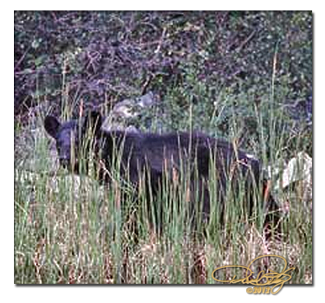
blakbearingrass

Some odd thoughts  rumble through  my mind without apparent thought or reason. Current weather of circumstances have little to do with when these thoughts come to mind.

I don’t know how it happens. I guess it’s just the way my brain is wired together. Frankly, I  delight in these off-the-wall thoughts because they usually put a gentle spin on an  uneventful day.

I was looking through an old pile of Outdoor Life magazines from the decade when I wrote stories for them  on a regular basis for. One article was about a grizzly bear attack that I'd covered for the magazine.

The biologist was a man who had most of his face chewed or ripped off by a grizzly bear, and lived to tell me the story. The magazine flew me to Salt Lake City where the interview took place.

The man got too close to the bear without knowing it. Bad mistake

He lost one eye, his nose and one ear, and the bear literally ripped his face off. He'd had over 1,000 stitches when I did the interview, and he had more plastic surgeries scheduled.

That got me to thinking about the number of black bears I've killed while mopping up a messy job of shooting by other people. Years ago, when bear hunting meant going into a sporting goods store and buying a license. There was no need for a lottery draw in those days. Few people hunted bruins back then.

One of those kills was a bruin that had been shot in the hip, breaking the leg bone. The hunter was frightened and asked if I'd help. I said I would if he agreed to stay behind so I didn't have to listen to his nervous jabbering.

He agreed, and I went after the bear with a 3-inch magnum 12 gauge shotgun stoked with five No. 4 buckshot. I saw the bear at 40 yards, and hit him. He went down at the shot, got up, came running toward me, and four more shots were taken with the last one at six feet. It finally killed the pain-crazed animal.

I'd read stories as a kid about African hunters shooting a leopard or lion, and then having to dig them out of thick cover and kill them at close range. This was pretty heady business for me, knowing full well I'd never go to Africa. I'd have to settle on killing wounded bears that other people had severely injured but were scared to finish the job.

Another bear led me on a two-day hunt that covered a small swamp bordered on one side by a tiny creek. I had lost any blood sign but had found where the bear had bedded down three times. Finally a drop of blood was found near the creek. I crossed the creek and followed a faint blood trail slowly up a steep hill.

The shotgun barrel preceded me, and bent blades of grass pointed out the path taken by the wounded bruin. I'd just topped the hill when I spotted the bear three feet away. It moved and I shot, and that mess was over.

Take a step, stop, listen and look around, listen again and be silent

Bears have provided me with some hair-raising thrills. People talk about brown bears, grizzlies and polar bears, but more people are attacked by black bears each year than many people believe. Black bears are most common, and I've had some close encounters when armed and unarmed, and it's a thrill most people would prefer to live without.

Only once did I go after a wounded bear with another person, and it was a friend whose skills were legendary. We got that bear, but every other time I've done it was alone. And that was the way I preferred it.

Frightened people talk, make noise, and generally get in other people's way when some serious work must be done. Wounded bears often are shot at very close range in thick cover, and I didn't want anyone nearby for fear they would create a greater hazard than already existed.

I'd move slowly if the going was tough, stopping often and looking around. Of the six wounded bears I've dispatched, none had injuries that would have been immediately fatal. All animals were moving, and often the dirty work was done within an hour of sundown. It meant moving fast and quiet, getting close enough to the animal for a deadly shot. Of those six, only the one noted above required more than one shot.

It isn't something I'd do now because my vision is so poor. Back then I could see well, and there is a major adrenalin rush when the wounded animal is first spotted. Then it means staying downwind and trying to get close to the bruin without spooking it.

Doing this nasty piece of  business was never fun but whenever I went after a bear it was because the hunter couldn't or wouldn't do it. It meant putting an animal out of its misery as quickly as possible. I never advertised my services, never went looking for this kind of work, but for many years I always seemed to be in the area where bears were being hunted and trouble always seemed to find me.

This type of adventure offers more than enough for most people

I did it because someone had to. Otherwise, a frightened hunter may walk away from the problem or wait until the next day and not be able to find the bear.

This string of memories came back to me like a recurring bad dream. This wasn't Africa, and it wasn't a wounded leopard or lion at the end of a blood trail, but they were wild black bears that would be lost or may live long enough to become a danger to someone else.

It offered some hair-raising adventures, and the adrenalin rush was rather addictive to this small-town sportsman. And trust me, these were adventures I'll never forget.

Posted via email from Dave Richey Outdoors

Monday, August 15, 2011

Watch for bears in the woods and swamps during bear season

A bear this size, at close range, is a formidable animal. Be aware of nearby bears.


Bear hunting is a special brand of outdoor adventure where the hunted can become the hunter. It's when the tables can be rapidly turned on a sportsman, and where things can get very interesting very quickly. It doesn't happen very often with black bears, but when one attacks, it's not good news. A grizzly will maul and bite a human, often inflicting horrific injuries, but the person often lives.

Black bear, even though they are the most common bruin of all, are perhaps the most dangerous. Their attack may continue until the victim is dead. It has happened many times across North America, and in many cases, the human doesn't survive such a brutal mauling.

Someone in North America gets mauled by a black bear every year.


I lay no claim to being a black bear expert, but have hunted bruins, photographed them, and have had them approach within three feet of me. Each experience is one to learn from, and to hope it never happens again. A human best hope he does everything right if a bear gets within three feet of him. One wrong move, and it can mean terrible trouble.

I've never been truly frightened of a black bear even when they've come within spitting distance on a dead run. Knowing some things about bears can help you cope with the animal when things turn sour, and an angry bear is only feet away. What you do may truly affect the outcome of the encounter.

This is not meant to frighten you, but the Michigan bear hunting seasons open next month. Realize, first of all, black bears are very unpredictable. Don’t trust them.

Whenever bears are baited or being run with hounds, humans may find themselves within close proximity of a bruin, and neither one knows it. Throw in the fact that the bear may be a sow with young cubs, and there is the potential for disaster.

Once while photographing a black bear in Canada's Northwest Territories I was downwind of a foraging bruin. It turned, looked in my direction just as I took a photo with a flash. It startled the animal, and it came walking slowly toward me. It was straight upwind of me.

I talked to the animal in a fairly soft voice. I kept my voice level, and it approach close enough that I could have touched it, which I knew would be a mistake. The animal continued to circle me, and as it moved around me, I turned with it and continued to face it and talk. The bear got downwind of me, caught my scent, and circled back the same path as before and slowly walked away.

Talk to a bear in a soft, level ton. Don't scream or shout.


One important thing in bear encounters is to keep a clear head. Don't scream at the animal, and realize that a wild bear can sense anxiety and fear. The same is also true of a junkyard dog. Running from a bear is a bad thing to do because they are impossible out-run. Watch the animal, and read the messages it gives you.

Know this: bears, especially sows with cubs, will often make a false charge toward a person. They can walk, trot or run, but you'll hear teeth clacking, deep growling, and then the bear will stop at 10 to 20 feet.

It is defending its turf and its cubs, and a slow dignified retreat with soft talk while facing the animal can put an end to the whole business. However, it doesn't always end that way.

Know what to do, and do it, in a bear-man confrontation.


The trick is to stand your ground until she stops. Step backwards slowly for a step or two, and talk to the bear. If it does nothing, take two or three more slow steps backwards. This allows the animal some space, and gives it a chance to save face. Its enemy is retreating to avoid what could be a deadly confrontation. Just don't make any quick moves, and pay some attention to your footing. If you fall down, it could trigger an attack that would be difficult to defend against.

Watch the bear. Keep a level head, and don't crowd the animal. If it comes, turn with it, but watch its head because the body will follow the head. Study its actions intensely. A bear that becomes increasingly agitated is now a deadly animal and the risk of an attack escalates.

A bear that approaches within 15 to 20 feet and stops, its ears laid back against its skull, and is clacking its teeth and growling, is a dangerous animal. A bear that does that, and then begins slamming its front feet against the ground, has become truly dangerous. Back up and try to defuse the situation with a slow retreat and a soft voice. Don't step toward a bear that is stomping its front feet.

Do not run. Never run from a bear because it's like running from a mean dog: the chances are it will trigger a charge. A full-blown charge with foot stomping, growls, ears laid back, and clacking of teeth is something that will stir your guts into soup and give your mouth a coppery taste. This is no time to lose your head and do stupid things.

Continue to face the animal but try a slow-moving retreat. Chances are the bear doesn't want to force the issue, but this posturing can be a prelude to a mauling and death or a close call. In many cases, the humans’ movements or lack of them may act as a catalyst that triggers an attack.

Allow a bear to save face. Give it a way out of a bad situation.


Saving face is no different with a bear than with a barroom bully. Sometimes the issue can be resolved without incident; other times, it can only be resolved with force. A man alone, unarmed, is not capable of fighting a faster and stronger bear. A few instances have been noted of a bear-man fight, including one here in Michigan, and they are the stuff of wild tales ... except some of them are absolutely  true.

Few people will ever face a false charge, and even fewer will come to grips with a full-blown charge. Those who face the latter (and it's difficult to determine one from the other until the attack occurs) and live to tell the story are a rare breed in today's society.

I've faced three, and all were defused after several troubling minutes, but the best advice is to stand tall, make yourself look as big as possible, talk (don't scream) to the animal, and give the bear a chance to save face without injury to it or you.

Backing away or stepping aside when a bruin is very close can leave you with a wildly beating heart, a dry mouth and your life, providing you do everything right. The chance of a bear attack anywhere is rather remote, but it pays to have some knowledge of what to do well before such a need is standing only 10 feet away.

Especially if the bear has a surly attitude and you are wondering how you ever got into such a situation. Just remember: keep your head, don't lose control, and you may have a hair-raising tale to tell.

Make a mistake at this critical point, and even the best Hollywood make-up artist won't be able to make you recognizable to your family.

Saturday, November 20, 2010

Try a late-season hay-bale blind


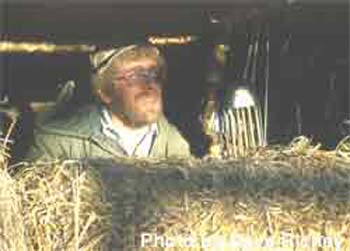
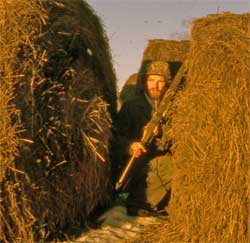
Two type of hay-bale blinds. Usually the hunter sets farther  back in each one.


The deadliest, most unconventional and warmest hunting blind in the deer woods has escaped many hunters. At first guess, many firearm hunters or December bow or muzzleloaders might feel a heated on-the-ground or elevated stand is best.

Not me. For my money, a hay-bale blind blind beats everything else. It has so many advantages, and only one disadvantage. Hunters afflicted with hay fever shouldn't hunt from this type of blind.

The solid points in favor of them are many and all are valid. Here are some great reasons to use such a blind in lake November and December.

A hay-bale blind is warm as toast as long as the wind doesn’t blow in.


*Hay-bale blinds can be constructed from big round bales or the smaller and more manageable rectangular bales.

*A round bale blind is made by putting two round bales together at an angle to form a capital "V." Put a sheet of one-inch plywood over the top, and stack six or eight rectangular bales on top to provide a warm roof over your head.

*A rectangular blind requires quite a few rectangular bales. Pile as many bales up on the left and right sides, and behind you, and put a chair inside to sit on. Stack the bales at least two high in the front, and leave just enough room to shoot. Cover the top with plywood and more bales, and you are set. The disadvantage of this blind is if one or two bales get bumped, the blind will fall like a house of cards.

*Of the two, my favorite is made from round bales. Five minutes with a tractor to move the two round bales together, laying a sheet of plywood on top and several rectangular bales on top and in front to form a shooting window will complete the blind.

*Any hay blind placed before October in a key location will pay off when late-November and December rolls around. The deer will soon get used to it, and by the time the winter archery season rolls around, it will entice deer to your area.

Place hay-bale blinds close to a food source such as a corn field near a trail.


*Key spots for a hay-bale set is near the edge of a cornfield, in an open field where two or more trails converge, or back in the woods where a good trail carries a great deal of deer traffic.

*This blind is warm. Unless the shooting window faces directly into the wind, this is the warmest blind there is. Wet hay builds a certain amount of heat, and hunters can stay warm in the most bitter weather.

*Human odor isn't a problem with hay blinds. The heavier odor of hay serves to cover any human scent inside the blind.

*It would be difficult to consider a hay-bale blind as a bait site although deer occasionally mat eat some of it while the hunter is inside but that's not something one can count on happening.

*Of major importance to me, and to others who use such blinds, is they offer straight-out, horizontal shots at whitetails. There is none of the problems of shooting downward while sitting or standing in a cold tree stand or elevated coop, and deer often walk within six feet of a hay-bale blind. The shots can be impossibly easy to make unless the hunter suffers from buck fever.

These blinds produce heat and absorb most small noises.


*The hay absorbs almost any noise. I've coughed, sneezed, and done other noisy things in a hay-bale blind without having nearby deer hear me. Of course, any movement visible through the narrow shooting window might be spotted.

*Is it too late to build a hay-bale blind? It depends on deer numbers in your area, the available food supply, and how quickly the blind can be constructed. Deer often take three or four days, and sometimes as much as a week, to become accustomed to the blind. But hay bales often are found around field, and often are covered with plastic.

If I were a hunter with a new hay bale blind, I would not sit in it for a week. The one exception to that would be if a major winter storm was due to hit that evening. Every deer in the area will be on the prowl before dark, and I'd suggest being in the new stand no later than 2 p.m.

If snow falls before the deer move, so much the better. It will help cover any human scent, and it can produce the occasional big buck.

Hay-bale blinds are not difficult to make, and they provide everything a late-season bow hunter could ask for: no scent, being as warm as toast, and being in a blind while the deer travel close to it

It doesn't get much better than that.

Posted via email from Dave Richey Outdoors

Thursday, October 21, 2010

Getting the shot ... photos


Many people visit my blog on a daily basis, and those who do know that killing a deer isn't the most important part of my hunting life. There have been too many deer taken over 55 years to shoot a small buck.

So, I sit patiently in a ground blind, elevated coop or tree stand, and wait. I bought a new Canon digital camera with two lens, and it set me back more than $3,000, but I can now reach out and get some of the deer photos that were impossible to get in the past.

My new hobby is taking more and more deer photos. You see, besides getting more photos to illustrate my daily weblogs, it offers one more reason to study deer.

Shooting deer photos teaches hunters about whitetails.


I carry my bow while photographing, but have yet to see a shooter buck this year. So, if there are no good bucks around just yet, I'm content to kick back and watch the passing movements of these animals. Time, as it passes, is working in my favor.

So far, in three weeks, I've passed up three small bucks within easy bow range. I've seen an 8-pointer, a spike and a tiny 4-pointer. I saw one animal on the archery opener that looked like a nice buck with its head down, but it was back in the dark timber, and I just couldn't grow antlers on it. I think it was a buck but couldn't tell.

Taking photos is good practice for a bow hunter. A classic example. Last night I clicked off several shots of a nice 8-point, and he illustrated my blog. The breeze was in my face and he was upwind of me, and most photos came while the wind was blowing. It stopped blowing just as I clicked the last photo, and he heard the shutter noise. You can't shoot photos of deer without that happening on occasion. Often, the deer run off but sometimes the noise doesn't both them.

Even more important than shooting a deer, with bow or camera, is to enjoy the outing. Each day is counted as a blessing, and I look at the bright side of every day.

Yesterday we had 15 minutes of sunlight when the deer moved, and today was windy until sundown. I look for the unusual things, and that satisfies my artistic bent. A beautiful sunrise or sunset is perfect, but so too is the cobalt blue skies that often grace us during October. I enjoy framing deer with natural objects when photos are taken, but it's not always possible, but I seek unusual shots.

For all intents and purposes, our leaf drop has ended. Today's harsh wind and last night's short-lived rain, combined to encourage what few leaves that were left to drop. The woodlots are mostly open now, and seeing deer will become a bit easier from now on.

The chasing phase of the rut will kick off any day now.


The first stage of the rut -- the chasing phase, which is my favorite -- is due to kick off within the next week. With luck, spotting other bucks will be much easier providing they decide to move before sundown. My hint to most sportsmen is to hunt the mid-day hours whenever possible.

I study deer every day I'm in the field, and it's that constant study and attention to minute detail, that allow me to be a good deer hunter. Sure, I study wind currents, stay downwind of the deer, and put myself into situations where the deer will move my way.

These are things learned through constant deer studies. A tail flick can mean one thing to most people, but to me it means that animal may be getting ready to move out of the area. Reading a doe or buck's body language is important because it tells me what is going on around me.

Head-up and alert deer means something can be heard but not seen. Is it another deer or danger? The head-down approach of one buck to another means one of two things: the approaching buck is spoiling for a fight or he is intimidating a subordinate buck.

Posturing is a big part of a deer's world, and watching them pull their ears back and make the neck hairs rise is a cue that something nasty could happen. Often, other deer read these signs accurately, and bail out of the situation before it turns ugly.

Buck fights during the rut can be painful or deadly.


It's been my pleasure to have watched a knock-down, drag-out fight between two evenly matched bucks, and those who believe deer live in a Bambi-like world haven't spent any time in the field during the rut. A serious buck fight is nasty, and often one buck or the other is seriously injured and sometimes killed.

I've seen bucks gored, eyes poked out by an antler tine, skin ripped off their skull, animals with dangling ears or tine holes in their rump, and it's not pretty but it's part of the real world. And I count myself fortunate to be able to watch some of these whitetail pre-rut actions, and hopefully will be able to photograph a major buck fight this fall.

So, if you'll excuse me, I've rambled on long enough. It's time to see what images I've got, and those photos do nothing but whet my appetite for more deer-watching tomorrow.

Posted via email from Dave Richey Outdoors