Showing posts with label odor. Show all posts

Friday, March 04, 2011

Winter thoughts on the whitetail rut

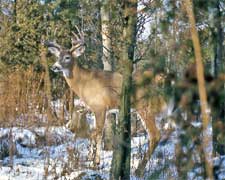
Look at the neck on this rutting buck. He’s a nice buck anywhere.

The buck was banging its antlers against a tree, and I listened to him working a scrape for 30 minutes late last October. The buck was within 20 yards of me but he was screened by thick brush and invisible.

I sat in my tree stand and listened. He was close enough to hear the urine hitting the scrape, and he was upwind and the pungent ammonia odor was strong. He worked that tree over, yanked at the overhead licking branch, and for all the noise and commotion he made, the buck was impossible to see.

I checked the spot the next day. He'd been working two scrapes, and one was eight inches deep and as big around as two large platters. The buck had pulled the old licking branch down, and I replaced it. It suited him because the scrape had tine marks and a hoof print in it, and the new licking branch looked pretty ragged. The second scrape was opened up, and the licking branch was chewed to a frazzle.

Find a new scrape, and check it tomorrow. Hunt nearby if it’s been reopened.

What was even more interesting was that the buck had opened up a third scrape. Huge clots of wet earth was piled at the north end of the scrape, and he had made it the night before. How do I know?

Buck scrapes have dirt and debris piled at one end or another, and if the dirt is piled at the end closest to thick cover, it generally means the deer is tending that scrape in the evening as he leaves the bedding area for a night of chasing cute little does.

This told me several things: One is the rut had not started but the chasing phase had set in. This chasing phase lasts several days before the full rut starts. As long as fresh activity is seen at the scrape, and it is being tended one or more times daily, the rut has not begun. Once the scrapes show no sign of activity, that means the rut is underway.

One thing few hunters realize is that the mid-day hours just before and during the rut can produce a fine buck. This buck may have other nearby scrapes that it had been working, but once a buck is shot and is taken out of the woods, another will take its place. Nature abhors a vacuum, and when a big brown trout or a big whitetail buck is removed, another moves in and takes over.

The mid-day hours are a great time to hunt during the rut.

Hunting from 10 a.m. to 2 p.m. works well during the chasing stage and the rut. If possible, be in your stand by 9 a.m., and sit patiently. The bucks will move during the mid-day hours.

I first learned of this phenomenon many years ago while hunting ruffed grouse. Two days in a row a buck was seen darting away from me in the same area. I checked the area, found his scrapes, and went back and set up a stand 30 yards downwind of it. The buck came by that first day at about noon, wind-checked the scrape from downwind, and offered me a 12-yard shot.

Hunting the pre-rut and the rut during mid-day hours can pay off. Sure, many can't take time off work to hunt those hours, but keep it in mind for weekends. Hunt near natural funnels between bedding and feeding areas, and once the rut kicks in, start hunting the heavier cover.

My only real problem with hunting the mid-day hours is a personal one. I'm good for three hours maximum in a tree before everything gets sore. I'll stick it out until about 2:30 p.m., grab a bite to eat, and then hunt from 4 p.m. until legal shooting time ends. It means spending long hours in a tree, but it can pay big dividends with a husky whitetail buck.

This method has worked for me, and can work for you regardless of where you hunt. Try it this fall and see if it doesn't produce action at a time when no one is hunting. It's rut hunting's biggest secret, and now only you, me and several hundred thousand other people will know.

Posted via email from Dave Richey Outdoors

Saturday, November 20, 2010

Try a late-season hay-bale blind


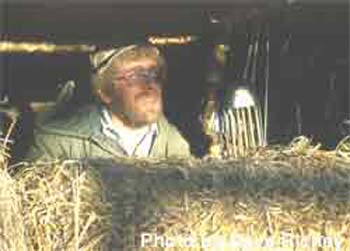
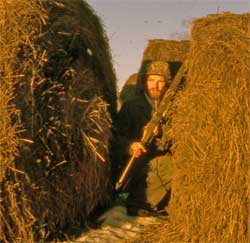
Two type of hay-bale blinds. Usually the hunter sets farther  back in each one.


The deadliest, most unconventional and warmest hunting blind in the deer woods has escaped many hunters. At first guess, many firearm hunters or December bow or muzzleloaders might feel a heated on-the-ground or elevated stand is best.

Not me. For my money, a hay-bale blind blind beats everything else. It has so many advantages, and only one disadvantage. Hunters afflicted with hay fever shouldn't hunt from this type of blind.

The solid points in favor of them are many and all are valid. Here are some great reasons to use such a blind in lake November and December.

A hay-bale blind is warm as toast as long as the wind doesn’t blow in.


*Hay-bale blinds can be constructed from big round bales or the smaller and more manageable rectangular bales.

*A round bale blind is made by putting two round bales together at an angle to form a capital "V." Put a sheet of one-inch plywood over the top, and stack six or eight rectangular bales on top to provide a warm roof over your head.

*A rectangular blind requires quite a few rectangular bales. Pile as many bales up on the left and right sides, and behind you, and put a chair inside to sit on. Stack the bales at least two high in the front, and leave just enough room to shoot. Cover the top with plywood and more bales, and you are set. The disadvantage of this blind is if one or two bales get bumped, the blind will fall like a house of cards.

*Of the two, my favorite is made from round bales. Five minutes with a tractor to move the two round bales together, laying a sheet of plywood on top and several rectangular bales on top and in front to form a shooting window will complete the blind.

*Any hay blind placed before October in a key location will pay off when late-November and December rolls around. The deer will soon get used to it, and by the time the winter archery season rolls around, it will entice deer to your area.

Place hay-bale blinds close to a food source such as a corn field near a trail.


*Key spots for a hay-bale set is near the edge of a cornfield, in an open field where two or more trails converge, or back in the woods where a good trail carries a great deal of deer traffic.

*This blind is warm. Unless the shooting window faces directly into the wind, this is the warmest blind there is. Wet hay builds a certain amount of heat, and hunters can stay warm in the most bitter weather.

*Human odor isn't a problem with hay blinds. The heavier odor of hay serves to cover any human scent inside the blind.

*It would be difficult to consider a hay-bale blind as a bait site although deer occasionally mat eat some of it while the hunter is inside but that's not something one can count on happening.

*Of major importance to me, and to others who use such blinds, is they offer straight-out, horizontal shots at whitetails. There is none of the problems of shooting downward while sitting or standing in a cold tree stand or elevated coop, and deer often walk within six feet of a hay-bale blind. The shots can be impossibly easy to make unless the hunter suffers from buck fever.

These blinds produce heat and absorb most small noises.


*The hay absorbs almost any noise. I've coughed, sneezed, and done other noisy things in a hay-bale blind without having nearby deer hear me. Of course, any movement visible through the narrow shooting window might be spotted.

*Is it too late to build a hay-bale blind? It depends on deer numbers in your area, the available food supply, and how quickly the blind can be constructed. Deer often take three or four days, and sometimes as much as a week, to become accustomed to the blind. But hay bales often are found around field, and often are covered with plastic.

If I were a hunter with a new hay bale blind, I would not sit in it for a week. The one exception to that would be if a major winter storm was due to hit that evening. Every deer in the area will be on the prowl before dark, and I'd suggest being in the new stand no later than 2 p.m.

If snow falls before the deer move, so much the better. It will help cover any human scent, and it can produce the occasional big buck.

Hay-bale blinds are not difficult to make, and they provide everything a late-season bow hunter could ask for: no scent, being as warm as toast, and being in a blind while the deer travel close to it

It doesn't get much better than that.

Posted via email from Dave Richey Outdoors