Showing posts with label downwind. Show all posts

Monday, February 07, 2011

Reading deer sign


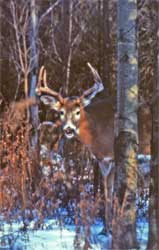
Reading deer sign can put a hunter close to a nice buck like this.


Reading deer sign is something that has always made sense to me. It gives me more knowledge of the animals, where they feed, where they travel, and in the end, it's this knowledge that makes hunters more successful while allowing them to accurately determine where best to set up their stands.

I'm so mindful of a big buck from several years ago. I'd seen him on three occasions but didn't know where he lived. It took me a week of reading October deer sign to pin down his whereabouts.

The area was in fairly heavy cover. I knew the buck had an exceptional 10-point spread, and reasoned he would be working over some big trees to strengthen his neck muscles before the rut began.

Check areas during mid-winter to find the latest buck sign on trees.


I'd moved slowly through the heavy cover without seeing much buck sign except for a few small rubs on some tag alders. I came out the other side of the tag alders, and entered a 25-yard by 25-yard stand of cedars and pines. That is when I worked out this whitetail puzzle.

One of those cedars was scarred by a pre-rutting buck. Lower limbs were broken off, and the trunk was scrubbed hard from a foot above ground to five feet off the ground. Mind you, I couldn't circle my arms around the tree trunk. This gigantic rub was truly huge.

Checking around let me find a faint trail that ran toward another cedar, and it too was rubbed by the same buck. Three trees within 25 yards formed a minor rub line, and the trail had exited the cover I had just walked through. This buck was leaving the tag alder to rub the cedar and pine trees, and most likely, the deer was moving out just before dark.

A nearby tree was perfect for a stand. There would be no clattering and banging required to erect a tree stand here. I'd attach a rope to my bow and my belt loop, lay the bow down flat, climbed 10 feet up the tree on limbs and stand on two thick parallel limbs that grew close together. Another limb came out at waist level, and I could stand on two limbs and lean back against the other one.

It wasn’t a long wait once I climbed into the tree.


Two nights later as the sun was sinking into the western sky I caught the glint of sunlight shining off brownish-white antlers. The buck went to the first tree, thrashed it hard for several minutes, looked around, and went to the second tree and repeated the process. Fifteen minutes later it arrived at the tree just 15 yards upwind of me.

It took a minute for the buck to rake the tree to a pile of fuzzy bark curlings at the base. He nosed his handiwork, lifted his head, moved around the tree to work on the opposite side. The deer was quartering-away at 15 yards, and it was an easy shot.

It's not my policy to advise anyone to stand on cedar or pine boughs and lean against another one, and I don't suggest you follow my lead. However, I knew the limbs would support me for one evening of hunting. I was certain it would lead to a shot at the big buck on the first night, and it did.

That buck was a creature of habit, and such habits can put a deer in trouble. Once the buck stopped rubbing and visiting the nearby scrape, this idea wouldn't have worked. My adventure with that big buck was timed perfectly, and that is where knowing something about the rutting activity comes in handy. From the end of October through mid-November, that tree might not have paid off as the buck hazed does through open fields and thick cover.

Hunting one buck is an adventure, a matter of going after them one on one. It means knowing as much about the area as is possible, and being able to translate that knowledge into an action plan.

There are countless other ways of reading deer sign that will pay off in a big way, and we will cover some other examples in the future. The important thing to realize is that studying deer sign is as much a part of deer hunting as carrying a bow into the woods.

Be alert to deer sign, read what it tells you, and you'll be on your way to becoming a much better deer hunter.

Saturday, January 08, 2011

A turkey call for coyotes


Coyotes run dry ground or snow in the winter. February is the breeding season.


HONOR, Mich. -- You've heard fingernails being dragged down a blackboard. Or chair legs scraping across a tile floor. Right?

The sound seems to rip through your ears and produces an instant headache. It wouldn't be any fun coyote hunting with Roger Kerby of Honor unless you wear ear plugs. His predator call will set your nerves teeth on edge. Just writing about it makes my skin crawl.

He uses a diaphragm call made for turkey hunting. Used in the manner for which it was designed, the call sounds like a turkey. Used how Kerby does it, it sounds like a rabbit being eaten alive by fire ants.

A nasty sound that many coyotes cannot ignore.


He and his wife, Nancy, were cruising the back roads near home recently. They came to a spot, and both jumped out of the car and quietly eased the car doors shut after he grabbed his .308 bolt-action rifle, and they walked silently into an area he had hunted many times before.

The wind was right for this location because downwind was fairly open. Coyotes, when coming to the call, often circle to the downwind side to check for danger.

They sat down, Roger with the rifle across his lap, and inserted the diaphragm call in his mouth. He moved it around to lubricate the latex reed with saliva, took a deep breath, and began calling.

He uses a great deal of force, and leans hard on the reed with his breath. It is pinned hard by his tongue  to the roof of his mouth, and air is forced hard over the reed. The resulting sound will make your ears hurt and keep your eyes moving in search of a coyote.

It is a high-pitched "e-e-e-e-e-ah" sound and was quickly followed by another ear-splitting call. He called steadily for a minute, lowered the volume by reducing the force of his breath over the reed, and then stopped and sat motionless.

His .308 was topped with a scope, and Kerby has excellent vision. He waited for several minutes, and ran through a shorter version of the same call with it ending in a blood-chilling gurgle.

Getting ready for a shot that can come at any time.


A second later he nudged Nancy, and they spotted a coyote a quarter-mile away streaking in their direction. He knew the animal would stop, but kept the scope on the big animal. It stopped about 100 yards away, and the crosshairs settled on its shoulder, and he gently squeezed the trigger.

The coyote swapped ends in mid-air, landed, thrashed once and died.

"I've been using a turkey call for many years," he said. "I have a Stewart electronic caller, and other commercially made hard plastic predator calls, and they work fine. Some days I used the electronic unit if I don't have to carry it far. If I have a long haul over rough terrain, I just carry my turkey diaphragm and my rifle."

A soft huff of air will produce a cluck or yelp like it is supposed to do but that doesn't work for him. It's when he leans heavily on the call, and forces the air hard over the reed that the grating noise comes out.

"Once I shoot," he said, "I keep calling because often other coyotes are around. I've shot three coyotes while hunting from one spot.

"Experience has taught me that too many hunters call a few times, get up and move to another area. Often an unseen coyote is coming, and is then spooked by the moving hunter. Give each spot a little bit of time, and then give it a few more minutes. Some coyotes come running on the first call, some move on the last call, and some coyotes never come.”

Keep moving and trying other locations.


They moved on to another spot where Kerby had killed a coyote the previous week, and tried it. It didn't produce, but that doesn't mean it wouldn't work the next time.

"Some coyotes show an unusual amount of caution, and the next one comes running in like it hasn't eaten in a week," he said. "Each coyote acts differently, and the trick is to be positioned so you can see a coyote coming before he picks up your scent."

Coyote hunting is a passion for Roger Kerby. He spent years guiding deer and turkey hunters, but when snow covers the ground, he gathers up his rifle and diaphragm or electronic call, and heads for the woods and open fields.

The screeching that comes from his diaphragm call will give you the heebie jeebies, but it sounds like the dinner bell ringing to a coyote. He admits that learning how to put the screech into the call and the other little nuances he uses when calling can only be learned by trial and error.

"I don't even remember why I first tried the diaphragm call, but it works just fine," he said. "Whenever I can call a coyote into rifle range, it is a good day. They are one of the most exciting animals there is to hunt on winter snow, and their caution level is always on red alert."

That caution has to be respected by the hunter, and they must make every attempt to avoid being winded. Kerby takes about 10-12 coyotes every year, and considers them one of the most difficult animals to hunt. That's why he likes to call these predators. in as close as possible.

Posted via email from Dave Richey Outdoors

Friday, October 08, 2010

Controlling human scent


Humans have some funny notions, and oddly enough, some people believe them. Our beliefs often are very strong about things concerning hunting, and we sometimes believe them even if they are not true.

The problem is our Daddy or Gran'daddy told us those hoary old thoughts were true. Some of these myths have been passed down from one generation to the next, and most lack any basis in fact.

For instance: we may think we smell just dandy after a bath or shower using a liberal dose of shampoo and soap. We think we smell as natural and pretty as a rose garden, and it's possible that we may smell dandy to ourselves and other humans, but a whitetail deer would probably think we stink.

To a deer, people stink no matter how clean they are.

To a deer, we probably smell as bad as Peppy La-Pew, the skunk, after a face-to-face with a speeding 18-wheeler and getting squashed. We, as humans, can smell the pungent odor of roadkill skunk. Deer, if they get downwind of us, can smell us as easily as we smell Peppy's lingering odor.

I used to be able to smell a fox if I was within 50 yards downwind of the animal, and then in a teen-age quarrel with a beefy guy much larger than myself, I hit him in the fist with my nose and my sniffer hasn't worked right since. Nor have my fighting abilities, so that fight at age 19, was my last. Sadly, the nose still doesn't work right.

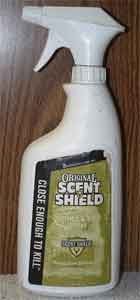
But, this is about fooling deer. A reader wrote today and asked what scent eliminating sprays work. I advised him that he had several options, and one was to buy a Scent-Lok suit. It's the route I choose even though my Scent-Lok suit is now old and tattered and about wore out.

He wanted to know what he personally could do to eliminate his personal odor. He was looking for a shortcut to success without saying so, and even when using the scent-eliminating sprays or Scent-Lok clothing, it is not a cure-all for all of a person's hunting ills.

However, scent-eliminating sprays and Scent-Lok suits can work in much the same way as deer scent or fishing lures do. If the angler or hunter believes in them, their use will usually make that person a better sportsman because hunters are more likely to take the necessary precautions to avoid being winded than other hunters.

Drawing down on deer is great practice as a loudmouth once learned.

Many years ago, while toiling for The Detroit News back when they still had a weekly Outdoor Page, I was sent some Scent Shield scent-eliminating spray. Me and several other sportsmen were hunting deer in the Club Country of Montmorency County as the guest of a good friend.

A guy I invited on the hunt shot a button-buck the first night as it stood 12 yards away, staring at him, and he was bragging on his bow-shooting prowess. He asked what I saw, and I told him I'd drawn down on 15 different deer that night, including two antlered bucks, and chose not to shoot for a variety of reasons. The important reason I didn't shoot was because both animals were small 1 1/2-year-old bucks.

One thing led to another, and he as much as called me a liar, saying that no one can draw on a deer without getting spotted or winded. I told him that he was dead wrong, and he wanted to bet some big money.

"OK, sport, you've been bragging up your new video camera," I said. "I'll prove it tomorrow night. I'll draw down on every deer I see within my shooting range, and you can videotape the action but don't be spooking my deer. I'll be a nice guy and not take your money but I'll teach you a lesson about opening your mouth before engaging your brain."

I climbed up into an oak tree. I'd seen a bunch of deer follow a trail on the far side of a rundown fence next to the big oak. I donned my old Scent-Lok suit, sprayed my boots, groin, legs, torso, butt, back, arms and gloves. I sprayed the Scent Shield on the inside and outside of my cap and my face mask.

The guy was crosswind along a fence-row about 50 yards away where he could see me and the deer as they stepped over the fallen fence. Each time one came by, I drew on the animal and aimed at it as if I was going to shoot before letting up. The first 26 animals were all button-bucks, does and doe fawns, and as the herd began to build 25 yards downwind of me, it became tougher to draw without one of the deer spotting my super-slow movements.

I successfully drew on all 26 deer, one at a time as they passed my tree, and No. 27 was a decent buck. He walked out, I drew, aimed and killed that animal.

I drew on 26 deer without being spotted, and shot the 27th deer, a nice buck.

The joker now had to believe it could be done. He had videotaped me drawing on all 27 deer as they stood directly downwind of me. I wrote that story for The Detroit News, and Scent Shield, the first maker of scent-eliminating sprays, was off and running, and Michigan sporting goods stores sold out of the product overnight.

Lately I've been using Vanishing Hunter spray, which is made by Buck Fever Synthetics in nearby Manton, Michigan. Phone them at (888) 824-9894. I'm also using Scent Killer from Wildlife Research Center in Ramsey, Minn. I go through the same ritual day after day: everything gets sprayed good, and I don't get winded. However, in all fairness, I'm either in an elevated coop or downwind of the travel trails.

I'll also trickle some milkweed fibers into the breeze every few minutes. If any drift downwind to the trail I'm hunting, I pick up and head elsewhere or won't hunt. Getting winded ruins more hunts than anything else.

I know how to sit still, and haven't spooked an incoming buck or doe in many years. Scent-eliminating sprays and Scent-Lok suits certainly have a major place in a hunter's repertoire but nothing can beat being downwind of deer.

I keep all of my hunting clothing and knee-high rubber boots in an air-tight plastic tub. I take the tub out of the car, carry it 50 yards away, sit on a folding chair, and either wear my Scent-Lok suit in cooler weather or lightweight camo clothing in warm weather. I stay away from the car once I've sprayed down my clothing.

Walking hard and fast to a hunting stand can get a guy (or gal) all sweaty, and  that isn't good. The moisture soaks into clothing, and although we may not be able to smell ourselves, it's dead certain that a deer can smell us. I'd rather take an extra 10 minutes to reach my stand, and be cool and collected, than rush and have my clothing saturated with perspiration.

Whenever I use scent-eliminating sprays, everything is sprayed. The front and back of my hunting pants and shirt, my boots, gloves, face mask and hat. I stay away from gasoline and exhaust fumes, and I'm clean when I head into the field. Some people kid me about my fetish for being scent-free but I shoot more and bigger bucks than they do and have more opportunities for good shots.

The key thing is to pay particular attention to those areas that are most likely to get sweated-up during a walk. This would include the head, underarms, groin, rump and feet. Such areas get sprayed thoroughly before every outing, and since I usually hunt seven days a week, my hunting clothing is washed on a regular basis.

Washing camo clothing should be done in Atsko SportWash. It has a gentle cleansing action and does not contain brighteners. Tide and other common household detergents used to wash our clothes contain brightening agents that "make whites look whiter." Me, I want my camo to look dull so it blends in. I don't want bright-looking camo clothing.

I've seen people wearing old camo clothing that has been washed so many times that it is faded out and almost glows in sunlight. I have poor vision, but if it looks bright to me, it must look like a blinking neon light to an incoming deer. The animal may not see the hunter but it can probably see the unusual light-colored blob in the tree. Guess what? That light-colored blob happens to be you. It may be time for new camo clothing.

Using the proper cleansing agent and the proper scent-eliminating spray can help hunters score providing they are properly set up in a good spot, play the wind, do not move, know when to draw, and don't make any noise.

Neither Scent Shield, Vanishing Hunter, Scent Killer or even Scent-Lok clothing can keep hunters from making that one mistake that can and will spook deer. If they get pegged by deer, nothing will enable them to salvage a shot at a wary animal.

These hunter accessories can only make good hunters better. And you've got to be plenty good and scent-free to keep shooting good bucks, year after year, and you can take that little tidbit to the bank.

Posted via email from Dave Richey Outdoors

Friday, October 23, 2009

Hunting Pre-Rut Bucks

Pre-rut deer are like a walking billboard. They advertise themselves in many ways, and savvy hunters may want to bone up on some of the pertinent data that bucks leave behind as they travel around their home turf.

Deer scrapes are where you can find them during the pre-rut. Those scrapes found along field edges often are "boundary scrapes" that mark the edge of a deer's normal range. They are usually small, and somewhat regularly spaced along a wooded field edge.

A deer will open them up, and may never return again. They serve little purpose other than to mark their personal range. I've seen cases where 10 or 12 scrapes will follow a field edge, and once opened, they are never touched again. A string of boundary scrapes should not be confused with a scrape line or a rub line.

When do bucks visit hot scrapes?

The really hot and active scrapes may be visited several times every day, and most of them will be found in fairly thick, heavy cover although some of the largest scrapes I've ever seen were located in a grove of sparse pines.

The scrapes in that area were all as big as a washtub, and every one had fresh urine, a hoof print and antler tine marks in them. Each one had a licking branch directly above the scrape, and most of the nearby pine trees were nearly girdled by the rakings of a large buck. Know this that a really big and hot buck may yank the licking branch down but I've had great success by tying a new limb in its place

I hunted that area several times over two years, and eventually the big rubs and scrapes disappeared. The buck was working on trees 10 to 12 inches in diameter. It would take a huge buck to do that kind of damage, and I never heard of such a buck being taken and it's likely he died of old age. He may never have been seen.

Some tips on scrapes and what they can tell you

Some of what follows may seem elementary but it's important stuff to know. Fresh and actively maintained scrapes are round or oval in shape, and sometimes one will overlap into another scrape. The ground is pawed away until all grass, leaves and twigs are scattered away.

Nearby trees often feature smooth bark but I've seen many rubs on cedar and pine trees as well as popple, tag alder and maple.

A scrape offers great indications about when the buck is visits and works the scrape, and the clues are easy to spot. Most, if not all, of the pawing will be done in one direction. The dirt, grass, leaves and twigs will pile up at one end of the scrape.

If the dirt is piled up at the end of the scrape closest to thick cover, it usually means the buck is visiting it in late afternoon or early evening while leaving his bedding cover. Dirt piled at the end closest to open feeding fields often are visited in the early morning as the buck heads for heavy cover to bed down.

New or old? Good question, and easily answered. Some scrapes are made, and then abandoned. Perhaps the animal was spooked by a hunter, and went elsewhere. Active scrapes are damp with urine, and often feature one or more hoof-prints and/or antler tine marks.

Old and abandoned scrapes fill in with grass and fallen leaves. An active scrape will be cleaned of all debris once to several times a day, because this is where the buck wants to meet an estrus doe. Of course, bucks and does often meet in open fields or woodlands but the initial contact usually occurs near an active scrape.

Scrape hunting can be exciting

Watching a buck work a scrape is really neat. A young buck knows he is supposed to be doing something but he doesn't have a clue. A buck with some age will often wind-check the scrape from downwind, and if it appears to have been visited by an estrus doe, the buck will tend the scrape.

He will paw the dirt, nibble on the overhead licking branch, rub his forehead scent glands on the overhead branches, urinate in the scrape, paw and stomp it into mud, and hang around nearby. This is when a hunter may get a chance for a shot if he is positioned properly.

Some does often hang close by waiting for the buck, and sometimes, the buck will follow the doe's trail. Such tending bucks often give a low grunt as they follow the hot trail. Bucks usually wind-check active scrapes 20-30 yards downwind of the scrape. The hunter, if he sits 40 yards downwind of the scrape can often  intercept the buck coming through and wind-checking as he walks through the arera

Scrapes full of debris are not being used. Scrapes can go from hot to cold overnight, and a previously active scrape that shows no use provides hunters with another important clue. An active scrape that suddenly shows no use means just one thing: the rut has started.

Rut hunting is a fascinating time to be afield but remember the hours of 10 a.m. and 2 p.m. are mid-day hours that bucks prefer. The bucks can appear at any time during the day, and watching a randy old buck hot on the trail of a young doe gives us all hope. Maybe, just maybe, she will lead him past our stand.

One can only hope. Waylaying a nice buck near a scrape does happen but the hunter must always be ready. Big bucks rarely offer a second chance.

Posted via email from Dave Richey Outdoors