Showing posts with label best. Show all posts

Wednesday, July 18, 2012

Find a beaver pond and protect it

The late John Voelker, a.k.a. Robert Traver, casting delicately to brookies on his beloved Frenchman's Pond
photo courtesy Dave Richey Outdoors ©2012

My several experiences fishing Frenchman's Pond with the late John Voelker, a.k.a. Robert Traver, taught me many things about fishing for brook trout.

The Bard of Frenchman's Pond always believed in a calm and delicate fly presentation, and he believed these great game fish respond best to a cautious and delicate approach.

I think of the old Judge often, especially when fishing a back-of-beyond beaver pond where getting to the thing is two-thirds of the battle. The other third revolves around finding a receptive taker. Some beaver ponds are sterile.

Follow a creek upstream and maybe you’ll find a beaver pond

Voelker once wrote that the environs where brook trout are found are invariably beautiful but much of what man has created is not, and if Judge Voelker was right about anything, it was his thoughts that Man could screw up a one-car parade.

Brook trout fishing is occasionally too easy which is why gluttons and other fools who would take a limit of fish today, return to do the same spot tomorrow, and clean up what is left on the third day, should never fish such waters because it is inherently wrong. As wrong as it is, many fishermen subscribe to the theory that if the trout are there, they are meant to be caught.

Such thinking has sounded the death knell for many once-thriving beaver ponds and small streams. The fish simply are too gullible in tiny waters to pass up any chance for a meal.

Show me a beaver pond that holds brook trout, and if the word is spread around, it no longer will be a beautiful, unsullied, fish-producing piece of wonderful water. Sadly, many people subscribe to the "Me first" attitude where the first person in to a pond deserves the spoils. It reminds me of Genghis Khan's philosophy of rape and pillage.

I've been known to park my car two miles away and hike in to a beaver pond to hide its identity and location. I once fished a tiny pond that produced some 14-inch bookies, and the hiding place for my car was between two huge white pines where the boughs obscured my vehicle. I was never found in that location.

Many little jump-across creeks that flow out of a cedar swamp are destroyed; if not by human pressure, than by the worm containers and beer cans or bottles people leave behind. Such things weigh much less when carried out empty than when carried in full.

Beaver ponds come in all shapes and sizes

I began fishing brook trout at a tender age of 11 on some tiny Michigan streams. I began by using bait, and garden hackle threaded onto a hook with one split-shot above, was all it took to catch trout in those long-ago days.

It's all that is needed to catch brookies today. The bad thing is that undersize brook trout love worms, and they will swallow the bait. Easily two-thirds of the fish caught on live bait are killed before they reach legal size.

These days, if the area being fished is too confined for fly fishing, I'll use a number 0 Mepps spinner. Two of the three hooks are cut off, and far fewer fish are hooked too deep. A treble hook simply requires too much time to remove without killing the fish.

Beaver ponds are like rare jewels that sparkle in the distance when glimpsed through heavy conifers. They are generally small and very fragile ecosystems, where the removal of too many trout will cause it to decline into a silt and marl-bottomed pond with no redeeming features.

Don’t tell anyone about a beaver pond; Keep it a personal secret

Some of the best brook trout fishing I've had came on the land of a friend's friend. The man never invited anyone in to fish except my buddy, and he would run others off with threats of calling the police.

My buddy knew that his friend had a fondness for strong drink, and whenever we showed up, a pint of whiskey would change hands. He'd make some excuse to his wife about why we were fishing the pond, and our fishing trips usually began at dark.

We'd carry in our fly rods, waders, swim fins and a belly boat. Wading the edges of that pond was a death trap. We would set off into the darkness, sitting in the belly boat, and cast flies here and there along shore. My friend usually caught the largest fish because he concentrated on the deepest water near the beaver dam.

On occasion, we would speak to each other, but for the most part we silently fished in the dark. Most of those brookies were at least 10 inches long, and we caught a few 16-inchers. We would keep one or two of the smaller fish -- if we kept any at all -- and fished that pond only once or twice a year. The pond went out in a spring freshet when snow melt and heavy rain washed out the dam.

Beaver ponds are like that. They survive between being washed out, and once they are gone, the brook trout go with them. It's while they are vibrant and still alive that they can be the things of which anglers dream of but seldom find.

Posted via email from Dave Richey Outdoors

Sunday, July 01, 2012

Wading tricks to remember

DRO, Some Wading Tips 06.30.12
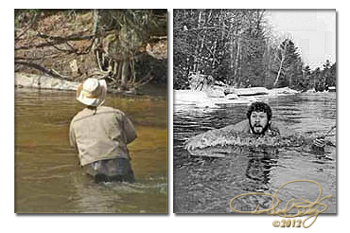
A wading angler fly fishes while another swims in fast water

Water is great stuff. It's wonderful to drink, the right stuff for showers, great to wade in, fun to fish in, and a necessity when hunting ducks in the fall.

However, it is not fun to swim in at this time of year. Here's what happened.

The Betsie River has strong currents in certain locations and dark water. High water complicates things even further because it dirties up once the spring run-off occurs. Seeing bottom becomes problematic or impossible.

Certain areas can only be waded with caution. I knew two early-spawning steelhead were on a bed, and proper positioning had me in the key location to cast a wet fly. Time after time the fly passed their nose, and time and again the male and female parted to allow the intruding fly to swing past.

It may have been the 50th or 60th cast when the male separated early, moved toward the fly, and sucked it in. The hook was set and the fish jumped once. It darted upstream, and fought hard until it began to tire.

The buck steelhead, his cheeks and gill covers the color of orange-pineapple ice cream, put his broad side to the current and started drifting downstream. I was fishing a familiar area, one I knew like my backyard.

It was necessary to stick close to the bank, and with the river swollen with run-off, I knew it would be tippy-toe as the fish tugged its way downstream. The first six steps took me into waist-deep water.

"Cool," I thought. "This isn't too bad. The bottom shelves up 10 feet from here."

That 10 feet was a real treat. Five feet into it my toe bumped against a submerged log that had washed in on high water, and with the water pushing hard on my back, over I went with a mighty splash.

The strong current turned me upside down, rolled me around, sent me feet-first and then rump-first, down around the bend. The fish was still on, tugging at my rod as it was held up out of the water, but a one-armed breaststroke just wasn't cutting it. The river carried me 100 yards around the bend, and as I came to a shallow gravel bar, I heaved my rod up on shore.

My waders were filled with water, and the current ground me into the gravel bar, and finally I was able to get to my hands and knees and crawl across the gravel to shore where I floundered like a beached whale. I grabbed a sapling, pulled myself to my feet, and bent over to dump some water from my waders.

My butt plunked onto the bank as I pulled my waders down and then off, and emptied them back into the river. The temperature was in the mid-20s with a 10 mph breeze, and I had to get my rod and head for the car. Shivering had set in.

My rod was pulled from the brush, and as I reeled in my line, the rod suddenly came alive in my hands. One hundred yards downstream the steelhead bolted into the air, flipped its tail like a farewell wave, and we came undone.

There was a steep hill to climb, and as I reached my car another angler stopped to ask about the fishing. He then noticed I was soaking wet.

"Fall in?" he asked. Here was a man with a magnificent grasp of the obvious.

"Nope," I said, "a big steelhead took me water skiing. The problem was he couldn't pull quite hard enough to keep me up on top. He got away, and all I got was a short but wet and wild ride down the river."

It had been a neat experience. Mind you, it's not one I wish to try again anytime soon, but one that has carved a special niche in my memory.

Some wading tips

  1. Fasten waders tight, and a raincoat over the waders, and cinch a belt tight around your waist and over top of the raincoat and waders. This will keep most of water out of your waders.
  2. Wear a manually inflatable life preserver.
  3. Wear the proper sole for the bottom contour being waded. It could be clears or felt soles.
  4. Wading a stream isn’t like walking down a sidewalk. Shuffle one foot and then the other, and turn sideways to the current. If you turn your back to the full force of the water, it will push you over in the current.
  5. Use a wading staff if necessary. I have back and leg problems from earlier injuries, and a wading staff if helpful to me.
  6. Read the water ahead of you, and learn your wading capabilities. A fast-water rapids, with large boulders or rocks, and when coupled with very strong current, can be a formidable challenge. If you fall, you’ll be out-of-control, and if you hit your head, you could drown.
  7. Look ahead and study the water. Look for a clay or sand bottom, and avoid both if possible. Get too deep in the water, and sand will wash out from under your feet. Get on clay in deep water, and the current push down the slippery surface.
  8. Should fall in, and lose your balance, don’t panic. Try swimming, and if possible, throw the rod and reel into the brush. If that is impossible, throw the rod and reel away from you to prevent becoming entangled in the line. And then swim as if your life depends on it, which it may.
  9. If you are thrust onto a gravel bar, try to keep the current from pushing you off the bar. Try to get to your feet.
  10. Remember, above all else, keep your wits about you and do not panic. To do so may lead to death. Remain calm.

Posted via email from Dave Richey Outdoors