Showing posts with label decoy. Show all posts

Tuesday, August 21, 2012

Try grunting with a deer decoy

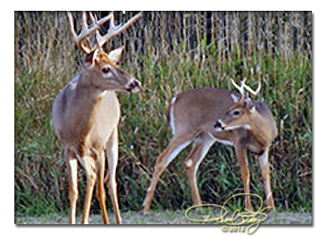
DRO_ Grunting up a buck
There's always a chance a big buck will investigate a grunt call
photo courtesy Dave Richey Outdoors ©2012
If you've never used a grunt tube to call bucks, you may be surprised in two ways: the call, properly used at the correct time, can call a buck within easy bow range.

The second way to be surprised is the sounds the call will make. It vaguely reminds one of ... ah, how can I put this delicately? Ah, ah, let's see ... ah, well, ah, sort of like someone four hours after eating a big plate of refried beans.

There, that's out of the way. For a first-time buck grunter, one often spends the first sequence of calling smiling and silently giggling. Just often enough, a grunt call will effectively pull a nice buck close enough for a decent shot.


A grunt tube sounds obnoxious but it does work...sometimes


There are two things to bear in mind about using a grunt call. No sounds you can make will scare deer away. The second thing is that it works best when you can see a buck.

Here's the scenario. You are sitting in a ground blind or tree stand, and spot a buck some distance away. A low grunt, breathe and grunt again for three or four seconds may stop a buck if he hears the call.
If the wandering buck stops, appears indecisive about what to do, wait and see what it does do. An amazing thing about grunt calls is that one buck will come to the call, and another one won't. You always work on the basic philosophy that this antlered critter is one that will. Feel it and believe in it.

Watch the deer. The animal knows precisely where the sound comes from, and may work his way cautiously or come on a dead run toward you. If the buck walks, trots or runs in your direction, do nothing but get prepared for a shot.


Pay attention to how a buck reacts to a call; Don't over-call


However, if the buck looks around and acts as if it doesn't know what it heard, wait. If the buck turns, and starts walking away, blow another sequence of calls but do so softly. If the buck stops, turns around and looks, wait to see if he will come. If he turns to walk away, give another calling sequence but even softer and shorter than before. Make it sound as if a doe or another buck is walking away.

That often is all it takes to turn a deer around. Watching how a buck reacts to the deer call is very important. Once they start coming in your direction, get ready for a shot because the buck may move to within 10 feet of your position.

There are any number of grunt calls available. There are calls that a hunter can blow into, but they can freeze up in cold weather. Other grunt calls work by inhaling air through the calls. A few have both features where authentic sounding calls can be made by inhaling and exhaling. This gives a very realistic tending buck grunt.


Try using an extension to position your call on the ground


One company believes that most big bucks are never found in trees, and it has an inhale tube that passes through 18 feet of rubber tubing so the call appears to be coming from ground level. This call appeals to me simply because it come from ground level, and a buddy of mine never sits over 15 feet off the ground and he calls bucks to him regularly.

According to my friend the best time to call bucks is prior to the rut. Bucks, he says, pay little attention to a grunt call during the rut and post-run periods. But other hunters disagree with that philosophy. They feel grunting may work anytime during the hunting season. Nothing about a grunt call  will frighten deer so I believe in using them whenever I but bucks within sight can come if they hear the call. It really can pay off at any time of the season.

Grunting with a nearby deer decoy can be deadly early in the season until just before the rut begins. This same man, who shall remain anonymous by his wishes, uses a deer decoy and a long-tubed grunt call at the same time.


Adding a deer decoy improves the effectiveness of a grunt call


He positions the deer decoy where to whether he plans to shoot a buck or a doe. Bucks will almost always circle and come to a doe decoy from the rear. He uses a small strip of white towel, and tacks it to the hind end of his doe decoy. The cloth is saturated with some type of doe-in-heat lure, and he strings 6-pound mono from him to a screw eye to an overhanging branch near the decoy's rump. He ties one end of the mono to the white cloth strip, runs it through the screw eye(s), and to his position in the tree.

If a buck is spotted, he gives one or two grunt sequences, making them soft and guttural sounding. Once the buck looks his way, he gently pulls on the mono line, and the combination of a grunt, the sex lure and a moving white strip of cloth on the doe's rump, makes it looks like a doe flicking its tail. Bucks often move in with caution.

My buddy thinks calling can be overdone. He begins with a short and soft muffled grunt that last one or two seconds, a pause, another longer and slightly louder drawn-out grunt that lasts several seconds, another pause, and a soft and short grunt, and that's it. If needed, repeat the sequence again, but call every 30 minutes. Sometimes blind calling will attract a buck passing through the area even though it is out of sight.

Using a grunt call isn't for everyone. If you feel self-conscious, leave it home. It the sounds doesn't bother you, and you wish to add two more tools to your deer-hunting arsenal, give a grunt call and doe decoy a try.

Nothing ventured, nothing gained.

Friday, April 27, 2012

Buying old turkey hunting books

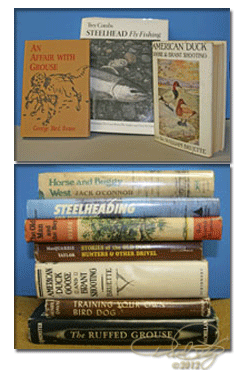
Scoop's Books sells antique, rare and hard-to-find sporting literature
Unique, Rare and Hard-to-Find books are what Scoop’s Books deals in: looking for and For Sale. Contact us today to Buy or Sell.
photos by Dave Richey
I spent just enough time outdoors today to go to the doctor, say hello to my neighbor and bask in the warming breezes. I’m trying to work some nasty knots out of my back, and it’s not working very well.

At 45 degrees, the weather seems almost balmy. I spent some time arranging and rearranging books that will be for sale on my Scoop’s Books website. Some titles are once-in-a-lifetime acquisitions for any sportsmen and some are moderately priced. I may have a new address for my new book website soon. I hope to have 1,000 or more fishing and hunting books up very soon.

These fishing and hunting books are meant to provide two specific things for book buyers: education and information.

I also am placing some books on eBay for auction purposes. Feel free to check them out.

I want to buy your old turkey hunting & duck decoy books

It's obvious that not all sportsmen like to read books, and that is OK. They just don't know what they are missing. There are so many fine fishing and hunting books available and listed on Scoop's Books. Find a book cover that interests you, and email me at the above email address to see if the book is still available.

A hunter might ask: why buy a book on deer hunting? I already know how to deer hunt. Good question but a poor answer. Anyone who doesn't study deer regularly will know something about hunting these animals, but won't know enough about how to hunt them when the going gets tough.

It's the same with turkey hunting books. I buy as money as I can afford for my collection, and still need some others. If you have any turkey titles, and might consider selling them, send me a list of the book titles and the author's name, and I'll get with you soon.

Lots of people can cast a fly, but there are countless books available that can help with casting more accurately but also can teach us how to read the river, determine which insect is hatching, and which patterns will help fool the fish. Nothing is ever guaranteed except paying taxes until you die, but reading can broaden your horizons and help people learn new skills.

I'm constantly looking for fishing or hunting books to buy. I need to buy books in order to sell books, and I'm picky about condition but pay fair prices. So just what am I looking for and hope to buy from you?

I'm primarily interested in turkey hunting titles now. The scarcer they are, the better. Common turkey hunting books I don't need.
The easiest answer is for you to tell me the author's name, the title of the book, and whether it is a paperback or hard-bound book with a dust jacket. From that tiny bit of information, I can usually determine whether I may be or am not interested in buying that title.

Contrary to popular belief, all fishing and hunting books are not scarce. Most also are not worth big money. Many books I turn down are not worth $5, and I have no need for them. But for you, the potential seller, I will pay within reason what it takes to buy books in good shape that I want for resale.

Books with damaged covers, childish scribbles, underlined passages, highlighted sentences, damp-stained covers or those with other faults are not worth offering. I never buy musty, mildewed or ex-library books because they usually aren't worth owning.

Anything noted immediately above is what I don't want

So, c'mon Richey, what exactly are you interested in? I seldom buy new titles. I never buy Readers Digest or condensed books. I prefer books that state 1st edition or 1st printing on the copyright page. I absolutely will not buy print-on-demand books.

Topics of interest to me include Atlantic salmon, muskie, brook trout, tarpon, fly tying, bamboo rod building and other types of fishing books work for me. I crave good books on hunting ruffed grouse, deer, ducks, geese, upland game, wild turkey, woodcock and other hunting books. I have a mild interest in African hunting books but am picky about what I buy. I do pick up books on duck decoys.

Some hunting authors that I'm collecting. Please save this list. There are certain authors I collect.

Robert Austin Fred Bear Havilah Babcock Larry Benoit Wayne Bledsoe
Stewart Bristol Bob Brunner Nash Buckingham Doug Camp Thomas C. Chubback Burns
Peter Hathaway Capstick
(first editions only)
Russell Chatham Wally Chodak Thomas C. Chubb Malcomb Commer
Wingbone Cryer Eugene Connett Ralf Coykendall Paul Dalke Henry Davis
Jack Dudley John Duff George Bird Evans J. Wayne Fears Bill Harper
William Harnden Foster Percy Haver Marv Heeler Vic Jansen John Knapp
Dana Lamb Homer LeBlanc J. Stockley Ligon Doyle Loadholtz John Lowther
Thomas McGuane John Minor Art Moraski Richard Nissley Jack O'Connor
Hoffman Phiilip W. H. Purser John Pusztay Larry Ramsell George Richey
Robert Ruark Ernest Schwiebert Louie Spray Bob Swineheart Robert Traver
Jack L. Turner Ted Vogel Alfred Weed

and many more.

I'm always interested in any books written by Michigan turkey hunters like Denny Geurink. State published turkey hunting, management, ecology, roosting habits, food habits, etc. are needed.

People have nothing invested in offering me books for possible purchase. If I can't or won't buy your books, I'll be happy to explain why. If I do buy, know that I will give you the highest possible price, and hope then to be able to resell the books for a modest profit but that doesn't always happen.

I've never cheated anyone, and don't plan on starting now. My reputation is excellent, and I sell books off my website and some by mail order sales. It's in my best interest to pay the highest possible price, and still realize a potential profit.

I grade books fairly, charge a fair price and pay a fair price when I buy. I've been buying and selling books for 43 years, and one doesn't stay in this kind of business for long by cheating people.

Give me a try. The nasty winter weather is behind us, but late spring rains may stall your outdoor activities.  Take a bit of that time to dig through that pile of fishing and hunting books stashed in the attic, barn, basement, cellar, closet, garage or wherever, write down the author's name, the book title, and whether paperback or hardcover with dust jacket. If you can read this, you can certainly email me and tell me what you have for sale.

It's that easy. And who knows? The book you sell could be valuable or not, but the payment may allow you to purchase some fishing or hunting equipment. Try me and let's see what happens.

Saturday, February 04, 2012

Buying old turkey hunting books

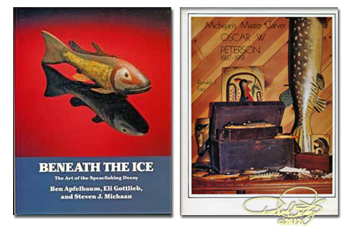
Two examples of nice ice spearing decoy books I sell

I spent just enough time outdoors today to shovel off the deck, say hello to my neighbor and bask in the warming breezes.

At 40 degrees, the snow is mostly off the roof. I spent some time arranging and rearranging books that are for sale on my website at Scoop’s Books. Some titles are once-in-a-lifetime acquisitions for any sportsmen and some are moderately priced.

I also am placing some books on eBay for auction purposes. Feel free to check them out.

I want to buy your old turkey hunting and duck decoy books

It's obvious that not all sportsmen like to read books, and that is OK. They just don't know what they are missing. There are so many fine fishing and hunting books available and listed on Scoop's Books. Find a book cover that interests you, and email me to see if the book is still available.

A hunter might ask: why buy a book on deer hunting? I already know how to deer hunt. Good question but a poor answer. Anyone who doesn't study deer regularly will know something about hunting these animals, but won't know enough about how to hunt them when the going gets tough.

Lots of people can cast a fly, but there are countless books available that can help with casting more accurately but also can teach us how to read the river, determine which insect is hatching, and which patterns will help fool the fish. Nothing is ever guaranteed except paying taxes until you die, but reading can broaden your horizons and help people learn new skills.

I'm constantly looking for fishing or hunting books to buy. I need to buy books in order to sell books, and I'm picky about condition but pay fair prices. So just what am I looking for and hope to buy from you?

I'm primarily interested in turkey hunting titles now. The scarcer they are, the better. Common turkey hunting book I don't need.

The easiest answer is for you to tell me is
  • the author's name
  • the title of the book
  • paperback or
  • hard-bound book with a dust jacket
From that tiny bit of information, I can usually determine whether I may be or am not interested in buying that title.

Contrary to popular belief, all fishing and hunting books are not scarce. Most also are not worth big money. Many books I turn down are not worth $5, and I have no need for them. But for you, the potential seller, I will pay within reason what it takes to buy books in good shape that I want for resale.

Books with damaged covers, childish scribbles, underlined passages, highlighted sentences, damp-stained covers or those with other faults are not worth offering. I never buy musty, mildewed or ex-library books because they usually aren't worth owning.

Anything noted immediately above is what I don't want

So, c'mon Richey, what exactly are you interested in? I seldom buy new titles. I never buy Readers Digest or condensed books. I prefer books that state 1st edition or 1st printing on the copyright page.

Topics of interest to me include
  • Atlantic salmon
  • muskie
  • brook trout
  • tarpon
  • fly tying
  • bamboo rod building
and other types of fishing books work for me.

I crave good books on
  • hunting ruffed grouse
  • deer
  • ducks
  • geese
  • upland game
  • wild turkey
  • woodcock and
  • other hunting books.
I have a mild interest in African hunting books but am picky about what I buy. I do pick up books on duck decoys.

Some hunting authors that I'm collecting; Please save list

There are certain authors I collect.


Robert Austin Fred Bear Havilah Babcock Larry Benoit Wayne Bledsoe
Stewart Bristol Bob Brunner Nash Buckingham Doug Camp Thomas C. Chubback Burns
Peter Hathaway Capstick
(first editions only)
Russell Chatham Wally Chodak Thomas C. Chubb Malcomb Commer
Wingbone Cryer Eugene Connett Ralf Coykendall Paul Dalke Henry Davis
Jack Dudley John Duff George Bird Evans J. Wayne Fears Bill Harper
William Harnden Foster Percy Haver Marv Heeler Vic Jansen John Knapp
Dana Lamb Homer LeBlanc J. Stockley Ligon Doyle Loadholtz John Lowther
Thomas McGuane John Minor Art Moraski Richard Nissley Jack O'Connor
Hoffman Phiilip W. H. Purser John Pusztay Larry Ramsell George Richey
Robert Ruark Ernest Schwiebert Louie Spray Bob Swineheart Robert Traver
Jack L. Turner Ted Vogel Alfred Weed
... and countless others.

I'm always interested in any books written by Michigan turkey hunters like Denny Geurink. State published turkey hunting, management, ecology, roosting habits, food habits, etc. are needed.

People have nothing invested in offering me books for possible purchase. If I can't or won't buy your books, I'll be happy to explain why. If I do buy, know that I will give you the highest possible price, and hope then to be able to resell the books for a modest profit, but that doesn't always happen.

I've never cheated anyone, and don't plan on starting now. My reputation is excellent, and I sell books off my website and some by mail order sales. It's in my best interest to pay the highest possible price, and still realize a potential profit.

I grade books fairly, charge a fair price and pay a fair price when I buy. I've been buying and selling books for 42 years, and one doesn't stay in this kind of business for long by cheating people.

Give me a try. Nasty winter weather will be around for another six to eight weeks. Dig through that pile of fishing and hunting books stashed in the attic, barn, basement, cellar, closet, garage or wherever, write down the author's name, the book title, and whether paperback or hardcover with dust jacket.

If you can read this, you can certainly email me and tell me what you have for sale.

It's that easy. And who knows? The book you sell could be valuable or not, but the payment may allow you to purchase some fishing or hunting equipment. Try me and let's see what happens.

Tuesday, April 05, 2011

Turkey Decoy Tactics 101


This jake is a good bird for a first-time turkey hunter.


Many decades ago, when turkey hunting was only practiced in southern states, using a decoy was unheard of because hadn't been invented yet.
And now, anyone with one or two gobblers to his or her credit has two or more decoys stuffed in the back of their hunting vest. Some folks use as many as five decoys, and I wonder how they can find time during a hunt to put out such a large flock of fake birds.

Hunters who have fallen into the turkey decoy habit may have missed the heart-pounding excitement of calling a gobbler through the woods, and have it come to the call looking for you. The bird may arrive from any direction, including the wrong one, and the hunter must be patient and vigilant as the gobbler struts, drums, gobbles, spits and tries to find the hen. Often the bird may be within a few feet of the hunter, setting your nerves a'jangle.

I was calling for my wife in Iowa several years ago. She was sitting slightly uphill from me as I worked a gobbler on and off for an hour before he shut up. I had my back to a big maple, my left elbow on a wire fence, and was ready to hang it up when something brushed my elbow.

It was a gobbler and a big one. The bird was less than a foot away. I sat still, and the bird walked down hill, jumped through a hole in the fence, and walked within two feet of my boots before heading uphill to her. Kay killed a 28-pound gobbler, and regardless of where you live or hunt, this is a huge bird.


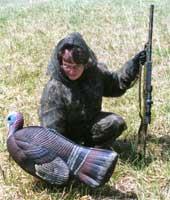
Kay Richey places the finishing touches on this jake decoy.


But this is about turkey decoys, and although I think there is more excitement when hunting without the fakes, I always carry two or three. A flock of four, five or six decoys may work, but I find it cumbersome to carry that many fakes folded up in my vest.

Hunters ask: "Do decoys always work?" The answer is no. I've seen many cases where they didn't work, and many cases where they may have spooked incoming birds, but on average, if they are properly used, a decoy can toll in a big ol' Tom. One major problem is it's possible that two many gobblers may have seen one of their siblings get dusted, and if they see a decoy, some birds head for distant parts.

There have just been too many cases noted among very accomplished hunters where birds come just so far to a small spread of decoys, turn and head off in another direction. Decoys are not a cure-all for all turkey-hunting problems. Good hunting skills are needed.

There are some key things for turkey hunters to remember when using decoys. Here are a few to keep in mind when the season opens.

  • Have the jake turkey facing you at 20 to 33 yards. An adult gobbler can and usually will go to a jake decoy, and face it. The gobbler, once his attention is riveted on the jake decoy, usually forgets everything else. Wait until the bird turns his body and lifts his head and neck to make that area visible for an accurate shot. Don't shoot at gobblers when their head and neck is retracted down into what appears to be their shoulders.

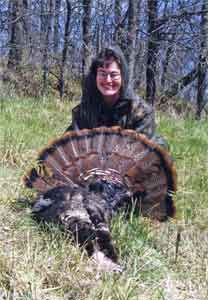
    Kay Richey poses with a nice gobbler take while using the tactics from this article.


    • If you know where the gobbler will come from, it's possible to position the jake decoy 20 yards out and 20 yards to the opposite side. The adult gobbler will walk past you on his way to smacking the fake jake around. It offers an ideal shot. Just make certain you have the shotgun up to your shoulder and be ready for a shot before he reaches the decoy. Things can get a bit frenzied when a gobbler goes after a jake.An adult bird that spots a jake decoy may come or may not. He may be ready to fight, and may hang back. A long-spurred gobbler, once he gets riled up, will put the spurs to a jake. I've had more than one jake shredded by the hooks of a big gobbler. It's a sight to behold, and there is nothing nice about it.
    • Once, many years ago, I had a single hen decoy out and a light breeze made Henrietta turn just a bit on her stake. I had taken an old aluminum arrow, cut it in half, and put a target point on the end that goes into the ground, The end of the stake that went into my decoy had a washer next to the insert, and then another target point was used. The threads went through another washer, and screwed into the insert. This allowed the decoy to move slightly in the wind, which adds a touch of realism to a decoy spread.A gobbler began a slow approach through the woods, and when the bird was 50-60 yards away, the wind picked up and gusted hard. The wind blew the hen decoy around in a full circle, and that movement didn't put a gleam in this gobblers eye. He ran off like his tail feathers had been scorched.

      When I returned home, I found another scrap aluminum arrow, cut it in half, painted it dark brown. I moved the decoy tail back and forth, and inserted one of these stakes at each end of a quarter-circle swing. If the wind gusts, the decoy will move a bit but not too much, and it adds even more realism to your set-up.
    • I dislike a motionless decoy. Watch real hens, and they are head-up, head-down, shaking their feathers and moving around. Your decoy should do the same, but it's hard to make that happen unless there is enough breeze to stir the decoys.
    • My preference, when hunting near a field, is to have the hen decoys out about 15 yards past the jake decoy and away from where the gobbler will come. Separate the hens (if using more than one) by at least 15 to 20 yards. They can be positioned facing in most directions away from the jake.
    • Most decoys are made so the stake can be placed at an angle. I like at least one hen decoys to be tipped forward with its head near the ground as if feeding. It makes your rig look more realistic.
    • I have an old hen decoy that has been jumped and half-shredded by a randy old gobbler. Often, when gobblers are breeding hens, I use this hen and stake her flat to the ground, and place a jake decoy astraddle her. This can bring a longbeard streaking in to rescue the hen for his personal pleasure.
    • I've owned and used many different decoys. I dislike gaudy looking jakes with too much red (and have seen some with orange heads). To me, they just don't look real.
    • Spread your decoys out. Don't jam them together because this is what threatened birds do before they fly or run. Do not use decoys with erect heads. One with its head up is fine, but change the body and/or head position of the others. Don't have all the hen decoys facing the same direction.
    • Decoys require some experimentation. Move them around, but I've found that keeping a jake decoy between hen decoys and the woods gives the illusion that the jake is keeping them corralled.
    • If a gobbler is seen coming fast or slow to the decoys, let the fake birds do their job. Too much calling is a major mistake. Two or three hens, if they are feeding and spot an approaching longbeard, will usually shut their beak. Take a cue from the real birds. Don't call too much but play this part of the hunt slow and easy. Do this, and you'll probably punch that gobbler's ticket whenever your season opens.

      Be careful and stay away from other hunters.