Showing posts with label quality. Show all posts

Saturday, September 03, 2011

Names have a place among sportsmen

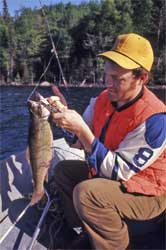
Pat Madigan unhooks a big brookie.


What’s in a name? Much can depend on how anglers and hunters use the name to communicate with other sportsmen. Names can and do play an important role in how we feel and think about the outdoors. And, in many cases, how we choose our next adventure.

They may remind us of a favorite trout pool with mist rising off it or a secret woodcock covert where white splashings cover bracken ferns, and names often play a major part in identifying where we fish or hunt.

Mind you, I’ve been banging around the outdoors for more than 60 years. During that time I’ve learned something about a good many places and things, and it’s fun to talk about these different spots to like-minded sportsmen who share our special name codes. Of course, other folks may have developed their own names to confuse other anglers or hunters.

The Platte River has long been one of my favorite salmon and trout streams. I guided anglers on it and other streams in our northern counties for 10 years, and have fished it for more than 50 years.

The Platte has many local  names that help anglers pinpoint specific locations. For instance, the old Rope Hole, just upstream from the mouth, was the first spot salmon and steelhead would pause on their way upstream to spawn. It was known by this name by many anglers.

The Hole Where It Never Rains was a hotspot until the outlaws began going under the M-22 Bridge to snag fish. The conservation officers also knew where this spot was, but few people had the knack of fishing it.

The trick to fishing this spot was to wait until broad daylight. Any fish in the hole at dawn would stay there. Those people who went under the bridge in the dark would spook the fish upstream or down. The hole would be empty of fish at dawn if anglers tried fishing at night.

There was the Goose Pasture (also called the Goose Grounds), a campground on the upper Platte River off Goose Road. It was always good in the old days when more fish were available than anglers.

There was the Swimming Hole in Honor, the Doctor’s Hole and the Nurse’s Hole, all upstream from Honor. Two favorite spots years ago were the Grades. There were two: the Upper Grade between Haze Road and US-31 and the Lower Grade, downstream from Haze Road. These grades were where an old logging train once crossed the river. Some of the old pilings still remain but the only thing they are noted for now are gravel bars for spring and fall spawning fish.

Think about it. Two anglers in a restaurant are talking about where to fish over bacon and eggs, and one would be heading for the Rope Hole while the other was heading for the Upper Grade. Few other anglers would know what or where they were talking about.

My Home Stream was the Sturgeon River in Cheboygan County between Wolverine and Indian River. I began fishing it at the tender age of 11, and spent every summer camping there to escape the downstate pollen that affected my hay fever. It too is rich in angling history and place names that were, in some cases, rather odd.

I can close my eyes, and think of The Snow Hole, and the spot instantly comes into sharp focus and in full color. The river flows downstream, dropping into a deep hole in front of the old Snow Cabin, and then it makes a sharp 90-degree bend to the left. It then splits into two current flows as it goes around a tiny island before both threads of current connect again.

Nothing much has changed there. It’s the hard bending left turn that send screwball canoers and tubers headlong into the island bushes.
My late twin brother George and I laid claim to the Snow Hole while others who fished the Sturgeon had their favorite spots. The Sturgeon is a wild and free-flowing stream, and it holds steelhead and brown trout.

It also holds the ashes of my twin  brother and of a very fine gentleman and good friend named Russ Bengel. He donated large sums of money to Ducks Unlimited, and loved the river like he loved life itself. One day when my last fishing trip has been taken, and my last hunt has ended, my ashes will mingle with theirs in my beloved Snow Hole.

The Sturgeon is filled with names. Take the White Road Bridge. One might figure the bridge to be painted white, but it was painted red. Go figure. It was easy to throw people off our track if we mentioned going to fish the Five Sisters Hole.

It wasn’t a hole, but a smooth run along the opposite bank, and at the head of the run were five aspen trees growing from a single trunk. The Rain Hole was immediately downstream, and it always paid off with a good fish just before a rain.

You know how it is before a rain. You can smell it on the air. We would race off to the Rain Hole, and if we beat the rain, it always delivered a nice steelhead. It was one of the surest bets on the Sturgeon River.

Then there were the Meadows  pools, the Clay Hole, Yontz’s Hole, Eddie’s Pool, Railroad Bridge and many others. Knowing the whereabouts of these named locations gave some anglers a heads-up on others who were out of the loop.

Rog Kerby admires a nice buck.


Names also applied to hunting, and nowhere was it more pronounced than with grouse or woodcock coverts. Upland bird hunters were more close-mouthed than mushroom pickers and trout fishermen, and the names they gave to each of their favorite coverts were known only to them and two or three close friends who had been sworn to secrecy.

A good friend always starts hunting at the Church covert. This bit of tag alder swale was noted for late October woodcock, and among those of us who knew its location, we kept it a secret for many years. Actually, the secret didn’t come out until the aspen and tag alders grew too high, and it became useless habitat for migrating birds.

The Caboose covert was on private land where I had permission to hunt, and was surrounded by 40 acres of aspen and bracken fern bordered by an old pasture on one side, a road on the other, and the edge of a damp cedar swamp. It produced wonderful grouse and woodcock hunting for many years, and its name was derived from a train caboose sitting in the woods. Don’t ask me why, or how it got there, but it stood for many years. A few of us were allowed to hunt the area for birds, and we flushed more than one grouse from under the caboose.

Then there were key grouse hotspots such as the Grape Arbor Run, the Split Rail Fence, and Old Baldy. The area 20 feet below Old Baldy was grown up to a smorgasbord of grouse foods, and it held plenty of birds until wild turkeys moved in and took over. They used Old Baldy’s sand to dust in, and the grouse moved out.

Another spot that always comes to mind even though shooting grouse has become more difficult in recent years. I called it Dave’s Double, in reference to one of those memorable days when the shooting gods smiled and two grouse flushed. I took the farthest one first, and then swung on the closer bird, and he fell in a puff of feathers. It was my first double on ruffed grouse, and the spot deserved a special name.

In fact, such locations are named for a variety of reasons. Some make sense while others do not, but there it is. We accept such things, and when the whim strikes, we name another location.

Many such spots are meaningless except to us, and then only because something caused them to stand out in our memory. Naming our hotspots is as much a part of fishing and hunting as carrying a rod and reel or toting a shotgun into the woods.

And lest you think all such places are good, I’ll close with one where I won’t be when the deer season closes on Jan. 1. I won’t be in the Willow Tree stand. I tried it once, the wind kicked up, and the willow blew six feet in one direction in a gust, and six feet back. A nice 8-pointer showed up, and I came to full draw and couldn’t keep the sight on the deer.

I gave up and climbed down. Later that night, part of the willow tree broke off and fell to the ground. It smashed up my stand but I was long gone by then, and much wiser for the experience.

Tuesday, April 05, 2011

Turkey Decoy Tactics 101


This jake is a good bird for a first-time turkey hunter.


Many decades ago, when turkey hunting was only practiced in southern states, using a decoy was unheard of because hadn't been invented yet.
And now, anyone with one or two gobblers to his or her credit has two or more decoys stuffed in the back of their hunting vest. Some folks use as many as five decoys, and I wonder how they can find time during a hunt to put out such a large flock of fake birds.

Hunters who have fallen into the turkey decoy habit may have missed the heart-pounding excitement of calling a gobbler through the woods, and have it come to the call looking for you. The bird may arrive from any direction, including the wrong one, and the hunter must be patient and vigilant as the gobbler struts, drums, gobbles, spits and tries to find the hen. Often the bird may be within a few feet of the hunter, setting your nerves a'jangle.

I was calling for my wife in Iowa several years ago. She was sitting slightly uphill from me as I worked a gobbler on and off for an hour before he shut up. I had my back to a big maple, my left elbow on a wire fence, and was ready to hang it up when something brushed my elbow.

It was a gobbler and a big one. The bird was less than a foot away. I sat still, and the bird walked down hill, jumped through a hole in the fence, and walked within two feet of my boots before heading uphill to her. Kay killed a 28-pound gobbler, and regardless of where you live or hunt, this is a huge bird.


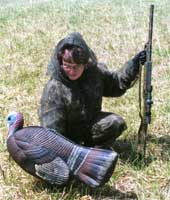
Kay Richey places the finishing touches on this jake decoy.


But this is about turkey decoys, and although I think there is more excitement when hunting without the fakes, I always carry two or three. A flock of four, five or six decoys may work, but I find it cumbersome to carry that many fakes folded up in my vest.

Hunters ask: "Do decoys always work?" The answer is no. I've seen many cases where they didn't work, and many cases where they may have spooked incoming birds, but on average, if they are properly used, a decoy can toll in a big ol' Tom. One major problem is it's possible that two many gobblers may have seen one of their siblings get dusted, and if they see a decoy, some birds head for distant parts.

There have just been too many cases noted among very accomplished hunters where birds come just so far to a small spread of decoys, turn and head off in another direction. Decoys are not a cure-all for all turkey-hunting problems. Good hunting skills are needed.

There are some key things for turkey hunters to remember when using decoys. Here are a few to keep in mind when the season opens.

  • Have the jake turkey facing you at 20 to 33 yards. An adult gobbler can and usually will go to a jake decoy, and face it. The gobbler, once his attention is riveted on the jake decoy, usually forgets everything else. Wait until the bird turns his body and lifts his head and neck to make that area visible for an accurate shot. Don't shoot at gobblers when their head and neck is retracted down into what appears to be their shoulders.

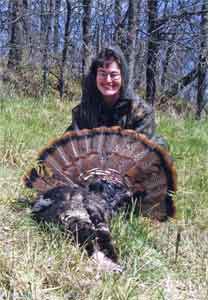
    Kay Richey poses with a nice gobbler take while using the tactics from this article.


    • If you know where the gobbler will come from, it's possible to position the jake decoy 20 yards out and 20 yards to the opposite side. The adult gobbler will walk past you on his way to smacking the fake jake around. It offers an ideal shot. Just make certain you have the shotgun up to your shoulder and be ready for a shot before he reaches the decoy. Things can get a bit frenzied when a gobbler goes after a jake.An adult bird that spots a jake decoy may come or may not. He may be ready to fight, and may hang back. A long-spurred gobbler, once he gets riled up, will put the spurs to a jake. I've had more than one jake shredded by the hooks of a big gobbler. It's a sight to behold, and there is nothing nice about it.
    • Once, many years ago, I had a single hen decoy out and a light breeze made Henrietta turn just a bit on her stake. I had taken an old aluminum arrow, cut it in half, and put a target point on the end that goes into the ground, The end of the stake that went into my decoy had a washer next to the insert, and then another target point was used. The threads went through another washer, and screwed into the insert. This allowed the decoy to move slightly in the wind, which adds a touch of realism to a decoy spread.A gobbler began a slow approach through the woods, and when the bird was 50-60 yards away, the wind picked up and gusted hard. The wind blew the hen decoy around in a full circle, and that movement didn't put a gleam in this gobblers eye. He ran off like his tail feathers had been scorched.

      When I returned home, I found another scrap aluminum arrow, cut it in half, painted it dark brown. I moved the decoy tail back and forth, and inserted one of these stakes at each end of a quarter-circle swing. If the wind gusts, the decoy will move a bit but not too much, and it adds even more realism to your set-up.
    • I dislike a motionless decoy. Watch real hens, and they are head-up, head-down, shaking their feathers and moving around. Your decoy should do the same, but it's hard to make that happen unless there is enough breeze to stir the decoys.
    • My preference, when hunting near a field, is to have the hen decoys out about 15 yards past the jake decoy and away from where the gobbler will come. Separate the hens (if using more than one) by at least 15 to 20 yards. They can be positioned facing in most directions away from the jake.
    • Most decoys are made so the stake can be placed at an angle. I like at least one hen decoys to be tipped forward with its head near the ground as if feeding. It makes your rig look more realistic.
    • I have an old hen decoy that has been jumped and half-shredded by a randy old gobbler. Often, when gobblers are breeding hens, I use this hen and stake her flat to the ground, and place a jake decoy astraddle her. This can bring a longbeard streaking in to rescue the hen for his personal pleasure.
    • I've owned and used many different decoys. I dislike gaudy looking jakes with too much red (and have seen some with orange heads). To me, they just don't look real.
    • Spread your decoys out. Don't jam them together because this is what threatened birds do before they fly or run. Do not use decoys with erect heads. One with its head up is fine, but change the body and/or head position of the others. Don't have all the hen decoys facing the same direction.
    • Decoys require some experimentation. Move them around, but I've found that keeping a jake decoy between hen decoys and the woods gives the illusion that the jake is keeping them corralled.
    • If a gobbler is seen coming fast or slow to the decoys, let the fake birds do their job. Too much calling is a major mistake. Two or three hens, if they are feeding and spot an approaching longbeard, will usually shut their beak. Take a cue from the real birds. Don't call too much but play this part of the hunt slow and easy. Do this, and you'll probably punch that gobbler's ticket whenever your season opens.

      Be careful and stay away from other hunters.