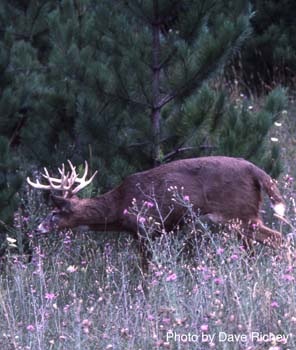
This nice buck is checking his surroundings for danger before moving.
Why do people climb mountains? The answer is obvious. Because they are there.
The same analogy applies to deer hunters. Why do people switch stands methodically. The answer is because they can and should.
A lady bowhunter I know loves to sit in just one stand. She will hunt in it every day of the season if possible. She loves her stand, its location and she knew where the deer would come from to pass within her shooting range.
What's more: she shoots good bucks from that stand. It works for her but this method of hunting is not for me.
I want to know when and where bucks travel. Finding such areas is hard work.
I always want to know what lies ahead and around the next bend in the trail. Each day of deer hunting is a day of discovery for me, and that means moving around from one area to another.
It's not my nature to hunt the same stand two days in a row unless I feel a big buck will show. I watch deer on a daily basis, and know where the bigger bucks travel.
Some bucks get into lockstep with moving along the same trail but many big-antlered deer vary their travel routes and schedules. Young bucks can be patterned, and it's possible to predict with 95 percent accuracy what time the little buck will arrive. Nine times out of 10 they will show up within five minutes of when they are expected.
Now, me, looking at the same scenery day after day takes its toll on my patience. It's much more fun, to my way of thinking, to sit in a different stand every day. It helps me avoid getting into a rut.
My hunting method allows me to move daily, play the wind and not get bored.
My preference is to mix up my hunting activities. One day a treestand will be picked, and the next day it may be a ground blind a mile away. The following day may be an elevated coop, and the next day I may choose a pit blind. This allows me to study different deer, try to pinpoint a big buck and his travel area, and it keeps me from getting bored.
A bored hunter is not an effective one. Move around, try different locations, and it keeps you hunting different areas. Switching hunting spots on a regular basis keeps hunters from being patterned by deer. I will seldom hunt the same spot twice in one week.
Each spot will feature bucks approaching from a new and different angle, and like other sportsmen, it's like learning a new stretch of river. Sometimes the new spots will not pay off, but other times they do.
It's impossible to know how good a hunting area can be if we don't hunt it. A great deal of thought goes into choosing locations for ground or tree stands, and that means someone must sit there and study deer patterns and travel routes under various wind directions.
I want to know everything there is to know about a certain location. There have been times where I've put in a stand, hunted it for a day or two, and pulled it out because something about it just didn't feel right.
Hunters, like many people, listen to gut feeling. They have hunches, and I'll look at it a few times, put a stand up, and know within 30 minutes of crawling into the stand that it isn't right. If it doesn't pass muster the first night, it won't be there the next.
It’s my intention to know about every stand I hunt. It makes me effective.
I don't believe in moving stands just because it goes cold for a week or so. If it has a proven record, it stays in place for a season. I've seen a few stands be cold for most of a season, and then pick up toward the end as deer shift into their winter mode.
The December bow season is long gone, but these tips are meant to give hunters food for thought between now and when December rolls around again. If you are limited to 10 acres, there may only one or possibly two good spots to hunt. If so, switch back and forth. Twenty acres offers two or three spots, and 50 acres offers even more possible stand location choices.
My wife and I once leased 300 acres of deer habitat. It took us a year to learn how to hunt it. We studied travel routes for spring, summer, fall and winter, learned where deer bedded and where they fed.
Study deer movement during all four season, and sooner or later a hunter will put all the puzzle pieces together for one area. If he figures out one spot, it's then time to learn everything possible about another location.
That leased land is a case in point. We'd invite the occasional person to hunt, and it was a big thrill for me to put a young bowhunter in a stand, and tell him: "A buck comes by here every day at 5:25 p.m., and he comes out of the far corner on the right."
I'd sit with him, and say: "Get ready. That buck will be here in five minutes."
Sure enough, the buck had been patterned so well that he would show up on time. It never ceased to amaze the adults or kids I worked with. People get that woods-savvy only be spending long hours in many locations. Do it right, and shooting a buck is pretty easy. Shooting a big buck is much more difficult, but that only increases the thrill of hunting a particular animal.
The key point here is not to get locked into hunting one spot day after day. Sooner or later the deer will pattern you, and that is not a good situation to find yourself in midway through a season ... unless you are my wife. It always seems to work for her.