Showing posts with label aim. Show all posts

Sunday, January 09, 2011

Draw your bow daily


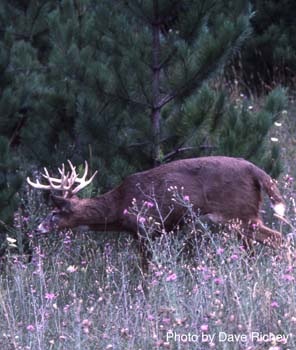
Practice now, and next fall when a buck like this shows up, you’ll be ready.


Many people from all over the state have told me they shoot in an archery league to stay sharp during the winter. Others  have developed some rather ingenious ways to conduct winter practice.

The primary function here is to shoot enough to pick up the bow, draw, aim and shoot without feeling any discomfort. Stay away from shooting of any kind for a month or more, and the bow often feels a bit uncomfortable in your hands. The trick is to stay comfortable with a bow in your hands all winter.

My basement has a 20-yard archery range in it. I can shoot every day if the mood moves me, which it often does.

Shooting a few arrows makes the bow feel five pounds heavier than it really is, and the back and shoulder muscles get sore easily. Shooting is the best cure for any of these problems, and it makes accurate shooting much easier.

Consistent practice, whether just drawing or shooting, is more comfortable.


If a person just has no place to shoot, they can still draw their bow and develop some strength training. Here are several examples of things one can do during winter months to stay comfortable drawing a bow.

A buddy does his shooting out in his cavernous garage. A target is set up at one end of the garage, and he can shoot at distances from 15 to 25 yards. Of course, on a bitter cold day, five or six shots is about all he can handle.

Another friend has a 17-yard archery range in his basement. He is talking about cutting a hole in the wall which would allow him to shoot at 25 yards, and it would more closely simulate shooting from an enclosed hunting blind.

He practices standing up and sitting down while shooting, and this is good. As a rule, he normally shoots while sitting. He can don some fairly heavy clothing similar to what he would wear for December hunts or he can wear lighter clothing to simulate shooting in October.

Still another gent I know does shoot some, but he walks around his house, comes to full draw, centers the sights on the nearest light bulb, telephone or drawer pull, and he finds it is excellent practice.

Just draw and aim at different household objects without shooting.


Most people when they draw on a deer have to fiddle around a bit to get their sight pin on target. All of that uses up time, and if the buck is walking away, it makes people hurry. When they hurry, they usually make a mistake and take a bad shot.

Not this guy. He practices all winter drawing an empty bow and concentrating on putting the sight where he wants the arrow to go. He works hard at it, and when he is shooting he will do the same thing with an arrow on the string. The bow comes up and back, and the arrow is on its way. This only comes from perfect practice.

Such practice makes target acquisition quick and easy. He always nails his anchor point, and if he is on his anchor point and the sight is on the target, a twitch of the finger on a release sends the arrow downrange to where he wants it to go.

Practice can take many forms, but it's important to become somewhat committed to handling your bow during the winter months. I shoot as often as possible, as I follow my no-nonsense method of drawing, achieving my anchor point, aiming and shooting.

How you practice is up to you, but practice is very important when shooting deer.


It gives me the daily practice that I want, and the result is that when it comes time to shoot a deer during bow season, I am ready. My muscles are tuned up, my eyes are sharp, and when I hit my anchor point, a slight adjustment tweaks my aim and the arrow is gone.

Many hunters wait until two or three weeks before the season opens, to start practicing. It's better than nothing, but the people who are the finest shots practice shooting on a regular basis.

Their muscles are all peaked out at a comfortable draw weight, and their eyes automatically center on the aiming point, and all it takes is to touch the trigger, and the arrow goes where it should. It's simple once you begin to practice on a regular basis.

Sunday, November 14, 2010

Firearm rut-hunting tips & Sidebar


It’s roughly 11 hours and a wake-up until the 2010 firearm deer season opens. Some rutting activity is still in progress, and hunters are urged to be alert. Some rain today will have softened up the leaves, but if it frosts tonight, it may be possible to hear deer walking in the woods.


Firearm openers are calendar dates but the rut runs when does are in estrus. One of the hardest things to do is to predict the actions of a rutting whitetail buck. They are very intense, somewhat erratic and flighty, and trying to predict what they will do is like flipping a coin.

Heads or tails? Forward or backward? Right or left? A buck can move in any of these directions but the bottom line is a buck is going to head for where the does are. That's it! That's what hunters must remember!

Bucks in rut are very unpredictable.


If that doe is in estrus, and she shows herself to the buck, hunters know the buck will head her way. The next question is: at what speed? Will he move fast, slow or in the stop-go-stop, herky-jerky manner of rutting bucks?

Shooting a rutting buck is a bit different than a buck at other times of the season. Young bucks are more predictable than an older animal, and it's not uncommon for a young buck to stand motionless and get himself shot.

Rutting bucks, even when still, always seem to be in motion. Their body is moving, the head is up and then down or sideways, and they often move when they first spot a doe. Hunters, especially when in a tree stand, may spot the doe before the buck and get ready for a shot.

Guessing a buck's actions opens a hunter up to making errors. I once watched a buck dogging a doe across a field to a hole in a fence. She jumped right through without stopping. I thought he'd do the same and made my release when his nose entered the hole.

The buck stopped instead of coming through and the arrow sliced harmlessly through the air and stuck in the ground. The buck then jumped through the hole, sniffed the arrow and took off after the doe. No big deal for him but a complete miss for me. So much for trying to second-guess a rutting buck.

Don’t be too eager to shoot. Hunters usually more time to aim than they think.


Some bucks act somewhat predictably and others do not. Study the buck, and it helps to be at full draw when the buck comes into sight or, if rifle hunting, watching it with binoculars. If the buck takes two or three steps and then stops, shoot the instant he stops if it offers a high percentage killing shot. Running the clip dry on a running buck is usually a waste of time.

Sometimes a buck will head into the brush on a doe's trail, and stop before committing himself to the move. Be ready if he hesitates, but this isn't something a hunter can count on a buck doing.

A buck tending an estrus doe will often grunt as he trails along behind. Once the grunt is within bow or rifle range, come to full draw and be ready to shoot once he steps out. Often, a buck will stop just inside a clearing or wide spot in the trail to look around, and that may offer an opportunity for a clear shot.

Hunters who hunt near food sources may find an estrus doe will stop to feed, and the buck may approach as she feeds. I've seen bucks stop near standing corn fields or food plots, but it's not something a hunter can always count on.


Try mouth grunting to stop a buck. It may works, and at other times it won’t.


The one thing that decades of deer hunting has taught me is to always be prepared. Rutting bucks can approach quietly or with noise. A hunter who sits with his bow or rifle hanging off a tree branch usually doesn't have enough time to pick it up, come to full draw, aim and shoot.

All too often a buck moves past a motionless hunter without stopping. Or, if he stops, it is just for an instant and then is off again.

One trick that works on occasion is to wait until the buck is in a perfect spot, and then grunt loud and guttural. A harsh grunt may stop a buck for an instant, but it fails as often as it works. Of course, the hunter can't grunt, raise the bow and shoot. He must be at  full draw when he grunts to stop the animal. A gutteral “eehhh” or “uuhhhh” eliminates the need to hold a grunt call.

The Boy Scouts of America have always had a motto: Be Prepared. It works for BSA members, and it certainly will pay off when bow or rifle hunting rutting bucks. Hunters who are not prepared, both mentally and physically, often miss their golden opportunity.

The only thing deer hunters can count on is the buck’s unpredictability.

Some firearm tips to remember tomorrow.


*Be afield and in your stand at least 45 minutes before sun-up.

*Plan on an all-day hunting, if necessary. Know when shooting times begin and end.

*Pack a lunch in soft cloth towels and bring along something to drink. (Not beer or booze).

*Deer are most likely to move at dawn, between 10 a.m.-2 p.m., and just before dark although if hunters are moving, the deer may move sporadically throughout the day.

*If hunting in the open rather than from a coop, be alert to wind direction and where deer move.

*Fast-paced shots seldom produce when shooting at a running deer moving through heavy cover. After two shots, the barrel heats up and shots begin to wander. It’s far better to watch the animal, and when it offers a standing broadside or quartering-away shot, that’s when to shoot.

*Positively identify your target as a deer. Scan the terrain behind the deer to learn if it is safe to shoot. Observe the 450-foot “safety zone” around houses, cattle, barns, etc.

*Remain as motionless as possible, and keep any sound to an absolute minimum.

*If hunting from an elevated stand, do not load a firearm until after is has been raised into the stand. Use extreme caution when walking into and out of a stand. Use a light in darkness.

*Wear Blaze Orange or Hunter Orange clothing.

Posted via email from Dave Richey Outdoors