Sunday, April 01, 2012

Rummaging Around

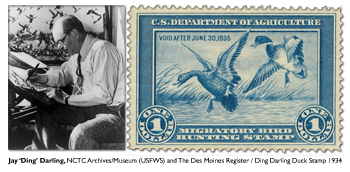
Jay 'Ding' Darling; 1st duck stamp, 1934
Jay 'Ding' Darling, at his drawing table doing what he did best, brought to the early 20th Century a sense of Conservation embodied in the emotive of the wildlife art format he created; the Duck Stamp.
photo/stamp NCTC Archives/Museum (USFWS)
Saturdays are good days for rummaging around in old boxes filled with "junk," as my wife often calls these little bits of forgotten folk art.

None of it is valuable. One thing that captured my fancy for a few minutes was an old 1984 press release celebrating  the 50th anniversary of the Federal "Duck Stamp." This stamp is required of all waterfowl hunters in the United States.

The first Migratory Bird Hunting Stamp, as it was called in 1934, cost one dollar. It was drawn for the Federal government by Jay "Ding" Darling, the Des Moines Register's editorial cartoonist.

Early "Duck Stamps" are valuable if not canceled

Darling led the campaign that convinced Congress to authorize an annual Migratory Bird Hunting Stamp, and his cartoons stuck a painful barb in the hides of greedy swamp drainers, fillers of duck nesting ponds, on-the-take politicians, and others who would destroy our natural resources.

Habitat loss, railed Darling in his scathing editorial cartoons, was a major problem, especially with ducks. Those early stamps, especially Darling's first ever stamp, are worth thousands of dollars for one that has not been canceled by a hunter writing his name across the front or being stamped by the post office. According to old statistics 635,000 of these stamps were sold the first year, and those dollars went into preserving and purchasing waterfowl habitat.

As of 1984, famous waterfowl artist Maynard Reece had the winning duck stamp entry five times -- in 1948, 1951, 1959, 1969 and 1971. Many years ago more than 119 million federal duck stamps had been sold.

Waterfowl have been featured on these stamps every time, except for  one. John Olin's King Buck was featured on the 1959 federal duck stamp. Olin was the president of Winchester/Western for many years, and owned Nilo Farms. Nilo is Olin spelled backwards. That stamp of King Buck, a black Labrador retriever, was a big hit with hunters.

These old stamps and stamp-prints are priceless

It's been said that winning the Federal Waterfowl Stamp contest can and will make the artist a millionaire. Not from the stamp sales, but from sale of other work. It boosts an artist into the upper echelon of waterfowl artists, and their other drawings sell well.

Proceeds from the sale of these "federal duck stamps" continue to help provide better and more waterfowl habitat, now and into the future. They are available from U.S. Post Offices across the country.

My twin brother George was the lure collector in the family. If I ever had anything of any value, George would trade me a book I wanted for a lure he wanted.

I found an old Super Duper lure, and can remember buying my first one in 1956 from Wanigas Rod Company in Saginaw. It was touted as being one of the best trout lures available, and demand for these "clothes pin" lures was strong. They looked like a metal clothes pin, and their shape is apparently what provided the trout-catching action.

Other treasures of a lifetime

Rattling around in the bottom of an old box filled with some old outdoor magazines was a 12 gauge brass shotgun shell. It was a rather nice find although there is little demand for them these days except as a collector's item. I have two.

Talking of old outdoor magazines I found perhaps 1,000 old timers ranging from the 1950s back to the 1920s. I love the art work on those old covers, and there is a rather brisk trade among avid sportsmen for such magazine covers. I have several listed on my Scoop's Books site where I sell them and old books.

Be warned: some different books are being added starting today and tomorrow, and I'm offering some very good deals on books that I'm overstocked with. If you're looking for some hard-to-find items, email me: Dave Richey,  and tell me what you want. Chances are good I have it or can find it.

Sadly many of the old magazine covers get cut off the magazine, and the cover is matted and framed for use as a wall decoration at fishing and hunting camps. Many lure collectors buy these old mags to search for ads  for specific lures. Some lures were in and out of business in less than a year, and a magazine advertisement is collectible in its own right. Old magazines with great color cover art, especially by artist with a national reputation, are no longer cheap. Their value has increased in recent years.

I've found several knives stuck in stumps from when a hunter shot a buck, gutted the deer and then cleaned his hands, and struggled off dragging the deer. Often, the knife was left behind in all the excitement of a successful hunt.

One of those knives was found today in a box. It had once been a pretty knife, but the test of time spent out in the elements dulled the blade and turned it into an object best  thrown out with the trash.

But, I kept this blade for what it had been, not for what it was today. I know what it's like to lose a good hunting knife, and I hope anyone who has found one or two of mine did so before the were ruined. It's my hope they care for my knives as I care for those I find.

Stuff in a box may be junk to one person but it may be a treasure to a pack rat like me. My awe is overwhelming whenever old things from an earlier era are found.

Such days may me very happy.

Friday, March 30, 2012

Sitting Still is an art. Learn now.

Calm your mind before starting to hunt; Don’t think!

sitstill
Sitting still is an art. Sit like you're asleep, but don't. Watch closely and learn.
photo Dave Richey ©2012
There is an art to sitting still. Not only motionless but doing so without making a sound.

It may sound easy but it is a very difficult thing to do. Everyone fidgets at times, moving around, easing that tree stub that pokes you in the back, and swatting at mosquitoes.

Trust me, sitting still is an art. Not everyone can do it, and I can set like a statue but nothing like I could 20 years ago. Age brings with it knowledge and more aches and pains.

Learn some of the sitting-still methods before bow season

The knowledge is what allows me to tune out the sore back, hips, legs and other body parts. Knowledge is the key to becoming a successful deer hunter.
Anyone who ever studies deer should have learned two things very quickly. Stay downwind of the deer, and  learn how to sit still.

It is not easy to sit still. Those who think they are being motionless and silent are, in many cases, moving far too much and making some noise in the process.

How do you sit still? The best way to learn is to go where deer are plentiful, and sit in a tree or a ground blind. See how long it takes before the hunter spooks deer.

Many feel that only spooked deer snort. Lots of deer simply melt back into cover, and leave the area silently. They are spooked but do not snort.

Watch deer, and see how often they stop and look around for danger. I've watched large numbers of deer over the years stand motionless for 30 minutes to an hour after detecting the presence of a hunter. Not a muscle, ear, eye or anything will move it they've  been alerted to nearby human  presence.

One of my hunting friends used to hunt a funnel leading out of a cedar swamp to open hardwoods. The swamp was full of water, and it was easy to tell where the deer were coming from. Deer that were wet clear up to their belly were coming through the swamp. Those deer could be heard coming for 15 minutes as the water sloshed around as they moved slowly.

Develop your own method for clearing your mind

Once he spotted a buck moving slowly, and then it stopped. It was 200 yards away but there was an open spot he could see through with binoculars, and he knew there was a hunter upwind of the deer. That animal stood  in cold November water for over an hour without moving. Dusk came and went, and the buck still stood in the water, as motionless as a statue.

How do you sit still? Part of it comes through practice but much of it comes from a total state of mental relaxation. Put your mind at ease, forget about aches and pains and that stiff little stub poking into your rump.

Tune it out. The more you think about it the more it will bother you. The same is true of mosquitoes early in the bow season; forget about them, and the less you move the less they will bother you.

Think good thoughts about good friends. Leave business problems at the office, and dismiss them from your mind. Mentally think about something calm and pleasing. Put your mind in a relaxed state. Forget missed phone calls or upcoming doctor appointments. Clear your mind of anything and everything, relax and don't think.

Purge your mind of all thoughts and picture yourself somewhere lovely, a spot where you feel a gentle sense of peace, and where nothing can affect you. A friend imagines himself on a calm pond where no wind is felt, no sound is heard, and in his mind he lays back against a boat cushion, stares up at the clouds and his breathing slows down. He keeps seeing that gentle pond in his mind's eye, and he sits quietly and without motion.

Time seems to pass slowly, and almost as if from a haze, out steps a buck. The animal is upwind, sniffing and looking for danger. Sensing none, he steps forward two or three more paces, and stops.

Don’t fall asleep but act like you are; Pay attention to deer

Relaxed, the deer looks around and watches his back trail. As the deer looks away, the hunter slowly and quietly comes to full draw, aims and kills that deer.

It was easy because the hunter was relaxed. A relaxed sportsman, at peace with body and soul, doesn't move and doesn't make a sound.

It takes practice but then so do many other thing in life. Sit in the woods during the summer months, and practice the art of sitting motionless and silent, but realize you needs practice. Do it now, and you'll be ready for the hunting season when it arrives.

Thursday, March 29, 2012

Me and Max fish the AuSable River

Besides trout, Max Donovan loved to hunt ducks and geese

Max Donovan, consumate sportsman and mentor
Max Donovan, consumate outdoorsman and mentor, admires one element of the beauty of waterfowling.
photo Dave Richey ©2012
Some 55 years ago, my long-time mentor -- Max Donovan of Clio -- took pity on the scrawny blond-haired kid with glasses, and took me north to fish the mainstream AuSable River for trout.

"We're going to be fishing near a place called Wa-Wa-Sum," Max said. "It don't make no difference what fly is hatching today. We'll be using the Adams, a No. 12 or 14, I suspect."

Now, a bit of background history. Max was a hemophiliac, a bleeder. He would bleed for a week or more if he nicked his chin while shaving. He also was, at the time, the oldest living hemophiliac who had part of a leg amputated. His "wooden leg," as he called it, worked quite handily and he could wade well at the time.

He also had forgot more about fishing than many know

The drive proved a lesson in history about the inventor of the Adams fly, which we would soon be using. Max had it down pat.

"This here is my favorite fly and I can catch any kind of trout on it that rises to the surface to feed," and after having shared many fishing trips with Donovan, I knew he could do it. "This fly looks like many other flies, and drift it drag-free over a feeding fish, they will take it like they were starving.

"OK, Len Halladay of Mayfield (just north of Kingsley), invented the Adams fly in 1922 to fish on Mayfield Pond and streams such as the Boardman River. He named the fly after his friend, Judge Charles Adams of Ohio."

The fishing was perfect on a great day

Some feel the Adams closely imitates some mayflies and stoneflies. The fly, born at the Mayfield Hotel and first used on Mayfield Pond, has been imitated but Halladay's original creation, is a wonderful catcher of trout.

"Now, listen up, don't you worry about me," Donovan said after his Len Halladay-Adams  one-sided discussion. "I'm heading downstream. I know this stretch of water well, and know where the deeper spots are. I know where the trout hold and where they don't.

"Got any Adams flies," he asked, knowing full well I didn't. "Here are a half-dozen. Lose them all in the trees and it will be a long day. Watch your back cast, don't pitch the flies into the trees, and find a feeding fish. There will be a quiz later about what you've learned while fishing alone."

His lecture on the Adams fly was forgotten as I headed upstream

Off he went, with a little hitch in his git-along, and he would drill casts under over-hanging branches to fish water most anglers could never reach. I watched him fish around the bend and out of sight, and then headed upstream along the bank.

I was looking for rising fish, and soon found some. I'd work into position, cast so the No. 14 Adams landed a few feet above the rising trout. I mended the line like Max had taught me, and soon hooked a 12-inch brown. Into my creel it went, this being well before the catch and release restrictions.

Mind you, this was in the days of yore, long before this stretch near Wa-Wa-Sum became catch-and-release. For me, at the time, fishing was a philosophy of catch-and-keep.

The fish were fairly easy, and I caught several and put a few down with a sloppy cast. One was a beautiful 14-inch brown, and being young and needing praise from the master, the fish was kept.

Time dragged on as the sun started lowering into the west, and I fished back downstream to the end of Thendara Road where we had parked.

There was just enough rising trout to keep me interested

A good fish rose just upstream from the road-end at Wa-Wa-Sum, and I worked him patiently. I erred on the side of caution on my approach, and eventually worked myself close enough to the fish to drift a fly. I switched to a No. 12, a  larger fly, and knew I'd have but one or two casts.

The brown moved to the fly, tipped up and sipped it off the surface. The fish jumped once, settled into a midstream scrap, and he was finally landed.

Some clapping was heard, and Max stood by the car watching, and offered a "Good job. Let's take a look at him."

Max had a way of making me look better than him

He said he never caught a fish but I didn't believe him, but I showed off five fish including two really nice ones. He studied them and me, asked it I'd had a good day, and he was told that it had been a wonderful day.

Then came the quiz. "When did Len Halladay invent the Adams? I had forgotten about the date and the quiz.

"That's great," he said. "In view of your exceptionally good luck and my poor luck, and because you failed the test, I'm going to let you clean all those fish. We will eat them tonight as we think of our trout fishing day, Len Halladay, the Adams fly, and how you really made me look bad.

"For that, you also get to wash and dry all the dishes. My bum leg is getting a bit tender, so I have get off it, and because I'm all gimped up and can't get away, I suppose you'll torture me to death about your fish-catching prowess."

Somehow, I knew I'd get stuck with the cooking and dishes. But that was the price of admission to learn about trout fishing and fly-tying history from the master.

Bless him. He's been gone for nearly 30 years but it's amazing how many memories I have of me and Max fishing and hunting. All are treasured, and will be trotted out occasionally. Stay tune for another at some future date.

Tuesday, March 27, 2012

Always be prepared for a bow shot

The Boy Scouts of America have a famous motto: Always Be Prepared

buckwhitetail
To best the better deer, operate on the Boy Scout motto: "Always Be Prepared"
photo Dave Richey ©2012
That same motto should certainly apply to bow hunters, especially those who hunt the December archery season. Bucks are does can appear and disappear without warning, and hunters who have their bow hanging off a limb or hook are not really prepared.

One of my friends told me last fall that a pair of does snuck in on her, and before she could lift her bow off a nearby limb, the buck and both does had vamoosed. She didn't spook them; the buck was keeping the does away from the food source, and when they left he was pulled along in their wake.

"What did I do wrong?" she asked. She wanted the truth but wasn't really prepared for my answer.

Her problem was the same of most people: not being ready

"You weren't ready," I told her. "I learned many years ago to always be prepared for a shot. The hunter must always be ready, and it's one reason why shooting bucks is easy for me."

If a buck is within range, and offers a broadside or quartering-away shot, from the first sighting of the animal until the arrow slices in behind the front shoulder, is a matter of five seconds or less.

Many hunters tire easily of holding their bow. It fatigues arm, shoulder and back muscles, and stiff muscles are slow to respond.
I often lay my bow across my lap while sitting down, and the release is always on the string. Too many people tell me it takes them 10-15 seconds to get the release on the string when a buck shows up. For most of them, the buck is out of range as they fumble and make small noises while trying to put the release on the string.

They get all jittery at the sight of a buck within bow range, Their heart beat speeds up, they make useless movements and make noise and waste time, and by the time they are ready the buck is gone.

Get into a proper shooting position in your stand, and ready the bow. That means having the release on the string from the beginning to the end of the hunt. Trying to pull a release out of a pocket when a deer is nearby is a lesson in frustration and futility.

Being ready  means a shot is imminent and all things are in place

If my bow rests across my lap, all I have to do is rotate the bow upright, and begin making the draw when the moment is right. Missing that right moment is easy when the hunter isn't mentally and physically prepared.

A friend of mine, who bow hunts about 85 days per year, wears tall knee-high rubber boots as we all do to cut down on human scent. He has developed a novel way of always being ready for a bow shot.

"I sit while hunting, and being right-handed, will stick the lower limb of my C.P. Oneida Black Eagle bow into the top outside edge of my boot," he said. "A buck walks in, and the bow is upright, and I begin my draw (the release is already on the string) while sliding the lower limb out of my boot.

By the time I'm at full draw, my red-dot sight is tracking the animal. When it stops or provides me with an ideal shot, the arrow is released. It takes about two seconds to draw, aim and shoot, and there is very little movement to spook wary deer."

What many hunters don't realize about late-season hunting is that bucks are hungry, and are trying to regain weight lost while in rut. This is a vital concern for them, and if does are traveling with a buck, he may drive them away so he can feed.

Some hunters will pass up a 4-, 6- or small 8-point buck in order to help serve as a steward of our natural resources, and will try to shoot a doe. The does are flighty because bucks are hooking at them with their antlers, and they come in and out and seem to be in constant motion.

Just remember that Boy Scout motto while hunting

Hunters like the woman who missed her opportunity tonight must learn to be ready at all times. It requires paying constant attention. Deer can appear and vanish within a few seconds, and hunters who are reaching for their bow or fumbling with a release are usually too late.

I tend to daydream a bit while on stand but my mind is always aware of what is going on around me. I can slip from an idle daydream into drawing my bow in an instant, and hunters who can do this time after time seldom miss an opportunity to shoot at a buck or doe.

They, like a true Boy Scout, are always prepared for action.

Sunday, March 25, 2012

Savor the memories of friends now gone

George Richey unhooking a fly that he used to catch fish

George Richey unhooking trout; memories that last.
Life is guaranteed to no one. Life can begin and end at a moment's notice. Make time to savore the memories of friends while you can.
photos Dave Richey ©2012
A number of people who have been near and dear to me may have taken life for granted at one time or another. Most of them, in the final days of their life, realized their mistake.

In other situations, some of us don't take things for granted, but life can still step up and blind-side us.

None of us are infallible, and none of us are invincible, no matter how strongly we believe it. Life can begin and end on a moment's notice.

The death of a friend or relative can come suddenly,without notice

My life has been blessed in many ways, and I took my vision for granted until I began losing it. Now, every day is a precious commodity to be wisely considered and lived with a fervent passion.

The problem is that none of us know how much time we have to live. My father, who died of old age, had prostate cancer for years. It didn't kill him but 94 years of life did.

Twin brother George lived life to its fullest. He did nearly everything in life he really wanted to, and learned on a Saturday that he had incurable cancer and he died the following Wednesday.

He didn't go to his Maker kicking and screaming. Hours before he passed away, he told me: "I have no regrets. I've lived a good life, and now I'm ready to go."

Life is meant to be lived to its fullest, Death is permanent

A good friend of mine died two days later in Oregon. He had made it through perhaps ten years in a wheelchair, and died after having lived a full life before a stroke kept him from walking.

Brother George had seven different kinds of cancer, and his pain levels were mild compared to that of others. Why does this happen? Why do so many people die of this disease in agonizing misery while others have an occasional ache or twinge of pain?

My aunt, who died years ago at the age of 84, was a very religious woman. She never smoked or drank, but battled cancer for many years. She attended church two or three times a week, and still the disease finally wore her down.

My first wife died at the age of 40 from cancer. She didn't visit the doctor as often as she should have, but no one deserves such a painful and undignified death.

Three good friends died early. Two had families, but died of self-inflicted gun-shot wounds. Only one was physically ill, and he had inoperable cancer and chose his own time of death.

I talked with him three days before his death

All of these people, with the exception of the two suicides, had cancer. It wreaked havoc on their bodies, and in the end, the pain and the debilitating effects of chemotherapy and radiation probably hastened their demise.

My good friend, Fred Houghton a friend since childhood, died quietly. He loved to fish for walleyes and yellow perch on Saginaw Bay, was married the second time about four years before his death, and kept himself in great shape.

Physical conditioning doesn't bar the way to cancer. It can come calling, as it did with him, and now my old friend is gone. I remember many fishing days from when we both went to Clio High School, and we spent many days over many years hunting ducks and geese.

He lived a good life, retired fairly early, and had everything going his way except for a cancer he didn't know about until it required surgery.

He was pronounced cancer-free, as he told me several months before his death, but the disease took him from us all too soon.

I attended a birthday party for a friend who just turned 90 years old. I've thought about him and another 90-year-old friend all day,

remembering their contributions to my success as a photographer and writer.

I remember while duck hunting on Wigwam Bay near Standish in the late 1950s, when brother George and I were hunting from a sneak boat. My childhood buddy was hunting in the cattails, got cold and tried to climb into our boat.

It didn't work, and the boat finally sank beneath the waves as he tried to clamber aboard. I was the only one without waders (who knows why) but I went down with the ship, and got soaking wet and cold during an early November storm.

My buddy always had a much different version of that story, and we argued long and hard about the merits of his or my version. But the boat went down, and in a good-natured way, I always told him it was his fault. He blamed me, and we both had a good laugh about me getting wet.

That story, now that he is gone, was part of the glue that held us together as friends for over 60 years. As is so true with all of us, one day we will all have run our race.

Fred's race sadly ended early, and I shall cherish his memory and that of my brother and father. He was a good man, a kind and considerate friend, and cancer took him much too early.

I will miss my dear friends, family and relatives. They are gone, and the of us who remain, are stuck with memories. Enjoy them as memories are meant to be cherished, and leave the sadness behind where it belongs.

Wednesday, February 29, 2012

Remembering follow-ups on wounded bears

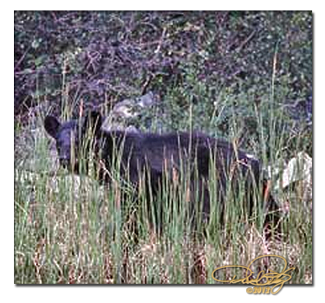
Most times a hunter is tight to a bear without ever knowing it

blakbearingrass

Some odd thoughts  rumble through  my mind without apparent thought or reason. Current weather of circumstances have little to do with when these thoughts come to mind.

I don’t know how it happens. I guess it’s just the way my brain is wired together. Frankly, I  delight in these off-the-wall thoughts because they usually put a gentle spin on an  uneventful day.

I was looking through an old pile of Outdoor Life magazines from the decade when I wrote stories for them  on a regular basis for. One article was about a grizzly bear attack that I'd covered for the magazine.

The biologist was a man who had most of his face chewed or ripped off by a grizzly bear, and lived to tell me the story. The magazine flew me to Salt Lake City where the interview took place.

The man got too close to the bear without knowing it. Bad mistake

He lost one eye, his nose and one ear, and the bear literally ripped his face off. He'd had over 1,000 stitches when I did the interview, and he had more plastic surgeries scheduled.

That got me to thinking about the number of black bears I've killed while mopping up a messy job of shooting by other people. Years ago, when bear hunting meant going into a sporting goods store and buying a license. There was no need for a lottery draw in those days. Few people hunted bruins back then.

One of those kills was a bruin that had been shot in the hip, breaking the leg bone. The hunter was frightened and asked if I'd help. I said I would if he agreed to stay behind so I didn't have to listen to his nervous jabbering.

He agreed, and I went after the bear with a 3-inch magnum 12 gauge shotgun stoked with five No. 4 buckshot. I saw the bear at 40 yards, and hit him. He went down at the shot, got up, came running toward me, and four more shots were taken with the last one at six feet. It finally killed the pain-crazed animal.

I'd read stories as a kid about African hunters shooting a leopard or lion, and then having to dig them out of thick cover and kill them at close range. This was pretty heady business for me, knowing full well I'd never go to Africa. I'd have to settle on killing wounded bears that other people had severely injured but were scared to finish the job.

Another bear led me on a two-day hunt that covered a small swamp bordered on one side by a tiny creek. I had lost any blood sign but had found where the bear had bedded down three times. Finally a drop of blood was found near the creek. I crossed the creek and followed a faint blood trail slowly up a steep hill.

The shotgun barrel preceded me, and bent blades of grass pointed out the path taken by the wounded bruin. I'd just topped the hill when I spotted the bear three feet away. It moved and I shot, and that mess was over.

Take a step, stop, listen and look around, listen again and be silent

Bears have provided me with some hair-raising thrills. People talk about brown bears, grizzlies and polar bears, but more people are attacked by black bears each year than many people believe. Black bears are most common, and I've had some close encounters when armed and unarmed, and it's a thrill most people would prefer to live without.

Only once did I go after a wounded bear with another person, and it was a friend whose skills were legendary. We got that bear, but every other time I've done it was alone. And that was the way I preferred it.

Frightened people talk, make noise, and generally get in other people's way when some serious work must be done. Wounded bears often are shot at very close range in thick cover, and I didn't want anyone nearby for fear they would create a greater hazard than already existed.

I'd move slowly if the going was tough, stopping often and looking around. Of the six wounded bears I've dispatched, none had injuries that would have been immediately fatal. All animals were moving, and often the dirty work was done within an hour of sundown. It meant moving fast and quiet, getting close enough to the animal for a deadly shot. Of those six, only the one noted above required more than one shot.

It isn't something I'd do now because my vision is so poor. Back then I could see well, and there is a major adrenalin rush when the wounded animal is first spotted. Then it means staying downwind and trying to get close to the bruin without spooking it.

Doing this nasty piece of  business was never fun but whenever I went after a bear it was because the hunter couldn't or wouldn't do it. It meant putting an animal out of its misery as quickly as possible. I never advertised my services, never went looking for this kind of work, but for many years I always seemed to be in the area where bears were being hunted and trouble always seemed to find me.

This type of adventure offers more than enough for most people

I did it because someone had to. Otherwise, a frightened hunter may walk away from the problem or wait until the next day and not be able to find the bear.

This string of memories came back to me like a recurring bad dream. This wasn't Africa, and it wasn't a wounded leopard or lion at the end of a blood trail, but they were wild black bears that would be lost or may live long enough to become a danger to someone else.

It offered some hair-raising adventures, and the adrenalin rush was rather addictive to this small-town sportsman. And trust me, these were adventures I'll never forget.

Posted via email from Dave Richey Outdoors

Tuesday, February 28, 2012

Let natural sound help you to shoot deer

This buck watched kids get off a bus, and then I shot him

schoolbusbuck

The big buck moved two or three feet at a time, stopped for a lengthy pause, studied the cover on both sides and in front of him, sniffed the air, and then moved forward again.

He was going nowhere fast. It was obvious this buck had been spooked by another hunter sometime in the past, and he was cautious. There were no other deer nearby -- just him -- and he was taking his slow, sweet time.

Another few steps, and a slight turn, and he would be within range. I looked at my watch, and knew this buck was mine. Every day at about the same time the school bus would come clattering down the highway, stop in front of a nearby house, and the buck would raise his head and look toward the road and listen to the noisy kids getting off the bus.

This buck always seemed to wait and listen for the school bus

He had just finished taking those steps when the bus came to a gear-grinding stop. The big 8-point raised his head, looked out toward the road, and the sounds of the kids getting off the bus caused him to raise his ears. It was a natural sound he had heard many times before.

What he didn't hear was my bow coming back to full draw as he stood quartering away. The arrow sliced in and that buck ran 60 yards before falling, his ears still hearing the kids chattering out at the road.

Deer are accustomed to hearing all types of natural sounds. Some are heard so often they become second nature to a deer. A deer hears the sound, recognizes them for what they are, and doesn't become alarmed.

These natural sounds can work to a bow hunter's advantage. I've deliberately placed elevated coops where the slightest wind will cause the tips of branches to rub against the roof of the wooden stand. It doesn't take a genius to figure out when to draw on a deer standing out in front of that blind. That deer is accustomed to hearing that sound, and hunters should wait until the branches start rubbing against the stand, and then draw, aim and shoot.

Years ago I had a stand placed on the ground near two trees growing out of a single trunk. Any breeze at all, no matter how softly, would cause those two trees to creak. I used the "creaking tree" trick to shoot a number of fine bucks over the years.

I had a stand once that seemed to be directly under the flight path of the Detroit-Traverse City late-afternoon or early evening flight. Perhaps this buck couldn't understand what the noise was, but every day he would stop, lift his head up, point his nose toward that passing jet, and it always provided me with an easy shot.

I passed on shots at that buck for two years, waiting for him to grow a decent rack, and when he did and came by and was in front of me when the jet flew over, it was an easy shot.

Any natural sound that a deer recognizes can  help the hunter

Squirrels running through dry autumn leaves always seem to attract the attention of deer. They may see that squirrel running through the woods a dozen times each day, but whenever they scampered from one tree to another, deer often turn to look at them. This often provides enough noise to cover the drawing of your bow, and the scampering squirrel is actually working on your behalf.

Birds flit overhead, land in nearby trees, and are common sights for deer but they always turn to look at flying birds. The movement catches their attention.

Crows fly overhead, cawing like crazy, making enough racket so 10 people could draw their bows. Deer seem to pay more attention to a crow when it is nearby rather than when 300 or 400 yards away.

Blue jays serve the same purpose as crows except they don't range as far. Jays often flit from bush to tree limb, to the ground, and up to a tree again. Each time the bird moves it attracts the attention of a deer, and when the deer turns to look at the jay, that is when to make your draw providing the animal is positioned properly.

Animal and bird sounds are natural. Let these sounds help you

Hunters must learn to take every possible advantage offered by natural every-day sounds. Wait for the deer to get perfectly positioned, and wait for a noise of movement nearby to attract their attention.

Use that time to come to full draw. Don't hurry it because hunters usually have more time to aim and shoot than they think. Acquire the proper sight picture, hold steady, and make a smooth release.

Hunters who learn this trick seldom go without venison during the winter months. I suspect, with a little thought, you can figure out others to out-smart a nice buck by using natural sounds the animals are accustomed to hearing.

Posted via email from Dave Richey Outdoors