Showing posts with label loss. Show all posts

Sunday, March 25, 2012

Savor the memories of friends now gone

George Richey unhooking a fly that he used to catch fish

George Richey unhooking trout; memories that last.
Life is guaranteed to no one. Life can begin and end at a moment's notice. Make time to savore the memories of friends while you can.
photos Dave Richey ©2012
A number of people who have been near and dear to me may have taken life for granted at one time or another. Most of them, in the final days of their life, realized their mistake.

In other situations, some of us don't take things for granted, but life can still step up and blind-side us.

None of us are infallible, and none of us are invincible, no matter how strongly we believe it. Life can begin and end on a moment's notice.

The death of a friend or relative can come suddenly,without notice

My life has been blessed in many ways, and I took my vision for granted until I began losing it. Now, every day is a precious commodity to be wisely considered and lived with a fervent passion.

The problem is that none of us know how much time we have to live. My father, who died of old age, had prostate cancer for years. It didn't kill him but 94 years of life did.

Twin brother George lived life to its fullest. He did nearly everything in life he really wanted to, and learned on a Saturday that he had incurable cancer and he died the following Wednesday.

He didn't go to his Maker kicking and screaming. Hours before he passed away, he told me: "I have no regrets. I've lived a good life, and now I'm ready to go."

Life is meant to be lived to its fullest, Death is permanent

A good friend of mine died two days later in Oregon. He had made it through perhaps ten years in a wheelchair, and died after having lived a full life before a stroke kept him from walking.

Brother George had seven different kinds of cancer, and his pain levels were mild compared to that of others. Why does this happen? Why do so many people die of this disease in agonizing misery while others have an occasional ache or twinge of pain?

My aunt, who died years ago at the age of 84, was a very religious woman. She never smoked or drank, but battled cancer for many years. She attended church two or three times a week, and still the disease finally wore her down.

My first wife died at the age of 40 from cancer. She didn't visit the doctor as often as she should have, but no one deserves such a painful and undignified death.

Three good friends died early. Two had families, but died of self-inflicted gun-shot wounds. Only one was physically ill, and he had inoperable cancer and chose his own time of death.

I talked with him three days before his death

All of these people, with the exception of the two suicides, had cancer. It wreaked havoc on their bodies, and in the end, the pain and the debilitating effects of chemotherapy and radiation probably hastened their demise.

My good friend, Fred Houghton a friend since childhood, died quietly. He loved to fish for walleyes and yellow perch on Saginaw Bay, was married the second time about four years before his death, and kept himself in great shape.

Physical conditioning doesn't bar the way to cancer. It can come calling, as it did with him, and now my old friend is gone. I remember many fishing days from when we both went to Clio High School, and we spent many days over many years hunting ducks and geese.

He lived a good life, retired fairly early, and had everything going his way except for a cancer he didn't know about until it required surgery.

He was pronounced cancer-free, as he told me several months before his death, but the disease took him from us all too soon.

I attended a birthday party for a friend who just turned 90 years old. I've thought about him and another 90-year-old friend all day,

remembering their contributions to my success as a photographer and writer.

I remember while duck hunting on Wigwam Bay near Standish in the late 1950s, when brother George and I were hunting from a sneak boat. My childhood buddy was hunting in the cattails, got cold and tried to climb into our boat.

It didn't work, and the boat finally sank beneath the waves as he tried to clamber aboard. I was the only one without waders (who knows why) but I went down with the ship, and got soaking wet and cold during an early November storm.

My buddy always had a much different version of that story, and we argued long and hard about the merits of his or my version. But the boat went down, and in a good-natured way, I always told him it was his fault. He blamed me, and we both had a good laugh about me getting wet.

That story, now that he is gone, was part of the glue that held us together as friends for over 60 years. As is so true with all of us, one day we will all have run our race.

Fred's race sadly ended early, and I shall cherish his memory and that of my brother and father. He was a good man, a kind and considerate friend, and cancer took him much too early.

I will miss my dear friends, family and relatives. They are gone, and the of us who remain, are stuck with memories. Enjoy them as memories are meant to be cherished, and leave the sadness behind where it belongs.

Wednesday, March 23, 2011

Get your vision checked yearly

Dave Richey and his two bad eyes. Have yours examined yearly.

Operations do not scare me. They never have and probably never will.

There have been so many eye surgeries: nine on my right eye, the only one that works, and 10 on the left.

It's been a 30-year slugfest against glaucoma. My left eye is sightless. Obviously, there is great concern for any more right-eye surgeries or vision loss but that thought doesn't rule my life.

Skip this blog if you wish, but be aware of the possible consequences.

This blog is written in hopes that readers will have their vision tested at least once each year after turning 40 years old, and be checked for glaucoma. You may see well right now, but most people take their vision for granted, which was hammered home years ago after undergoing my first eye surgery.

Before glaucoma came visiting, no one in the Richey family ever had glaucoma ... until me. We really didn't know that it is the greatest sight robber of all. My father developed glaucoma late in life, and my twin brother was on the bubble for glaucoma when he died in 2003.

My vision was never great, and never was 20-20 corrected vision found in our family. My brother began wearing glasses in kindergarden, and thick glasses covered my face, so it's been glasses or contact lens from that day forward. Now my life became one of eye drops and eye surgeries.

It was after my first glaucoma surgery more than 20 years ago that the idea of looking and seeing, and paying attention to things unseen earlier in my life, became so important. My glaucoma came on suddenly with headaches, blurred vision and preliminary tests were done.

And then came even more complicated tests as doctors determined that my intraocular (inner eye) pressure was four times higher than normal.

Glaucoma pressure at a higher-than-normal rate causes pinching of the optic nerve. The more the nerve is pinched, the more vision loss is noted. By the time they determined that glaucoma had settled in, some of my vision had already been lost. My depth perception began to go, and stumbling over things became a problem, and peripheral vision was soon lost as more and more open doors suddenly jumped out at me.

Vision loss is slow at first but can speed up without notice.

The early surgeries helped, but vision loss kept disappearing like a mirage. Outdoor walks, hunts and fishing trips with friends became more meaningful, and stopping to study the spring flowers and smell the roses, became much more important as time went on.

Soon those spawning salmon and steelhead that had been easy to spot, were now very difficult to see, even with polarized sunglasses. More than once an improper step found me plunging into river bank holes, and on more than one occasion, my wader-clad boots would trip over a submerged log and we'd come splashing ashore through cold water.

My companions thought it was funny, and we laughed at my apparent clumsiness, but it wasn't a case of being clumsy. It was caused by poor vision. No longer was the river bottom in an assumed location.

There have been 19 eye surgeries.

The times spent outdoors have become more dear in recent years. It's easy now to marvel at glowing sunrises and sunset, and although grouse hunting was always a passion, there were more missed birds than before. If they scoot out the sides, my peripheral vision misses them. Once every 10 flushes a bird may be seen somewhat clearly, but that doesn't necessarily translate into a hefty bird in my game bag.

It's still possible to hunt deer, and many folks ask why my bow range for bucks is 15 yards or less, and the answer is the animals can't be seen clearly enough at 20-25 yards to make an accurate shot. Knowing my limitations, and hunting within them is my key to success. Give me a rifle with a quality scope, and there are no missed shots. The magnification allows me to place the bullet accurately, but one can't always walk around with a scope to his eye.

Living in denial doesn't work. Accept the problem but keep working.

It's become necessary to adapt to this problem. My lack of vision and my life has changed and my thought is to ask my valued readers to learn from my situation. Get your eyes checked once a year after the age of 40. Glaucoma damage to an eye is irreversible.

Hunting and fishing has been my life, and now it is slowly changing, and this points out that life holds no guarantees for any of us. My operations have helped save my right-eye vision. My life could be much worse.

Much of my time is still spent outdoors. Winter days are spent tracking bunnies and squirrels around the house or wherever life takes me, and hours are spent watching birds from my kitchen window. It's easy to drink up the outdoor sights like a 21-year-old chugging their first brew. Ice fishing has become a special pleasure for me.

My thought is to store up outdoor memories, to place pictures in my mind of things seen and done, and places visited in the past, and if my surgeries don't do the job, there are memories stored for the future.

Don't feel sorry for me, nor shed a tear on my behalf, and please don't pity me. My life has been one wonderful adventure after another. Day after day, week after week, and year after year for over 40 years, the outdoors has been my private banquet table where one could feast heartily on all sorts of wonderful and exciting fishing and hunting experiences.

Any upcoming surgeries will be just another adventure. Each new day is another adventure as time is spent looking forward to another new experience. Time will tell, but one way or the other, any surgeries needed will happen. So, until then, my vast warehouse of memories continues to grow.

You may have noticed a brief absence of stories lately. That occurred because of computer glitches. Sometimes I can see them and other times I can't, so just bear with me. It's my intention to bring more fishing and hunting stories your way, so stay tune.

Never take your vision for granted, and live each day to its fullest, and suck up all outdoor memories like a new kitchen sponge. One day we may need them to flow vividly through our mind's eye.

Posted via email from Dave Richey Outdoors

Thursday, December 09, 2010

Michigan’s grayling are gone again


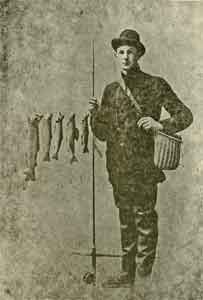
These grayling came from Bear Creek in 1890s. Bert Winnie, Traverse City.


The Michigan grayling were so plentiful 125 to 150 years ago that they were caught by the dozens to eat. Some timber companies of the 1880s fed these tasty game fish to the loggers who were cutting down trees nearby.

The fish with the overly large dorsal fin sustained the men who would ultimately destroy them. As large standing timber along streams were cut to allow more sunlight on the river surface, and the trees were rolled into the rivers to gouge out spawning gravel or clog it with sawdust, the beginning of the end was underway.

Over-fishing, timbering, warming of the stream water, and removal of spawning gravel made the inevitable demise of the Michigan grayling a certainty. Some Lower Peninsula streams held grayling until the early 1900s, and a few grayling were found in the Upper Peninsula, until the fish went extinct in the late 1930s.

Grayling were extinct in Michigan by the mid-1930s.


Waters such as the AuSable, AuGres, Black, Boardman, Boyne,  Cheboygan, Hersey, Jordan, Manistee, Muskegon, Pine and Rifle rivers once held the majority of grayling in this state. Studying data from a book called Trout of Michigan, by Harold Hinsdill Smedley (books from me for $10 plus $3 postage <dave@daverichey.com>), and from a little monograph called The Grayling In Michigan by Charles W. and Edwin P. Creaser of Alma, it quickly becomes apparent that the Michigan grayling went extinct soon after logging ended.

The last holdout for the Michigan grayling was in Houghton County's Otter River where fair to good numbers of fish were still available in the early 1900s. Michigan tried to raise Otter River fish in downstate hatcheries, and many were planted (including some in the Cedar River near Gladwin) but all such plants soon died out.

Other planting efforts took place with the last major plantings of hatchery-reared fish from Alaska and Montana, were made in the 1980s. The fish were planted in the AuSable and Manistee rivers, and in a few small Upper Peninsula streams, and in a few select lakes in both peninsulas, but after three years they had vanished without a trace.

To the best of my knowledge, the Michigan grayling were gone again by the mid-1980s. The last recorded true Michigan grayling was caught in the Otter River in 1935, and the game fish was declared extinct soon after.

It’s doubtful that grayling could survive now in Michigan lakes and streams.


I've caught Arctic grayling in northern Saskatchewan, Canada's Northwest Territories, and in Alaska. I truly wanted to catch a Michigan grayling after the most recent plants 20-some years ago, but even though they had to be released alive if hooked, I didn't want to jeopardize the fish.

Apparently it wouldn't have made much difference because the fish soon disappeared. Grayling did live a bit longer in the cold inland lakes, but I suspect other game fish ate the small grayling for lunch.

The original grayling of this state averaged 8-11 inches with an occasional fish to 14 inches. By comparison, I landed a 4 1/2-pounder in Great Bear Lake in the Northwest Territories. It was mounted in all of its majestic colors, and some slob stole it from a display at the Outdoorama show at the State Fairgrounds in Detroit in the early 1980s.

The large sail-like dorsal fin allowed these fish to put up a good fight. It was like battling a big bluegill when the fish turns its side to the pull of the line. Grayling threw up that big dorsal fin, and the fight becane more difficult. They are wonderful to eat.

The two photos above are both old-timers taken when grayling still survived.


The b/w creel photo above was taken by a gentleman named Hanselman of Ann Arbor about 1886 and shows a nice catch of Michigan grayling from Bear Creek, a Manistee River tributary.

The other b/w photo is of the late Bert Winnie of Traverse City, and was taken about 1894, and may be one of the last photos that exist of a Boardman River grayling. The grayling is the second fish from Winnie's right hand. It has a big dorsal fin.

The grayling in this state are gone, and will probably never be seen in our waters again. However, the city of Grayling owes its name to this great game fish that, like the passenger pigeon, is now extirpated. And state residents are much poorer for that loss.

The Michigan grayling were so plentiful 125 to 150 years ago that they were caught by the dozens to eat. Some timber companies of the 1880s fed these tasty game fish to the loggers who were cutting down trees nearby.

The fish with the overly large dorsal fin sustained the men who would ultimately destroy them. As large standing timber along streams were cut to allow more sunlight on the river surface, and the trees were rolled into the rivers to gouge out spawning gravel or clog it with sawdust, the beginning of the end was underway.

Many factors conspired against Michigan grayling’s survival.


Over-fishing, timbering, warming of the stream water, and removal of spawning gravel made the inevitable demise of the Michigan grayling a certainty. Some Lower Peninsula streams held grayling until the early 1900s, and a few grayling were found in the Upper Peninsula, until the fish went extinct in the late 1930s.

Waters such as the AuSable, AuGres, Black, Boardman, Boyne,  Cheboygan, Hersey, Jordan, Manistee, Muskegon, Pine and Rifle rivers once held the majority of grayling in this state. Studying data from a book called Trout of Michigan, by Harold Hinsdill Smedley (books from me for $10 plus $3 postage <dave@daverichey.com>), and from a little monograph called The Grayling In Michigan by Charles W. and Edwin P. Creaser of Alma, it quickly becomes apparent that the Michigan grayling went extinct soon after logging ended.

The last holdout for the Michigan grayling was in Houghton County's Otter River where fair to good numbers of fish were still available in the early 1900s. Michigan tried to raise Otter River fish in downstate hatcheries, and many were planted (including some in the Cedar River near Gladwin) but all such plants soon died out.

Other planting efforts took place with the last major plantings of hatchery-reared fish from Alaska and Montana, were made in the 1980s. The fish were planted in the AuSable and Manistee rivers, and in a few small Upper Peninsula streams, and in a few select lakes in both peninsulas, but after three years they had vanished without a trace.

To the best of my knowledge, the Michigan grayling were gone again by the mid-1980s. The last recorded true Michigan grayling was caught in the Otter River in 1935, and the game fish was declared extinct soon after.

I've caught Arctic grayling in northern Saskatchewan, Canada's Northwest Territories, and in Alaska. I truly wanted to catch a Michigan grayling after the most recent plants 20-some years ago, but even though they had to be released alive if hooked, I didn't want to jeopardize the fish.

Apparently it wouldn't have made much difference because the fish soon disappeared. Grayling did live a bit longer in the cold inland lakes, but I suspect other game fish ate the small grayling for lunch.

The original grayling of this state averaged 8-11 inches with an occasional fish to 14 inches. By comparison, I landed a 4 1/2-pounder in Great Bear Lake in the Northwest Territories. It was mounted in all of its majestic colors, and some slob stole it from a display at the Outdoorama show at the State Fairgrounds in Detroit in the early 1980s.

The large sail-like dorsal fin allowed these fish to put up a good fight. It was like battling a big bluegill when the fish turns its side to the pull of the line. Grayling threw up that big dorsal fin, and the fight becane more difficult. They are wonderful to eat.

A few details exist about the above photos.


The b/w creel photo was taken by a gentleman named Hanselman of Ann Arbor about 1886 and shows a nice catch of Michigan grayling from Bear Creek, a Manistee River tributary.

The other b/w photo is of the late Bert Winnie of Traverse City, and was taken about 1894, and may be one of the last photos taken of a Boardman River grayling. The grayling is the second fish from Winnie's right hand.

The grayling in this state are gone, and will probably never be seen in our waters again. However, the city of Grayling owes its name to this great game fish that, like the passenger pigeon, is now extirpated. And state residents are much poorer for that loss.

Posted via email from Dave Richey Outdoors