Wednesday, April 11, 2012

Missing my twin brother

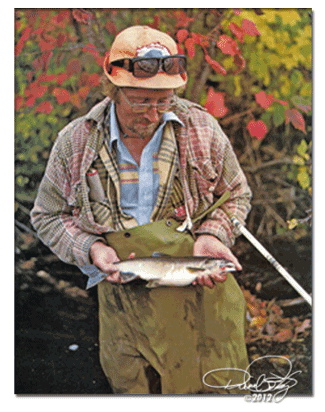
George Richey hold his former State (MI) Record pink salmon
George Richey, holding his former, 2lb. 7oz., Michigan State Record pink salmon.
photo Dave Richey ©2012
It was one of those mid-September days when it felt right to be going through my deer-hunting backpack and sharpening broad-heads. It was something to do while waiting for my next trout fishing trip to arrive.

So I was puttering with my bow quiver of sharpened heads when a memory jolted me as it entered my mind without me thinking. It was of brother George, and he was coming down the Little Manistee River in high water in early April with a rampaging steelhead on his line.

"Try and get a net under this guy," he hollered. "I hooked him a quarter-mile upstream, but he's riding the current broadside. Stick your net in the water, and I'll put him head-first into the net. Ready?"

We'd done this for each other and both knew what to do

My net was pulled from under my belt behind my back, and my rod butt went in underneath the belt. The fish was 10 feet upstream as my net went into the water, and George leaned back on the rod to get the fish up onto the surface, and just at the right time, he dropped the rod tip and the fish dove right into the net. My job was to lift it from the water.

"Good dip," he said, as we waded ashore. The steelhead, a red-sashed male with bright cheeks and gill covers, was 16 pounds of broad-beamed raw power. George worked the No. 4 wiggler fly free, eased the big guy into the river, and with a mighty splash it was gone.

Another time George and I hunted Le Chateau Montebello, a famous resort in Quebec. We were there to hunt deer, and the guide told us we would be lucky to see a deer. If we did, he said, it would be a shooter.

The guy put on one-man drives, and I've been involved in deer drives for most of my life. I can tell good from bad, and this guy was an expert. He walked softly, yipped like a beagle puppy on occasion, and he never hurried the deer. They just moved slowly ahead of him.

We driven deer for years, and this guy was the best I'd seen

Far off, on the third day, I heard him yip softly to let us know he was coming. It was a large area to watch, but 10 minutes later a white-antlered 8-pointer eased from the woods and stood, side-lit by the afternoon sun against a pine, and he was a beautiful sight to behold.
He turned to look the opposite way at George, and I slowly raised the rifle and aimed. He went down at the shot, and George almost beat me to that buck. It was the only deer either of us saw on that hunt, but he wasn't disappointed not to get one. He loved listening to the wolves howl at night, and was happy that one of us shot a good buck.
"Good shot, good buck, and where's the guide?" He asked. "This buck weighs well over 200 pounds, and we will need help to move it far."
The guide showed up, we boiled a kettle to have hot tea with our sandwiches, and then had us a four-mile hike back to his truck and he drove up to the dead animal. It is the only whitetail I've taken in Quebec, but it's important to me because George and I shared the hunt in a unique part of Canada.

Ours was never a competitive thing. We just had fun

Neither of us have ever been truly competitive with each other, but years ago before I wrote the first story about runs of pink salmon in Upper Peninsula streams, George was with me to share what might or might not be an adventure. We didn't know if we'd find the pink salmon.

We would fish pink salmon in the morning and hunt bears in the afternoon, and we found some fish in the Big Huron River. They usually spawned during September on odd-numbered years and we found hordes of them on the first gravel patch above the river-mouth.

We'd been guiding river fishermen for a few years, and started catching pinkies of flies. An orange fly tied on a No 6 hook seemed to produce best, and they were some of George's tried-and-true steelhead and salmon patterns. The fish weren't big but they were aggressive.

"Here's another one," he said. "I'm taking it in to the store to get it weighed. I figure it to be just over two pounds. There's no state record for these fish so one of us should set the record."

Back he came, and it weighed 2 lbs., 3 oz., and so I tried to beat him. Mine weighed 2 lbs., 4 oz. The next day we caught fish of 2 lbs., 5 oz, and then 2 lbs., six oz. It was on the last day that George caught one that weighed 2 lbs., 7 oz., and it became the state record that held up for many years.

I was tickled for him, and he got a Master Angler award, and the mounted fish hung in the DNR offices in Lansing for years before his record was broken. He didn't care. He'd had his "15 minutes of fame."

And that was the neat thing about brother George. He could go with the flow, be happy doing anything outdoors, and greet each new day with a smile on his face. He had the capacity to make people feel good.

He's been gone for nearly nine years, and I miss him greatly. I'd trade many of my tomorrows for a single yesterday, doing something outdoors with him.

Always be prepared for a bow shot

The Boy Scouts of America have a famous motto: Always Be Prepared

buckwhitetail
To best the better deer, operate on the Boy Scout motto: "Always Be Prepared"
photo Dave Richey ©2012

That same motto should certainly apply to bow hunters, especially those who hunt the December archery season. Bucks are does can appear and disappear without warning, and hunters who have their bow hanging off a limb or hook are not really prepared.

One of my friends told me last fall that a pair of does snuck in on her, and before she could lift her bow off a nearby limb, the buck and both does had vamoosed. She didn't spook them; the buck was keeping the does away from the food source, and when they left he was pulled along in their wake.

"What did I do wrong?" she asked. She wanted the truth but wasn't really prepared for my answer.

Her problem was the same of most people: not being ready

"You weren't ready," I told her. "I learned many years ago to always be prepared for a shot. The hunter must always be ready, and it's one reason why shooting bucks is easy for me."

If a buck is within range, and offers a broadside or quartering-away shot, from the first sighting of the animal until the arrow slices in behind the front shoulder, is a matter of five seconds or less.

Many hunters tire easily of holding their bow. It fatigues arm, shoulder and back muscles, and stiff muscles are slow to respond.

I often lay my bow across my lap while sitting down, and the release is always on the string. Too many people tell me it takes them 10-15 seconds to get the release on the string when a buck shows up. For most of them, the buck is out of range as they fumble and make small noises while trying to put the release on the string.

They get all jittery at the sight of a buck within bow range, Their heart beat speeds up, they make useless movements and make noise and waste time, and by the time they are ready the buck is gone.

Get into a proper shooting position in your stand, and ready the bow. That means having the release on the string from the beginning to the end of the hunt. Trying to pull a release out of a pocket when a deer is nearby is a lesson in frustration and futility.

Being ready  means a shot is imminent and all things are in place

If my bow rests across my lap, all I have to do is rotate the bow upright, and begin making the draw when the moment is right. Missing that right moment is easy when the hunter isn't mentally and physically prepared.

A friend of mine, who bow hunts about 85 days per year, wears tall knee-high rubber boots as we all do to cut down on human scent. He has developed a novel way of always being ready for a bow shot.

"I sit while hunting, and being right-handed, will stick the lower limb of my C.P. Oneida Black Eagle bow into the top outside edge of my boot," he said. "A buck walks in, and the bow is upright, and I begin my draw (the release is already on the string) while sliding the lower limb out of my boot.

By the time I'm at full draw, my red-dot sight is tracking the animal. When it stops or provides me with an ideal shot, the arrow is released. It takes about two seconds to draw, aim and shoot, and there is very little movement to spook wary deer."

What many hunters don't realize about late-season hunting is that bucks are hungry, and are trying to regain weight lost while in rut. This is a vital concern for them, and if does are traveling with a buck, he may drive them away so he can feed.

Some hunters will pass up a 4-, 6- or small 8-point buck in order to help serve as a steward of our natural resources, and will try to shoot a doe. The does are flighty because bucks are hooking at them with their antlers, and they come in and out and seem to be in constant motion.

Just remember that Boy Scout motto while hunting

Hunters like the woman who missed her opportunity tonight must learn to be ready at all times. It requires paying constant attention. Deer can appear and vanish within a few seconds, and hunters who are reaching for their bow or fumbling with a release are usually too late.

I tend to daydream a bit while on stand but my mind is always aware of what is going on around me. I can slip from an idle daydream into drawing my bow in an instant, and hunters who can do this time after time seldom miss an opportunity to shoot at a buck or doe.

They, like a true Boy Scout, are always prepared for action.

Posted via email from Dave Richey Outdoors

Tuesday, April 10, 2012

Avoid these turkey hunting mistakes

Do everything right, and avoid Mr. Murphy, and you can shoot a bird

Hunt wild turkeys long enough and you're gonna make a blunder or two. That's bankable.
photo Dave Richey ©2012
"Keep your powder dry" was the motto in the 1700 and 1800s when muzzleloading hunters and frontiersmen roamed parts of North America. Those who failed to follow that sage advice often went hungry or had their hair lifted and cut off below the roots.

My list of hunting mistakes with game, especially turkeys, is endless. Years ago, while hunting in a heavy rain with a muzzleloader, I forgot to cover the muzzle. I set my front-loader against a tree with the powder and shot charge in the barrel but the shotgun wasn't primed.

I set out my decoy, retreated to my chosen spot, and primed the muzzleloading shotgun. A large number of gobblers and hens came, and milled around in a tight circle near the decoy, and I couldn't shoot for fear of killing more than one bird. They eventually left, and I called again.

Make certain to learn the exact location of a roosted longbeard

A lone gobbler a half-mile away answered, and I sweet talked him with a soft yelp and some hen jabber with a push-pull call. He came running up. I saw him first at 30 yards, and then he dropped into a little dip in the ground, and popped up again at 20 yards and stopped. The shotgun was up, and when I pulled the trigger, the primer went off with a pop. The powder did not.

I'd forgotten to put a balloon or anything else over the muzzle to keep my powder dry. The Pyrodex was a black semi-liquid. It was a lesson well learned and never forgotten.

I took a guy out one day, late in the season, and spotted a jake 150 yards away. This guy wanted to shoot a gobbler, and beard length didn't matter. It took 30 minutes to bring the jake within 80 yards, and the guy was aiming at the bird.

"He's too far away," I whispered. "Don't shoot yet. Let him get to within 35 yards." He said the bird was only 35 yards away, aimed and shot.
The young gobbler hauled tail feathers into the woods. The man maintained the bird was only 35 yards away until I asked him to give me a prominent landmark where the bird had been standing. He said the bird was right near that little bush that stood three feet high.

He was urged to pace it off in approximately 36-inch steps as I walked beside him counting the paces. I got 80 steps and he got 77 steps, and then he realized the mistake he had made. It was the last gobbler we saw that day.

Pay attention to distance and don't take long shots

This didn't happen to me but to a friend. He knew, within 50 yards of where a gobbler had roosted the night before. He snuck in the next morning, and stopped well short of the roosting area to wait for the first gobbles of the morning. The sun came up and all was silent.

He gave a very soft tree yelp or two but nothing responded. He stuck with it, and finally with a great deal of impatience, he uncorked a loud yelp on his box call and something happened. A big gobbler bailed out of the tree he was sitting under, and it flew 75 yards, hit the ground a'runnin', and that was it. He had set up directly under the gobbler and missed his big chance.

Two friends, on their first gobbler hunt, went looking before dusk and spotted several dark birds on the ground. Just before dark they flew up into a tree. These guys knew about roosting birds and were happy.

Be positive roosted birds are wild turkeys

They returned the next morning well before dawn, set up about 100 yards away, and waited for the day to wake up. Tweety birds tweeted, crows cawed, and they yelped on box calls. They could see several dark forms in the trees, and called again and again.

Eventually the birds flew down, and went to where the hunters had seen them the previous night. No amount of calling seemed to work, so one of them slowly eased his binoculars from his backpack, and with infinite patience, eased them up to his face and studied the birds.

The birds they had roosted the night before were not real turkeys. They were turkey vultures, and they were feeding on carrion on the ground. They admitted it, and took their share of ribbing.

There is only one sure thing when turkey hunting. Murphy's Law always applies, and simply stated: If anything can go wrong, it will. Keep Mr. Murphy in mind, try to outguess him, and sometimes the gobblers react as you plan and the hunt is a success.

Of course, when we mess up, it's still good for a laugh even when we don't feel much like laughing at our silly mistakes. Trust me on this: if you hunt wild turkeys long enough, you too will make a blunder or two.

Fish stories and deer tales

fishdeertales
All too often outdoorsmen get caught up in stretching their adventures afield so far they frey and break. Too bad, the truth is often far more interesting.
illustration - i65Design+Media; photos - Dave Richey

A deer tale is made up of some of the very same components as fish stories. Both usually require the use of both arms and hands to measure how long the trout was or how wide the  antler spread happened to be on that big buck they missed.

Oddly enough, some deer tales are true. Others may be partly true, and some have no truth to them whatsoever. For them, the  teller seldom lets the truth get in the way of a good story.

Some of these tales will provoke a questioning response from the listener. Some are out-and-out lies, and others may contain a kernel or two of truth simply because they are so outrageous, it seems likely they must contain some truth.

Some people lie when the truth would be more exciting

Over 58 years of hunting, some deer tales have come my way. Many are considered lies because I can see the teller's lips moving, and know he never tells the truth.

Years ago, a man who is not prone to lying told me a tale about a hunter he knew. The gent had watched a nice buck jump a dry drainage ditch at the same place several days in a row. The time was almost always about 5 p.m.

My friend's friend decided to ambush, bushwhack or dry-gulch the animal with a bow when it jumped the dry ditch. He peeked through tall marsh grass and watched as the buck moved closer. He said he came to full draw, while laying on his back in the ditch, and waited ... or so the story went.

The buck was heard near the edge of the ditch, and as the buck sailed over his prone body, he released the arrow. The shaft skewered the buck just behind the brisket, hit the spine, and exited the animal's back.

The buck could be heard alongside the road, flopping about, paralyzed, and slowly dying. He said a driver, sailing along in his car, almost hit the deer as it folded up inches from the edge of the road. The driver nearly had a heart attack, and thought the animal would crash through the windshield, which quite possibly could have happened.

My problem is: how does a bow hunter draw a bow while laying flat on his back? How does he nail a firm anchor point? Go ahead, try it: try laying on your back and draw an arrow.

Could it have been done? I doubt it. What do you think?

This next story I’ve heard from several people. Some truth involved,

Years ago several guys traveled to Tennessee each year to hunt those wild Rooshian boars, as the locals called them. Their weapon of choice was a spear. They found a boar, taunted it until it charged, and when the boar with its knife-sharp tushes came at them, they would put the back end of the spear in the ground, and when the pig charged, they met the charge with a spear point.

The storyteller said they killed several boars with a spear, and wanted to try it on deer. They knew it would be impossible to get a buck to charge so decided to try spearing a deer from a tree stand, even if it wasn't legal.

One of these yahoos saw a small buck walk past his stand, and he drew back his arm and threw the heavy spear with all of his might. The point went in behind the front shoulder, knocked the deer over, but it ran off and the spear fell out.

The violator climbed down, gathered up his bloodied spear, and started following the blood trail. He trailed the deer for some distance, saw it laying dead and walked up to it.

He squatted down, the spear held with the point upright like an African warrior, to admire the splendid throw he'd made. The spear was suddenly snatched from his hand. He jumped up, cussing up a streak, only to see a smiling conservation officer. The gent lost his deer and spear, received a ticket, paid a big fine, and lost his right to hunt for three years. That was rather a boneheaded play.

The fish and game we take deserve the truth, not a bunch of lies.

Such stories are almost too far-fetched to be true. Both show a wonderful sense of imagination, even if they probably aren't true. One of the secrets to telling a joke, a tall tale or a lie, is each one should contain some semblance of truth.

It's that little dash of truth, like mustard on a hot dog, that makes the tale somewhat tasty to the listener and easier to swallow. And, over many years, I've spent a good deal of time with conservation officers, and some of the tales they tell are about as far off center as these. So, perhaps they could be true.

I've got some other whoppers I've heard in the past, and some day soon I'll trot out a few more for your reading pleasure. If you've got a good one, send it along.

Posted via email from Dave Richey Outdoors

Monday, April 09, 2012

Fool a gobbler on his turf

Choose your spot wisely and you’ll shoot a nice gobbler

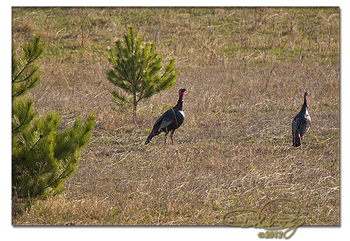
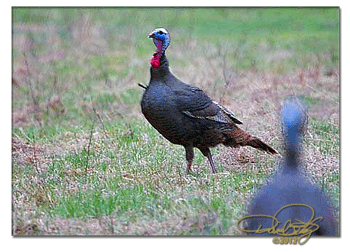
Wild turkey's on home turf
Make the right assumptions and you will fool that gobbler on his home turf and enjoy a successful hunt.
There are a great number of assumptions in today's blog. I am assuming that you'll roost a big gobbler the night before your turkey hunt opens.

We further assume you know which tree he will roost in, and which little wooded opening he will try into. For good measure, we'll also assume the direction he and his harem of hens will take to the closest strutting zone after fly-down.

I told you there were many assumptions. And, if you think about it very long and hard, you will note such basic assumptions exist on almost every spring turkey hunt.

Now, the trick is to get into place within 100 yards (give or take 25 yards) of the roosted limb-hanger. The question of the day is simple: Does the gobbler fly down into the field or into a wooded opening?

If the open field is close, it can affect where you choose a stand. If the bird lands in the woods, the hunter can set up in the woods, along the path they normally travel to get to the field or near the field edge.

If you don't assume correctly, you are counting on luck

There are hazards to setting up near the wooded opening. It is easy to bump a bird if you mistakenly get too close to the roosted gobbler and he or his hens hear or see you moving into position.

Another problem with setting up in the dark is it is lighter from above, and the bird can see down into the woods better than you can see while sitting down in the woods. The fly-down may come so early (minutes before actual sunrise), and it can fly down and the beard may not be clearly visible. The gobbler may walk past a hunter gobbling like crazy, and it's easy to assume this is a gobbler (which it probably is) but it may have lost its beard. It wouldn't be legal to shoot a beardless bird.

I prefer to set up fairly close to the open field, and call once or twice to get the attention of the gobbler, and sit back to see what happens. Just remember now to face the west when you set up or you may be looking directly into a fiery sunrise and not be able to see the gobbler as he moves past.

Pop the bearded bird if it flies right to you at fly-down

The trick here is to move 10 to 15 yards into the woods, sit down and be ready for a shot. The gobbler may twist off two or three lusty gobbles from the roost, fly down, gobble once again, and then move out without gobbling again.

If preseason scouting indicates where the bird roost, and it is a short distance (within 100 yards) of the field, I'd set up near the field edge. This provides perhaps the easiest and quietest place to sit up, and you can avoid spooking birds.

There is  no need to be breaking branches at the last moment. If you've watched the birds walk out of the woods to the strutting area, once they move off across the field or back through the woods, find a key location, locate where you will sit, remove those broken stubs that stick your back or butt, clean away all dry leaves underfoot, and determine where you will put the decoys (if you use them).

Prepare such a spot a day or two before the season opens but make certain the birds are gone before you do anything. Take care of your set-up area, and move quickly away. Try to avoid being pinpointed by other hunters.

Get in place early and quietly arranges calls, and then relax and wait

Come opening day, I try to be in place at least an hour before daybreak. Sit back and relax, and don't start second-guessing your spot. If it looked good by light of day, it should look good on opening morning.

Make certain you know how to get into the area without stumbling around. Turkeys are accustomed to hearing deer, raccoons and other ground-dwelling critters move around in the dark. A tiny bit of noise is acceptable but no talking.

Muffle box calls and push-button calls so they don't squawk if you bump against a sapling or tree limb or trunk in the dark. I lay out all the calls I plan to use on a green or brown towel next to my left leg within easy reach.

Enjoy watching the woods come alive, and be prepared for that first gobble of the day. Shooting a gobbler is anticlimactic to hearing the first few gobbles and watching a snowball-white head come bobbing through the woods as the bird comes to the call.

Pulling the trigger is the least of my concerns. For me, calling and fooling a gobbler on his turf is what the hunt is all about.

Sunday, April 08, 2012

High gas prices hurt consumers

Dave Richey holds up a nice mint-silver steelhead

daverichy-silversteel
Knee-deep in a spring steel run may be replaced by knee-deep in too costly fuel prices to even get there.
Well, duh! It's true that the price of gas is affecting everyone. It's hurting the economy, and yet two major oil companies announced recently they made record profits last year.

And just think, they feel proud of their accomplishment. And they probably wonder why everyone is ornery with them.

We had to go to a downstate funeral last weekend, and I got to chatting with one of the people at the funeral home. They told me that spring fishing trips were no longer being factored into their budget. They said they no longer could afford to drive north to fish for steelhead.

I'm not seeing the heavy steelhead pressure of the past

Another person told me that although he drew a tag for the first turkey season for Area K, he wouldn't be hunting this spring. He also said that money was tight, fear of layoffs at Ford and General Motor, and a lack of money would keep him near home.

Frankly, where I live at Traverse City, people are accustomed to the local gas stations raising prices Thursday afternoon, and dropping them slightly on Monday morning. They try to tell us that demand dictates the price, and to a point that is true.

However, gas stations have known for years that more people fill up prior to the weekends. So ... the fuel prices get cranked up.

I read somewhere that Michigan tourism wants to get more people traveling around the state. Good luck on that one, because many folks are having a tough time just buying enough gas to drive to work.

Sure, people can car pool but most don't want to. There may come a day when people will be forced into carpooling whether they want to or not. We, as a nation, have become so dependent on low-priced fuel that we've been spoiled.

So what happens? Big Oil figures it out, and starts jockeying prices, and what happens, they have record profits in 2005. Does anyone need a road map to figure out how those profits came to be?

Massive profits only help Big Oil get bigger and richer

Many local fuel company owners claim they do not manipulate the prices, but any second-grader could figure out why they raise prices on weekends. I'm not a big fan in trying to get people to do things, but ...

I've often wondered what would happen -- if anything -- if everyone took a week vacation and stayed home. No trips to town, the bowling alley or onto Lake Michigan to fish. How much impact would that have on local oil companies? Would it get their attention?

We all know the oil companies could ride that out, and could probably ride out a month-long boycott, but somehow, some way, this business of high-priced gas gouging must end.

The automakers are working on cars that will run on alternate fuel. Is anyone naive enough to believe that this alternate fuel will become just as expensive as fossil fuel?

And then, one trip into downtown Traverse City, and we'll see foolish drivers going 15 miles per hour over the legal speed limit. They weave in and out of traffic, and crowd up on the next car's back bumper, goose it hard to get around, and then sits idling at the stop light.

The roadways are filled with high speeding motorists

They've gained nothing but have wasted enough fuel to ruin any chance for better gas mileage. So I ask: Are gas prices affecting sportsmen?
Absolutely. The spring steelhead run seems to be sputtering along but the number of anglers are down. I don't see as many people trolling the harbors for spring brown trout.

Let's face it. An angler that lives downstate, and wants to drive anywhere up north on Friday night, fish hard on Saturday and Sunday, and drive home Sunday night, will probably spend $60 to 100 on fuel. Add meals and perhaps lodging, and it will cost them a minimum of $200 for a weekend.

If I were working at Ford, General Motors or any of their parts suppliers, I'd think twice about making the trip. I talked last week to a guy that wanted to drive up to fish steelhead, but changed his mind and fished a nearby river for suckers. He caught some fish, they put a bend in his rod, and he had fun. His total expense was 10 bucks.

Anglers and hunters, if the fuel costs continue to soar so greedy gas companies can make greater profits, they may soon learn that doing things closer to home will be their thing this summer. And, Michigan tourism, bless their souls, may find fewer and fewer people making the trek up to the north country.

And they don't have to look any farther for someone to blame than the national and neighborhood gasoline companies.

Control turkey hunting nerves

A jake; See gun barrel; Inch the barrel left and shoot for the head-neck

tom-in-site
A jake and a gun barrel ready for alignment and tagging.
Watch those television hunting shows about chasing gobblers, and many of those good old southern boys can control their nerves although some hyperventilate a bit as a nice gobbler gets closer. They may get excited but they almost always appear cool and rock-steady.

They shoot gobblers with what appears to be calmness. I know some hunters who hunt a dozen states every spring, and they have plenty of time and experience to hone their skills to avoid moving at the wrong time or to make some of the other mistakes made when gobblers close the gap between out-of-range and time-to-shoot.

Folks, in about two weeks, Michigan's first turkey season will open to hunters with the necessary permit. Two weeks doesn't leave too much time to begin thinking about  calling in and shooting a nice gobbler. It may be time to tighten up your nerves before the opener.

Unless you're a well-seasoned pro, most hunters lose their cool

I've had gobblers almost trip over my feet, brush against my elbow, and stand within three feet of my shotgun barrel and gobble in my face.

Are my nerves better than yours? I can't answer that question, but when I hear a bird approach, stop to spit and drum, I know any movement or noise on my part would end this hunt fast. Once a bird came very close to me along a fence, and was near enough for me to grab had I been dumb enough to try.

Most people who grab supposedly dead long-spur gobblers off the ground by the feet when the bird is still flopping usually only make that mistake once. A bird with good spurs will rake deep cuts in your hand, and most require a visit to the hospital.

I was ready for that sneaky bird, and once he put a couple of trees between us, and stopped to fan out and display, I knew this hunt would end with a big and dead gobbler over my shoulder.

He gobbled once near the decoy, and when the decoy didn't respond, he lifted his head to look around, and I shot him. Is this coolness under pressure or just a matter of experience?

Perhaps a measurable bit of both

To my humble way of thinking, it is more experience than ice water in my veins. So far this season I haven't had the chance to test my mettle against a wise or gobbler because my season starts April 30.

There have been many times when a bird may circle. Your eyes can only track a bird just so far to the right or left and you lose sight of him. Just because you can't see the bird doesn't mean he or one of his chums can't see you. Grit your teeth and hang tight.

These are times when so-called "nerves of steel" come in mighty handy. My hearing helps make up for my poor vision, and I can hear turkeys walking behind me and that helps me know their exact location. The trick then is to remain absolutely motionless, and wait for the bird to circle around in front of the shotgun. Sometimes they do and other times they don't. It's a part of the hunt we can't control.

Think of yourself as a statue: immobile, rigid and incapable of  movement or sound. Trust me, it's tough to do when a gobbler gets right behind you and rocks your head and hat with a tremendous gobble. Expect that to happen, and be prepared for it. If a gobble doesn't come, that's great, but it's smart to be ready to avoid jumping.

I guided a young lady one time, and saw some birds cross into our woods behind us. I told her the birds may walk down the edge of the field near her, and to be prepared.

They did and she didn't. The birds were 10 yards away when she went "Eek! There are some turkeys," in her loudest voice. It took them about 10 seconds to put 200 yards between us, and she never got a shot.

She blew her only chance by screaming

Imagine a gobbler in search of a hen. Your shotgun should be up to your shoulder and balanced across your knees long before the gobbler gets close enough for a shot. The stock should be against your cheek, you eye lined up over the front bead, red-dot sight or scope. Once the bird is in the right spot, pinch off a push-button safety between thumb and forefinger, ease the finger up to the trigger, aim and shoot.

It's sometimes amazing how motionless and quiet you can make yourself if you concentrate hard enough on it. Just take the occasional deep breath, ease it out softy, try not to hyperventilate, and enjoy the experience for what it is: an exceptional opportunity to achieve absolute calmness before the shot.

Then, if you shoot straight and a big longbeard lays on the ground 25 yards away, feel free to let loose with a silent scream of wonder and joy. An audible scream will probably spook other nearby birds out of the county and ruin any chance for someone else to score.

Turkeys often will stand and look when a shot goes off or they may run 20 yards, stop and turn around to look at their fallen friend. Occasionally they will take off and fly far out of sight before landing.

A loud scream will send them wildly on their way. So learn to conquer your nerves, and it's surprising how easy turkey hunting can be ... once in a while.