Showing posts with label area. Show all posts

Monday, April 09, 2012

Fool a gobbler on his turf

Choose your spot wisely and you’ll shoot a nice gobbler
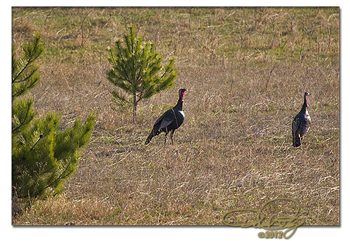
Wild turkey's on home turf
Make the right assumptions and you will fool that gobbler on his home turf and enjoy a successful hunt.
There are a great number of assumptions in today's blog. I am assuming that you'll roost a big gobbler the night before your turkey hunt opens.

We further assume you know which tree he will roost in, and which little wooded opening he will try into. For good measure, we'll also assume the direction he and his harem of hens will take to the closest strutting zone after fly-down.

I told you there were many assumptions. And, if you think about it very long and hard, you will note such basic assumptions exist on almost every spring turkey hunt.

Now, the trick is to get into place within 100 yards (give or take 25 yards) of the roosted limb-hanger. The question of the day is simple: Does the gobbler fly down into the field or into a wooded opening?

If the open field is close, it can affect where you choose a stand. If the bird lands in the woods, the hunter can set up in the woods, along the path they normally travel to get to the field or near the field edge.

If you don't assume correctly, you are counting on luck

There are hazards to setting up near the wooded opening. It is easy to bump a bird if you mistakenly get too close to the roosted gobbler and he or his hens hear or see you moving into position.

Another problem with setting up in the dark is it is lighter from above, and the bird can see down into the woods better than you can see while sitting down in the woods. The fly-down may come so early (minutes before actual sunrise), and it can fly down and the beard may not be clearly visible. The gobbler may walk past a hunter gobbling like crazy, and it's easy to assume this is a gobbler (which it probably is) but it may have lost its beard. It wouldn't be legal to shoot a beardless bird.

I prefer to set up fairly close to the open field, and call once or twice to get the attention of the gobbler, and sit back to see what happens. Just remember now to face the west when you set up or you may be looking directly into a fiery sunrise and not be able to see the gobbler as he moves past.

Pop the bearded bird if it flies right to you at fly-down

The trick here is to move 10 to 15 yards into the woods, sit down and be ready for a shot. The gobbler may twist off two or three lusty gobbles from the roost, fly down, gobble once again, and then move out without gobbling again.

If preseason scouting indicates where the bird roost, and it is a short distance (within 100 yards) of the field, I'd set up near the field edge. This provides perhaps the easiest and quietest place to sit up, and you can avoid spooking birds.

There is  no need to be breaking branches at the last moment. If you've watched the birds walk out of the woods to the strutting area, once they move off across the field or back through the woods, find a key location, locate where you will sit, remove those broken stubs that stick your back or butt, clean away all dry leaves underfoot, and determine where you will put the decoys (if you use them).

Prepare such a spot a day or two before the season opens but make certain the birds are gone before you do anything. Take care of your set-up area, and move quickly away. Try to avoid being pinpointed by other hunters.

Get in place early and quietly arranges calls, and then relax and wait

Come opening day, I try to be in place at least an hour before daybreak. Sit back and relax, and don't start second-guessing your spot. If it looked good by light of day, it should look good on opening morning.

Make certain you know how to get into the area without stumbling around. Turkeys are accustomed to hearing deer, raccoons and other ground-dwelling critters move around in the dark. A tiny bit of noise is acceptable but no talking.

Muffle box calls and push-button calls so they don't squawk if you bump against a sapling or tree limb or trunk in the dark. I lay out all the calls I plan to use on a green or brown towel next to my left leg within easy reach.

Enjoy watching the woods come alive, and be prepared for that first gobble of the day. Shooting a gobbler is anticlimactic to hearing the first few gobbles and watching a snowball-white head come bobbing through the woods as the bird comes to the call.

Pulling the trigger is the least of my concerns. For me, calling and fooling a gobbler on his turf is what the hunt is all about.

Friday, March 04, 2011

Avoid tunnel vision


This is a perfect quartering-away shot. Aim to put the arrow into the off-side shoulder. Hold halfway between belly and back.


Tunnel vision occurs when a person is in a high-stress situation. The buck is approaching, and ever so slowly it moves your way and you want to shoot that buck. You have a strong desire to take the animal with a clean shot.

It stops, rubs a tree briefly with its antlers, then stands back to admire his handiwork, hits another lick on the bark, checks it out again, and continues your way. He stops, and can't smell you or any danger, but he is in no rush.

The anxiety level builds after the third or fourth stop to putter around doing big-buck things, and then he moved forward again. He is now 50 yards away and will soon have a date with destiny. Your breath is labored and ragged, and you feel a bit light headed as your heart thunders in your ears and chest.

Total concentration is needed to shoot a big buck.


His antlers are big, possibly the largest whitetail buck you've seen in the wild. He stands, out of bow range, and surveys the area. He doesn't smell or see any danger, but he didn't grow a rack with 10 good long points and a 20-inch inside spread by being dumb.

He stands, motionless, head up and looking around. He's not spooky, just careful.

Satisfied, he moves to within 40 yards. The rack seems to grow even larger the closer he gets. Now you are sucking air, and begging for a 20-yard broadside side. The thought of shooting this buck makes you dizzy with excitement, and your heart is racing.

A full load of adrenalin is streaming through your system, and the buck closes to 35 yards and then to 30, where he stands behind a thin screen of brush. Jolt after jolt of adrenalin has you as wired as drinking 10 cans of Mountain Dew.

He offers a brief 25-yard shot but your eyes are riveted on that rack, and you don't want to make a mistake. He's coming, just let him move into the 20-yard range and then wait for a broadside or quartering-away shot at this huge buck.

It’s an easy shot, you think. It’s time to refine your aiming point.


Finally, he steps into range, turns to offer a quartering-away shot at 20 yards. The buck stares off toward other deer 100 yards away in the field, and you raise your bow, stare at the antlers again, come to full draw, aim and turn loose an arrow.

There is a large whack noise, and the buck races off while the arrow and broadhead sail off into the brush. Excited, knowing you made a killing shot, you climb down and follow the Game Tracker string to the arrow. There isn't a drop of blood anywhere on the arrow and none on the ground.
Tunnel vision had set in and when the hunter aimed and shot. He aimed at the major focal point on that buck -- the antlers. He forgot to force himself to pick a spot behind the front shoulder. His continuous focus on the buck and his majestic rack was his undoing because that is where he aimed.

Total concentration is paramount during the aiming process. Once I know a buck has antlers, and decide to shoot him, I never look at the antlers again. I focus on the heart-lung area, shoot and the deer dies.

Take time to relive your shot. Study it, and learn what went wrong.


A buddy of mine went on a wild boar hunt down to Tennessee, and I warned him against studying the length of the boar's tushes. These big curved teeth are fascinating, and my friend looked at the tusks, aimed and hit the boar in the top of the head. It wasn't an immediate killing shot. Realizing his mistake, he shot at the heart-lung area. The boar died a quick death.

Tunnel vision doesn't just happen to police officers in a fire-fight with some criminal. It happens to hunters all the time, and most often to sportsmen with very little hunting experience.

It can ruin a hunt, but there is no need for it. The trick is to determine whether the buck has antlers, and if it is what you want. Once that has been determined, forget about them, and intently focus on the vital area.

Once you draw back the arrow, and aim, do not look at the antlers. Pick a tiny spot, concentrate on that spot, make a smooth release, and do not drop your bow until the arrow makes contact with the deer.

Big bucks come often to the television hunters, but for most bow hunters like you and me, it can be a once-in-a-lifetime deal. The timing is too important to waste time missing an easy shot.

Concentration, and not tunnel vision, is the key to hunting success.

Saturday, November 06, 2010

Where are the bucks?


It’s not a big buck but seeing it today would have made me feel good.


The only sound I heard in my tree stand today was that of the northwest wind soughing through the branches. The temperature plummeted to a chilly 27 degrees, early this morning and even though the wind was a bit more than I'd prefer, it didn't stop some of the deer from moving.

A couple of does and fawns eased out of the tag alders 250 yards away, walked up a low hill, and stood there like sentries checking out the battlefield below. The deer fed up high, eased on down through the field, fed some more, crossed a woods road, and entered a low-lying tag alder run near my stand.

I sat quietly, dressed warmly in my Scent-Lok suit, and waited for the deer to arrive. It was my hope they would pick up a buck along the way, and bring him in close to me. The logic was sound on my part, but something got lost in the translation for the deer.

Uncooperative whitetail bucks. A day when few deer of either sex moved.


They got into the tag alders, jumped the creek, and headed east into another big field. Perhaps a trolling buck found one of the does to his liking but I suspect those antlerless deer old enough to be bred, had been.

There was no deer grunts near me. The bucks were apparently bedded down or up and moving elsewhere ... but not in my neighborhood.

The does and fawns didn't come my way. They didn't go to another hunter a quarter-mile away, and they apparently failed to rouse the interest of any nearby bucks ... if any existed.

It was one of those morning and evenings when nothing much moved until well after dark. Driving out the woods road revealed a buck here, one a mile farther down the trail, and a sprinkling of does and fawns. There didn't seem to be many deer moving, and no pattern to their movement.

The rut sometimes happens this way. The first round of does get bred early in the rut, and then several days may pass, and another spurt of rutting activity seems to kick in about Nov. 8-10. and it will be good again until the Nov. 15 firearm opener.

The mid-day hours are really my favorite rutting time to hunt, and I find far fewer hunters afield. It's easy to make your way to a tree stand or ground blind, and seldom will we bump into a deer, and then from 10 a.m. to 2 p.m., the chances of seeing bucks on the move seem to increase.

A few deer moved on the drive home but not many.


It doesn't always work out this way. Nothing about deer hunting is cast in stone. There are some days when rutting activity seems to slow down. Blame it on the weather, too much hunter traffic in the woods, nasty weather ... whatever. There are days when mid-day bucks are on the move, and days when they are not. Go figure.

Right now it's tough for me to hunt anytime except from 4 p.m. to the end of legal shooting time. Admittedly, it may not be the best time to hunt, but we get away when we can. We work with what we have, and next year things will be different.

I've hunted many years during the rut, and this one has been one of the strangest seasons I've seen. But deer hunting means going through days of little or no deer movement, and days when the deer are constantly on the move.

We just have to live with what we have, and try again the next day in hopes that things shift around. You see, for me, deer hunting is far more important than deer killing.

Still, it's nice to see deer up close and within bow range.

Posted via email from Dave Richey Outdoors