
 |
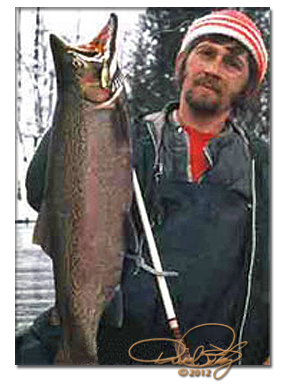
| The author with one of the thousands of steelhead caught since the early 1950s photo c. Dave Richey Outdoors ©2012 |
In my lifetime I came to personally know thousands of scribes from across the United States and Canada. Some were known through word of mouth, and many were folks that I worked with in one way or another.
Some were magazine editors, newspaper reporters, photographer, or people who labored in the vineyards of radio or television. Some wrote books on fishing or hunting, and others were fishing or hunting guides who wrote on the side.
Most writers are honest but I’ve known a number who were not
The good ones had one trait in common. They were honest in their writings, and always told the truth.
My father told me during my second year of outdoor writing in 1968 that he expected one thing out of me: honesty. “Never lie to your readers,” he said. “Tell the honest truth about your experiences, and never fib to them. They will spot a liar in a heartbeat, and make damn sure you know what you’re talking about. If you don’t know a topic, don’t write about it.”
I’d never had any intention of lying to anyone, but when my father told me that, I paid attention. I’ve been at this job for almost 45 years, and have never lied to my readers.
I sell books about fishing and hunting, and buy books, and I’ve always been honest. If someone sends me a book for appraisal and possible sale, I tell them the approximate value of the book and what I can pay. I explain I must buy at wholesale price, and by selling at retail price, I make some money although I never know how long I may have to hold that book before it sells.
Most people are aware of the differences between wholesale and retail, and most know that a bookseller who buys book at retail prices and tries to sell them at retail, will soon be out of the book- buying business.
However, I’ve got a bit off the track. Some writers I’ve known were not honest. I once knew a guy who got into a financial bind, and came up with this solution to make some easy money. He was going on an Ontario moose hunt.
This guy was an out-and-out crook
He contacted Remington for a 30-06 to use on this hunt. He then went to Winchester and got a .270, and then to Savage for a 30-30 rifle. He hit on Weatherby for something else as well as several other firearm manufacturers, and apparently left on his hunt. He didn’t tell the firearm manufacturers that he had borrowed several other rifles.
Two months went by, and a bunch of firearm reps were gathered at a show, and got to talking about a hair-raising experience that Johnny Outdoorsman had experienced on a recent hunt. The Winchester guy mentioned loaning his a rifle and scope, and then told how the writer explained how he and his guide narrowly escaped with their lives. He had one of our rifles, and when the canoe swamped in a sudden storm, the canoe capsized and all of the equipment and food went to the bottom of the lake.”
“Well, said the Remington spokesman said, “that’s some story. He told me the same story about the guy telling him about losing their 30-06. The Weatherby and Savage Arms guys piped up saying they had lost firearms to the same guy. They began talking amongst themselves, and the Winchester rep, who lived nearest the outdoor writer, agreed to talk to the guy.
When confronted with so much incriminating evidence, the writer ‘fessed up to telling a lie. All told, he had bilked the manufacturers out of nearly $20,000. He had turned the firearms over to friends that bought them at “discount” prices.
He was a member of the Outdoor Writers Association of America, a group that I’ve been a fulltime member since 1968. OWAA drummed the guy out of our organization, and the companies sued for the value of the so-called “lost” firearms.
For a number of years my wife and I had a business working with outdoor writers who wanted to self-publish books that were not attractive to the big publishers. We worked with a number of people, but there was a problem. Within a group of southern writers there was one person who saw a way to make some big money.
He would hire out to help an author come up with a good title, a fine book, and get it published. I know one man who lost about $40,000 to this outfit. Every two weeks the gent he hired would send an invoice for $2,000. He had over $20,000 into a book that hadn’t even gone to press yet, and he felt he’d been taken.
He called me, asked me what I thought, and I told him to call the law, work with OWAA and the attorney general for that state, and that thief narrowly escaped going to the Gray Bar Hotel for his crimes.
The point of all this rhetoric is: as is true in all walks of life, there are crooks and thieves out to make a shady buck. Usually, they trip themselves up. The biggest way is they begin to tell lies. It’s said that liars and lovers should remember their tales because they often slip up.
One could ask who these writers are. I know but I’m not talking. The problem is that if someone starts lying it’s usually in a written story. I’ve been at this job for all these years, and there is no need to lie. I’ve got a weather of true stories, more than enough to last me the rest of my lifetime.
I’ve been in some very tight spots at different times
I once wrote a piece about things that have happened to me in the outdoors. Falling off a hotel fire escape and breaking my back, being attacked by a pack of semi-wild dogs, getting caught in quicksand, and having a drunk pull a .45 on me in a bar-restaurant.
There’s not a word of a lie in any of them. They happened to me, and everything about these experiences was true.
My getting the job as the Outdoor Writer for The Detroit News in 1980 meant the company went into my background with a fine-tooth-comb, and did a thorough background check on my character. In closing, I reiterate what I’ve said before.
I took my Daddy’s advice, and have always told the truth. If you read somewhere that I caught a 38-pound Chinook on a fly line, you can take it to the bank because I had that fish weighed on honest scales about three hours after it was caught.
If I write about me and another man catching and releasing 99 of 100 steelhead we had caught in one day on the Platte River, it’s another believable story. Catching 12-13 pound walleyes on Manistee Lake is true, and there is nothing to gain by lying.
What I write about is what I’ve done, and I’m proud of my accomplishments and those thing’s I’ve done in my life. Mind you, this job hasn’t always been fun but I honestly believe I’m the luckiest guy in the world.


