Friday, August 31, 2012

Steelhead Fishing: Four Decades Ago

DRO-steelhead 40 yrs ago
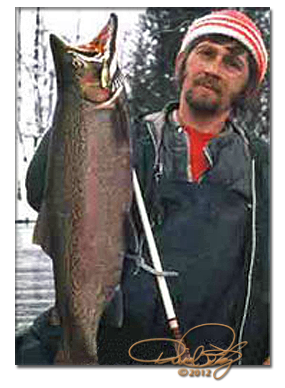
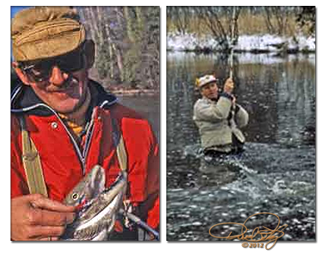
George Richey (left) with big fish and the late Stan Lievense at work
photo c. Dave Richey Outdoors ©2012
It was April 1, 1968, my second year of guiding brown trout, salmon and steelhead fishermen, and I was scouting the Little Manistee River for clients who would arrive the next day.

The river was rain-swollen and murky, and in another hour of heavy rain, it would be a foot higher and the color of chocolate milk. I thought a big buck steelhead was on a shallow gravel bar an easy cast from shore, and brother George shinnied up a tree and stood on a big branch.

"That fish is huge," George muttered to me. "It's bigger than any steelhead I've ever seen, and his cheeks and gill covers are an orange-red color. It is a truly awesome fish.


The fish was huge at about 25 pounds; Could I hold him


"You know about where he is. Cast a copper spinner upstream and reel hard when I tell you."

I cast, and George said to cast another six feet farther upstream in hopes of getting the spinner down in the heavy current. My next cast, he said, was on target.

"That's the spot," he said. "Keep casting to it. Reel hard now!"

I reeled, and nothing happened. Cast after cast went into the right spot, and I'd reel fast enough to make the spinner blade turn over in the current, and after 40 or 50 casts, George yelled "Hit him!"

The hooks were slammed home as I felt the strike, and nothing happened, so I pounded the rod tip back to set the hooks again. The huge steelhead rolled to the surface, his cheeks and gill covers glowing like evening campfire embers, and the fish started upstream, his dorsal fin creasing the surface like a shark. Not fast but with great power.

I moved along the bank but stayed downstream. The trick was to make the giant fish fight the rod pressure and the river current. We duked it out in the soggy rain for 10 minutes before the fish swapped ends and headed downstream into a deep hole. I was reeling while running but still the fish tangled the line in underwater brush and broke me off.

"How big," I asked George. He'd caught steelhead to almost 20 pounds, and guessed this ponderous male was at least 25 pound, perhaps more.


It was the largest steelhead I’d hooked, before or since


Wow, you say. That's what I said, and of the thousands of steelhead I've caught before and since, it remains the largest one I've seen.
or hooked.

My point with this is that incident occurred back in the days of very few steelhead fishermen and lots of big fish. The Little Manistee River at that time had a huge run of spawning steelhead that averaged, according to the DNR, between 11 and 12 pounds. A 15-pounder wasn't anything special, and it took a 17- or 18-pounder to raise eyebrows.

That year, also on the Little Manistee River, I found a 30-yard stretch of gravel that was wall-to-wall fish. The bottom was honeycombed with spawning redds, and 15 or 20 feet away would be another redd, and every one held a female and one to four males. We fished only for the male fish because a hooked hen would take all the boys with her.

On that day I set a record of sorts. I hooked 30 steelhead in eight hours, and am proud to announce that I made a professional release on every fish. If you're unfamiliar with the phrase, a professional release means I lost every fish, one way or another.


Steelhead four decades ago far out-numbered anglers.


There were far more steelhead in those days than now. There are far more fishermen today than back then. It's easy to do the basic math; fewer fish are being sought by more anglers.

There are still some rather exciting days if anglers can find a spot where fishing pressure is minimal. A few years ago me and another man hooked 30 steelhead in a morning. We landed about half of them, and released each and every one. Those days seldom occur any more.

Low Lake Michigan water levels haven't helped. The Betsie River mouth has been so low in recent years that very few fish make it upstream. Rivers like the Manistee below Tippy Dam can be good at times, but the fishing pressure is just too much to suit me. I can take a half-day of fishing in a crowd, and then get turned off by the whole thing.

That doesn't mean that you should, but it's easy for me to remember way back when to those special occasions when a steelhead fisherman would be unlucky to see two other anglers all day. And, back in the day, people didn't crowd you or wade down through a spawning bed. People had manners, which are hard to come by these days.

They had some class. The fish were larger and more plentiful, and the rivers weren't swarming with anglers. It was a different era, and the steelhead fishing now is still fairly good, but remembering what it was like 40-45 years ago is enough to make a grown man cry.

Personally, it's my thought that we'll probably never see the likes of those days again but remembering them remains a great thrill.

Wednesday, August 29, 2012

Honesty in the outdoors

DRO-honesty in outdoor writing
The author with one of the thousands of steelhead caught since the early 1950s
photo c. Dave Richey Outdoors ©2012
I’m well into my 45th year of outdoor writing. Some of the nation’s premier outdoor writers are or were my friends before they passed on.

In my lifetime I came to personally know thousands of scribes from across the United States and Canada. Some were known through word of mouth, and many were folks that I worked with in one way or another.

Some were magazine editors, newspaper reporters, photographer, or people who labored in the vineyards of radio or television. Some wrote books on fishing or hunting, and others were fishing or hunting guides who wrote on the side.


Most writers are honest but I’ve known a number who were not


The good ones had one trait in common. They were honest in their writings, and always told the truth.

My father told me during my second year of outdoor writing in 1968 that he expected one thing out of me: honesty. “Never lie to your readers,” he said. “Tell the honest truth about your experiences, and never fib to them. They will spot a liar in a heartbeat, and make damn sure you know what you’re talking about. If you don’t know a topic, don’t write about it.”

I’d never had any intention of lying to anyone, but when my father told me that, I paid attention. I’ve been at this job for almost 45 years, and have never lied to my readers.

I sell books about fishing and hunting, and buy books, and I’ve always been honest. If someone sends me a book for appraisal and possible sale, I tell them the approximate value of the book and what I can pay. I explain I must buy at wholesale price, and by selling at retail price, I make some money although I never know how long I may have to hold that book before it sells.

Most people are aware of the differences between wholesale and retail, and most know that a bookseller who buys book at retail prices and tries to sell them at retail, will soon be out of the book- buying business.

However, I’ve got a bit off the track. Some writers I’ve known were not honest. I once knew a guy who got into a financial bind, and came up with this solution to make some easy money. He was going on an Ontario moose hunt.


This guy was an out-and-out crook


He contacted Remington for a 30-06 to use on this hunt. He then went to Winchester and got a .270, and then to Savage for a 30-30 rifle. He hit on Weatherby for something else as well as several other firearm manufacturers, and apparently left on his hunt. He didn’t tell the firearm manufacturers that he had borrowed several other rifles.

Two months went by, and a bunch of firearm reps were gathered at a show, and got to talking about a hair-raising experience that Johnny Outdoorsman had experienced on a recent hunt.  The Winchester guy mentioned loaning his a rifle and scope, and then told how the writer explained how he and his guide narrowly escaped with their lives. He had one of our rifles, and when the canoe swamped in a sudden storm, the canoe capsized and all of the equipment and food went to the bottom of the lake.”

“Well, said the Remington spokesman said, “that’s some story. He told me the same story about the guy telling him about losing their 30-06. The Weatherby and Savage Arms guys piped up saying they had lost firearms to the same guy. They began talking amongst themselves, and the Winchester rep, who lived nearest the outdoor writer, agreed to talk to the guy.

When confronted with so much incriminating evidence, the writer ‘fessed up to telling a lie. All told, he had bilked the manufacturers out of nearly $20,000. He had turned the firearms over to friends that bought them at “discount” prices.

He was a member of the Outdoor Writers Association of America, a group that I’ve been a fulltime member since 1968. OWAA drummed the guy out of our organization, and the companies sued for the value of the so-called “lost” firearms.

For a number of years my wife and I had a business working with outdoor writers who wanted to self-publish books that were not attractive to the big publishers. We worked with a number of people, but there was a problem. Within a group of southern writers there was one person who saw a way to make some big money.

He would hire out to help an author come up with a good title, a fine book, and get it published. I know one man who lost about $40,000 to this outfit. Every two weeks the gent he hired would send an invoice for $2,000. He had over $20,000 into a book that hadn’t even gone to press yet, and he felt he’d been taken.

He called me, asked me what I thought, and I told him to call the law, work with OWAA and the attorney general for that state, and that thief narrowly escaped going to the Gray Bar Hotel for his crimes.

The point of all this rhetoric is: as is true in all walks of life, there are crooks and thieves out to make a shady buck. Usually, they trip themselves up. The biggest way is they begin to tell lies. It’s said that liars and lovers should remember their tales because they often slip up.

One could ask who these writers are. I know but I’m not talking. The problem is that if someone starts lying it’s usually in a written story. I’ve been at this job for all these years, and there is no need to lie. I’ve got a weather of true stories, more than enough to last me the rest of my lifetime.


I’ve been in some very tight spots at different times


I once wrote a piece about things that have happened to me in the outdoors. Falling off a hotel fire escape and breaking my back, being attacked by a pack of semi-wild dogs, getting caught in quicksand, and having a drunk pull a .45 on me in a bar-restaurant.

There’s not a word of a lie in any of them. They happened to me, and everything about these experiences was true.

My getting the job as the Outdoor Writer for The Detroit News in 1980 meant the company went into my background with a fine-tooth-comb, and did a thorough background check on my character. In closing, I reiterate what I’ve said before.

I took my Daddy’s advice, and have always told the truth. If you read somewhere that I caught a 38-pound Chinook on a fly line, you can take it to the bank because I had that fish weighed on honest scales about three hours after it was caught.

If I write about me and another man catching and releasing 99 of 100 steelhead we had caught in one day on the Platte River, it’s another believable story. Catching 12-13 pound walleyes on Manistee Lake is true, and there is nothing to gain by lying.

What I write about is what I’ve done, and I’m proud of my accomplishments and those thing’s I’ve done in my life. Mind you, this job hasn’t always been fun but I honestly believe I’m the luckiest guy in the world.

Tuesday, August 28, 2012

Rainy Day Whitetails

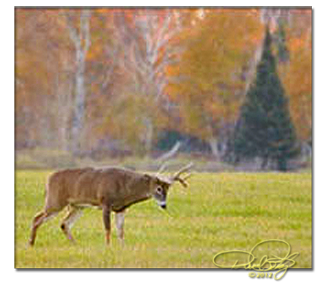
dro_big buck
A big buck posturing in a soft rain and far from any bow hunters
photo courtesy Dave Richey Outdoors©2012
There are times when a bow hunter can hear a whitetail coming for 100 yards. If the animal is upwind, and the leaves are as dry as corn flakes, the sound carries for a long distance.

Whitetails depend on their hearing for survival, and dry leaves advertise their presence. The opposite is true when it rains.

The leaves soak up the rainy weather, and a whitetail can ghost through the woods with barely a sound. This is an important reason for hunters to spend time in the woods when the rain is falling.

Fog, a light mist or a soft drizzle can cause bucks to move


I've written before that deer love to travel when a soft misty rain is falling. There is a soft pitter-patting sound under such conditions, but it doesn't seem to bother the deer. They seem to be able to separate that soft noise from a dangerous noise without a problem.

These soft rains seem to get deer moving earlier in the evening, and it appears that deer move with more confidence during a soft rain. They appear more comfortable moving between bedding and feeding areas, and they seem to eat and move without hesitation.

I've had people ask if I feel a soft rain will carry human scent downward. I believe, to a small degree, that it does. I also think that low-lying ground fog will hold human scent near the ground.

Soft rains and fog seem to go hand in hand during the autumn months, and I've seen some of my largest bucks under such conditions. The fog seems to offer big bucks a sense of security, and they seem to be on the move. This is most certainly true during the pre-rut, rut and post-rut, when buck and doe activity is high.

One thing about fog is it distorts the sense of sound. I don't know how many times I've listened to a buck grunting as he tends an estrus doe, and in the fog, my vision and hearing is limited. I've seen bucks appear and disappear in the rainy fog without ever seeing the doe, and there have been many times when the doe is visible but the tending buck cannot be seen.

Fog is the hardest to hunt in because it distorts hearing and vision


It's at times like this that a hunter must be alert. I remember one night several years ago just before the Nov. 15 firearm season opener, when I saw a half-dozen bucks appear and vanish into the fog. All were moving, all were grunting, and the antler and body size of each one indicated they were individual animals.

Judging distance in the fog can be difficult. I've talked with a number of people who know the far edge of their bait pile is 20 yards away, and if a doe or buck appears in heavy fog, they feel the animal is much farther away that it appears. They aim high to compensate for this imagined difference and shoot over the animal.

The best advice is to put out markers  if you are not using bait. A measured distance must be believed, even if the fog makes the animal appear much farther away than what it is.

I like rain on the roof, rain after my crops are planted, and rain (on occasion) when I'm hunting. I dislike a steady diet of it, and I compare that to eating steak every night. One soon grows tired of it.

I find it enjoyable to  hunt under these conditions


Hunting in the rain isn't too bad. It offers something a little different to a bow hunter, and that is fine by me. I enjoy a variety, a change of pace, in my hunting, and I can hunt in anything except a downpour or when the lightning is dancing in the sky.

Most of all, I like to hunt in those soft misty evening when the darkness comes early because of heavy rain clouds overhead, and when the whitetails seem to slip up on a guy. That is when a hunt really means something to me.

Monday, August 27, 2012

Thinking and being alert to deer is easy

DRO-big bucks
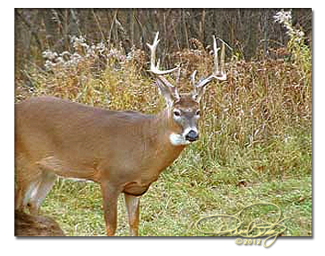
This buck has a larger rack than you think; Count the points
photo c.  Dave Richey Outdoors
My mind seemingly has tunnel vision. The only two things i seem focus intently on while bow hunting is studying deer, which really doesn’t make me all bad. I could care less about ball parks, Nascar races, or tournament golf.

Whitetails excite me; almost everything else is far less interesting, and certainly a lot less fun.

People question how I can only think about these two items most of the time. It must be easy because both passions have consumed my thoughts for more than 50 years.

Both thoughts are of equal importance, and without my intense study, there would be less hunting success. A number of years ago, I was asked a question at a bow-hunting seminar I was giving.

Another seminar attendee asked if the only thing I thought about was writing. I gave the man a straight answer.

It's a wise hunter who can act and think at the same time


"Writing is what I do," I said. "It's how I make a living, and to do my job properly, I'm always thinking about the next story. It has to be what I think about on a daily basis. I'd be dead in the water without the next story idea. The same thing applies when I bow hunt for whitetails."

My answer is based on these reasons. For me, hunting whitetails with a bow, and studying the animals at every opportunity, is what I do. To stop studying deer is to stop learning about whitetail deer. To stop learning means less opportunities and decreased success.

When I hunt, I become totally focused and immersed in my surroundings, and what the deer are doing. I never lose my concentration on deer, but I continue to focus and watch other deer. I can solve all kinds of deer hunting problems while sitting in my ground blind or in an elevated coop or tree stand.

Stay focused on your surroundings and remain alert


When working, my thoughts are always on deer hunting or trying to figure out why a particular deer did what it did the night before. Most people forget yesterday's hunt but not me.

Some people find it hard to think about two things at once or have trouble chewing gum and walking. That often happens when deer hunting: I'll be trying to solve a knotty little deer travel pattern problem, and a nice buck will walk out. My reflexes take over, and I can shoot that buck while shifting mental gears, and then I will shift back to solving other problems after shooting the deer or passing up a shot.
Solving any bow-hunting problem is always easier while bow hunting. Any hunting area always has some natural noises, but out there, the phone doesn't ring to distract me.

Years ago I learned that many of my award-winning articles and columns came to me while sleeping. One part of my brain kicked into gear, and I would wake up, slip out of bed, head for my office and write it while the idea was still fresh in my mind.

The same thing happens while bow hunting. A problem may bother me for weeks, and then one night while sound asleep, the answer wakes me up faster than a face slap with an ice-cold wash cloth. I suspect that being asleep allows the subconscious to kick in, provide the needed answer, and usually the answer is so simple I wonder why it didn't come to me much sooner.

Hunting and thinking is just as easy as walking and talking


I'm able to study deer, think about various deer patterning problems, and be ready and able to shift gears automatically, and shoot the buck. It's what I've trained my body and mind to do, and anyone else can do it providing they've learned the basic fundamentals of drawing and properly aiming a bow and making a smooth release. Do those things long enough, and do them properly, and it becomes simple.

This sort of thing often happens while I'm hunting. When my two main thoughts meld while aiming at a big buck, it is one of the most memorable events of my life.

Sunday, August 26, 2012

Hunt regardless of the weather

DRO-think big bucks
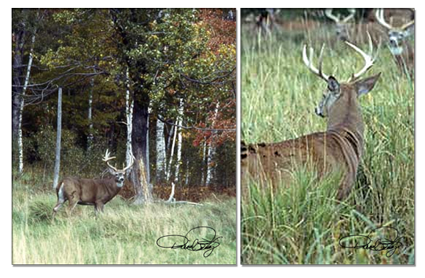
Check out these bucks; They’re all standing up at once
illustration/photo c. Dave Richey Outdoors / I65DESIGN+MEDIA ©2012
Millions of deer hunters are found across this great nation of ours, and we all seem to have a different philosophy on deer hunting. We seldom agree on wildly varying topics.

Some hunters refuse to hunt various wind directions. Anything from the east is normally bad. For years, October featured south and southwest winds and then west and northwest, and by December we were hunting northwest, north and northeasterly winds.

All the climatic changes we've seem to have produced more hot, dry weather, and the drought we've experienced this year has burned up many food plots or farm fields. It's still a bit unclear what we will be dealing with this fall, but all of us will probably dealing with freaky weather changes.

If we can’t change the weather, learn how to work with it


So, do we worry about it or allow nature take its course, and we deal with the changes as necessary?  My though is that we deal with the changes as best we can because we can't change the weather.

My philosophy is that a deer hunter won't get much hunting in if they stay home whenever there is a bad wind. I hunt but switch from an open tree stand to an elevated and enclosed coop on such days. A few stands are set for an east wind, and they are in demand when the wind goes sour.

I strongly advise hunters to make certain there are a couple of stands, whether elevated or on the ground, that allow us to cope with and hunt on an east wind.

Many are the deer hunters who believe they should only hunt during the dark of the moon. Others only hunt the week before the full moon, and others never hunt during a full moon.

There are those who believe in hunting around the Harvest Moon, the Hunters Moon, the Rutting Moon, and some who will only hunt just before the second full moon after the autumnal equinox. The nice thing about living in a free society is each of us can indulge in such pleasures that make us happy and perhaps more productive.

I personally don't care which day of the week it may be, which way the wind blows, what the moon phase happens to be, or anything else. I find it difficult to kill deer while sitting in the house rather than be out hunting.

There are others who place great emphasis on hunting the rut. Little do they know that the 10 days before the full rut begins, deer go through the chasing stage or the pre-rut. It is a wonderful time to be hunting, regardless of the moon phase or wind direction. Just hunt with the wind in your favor and forget everything else.

The rut is pretty much at the same time in Michigan


Many feel the rut begins Oct. 20-25, and that is the beginning of the chasing stage, and it will last for about 10 days before the full rut begins. It's possible to find many people who would disagree on when the rut actually begins.

The peak of the rut in northern Michigan where I hunt will occur on or about Nov. 3-4, and it is winding down by the Nov. 15 firearm season opener.

There are numerous variations, depending on where you hunt. Weather conditions and people pressure can alter these dates a bit.
Some hunters are addicted to the Solunar Tables. These tables, first invented by John Alden Knight many years ago, are based on the sun and moon and their effect on tides and the earth. They contend there are normally two minor and two major periods most days when fish bite, and when wild game move about.

Some sportsmen hunt according to the Solunar Tables and kill deer, and I know other folks who hunt whenever they can, and they also have good hunting success while hunting outside of these major and minor periods.

Nothing is 100 percent but hunt when cows are standing up


One time an old Florida cracker took me fishing. We poked around because he told me the fish aren't biting and the deer aren't moving. Two hours later cattle along the St. Johns River began getting to their feet.

"Let's go fishing now," he yelled, tossing a small baited jig into the water. We caught lots of fish while the cows were up, soon the cows laid down and the fish quit biting.

"I've watches this phenomenon for many years," he said, "and there is a correlation between standing cows, biting fish and moving deer. Fish and hunt when the cows stand up."

I've hunted many years with some poor and some great success. Good hunting habits bring wonderful hunting success, and simply being afield whenever possible is a good reason some people are more successful than others.

I forget about all this other business, and go on doing what works best for me. That means that I hunt whenever possible, and try to hunt every day of the season.

Take the normal precautions with the wind, stay downwind of the deer, and it becomes fairly easy to build your own deer-hunting success .... at least during normal weather.

The jury is still out on how future weather will affect hunting.

Saturday, August 25, 2012

Highlighting Michigan’s Massasauga Rattlesnake

ra
Map showing snake counties (brown) and a photo of a
Massasauga rattler
illustration courtesy Dave Richey Outdoors / I65DESIGN+MEDIA ©2012
CADILLAC - No one has an accurate count on how many Massasauga Rattlesnakes (Sistrurus catenatus catenatus) live in Michigan, but one thing is well known: We have the lions share of the population of this, the state's only venomous snake.

All the other populations that stretch from Iowa and Missouri up through Illinois, Indiana, Michigan, Minnesota, New York, Ohio, Pennsylvania, Wisconsin, and a small number in Ontario, make up the world's population.

"These snakes are very scarce, and everywhere else, they are considered  "threatened" or "endangered," said Michigan State University doctoral candidate Rebecca Christoffel of East Lansing, who was speaking to some Michigan Outdoor Writers. "I've studied these little rattlers for some years. They are harder to find than most wildlife in this state or any other area."

Currently the Massasuaga rattlesnake is listed in Michigan under Special Concern and is a candidate for federal listing.

These small rattlesnakes are shy and reclusive, and are seldom seen


This snake is seen so seldom that there is much that most state residents do not know about these pit vipers. This much is known: the Eastern Massasauga rattlesnake (Sistrurus catenatus catenatus) is quite small, averaging 18.5-30 inches in length. They are thick-bodied, and gray or light brown with large, light-edged, chocolate-brown saddle-shaped blotches on the back with smaller dark spots along the sides. It has a blunt tipped tail with a segmented rattle at the end.

They are found throughout Michigan's Lower Peninsula and Lake Huron's Bois Blanc Island off Cheboygan. None are found in the Upper Peninsula, and wherever they are found, the land is mostly wetlands that include bogs, fens, marshes, sedge meadows, swamps and other wetlands that include prairies and savannas. See the above map for counties where known rattlesnake sightings have been documented.

Periods when Massasaugas are active


Massasaugas are active from April through October, and often are seen basking in the sun. Personally, I've seen only one live Massasauga rattler other than the one shown in the photo published today.

"Many people are frightened of these small rattlesnakes," Christoffel said, "but they are quite shy and will try to hide from view to avoid detection. They generally strike only when threatened, and most bites come when people try to handle them. They shake their small rattles, but the sound isn't as distinct as with a larger rattlesnake. Their rattling sounds more like the faint buzzing of an insect."

She said that perhaps 25 to 50 percent of massasauga snakebites are "dry," meaning the snake does not release venom. She added that from  1999-2005, from three to eight statewide snakebites were reported to Michigan Poison Control.

The chances of getting bitten by a Massasauga rattlesnake are very remote. There are certain precautions one can take, and that is to recognize where these snakes may be found. Usually, in the wild, they are found on or near humps of ground; near root wads of fallen trees; and near trash dumped in the woods by ignorant people.

"Learn to recognize possible rattlesnake habitat," she said. "The ground can be moist or sandy and dry, but there is normally some woody debris on the ground. Piles of fallen tree limbs, leafy areas, sandy hills and marginally wet areas around marsh hummocks are key locations for these snakes."

She also offers these tips to prevent getting bitten by these short-fanged snakes.

Tips to remember when in possible snake country

  • Stay on the trail or the beaten path while walking in potential snake habitat.
  • Always wear close-toed boots or shoes and long pants. Use a flashlight when walking after dark.
  • Watch where you place your hands and feet. Do not reach into brush, rocks or dark places where it's impossible to see.
  • Stop moving and determine the snake's location if you hear a rattle or buzzing sound. Step away slowly and give the snake the opportunity to move away.
  • Never pick up a Massasauga rattlesnake or any other snake you cannot positively identify. Trying to pick up a snake is the most common cause of snakebites.
  • Never chase, harass or threaten a snake. This is the second most common cause of snakebites. Remember, Michigan's Massasaugas, while not endangered or threatened, are protected (of Special Concern; candidate for federal listing). It is illegal to bother them.
  • A Massasauga rattlesnake can strike a distance of half to two-thirds of its body length. A two-foot snake can strike 12 to about 16 inches.
  • Keep pets on a leash at all times when in wild places. Besides the remote possibility of being bitten, a dog can run off to chase a fawn or even an adult deer. Keep them under control at all times or leave them behind.
  • Four other snake species often are improperly misidentified as a Massasauga rattlesnake. Learn the many differences between the
    • Eastern Milk snake (Lampropeltis triangulum triangulum) [photo.info]
    • Eastern Hognose snake (Heterodon platirhinos) [photo.info]
    • Northern Water snake (Nerodia sipedon) [photo.info]
    • Eastern Fox snake (Elaphe vulpina and Elaphe gloydi) [photo.info]

The Massasauga rattlesnake is a rather timid animal, and will go out of its way to avoid humans. Michigan has the largest number of these small rattlesnakes, but the population is a relative thing. These snakes are not plentiful even in the best habitat, and they deserve the protection afforded them.

For more information on massasauga rattlesnakes, go to the Michigan DNR -Massasauga website.

Friday, August 24, 2012

Start deer scouting soon

DRO_deer scouting success
The author with a nice buck he scouted after the season opened
photo courtesy Dave Richey Outdoors ©2012
There is nothing better than putting down boot leather when it comes to learning a new hunting area, and that is what most people do. A few take this "learning-the-land" proposition two steps further.

The use of topographical maps is one key element of learning new land, and aerial photographs is still another. Combine these strategies, and a hunter will have a recipe for possible success.

To properly scout an area, it's vitally important to prevent your scent from drifting downwind to a whitetail bedding area. Play the wind like a fine violin, stay downwind of bedding areas, move through the area while checking ground sign for trails, food areas and bedding spots.


There is just a bit more than a month to scout before the opener


Nothing is 100 percent when it comes to hunting whitetail deer, but having a firm grip on the terrain is very important. There is a quarter-mile field that runs mostly north and south on my land, and through this open field are a series of small rolling hills and dips in the land. Deer have learned to use those tiny valleys and tiny hills to sneak through the open terrain.

Walking such an area is one way to learn how deer travel, and doing it with some snow on the ground is even better. There are places where bucks can enter the field on the west side, and by moving left and right, they can stay down in the dips and out of sight of most hunters.

What I've done is build hunting coops and they are strategically placed so that most of these travel routes can be covered. Deer often move east in the evening and west in the morning, and hunters can place themselves in key positions to waylay the animals as they pass.

However, when hunting strange land that you've never hunted before, topo maps and aerial photographs, when combined with walking the terrain will enable hunters to determine good spots to hunt.


Use time wisely to learn where deer travel; Do it now


Funnels are an absolute deadly spot to hunt. A funnel is created by a narrowing of heavy cover. It can be a brushy fence-row that connects a wood lot and swamp, two wood lots, a wood lot and a pine plantation, and other such thick and narrow places like creek beds where deer movements are funneled through a narrow area. They are natural travel corridors that deer use.

The bases of hills are another hotspot. Often the thicker cover is at the lower elevations, and if there are three hills, only one will be vitally important to hunters. Deer often choose the one that offers the easiest access and exit routes to heavy cover, and they will ignore other nearby hills.

Field corners that border on swampy or wooded areas are great, Again, only one field corner is most likely to produce deer, and again, it is usually the thickest corner that still provides animals with a good view of a distant field.

Saddles or breaks in flat or low-lying areas or ridges that allow easy access to feeding fields are good spots. Such locations may have one good trail that leads from higher ground, down through the saddle, and through swampy or wooded areas that border the crop lands.

Dry or wet creek or river bottoms are especially good because there is a good deal of cover, the possibility of mast crops such as acorns and beech nuts, most bottom land areas are thick with berry bushes and other cover.


Don't ignore aerial maps or topographical maps; They can help


Walking this land is fine, but putting aerial photos and topo maps together enable hunters to obtain a birds-eye view, and the topo maps will show contour changes. Most topo maps have contour lines and special colors or symbols that indicate hills, wooded areas, swamps, creek or river beds and much more.

Spot the funnels, saddles and other topographical features, find their relationship to the aerial maps, and plot the best method of moving into these areas to hunt. Find such key locations, determine the bedding and feeding areas, and then begin scouting for active deer sign.

Locate the food source, and then find the bedding area, and the trails deer use will be relatively easy to find. Determine the prevailing wind direction, and start looking for good trees for a stand.

Finding hotspots in new areas isn't terribly difficult but it requires some scouting time. Most of all, carry a compass or GPS, and know how to use them. Finding such out-of-the-way areas, where other people seldom hunt, and you'll have your own little gold mine for deer.