Showing posts with label changes. Show all posts

Friday, August 31, 2012

Steelhead Fishing: Four Decades Ago

DRO-steelhead 40 yrs ago
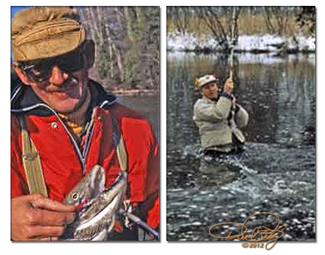
George Richey (left) with big fish and the late Stan Lievense at work
photo c. Dave Richey Outdoors ©2012
It was April 1, 1968, my second year of guiding brown trout, salmon and steelhead fishermen, and I was scouting the Little Manistee River for clients who would arrive the next day.

The river was rain-swollen and murky, and in another hour of heavy rain, it would be a foot higher and the color of chocolate milk. I thought a big buck steelhead was on a shallow gravel bar an easy cast from shore, and brother George shinnied up a tree and stood on a big branch.

"That fish is huge," George muttered to me. "It's bigger than any steelhead I've ever seen, and his cheeks and gill covers are an orange-red color. It is a truly awesome fish.


The fish was huge at about 25 pounds; Could I hold him


"You know about where he is. Cast a copper spinner upstream and reel hard when I tell you."

I cast, and George said to cast another six feet farther upstream in hopes of getting the spinner down in the heavy current. My next cast, he said, was on target.

"That's the spot," he said. "Keep casting to it. Reel hard now!"

I reeled, and nothing happened. Cast after cast went into the right spot, and I'd reel fast enough to make the spinner blade turn over in the current, and after 40 or 50 casts, George yelled "Hit him!"

The hooks were slammed home as I felt the strike, and nothing happened, so I pounded the rod tip back to set the hooks again. The huge steelhead rolled to the surface, his cheeks and gill covers glowing like evening campfire embers, and the fish started upstream, his dorsal fin creasing the surface like a shark. Not fast but with great power.

I moved along the bank but stayed downstream. The trick was to make the giant fish fight the rod pressure and the river current. We duked it out in the soggy rain for 10 minutes before the fish swapped ends and headed downstream into a deep hole. I was reeling while running but still the fish tangled the line in underwater brush and broke me off.

"How big," I asked George. He'd caught steelhead to almost 20 pounds, and guessed this ponderous male was at least 25 pound, perhaps more.


It was the largest steelhead I’d hooked, before or since


Wow, you say. That's what I said, and of the thousands of steelhead I've caught before and since, it remains the largest one I've seen.
or hooked.

My point with this is that incident occurred back in the days of very few steelhead fishermen and lots of big fish. The Little Manistee River at that time had a huge run of spawning steelhead that averaged, according to the DNR, between 11 and 12 pounds. A 15-pounder wasn't anything special, and it took a 17- or 18-pounder to raise eyebrows.

That year, also on the Little Manistee River, I found a 30-yard stretch of gravel that was wall-to-wall fish. The bottom was honeycombed with spawning redds, and 15 or 20 feet away would be another redd, and every one held a female and one to four males. We fished only for the male fish because a hooked hen would take all the boys with her.

On that day I set a record of sorts. I hooked 30 steelhead in eight hours, and am proud to announce that I made a professional release on every fish. If you're unfamiliar with the phrase, a professional release means I lost every fish, one way or another.


Steelhead four decades ago far out-numbered anglers.


There were far more steelhead in those days than now. There are far more fishermen today than back then. It's easy to do the basic math; fewer fish are being sought by more anglers.

There are still some rather exciting days if anglers can find a spot where fishing pressure is minimal. A few years ago me and another man hooked 30 steelhead in a morning. We landed about half of them, and released each and every one. Those days seldom occur any more.

Low Lake Michigan water levels haven't helped. The Betsie River mouth has been so low in recent years that very few fish make it upstream. Rivers like the Manistee below Tippy Dam can be good at times, but the fishing pressure is just too much to suit me. I can take a half-day of fishing in a crowd, and then get turned off by the whole thing.

That doesn't mean that you should, but it's easy for me to remember way back when to those special occasions when a steelhead fisherman would be unlucky to see two other anglers all day. And, back in the day, people didn't crowd you or wade down through a spawning bed. People had manners, which are hard to come by these days.

They had some class. The fish were larger and more plentiful, and the rivers weren't swarming with anglers. It was a different era, and the steelhead fishing now is still fairly good, but remembering what it was like 40-45 years ago is enough to make a grown man cry.

Personally, it's my thought that we'll probably never see the likes of those days again but remembering them remains a great thrill.

Friday, February 17, 2012

Weather tips for hunting deer and gobblers

Let’s settle the playing field first

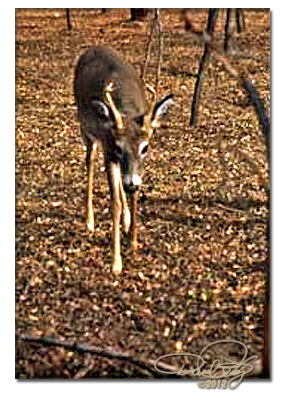
woodlanddeer
It's impossible for hockey players to play a game unless they are on the ice, and it's impossible for hunters to shoot a buck or doe if they are sitting indoors watching television.

That's settled, so what do we do when faced with inclement weather? You know: like some of what we've had so far this month?

East winds, northeast and southeast winds, and rain. Some snow flurries today. Copious amount of rain two or three times. Strong blustery winds. Weather that even deer dislike.

If we were to set out every evening during hunting season when inclement weather rears its ugly head, we may have been able to hunt only a few nights so far this season. The abundance of combined weather conditions has been noticeable to most hunters.

The spring turkey hunting season begins shortly, and if nature stays its course, there may be some days when the big birds hunker down and do nothing. Few birds like to move when the wind is strong.

So, what can we do about it? The answer is to go hunting anyway. Some of the animals and birds we hunt in season will move even in bad weather although they may not move very much or very far.

It’s bad weather, attitude and grit will get you a chance

It only makes sense that if critters move for only 15 or 20 minutes, the closer one hunts to the bedding area should provide them with greater opportunity to be nearby when they get up to feed.

Mild rain doesn't bother turkeys or whitetails at all. They are out in it on a daily basis, and can't come inside out of the weather. If it is a soft rain, they often move well. They move less in a hard down pouring rain. I hunted turkeys once in a heavy snow storm and the birds moved well. Predicting movement is not a precise art.

Deer will move on an east wind, but most hunters have few locations set up where an east wind offers them an advantage. A strong wind is much worse than a soft breeze.

Heavy winds put everything into motion. Trees, weeds, cattails and tall grasses move. Leaves (those still on fall trees) shake violently on the trees, go blowing off branches, and leaves are constantly in the wind at ground level and above. Deer and turkeys detest such windy conditions because it removes their ability to see motion because everything within sight is moving. Strong winds make noise, both deer and gobblers depend on their hearing to keep them safe.

Stands located closest to heavy cover offer hunters the best opportunity to see deer on such miserable days. The important thing is to get into a stand without being seen, smelled or heard.

Crow hunters say that these black birds can't count. I contend that deer can't count either, and that opens up one possibility to get into a stand even if the deer bedding area or turkey food or roost sites are downwind of the stand. A friend can drive you in by truck, park with the motor running while the hunter crawls into the stand, and then drive off. That doesn’t work well for turkey hunters because of vehicle lights at night near a roost site drive many birds crazy.

A friend of mine and his wife leased land for many years, and each of them hunted a different parcel. My buddy would drive his wife 3/4 miles back off the road to her stand, walk with her to her ground blind while the four-wheeler idled nearby, and once she was in her blind, he would jump back on the machine and drive away. Again, this technique doesn’t work for gobblers unless they are hunting in mid-day, and guess approximately when and where the birds will travel.

She often saw deer while the sounds of the four-wheeler were still audible in the distance. The noise of the four-wheeler didn't bother the deer during daylight hours, and if anything, it gave them advance warning that people were coming. Two people get off, two walk to the blind, one walks back and drives away. Deer can't count, and this method works well.

Up your chances for success with a few simple field rules

The one thing to bear in mind is that deer and turkeys are used to seeing cars and trucks, tractors and other farm equipment in most areas during daylight hours. Deer will run from all motorized equipment heading in their direction, but they don't run far unless the humans talk to each another. Human voices add another annoying dimension to this equation.

Talking while dropping someone off at a blind or when picking them up should not be done. Deer also are accustomed to hearing people talk, but whether talking near a hunting stand is a good idea, I think it's best to drive up, drop off the hunter, and drive away without speaking. Why ruin a good thing?

One thing about weather: Any time there is a storm moving in, deer and turkeys will usually move just ahead of the storm during daylight hours. If the weather forecasts a storm arriving about 4 o’clock, try to be in a good spot by 2 p.m. It can be a super time to be hunting.

Weather plays an important role in deer and gobbler movements and travel. Rather than sitting indoors and not hunting, try to incorporate some other tactics into your hunting bag of tricks, and hunters may be pleasantly surprised at how well some of these will work.

Thursday, August 11, 2011

Can We Solve Natural Resources Problems


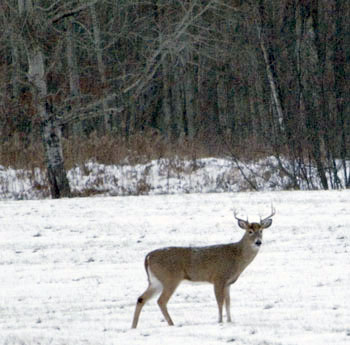
Wild turkeys and whitetail deer may have severe die-offs in bad winters.


Guess what? Fishing and hunting isn't the same as it was 10 years ago, and it won't be the same 10 years in the future as it is now.

Fishing and hunting have become fragmented. How so? There are many ways to look at our natural resource problems, such as:

Years ago, a bear hunter bought a license and went hunting. Now, we have sound, scientific wildlife management, and that means more bears are being killed each year under a quota system than were ever killed under the old rules when anyone could buy a tag and hunt bruins.

Bear numbers and habitat are getting out of line and bruins are moving.


And it's OK that we have more bears than ever before, and the animals are moving into new territories, and management means determining the social carrying capacity of bruins. How many bears will people tolerate near their homes before they start squawking?

We have elk hunts now with some rather new rules. The rules only affect those who draw an elk tag from now on. I've applied for an elk tag ever since they had their first hunt in 1965. I've never been drawn, but instead of drawing names from those who have applied and have missed being picked, the DNR is now enforcing the newer rules.

And frankly, I'm not the only one who has applied and been denied. It means that hunters who drew an elk tag years ago can still draw another one. Does this make sense? Is it sour grapes on my part? No, it just means that me and many others are dissatisfied with a system that makes no sense. No one should ever draw another elk tag if they've already drawn one but that's not how it works these days.

The DNR has had ample opportunities to allow Region II turkey hunters to obtain some private-land turkey tags that would guarantee them a first- or second-season hunt for those applicants who own property up here, but pressure from other groups is louder than the mumbles of regional landowners. So, private-land turkey tags can be obtained in the Upper Peninsula in those counties where birds are hunted, and throughout southern Lower Peninsula counties, but again Region II landowners get the short and dirty end of the turkey-permit stick.

It appears the DNR is caving in to special interest groups. In case you haven't noticed, the special interest groups are in the face of the DNR biologists to get what they want, not what is fair to the general public.

Do you remember when Michigan had their statewide trout season opener on the last Saturday in April? And then, in hopes of streamlining our fishing seasons, the DNR allowed Lower Peninsula muskie, pike and walleye fishing to open at the same time as the trout season. There are many sport shops in the Lower Peninsula, and this ruling 10-15 years ago, denied sportsmen two opening days -- trout and walleye, etc., and simply lumped them all together.

Making senses of our state fisheries regulation, and our open and closed areas.


There is nothing streamlined about our fishing or hunting regulations. Some conservation officers say they must read the annual fishing or hunting digests time and again before trying to enforce the law. The language is stilted and cumbersome, and an attorney would probably have trouble defining what some of the DNRE legalese language really means. Some rules can make violators out of perfectly honest people. Make anything too difficult, and many give up for fear of unwittingly breaking the law.

Guess which one season most people prefer, and in resounding fashion? It isn't trout, which are harder to catch. Those people who once opened the trout season, and then on May 15, opened the walleye season years ago, jumped for joy. They got more than two more weeks of walleye fishing, and the sporting goods stores lost a wonderful chance to make money on the second opener, which is now gone.

The DNR currently backed into a corner by angry deer hunters, have been taking it on the chin. The DNR's little dog-and-pony show went on the road to discuss issues with deer hunters several years ago, and they were confronted by many angry people who were tired of not seeing deer and even more tired of horrible deer management policies.

Trust me, in many parts of the state, the chances of seeing and killing a deer is as high as drawing one of the aforementioned elk tags. Southern Michigan counties still have lots of deer, but such is not the case in the Upper Peninsula and northern Lower Peninsula.

These hunters were and still are clamoring for change, and rightfully so. I've backed the DNR for more years than I can remember, but things are changing ... and frankly folks, it's not for the better. Deer are plumb hard to find in the U.P., and things aren't much better in the northern half of the Lower Peninsula. But guess where the deer are: on private land in the southern Lower Peninsula counties. The big numbers aren't Up North, no matter what anyone says.

This deal over deer and deer hunting is far from over. The DNR needs to begin mandatory deer registration, and do away with the two-license deal. If they want to make more money, make it mandatory that hunters register their first deer before they can buy a second license. Hunters no longer believe the estimated Oct. 1 deer numbers, and they certainly don't believe the  final totals that show deer kills higher than what anyone believes, especially those sportsmen who do not see a whitetail buck during the combined hunting seasons.

Deer  regulations can be another tangled maze to understand. Can’t it be simple?

Last year was the first time in history that I can remember when the DNR came out and admitted the deer kill was down dramatically. Is this a harbinger of bad things to come? I suspect it is.

Now, in an effort to raise more money and to potentially alienate more people, the DNRE will be selling some permits for some of the species that are difficult to draw -- like the bull elk tags. If you've got enough money, you too can bypass the lottery system, and bid lots of money. This further tips the scales away from the ordinary sportsman, and will become the most direct cause of higher license fees and perhaps even fewer hunters.

And, while we are at it, it means the rich get what they want while the average sportsman get little or nothing. Go over to Germany and try to hunt. It will cost an arm and a leg, and a lengthy training session before you'll take your firearm into the woods.

Baiting and feeding was eliminated in the entire Lower Peninsula. In the meantime, baiting continues in the Upper Peninsula. Many people began cheating in the Lower Peninsula where they continued to bait. Does it make sense to have legal baiting in one part of the state but not in the rest? Not to me it doesn't.

Ask the DNR about the compliance rate for not baiting. They maintain the compliance rate is high, but bait is still being sold at local gas stations, and someone is certainly buying and using it.

And all of this mess because of one CWD disease in a private enclosure. Everyone must pay the price for that solitary animal. Did people resent this, and is it sound scientific management? It makes one wonder. The DNR and Department of Agriculture should get their collective acts together.

Deep snow hamper deer and winter turkey movements. Die-off can be high.


Have deer and turkeys suffered in the northern Lower Peninsula. You bet. Folks, where I live had more than 180 inches of snow two winters ago and more than 125 inches so far this season. I've seen very few gobblers and more than 160 inches last year, and only a few hen turkeys were seen this past winter. If the DNR's weird sense of having turkey feeding sites weren't so laughable, I'd cry.

We had fewer turkeys this spring than in the past, and we can look to a lack of a winter feeding program. Turkeys are big birds and burn a lot of energy launching into flight from the ground, but to expect birds to burn up even more fat reserves during winter months by flying up to an elevated position for corn, is silly.

Am I in a bit of a nasty mood? Naw! It’s just that Michigan hunters once stood tall and proud of their DNR, our deer management policies, and the fact that we had more combined deer hunters and man-days of deer hunting than any other state in the nation. That was something we were proud of.

We don't have much to be proud of now except in areas where there is a Quality Deer Management program. Hunters in such areas are now seeing more bucks and larger animals in some of those counties than ever before.

Folks, it goes against the grain of Mother Nature to try to maintain a status quo, year after year. It's impossible to accomplish, and management of our deer herd is sorely lacking in its focus.

I never see a wildlife biologist in the field, and in the words of a fine wildlife biologist who retired some years ago, "the new wildlife biologists don't have any dirt on their boots."

One might wonder if they even own a pair of boots. They spend little, if any time, in the field. They manage by building computer models, and I for one, know that this philosophy really isn't working.

And sadly, the biologists seldom want to talk with landowners and hunters, especially in northern counties. They know they'll get an ear full, and most of the anger generated their way these days is justified.

Perhaps we need a shake-up in state government.


One doesn't have to look hard or into a crystal ball to see that state government and some legislators have wrecked the economy, our jobs and our livelihood, and politicians have left taxpayers holding the bag ... once again.

This is the adult version of the old snipe hunt trick we played on other kids when we were young. It was funny back then, but nobody is laughing now because many of us are left holding that empty bag. It's difficult to compare deer hunting 20 years ago with what we now have because there can't be a comparison. It just gets worse every year.

And excuse me for not being politically correct. The DNR is no longer correct and proper. The proper alphabet soup name is now DNRE. The "E" is for Environment, and where the DNR once rolled easily off our tongue, adding an "E" doesn't seem to have done much for this once-proud state agency.

The people who are most visible to the public -- our conservation officers -- are often seen in the field but the same cannot be said for many of the DNRE's wildlife biologists. What a sad situation, especially when it comes to some of the newer wildlife biologists.

Fortunately, we still have some good wildlife biologists. Not many but some really good people still remain, but when they retire, who will we have to carry on proper wildlife management of our natural resources?

It makes one wonder.

Tuesday, November 30, 2010

Remember this: deer can’t count


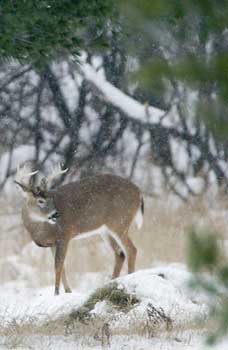
This buck has someone pegged, and it may cause the deer to leave the area.


It happens every November and December now people continue to hunt the same blinds day after day. Two or three mornings or evenings of climbing into the same stand means the deer will soon have you patterned.

What happens after they pattern the hunter is they seldom show up at that spot during legal shooting time. I proved it to a friend two nights ago.

He told me that every deer that steps out seems to be looking at his stand. He couldn't understand why.

Try to change your routine every day. Try new stands and way in and out/


He had shot a doe that night and it ran into the woods 50 yards before dying. We followed the deer after dark, and I suggested he look around the edges of the heavy cover.

"You'll see deer beds everywhere within 20 yards of the edge of the cover," I told him. "Those deer watch you walk in from the road, and see you climb into your stand. The deer have you patterned."

Shifting from one stand to another, and never hunting the same one two nights in a row, eliminates much of the problem. It's difficult to sneak into anywhere when snow covers the ground, but one trick that that does work in farmland country, providing the snow doesn't get too deep, is for one person on a four-wheeler or a truck to drop the other hunter off.

Deer can't count. If they see and hear a four-wheeler or pickup truck come in, and both people get out, one stays and the other leaves, and nearby deer seem to think that everyone has left. That is unless the hunter makes too much noise, moves around or is spotted by the animals.

The same can hold true in the evening. If a hunter is pinned down by deer out in front of them, and they climb down, every nearby deer is educated to the human presence. However, if a four-wheeler or truck comes putt-putting in after dark, it scares off the deer, and then leaves, the animals are not overly frightened by the vehicle. Deer see cars or trucks every day, and we've used this method effectively for mptr years than I can remember.

This trick is so easy. Just ease into an area, park where deer can see, and one hunter can climb into the stand. Once he is in place, the other person drives off.


The vehicle is what spooks the deer, not the hunter climbing down in front of the deer. The whitetails run off, the hunter climbs down and gets into the vehicle, and the deer are none the wiser.

I know a guy that goes for a walk every evening he hunts, and his wife and their dog tag along. When he gets to his stand, he quietly gets into in and his wife and the pooch walk off. He shoots bucks every year with this little trick.

Ofte, deer are gone by full dark. We can then climb down and walk out without spooking any animals. Just take the arrow off the string and lower it to the ground, and wait for the deer to move off naturally. Give them several minutes, and then climb down.

Late November and December can be hard on bucks that are recovering from the rigors of the rut. They need to feed heavily in a short period of time to build up enough body fat to carry them through the winter. Anything that disrupts their schedule of moving out to feed can lead to stress, and in areas like this one with very low deer numbers, we try not to stress the deer any more than necessary.

Learn what stresses December deer, and perhaps you’ll score in the late season.


Stress can be caused by a variety of reasons. If deer traditionally bed near a stand, and night after night a hunter walks in to that same spot, the deer get a mite spooky and often hold off on their travels until full dark. Or ,,, they will move elsewhere.

Changing stands, changing arrival times at a hunting spot, or giving a stand a rest for a few days allows deer to settle down and start getting back to their normal travel patterns.

Whatever hunters can do to make human impact on deer even less will often result in better deer hunting. The more stress we put on nearby deer, the poorer the hunting becomes.

Right now we are already putting a bit of stress on deer with some light snow. We are supposed to get snow daily for the next couple of days. If any major accumlation falls, it will only make matters worse for the animals.

Try a new approach with the rest of the bow and muzzleloader hunting seasons. Move around, change the times you arrive and leave a stand, and if possible, have someone drop you off. It certainly doesn't solve every problem, but it can lead to slightly better hunting if the animals aren't stressed out by too much hunting pressure.

Posted via email from Dave Richey Outdoors