Wednesday, February 29, 2012

Remembering follow-ups on wounded bears

Most times a hunter is tight to a bear without ever knowing it
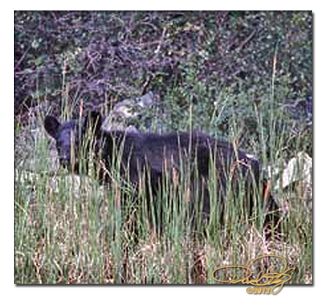
blakbearingrass

Some odd thoughts  rumble through  my mind without apparent thought or reason. Current weather of circumstances have little to do with when these thoughts come to mind.

I don’t know how it happens. I guess it’s just the way my brain is wired together. Frankly, I  delight in these off-the-wall thoughts because they usually put a gentle spin on an  uneventful day.

I was looking through an old pile of Outdoor Life magazines from the decade when I wrote stories for them  on a regular basis for. One article was about a grizzly bear attack that I'd covered for the magazine.

The biologist was a man who had most of his face chewed or ripped off by a grizzly bear, and lived to tell me the story. The magazine flew me to Salt Lake City where the interview took place.

The man got too close to the bear without knowing it. Bad mistake

He lost one eye, his nose and one ear, and the bear literally ripped his face off. He'd had over 1,000 stitches when I did the interview, and he had more plastic surgeries scheduled.

That got me to thinking about the number of black bears I've killed while mopping up a messy job of shooting by other people. Years ago, when bear hunting meant going into a sporting goods store and buying a license. There was no need for a lottery draw in those days. Few people hunted bruins back then.

One of those kills was a bruin that had been shot in the hip, breaking the leg bone. The hunter was frightened and asked if I'd help. I said I would if he agreed to stay behind so I didn't have to listen to his nervous jabbering.

He agreed, and I went after the bear with a 3-inch magnum 12 gauge shotgun stoked with five No. 4 buckshot. I saw the bear at 40 yards, and hit him. He went down at the shot, got up, came running toward me, and four more shots were taken with the last one at six feet. It finally killed the pain-crazed animal.

I'd read stories as a kid about African hunters shooting a leopard or lion, and then having to dig them out of thick cover and kill them at close range. This was pretty heady business for me, knowing full well I'd never go to Africa. I'd have to settle on killing wounded bears that other people had severely injured but were scared to finish the job.

Another bear led me on a two-day hunt that covered a small swamp bordered on one side by a tiny creek. I had lost any blood sign but had found where the bear had bedded down three times. Finally a drop of blood was found near the creek. I crossed the creek and followed a faint blood trail slowly up a steep hill.

The shotgun barrel preceded me, and bent blades of grass pointed out the path taken by the wounded bruin. I'd just topped the hill when I spotted the bear three feet away. It moved and I shot, and that mess was over.

Take a step, stop, listen and look around, listen again and be silent

Bears have provided me with some hair-raising thrills. People talk about brown bears, grizzlies and polar bears, but more people are attacked by black bears each year than many people believe. Black bears are most common, and I've had some close encounters when armed and unarmed, and it's a thrill most people would prefer to live without.

Only once did I go after a wounded bear with another person, and it was a friend whose skills were legendary. We got that bear, but every other time I've done it was alone. And that was the way I preferred it.

Frightened people talk, make noise, and generally get in other people's way when some serious work must be done. Wounded bears often are shot at very close range in thick cover, and I didn't want anyone nearby for fear they would create a greater hazard than already existed.

I'd move slowly if the going was tough, stopping often and looking around. Of the six wounded bears I've dispatched, none had injuries that would have been immediately fatal. All animals were moving, and often the dirty work was done within an hour of sundown. It meant moving fast and quiet, getting close enough to the animal for a deadly shot. Of those six, only the one noted above required more than one shot.

It isn't something I'd do now because my vision is so poor. Back then I could see well, and there is a major adrenalin rush when the wounded animal is first spotted. Then it means staying downwind and trying to get close to the bruin without spooking it.

Doing this nasty piece of  business was never fun but whenever I went after a bear it was because the hunter couldn't or wouldn't do it. It meant putting an animal out of its misery as quickly as possible. I never advertised my services, never went looking for this kind of work, but for many years I always seemed to be in the area where bears were being hunted and trouble always seemed to find me.

This type of adventure offers more than enough for most people

I did it because someone had to. Otherwise, a frightened hunter may walk away from the problem or wait until the next day and not be able to find the bear.

This string of memories came back to me like a recurring bad dream. This wasn't Africa, and it wasn't a wounded leopard or lion at the end of a blood trail, but they were wild black bears that would be lost or may live long enough to become a danger to someone else.

It offered some hair-raising adventures, and the adrenalin rush was rather addictive to this small-town sportsman. And trust me, these were adventures I'll never forget.

Posted via email from Dave Richey Outdoors

Tuesday, February 28, 2012

Let natural sound help you to shoot deer

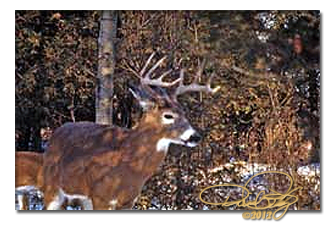
This buck watched kids get off a bus, and then I shot him

schoolbusbuck

The big buck moved two or three feet at a time, stopped for a lengthy pause, studied the cover on both sides and in front of him, sniffed the air, and then moved forward again.

He was going nowhere fast. It was obvious this buck had been spooked by another hunter sometime in the past, and he was cautious. There were no other deer nearby -- just him -- and he was taking his slow, sweet time.

Another few steps, and a slight turn, and he would be within range. I looked at my watch, and knew this buck was mine. Every day at about the same time the school bus would come clattering down the highway, stop in front of a nearby house, and the buck would raise his head and look toward the road and listen to the noisy kids getting off the bus.

This buck always seemed to wait and listen for the school bus

He had just finished taking those steps when the bus came to a gear-grinding stop. The big 8-point raised his head, looked out toward the road, and the sounds of the kids getting off the bus caused him to raise his ears. It was a natural sound he had heard many times before.

What he didn't hear was my bow coming back to full draw as he stood quartering away. The arrow sliced in and that buck ran 60 yards before falling, his ears still hearing the kids chattering out at the road.

Deer are accustomed to hearing all types of natural sounds. Some are heard so often they become second nature to a deer. A deer hears the sound, recognizes them for what they are, and doesn't become alarmed.

These natural sounds can work to a bow hunter's advantage. I've deliberately placed elevated coops where the slightest wind will cause the tips of branches to rub against the roof of the wooden stand. It doesn't take a genius to figure out when to draw on a deer standing out in front of that blind. That deer is accustomed to hearing that sound, and hunters should wait until the branches start rubbing against the stand, and then draw, aim and shoot.

Years ago I had a stand placed on the ground near two trees growing out of a single trunk. Any breeze at all, no matter how softly, would cause those two trees to creak. I used the "creaking tree" trick to shoot a number of fine bucks over the years.

I had a stand once that seemed to be directly under the flight path of the Detroit-Traverse City late-afternoon or early evening flight. Perhaps this buck couldn't understand what the noise was, but every day he would stop, lift his head up, point his nose toward that passing jet, and it always provided me with an easy shot.

I passed on shots at that buck for two years, waiting for him to grow a decent rack, and when he did and came by and was in front of me when the jet flew over, it was an easy shot.

Any natural sound that a deer recognizes can  help the hunter

Squirrels running through dry autumn leaves always seem to attract the attention of deer. They may see that squirrel running through the woods a dozen times each day, but whenever they scampered from one tree to another, deer often turn to look at them. This often provides enough noise to cover the drawing of your bow, and the scampering squirrel is actually working on your behalf.

Birds flit overhead, land in nearby trees, and are common sights for deer but they always turn to look at flying birds. The movement catches their attention.

Crows fly overhead, cawing like crazy, making enough racket so 10 people could draw their bows. Deer seem to pay more attention to a crow when it is nearby rather than when 300 or 400 yards away.

Blue jays serve the same purpose as crows except they don't range as far. Jays often flit from bush to tree limb, to the ground, and up to a tree again. Each time the bird moves it attracts the attention of a deer, and when the deer turns to look at the jay, that is when to make your draw providing the animal is positioned properly.

Animal and bird sounds are natural. Let these sounds help you

Hunters must learn to take every possible advantage offered by natural every-day sounds. Wait for the deer to get perfectly positioned, and wait for a noise of movement nearby to attract their attention.

Use that time to come to full draw. Don't hurry it because hunters usually have more time to aim and shoot than they think. Acquire the proper sight picture, hold steady, and make a smooth release.

Hunters who learn this trick seldom go without venison during the winter months. I suspect, with a little thought, you can figure out others to out-smart a nice buck by using natural sounds the animals are accustomed to hearing.

Posted via email from Dave Richey Outdoors

Tune in on the does, and they will lead you to a buck

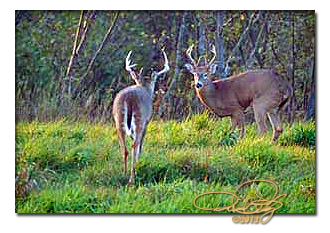
Small but smart bucks give way to the bully

twobucks

The doe was acting a bit shaky last fall. She would stop, start, and move a bit, but from my elevated stand, my attention was riveted on the late-October whitetail doe.

Her actions were keeping me informed on where the buck was standing, out of sight. I couldn't see the antlered buck from my vantage point downwind of the doe and buck, but the antlerless deer was some kind of agitated. The buck was nearby, of that there was little question, and her sides were heaving from being chased.

The buck had apparently bird-dogged the doe across the field and through the woods, but this was the chasing stage, one of my favorite times to hunt. She was close to estrus, but she wasn't quite ready for breeding. But, chasing primes the pump, so to speak.

A panting does has been chased a long distance

The buck knew that, and there seems to be a direct correlation between the chasing phase and the beginning of the rut. Biologists feel a buck chasing the doe gets both animals  ready for the breeding period.

My bow was ready, and although I suspected a big buck was chasing this doe, I had yet to see the animal. The doe, by her actions, told me where the buck was, and whether he was standing still or moving.

She kept peering back into the heavy brush, and try as I may, the buck was impossible to see although there was no doubt in my mind that he was there. The doe was twitchy; moving, stopping, switching her tail, and turning to face the brush before turning and facing her body away from the buck but looking back over her shoulder.

She was sending body language signals to the buck, and he was moving slightly. Her ears would twitch up, swivel toward some sound unheard by me, and then the buck would apparently stop. I was beginning to think these two deer would carry on like this for hours.

In reality, as the sun headed toward the western horizon, the doe moved slightly toward the buck, and then wheeled and ran off 20 yards before stopping to look back. She was getting this old boy fired up, and her message apparently was getting through to him.

Her head movements pinpointed the buck’s location, and it took 10 minutes of probing the alder brush before my binoculars picked out the white bone of an antler tine. The buck was standing stock still, not moving, and contently letting the doe lead the show.

I knew this wouldn't last forever, and sooner or later the buck would make his move. The doe would let me know when that was about to happen.

Her ears perked up again, her head changed positions, and I knew the buck had moved again. The binoculars scanned the area where the buck had stood, and sure enough, he was gone. I followed the direction of her head, and after five minutes of looking, found the buck again.

Watch the doe and other bucks and she’ll lead you to the big boy

He was getting closer to the edge of cover, and by now, the sun had set. There was less than 30 minutes of shooting time left, and I knew he would soon take up the chase again. The big question was whether he would offer a shot or choose to circle the doe, and force her into running off with him in hot pursuit.

Ten minutes of shooting time remained when the action started. The doe whirled at the sound of his first tending grunt, and she cut a lick for the open field, running hard. The buck was patient, and he slowly moved toward the edge of cover on a wooded ridge, and watched her go. He knew he could track her down.

He had only to move 10 yards in my direction, and it would be possible for a shot. He moved half that distance, stopped, and my bow was up and ready. When he moved, he exploded from cover like a ruffed grouse taking wing, and was at an instant gallop.

He offered no opportunity for a shot, even though I was ready, and as he began moving, it was easy to tell he was a high and wide 10-point with good mass. He crashed off through the brush, and there is no doubt he caught and bred that doe that night.

The lesson behind this anecdote is to study does during the pre-rut and rut seasons. They can, by their head and body language, tell the hunter where the buck is and what he is doing.

Be patient and play the waiting game

There are many times when this leads to a shot, and there are times when luck is riding along with the buck. However, study this body language as often as possible, and learn more about hunting bucks. The does can teach hunters this very  important lesson, and bow hunters who don't spook does but study their actions will often take a nice buck.

You can bet on it.

Posted via email from Dave Richey Outdoors

The essence of a quick and honorable kill

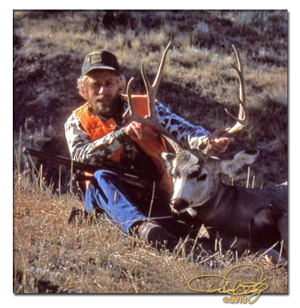
A long shot on a mule deer is possible with practice

muledeer

The truest form of respect to an animal sportsmen hunt is the ability to make a clean, killing shot, whether with a bow, muzzleloader, pistol, rifle or shotgun.

The thing that many anti-hunters are against are wounded animals. I have people contact me, and some say they are ill-prepared for the shot. A bad hit is the result of jittery nerves, buck fever and an inability to shoot straight when an opportunity presents itself.

People who regularly hunt make killing shots. Most of them hunt with a bow, even during firearm seasons, but others also hunt with a muzzleloader or center-fire rifle. When they aim at a deer, and pull the trigger, the animal goes down and dies instantly.

Learn how and practice aiming for an instant kill

There is no long, lingering chases to finish off the animal. There is no long hours spent blood-trailing a deer for miles. There are no cases of someone taking a hasty shot, and making a bad hit.

These hunters have one thing in common: they can shoot straight, and they don't miss. One man has shot eleven bucks, and he takes only one each year. Five were taken with a bow and none ran over 75 yards, and four died when the arrow sliced through both lungs.

The other two deer were taken with a flat-shooting rifle with a 140-grain pointed soft point. Both deer were hit low behind the front shoulder, and both deer died instantly where they stood.

Another man shot a big 10-point last fall after he had hunted the animal into December. The buck made a mistake, walked past the hunter, and one arrow killed the buck. It went just 50 yards and tipped over.

What do these men have that other sportsmen don't have? They have the patience to wait for a clear shot, and possess the ability to put an arrow or bullet in that proper location that causes instant death.

They practice shooting all year. The centerfire rifle usually doesn't come out of the gun safe until just a week before the Nov. 15 firearm deer opener for many people. They may shoot the rifle a dozen times in one day before the season opener, and they feel they are familiar with their bow or firearm. They know that when the rifle's cross-hairs center the heart-lung area that the deer is dead but doesn't know it just yet.

An old hunting question has been around for more years than I can remember, and it goes like this: People don't ask, can you? They ask, did you?

The ones that can, do; Those that can't, tell stories

Good hunters know that when they put the bow sight behind the front shoulder of a buck, that animal will go down. They shoot regularly, never exceed their shooting abilities by taking long bow shots, and they know how and when to draw and shoot. The deer they shoot are unaware of danger because these hunters play the wind every day and can sit still on stand.

These men and women are not casual hunters. They work hard to learn as much about deer as possible. They know how and where deer travel, and soon learn when the animals will come near their stand.

They never take hurried shots, and never take a low-percentage shot. They know that tomorrow may offer a better opportunity, and are willing to wait until all conditions are in their favor. They never make a mistake when shooting game, and they respect those animals they hunt.

I once shot a 6X5 elk in New Mexico at 350 yards. Elk are big critters, and when my Swarovski scope's crosshairs settled low behind the bull's front shoulder just as he finished bugling and he'd emptied his lung, the trigger was squeezed and the bull died instantly.

Another time I shot a very nice mule deer across a side canyon along the north rim of Arizona's Grand Canyon with a 7mm Magnum at 450 yards. One shot, and down he went. My guide said he'd never seen such a shot. There was nothing for me to say because I'm accustomed to long shots. But then, I practice shooting a lot.

Hunters must practice, and I don't pretend to specialize in long shotsm but I only shoot when I know from past experience that I can make that shot. Some of it is a result of  practice, and some of it is knowing that the shot can be made with confidence. Both of these shots, no brag, were instant kills.

Hunters who can do this on a regular basis have no need to brag about their prowess, never make the deer appear dumb or stupid, and they never show the animal any disrespect. Many have learned over time that hunting means more than just killing, and also know that the meat from these animals will grace their table all year 'round.

They know that hunting is something more, much more, than killing a small deer with tiny antlers. They are willing to pass up young bucks, knowing that two or three years on a buck will allow them to take a trophy buck of their dreams.

More so, they are hunters, 365 days per year, and that is why many are so deadly in the autumn woods. They have the patience, skill practice and common sense to do everything right. They don't have to think long and hard about it but just react to the situation.

Thinking too hard on anything can make it more difficult than it should be. And that, my friends, is a direct quote.

Posted via email from Dave Richey Outdoors

Build your own fishing shanty

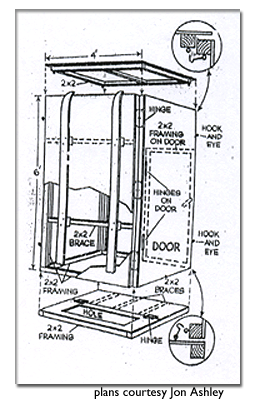
This shanty can be built quickly and towed across the ice

iceshantyplans

Snow covers the ground and skimpy icy covers some lakes. Even though a few daring anglers are fishing, fishermen are hoping for more cold temperatures to make solid ice for the next few weeks.

Thirty-six years ago when I moved into the Traverse City area, got married to a lady who worked in a ski shop, and we became friends with a co-worker while I  befriended Jon Ashley of Traverse City. He and I traveled all over hunting caribou, deer, moose, wild boar and much more.

“I love ice fishing but my fingers have been frostbit several times,” I told him. “My fingers and hands hurt when they get cold. I need a shanty I can tow onto the ice.”

I like fishing inside a shanty because it helps protect frostbit fingers

Ashley is an idea guy, and he quickly set to building a collapsible shanty that weighs very little, is inexpensive to make and is big enough for two people to fish comfortably. Having a pull-along shanty eliminates chopping big heavy shanties from the ice as spring approaches. At that time, portable shanties were seldom seen.

“I’ve always wanted a collapsible shanty, one that be pulled on and off the ice each day and something that could be put up or taken down in less than five minutes by one man,” Ashley said. “And, it has to cost less that $60, using material easily purchased at a lumberyard.”

The $60 shanty he built is sturdy enough that it can be towed on skis across the ice. These are his plans and instructions, and the shanty can easily be built in time to be used during the future, although it may cost more than the original $60 now..

Wood isn’t cheap, but knotty 2X4s or enough 1X2s to complete the job often can be purchased at lower prices than knot-free lumber (if such a thing exists these days). Many lumberyards sell seconds or rejects which may be warped but are still suitable for this kind of winter project.

Rip 2X4s into 2X2s, and cut plywood or particle board into 4X5-foot lengths. This will produce a six-foot-high shanty.

The siding should be framed inside with 2X2s. Glue and nail or screw the framing to the siding to lend support to the completed shanty. Frame Two sides at once, hinging both sides together with a 3 1/2-inch door hinge at the top, middle and bottom with equal distances between each. The two sides should be hinged so they form a 90-degree angle when fully opened. Some overlapping will occur when the shanty is taken down.

Follow the above procedure to build and hinge together the other two walls. The four walls will fit together snugly when properly constructed. Any wall gaps can be corrected by countersinking hinges or covering the inside corners with black felt.

Cut a door opening in one wall, along the inside edge of the framing, at a height of 54  inches. The top inside edge of the door frame must be reinforced with 2X2s for strength, and the piano hinge can be cut in half and spaced equal distance from top and bottom to allow it to swing outward. Furniture knobs or drawer pulls, inside and out, allow opening and closing the door, and an inside screw eye and hook will keep the door shut tight.

Take your time, follow the directions, and you’ll have a portable ice shanty

Nail and glue two 2X2 braces on the inside shanty wall, opposite the door, to serve as ski mount braces. Small pieces of scrap 2X4s can be nailed or screwed together to form a six-inch-high outside elevation block on which skis can be attached with screws. This will allow for easier pulling through snow or over rough ice.

Two of the four pieces of sides (each 2X4-feet) are hinged together to make a floor. This section must be cut and framed so the outside walls will fit flush to the ice with the floor bracing and floor inside the fishing coop. Cut a fishing or spearing hole to the desired size.

Set the four walls and floor together, and attach each two-wall section together with chest latches. This will draw the walls together and make the shanty light-proof.

The remaining two 2X4-foot sheets of siding will form the top. Join them together by gluing and nailing or screwing the inside edges to a  piece of 2X2. Frame the inside edge of the top so it sets on top of the four walls, and nestles inside the shanty walls and against the wall bracings.

Screw eyes are screwed into the inside roof bracing, and screw-eye hooks are fastened to wall bracings. These hooks will draw roof and walls tightly together when spaced equally around the four walls.

The finished shanty should be painted black, inside and out, to protect it from the weather, and to keep light out. Give outside walls two coats of paint.

Materials needed to build this rather inexpensive and portable ice shanty include:

  • Six chest hinges
  • Ten screw eyes and screw-eye hooks
  • One pound No. 8 nails
  • Fourteen 2X4X8s
  • Four 4X8 sheets of ¼ inch plywood or particle board
  • Six 3 ½-inch door hinges
  • One one-inch piano hinge
  • Glue
  • Two furniture knobs or drawer drawer pulls
  • A set of downhill skis

Skis with broken tips often can be obtained inexpensively from ski shops. Set-up and take-down time is less than five minutes for one person. A catalytic heater, minnow bucket, chair, fishing rods and tackle, plus a gas or manual auger can be stowed on top  of the collapsed shanty and towed onto the ice. Don’t forget your fishing license and an empty bucket to carry home your fish.

Posted via email from Dave Richey Outdoors

Is your deer a trophy? It should be, regardless of size.

Trophy bucks: Different strokes for different folks

trophydeer

A trophy buck means different things to different people. It's like beauty: you may not know the true definition beauty is but you’ll certainly recognize it when you see it.

Every outdoor magazine worthy of the name will run cover photos of some truly huge bucks. Most of the television bucks seen would be considered a trophy buck to all but record-book hunters.

Big-buck photos or videos sell television shows. Sadly, for them, the average 8-point is not considered a trophy buck. They don’t know what they are missing but hunting solely for a trophy.

I can shoot whatever buck I want, and occasionally I’ll take a good one but hunting should always mean something much more to a hunter than shooting a buck with huge head gear.

Taking does and fawns can help manage a deer herd

I'll shoot the occasional big buck but also shoot small bucks as well as does and fawns. There are some bucks that do not fit the criteria of what I want. An 8-point with a basket rack of scraggly antlers is a cull or management buck, and these deer should be removed from a local deer herd. It is a small buck that tells me that it is not, nor will probably t as defining the minimum of ever be, a trophy buck by anyone's standards. Let kids or any first-time hunters take these deer, and hold out for a big one.

So what defines trophy status? Whatever you or I think may be far from what others consider a trophy buck.

A youngster on his or her first hunt  may consider a doe or fawn a trophy, and wisely so. For most hunters who can count on one hand the number of deer they have shot and have fingers left over, may consider a fork-horn with a six-inch spread to be a trophy. Perhaps it might even be a buck with long spikes.

On the other hand, many hunters seem to set a basic standard of 8 points. Whether is has heavy mass or is a 1 1/2-year-old with a tiny basket rack makes it a trophy buck to some people. Frankly, I believe any buck should be considered a trophy.

Setting goals is OK but for most people, once that goal is met, they ratchet their standards up another notch. Say they want an 18-inch 8-point with heavy tines, and get it, then they will probably want a 10-point with a  20-inch spread.

If they score on such an animal, where do they go next? Many then lust for a 200-point buck. If they don't get it, they are disappointed and upset, and therefore have lost track of what deer hunting is all about. The hunt is, and always should be, something more than a dead deer and a mass of antler bone.

Such people soon learn their hunt for bigger and supposedly better bucks will eventually end. It's hard to keep climbing that bigger and better ladder.

That ladder of success soon becomes impossible to reach

The challenge of the hunt is far more important than the size of the animal taken. Want a really tough challenge?

Start hunting the oldest doe on the property. She will run a bow hunter around in circles. Taking an old doe that knows she is being hunted is a challenge worth tackling.

Hunting is not about winning or losing but about how the hunt plays out. It's not about winners or losers. Hunting is so much more than just dead meat and big antlers.

Some sportsmen compare hunting to a game. This is not a game but it is a matter of life and death for the animal. How we look at hunting is a very important part of the overall experience.

If we are to kill an animal, we must show it all due respect and utilize that meat to nourish our bodies. We must hunt with a passion; respect that which we hunt and kill; and make any deer we kill a trophy, regardless of its size, antler spread or the number of points.

Respect the game your hunt and kill and utilize it properly

We are hunters, and to us, a trophy doesn't have to be a huge buck or a buck at all, but it must represent a personal challenge. We must be ever mindful of exactly what that animal is and what it truly means to us.

It is, and must always be, something more than antlers and meat. It must be a deep emotional moment for us, and when we learn to accept that fact, any deer taken becomes a trophy animal.

Posted via email from Dave Richey Outdoors

Sunday, February 19, 2012

Living life to the fullest

Two great friends -- my son David (left) and Mark Rinckey of Honor

goodfriends
Life is a very precious commodity, and speaking only of myself, I try to live each day to its fullest.

There are many ways to live, but my life has been built on a strong foundation of honesty, hard work and helping others whenever possible. Those thoughts will be with me tonight, tomorrow and forever.

I consider myself a very lucky man. Hard work, they say, never hurts anyone and I suppose that is true. I've been fortunate in my life. It hasn't all been easy, and the money I needed to run my businesses hasn't always been there, but somehow we've always made it through.

It hasn't all been easy, but no one ever guaranteed an easy life

My business life, like that of others who are in business, has been a series of ups and downs, high and low points. My writing has always fluctuated with the moods of the stock market and the automobile industry, and there was never anything I could do to cure that except drum up more markets when business slowed down.

I've always believed in delivering the best possible product. If a story need two or three rewrites, that's what it got. I often went out to shoot specific photographs for a special story.

A magazine wrote a story once about me, saying I was an honest man. It wasn't an ego stroke for me. It's something I've always believed in all of my life. Honesty is the hallmark of every man, and as my Daddy once said, we come into life buck naked and with a good reputation and I want to leave it the same way.

There is much to be thankful for. My children and grandchildren and great-grandchildren work hard and are honest, and I'm almost always surrounded by family. They enable me to live my life as I choose.

My choice has always been to work, grow my writing business, and hunt as often as possible. My bills always got paid, my family eats well, and when it becomes necessary to reduce my workload, I made necessary changes.

My avocation also is my vocation; Few can say the same

Few people can say that they've had a job they loved. Many folks can't stand their boss or their job, but that has never been my problem because i am my own boss and my worst critic. I love meeting people, and my weblog gives me a great opportunity to meet some of the finest people in the world.

How many people can say they do what they wish to do. Many of my years were spent working for others, and then I began my machine shop and became my own boss. It gave me the freedom to work when I wanted, hunt whenever possible, and be a productive citizen.

My life, for the most part, has been spent being productive at a job I loved and wanted to do. Designing new bows, striving for the ultimate compound bow, and working constantly toward that goal is difficult but refreshing. We reach a certain point, encounter a problem, and then it takes time to solve it. Solving problems became a theme for me.

And it has made me stronger

I look at my life, and that of my family and close friends, and feel good about my place in society. If I had it to do over again, I would probably live my life the same way.

Such thoughts will surround me as we work our way toward Easter and spring weather, and I will give thanks for a long and fruitful life. I've lived it my way, and that means a great deal to me.

I've written thousands of magazine articles, newspaper columns, and daily weblogs, and it's you -- the reader -- on an individual and collectively, to produce good copy and fine photos. That I've done, and over 72 years, I've done things my way.

My reward in life is not measured by a large bank account, and a big beautiful car, and an expensive home but by the acceptance and occasional good and kind words of gratitude by my reading audience. I do this, not only for you, but also for myself.