Showing posts with label gobblers. Show all posts

Friday, February 17, 2012

Weather tips for hunting deer and gobblers

Let’s settle the playing field first
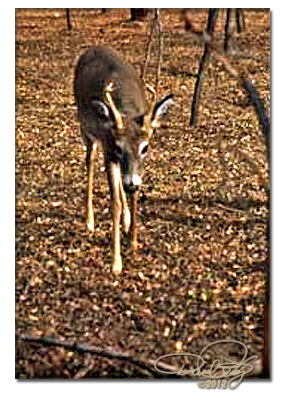
woodlanddeer
It's impossible for hockey players to play a game unless they are on the ice, and it's impossible for hunters to shoot a buck or doe if they are sitting indoors watching television.

That's settled, so what do we do when faced with inclement weather? You know: like some of what we've had so far this month?

East winds, northeast and southeast winds, and rain. Some snow flurries today. Copious amount of rain two or three times. Strong blustery winds. Weather that even deer dislike.

If we were to set out every evening during hunting season when inclement weather rears its ugly head, we may have been able to hunt only a few nights so far this season. The abundance of combined weather conditions has been noticeable to most hunters.

The spring turkey hunting season begins shortly, and if nature stays its course, there may be some days when the big birds hunker down and do nothing. Few birds like to move when the wind is strong.

So, what can we do about it? The answer is to go hunting anyway. Some of the animals and birds we hunt in season will move even in bad weather although they may not move very much or very far.

It’s bad weather, attitude and grit will get you a chance

It only makes sense that if critters move for only 15 or 20 minutes, the closer one hunts to the bedding area should provide them with greater opportunity to be nearby when they get up to feed.

Mild rain doesn't bother turkeys or whitetails at all. They are out in it on a daily basis, and can't come inside out of the weather. If it is a soft rain, they often move well. They move less in a hard down pouring rain. I hunted turkeys once in a heavy snow storm and the birds moved well. Predicting movement is not a precise art.

Deer will move on an east wind, but most hunters have few locations set up where an east wind offers them an advantage. A strong wind is much worse than a soft breeze.

Heavy winds put everything into motion. Trees, weeds, cattails and tall grasses move. Leaves (those still on fall trees) shake violently on the trees, go blowing off branches, and leaves are constantly in the wind at ground level and above. Deer and turkeys detest such windy conditions because it removes their ability to see motion because everything within sight is moving. Strong winds make noise, both deer and gobblers depend on their hearing to keep them safe.

Stands located closest to heavy cover offer hunters the best opportunity to see deer on such miserable days. The important thing is to get into a stand without being seen, smelled or heard.

Crow hunters say that these black birds can't count. I contend that deer can't count either, and that opens up one possibility to get into a stand even if the deer bedding area or turkey food or roost sites are downwind of the stand. A friend can drive you in by truck, park with the motor running while the hunter crawls into the stand, and then drive off. That doesn’t work well for turkey hunters because of vehicle lights at night near a roost site drive many birds crazy.

A friend of mine and his wife leased land for many years, and each of them hunted a different parcel. My buddy would drive his wife 3/4 miles back off the road to her stand, walk with her to her ground blind while the four-wheeler idled nearby, and once she was in her blind, he would jump back on the machine and drive away. Again, this technique doesn’t work for gobblers unless they are hunting in mid-day, and guess approximately when and where the birds will travel.

She often saw deer while the sounds of the four-wheeler were still audible in the distance. The noise of the four-wheeler didn't bother the deer during daylight hours, and if anything, it gave them advance warning that people were coming. Two people get off, two walk to the blind, one walks back and drives away. Deer can't count, and this method works well.

Up your chances for success with a few simple field rules

The one thing to bear in mind is that deer and turkeys are used to seeing cars and trucks, tractors and other farm equipment in most areas during daylight hours. Deer will run from all motorized equipment heading in their direction, but they don't run far unless the humans talk to each another. Human voices add another annoying dimension to this equation.

Talking while dropping someone off at a blind or when picking them up should not be done. Deer also are accustomed to hearing people talk, but whether talking near a hunting stand is a good idea, I think it's best to drive up, drop off the hunter, and drive away without speaking. Why ruin a good thing?

One thing about weather: Any time there is a storm moving in, deer and turkeys will usually move just ahead of the storm during daylight hours. If the weather forecasts a storm arriving about 4 o’clock, try to be in a good spot by 2 p.m. It can be a super time to be hunting.

Weather plays an important role in deer and gobbler movements and travel. Rather than sitting indoors and not hunting, try to incorporate some other tactics into your hunting bag of tricks, and hunters may be pleasantly surprised at how well some of these will work.

Wednesday, May 04, 2011

Become a doer rather than a procrastinator


Hey! If this buck keeps coming closer, are you going to shoot or think about it?


Those who have taken a Dale Carnegie course come out of it with an attitude. This 'tude is what some bow and turkey hunters need. They must think positively and act.

Some people develop a false hunting attitude where they think they can shoot a buck or gobbler. Those with the right mindset don't think they can; they know that when a shot is imminent, they will kill that critter.

There is a huge difference between thinking you can and knowing you can. Thinkers are doing just that. They think too much, and by the time their mind solves the issue, the deer is gone or offers only a low-percentage shot. They miss an opportunity by thinking too much.

Shooting game means doing so without thinking. Just develop an attitude.


How can a bow hunter go from being a thinker to a doer. It's really pretty easy.

They practice constantly on targets at distances consistent with their skill levels. They have confidence in their ability to shoot straight without having to think things out before drawing their bow.

They size up the opportunity, and have enough confidence in themselves and their arrow shooting ability to come to full draw at the right time and deliver a killing shot.

Confidence is the key word in this whole discussion. Confidence comes from knowing you can do it and then do it right. Any questionable thoughts just eat away at your confidence and a shot is usually missed. Good hunters, if faced with a questionable situation, won't shoot.

Good hunters know that a familiarity with deer or turkeys, and especially bucks or gobblers, is important. A sizable whitetail buck steps out within easy shooting distance, and the decision is made and the arrow is released in much less time than it takes to read this sentence.

Establish a buck has antler big enough to suit you and shoot at the right time.


The thinker, if he were sitting side-by-side with the confident doer, would still be evaluating the situation while the hunter has shot the animal. Thinkers deliberate and procrastinate, and doers shoot.

This doesn't mean the doers don't think. They size up the animal, raise the bow, aim and shoot in one fluid movement. Their mind, because they have a large amount of self confidence, instantly knows this is a shooter. The doer, if the animal switches positions, also can stop and wait if necessary.

This type of positive thinking comes from looking at a great many deer, learning to size them up, and being able to draw, aim and shoot without consciously thinking about it. Shooting becomes second nature.

Some people have enormous amounts of self confidence and some do not. Those who lack this confidence building skill must spend more time outdoors, and spend more time in close proximity to game.

Think of it this way. The wind is your greatest enemy because it allows deer to smell you. Your next worst enemy is the inability to sit still. Learn to conquer both items, and you'll have gained a large measure of self confidence.

The next step is to have a buck or gobbler within easy shooting range. Things change dramatically from when the deer is 100 yards away to when it is within 15 yards. The closer a buck gets, the more a thinker starts concentrating on the antlers than where the arrow must go.

A lack of concentration is the hallmark of the thinker. The doer is five steps ahead in his ability to draw, aim and shoot in a second or two.

The thinker also procrastinates. Learn deer body language, and a hunter can often tell if a deer is about to walk or run off or stay in the area. The longer a deer stands nearby, the longer the thinker studies the antlers, and the longer it takes to shoot.

Let's go back to high school exams. It's easy to tell the right answers, but some questions are more difficult. Often, studies show, the person's first instinct is right in a yes-no or multiple-choice question. It's when students begin to second-guess themselves, deny their original instinct and thought, that they often provide the incorrect answer.

Develop an attitude that allows an instant decision to be made and act on it.


Bow hunting is similar in many respects. Dawdle or think too much, and the opportunity walks off into thick cover while you dither about. This doesn't mean that hunters must rush their shot, because in most cases, they have more time to draw, aim and shoot than they think.

The doer recognizes that ideal moment, and instinctively reacts to it without conscious thought. Ninety-nine percent of the time, when the bow comes back to full draw, a shot quickly follows. The entire shooting experience becomes instinctive.

Deer act on instinct as well. There is no reason a hunter can't develop the same style of instinctive reaction to a quality shot opportunity. Shooting a deer with a bow should become instinctive, and mind you, learning how to do it doesn't come overnight.

Only consistent quality practice, being near deer or gobblers, being able to read a buck or gobbler's 's body language, and doing these things often, will lead to becoming a better hunter.

An old friend had a saying that seems to sum up this hunting philosophy: "They don't ask 'can you?'; they ask 'did you?"

The doers can, all the time, and the thinkers can, only on occasion. The summer months are a great time to work at becoming a doer rather than a thinker. In the long run it will pay off.

Thursday, April 28, 2011

Me and Mr. Murphy and the turkeys


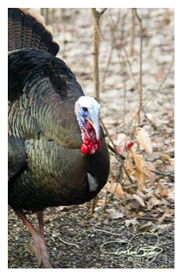
Watching jakes is fun but watching adult gobblers is something special.


Remember Murphy's Law? I wrote about it a week or so ago.

This quirky rule states that when hunting wild turkeys, if anything can go wrong, it will. Yesterday's hunt could serve as a great example.

It had rained a bit during the night, the skies were overcast, it was darker than the inside of a black cat, and I was walking across an open field on my way to a wooded ridge line. I woke up at 4:45 a.m., and not wanting to wake my wife, I fumbled in the closet for some pants and a shirt. I grabbed some jeans, pulled on a shirt and some sox, went out and got the newspaper, came back inside and dressed for the hunt.

Oops! Something was wrong.


I was midway across the field when it became obvious that I'd pulled on some jeans that were really too loose. I seldom wear a belt, but with every step, it was becoming more of an issue about my britches. I was 100 yards from my destination when I finally had to stop.

My trousers, underneath my rain gear, were down around my knees, and I was walking like a waddling duck. It may have been more meaningful if I hadn't been wearing rain pants, and if it hadn't been dark. I laid down the decoys and my Remington 870 pump shotgun, unhitched my rain gear, dropped those pants, pulled up my jeans, got an owl hoot (perhaps by an all-seeing owl), and continued on to my hunting spot.

The shame of it all. My unintentional strip tease in the misty rain seemed to set the stage for things yet to come. A quarter-mile away, in the black stillness of night, I heard a turkey crash down off his roosting limb, and it was followed by strong wing beats fading away into the night. Apparently one unseen bird was frightened from his roost by a half-naked stranger.

That thought put a weird smile on my face.

Moving in where I'd roosted birds the night before.


I reached my naturally camouflaged blind, put my shotgun flat on the ground where I wouldn't knock it down while wiggling in among some tree trunks, and then returned to the field to set up the decoys. I'd killed gobblers here before, and knew where the birds would come from, and placed the decoys with the jake-fake 35 yards out in front of me and the hen decoys about 45 yards out. This should make any live gobbler walk out in front of me and produce a good shot.

I put down my butt pad, wiggled around like an old lady pulling on her girtle, balanced the shotgun across my knees, and dug out a slate and box call, and laid them on a brown wash cloth next to my left leg. I leaned back, comfortable, and remembered pulling up my drawers in the middle of the field. I guess you had to have been there to appreciate it.

Thirty minutes passed before the tweetie birds began talking, and the first crow of the day flew over, cawing like a mad man, when a gobbler sounded off with a distant gobble. Another bird, much closer and behind me, joined in with a deep rumbling gobble, that shook the early-morning stillness.

I sat still, my calls and shotgun at the ready, and waited. I didn't want to join this party just yet. I wanted to see how many birds were nearby. Within 15 minutes, I'd located five gobblers, and they were mixed in with several muttering hens.

I held off calling until all five gobblers were dialed in.


I rasped out a soft little yelp, one that seemed nearly impossible to hear, but the keen-eared gobblers caught the faint sound and all five tuned in. I wouldn't answer, and waited five more minutes until one love-sick gobbler couldn't take it anymore. He gobbled lustily, and I called softly again, and he cut me off with a roar. I returned the favor with another soft yelp, and suddenly all five gobblers were cranked up.

Each Tom called to me, and I teased each one in turn, and finally only two birds -- obviously both without a hen -- remained. All of this had taken up more than an hour, but the two birds were still interested in coming to visit. They came in behind and downhill from me, and were close enough to hear their spitting and drumming. I did a tiny J-stroke on the slate just as the skies opened up and the rain poured down. The monsoons had arrived.

That didn't deter them. If anything, it seemed to re-ignite their fire, and both birds shook the ground with their gobbles. My shotgun was to my shoulder and steady across my knees when I heard the snap of a semi-dry twig. I was expecting it, didn't move, and then the landowner came over the nearby ridge with his tractor and manure spreader, tossing turds out onto the ground.

A tracker and manure spreader spooked them and I didn't get a shot.


It was too much for the skittish gobblers. They apparently whirled around and hauled tail feathers for someplace else. Just that quick, what had been an entertaining day was wrecked by Mr. Murphy and his weird sense of humor. I never saw the birds nor did I hear any other gobbles after that.

I was soaked to the skin by the time I got home. No turkeys, no shots, but one interesting and rather funny day afield. I thought perhaps you might be interested in how Mr. Murphy messed up my hunt but he didn't ruin my day. There's more to turkey hunting than shooting one, and my experience yesterday is proof of that.

Monday, April 25, 2011

My turkey opener was slow


Gobblers hit their strut zones from 8 to 10 a.m. Locate these areas and hunt.


Hunting conditions seemed perfect. Just a soft breeze, and a bit of lingering fog as the sun bathed the woods with sunlight. I was in place long before daybreak, put out my decoys within 150 yards of the roosted birds, and sat back for everyone to wake up.

It took a long time, and as best as I could determined, there was only one gobbler. He gobbled mightily from the roost, but this bird wasn't where I'd bedded down the others. Those birds had a bad case of shut-mouth.

The bird that gobbled was a half-mile away, on a piece of land that I don't have permission to hunt, and we traded sweet-nothings twice. I gave him some time before calling the third time, and he didn't respond.

Roost gobbling and then silence


I'd talked with a pair of hunters with first-season turkey tags, and they had ended their hunt yesterday. Today was my opening day, and only one thing could have made it more delightful -- seeing a bird. There was no way for me to know for certain, but my chat with the other hunters gave me a clue.

They told me each bird they would put to bed would gobble once or twice from the roost tree, fly down and shut up for the rest of the day. I've seen such situations on other occasions, but it's often weather related.

The early period after fly-down, is often when gobblers are vocal as they patrol one to four or five strutting zones. Temperamental longbeards may have several strut zones where they go to meet up with the hens, and this is usually a great time to work a bird.

However, it's been my experience not to call much unless a gobbler is rattling the trees with loud gobbles. Often, if many of the hens have been bred, they quickly move away from the big Toms to head back to their nest.

Sleep in and hunt the mid-day hours with minimum calling


What works? Try hunting at mid-day, don't call too much, and if you have a response, don't get too eager to reply. If a bird gobbles the second time, give him a soft call, sit back and be patient. A bird might come running in looking for a hen, but chances are equally good that they might sneak in without making a sound. Don't get too antsy about calling.

It goes against a gobbler's basic nature to come to a call. They expect the hen to come to them, which means hunters must be patient, and wait for him to edge closer. Play these birds with a cool hand, and don't try to hurry them.

Take a page out of the gobbler's book, and take your time. I've occasionall spent two hours patiently wooing a lusty gobbler away from other hens. It can be done but all sorts of things must fall into place.

Proceed slowly and don't try to hurry a gobbler


Rushing a bird at this point can lead to failure. But, using my example today, I try not to call to a roosted bird. Sometimes it helps, more often I think it hurts your efforts, and wait for the bird to fly down. Talk to him a little bit on the ground, and don't try to hurry up the process.

If he comes, there's a good chance he'll come all the way to you. Get up and move too early, and you may lose your only chance of the season.

Wednesday, April 20, 2011

Heavy snow hits the gobbler woods


Gobblers often head for bird feeders following a spring snowstorm.


I knew last night that my chances of seeing any turkeys to photograph today would probably be a gigantic waste of time. The forecast called for heavy snow, and at midnight last evening it was a near-blizzard.

The idea of going out today in the heavy wind, and sitting in eight inches of very wet snow didn’t happen. I got up this morning, shuffled through the snow to pick up my wet newspaper, and kept my head down against the snow that was still falling and wind that was still blowing.

Mind you, I’ve spent lots of days hunting deer in snow and wind, but I’ve never found the turkey hunting or photographing wild turkeys in such weather to be much fun. Often, the day is wasted while waiting for the birds to make their appointed round. Often, they stay roosted longer than normal, fly down late, peck around for a bit, and stay fairly close to their roost trees.

There are exceptions to all rules, but rarely will turkeys move well in heavy snow.


I heard no gobbles or yelps, saw no birds, and never saw a single sign of a turkey-bird, regardless of sex. Periodic snow fell today from leaden skies, and although the temperature warmed a bit, it didn’t melt much snow. Tomorrow doesn’t look like it’s going to offer very good hunting conditions, and this first season really points out the hazard of hunters choosing the first hunting season. All too often, the weather falls apart like it did today.

There was a pretty good lightning storm last night as it snowed, and thunder rolled through the North Country as the front moved through. Flashes of lightning could be seen last evening as the snow piled up on my deck.

So, does that mean hunters should apply for the short second season in Area K or go for the lengthy last season? I usually apply for the second season because I usually draw a tag. The third season can provide some of the most suitable turkey hunting conditions of all, but there are some problems with this late hunt.

Hunters have most of May to hunt, but that means mosquitoes as the weather warms. It also means morel mushroom hunters to share the turkey season with, which can lead to some unusual encounters with people who have no clue that turkey hunting season is open.

All they know is somebody in camo clothing is roaming the woods wearing a face mask and carrying a shotgun. Some people seem distressed by such a sight. However, for those who are willing to share the woods with people looking for morel mushrooms, it can provide some very good turkey hunting.

For me, I’m not sure how my second season will pan out but I’m hoping that we are far enough along in our spring weather that we won’t be fighting heavy snow storms. But then again, who can be sure with the crazy weather we’ve had so far this spring.

Monday, April 18, 2011

Turkeys can make fools of hunters


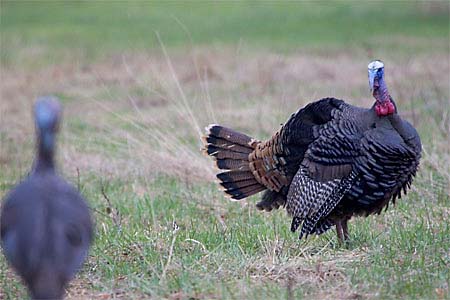
Is a gobbler like this one in your future. Hunt hard and smart?


It was quiet today. Too quiet for the first day of the first hunt of our Michigan's spring turkey season.

After two days of very strong winds, it dawned fairly windy this morning which would keep the birds roosted longer. I was outdoors a good bit today, and heard nary a gobble or a shot. I made a few phone calls to some turkey-hunting friends around the state, and based on what was seen and heard, the opening day got off to a slow and quiet start.

I've avoided the issue for a variety of reasons, but most importantly, it would never be my intention to play the gas-price hole card to cause people to stay home. But with gas prices that seem determined by supply and demand or price gouging to hit a new high every day, many people are foregoing some of their former outdoor pleasures to save money.

A bad first day of the turkey season doesn't make a hunt.


Trust me, I feel your pain because we've pulled in our horns due to high gas prices. A couple of people I've discussed the issue with feel as I do: people aren't traveling very much. The steelhead runs showed fewer anglers; fishing guides report fewer spring trips; and I suspect when all the votes are counted, many sportsmen may give up their chance to turkey hunt unless they can do it close to home.

The cost of losing one day's wages by taking time off work doesn't appeal to any of us. No one can really afford to go as often as we did a few years ago. The inflated price of gasoline will hurt some of the tourist business in many locations.

But then, is that really the cause of a poor showing today? Who knows? It could be the fault of the weatherman telling us that tomorrow or Wednesday we may see another 10 inches of snow, which certainly wouldn't help turkey hunters.

Can we ignore the possible warnings? I think not, based on the screwy weather we've had since New Year's Day. It's certainly not been like most Michigan winters. We get quite a bit of snow in our area near Traverse City, and I've kept track since the first significan snow-fall last November, and I've tallied 176 inches so far.

Some snow won't bother the gobblers but if the white stuff is accompanied by very much wind, it will keep the limb-hangers in place longer than usual. An old-fashioned blizzard would wreck at least two days of hunting effort.

Hunters must be prepared for any weather eventuality.


We've heard the wind blow before in this section of the north country, and often such storms blow through to the north or south of where we live. It makes little difference: it will have an major effect on hunting success wherever it hits.

In past years of driving back roads while scouting for birds, I've come to accept one fact: the fewer vehicles spotted while scouting usually means fewer hunters in the woods, which can mean a reduced turkey harvest.

Of course, wild turkeys are every bit as unpredictable in their actions as the spring weather. I've hunted lots of years in many areas of the country. And one very important thing I've learned is that predicting the actions of a big old Boss Gobbler is much like predicting your mother-in-law's attitude in advance of her visit. I'd like to talk to someone who has figured out gobblers and moms-in-law, and maybe they could teach me something I should know.

So, is there a moral to this story? You bet, and let's hope it works for you this week and me next week. The short and sweet part of this moral is simple: we can't change the weather, and even if we could, wild turkeys have a strange sense of timing. They always seem capable of throwing a big monkey wrench into any potential turkey hunt, and often do so without provocation.

Lay the best plans in the world, exercise the utmost caution, possess the stillness of a hunting owl, and yet, wild turkey can and will out-wit human hunters. Call like a champion, choose your hunting areas with great care, enter on quiet feet long before dark, sit with the patience of Job, and turkeys may spot the slightest movement, and charge off to parts unknown.

The best of plans often go awry when it comes to gobbler hunting.


The balance of your hunting time may be spent trying to find one gobbler who was in the back of the classroom when hunter savvy was handed out, and he may still find a way to humiliate a grown sportsman. He may zig when you feel he'll zag, and the shot pattern will poke tiny holes in the dirt but not in the bird.

It's nothing personal, you know. Turkeys don't think like we do, and I've seen them come 300 yards as straight as a string, and when they are within five yards of providing a shot, they will stop, strut a bit, turn around and walk back to their original spot. Who knows why?

It's been said many times that there's more to turkey hunting than pulling the trigger. Sometimes us mere mortals just don't stand a chance in the turkey woods. It's just part of the turkey mystique we must accept, even if we never do understand it.

Wednesday, April 13, 2011

Turkey Hunting


What does turkey hunting mean to me? It can be a rather difficult question to answer, but for many spring hunters, it means shooting a gobbler.

Well, that can be more easily said than done. During the spring season, only gobblers can be killed and often they are with hens. Those drab-looking hen-birds are notoriously wary, and are every bit as alert as an old whitetail doe.

There are many things that attract sportsmen to this past-time. It is, in fact, the only spring hunting season. With the opener of the first gobbler season on April 18, many camouflaged hunters will be afield.

Turkey hunting is a way of life for many spring hunters.


The rules are the same for everyone, and are detailed in the 2011 Michigan Spring Turkey Hunting Guide It’s important that all sportsmen hunt in the specific area they chose for a spring turkey hunt. Hunting times are from 30 minutes before sun-up to 30 minutes before sundown. The limit is one bearded bird, and note that some hens may have a visible beard.

I’ve seen some of the decoys available that can move by pulling a string or with the aid of battery power. Only wind movement is legal when turkey hunting. No electronic calls may be used to replicate the sounds that real turkeys make.

It is illegal to shoot turkeys roosted in a tree. It also is illegal to use or carry bird shot larger than a No. 4 shot. The most common sizes are No. 4, 5 and 6. shot. It also is legal to hunt wild turkeys with a bow, and hunting with bow-arrow from an elevated position is legal.

Scouting for birds is encouraged before the season opens, but hunters also are encouraged to leave their turkey calls home while scouting. Do not call during the scouting season, and I consider scouting by car as the least invasive method. Drive slowly, look for birds, note the time of day, and knowing the time can be useful. It possible, locate a gobbler (often with hens) just before they fly up to roost, and return to that area long before dawn. Don’t shine lights or talk, and don’t call to the roosted birds before shooting time begins.

Absolute quietness and stillness are two keywords to remember. Find a comfortable place to sit, and park yourself behind a tree as wide as your shoulders. Whenever possible, never get into a calling match with other hunters. It is a way to be accidentally shot by someone else. If you feel you are verbally dueling with another hunter, give up and leave without moving in the direction of the other hunter.

Leave calls at home if you are not confident. Use a hen turkey decoy.


If you lack experience or skill at calling, keep turkey calls in your pocket or at home, and rely on a turkey decoy. Set it up about 25-30 yards away, and if using a hen and gobbler decoy, place the gobbler fake near you so an approaching bird must pass in front of you to get to the decoy.

Turkey hunting requires a number of outdoor skills: woodsmanship, sense of direction, being able to gauge distance, good hearing, learning to sit still, being able to shoot straight, and much more. Most important of all is to learn how to sit without moving.

The challenges of being successful are many, and the odds in favor of success are lower than the odds of failing. Murphy’s Law states that “if anything can go wrong, it will.” Turkeys have added their stamp of approval to that known rule, and have gone on to establish countless other  ways they can use to further confuse hunters into making stupid mistakes.

There are many good things in favor of taking up turkey hunting. It occurs in the spring when no other hunting takes place. Sportsmen can find wild turkeys throughout most of the state, but rules apply when application is made for a spring turkey license. One must choose which hunting seasons they wish to be considered for, but the first hunt tags for most areas are difficult to draw. Choose an area you know well.

Wild turkeys are big birds and certainly can be easily seen. On most occasions, however, they are accomplished at quiet travel, remaining out of sight if they sense danger, and because they are big, the human brain seems to tell us the bird is closer than he really is. So, we miss.

I have literally hundreds of turkey calls. Most are diaphragm calls, but I also own scads of box calls, push-pull calls, a fairly large number of  pot calls with surfaces of aluminum, crystal, glass and slate. We should carry only those calls that we use most often, but a niggling little doubt causes us to second-guess ourselves, and that leads to more calls than we need. The result is we tend to lose calls, in one way or another, and those lost always seem to be our favorites.

Two or three turkey decoys are plenty. One hen decoy can do the job.


At most, I carry three decoys -- a jake and two hen decoys. Some folks I know may carry a half-dozen decoys, and putting out that many usually takes longer in the dark than we plan for, and it’s easy to make too much noise. Two or three decoys are plenty, and a single hen decoy can work on most gobblers.

We can take savage delight in being afield on a pitch-black morning, and get to watch nature come alive. The tweetie birds call at sunrise  as they begin to move around, and we’re often treated to deer sightings. Occasionally a late-hunting owl will be seen.

It’s the sights and sounds of dawn that invigorate my soul. It’s watching the rising sun give off shafts of brilliant yellow, orange and reds, and then a black cloud can be seen as it changes from black to a deep and vibrant purple. The sounds of a crow, an owl hooting, or a fence gate squeaking, can make gobblers rattle the woods with their roaring gobbles. Hens often call softly, but can start badmouthing and trash talking a gobbler for no apparent reason.

Turkey gobbles, whether near or far, never fail to stir my blood. In my mind’s eye, I see a gobbler with a white head, strutting around trying to impress the hen. We have our decoys out and well placed, and our calls, and we begin calling. The gobbler answers, and if things are meant to be, the longbeard will begin strutting in your direction.

The hunt is far more important than the kill.


We look forward to it, and if all goes right, will soon see a snowball-white head bobbing through the woods. Then we see the bird displaying, and our heart beat is like a triphammer, pounding in our chest and we can hear the blood pulsing in our ears. We may start sucking air, hyperventilating and often wonder why the bird can’t hear it. Closer and closer the bird comes, and then, there the gobbler is with his head held high as he looks for the hen.

As we place our shotgun sight where his head and neck join, a sudden thought goes through our head and we realize we’ve done everything right to reach this point in time. We also realize that there is so much more to turkey hunting than pulling the trigger.

Shooting a gobbler is anticlimactic. It’s only the icing on a turkey hunter’s cake. The actual hunt, everything that leads up to the shot, is the real thing and is why we hunt these birds.

Try not to confuse the issues and believe a dead bird is the sole reason for hunting. Do that, and forget what went before, and turkey hunting will soon lose its charm.

Monday, April 11, 2011

Turkeys in the fog

It was several years ago when I experienced what personally felt like a perfect turkey hunting day to me. I awoke with plenty of time to hike to my hunting spot, and stepped outside to see what the weather like.

I should have turned on the yard light first. Everything was a blur as thick tendrils of fog hovered like white gauze from ground level up to the tree-tops. It was impossible to see but I decided to leave early to walk to my hunting location. I’d need more time on this day to find my hotspot.

Turkeys often stay roosted until the fog clears off but these birds had been put to bed the night before. I knew where they were, and didn’t need any landmarks to find this spot. Just get on the north-south dirt road, and walk along the edge of it until i reached a narrow finger of woods that came down to the road. The almost one mile walk would take longer on this day, so I forsake a breakfast and hot coffee in favor of the early start.

A one-mile walk in the fog to reach the turkeys.


The fog was so thick it was literally impossible to see your hand in front of your face. My tiny penlight was shone on the road edge where weeds met the dirt, and I actually walked past the finger of woods in the dark and fog, and had to backtrack.

I eased off the road and into the trees, and knew I was within 200 yards of the roosted birds. There were three adult gobblers with long beards, two jakes and two hens ready for breeding. I had no clue what the day would provide but knew the birds would stay roosted even longer in the fog.

A narrow spot of farm land was separated by two woodlines. There seemed to be no need for a turkey decoy because the birds couldn’t see the ground. All I had to do was sit still near the clearing, wait with infinite patience for a roosted gobbler to call, and then try to sweet-talk him to within 35 yards while hoping all the birds didn’t approach at once.

A long hour passed, and there seemed to be a lightening of the fog but it was still impossible to see the trees on the other side of the clearing. The birds were roosted 100 yards deeper in the woods, and a small water puddle lay at the base of the roost trees.

Fog so thick I couldn’t see my hand in front of my face.


The second hour passed without hearing a bird. The fog seemed thick enough to cut, and it was lighter but the ground fog hung heavy over everything within sight. Eventually a lone crow flew over, cawed once, and a moment later a gobbler returned the greeting. Nothing happened for a few moments, and the bird gobbled again, and was joined by the others.

I sat there, knowing the birds probably wouldn’t fly down until it got a bit lighter so they could check for danger. I kept my silence, and so did they, and by nearly 9 a.m., the fog was thinning slightly but it still a long ways to go before I’d be able to see well enough to shoot.

Time seemed to drag by for another 30 minutes before the sound of flappint wings was heard. They hadn’t flown down but were getting restless on the roost. I coaxed out the faintest purr from my old Ben Lee box call, and the birds lit up. They double- and triple-gobbled, and the hens were making noise, and the tree-top-talking went on for another five minutes before they pitched down into the open spot in front of me.

The unseen gobblers called


All the gobblers, including the jakes, began ripping the air apart with their gobbles. Another faint yelp started another round of gobbling as the birds circled the clearing looking for the hen. On several occasions, the gobblers were right in front of me and their footsteps in the leaves could be heard, and they kept circling in a clockwise manner. The sounds still seemed a bit muffled by the fog but all the birds were within 25 yards of my shotgun, but the dense moisture-laden air was still too thick so see a thing.

Those birds circled around me, time after time, until about 10 a.m. when the fog began to clear. I called softly one more time, and the birds stopped moving. The biggest longbeard was 50 yards away, and I tried to appear to his male urges. One of the hens began calling to him, and I began a duel with the hen, and we verbally fought for 10 minutes before all the birds shut up and they moved off through the woods.

It had been a long morning of sitting with just a bit of calling, but the suspense of those birds circling in the fog right in front of me, has left an indelible imprint on my memory. I didn’t shoot that day, and it didn’t matter, because the symphony of turkey talk coming at me through the fog was enough to satisfy my hunting desire for one day.

Sunday, April 10, 2011

Stay calm when turkey hunting


When everything comes together, and the bird cooperates, this is the result.


Watch some television hunting shows about chasing gobblers, and many of those good old boys can control their nerves although some hyperventilate a bit as a nice gobbler gets closer. They may get excited but they almost always appear cool and rock-steady.

They shoot gobblers with what appears to be calmness. I know some hunters who hunt a dozen states every spring, and they have plenty of time and experience to hone their skills to avoid moving at the wrong time or to make some of the other costly mistakes made when gobblers close the gap between out-of-range and time-to-shoot.

I've had gobblers almost trip over my feet, brush against my elbow as I sit with my back to a tree, and stand within three feet of my shotgun barrel and gobble in my face.

Be prepared for a gobbler and don't flinch when it comes.


Are my nerves better than yours? I can't answer that question, but when I hear a bird approach, stop to spit and drum, I know any movement or noise on my part would end this hunt fast. Once a bird came very close to me along a fence, and was near enough for me to grab had I been dumb enough to try.

Most people who grab supposely dead long-spur gobblers off the ground by the legs when the bird is still flopping usually only make that mistake one time. A bird with good spurs will rake deep cuts in your hand, and most require a visit to the hospital.

I was ready for that sneaky bird, and once he put a couple of trees between us, and stopped to fan out and display, I knew this hunt would end with a big and dead gobbler over my shoulder.

He gobbled once near the decoy, and when the deke didn't respond, he lifted his head to look around, and I shot him. Is this coolness under fire or just a matter of experience?

Look sharp for circling strutters but don't move your head.


To my humble way of thinking, it is more experience than ice water in my veins. There has been some times when I haven't had a chance to test my mettle against a wise or gobbler because my season started with high winds and snowy weather, and birds didn't work well.

There have been many times when a bird may circle. Your eyes can only track a bird just so far to the right or left and you lose sight of him. Just because you can't see the bird doesn't mean he or one of his chums can't see you. Grit your teeth and hang tight.

These are times when so-called "nerves of steel" come in mighty handy. My hearing helps make up for my poor vision, and I can hear turkeys walking behind me and that helps me know their exact location. The trick then is to remain absolutely motionless, and wait for the bird to circle around in front of the shotgun. Sometimes they do and other times they don't. It's a part of the hunt we can't control.

Think of yourself as a statue: immobile, rigid and incapable of making a movement or sound. Trust me, it's tough to do when a gobbler gets right behind you and rocks your head and hat with a tremendous gobble. Expect that to happen, and be prepared for it. If a gobble doesn't come, that's great, but it's smart to be ready to avoid jumping.

Talk yourself into a state of immobility until the shot.


Imagine the bird is searching for a hen. Your shotgun should be to your shoulder and balanced across your knees long before the gobbler gets close enough for a shot. The stock should be against your cheek, you eye lined up over the front bead, red-dot sight or scope. Once the bird is in the right spot, pinch off the safety between a thumb and forefinger, ease the finger up to the trigger, aim and shoot.

It's sometimes amazing how motionless and quiet you can make yourself if you concentrate on it. Just take the occasional deep breath, ease it out softy, try not to hyperventilate, and enjoy the experience for what it is, an exceptional opportunity to experience absolute calmness before the shot.

Then, if you shoot straight and a big longbeard lays on the ground 30 yards away, feel free to let loose with a silent scream of wonder and joy. An audible scream will probably spook other nearby birds out of the county and ruin any chance for someone else to score.

Turkeys often will stand and look when a shot goes off or they may run 20 yards, stop and turn around to look at their fallen friend.

Occasionally they will take off and fly far out of sight before landing.

A loud scream will send birds wildly on their way. So learn to conquer your nerves, and it's surprising how easy turkey hunting can be ...at least once in a while.

Saturday, April 09, 2011

Murphy’s Law and Turkey Hunting


A turkey decoy (left) and a jake gobbler we passed up on that day.


It was the nicest day of my second turkey season in Area K several years ago. It was clear and cool when we got into a good spot to listen at dawn. My buddy Arnie Minka was giving me a break: no turkey talking for me today. He would do the calling on the last day of my season.

There was no wind, which was a blessing after all of the wind of the past two weeks, and we sat quietly waiting to see if any gobblers sounded off at daybreak. Dawn was a pink blemish on the eastern horizon when the first bird gobbled nearly a mile away.

Five minute later another bird gobbled, hit a double-lick, and then single-gobbled to punctuate his earlier comment. Two minutes later the bird, perhaps 250 yards away, gobbled again and then another bird gobbled a half-mile to the west.

Wild gobblers calling at dawn


We sat patiently, waiting for another gobble, and weren't disappointed. The only thing is this bird was off in the woods several hundred yards away, and the hens were talking up a storm. Arnie let him gobble again, and then stroked out a soft yelp on a box call.

Two birds gobbled hard, took a breath and gobbled again. I'm thinking this is a little bit of alright. Arnie was grinning under his face mask.
He switched, just to see if it would work, to a slate call. The peg rasped out a soft purr and whine, and both birds lit up again. He didn't want to rush the calling too much. He wanted to let it get a bit brighter so it would be easier for me to see an approaching bird.

He picked up the slate call again, drew the peg in a soft J-stroke and the soft yelp turned on one of the birds. He rasped out a throaty gobble, roaring hard, and that forced the bird 250 yards away into a similar respon

Here we were on this wooded hilltop, approximately halfway between two lusty gobblers. The bird farthest away gobbled once, and it sounded as if he was closing the gap. Arnie gave another soft yelp on the slate call, and both birds answered. This was getting pretty exciting.

The neat thing was we were working two birds, and their male ego or whatever turkeys possess wouldn't let either bird give in. Box call or slate, it made no difference to them. Both birds were coming, and he softly teased them with another soft yelp and purr.

Suddenly, both gobblers shut up. Murphy’s Law had struck again.


They gobbled, each bird now within 200 yards, and the furthest bird double-gobbled and I thought I could see him approaching the tempting hen decoy. The other bird gobbled, rattling the woods, and Arnie whined softly on the box call, and that lit him up like a July 4th fireworks display.

All of a sudden, there was no noise. Not a turkey gobble, not a crow cawed, and Arnie hit another soft lick on the box call and slate. Nothing. The birds had gone mysteriously silent.

Why, I wondered, he hadn't hit any bad notes with his calls. Something had to have frightened the birds.

Two people were tending to farm chores. It wasn't hunter harassment, but more like Murphy's Law crimping our style.

We quickly moved our base of operations 100 yards, and tried again. There was no gobbles, no nothing. It was as if the ground had opened up, and swallowed both birds.

There was a vantage point another 100 yards away where we could see where the other bird had been, and we made our way to it. I laid my shotgun aside, and we spent 20 minutes glassing woodlots and open fields on both sides of the road.

We sat back, thought about it, and began glassing an area across the road. A gobbler stood out in the field at least 500 yards away, and was watching the road. He was a half-mile away from us, and there was only one way that might put us within shotgun range.

It would be a mile hike, and we dropped off our hill top vantage point, studied the terrain where the other bird had been, and saw nothing. We moved through the woods, across plowed fields, crossed the road and entered the woods.

We moved slowly and silently through the wet woodlot, and eventually got to within 200 yards of where the bird had been. That joker had disappeared. We walked through a woodlot, and never saw him again.

Several other spots were tried, and we took a long scouting ride, but there were no more turkeys.  We saw one jake with a two-inch beard, and he never received any consideration from me. I'd let him grow into something bigger for next year.

My season ended early that spring when four hens and two jakes were spotted crossing a field and heading for their roosting area. They offered us a brief thrill but we both realized that Mr. Murphy had ridden our backs all day. He proved, once again, that if anything can go wrong on a turkey hunt, it will.

The good thing was our hunt was fun while it lasted.

Wednesday, April 06, 2011

Don’t make the mistake: take the jake


One must wait when a bunch of turkeys are present to avoid shooting two birds.

This is one of those unenforced rules that turkey hunters should always consider. The wild turkey is a very beautiful bird, and it's North America's largest game bird, and many hunters get caught up in all the beauty that is turkey hunting.

Everyone wants to hunt and shoot a great huge trophy. They want a bird with a beard as thick as a paintbrush and one that drags the ground, and preferably with hooks 1 ½-inch around the curve and a bird that tops 20 pounds.

Such birds are out there although spurs that long are often found only on the oldest gobblers. But it's all these things that attract gobbler hunters, and not every one will shoot a great big bird. In fact, very few of us will shoot a big gobbler when the season begins.


The decision isn't easily made until it presents itself, and you must move fast.


So the time-honored catch phrase “don't make the mistake: take the jake” can be excellent advice. Oh, yeah, I know: it's fine to hold out for Big Bird to show up, but as a general rule, those old Ground Shakers seldom show up when you want them to.

So, that makes the old catch phrase more meaningful. As often happens, especially when using calls and decoys, the first birds on the scene are the younger jakes with their itty-bitty two-inch beards. The big limb-walkers hold back, and watch the youngsters with all their eagerness, dash in to sweet-talk the hen decoys and then get shot.

It's one way to ensure that a gobbler grows up, grows a big beard, and develops some hook to his spurs. They let the little guys run in, while they strut and posture, and it just takes strutters longer to get moving sometimes. Capturing a bunch of hens from another gobbler's harem is always the idea, there's just no rush to it.


Try to think this problem through before it happens, and try to reach a decision.


Often, hunters can tell if the strutters are interested. They strut and dance, stick their heads out to call, turn around in little circles while displaying their strutting skills, and they move in slow. I like to wait and see what the longbeards plan to do.

Often, the strutters hang back with the hens they've already corralled, and they look for danger. Then the hens that run with gobblers are like doe deer; they are suspicious about anything that looks out of place. Suddenly, if a jake and two hens are in one spot, and not moving, it makes old hens skittish. Once the jakes get into the decoys, it piques the interest of the old gobblers.

Slowly, the older gobblers will finish their inspection, and move toward the jake decoy. This, obviously, is what many hunters want to see. Well, folks, sometimes it happens that way and other times it doesn't.

My advice if the big longbeard hangs back, the hunter can do one of two things: wait to see if the big boys move closer, but there is no way to tell if they will. Usually, if a longbeard plans to jump a hen decoy, it usually does it while the jakes are thinking about doing it. However, if the longbeard holds back, he's suspicious. If he walks away, and no longer answers the call, he's on his way out of Dodge City.

Now is the time when you make the final decision. No one can make it for you. Do you shoot the jake, and end your season by tying your tag to one of the legs, or do you pass up an easy shot in hopes of calling in another heavy gobbler? Only you can solve that problem.

Longtime hunters can tell when adult gobblers are about ready to skate out of there. The staked-out hen decoys aren't moving as a live bird would, and the big gobblers are holding back. The only target of opportunity is a jake.


Just don't move when turkeys are within shotgun range. Shoot or wait.


Mind you, there are no stigmas attached to shooting a jake. Only personal thoughts keep this from happening. The question that turkey hunters all over North American must ask themselves is this: I can kill that jake or I can wait and try for a larger birds. It can be a tough decision to make.
Only you can answer the question. I've shot lots of gobblers over the years, so it's my decision to shoot or wait, and I always wait. For first-time hunters or those who haven't shot many birds, my advice is simple. Don't make the mistake: take the jake.

Sunday, April 03, 2011

Practice turkey calling now … indoors


The author practices with a box call indoors.


It's one thing to choose a spot to ambush a gobbler when he walks by.  It's still something else to make a  longbeard come to you, one or two  tentative steps at a time; its head up and looking, the roar of a  return gobble, the sight of a snowball head moving slowly through the  woods toward the hen call.

Turkey hunting is fun. Calling a gobbler to the bow or shotgun is just  about as much fun as anyone can have while hunting. Is calling hard and must we be an expert caller to succeed?

Good questions. No, one doesn't have to be an expert and calling is not extremely hard. A diaphragm call is far more difficult to learn than an aluminum, glass or slate friction call. The wood box call is perfect because it is one of the easiest calls to master, and the easiest of all to is the push-button call that produces realistic sounds. So, what’s holding you back. Practice now, but not outside.

The most difficult turkey call of all to master is the wing-bone yelper. Anyone who can run a yelping sequence on a wing-bone or trumpet is a person who has my utmost admiration. It is extremely difficult to master this call, which is why few people use them in the northern states. Their use is slightly more common, but as a general rule, wingbone call are generally used by old-time turkey hunters.

There is one important thing to remember: turkeys, like humans, have different voices. They all sound slightly different.

I've listened to world champion callers, and once spent a week deer hunting with the late Dick Kirby of Quaker Boy Calls. He was prepping for the World Championship of turkey calling, and he could make truly realistic turkey sounds that were as clear and pure as the sound of a church bell on Sunday morning.

This longbeard was photographed coming to a turkey call.


"Championship calling is different than an in-the-field situation," Kirby told me years ago. "Hunters who can cluck, cutt, purr and yelp can call birds. Championship-type calling isn't required because no two turkeys sound alike. The key is more about the cadence and rhythm of a call than the quality of the sound. The biggest secret is knowing when to call, which call to make and not to call too much. A caller who calls too often will scare more birds than he attracts."

Using certain calls requires some skill but it’s not too hard to learn.


Box calls - Hold the call lightly in the palm of the hand. Many callers hold a box call horizontally, and draw the paddle across the top of the box. Some hunters, especially in southern states, hold the box vertically and hold the striker between index and middle fingers to strike the lip of the box. Both methods work well, and what it boils down to is using whichever method that feels the most comfortable.

A turkey show was on television recently, and the host was using a box call in a horizontal position, and would then hold the call in a vertical fashion. He didn't look very comfortable with either method. Use whichever feels most comfortable, and there's no need to switch back and forth from horizontal to vertical.

Make a cluck by popping the striker (handle) against the top of the box. It is a sharp one-note sound. To cutt, ake a series of sharp clucks in rapid fashion. Yelps are made by moving the handle across the lip of the box and cover the sound chamber to accomplish the two-note call. Purring is simple and works best early in the morning when birds are roosted; move the striker lightly and slowly across the lip of the box.

Diaphragm - Kirby could make astounding sounds with a diaphragm call but mine sound like a gobbler with a ruptured voice box. However, my diaphragm calls are effective. Remember, notes need not be competition perfect. Just understand the cadence of each call, and know when to make that particular call.

To cluck exhale air across the reed(s) and say "putt." Cutt by making three or four fast clucks quickly and sharply. They can be made loud or softly, and much depends on how far away the bird is and how he responds to the call. A soft cutt often excites birds when they are within 50 yards.

Master a purr, whine and yelp, and you can call gobblers.


A yelp begins high (and can be strung out) and falls off into a lower note. Yelps can be strung together quickly or done just once but jaw, mouth and tongue movement can affect volume and tone. Experiment until it sounds good. A purr is fairly difficult to do, but I find it easier than breaking off the high end of a yelp into the low tone. My yelps sound like a bird with tonsillitis but they come to it.

Aluminum, glass or slate calls are quite easy to use but require both hands. I favor these calls when a turkey is a good distance away, and as the bird comes closer, I switch to the diaphragm call so both hands are free to handle the shotgun.

All three materials require the use of a peg or striker. Strikers are made of glass, plastic or wood. To cluck, hold the striker like a ballpoint pen but turn the tip at an angle pointing toward your body and drag it toward you in a skipping motion. Press down harder to make a louder cluck. Cutting is done by making a series or fast and irregular clucks for five to seven seconds. Cutts can be soft or loud, and long or short in duration. Yelping is done by dragging the striker with some pressure in a circular motion or a straight line. The more pressure of striker against the call, the louder the sound. Purr by lightly dragging the striker across the call. This is one of my favorite calls early in the morning because it sounds like a contented bird.

A recording of these sounds make more sense for a beginner than me trying to put down what each sound is like. Hunters also can talk to an accomplished caller and learn these basic sounds.

Some gobblers are, by nature, downright call-shy, especially if some yoyo practices his calling outdoors. Gobblers often will call from the roost, and four or five Toms gobbling back and forth sends chills down my spine. As a general rule, don't call as often as a gobbler; let him wonder where the hen is and come looking for it. I often give one or two soft tree yelps after I hear the first crow calling at dawn. If there is no response, try again five minutes later. If a gobbler responds, sit still and say nothing. Wait for the gobbler to call again, and then softly cluck or purr for five seconds and shut up.

Hunters have up to four weeks to practice before their season opens.


A big limbwalker will probably boom back a return call but let him wait again. As he gobbles, birds in other areas may respond with a gobble so wait for a few minutes after silence is restored. Try another soft purr, and if it is full light, slap a turkey wing against a tree or your pant legs to imitate a bird flying down, and give one short and soft yelp to sound like a hen on the ground.

Muffle some calls like a hen moving around on the ground, and listen for the gobbler to fly down. Give him another yelp, and if he gobbles, let him come. If the bird stops 50 yards away, purr or softly cluck and scratch in the leaves with your fingers like a hen feeding. If the bird keeps coming, stay quiet and let him come. If the gobbler stops behind a tree within range, purr or cluck softly and shoot when he steps out and lifts his head.

If a gobbler hangs up, try a trick that has worked for me many times. Use two calls at once: yelp softly with a diaphragm and with a box or slate call to imitate two hens calling for Tommie. This trick has produced many gobblers for me and my friends. Or, try creeping backwards and turn and call softly to imitate a hen moving away.

Try to set up so the bird can come into a semi-open area to look for the hen. Gobblers will move through thick cover if necessary but they like to see what lays ahead and if it appears dangerous. Calling isn't particularly difficult but it requires some practice. Do it in the car, not out in the field. The first time you call outdoors is when you have a shotgun in hand.

The above are just some of the basics of calling a wild turkey within range, and it represents some of the tricks that work. Give 'em a try when the April-May turkey season is open, and work at learning something new every day. Studying turkey behavior and their calls- will pay off.

Naming some past turkeys


Some turkey gobblers are so special they deserve to be named.


Naming some of the gobblers we hunt lends a certain auro to them. The names also can identify certain Toms, and help us to remember where they were taken or shot at and missed. This practice of naming gobblers seems more prevalent down South than here in Michigan, but I often try to hang some kind of moniker to special birds.

What makes some of these gobblers so special? Many reasons come to mind, but difficulty in hunting them is a primary reason. Names become more common when more than one person knows the location of a particular bird.

Tonight's blog names some special birds I've hunted in Michigan. Countless can make a certain gobbler special.

The Ghost Gobbler


A special bird is the one I called the Ghost Gobbler. As one might expect from it's name, this bird lived for at least four years, and he was an odd bird. I hunted him for three years, and the reason I knew it was him was because he always seemed to show up unexpectedly and alone.

One of his traits was I saw him only once with another bird. He always seemed to travel alone, and he was never vocal. I watched him for two days from a distance of a quarter-mile, and saw him breed one hen. It's the only time I ever saw him with another bird. He actually seemed to avoid other gobblers.

He often roosted some distance from other birds. Once, I was working a different gobbler that eventually came to my shotgun along with two hens. I heard a rustle in the spring leaves behind me, and rather than turn and look, I concentrated on the incoming gobbler. The bird appeared at 20 yard, went into a full strut, and I shot him. Then I wheeled around, not to shoot but to see what was behind me, and it was the solitary heavy-weoght gobbler with a 12-inch beard.

He didn't gobble, and one day I set up in several different locations, trying to get in front of him without being seen or heard. I saw the bird three times that day, and although I did get in front of him, invariably he would go elsewhere. Three seasons passed, and I saw the same lone bird each year, but he never came to the call. He seems to have disappeared last year, and this is the only gobbler I've seen that would breed a hen and vanish. I never heard him utter a sound, and only once was he observed with a hen, and he was breeding her. He was the largest gobbler in 10 square miles, and I never heard of anyone ever taking that bird. He truly was a ghost gobbler.

The High Ridge Gobbler


This bird was one of a large group of turkeys that hung close to a ridge overlooking one of Michigan's major trout streams. Me and another guy hiked in to a spot well before daybreak, and sat and waited quietly. As the tweetie birds began chirping and a crow passed overhead, one gobbler on that ridge gobbled. That single gobble triggered gobbles from a half-dozen other nearby Toms. By the time the last one answered, the first bird double-gobbled, and each bird in turn would double-gobble.

The sound worked up and down the ridge like thunder from a summer storm, and then a solitary gobble came from across the river, and all six longbeards on our side had to answer. The ground=shaking roar of the birds was a wild cacophony of turkey talk that sent shivers up and down my spine. Then, we heard the sounds of heavy bodies breaking tree branches as the six birds flew down 100 yards away.

"Sit there," he whispered softly, pointing to a tall and wide stump. I'll get over behind yonder tree to call. The birds will walk right past you for an easy shot."

That didn't happen. The birds circled around, down the ridge and out of sight, and came up the hill at 75 yards. They spread out, and the biggest bird headed for where my buddy lay, belly on the ground, sweet-talking the birds. They circled around, keeping my ground-hugging friend between me and then. There was no chance for a safe shot.

They kept coming, and the biggest gobbler was double-gobbling, spitting and drumming, and I sat back to watch the show. That bird walked up to my prone partner, stood right between his legs, and gobbled lustily in his ear. I kid you not: my buddy seemed to instantly levitate about two feet off the ground, which spooked all the gobblers. I laughed so hard I was crying, and once the birds had disappeared, he asked: "Why didn't you shoot?"

I was laughing too hard. One more step, and that gobbler would have been standing on his butt. He didn't think it was funny but it was worth not shooting just to watch him jump.

The Cemetery Gobbler


This bird always roosted just behind a very old family cemetary right next to state. Tombstones were crumbling, names were faded, and it appeared to be a homesteader's plot far back from any road. I'd glassed the area from afar, and it was surrounded by state land.

I hunted that bird at dawn, but he seemed to favored an open field some distance away to strut for any nearby hens. This bird was cagey, and one day he would choose a strut zone in one location, and the next day he'd be in another part of the field. There was no pattern to where he would meet the hen at mid-morning.

It was the last day of my season, and I decided to sleep in. That afternoon, I hiked into the area near the cemetary, and since I knew which tree he roosted in, I moved to a spot he always seemed to pass before flying up to roost. It would put me into the right area at the right time, well before sundown.

There would be no calling this day. I was in place for two hours when I saw him moving slowly through the woods to his fly-up point. He walked past me at 20 yards, I checked my time, and I was fine with plenty of legal shooting time left. The bird stopped at 35 yards, and looked around. I put the crosshairs of my Bushnell scope on his head-neck area, clicked off the safety, and whispered "Hey!" His head went up like a periscope, and it was an easy shot. That Michigan gobbler weighed 20 pounds.

There are many other turkey tales about birds I've named, and more will have to wait for another time. Hopefully, these will whet your appetite for the upcoming spring turkey season. Remember this turkey-hunting advice: shoot once, shoot straight and don't miss.

Wednesday, March 16, 2011

Ethics and turkey hunting


Shooting a gobbler friom a car window is illegal


Shooting a gobbler before legal shooting time starts is a serious breach of ethics and laws. Dumping a gobbler after shooting time ends is equally wrong. Killing one with a rifle is illegal in this state although legal in others.

The advent of 3 1/2-inch 12 gauge shotguns and the heavy 10 gauge magnums with ultra-full choke tubes have made longer shots possible. I watched a gent unload one shot at a gobbler that would have kept coming had he not shot at 80 yards, and the bird flew away with the guy chasing it with two wild shots.

Only a fool would shoot at a bird that far away


Here was the dude who ignored my warning that the bird was too far away to shoot. He took an unbelieveably long chance and missed the shot
"I think I rocked him," he told me, somewhat proud that he may have buried some pellets in a bird that got away. I had told him to wait until the bird was 35 yards out, but he shot at over 80 yards and tried to convince me the bird was within range. Was it an ethical shot, or a Hail Mary shot? The latter is my thought.

There's no excuse for ultra-long shots. Allow the bird to approach within range, take your time, and when his head comes up, shoot. If the bird approaches, his head and neck tucked down, don't shoot. Birds often will go out of strut, straighten up, and lift their head after gobbling. The chance of wounding a bird is high until the head is straight up.

It's unethical to call to a bird if you know another hunter has been working it. Common sense, which plays a major role in hunting ethics, dictates that the newcomer should hunt elsewhere for a different bird.

I watched a big gobbler approach a highway, cross and head toward my hen and jake decoys. My set-up was 350 yards off the road, and the bird came off the road shoulder and out into the field. It then began to strut, gobble, and started my way again.

Most hunters, if they knew someone was watching, would never shoot a treed gobbler. It's just not an honest way to hunt. So, if we always believe that someone may be watching our actions, we follow the rules.

Ethics are legal and moral standards by which other people judge hunters. Shooting a gobbler from a car window is not ethical nor is it legal. Shooting one from someone's front yard, running out, grabbing the bird and racing back to the car for a fast getaway is not only unethical but illegal.

Turkeys are sure-nuff noble birds & ethics are needed


I had a chance several years ago to cheat. A huge gobbler was working my way, slowly but surely, and the minute hand was ticking slowly down to the end of shooting time. A soft little whining yelp teased the bird and he paused to gobble, do a little dance step and all it did was slow him down.

Ethical turkey hunters wouldn’d shoot this road-crossing gobbler


Ethical turkey hunting means hunting legal. For instance: we can't pot a gobbler from a roost tree, before or after dawn. Granted, some people might get away with it but it is unethical and illegal activity.

The gobbler had a beard that tickled the ground but was 55 yards out. Three minutes of legal shooting time was left, and I hoped he would get moving and take several fast steps closer. He could then dawdle along for another five yards, and be in range before shooting time ended.

He took two or three more steps, stopped again, went into a semi-serious strut, folded up his wings, and stood at 45 yards. It was now down to seconds: 10... 9 ... 8... and finally my watch said shooting time was over. Five seconds later the bird quickly walked to within 25 yards of me, stopped, and stood broadside with his head up for a full minute.

Watch gobblers and wait for the right moment to shoot.

Could I have shot? Absolutely. Did I shoot? The answer is no. Who would have known if I had cheated by less than a minute?

That answer is simple. I would have known, and every forkful of breast meat would have stuck in my throat. I couldn't have eaten that bird if I had violated ethical and legal codes of hunting conduct.

There are certain things ethical hunters will not do. A car came down the road, stopped when it saw the gobbler and pulled onto the shoulder. The driver leaned on the horn and startled the bird. It started coming again, and this time one nut-case yelled out the window while the other honked the horn. The gobbler lit out on a dead run, crossed a big field, and disappeared from sight.

Hunter ethics wasn't the issue here but instead, it was a clear case of hunter harassment.

You know, I know, and poachers know that conservation officers are spread too thin and it's hard for them to enforce all the laws. So, if anyone will help police our ranks, it must be you and me. Ethics must stand for something, and if ethical behavior goes out the window, where are we then?

Civilization must stand on a strong foundation of common sense and ethical behavior. If we lose one, the other will surely follow. If they both go, the world of hunting as we know it will falter and fail.


Monday, January 17, 2011

Looking ahead to turkey season


Turkey hunting is fun even if a bird isn’t shot. Calling produced for me.


Anyone who spends any time reading my daily blogs knows I am a turkey-hunting addict. Deer hunting may be what I enjoy most, but the only reason is because turkey hunting seasons don't last long enough. We have more than three months to go but I’m juiced already.

It's possible to hunt whitetails during October, November, December and January 1. Turkey hunting is much different.

Even if you hunt the whole season as has happened in the past, a hunter will get in about six weeks of hunting. It's a far cry from three full months of deer seasons. And when I can't turkey hunt, I buy used books on turkey hunting to read. Contact me at < dave@daverichey.com > if you have any turkey books to sell.

Turkey hunting is like selling a house: Location is everything.


My turkey hunting often allows me to pass up a bird or two early in my season, and I've been known to pass up several gobblers that provided easy shots only to end the season without a bird. Why, you  ask?

It's rather elementary. By not shooting the first, second or third bird that come to my calls, it allows me the maximum time in the field and the greatest potential to experience everything turkey hunting has to offer.

Shooting a gobbler, whether a jake or a longbeard, is not why I hunt these keen-eyed birds. I hunt them for the intense satisfaction that comes from making the most of my opportunities.

That means there are more opportunities to fool a gobbler.  More chances to listen to a big Tom gobble and double-gobble back at me, and more opportunities to watch the blue-white-red head of a highly charged-up gobbler move through the fields and woods in my direction.

Three years ago I was hunting a strutting zone 10 miles from home. Any bird that came to me would have to cross an open ridge, walk down the small hill, and cross another 200 yards of open field to get within shooting range.

The gobblers greeted the dawn from their roost trees, and behind me were some hen turkeys. Once the first gobbler sounded off, I held off from answering. He gobbled again, and then a big gobbler sounded off with a double-gobble.

Gobbles, double-gobbles and more made the ground shake. What a moment.


I gave a  soft yelp, and that livened up the hens several hundred yards behind me. The gobblers sounded off again, and I answered softly, and sat back to wait. The hens began calling, and I was perfectly positioned in a strut zone where gobblers and hens would meet. Hens were coming from  behind me, and the gobblers were coming toward me.

Ten minutes later the gobblers stood atop yonder hill, gobbled again when they saw my two hens and one jake-decoy. They were spread out like soldier, and began their advance on my position. They would stop and start, and I'm mentally urging them to hurry before the hens arrived and possibly lead them away.

The three longbeards and one jake started running when I made scratching sounds in the dry leaves like feeding birds. My shotgun was up and laying across my knees, and I was set up properly. It took those gobblers 10 seconds to cross the remaining 100 yards.

The lead gobbler ran up to poor Henrietta, my battered and bedraggled hen decoy, and knocked her off the stake while the other gobblers went after the jake decoy.

Poor Henrietta was laying flat on the ground with the large gobbler astraddle her, and the other birds were working Jakie over in a bad way. I watched this fascinating performance for another 10 seconds, and since it was now late in the season, the gobbler stood erect with his head up to survey the second hen decoy, and a load of 3-inch magnum No. 5 copper-plated pellets took him down.

Henrietta, my hen decoy, was spurred badly and now looks worse for wear,


The other gobblers stopped, saw the Big Boss Bird laying on the ground, and took off. I heard the hens flush behind me right after the shot, and then, all the real birds were gone.

I've called in two different gobblers on seperate hunts over the years when my wife shot them with a bow. It was pretty exciting, and each bird went 10 feet straight up into the air as the arrow drove through them, and both fell dead on the ground.

Turkey hunting is exciting. Shooting the bird is anticlimactic, and the hunt lives on long after the bird has been eaten and other thoughts of the hunt have faded away. Calling in a big gobbler, watching him approach, and then offering a shot is what triggers intense feelings in an addicted hunter like me.

The shot is nothing more than the final act in this outdoor drama. Sometimes the gobbler wins, and sometimes he doesn't, but what counts the most is the actual hunt. This is a pastime where the hunt is far more important than the kill.

I wouldn't have it any other way.

Posted via email from Dave Richey Outdoors

Friday, March 19, 2010

Cruising to spot gobblers

One thing about turkey gobblers always holds true. There are far fewer big longbeards running around northern Michigan than jakes.

The other day I spotted a huge longbeard in a field 15 miles from Traverse City. The bird was wandering alone although two or three hens weren't very far away.

What struck me about this bird, besides his larger than normal size, was his beard. The beard was at least 10 inches long, and appeared to be as wide as a big paint brush. It hung ponderously off his chest, and swayed from side to side as he walked.

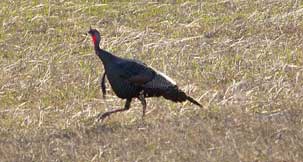
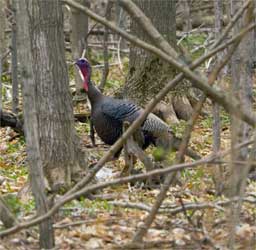
The beard doesn't show in this photo but it's there and it's big.

I noted the time of day, drove a half-mile down the road and out of sight of the gobbler, turned around and drove past him for another look. From this angle the bird looked even larger, and the beard was dragging the ground whenever he bent over to feed.

This was a gobbler of extraordinary proportions. Such birds are difficult to keep hid because he seemed bound and determined to stand out in the open where he could be seen by every vehicle that traveled the busy road.

We drove away, and the next day we went back looking for this Monarch of the open fields. Sure enough, he was in the same field, walking the edge of a wood lot, and about 100 yards off the paved road.

The question is how long will he stay there? If he keeps showing himself, every turkey hunter west of Interlochen and north of US-31 will be trying to hunt him. The bird is on private land, and seems enthralled with the area.

It's my assumption that the big gobbler and some hens are roosting nearby. I see him about two hours after sunrise, and the birds never stray too far from this spot.

Company came from Wisconsin and spent three days here, and I didn't have any chance to go out checking on the big gobbler. I know for certain that at least two other hunters know about him, and suspect he has been seen  by many more people.

Too much traffic will spook birds.

The burning question is whether he will still be around when turkey season opens. I spotted another car parked along the road, and figured he was watching the bird.

He had binoculars to his face when I pulled up. He turned, saw me and whispered "Big bird." I nodded in agreement.

The bird walked off into the woods, and he asked if I had known the bird was there. I told him I'd been watching the gobbler for a few days.

"Are you planning to hunt him?" he asked. I told him that I might if he sticks around.

The burning question about this gobbler.

"Do you think he will still be in this area when the season opens," he asked. "I just spotted him on my way home,  and I've never seen a beard like that before."

His was a valid question. Would this bird still be in the area when the turkey season opens? It's not very likely.

"I doubt if he will still be here then," I said, being honest with the guy. "A bird that big attracts a great deal of attention, and I suspect people pressure will force him to move on.

"How far he and the hens will move is just a guess. I'd expect him to breed those hens before the season opener, and then he will be off in search of other hens. He could be several miles away when the season kicks off."

Would I hunt him? Certainly, if I could get hunting permission for that land. However, my guess is he will be gone in a week or less because other people now know where he is, and if cars continue to stop and watch him, the pressure will force him to get on his way.

And, perhaps that is a good thing. Such big birds are tempting, and poachers often figure a way to shoot such birds out of season. That is one reason why I didn't say how far west of Interlochen Corners or how many miles north.

I may go looking for him again tomorrow, but it wouldn't surprise me if he is gone already. Perhaps I'll be lucky and find him again, and then, I may never see that gobbler again.

The next time I spot him, if there is a next time, there will not be any notations in my blog. The only reason I've written about the bird is because of his size and because I know he won't hang around there long.

He will shove off, move elsewhere, and it's likely he will take over the hens of a smaller gobbler, and soon he will be following the hens. They will keep him moving, and the more nearby eyes and ears there are, the safer that bird will be.

Posted via email from Dave Richey Outdoors