Showing posts with label shoot. Show all posts

Thursday, August 02, 2012

Don’t shoot little bucks

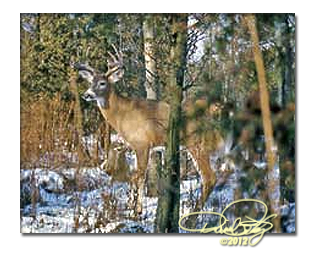
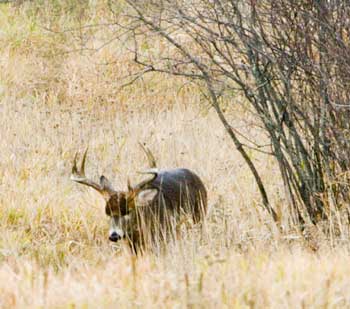
DRO 080212_Which Buck?
Which buck would you rather shoot? It’s an easy choice, isn’t it?
photo courtesy Dave Richey Outdoors ©2012

A single belief is a continuing thread that runs through the management of any deer herd. A buck needs time, lots of time, to grow to produce big antlers.

Big-antlered bucks don't just happen. In much of Michigan, a buck seldom lives long enough to really produce big antlers. Often, the first buck with bone on his head that walks past a hunter will get shot.

There is little or no deliberation for most people. Many hunters that see antlers of any size will shoot that buck, and check for size later. The vast majority of these bucks are 1 1/2-years-olds with their first set of antlers.

They get shot with a bow or firearm long before they have any potential for serious growth. For many hunters, killing a buck of this size is just an ego stroke. It offers them bragging rights. Nothing more or less.

Wow! They get to brag about shooting a little basket rack 6-pointer. Or, even worse, they drop a spikehorn. It allows them to say "I got my buck, did you?"

My answer to that statement is: Who cares


Bucks don't just hit the ground at birth with a big set of antlers. It takes time for them to grow, and on average, 3 1/2 years is the minimum. If a buck can reach 4 1/2 years, there is some possibility of seeing the great potential this animal has.

Drop a 1 1/2-year-old buck with his first rack, and that animal will never get larger. The hunter would be far better off, and do the local deer herd a favor by letting the little buck walk and shoot an anterless deer.

I've long maintained that shooting an old doe that has been around for several years is much more difficult than shooting a buck. Bucks can gain some instincts over time, and they may go nocturnal, but stick with a buck long enough and he'll make a mistake. Old does seldom make a life-threatening mistake.

Time, or if you prefer, age is one major factor in a buck living long enough to grow a big rack. It takes three or more years for their antlers to grow thick with long beams, a wide spread and long points.

The only way a buck can live in today's society where they will wear the rack of a big monarch is for hunters to give them a break by shooting a doe instead. Another possibility is if they travel the first year near thick cover, and jump into it at the first gunshot. There, if they are naturally cautious, will keep their head down and not venture out until long after dark.

Everyone talks about deer "going nocturnal," and heavy hunting pressure causes that to happen. If the deer smell too much human scent, see too many sportsmen walking to their stands, or catches a hunter moving while on stand, it sends them scurrying for the nearest patch of thick cover.

If it happens twice to a decent buck the animal may choose to hide out until all the people have left the woods. The bucks then come out, feed and jump back into their sanctuary. Hunting pressure and hunter errors forces deer into this nocturnal feeding-travel pattern.

A plan for hunting success down the road


The bottom line for sportsmen today is to spare some young bucks, and if everyone in the immediate hunting area subscribes to and practices this form of deer management, there will be more and larger bucks within three years.

Hunters can remove excess doe numbers, spare the button bucks, and other young bucks, and in time their chance of seeing and shooting something with an antler spread of at least 18 inches will be much better.

Cut these young bucks down when they still have a puny rack, and you've accomplished nothing toward about building a local herd of better than average deer.

It's a tough sell because there are countless people who listened to their Daddy and old Grandpa who continue to mutter the old folklore idiocies, such as: "You can't have more deer by shooting the mother deer."

That old saw has been proven wrong for so many years it's a wonder anyone still believes it.

We let young bucks live, and if you want good bucks on your land, you better do the same. Big bucks won’t show up overnight, but sparing small bucks for three years will do the job nicely.

Sunday, February 05, 2012

Choosing between shooting or not shooting a buck

deershootnoshoot

This nice buck pauses within easy bow range but I didn’t shoot

A hard northwest wind came moaning through the pines last fall, driving the snow horizontally across the newly whitened horizon, and making me wish for the comfort of home and hearth.

The pines were draped with snow, and only the foolish or hungry were afoot in this foul weather. I belonged to the first category, and was hoping a few deer from the second group would filter past my tree. My stand, 15 feet up a pine tree, offered a vast panoramic view of the nearby woods, tag alders and open feeding field. Several inches of new snow covered the ground, and a nearby tag alder thicket provided the only decent cover where deer could wait out the storm.

My glasses were almost useless because they were covered with melted snow, and periodic cleaning of my specs helped some, and the movement was necessary if I were to loose an arrow if and when a buck showed up.

It wasn't a nice day that year to be out, but bucks were moving

The wind sliced through the nearby bedding area like a knife through warm butter. It came gusting across the field, sandblasting my face with hard snow, when a buck stepped hesitantly into view.

The 8-pointer seemed to have come from nowhere. The animal appeared like gray smoke scudding ahead of the wind, moving dark against white from the tag alders into the snow-covered open woodlot.

It traveled downwind, and stopped at random to check the wind, and then seemed to drift slowly across the whitened woodlot. It was the epitome of a whitetails strength to survive in all types of weather and ensure perpetuation of the species. Deer must be tough to survive for long in this type of weather.

It also was the stuff of calendar photos: a snowy scene, green topped pines and a motionless, majestic buck alertly surveying his surroundings. I raised my bow as the buck stepped methodically through the deepening snow to within 30 yards, knowing I wouldn't shoot until it moved to within 15 yards and offered a high-percentage shot at a no-miss range.

It's a close shot or nothing because of my vision problems

The buck began to forage, and conflicting thoughts sent electrical currents coursing through me. Live or die, it's late in the second bow season. I may not have another opportunity to take a buck before the season finally ended.  Besides, it would be a tough drag for one man to get the animal out of the woods to where I could pull it to my car with the four-wheeler. It would be a back-breaking chore just to lift it into my vehicle.

Conflicting emotions offered the thrill of taking a nice 8-pointer while testing my mettle against a savage late-season snow storm. The buck fed closer, browsing on something just off the ground, and my mind was forcing me into a confrontation with myself over the sanity and wisdom of shooting or not shooting this buck.

Give in, and just do it, came one mental command. The flip side said no, it will be too tough physically and there will always be another opportunity.

Flip a coin or do something; I chose to pass on this buck

The buck solved my mental deliberations. It gradually fed into a thick tangle of second growth from a cutting made 10 years before, and it slowly disappeared from sight.

I trudged through the building snow to my vehicle, cased my bow, and prepared to head out. Within moments, the vehicle was filled with welcome warmth, and I calmly reflected on my ambivalence.

Was I too wishy-washy? Had I lost the killer instinct?

The questions pinged around like metal balls in a pinball machine. Minutes of inner reflection told me that the answer was a definitive no to both questions.

There's something about a nasty storm, and hunting in bad weather, that satisfies my mental needs. There also is something about taking an animal's life, or not taking it, that causes great deliberation. It's easier to kill the animal than to allow it to walk away.

Granted, venison is one of my favorite meats. I take deer every year with bow, muzzleloader, rifle or shotgun, and each year I pass up many bucks that could have been harvested.

But, darn it, it feels good to let one live another year and to recall the decision many times over a long winter.

That's why it was simple not to pull the trigger on my bow release. That decision made it easier to yank the four-wheel-drive lever into low-lock and ease down the rutted and slippery two-track for a snowy journey back to civilization where my decision to not shoot made even more sense.

The power of granting life or death over an animal had been satisfied once again, and this time, the buck lived to furnish many fine memories. The thoughts of passing on that buck will live longer in my mind than it would have if the buck had been killed.

Knowing I had made a wise decision based on my personal feelings and simple logic was enough to turn this hunt into a successful one.

Posted via email from Dave Richey Outdoors

Saturday, January 14, 2012

Winter archery makes us better shots

Indoor archery shooting gives hunters practice all year

Many people from all over the state have told me they shoot in an archery league to stay sharp during the winter. Others have developed other rather ingenious ways to conduct winter practice.

The primary function is to shoot enough to pick up the bow, draw, aim and shoot without feeling any discomfort. Stay away from shooting of any kind for a month or more, and the bow often feels a bit heavy or uncomfortable in your hands. The trick is to stay comfortable with a bow all winter.

My basement has a 25-yard archery range in it. I can shoot every day if the mood moves me, which it often does.

This allows me to shoot all winter 

Shooting a few arrows makes the bow feel five pounds heavier than it really is, and the back and shoulder muscles get sore easily. Shooting is the best cure for any of these problems, and it makes accurate shooting much easier.

If a person just has no place to shoot, they can still draw their bow and develop some strength training. Here are several examples of things one can do during winter months to stay comfortable drawing a bow.

A buddy does his shooting out in his cavernous garage. A target is set up at one end of the garage, and he can shoot at distances from 15 to 25 yards. Of course, on a bitter cold day, five or six shots is about all he can handle. He needs a small wood stove inside to make shooting warmer and more fun.

Another friend has a 17-yard archery range in his basement. He is talking about cutting a hole in the wall which would allow him to shoot at 25 yards, and it would more closely simulate shooting from an enclosed hunting blind.

Practice at shooting while sitting or standing 

He practices standing up and sitting down while shooting, and this is good. As a rule, he normally shoots while sitting. He can don some fairly heavy clothing similar to what he would wear for December hunts or he can wear lighter clothing to simulate shooting in October.

Still another gent I know does shoot some, but he walks around his house, comes to full draw, centers the sights on the nearest light bulb, telephone or drawer pull, and he finds it is excellent practice. Of course, he doesn't release the string, as in a shot.

Most people when they draw on a deer have to fiddle around a bit to get their sight pin on target. All of that uses up time, and if the buck is walking away, it makes people hurry. When they hurry, they usually make a mistake and take a bad shot or miss entirely.

Not this guy. He practices all winter drawing an empty bow and concentrating on putting the sight where he wants the arrow to go. He works hard at it, and when he is shooting he will do the same thing with an arrow on the string. The bow comes up and back, and the arrow is on its way. This only comes from perfect practice.

Look at your situation and determine what you can do 

Such practice makes target acquisition quick and easy. He always nails his anchor point, and if he is on his anchor point and the sight is on the target, a twitch of the finger on a release sends the arrow downrange to where he wants it to go.

Practice can take many forms, but it's important to become somewhat committed to handling your bow during the winter months. I shoot as often as possible, as I follow my no-nonsense method of drawing, achieving my anchor point, aiming and shooting.

It gives me the daily practice that I need, and the result is that when it comes time to shoot a deer during bow season, I am ready. My muscles are tuned up, my eyes are sharp, and when I hit my anchor point, a slight adjustment tweaks my aim and the arrow is gone.

Many hunters wait until two or three weeks before the season opens, to start practicing. It's better than nothing, but the people who are the finest shots practice shooting on a regular basis.

Their muscles are all peaked out at a comfortable draw weight, and their eyes automatically center on the aiming point, and all it takes is to touch the trigger, and the arrow goes where it should. It's simple.

That's why good hunters practice all winter.

Tuesday, April 26, 2011

Gobbler hunting with a bow


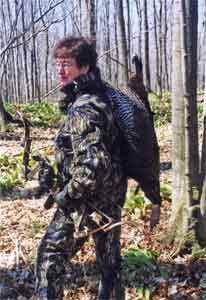
Kay Richey with a jake gobbler she shot with bow and arrow.


There are any number of ways to hunt these sharp-eyed birds, but one thing is a constant. Hunters must have some way of concealing the movements necessary when drawing a bow on a strutting gobbler.

Trust me, it's not easy. Turkeys see well, hear well, and there often is enough of them around a gobbler that coming to full draw isn't easy.

One way of doing it, and the most effective way, is to use a pop-up ground blind of camouflage material. These blinds take hardly any time to set up, and a bit of natural grasses or broken tree branches can allow a hunter and his blind to blend right in.

One way to do it is to locate a gobbler or two the night before, watch them fly up to roost, and return the next morning well before dawn. Set up the blind in the dark as quietly as possible, climb inside, sit down and stay quiet.

Sometimes gobblers will gobble first, but often small birds will be chirping and then the crows start to fly. The cawing of crows often triggers a spirited gobble.


Don't get impatient and hurry a bow shot before it's time.


I prefer to let the birds gobble two or three times before making a soft and short yelp. That's it, just one very soft call. Gobblers aren't deaf, and if they hear it and haven't been spooked, they will answer.

Just sit tight. It's not necessary to answer every gobble. In fact, let them gobble one or two more times, and make one more soft tree yelp. Listen for the birds to gobble from the roost, and then beat old turkey wing feathers against tree branches like a hen flying to the ground.

The gobblers will hear that, and often gobble again, and one more soft yelp is usually all it takes. If you are using decoys, there are different schools of thought on decoy placement.

I like to use two hen decoys and one jake decoy. I like the jake decoy facing the blind and the hens five or six yards farther out. When the gobblers come to the decoys, it's best to place the jake about 18 to 20 yards away and facing the pop-up blind. This will normally put the live gobbler between the jake decoy and you.

Gobblers almost always will head for the jake decoy, and I've watched adult gobblers jump up on the jake decoy, knock it over, and start putting the spurs to the decoy.

Shooting the gobbler is pretty easy with a shotgun, but it is much more difficult with a bow. Gobblers can stand still for long minutes, but when they come to the call and decoys, they are moving around.

Two certain shots are possible. A shot taken at a gobbler facing directly at the hunter is fairly easy but I know many people who wind up killing the bird but slicing off the beard in the process.

Wait for the bird to drop his wing-tips, spread his tail feathers, and prance around. Once the bird stops, aim for a spot just below where the beard comes out of the chest, lower the sight three or four inches, and try to hit just to one side or other of the beard. Done properly, this will kill the bird quickly.

The other way is to wait for the bird to start strutting, and let the gobbler turn all the way around to face the jake decoy. Aim for the center where all the tail-feather quills go into the back end of the turkey, and take a well-aimed shot.

Place the jake decoy in front of you and shoot when the gobbler goes to it.


A mortally wounded turkey will almost always shoot 10 to 12 feet straight up into the air, and fall back dead. I strongly suggest using a Game Tracker unit, because if the bird is not mortally wounded, it will fly or run off. The bird may not travel too far, but if it goes out of sight, they can become nearly impossible to find. A  string tracker can be a big help in recovering the bird.

Do not take side shots at a gobbler. The wing bones and feathers are heavy, and it's difficult to place an arrow through the wing feathers. I've talked to a few turkey hunters who say they shoot their bird at the juncture of the head and neck with an arrow, but it would be a difficult shot because a gobbler's head is always moving.

Of utmost importance is to position the blind so a shot can be taken sitting down. If the tent has horizontal and vertical windows, position a vertical window in front of you. Sit back, with full camouflage on, and wait for the bird to get into the proper position for a shot.

My wife has shot two gobblers with a bow.


My wife has shot two nice gobblers with her bow, and everything must into place in order to be successful. It is even more of a heart-pounder if a longbeard is taken with stick and string.

Turkey hunting with a bow is a major challenge. It's not easy with a bow, but when it works, it offers a surge of adrenaline that will be hard to forget.


Sunday, April 10, 2011

Stay calm when turkey hunting


When everything comes together, and the bird cooperates, this is the result.


Watch some television hunting shows about chasing gobblers, and many of those good old boys can control their nerves although some hyperventilate a bit as a nice gobbler gets closer. They may get excited but they almost always appear cool and rock-steady.

They shoot gobblers with what appears to be calmness. I know some hunters who hunt a dozen states every spring, and they have plenty of time and experience to hone their skills to avoid moving at the wrong time or to make some of the other costly mistakes made when gobblers close the gap between out-of-range and time-to-shoot.

I've had gobblers almost trip over my feet, brush against my elbow as I sit with my back to a tree, and stand within three feet of my shotgun barrel and gobble in my face.

Be prepared for a gobbler and don't flinch when it comes.


Are my nerves better than yours? I can't answer that question, but when I hear a bird approach, stop to spit and drum, I know any movement or noise on my part would end this hunt fast. Once a bird came very close to me along a fence, and was near enough for me to grab had I been dumb enough to try.

Most people who grab supposely dead long-spur gobblers off the ground by the legs when the bird is still flopping usually only make that mistake one time. A bird with good spurs will rake deep cuts in your hand, and most require a visit to the hospital.

I was ready for that sneaky bird, and once he put a couple of trees between us, and stopped to fan out and display, I knew this hunt would end with a big and dead gobbler over my shoulder.

He gobbled once near the decoy, and when the deke didn't respond, he lifted his head to look around, and I shot him. Is this coolness under fire or just a matter of experience?

Look sharp for circling strutters but don't move your head.


To my humble way of thinking, it is more experience than ice water in my veins. There has been some times when I haven't had a chance to test my mettle against a wise or gobbler because my season started with high winds and snowy weather, and birds didn't work well.

There have been many times when a bird may circle. Your eyes can only track a bird just so far to the right or left and you lose sight of him. Just because you can't see the bird doesn't mean he or one of his chums can't see you. Grit your teeth and hang tight.

These are times when so-called "nerves of steel" come in mighty handy. My hearing helps make up for my poor vision, and I can hear turkeys walking behind me and that helps me know their exact location. The trick then is to remain absolutely motionless, and wait for the bird to circle around in front of the shotgun. Sometimes they do and other times they don't. It's a part of the hunt we can't control.

Think of yourself as a statue: immobile, rigid and incapable of making a movement or sound. Trust me, it's tough to do when a gobbler gets right behind you and rocks your head and hat with a tremendous gobble. Expect that to happen, and be prepared for it. If a gobble doesn't come, that's great, but it's smart to be ready to avoid jumping.

Talk yourself into a state of immobility until the shot.


Imagine the bird is searching for a hen. Your shotgun should be to your shoulder and balanced across your knees long before the gobbler gets close enough for a shot. The stock should be against your cheek, you eye lined up over the front bead, red-dot sight or scope. Once the bird is in the right spot, pinch off the safety between a thumb and forefinger, ease the finger up to the trigger, aim and shoot.

It's sometimes amazing how motionless and quiet you can make yourself if you concentrate on it. Just take the occasional deep breath, ease it out softy, try not to hyperventilate, and enjoy the experience for what it is, an exceptional opportunity to experience absolute calmness before the shot.

Then, if you shoot straight and a big longbeard lays on the ground 30 yards away, feel free to let loose with a silent scream of wonder and joy. An audible scream will probably spook other nearby birds out of the county and ruin any chance for someone else to score.

Turkeys often will stand and look when a shot goes off or they may run 20 yards, stop and turn around to look at their fallen friend.

Occasionally they will take off and fly far out of sight before landing.

A loud scream will send birds wildly on their way. So learn to conquer your nerves, and it's surprising how easy turkey hunting can be ...at least once in a while.

Sunday, April 03, 2011

Solitary turkey hunting


More than one hunter with birds this close is one too many.


Make no mistake about it. By nature, I am a solitary hunter. Sure, I call turkeys for my wife, and some friends, but I enjoy being alone when turkey hunting.

Once, several years ago, a gobbler was 75 yards away and moving my way fast through the spring woods. He was fixated on Henrietta, my whupped-up-on hen decoy, and seemed committed to a quick romantic dalliance with her.

The longbeard was almost within shooting range when a morel mushroom picker walked up behind me, and bellowed: "What are you doing out here in the woods? What are you up to. I think I'll call the law."

The gobbler heard the human voice, hit the skids, jumped to the left, ducked behind a tree, and quickly disappeared from sight. He was as lost as last year's Easter egg from that time on. I was never able to locate that bird again.

Gobblers or a longbeard with hens are very spooky.

Other people chatter and talk. Some, like the above anecdote stated, are mushroom pickers. Many have no clue about turkey hunters, and it's just one more reason why one must be careful in the turkey woods.

Hunting these big longbeards is considered a one-man game. On occasion I'll take one or two people hunting, but dislike taking more than one. And frankly, I'd much rather hunt alone than with someone other than my wife.

The sad fact is that turkey hunting, which begins in a couple of weeks, is not a community event. It's not meant to be a social affair, a gathering of friends with similar hopes and desires. This gobbler business means absolute silence, no moving, and it also means a keen knowledge of how to set up on a bird and how to call it in.

Seldom will two hunters score during the same hunt. A guide and one hunter can work but one guide and two hunters soon becomes a lesson in frustration.

It's difficult for two people to shoot at two different birds.


There is much to be said for turkey hunting alone. You choose your hunting spot, and if the birds head the opposite direction, the hunter gets up, starts running while hoping to get ahead of them without being seen. It occasionally works, but most of the time it doesn't.

It's not easy, but it's much easier for one person than for two or three. Me and two others tend to get in each other's way, and often someone will move when they should be sitting still. A fidgety hunter will spook every turkey long before they walk within shotgun range.

Some hunters want to idle away slow time by chatting. I don't want people talking to me because I must listen, and don't need to hear stories of their earlier hunts, what he expects from this hunt, or to answer hunting questions when we should be motionless and silent.

My spare time on a hunt is spent trying to get someone into a bird. Sometimes it just doesn't work, and other times, the gobbler comes to the call like I have a rope tied to his neck. Now may be the time to state that I am not a for-hire guide. I only take family and good friends hunting, that is, if I have already taken my gobbler.

I prefer hunting alone although I often take my wife and she shoots.


Hunting alone has much going for it, and frankly, it pleases me immensely. It allows me to go where I want, make decisions whenever they become necessary, and there's no need to worry about someone else and their feelings, whether real or imagined.

One might say it's selfish, but who cares? It's my hunt, it's my time, and if I choose solitary hunting, so be it. It's not a case of being antisocial; it's a matter of knowing that one turkey hunter is far more effective than two or more people hunting together.

The odds improve greatly for solitary hunters. The only reason I take another person out for wild turkeys is that I enjoy watching them shoot their first gobbler. Both hunting alone and calling a bird for another hunter are selfish actions. I do them reasonably well on calm birds and with people who pay attention and don't move or talk.

People know I have bad vision, and they are counted on to help me spot incoming or circling birds. No words need to be spoken. An elbow nudge gets my attention, and the movement of a relaxed finger gives me the direction. The birds often are spotted first, but it doesn't always happen in a wooded area with heavy vegetation.

My instructions are simple, and should be easily understood. Sit still, don't move, sit with your back to a shoulder-wide tree, pull your knees up, rest the shotgun against your shoulder and across your knees, and listen to what is whispered to me.

I tell them that as the birds approaches us or my decoys that they cannot move, even if they have the mother of all back pains. Be still, don't make a sound and wait for the gobbler to move directly in front of the shotgun at 20 to 35 yards.

A sharp but barely audible putt is made when the gobbler is in the right position for a killing shot. The sound makes the bird stop, and its head goes up to look for danger. Be ready, and shoot the gobbler where the head and neck join. Hunters are warned to keep their cheek down on the shotgun stock, and don't lift their head when they pull the trigger or the shot will go high.

There will be plenty of time to palaver and talk once we leave the hunting area. Often other turkeys will have been with the dead gobbler, including other gobblers. Shoot the bird, sit still and don't move, and let the other birds wander off on their own.

Doing it this way doesn't alert them to humans in their midst. A shot could be confused with thunder, which turkeys hear all the time. It's the motion and noise of a moving hunter that jumps out from in front of a tree that sends birds heading for the next township.

Hunting a strutter can be hard. It's harder with another person.


Hunting alone removes all of these potential problems. It's one man, going one-up with a gobbler, and without any consideration for anyone else. It's making personal decisions, and living with them, whether they are right or wrong.

The case has been made for hunting alone, and although I take two to four hunters out every spring, I haven't figured out how to hunt error-free yet. Maybe I should hire me a guide and learn something new. But I won't because I enjoy the quiet solitude. It's what keeps me focused and willing to put up with too little sleep during the short spring season.

Wednesday, March 16, 2011

Ethics and turkey hunting


Shooting a gobbler friom a car window is illegal


Shooting a gobbler before legal shooting time starts is a serious breach of ethics and laws. Dumping a gobbler after shooting time ends is equally wrong. Killing one with a rifle is illegal in this state although legal in others.

The advent of 3 1/2-inch 12 gauge shotguns and the heavy 10 gauge magnums with ultra-full choke tubes have made longer shots possible. I watched a gent unload one shot at a gobbler that would have kept coming had he not shot at 80 yards, and the bird flew away with the guy chasing it with two wild shots.

Only a fool would shoot at a bird that far away


Here was the dude who ignored my warning that the bird was too far away to shoot. He took an unbelieveably long chance and missed the shot
"I think I rocked him," he told me, somewhat proud that he may have buried some pellets in a bird that got away. I had told him to wait until the bird was 35 yards out, but he shot at over 80 yards and tried to convince me the bird was within range. Was it an ethical shot, or a Hail Mary shot? The latter is my thought.

There's no excuse for ultra-long shots. Allow the bird to approach within range, take your time, and when his head comes up, shoot. If the bird approaches, his head and neck tucked down, don't shoot. Birds often will go out of strut, straighten up, and lift their head after gobbling. The chance of wounding a bird is high until the head is straight up.

It's unethical to call to a bird if you know another hunter has been working it. Common sense, which plays a major role in hunting ethics, dictates that the newcomer should hunt elsewhere for a different bird.

I watched a big gobbler approach a highway, cross and head toward my hen and jake decoys. My set-up was 350 yards off the road, and the bird came off the road shoulder and out into the field. It then began to strut, gobble, and started my way again.

Most hunters, if they knew someone was watching, would never shoot a treed gobbler. It's just not an honest way to hunt. So, if we always believe that someone may be watching our actions, we follow the rules.

Ethics are legal and moral standards by which other people judge hunters. Shooting a gobbler from a car window is not ethical nor is it legal. Shooting one from someone's front yard, running out, grabbing the bird and racing back to the car for a fast getaway is not only unethical but illegal.

Turkeys are sure-nuff noble birds & ethics are needed


I had a chance several years ago to cheat. A huge gobbler was working my way, slowly but surely, and the minute hand was ticking slowly down to the end of shooting time. A soft little whining yelp teased the bird and he paused to gobble, do a little dance step and all it did was slow him down.

Ethical turkey hunters wouldn’d shoot this road-crossing gobbler


Ethical turkey hunting means hunting legal. For instance: we can't pot a gobbler from a roost tree, before or after dawn. Granted, some people might get away with it but it is unethical and illegal activity.

The gobbler had a beard that tickled the ground but was 55 yards out. Three minutes of legal shooting time was left, and I hoped he would get moving and take several fast steps closer. He could then dawdle along for another five yards, and be in range before shooting time ended.

He took two or three more steps, stopped again, went into a semi-serious strut, folded up his wings, and stood at 45 yards. It was now down to seconds: 10... 9 ... 8... and finally my watch said shooting time was over. Five seconds later the bird quickly walked to within 25 yards of me, stopped, and stood broadside with his head up for a full minute.

Watch gobblers and wait for the right moment to shoot.

Could I have shot? Absolutely. Did I shoot? The answer is no. Who would have known if I had cheated by less than a minute?

That answer is simple. I would have known, and every forkful of breast meat would have stuck in my throat. I couldn't have eaten that bird if I had violated ethical and legal codes of hunting conduct.

There are certain things ethical hunters will not do. A car came down the road, stopped when it saw the gobbler and pulled onto the shoulder. The driver leaned on the horn and startled the bird. It started coming again, and this time one nut-case yelled out the window while the other honked the horn. The gobbler lit out on a dead run, crossed a big field, and disappeared from sight.

Hunter ethics wasn't the issue here but instead, it was a clear case of hunter harassment.

You know, I know, and poachers know that conservation officers are spread too thin and it's hard for them to enforce all the laws. So, if anyone will help police our ranks, it must be you and me. Ethics must stand for something, and if ethical behavior goes out the window, where are we then?

Civilization must stand on a strong foundation of common sense and ethical behavior. If we lose one, the other will surely follow. If they both go, the world of hunting as we know it will falter and fail.


Wednesday, November 10, 2010

Consider changing your firearm hunting plans


Be careful with this shot. The fawn is very close to the buck.


Firearm deer-season openers vary from one year to the next, but some things never change. Firearm hunters do things just before the season opener that can cost them a shot at a nice buck on the opener or during the 16-day season.

By Friday, the roads will start filling up with small trailers, truck campers, tent dwellers, and other people heading north to their favorite hunting area to set up deer camp. These camps are spread throughout most of the Upper Peninsula and northern Lower Peninsula.

Mistake No. 1 for most hunters is they are traveling in the wrong direction. Most sportsmen should turn aroundm and head south to the southern Lower Peninsula counties. That where most of the deer, and most of the larger bucks live.

Michigan’s southern counties are best for big bucks and lots of deer.


Mistake No. 2 of this deer-camp routine means sighting-in rifles. Where do these hunters go to make certain Ol' Betsy is still shooting straight? You've got it: they sight in their rifles where they plan to hunt. Duh! That’s not a smart move.

Deer are not capable of thought like a human being. They rely on finely honed instincts to stay alive. The woods have been relatively quiet with bow hunters closing out the early archery season, and only a few small-game hunters are around to make any noise.

All of a sudden, here comes an influx of sportsmen. They rattle and clatter around at their chosen campsite, and there are car doors slamming, loud talking, and people start to settle into their camp.

Deer sense changes in the fields, swamps and woods near deer camp.


They then walk through the woods through dry leaves or snow to determine where to sit on opening day. They lay down plenty of stinky boot leather, holler back and forth to each other, and leave the woods filled with human noise and scent.

Next, they set up a target 100 yards away, and blim-blam at it for several hours. They shoot fast, over-heat their rifle barrel, and never truly get a good reading of what their firearm is doing. They should know that any first shot they take at a deer on Monday will be the most accurate because it is being shot through a cold barrel. That is, if it is dead-on.

Shooting a clip filled with cartridges in rapid-fire fashion doesn't give the best results at sighting in a firearm or hitting a deer. As the barrel heats up, the bullets start hitting farther and farther apart. Hunters should always allow at least five minutes between shots when sighting in a rifle. Ten minutes is even better.

Be quiet, don’t slam car  doors, and realize that deer can hear, smell and see well.


There is loud conversation as the hunters compare notes, and advice is freely handed out. The steady sounds of shots being fired, and the loud talking, and people roaming aimlessly through the woods, isn't lost on the local deer population. It doesn't take much IQ to know that something new has been added to the mix, and anything new means possible danger.

It seems everyone now sits inside a portable tent or a small coop to hunt, and many people still use bait, even though it's illegal. Deer are always suspicious of bait that is suddenly found in the woods. It takes deer at least a week to become fully adjusted to a nearby bait site.

The problem of hunting from a fixed location is that no one is moving except before dawn, from 11 a.m. to 2 p.m., and then again after shooting time ends. Most hunters don't go out and work the swamps and other heavy cover because they don't want to push the deer to someone else. So if everyone sits, and the deer hold tight in their bedding cover or other thickets, there won't be many shots taken.

If the deer don't move, the hunters complain about a shortage of deer. They say the DNR has lied to them again. Sadly, most of the blame for very little deer movement can be laid at the feet of those hunters themselves. If everyone sits, and no one moves, the deer won't move until after dark.

Make just a few changes, and it can help hunters bag more deer.


Is there anything hunters can do? Not really, the damage has already been done for this year but sportsmen can sight in their rifles during the summer months at a gun club near home. They can make forays north during summer or early fall months, and make certain their blind is OK.

They can tone down the loud conversations, and realize that deer are not accustomed to continuous loud man-made noises. They can work together so that everyone walks around for an hour each day, and develop specific areas for hunters to walk through to move deer around.

I'd rather see four guys, who hunt together, sit until 9 a.m., and then one person should walk through a designated piece of cover for an hour before sitting down again. At 11 a.m. many people walk out to eat. At noon one of  the hunters could cover another parcel of thick cover, and most hunters come back out at 1 or 2 p.m. Another hunter could move at three, and a different one at 4 p.m., and that would put someone out walking around and moving deer most of the day. Everyone would see more deer and probably shoot more animals.

If every hunter stays in their blind all day no one will be moving animals. Hunters can work this or a variation of this movement pattern, and it is bound to help sportsmen see more animals.

Even more important, it isn't going to ruin anyone's hunt if just one person gets up and moves around for an hour. In fact, it could lead to better deer hunting for everyone. It's certainly worth a try.

Posted via email from Dave Richey Outdoors

Saturday, October 23, 2010

Choosing when to shoot


The buck was a nice animal. It was an adult 2 ½-year-old with eight points, the beginning of a really nice rack, and he wasn't rut-crazed just yet. This rack, while still thin and spindly, had an inside spread of 16 inches with good brow points.

The buck came to me early in the evening with plenty of shooting light, and stopped at 18 yards and stood at an extreme quartering-away angle for long minutes. It was a tempting shot possibility.

Questioning my desire

Did I want to shoot that buck? You know, I really can't answer that question. Undecided, I did as I often do, and came back to full draw. The tiny sight settled low behind the front shoulder, but the shot would have to be precise and I tweaked my aim a bit more.

It's too shallow of an angle, I thought. Too much margin for error. I held the bow back longer, waiting for him to turn. Finally the bow was eased down, and that buck stood in that position for several more minutes before shifting just a bit to turn directly away from me.

I continued to watch him, all the while asking myself: do you really want to shoot this buck? He is nice, but he isn't that nice. Another year of life would make this a really fine animal if someone else didn’t shoot him this fall.

The result was that my inner self talked me out of that buck until five minutes later when he turned slightly to watch another deer. I raised the bow, put the sight on the proper spot, and held it there.

That animal had no clue I was anywhere in the area. For me, much of my deer-hunting enjoyment comes from fooling the animals. I don’t need to kill a buck to have had a good hunt. But … this guy was very tempting.

If I touched the trigger of my release this would be a dead 8-point. I laid my index finger on the trigger, refined my aim just a tad and didn't pull it. Deep down, I really didn’t want to shoot this deer.

No shot and my reason

The bottom line was the buck wasn’t  exactly what I wanted. It was nice, to be sure, but not that nice. Besides, it was too early in the season for me to shoot a buck. I had time to wait for something bigger.

The buck walked away minutes later, completely unaware of how close he had come to getting shot. It was turned just right so I wasn't looking into its eye, and it wasn't fidgety. It was completely unaware of my predatory presence, and I let that buck walk.

Thirty minutes later an even larger 8-point walked down the wooded trail. This guy stood broadside, and offered an easy 17-yard shot. I aimed, held the red-dot on the vitals for 30 seconds and eased up.

Shoot or don’t shoot?

It was useless. I knew, in my heart, that I had no intention of shooting this animal that evening. He was a nice buck, but still didn't have quite what I wanted.

It occurred to me that I was having a problem identifying what it was I did want. Trophy hunting doesn't appeal to me, but after a half-century of deer hunting and shooting many basket-rack bucks and some other really nice animals, shooting what suits me is very important. Some years I don’t shoot a buck, and that is my choice. I certainly see enough antlered bucks within range that I can afford to be a bit picky with my choice.

I then agonized over trying to identify what it was I wanted, and got no further down that trail before I realized that a buck was important but it was nearly impossible to identify what unique requirements were needed to satisfy my need to release an arrow at the animal.

A lesson from the past

It reminded me of a conversation I'd had 30 years earlier with a magazine editor as we discussed his magazine’s photographic needs and how I could help him reach those goals. He said: "I don't know what I want but I'll recognize it when I see it."

My buck-shooting problem is similar to his photo problems: I probably won't recognize what it is I’m looking for until I see it, and then all of my motor skills will allow me to come to a full draw, aim with precision, and let loose a killing arrow providing the animal is within my clear and well defined shooting range.

Once, some years ago, I could see a big buck easing along the edge of an oak ridge. His position in relation to mine made it impossible to see both sides of this rack.

The buck sneaked along an overgrown fence line at the edge of the woods, and he would lift his head on occasion to look ahead for danger before lowering his head again. I heard a soft grunt coming from his direction, and I knew he was scent-trailing a hot doe.

He would come within easy bow range of my tree stand, but still the right side of his antlers wasn’t visible. He was a shooter, no doubt, if the right side was as good as the left.

Here he came, walking gently as if he was stepping through broken glass, and he paused 20 yards away. It was just a bit too far to shoot with unfailing accuracy. His head was down and out of sight, and he would be at 15 yards when both sides of his rack would be visible. Just wait, suck a bit more air, and settle down. The bottom line in all such cases is he will come closer or he won’t. Wishful thinking doesn’t work at placing deer at the preferred location.

He eventually took a few more steps toward me, stepped out into the open, and stood with his head held high. I looked at the right and left side as I drew and prepared to  aim. I soon let off on my draw, and knew I wouldn’t shoot this buck.

The right side had three antler tines broken off as a result of scrapping with another buck. His rack had been damaged in a fight, and if I am to shoot a big buck, his antlers will go on the wall. This old boy got a break on this day although another person shot him on the opening day of the firearm deer season.

A mental crossroads

My problem is I'm at some type of mental crossroads. I'm well past the point where I must shoot another buck. I'm not out looking for massive antlers although I'd probably shoot if that kind of buck walked in front of me at my preferred shooting range, but more than anything, outwitting a good buck seems much more of a personal challenge than just shooting a nice animal.

And I suspect it's one of the reasons I didn't shoot either one of those bucks. The time wasn't right, and whatever it is I seek in a whitetail buck, just wasn't there. Perhaps, both shots would have been too easy or perhaps the reason is the challenge just wasn't intense enough to excite me.

That said, the opportunity is out there. I know of a big 10-pointer in one of my hunting areas. Being there at the right time, with the right temperament, and within easy bow range might tempt me into taking a shot.

Will I take it? Only time will tell, because for me, the hunt is far more important than antler or skull size. Something must challenge my personal skills, and mental moods, and if the challenge isn’t there, neither is the need to shoot.

Many people think hunting is easy. This simply proves that for some people, hunting is far more difficult than one might believe.

Posted via email from Dave Richey Outdoors