Showing posts with label making. Show all posts

Wednesday, April 06, 2011

Don’t make the mistake: take the jake


One must wait when a bunch of turkeys are present to avoid shooting two birds.

This is one of those unenforced rules that turkey hunters should always consider. The wild turkey is a very beautiful bird, and it's North America's largest game bird, and many hunters get caught up in all the beauty that is turkey hunting.

Everyone wants to hunt and shoot a great huge trophy. They want a bird with a beard as thick as a paintbrush and one that drags the ground, and preferably with hooks 1 ½-inch around the curve and a bird that tops 20 pounds.

Such birds are out there although spurs that long are often found only on the oldest gobblers. But it's all these things that attract gobbler hunters, and not every one will shoot a great big bird. In fact, very few of us will shoot a big gobbler when the season begins.


The decision isn't easily made until it presents itself, and you must move fast.


So the time-honored catch phrase “don't make the mistake: take the jake” can be excellent advice. Oh, yeah, I know: it's fine to hold out for Big Bird to show up, but as a general rule, those old Ground Shakers seldom show up when you want them to.

So, that makes the old catch phrase more meaningful. As often happens, especially when using calls and decoys, the first birds on the scene are the younger jakes with their itty-bitty two-inch beards. The big limb-walkers hold back, and watch the youngsters with all their eagerness, dash in to sweet-talk the hen decoys and then get shot.

It's one way to ensure that a gobbler grows up, grows a big beard, and develops some hook to his spurs. They let the little guys run in, while they strut and posture, and it just takes strutters longer to get moving sometimes. Capturing a bunch of hens from another gobbler's harem is always the idea, there's just no rush to it.


Try to think this problem through before it happens, and try to reach a decision.


Often, hunters can tell if the strutters are interested. They strut and dance, stick their heads out to call, turn around in little circles while displaying their strutting skills, and they move in slow. I like to wait and see what the longbeards plan to do.

Often, the strutters hang back with the hens they've already corralled, and they look for danger. Then the hens that run with gobblers are like doe deer; they are suspicious about anything that looks out of place. Suddenly, if a jake and two hens are in one spot, and not moving, it makes old hens skittish. Once the jakes get into the decoys, it piques the interest of the old gobblers.

Slowly, the older gobblers will finish their inspection, and move toward the jake decoy. This, obviously, is what many hunters want to see. Well, folks, sometimes it happens that way and other times it doesn't.

My advice if the big longbeard hangs back, the hunter can do one of two things: wait to see if the big boys move closer, but there is no way to tell if they will. Usually, if a longbeard plans to jump a hen decoy, it usually does it while the jakes are thinking about doing it. However, if the longbeard holds back, he's suspicious. If he walks away, and no longer answers the call, he's on his way out of Dodge City.

Now is the time when you make the final decision. No one can make it for you. Do you shoot the jake, and end your season by tying your tag to one of the legs, or do you pass up an easy shot in hopes of calling in another heavy gobbler? Only you can solve that problem.

Longtime hunters can tell when adult gobblers are about ready to skate out of there. The staked-out hen decoys aren't moving as a live bird would, and the big gobblers are holding back. The only target of opportunity is a jake.


Just don't move when turkeys are within shotgun range. Shoot or wait.


Mind you, there are no stigmas attached to shooting a jake. Only personal thoughts keep this from happening. The question that turkey hunters all over North American must ask themselves is this: I can kill that jake or I can wait and try for a larger birds. It can be a tough decision to make.
Only you can answer the question. I've shot lots of gobblers over the years, so it's my decision to shoot or wait, and I always wait. For first-time hunters or those who haven't shot many birds, my advice is simple. Don't make the mistake: take the jake.

Saturday, October 23, 2010

Choosing when to shoot


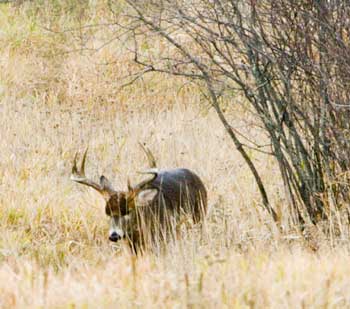
The buck was a nice animal. It was an adult 2 ½-year-old with eight points, the beginning of a really nice rack, and he wasn't rut-crazed just yet. This rack, while still thin and spindly, had an inside spread of 16 inches with good brow points.

The buck came to me early in the evening with plenty of shooting light, and stopped at 18 yards and stood at an extreme quartering-away angle for long minutes. It was a tempting shot possibility.

Questioning my desire

Did I want to shoot that buck? You know, I really can't answer that question. Undecided, I did as I often do, and came back to full draw. The tiny sight settled low behind the front shoulder, but the shot would have to be precise and I tweaked my aim a bit more.

It's too shallow of an angle, I thought. Too much margin for error. I held the bow back longer, waiting for him to turn. Finally the bow was eased down, and that buck stood in that position for several more minutes before shifting just a bit to turn directly away from me.

I continued to watch him, all the while asking myself: do you really want to shoot this buck? He is nice, but he isn't that nice. Another year of life would make this a really fine animal if someone else didn’t shoot him this fall.

The result was that my inner self talked me out of that buck until five minutes later when he turned slightly to watch another deer. I raised the bow, put the sight on the proper spot, and held it there.

That animal had no clue I was anywhere in the area. For me, much of my deer-hunting enjoyment comes from fooling the animals. I don’t need to kill a buck to have had a good hunt. But … this guy was very tempting.

If I touched the trigger of my release this would be a dead 8-point. I laid my index finger on the trigger, refined my aim just a tad and didn't pull it. Deep down, I really didn’t want to shoot this deer.

No shot and my reason

The bottom line was the buck wasn’t  exactly what I wanted. It was nice, to be sure, but not that nice. Besides, it was too early in the season for me to shoot a buck. I had time to wait for something bigger.

The buck walked away minutes later, completely unaware of how close he had come to getting shot. It was turned just right so I wasn't looking into its eye, and it wasn't fidgety. It was completely unaware of my predatory presence, and I let that buck walk.

Thirty minutes later an even larger 8-point walked down the wooded trail. This guy stood broadside, and offered an easy 17-yard shot. I aimed, held the red-dot on the vitals for 30 seconds and eased up.

Shoot or don’t shoot?

It was useless. I knew, in my heart, that I had no intention of shooting this animal that evening. He was a nice buck, but still didn't have quite what I wanted.

It occurred to me that I was having a problem identifying what it was I did want. Trophy hunting doesn't appeal to me, but after a half-century of deer hunting and shooting many basket-rack bucks and some other really nice animals, shooting what suits me is very important. Some years I don’t shoot a buck, and that is my choice. I certainly see enough antlered bucks within range that I can afford to be a bit picky with my choice.

I then agonized over trying to identify what it was I wanted, and got no further down that trail before I realized that a buck was important but it was nearly impossible to identify what unique requirements were needed to satisfy my need to release an arrow at the animal.

A lesson from the past

It reminded me of a conversation I'd had 30 years earlier with a magazine editor as we discussed his magazine’s photographic needs and how I could help him reach those goals. He said: "I don't know what I want but I'll recognize it when I see it."

My buck-shooting problem is similar to his photo problems: I probably won't recognize what it is I’m looking for until I see it, and then all of my motor skills will allow me to come to a full draw, aim with precision, and let loose a killing arrow providing the animal is within my clear and well defined shooting range.

Once, some years ago, I could see a big buck easing along the edge of an oak ridge. His position in relation to mine made it impossible to see both sides of this rack.

The buck sneaked along an overgrown fence line at the edge of the woods, and he would lift his head on occasion to look ahead for danger before lowering his head again. I heard a soft grunt coming from his direction, and I knew he was scent-trailing a hot doe.

He would come within easy bow range of my tree stand, but still the right side of his antlers wasn’t visible. He was a shooter, no doubt, if the right side was as good as the left.

Here he came, walking gently as if he was stepping through broken glass, and he paused 20 yards away. It was just a bit too far to shoot with unfailing accuracy. His head was down and out of sight, and he would be at 15 yards when both sides of his rack would be visible. Just wait, suck a bit more air, and settle down. The bottom line in all such cases is he will come closer or he won’t. Wishful thinking doesn’t work at placing deer at the preferred location.

He eventually took a few more steps toward me, stepped out into the open, and stood with his head held high. I looked at the right and left side as I drew and prepared to  aim. I soon let off on my draw, and knew I wouldn’t shoot this buck.

The right side had three antler tines broken off as a result of scrapping with another buck. His rack had been damaged in a fight, and if I am to shoot a big buck, his antlers will go on the wall. This old boy got a break on this day although another person shot him on the opening day of the firearm deer season.

A mental crossroads

My problem is I'm at some type of mental crossroads. I'm well past the point where I must shoot another buck. I'm not out looking for massive antlers although I'd probably shoot if that kind of buck walked in front of me at my preferred shooting range, but more than anything, outwitting a good buck seems much more of a personal challenge than just shooting a nice animal.

And I suspect it's one of the reasons I didn't shoot either one of those bucks. The time wasn't right, and whatever it is I seek in a whitetail buck, just wasn't there. Perhaps, both shots would have been too easy or perhaps the reason is the challenge just wasn't intense enough to excite me.

That said, the opportunity is out there. I know of a big 10-pointer in one of my hunting areas. Being there at the right time, with the right temperament, and within easy bow range might tempt me into taking a shot.

Will I take it? Only time will tell, because for me, the hunt is far more important than antler or skull size. Something must challenge my personal skills, and mental moods, and if the challenge isn’t there, neither is the need to shoot.

Many people think hunting is easy. This simply proves that for some people, hunting is far more difficult than one might believe.

Posted via email from Dave Richey Outdoors